Songs of the Winter Country
Rafe Rowan's woodpile, in the flat grey light of a proper morning, was a smaller and sadder thing than any of them had let themselves picture the night before: two low ricks of split wood, weathered silver on their outer faces, and behind them the raw gnawed look of a supply drawn down every night for nineteen years and made good again by one pair of hands and three valleys' worth of walking.
"Three valleys," Bracken said, standing over it with his hands on his hips. "Carried home on his own back, every stick, because there was nobody to spell him."
"There's seven of us and four mules that have carried heavier than firewood over worse ground than this," Dorrit said, already rolling her sleeves. "I make that a very short arithmetic."
It was short indeed. Bracken paired the mules two and two, and by the second crossing they had moved more sound wood than Rafe, by his own dry admission, had managed in any single month he could call to mind. He stood at the top of his own hill that first afternoon and watched four mules and six people file up the last pitch with loads that would have taken him a week apiece, and was quiet a long time, which was the shape his largest feelings took.
"I used to reckon it in trips," he said finally. "I don't know what to do with a day that isn't a trip."
Over the three days that followed, the shared-watch promise became deed rather than word. A proper woodstore went up beside the beacon fire, framed from sound timber salvaged out of the fallen byre; Bracken and Dorrit patched the one kept room's roof and touched nothing of the rest of the house — not the burned rooms, and not the room Rafe had been born in, which he did not walk into for any reason and which nobody suggested rebuilding. Dorrit turned the wreck of a garden behind the kept room back into rows without asking anyone's leave, including Rafe's, and by the third day he was pulling a weed of his own accord from a bed she had not reached yet. She stood over a clump of something grey-leaved by the wall a while, and said only that it wanted cutting back hard in the spring, and did not say what it was.
He ate, that first night, carefully, as though the plate might be taken back; by the second, without any carefulness at all. "I'd forgotten a meal could be a thing you looked forward to," he told Dorrit, "rather than a thing you managed." "Eat," she said, refilling his bowl. "You can be moved by it later."
The news went into him the same three days, woven through the work rather than delivered at once: Sereth, and Edda's Hazels, and a beacon gone unlit in living memory until this summer; the keepings scattered wide across a country that had spent three centuries with no road between them faster than a fire seen at distance; and Stanhope, near three hundred souls under the ground an easy few days east, tending lamps that had not gone dark since the closing, sworn to a charge of their own — tend the lamp, hold the hall, and remember the sun.
Rafe turned that over a long moment. "Three hundred souls keeping lamps under a hill, and I never so much as guessed at them, in sixty years of watching this same hill's dark. I'd have said I knew this country. I begin to think I knew one fire's worth of it, and called that knowing."
"You knew your own fire better than any of us ever will," Alder told him. "That's not the smaller kind of knowing. It's a different one."
They told him of the post growing up behind them, too, and that his own name would be among the first words it carried once it reached this far.
He gave back a trick of laying green wood under seasoned to draw the damp out of it, which Bracken wrote down that evening on his own slate — exactly the kind of knowledge that never gets written down, Wren thought, because it has never needed to travel further than one hill to be worth having.
It was on the second afternoon, hauling the day's last load, that Rafe stopped on the crown path and pointed west. "There's another hill out that way. One on from my own. You'll not see its light — there's none to see, and never has been, not in my life nor my father's nor his before him." He held his hand steady on the quarter, the way a man points at a landmark he has looked toward his whole life without ever once walking to it. "Kelder, the old telling calls it. First-lit of the whole line, if the old telling's to be trusted — first to catch, and, by the same telling, first to go dark, though I couldn't tell you which came first in the going, the frost or the forgetting."
The lament's own first line had begun its count of the dark on that same quarter of the horizon Rafe's hand was holding steady on. Wren looked at Luel and found Luel already looking back, and neither of them spoke it.
"Do you know anything more of it?" Iyene asked.
"Nothing I'd swear to," Rafe said. "My own knowing stops at my own wood. Past that it's smoke and telling, same as anything a man hasn't walked to himself."
Whether the line ran on past Kelder, and how far, and to what end — the question formed on more than one face that afternoon and set itself back down again unspoken.
Iyene surveyed Wakelow properly on the second day and set beside its drawn shape the same kept-fire mark she had given Sereth, inventing no new symbol for it. "A kept fire's a kept fire, wherever it's found." Rafe allowed he'd expected a mark of his own, and found on reflection that he liked it better this way: "not a curiosity. Just kept." Pip drew Rafe himself that afternoon, unposed, patched clothes patched and weathered hands weathered and nothing softened. "You've a proper eye, boy," Rafe told him, looking the finished page over. "Keep it plain. Plain's the harder trick, and the one worth keeping."
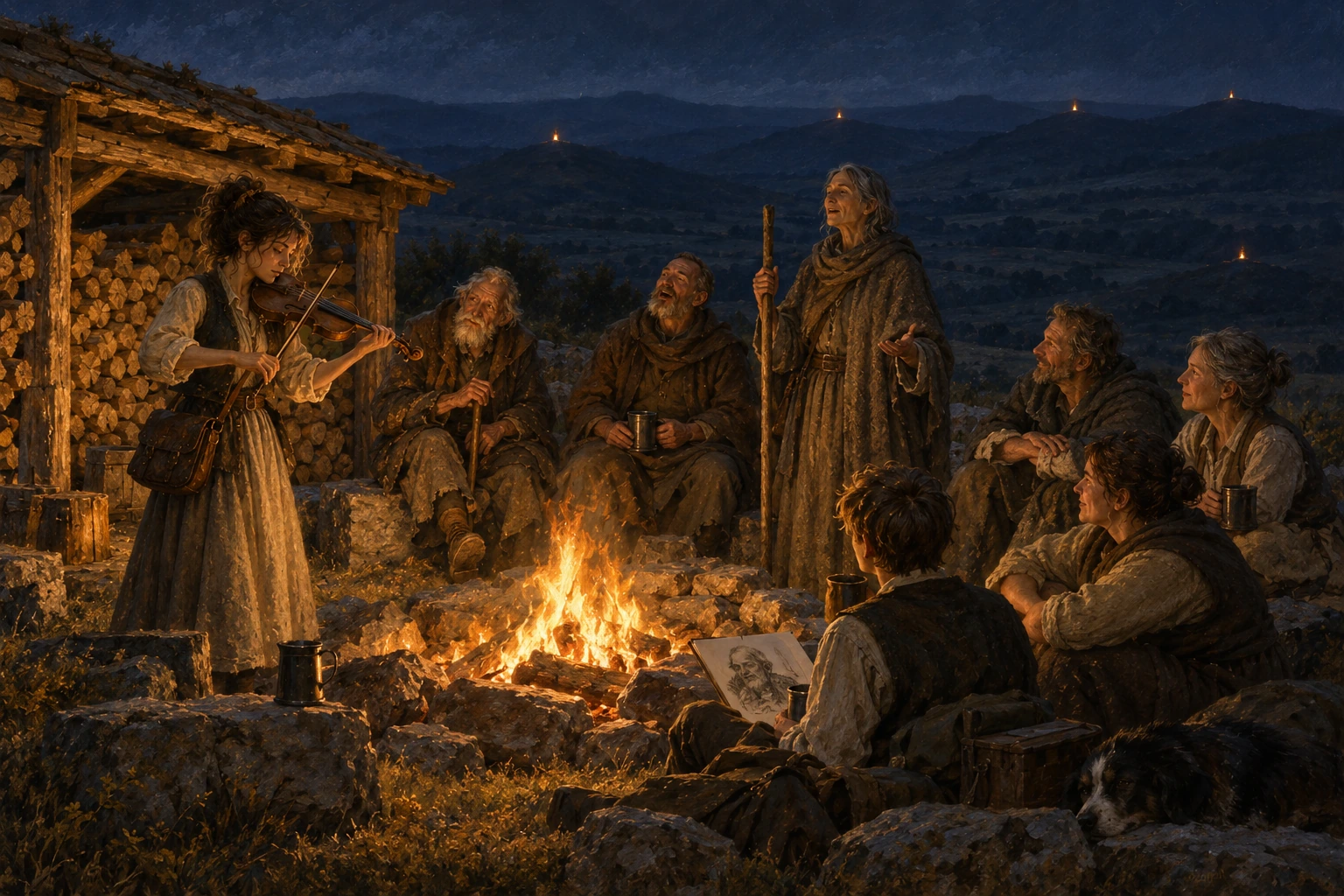
Supper on the third evening ran longer and warmer than the two before it — an extra dried apple worked into the bread, the last jar of preserved plums opened because three days' good work deserved a good end to it. It was afterward, the plates cleared, that Wren took out the fiddle and Rafe went still, with the stillness of a man attending something he had half-forgotten how to expect. "I've not heard music on this hill," he said, "since my own voice was the only one left to make it, and that's the better part of nineteen years." She played one reel, plain and wordless, and watched his foot begin, against what looked like his better judgment, to keep time before it was half through.
Then she gave him the counting-rhyme whole, the one a Hazel girl had recited to her a world away at Sereth, and watched him learn that children a fortnight and more east of him had been saying his own hill's name into the dark every winter of their lives. He heard it out, and then, dryly: "It's out of date, that rhyme, near enough as of this week. 'Wakelow waits' hasn't been true since you walked up this hill, and I don't fancy it'll get truer with age." "A rhyme like that belongs to whoever sings it," Alder said, smiling into the fire. "Let the children see to it."
Then it was Rafe's turn, unprompted and a little unsteady about it. "It's not much of a thing," he warned them, "a working-song, my own family's, sung hauling wood and minding the fire, generation on generation — and forward, now, to no one at all past myself. I've not had cause to sing it in nineteen years, seeing as a working-song wants more than one voice to be worth the singing." He cleared his throat, faltered through the first two lines, and found, somewhere in the going, the shape his voice had once known well enough not to need finding.
*Load it high, and lash it tight, three valleys home's a long way yet; the fire won't ask how far you walked, only that the wood came home, not wet.
Stack it dry, and stack it deep, under the eave where the frost can't win; feed the fire, keep the hill, and start the carrying over again.*
"Sing it again," Dorrit said. "We've got it now." He did, and this time Bracken came in on the second stanza, a beat behind and half a note flat, and by the final line four voices carried it — ragged and warm, filling the space above Rafe's own fire with a sound that hill had not held, by his own telling, since the winter his father died. "You may as well have it, all of you," he said when it had died away, "seeing as there's nobody left of my own blood to teach it to. I find I'd rather it went to seven people who'll sing it badly and often than sit unsung in one throat till that throat's done with it." "We'll set it in the day-book tonight," Wren told him, "word for word, so it's kept properly." "Allow it," Rafe said. "A thing written down is a thing that can't be lost the way a thing kept in one head can."
It was Luel who rose last, when the fire had burned low. "I have another song," she said. "The making of it was mine, and after tonight the carrying of it is not, and I would a great deal rather it were shared among a hundred throats than shut up in the one that happened to make it." She did not ask leave. She gave it, as she had told them once that a gift is not a taking.
*It burned a long time, burning alone— so the old song told it, plain and true; but the road came west to Wakelow's stone and found one fire still burning through.
Wakelow's light has company now, lit and found and kept the same— and every hill that holds a vow shall hear its neighbor call its name.
There's a hill called Kelder, west and dark, first to catch, or so they say; we leave that word here for the road to mark, and trust some fire to find its way.
So sing it walking, sing it home, in whatever voice the road provides— a fire that kept its watch alone now keeps its watch with company beside.*
The old man sat very still. "Sing it home," he said at last, very low, and it was not a question. "You mean for it to travel." "I mean for it to be sung on roads I will never walk," Luel said, "by mouths I will never hear, in years past any I am likely to see the end of. I made it to be carried — the way a letter is carried, or a name, or a light seen from a very great distance and never forgotten for the seeing of it. You may copy it, Wren, freely, the same as the lament had leave." Wren asked anyway, out of a habit too old now to break, and copied the whole of it by the fire's own light, Rafe watching her pen move with the same close attention he had given the fiddle's tuning.
Rafe went in not long after that, and the company sat on at his fire, and it was Bracken who said the thing all seven of them had been carrying for three days.
"I want a week here. And if I can't have a week, I want to leave somebody."
Nobody had to ask what he meant. It had been sitting in the middle of the hill since the first afternoon, when six people and four mules moved more wood in an hour than one man could move in a month, and everybody had done the arithmetic and kept the answer to themselves.
"He's near seventy," Bracken said. "Three valleys of wood, and it's one turned ankle in November. One fever. One wet fortnight when the near wood won't dry. I've stacked a woodstore against all of that, and a woodstore is not a man. I stood on this hill four nights ago and told him out loud his watch was shared. I'd like to know what I meant by it before we walk off the end of the sentence."
"You meant it," Iyene said. "That is not the same as being able to pay it."
She said it in the flat voice she kept for things she hated saying, and went on in it, because it was her office and there was nobody else whose office it was. "We are seven. The road west of here has not been walked by anybody living. Leave one, and we are six on unwalked ground and he is one on a hill, and both those numbers are worse than the ones we have. Stay a week, and we are a week later into a winter we know nothing about except what it did to everything that used to live in this country. I have gone over it twice tonight, and I would like to be wrong."
"Go over it a third time," Dorrit said.
Iyene did, out loud, and it came out the same, and Dorrit listened to the whole of it with her jaw set.
"Then say the rest of it," she said. "Since we're being honest at this fire. We can't afford him. That's the sentence underneath the arithmetic. We walked a thousand miles to find one man still keeping, and the finding is the whole of what we can afford."
"Yes," Iyene said.
Dorrit got up and went out past the new woodstore into the dark, and was some time coming back.
Wren found she had nothing to say, which surprised her, because she had a great deal. She had grown up in a house where one person held one thing and the holding was the entire arrangement, and she had left a seventy-nine-year-old woman standing at a gate in October with everybody's blessing and her father's coat on her back. She had never settled whether the ease of that leaving was a kindness or a failure of nerve, and she was not going to settle it tonight, on somebody else's hill, at somebody else's fire.
"Alder," Bracken said.
Alder had not spoken through any of it. He sat with his stick across his knees and looked at the flames, and took long enough that Pip began to fidget.
"We go," he said.
"That's your whole answer?"
"No. That is the ruling. The rest of my answer is that I dislike it, that I have made it before, and that having had longer than any of you to get used to making it is not the same as being good at it. Bracken is right about the winter and Iyene is right about the road, and the thing can still be a poor piece of work, and it is one."
It was Rafe who ended it. He had come out of the doorway behind them at some point in the middle, and had heard, by the look of him, enough.
"You'll not leave anybody," he said. "I'd have to feed them."
Bracken began to answer that, and Rafe put a hand up, slowly, and stopped him.
"I've fed one on this hill nineteen years, and I know to a stick what one costs. Two isn't two sticks more. It's a different arithmetic, and I haven't got it, and I'll not spend my last good autumn teaching somebody else's youngster which slope dries first." He looked round at them. "And here's the rest, since you've had the whole of my life off me these four days. I've had my company — four nights of it, and a song, and my hill's name in a rhyme children say in the dark. Leave one of your own behind to watch me and what I've had is a nurse, and I'd sooner have had the four nights."
There was no answer to that. It was small, and stubborn, and entirely his to say.
"Go and light the next one," Rafe said. "That's the thing I can't do from here."
They left Wakelow at first light, the woodstore full behind them and Rafe standing at his own door to see them off, one hand raised rather than waved, his eyes already gone west, toward the quarter of the horizon where a hill called Kelder had kept no light for longer than any living telling could account for.
Dorrit did not speak to Bracken the whole of that day. It was not fair and she knew it — he had asked for the week, and she had been standing beside him when he asked — and she did it anyway, because he was the one who had said your watch is shared out loud with his hand on the old man's shoulder, and somebody had to answer for a sentence like that, and Iyene could not be made to answer for anything. He let her not speak to him. Next morning he lifted her chest onto Suet without being asked, and she took it down and re-lashed it herself, and he let her do that too.
"First to catch," Bracken said, shouldering his own pack, "and first to go dark. We'll want to know which of those is the truer word, before this line's done with us." He got no answer, because there was none yet to give; and the company turned west toward a hill that had shown no flame to anyone in three hundred years, with one fire behind them that would not, for the first time in as many, have to wonder alone whether it was worth the keeping.