The Arranged Dark
The roofs came up whole out of the fourth day's grey, and for the length of a mile that was all any of them let themselves think about.
Three days out of Thistleton the mud had begun, at last, to firm underfoot, the road climbing into country where the frost had started coming down properly at night and staying past noon, and the company had walked most of that morning in the particular silence that follows a bad town — not unfriendly, only careful, each of them keeping to whatever thought served. Then the land folded back on itself below a long shoulder of hill no book yet had a name for, and there below them sat a scatter of stone houses around a yard and a well, a byre, a fold on the slope above for stock, and over one chimney — only one, but one was enough — a thread of smoke standing straight up into windless air.
"Someone's kept a fire," Pip said, and did not manage to keep the hope out of it, and nobody blamed him for that.
Bracken looked longest, the way he always looked at a thing before he trusted it, his weight settled onto his good leg and his bad shoulder held a fraction higher than the other out of a habit a year old now and past arguing with. "Could be," he allowed. "Could be a great many things." He did not say which he thought more likely, and for once that felt less like caution and more like a man letting the rest of them have the hope a little longer before he had to take it back.
Iyene had her book out before they had gone another hundred yards, walking with her eyes half on the road and half on the page, sketching the fold of the hill against the settlement's own lie of houses in quick, sure strokes — the pleasure of a new thing to record was on her plainly, the small private satisfaction she wore whenever the country handed her something her instruments had not already priced. She had been in good spirits since Thistleton, in the particular way a person is glad of hard work well done rather than glad of anything easy, and it showed in the set of her shoulders and the speed of her hand both.
Alder walked without speaking for most of that mile, which by itself said little — he often did — but Wren, watching him from three paces back the way she had learned to watch him, saw him lift his head twice at nothing the rest of them could hear, and each time lower it again without comment. Dorrit walked at the front with Suet's lead in her hand, as she had walked every morning since the argument on the beacon road, the gap between her and Wren no wider and no narrower than it had been for nine days, and just as costless to keep on a road with room enough for it.
The gate at the top of the lane stood shut.
That alone should have meant nothing. Gates fell shut on their own, in three centuries, as often as they fell open — old wood settling to whichever angle its last hinge preferred. But this one was barred, the drop-bar seated true in its two iron staples, and Bracken, closest to it, put his hand flat on the wood for a moment before he lifted the bar himself, and said nothing at all about what he had felt under his palm.
The first house took the hope out of them one working noun at a time.
The hearth inside was cold — three centuries cold, ash gone to pale dust that lifted at a breath — but it had been swept. Not scattered by weather through a fallen roof, not stirred by three hundred years of wind finding its way in through a door long since rotted from its hinges: swept, into a low careful cone at the hearth's near corner — swept as a hearth is left for the night, not as a hearth is left when the hand that tended it stops tending it forever. The door itself was neither broken nor hanging. It stood shut, and the drop-latch on its inner face — the kind a person works from inside a room, not from a lane outside it — sat fully home in its slot.
"That's not weather," Bracken said, low, mostly to himself. "Weather doesn't shut a door behind it and go on to the next one."
They found the next one shut the same way, and the one after that standing open — the only open door in the row — as though whatever had gone down this lane had a use for exactly one door left that way and none of the others. Alder stood longest in that open doorway, one hand resting on the frame rather than crossing the threshold, his head tipped in the listening attitude Wren had come to know from a dozen wards and border-crossings. "There's a discipline in this," he said at last, and did not explain what he meant by the word, only that his own craft recognized something working alongside a different grammar than random ruin used, before he stepped back and let the others by.
The well in the yard held its bucket square on the coping stone, rope coiled beside it in a neat figure, not fallen in, not rotted to rags across the stone the way three centuries ought to have left it. Above the yard, on the slope, the fold stood closed and holding, its hurdles sound, and empty — no huddle of old bone inside it, no scattered fleece gone to felt in the grass, nothing at all to say what had become of whatever it once kept, only the gate shut fast on nothing.
"They didn't kill the stock," Dorrit said. She had gone very still at the fold's rail, her knuckles white on the top bar. "Whatever did this — it would have been so easy. It's always the easiest thing. And they didn't."
No answer came, and the not-having sat on the company for the length of the yard.
The dead, when they found them, were not where a fall would have put them.
A man sat in a chair drawn close to the swept hearth of the second house, hands loose in his lap, head tipped forward as though sleep had taken him mid-thought, three centuries of stillness folded neat around a set of small bones that had once been a set of large ones. He had not died sitting. Whatever had killed him had killed him somewhere else and carried him here after, set him in the good chair, angled his hands the way a hand rests when its owner means only to doze a moment before the fire burns down — and the fire under him, the fire that should have been three hundred years dead in the same breath he was, showed the faint dark scorch of a hearth that had held a real flame some while more recently than that.
A second, at the third house's threshold, knelt with one hand raised toward the door's own drop-latch, in the exact attitude of a person shutting a door from the wrong side of it — outside, reaching in, latching a room he could never again have entered by that latch, and could not have latched from where he knelt even alive. A third lay along the byre wall with its legs drawn up and its arms crossed over what had once been a chest, composed as a mourner composes a body for viewing, not as a body settles itself in dying.
"Somebody moved them," Wren said, and heard her own voice come out smaller than she meant it to. "After."
"Somebody moved them very carefully," Iyene said, and there was already, under the plain flatness of the words, the first thread of something that was not yet delight but would be. She had her book out again, and this time she was not sketching the hill.
By the fourth house Iyene had stopped walking with the rest of them and started working, and the working had its own weather, one the company had learned to give room to over two years on the road: she went from house to house with her folding rule and her small brass lens, kneeling at each of the dead in turn, pacing off the ground between them in long deliberate strides and murmuring the count under her breath. Interrupting her mid-count only ever bought a longer wait and the same count started over, and the company had learned that lesson years before; no one tried it now.
"Twelve paces," she said, straightening from the second body to the third. "Iyene?" Pip had his sketch-case open on his knee, kneeling in the lane, and had learned by now not to ask what she wanted drawn until she told him; he only kept his hand moving, laying down the shape of the lane and the houses as she called out each distance, a habit two years old and steadier for it. "Twelve again, third to fourth. Pip, mark the fourth a hair north of true — the byre's wall bows there, allow for it." She crossed to the well, sighted back along the line of houses through the brass lens raised without her seeming to notice raising it, and made a small sound of pure interest, the sound of a woman finding a coastline a degree out of true and liking the world rather better for it.
"It isn't a perimeter," she said, half to herself, half to the lane. "I thought at first it might be a warding — a ring drawn round something, of the kind a frightened household draws round a well or a cradle. But a ring closes. This doesn't close. It runs." She looked up, and her face had opened the way it opened over a good map, delight arriving before caution had quite caught up to it. "It runs in one direction, and it runs at the same interval the whole length of it, and I have paced a great many things in my life and very few of them by accident come out even twelve paces, twelve paces, twelve paces, door to door to door."
"A road," Alder said. He had come to stand at her shoulder, and something in his voice had gone careful in a way Wren had not heard from him since the door at Stanhope.
"Not a road. A road doesn't need marking every twelve paces; a road is its own mark. This is smaller than a road and larger than a threshold. This is—" She stopped herself, the correcting look crossing her face that the company had seen a hundred times over two years, the look of a woman catching her own first answer before it could harden into something she'd have to unsay later. "No. Not smaller than a road. The wrong shape for that comparison entirely. I keep reaching for a road because a road is what I know, and this isn't one. Give me the book, Pip — no, the other one, my own."
She paged through it with the quickness of a woman who already half knew what she was looking for, found it, and held the opened page beside the lane so that the spacing of her own old survey-marks — the small deliberate figures a Surveyor sets between the great mile-posts, the minor waymarks nobody outside the College ever learns to read — sat plainly against the spacing of the dead.
"That's it," she said, and her voice had dropped into the register she used for nothing else in the world, the one Wren privately thought of as Iyene talking to the map rather than to the room. "That's exactly it. That's a Surveyor's own interval, laid the way Wystan's people laid it, the way I was taught to lay it before I ever held the charter — someone set these people down the way you set waymarks along a line you mean to be walked and read, in order, one truth given up at a time until the reader has the whole of it." Delight was climbing in her now, plain and unguarded and entirely genuine, the pure animal pleasure of a pattern surrendering itself after a lifetime spent listening for exactly this kind of surrender. "Which means whoever did this did not merely kill these people. They laid a line with them. They laid it the way we lay lines, in a grammar only one of us would ever—"
"Iyene." Alder's voice, very low.
"—only one of us would ever think to test it against a book at all, which is the whole of what makes it—"
She never finished the sentence.
The fifth body, at the lane's last house before the ground rose toward the fold, had been given no such tending. It sat upright against the wall inside the doorway, indistinguishable at four strides from every other quiet, composed, three-centuries-still shape they had already walked past that morning — until Iyene, crossing the threshold to measure the final interval of her line, close enough to touch it, found that the last waymark was not stone and not old bone at all.
It came off the wall in one motion, faster than anything that had waited three hundred years had any right to move, and took her down across the threshold with its full weight behind the fall.
"Bracken!" — Dorrit's voice, already moving before the name was fully out of her mouth.
There was no room in that doorway for more than two people to fight at once, and so it fell to Bracken first, his blade already out, his bad shoulder taking the jamb's edge hard as he forced himself through a gap built for one body sideways; the thing had Iyene's coat in one fist and something in her that made her cry out once, short and cut off, before Bracken's blade opened its forearm to the bone and it let go to take the new threat instead. Dorrit went past him low, staff swinging up into the thing's knee with everything her whole body could put behind it in the narrow space, and it staggered but did not fall, because the things never buckled as a living man buckles; Luel had a hand alight before anyone had asked her for one, a strip of true flame laid across its shoulder and throat that made it flinch for the first time in the whole ugly minute, and in the flinch Bracken had the opening he needed and took it, driving the blade in under the arm and through, and it went down at last the way the dead go down when there is finally nothing left in them to hold a shape upright.
It could not have taken longer than the length of two long breaths. It felt, to Wren, like the entire remaining length of the morning compressed into a space too small to hold it.
"Iyene." Dorrit was already on her knees in the doorway, hands moving before her voice had finished the name, running down the length of her with the particular fast, sure touch that meant she had done this exact motion enough times now not to need to think about where her hands went next. "Iyene, look at me. Where."
"My back," Iyene said, and her voice came out wrong — flat where it should have had a wince in it, too even, the voice of someone listening to her own body report something she did not yet believe. "And my leg. The left one. I can't—" She stopped. Tried again, in the same flat register. "I can feel it. I can feel that it's there. It won't do anything I ask it."
Nothing comforting suggested itself, because there was, just then, nothing true enough to say.
Dorrit worked with her hands and her voice both under a control that cost her, visibly, everything she had, and gave no sign at all of what it was costing beyond the whiteness at her knuckles and the flatness of her own voice, which had gone as careful and even as Iyene's.
She would not let them move her until she had gone the length of her twice, feeling along the line of the spine with two fingers pressed light and steady, watching Iyene's face rather than her own hands for the answer neither of them wanted. "Nothing grinds," she said at last, mostly to herself, mostly for her own comfort rather than anyone else's. "Nothing's driven through anything it shouldn't be near. The hip's wrong — badly wrong, I'd guess broken through, maybe cracked along the seat of it too, I can't be certain without seeing bone I'm not going to see out here — and the leg answers nothing below the knee. That's the part I can't fix and I want that said plainly, now, so nobody spends the next three days hoping I'm about to." She looked up, and for one unguarded moment the fury under the control showed all the way through. "I have willow-bark for the pain and comfrey for what bruises and a splint for what breaks clean, and one jar I have stopped trying to put a name to, and none of it, not one thing in that whole chest, touches what's actually wrong with her. I can slow it. I cannot mend it. I need that understood before anyone asks me again."
"She isn't a healer," Iyene said, from the ground, in the same flat voice, and it took Wren a moment to understand she meant Wren, not Dorrit. "Don't let anyone suggest it. I know what she does and what she doesn't, better than most of you, I keep the ledger. Whatever she is, she isn't this." She shut her eyes for a moment, and when she opened them the flatness had cracked just enough to let something else through — not fear, quite, but its close cousin. "I would rather know exactly what I am carrying out of here than be told a comfortable thing on the way."
"Then you'll know it," Dorrit said, and softened nothing of what she said next — the only kindness left that she had to give.
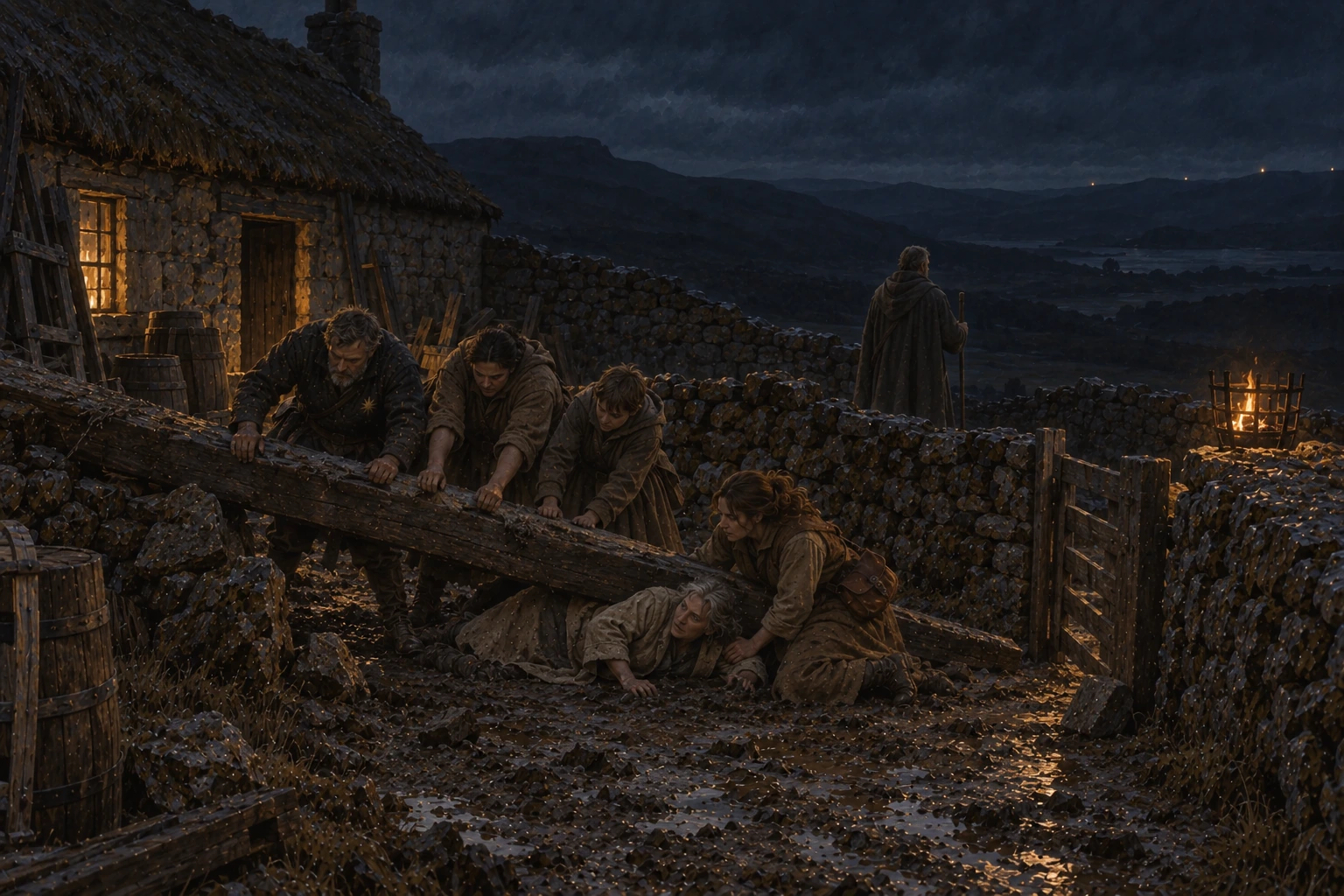
The hurdle took the better part of an hour to build, and every one of that hour's minutes argued with the one before it.
Bracken wanted two of the fold's own hurdles lashed together, sound ash withies that had held sheep three centuries and might yet hold a person if the lashing held; Dorrit wanted the company's own tent-poles instead, longer and truer and known, rather than trust a stranger's woodwork sight unseen even for a night. They settled it the way they had learned to settle most things by now, which was not by agreement but by whoever could show the better reason fastest: the fold's withies, doubled and cross-lashed with every spare cord the company carried, padded the length of it with both bedrolls and every spare cloak, because a broken hip on bare wood over broken ground would undo in the first mile whatever the last hour's care had bought.
Bracken lashed the crosspieces one-handed more often than he meant to, his right arm still refusing him the grip it had refused him since the Long Shelf, and would not let anyone finish a knot for him even when his own fingers fumbled it twice. "I'll get it," he said, the second time. He got it. It took him considerably longer than it would have taken him a year ago; the company went on loading the mules around him and let him finish it in his own time, which was the only courtesy the moment would hold.
Iyene lay where they had first set her, on a folded cloak, and directed the lashing's tension herself between one long silence and the next — "tighter there, that crosspiece will walk loose on the first slope" — with the same exacting eye she gave a fair copy of a coastline, because it was, Wren understood, watching her, the only work left to her that her own body could still do.
They lifted her onto it at last with Bracken and Dorrit taking the weight between them and Wren steadying the bad leg the whole slow way down, and Iyene made one sound, short and swallowed almost before it started, and then none at all, her jaw set hard enough that Wren could see the muscle standing in it from three feet away.
"That's the worst of the lifting done," Dorrit said, low, close to her ear, in a voice gentler than any she had used on the rest of them in nine days. "The rest is only carrying."
"Only," Iyene said, and something that was almost her own dry voice came back into it for a moment, thin as paper but hers. "You have a talent for the word, Dorrit Fallowmere."
The ground between the keeping and anywhere fit to camp ran two miles of broken slope, tussock and old field-wall and a stream-cut that had to be crossed twice before it finally agreed to stay on one side of the road, and every yard of it had to be carried.
Four men's hands would have made easy work of a hurdle on flat ground. Six people and four mules made hard work of it on that ground, because Bracken could take a corner but could not take his own share of the weight past a few hundred yards at a stretch before the shoulder told him, in its own wordless way, that it had reached the end of what it would give that day; because Alder's strength was real but his balance on broken footing was a younger man's balance borrowed rather than owned; because Pip, for all his willingness, stood a head shorter than the work wanted and had to be paired at the low corner with whoever could match his height rather than his strength. They traded off in shifts of a hundred paces, calling the change before anyone's arms gave out rather than after, because a stumble carrying that weight would cost more than the two minutes lost swapping hands ever would.
Luel took a corner as readily as anyone, and held it longer without complaint than anyone but Dorrit, her strength in her arms a plain fact rather than a boast, though she would not be persuaded to lead the pace — "I do not know this ground the way your feet do; better I follow the ones who do" — and stepped exactly where Bracken stepped, the whole two miles, without once being told to.
They crossed the first stream-cut by unloading Suet of everything he carried and walking the hurdle across empty-handed on a plank Bracken cut from a fold-hurdle they had not needed, four of them wading beside it waist-deep to keep it level, the water running fast enough with the season's first real cold that nobody's legs stayed steady in it past the first ten strides. Iyene gripped the hurdle's rails through the whole crossing, knuckles white on the wood, and made no sound at all. Barrow forded behind them without complaint, an honest ford being no trouble to him whatever a hollow plank might be; Gable came after at his own slow pace and had to be prodded twice; Nettle bit Pip on the shoulder for no reason he could name and then crossed as sweetly as a lamb, which was, Bracken said, about what the day had coming to it.
Dorrit walked at the hurdle's head the entire two miles, watching Iyene's face rather than the ground, and twice called a halt the others had not yet felt the need for, because she had seen something cross Iyene's face that the rest of them had missed. The halts went unquestioned, though full dark was coming and everyone in the party could feel it coming, because the two miles they were making at that pace were, plainly, all the pace that ground and that cargo would honestly allow, and pretending otherwise would only have cost them worse later.
Wren walked at the foot of the hurdle for most of it, taking her turns at the rail like everyone else, and found herself, more than once, watching Bracken's shoulder rather than the ground in front of her own feet — the small hitch in his stride when the weight came onto that side, his jaw set exactly as Iyene's had been set. This time there was no one behind him to spare him a third knot.
They made camp at last on a shelf of drier ground above the second stream, full dark down around them and a fire built high because for once nobody argued the cost of the wood against the cost of being seen. Alder walked the camp's edge twice with his hand trailing the air the way he did when he meant to be certain rather than merely hopeful, and said, when he came back to the fire, only that the ground here held nothing that had not always been ordinary ground, which was the most any of them had wanted to hear all day.
Dorrit worked over Iyene by firelight long after everyone else had gone still, splinting what could be splinted, binding what could be bound, feeding her the willow-bark in the smallest dose that would still answer the pain, and said, once, low enough that Wren nearly missed it, "I would give a great deal to be wrong about the hip." No answer came, because there was nothing to say that would not have been either a lie or a cruelty, and Dorrit did not seem to want an answer so much as she wanted the saying of it, out loud, to someone, after a day that had given her no room to say anything at all.
Alder sat apart from the fire's main ring for a long while, turning something over that none of them could see, and when he finally spoke it came out of him the way a stone comes loose from a wall that has held it a long time without anyone noticing the crack. "I have seen a line laid like that before," he said, his eyes on the dark. "Once. A long time ago. I told no one, because I believed it was one man's madness and not a — " He stopped there. He did not try again, and Wren, for once, did not reach for the day-book either — whatever had come loose in him had plainly come loose faster than he had meant to let it, and a man overtaken by his own memory does not want to be caught at it twice in one evening.
Iyene lay wrapped against the cold with her splinted leg propped on a rolled cloak and her eyes on the fire, and when Wren came to sit near her, thinking she might be asleep, found her instead entirely awake and watching the flames with an expression Wren had never seen on her in two years of the road.
"I was right," Iyene said, quietly, not quite to Wren and not quite to herself either. "Whatever else the day cost — I want that said once, out loud, before I let myself stop thinking about it. I was right, and I would rather have been wrong and walking than right and carried, and I am ashamed of exactly how long it took me to feel ashamed of that, lying here." She turned her head, and the firelight caught something in her face that was very nearly a smile, thin, and entirely without regret in it. "Don't tell Dorrit I said that part. She has enough tonight without adding my vanity to the ledger."
Wren said she wouldn't, and meant it, and sat with her a while longer, listening to the fire and to the four mules settling for the night and to Iyene's breathing going slowly, carefully even. Whatever had read the company well enough to build that line had read Iyene best of anyone in it, and had known, before any of them did, exactly which one of the seven would stop to look.