The Returning Road
Willem drove the fourth stake into ground that had gone soft everywhere at once that week, the frost letting go the whole length of the wall in two days where it had never let go in any spring he'd served through, and his thumb found new grass under the post instead of mud, and he did not pull his hand back. A year ago he'd have called someone to look at it. This year he wiped his thumb on his trousers and drove the stake the rest of the way in, because grass under a hand was exactly what grass under a hand was supposed to be, and there was a wall to finish and no daylight to spend being startled by ground behaving like ground.
Further up the corridor, where the road ran through a stretch of chest-high verge grass thick enough to have hidden a standing man a season earlier, a boy chasing a loose goat waded straight into it after the animal and came out the far side with burrs on his trousers and nothing worse to show for it. Bracken watched him go without reaching for anything at his belt, and caught himself watching, and said nothing about either the watching or the catching.
The east that spring was not a country celebrating. It was a country digging, and mending, and counting seed against mouths, in that order. Fields that had gone three years without a plow took two men and a pair of oxen to break where one man and a horse had done it before the war, and half the oxen in the valley were dead or eaten, and nobody wasted a morning being sorry about it before going to find rope and borrow the difference from a neighbor who had less to spare than they did. In Aemuth's market, thin all winter, a stall had opened again selling nothing but nails, hinges, and the particular small iron fittings a rebuilt door needs, and the woman running it had more custom by midmorning than the baker two stalls down, because a country putting its roofs back on needed hardware before it needed bread, and knew it, and had stopped pretending the order should run the other way. Harrol was buried in the yard beside Tolly, under a marker cut plain and low the way the Watch cut all its markers, name and years and nothing beneath them, because the wall she'd died holding was still standing above both graves and that, in the Watch's own reckoning, was epitaph enough. Willem visited it most mornings on his way to the gate and did not linger there longer than it took to see that the ground hadn't settled wrong, and went on to the gate, because the gate was hers before it was his and holding it was the only eulogy either of them had ever wanted.
Marle had a ledger open on the table just inside the wall when the company came through — seed counts now instead of muster rolls, the same cramped exact hand running down both kinds of columns — and he looked up long enough to lift two fingers off the page, which was as near a greeting as Marle had ever managed to anybody, and they took it for what it was and let him get back to his counting. He had grown thinner over the winter and steadier with it, a man who had found the one thing paper was actually good for and meant to keep doing it as long as anyone would let him.
A woman named Bett was hauling stone up from the riverbed to shore a collapsed section of wall when they passed, sleeves rolled past the elbow and mud to her knees, and she straightened once to watch them go by and did not say anything, and neither did any of them, and she went back to the stone. Nobody in the valley had ever told her what her own long walk north had been worth, and she had stopped, by the look of her, waiting to be told.
The Watch turned out in twos and threes rather than as a body to see the company off toward Merrow — a handful at the gate, a few more up on the mended stretch of wall who lifted a hand without stopping their work, one old woman who pressed a wrapped loaf into Dorrit's arms and walked off again before anyone could thank her properly for it. There was no muster called, no line drawn up, nothing that would have made a story out of it later. It was simply a place that had held, letting six people who had helped it hold go on to wherever they were next needed, the same unceremonious way it had done everything else that spring.
Nobody made a parade of any of it. The east had mustered late in this war and knew it to the hour, and a people who know they were late do not throw themselves a homecoming; they bury who needs burying, mend what needs mending, and plant, because planting cannot wait for anyone's feelings about the season before it. The passes above them had opened eleven days earlier than any log in the Watch's keeping had ever recorded, and the company had come down through green on both sides of the road the whole way, and not one of them had said a word about it, because saying it aloud would have meant admitting how strange it still felt not to flinch.
They reached Merrow in the fourth week after the thaw, three years of road still on all six of them, and the porter at the College's east door did not make them wait on it. He sent a runner ahead and held the door himself, because a survey party six months overdue and still on its feet was not a thing the College of Roads meant to leave standing on its own threshold. Wren remembered a corridor in this same building, three years younger than she was now, a room built to hold a thousand people and a candle-flame walking into it not knowing whether it would be let stay. The stone underfoot was the same stone. The light through the tall east windows fell the same way it had fallen then, in long pale bars across a floor too big for any six people to fill.
Nobody today asked her to explain herself. A clerk took their names off a list already prepared and walked them through to a room with charts pinned floor to ceiling and tea already poured, and that was the whole of it: they walked in the front door, and they were expected, and expected turned out to be worth more than any speech a single one of them could have stood through. Somewhere behind a closed door down the corridor a bell rang the hour, and a different clerk somewhere answered it with the scrape of a chair, and none of it had anything to do with the six of them at all, which was exactly the point.
Wren set the survey's fair copies on the table herself, three years of it bound in the oiled cloth Dorrit had sewn for the purpose somewhere on the far side of a mountain neither of them named that afternoon, and a second clerk carried them off to be filed among ten thousand other rolls without asking a single question about how they'd been made. Somewhere else in the building, in a wing nobody they knew had reason to visit anymore, the Relic Court kept whatever offices it still kept, arguing precedence over things that had stopped mattering to anyone outside its own four walls; none of the six of them so much as passed its door.
Iyene was in the yard behind the College rather than inside it, on a stick now that had replaced the crutch and would not be replaced by anything better, shouting corrections at a road crew relaying a stretch of the old west highway that three years of siege carts had worn to ruin. "Not there — a hand's width east, or the water finds the same low point it found last time and we do this again in a year." A man twice her size shifted the stone the width she'd named without arguing the point, because arguing a road with Iyene Sath had stopped being a thing anyone in Merrow did the first winter of the war and had never started again. She caught sight of the company over the crew's heads and did not come to greet them so much as keep working while they crossed the yard to her, which Wren understood as its own kind of welcome long before Iyene said anything at all.
Up close she looked older than the three years should have made her and stronger for it in some way that had nothing to do with her leg, sun-browned and sharp-eyed and impatient with the stick in a way that suggested she meant to argue it into obsolescence through sheer use. Chalk dust from the crew's own lines still marked one sleeve, and she brushed at it once, uselessly, and gave up. She embraced Dorrit first, then Pip, then gripped Bracken's forearm rather than his hand, and when she came to Wren she held on a beat longer than the rest, and said nothing about it, and let go.
The runner found her twenty minutes later with the coast news, and she read it standing with the stick under one arm and the paper held out at the length her eyes now needed. Sails sighted standing in off Aveleth — not sighted at the coast itself, only reported by a fishing crew far enough out to have seen them and turned for shore to say so, no count given, no names, nothing anyone could yet call certain. Aveleth was nowhere near the beacon-line and never had been; whatever this was, it had come the slow way, by word of mouth from a boat to a dock to a road. Iyene read it twice and folded it along its existing creases and did not ask anyone to total the households it might mean.
"Well," she said. "That's one column I've been carrying with nothing in it for two years, and I find I don't mind if it stays empty of proof a while longer, so long as it stops being empty of hope." She handed the paper to Bracken, who could not have said what he was meant to do with it and took it anyway. "Don't put a number on it in front of me. I've spent three years telling people I wouldn't, and I'd rather not undo the habit on my last afternoon with all of you in one room."
"Small enough thing to ask," Bracken said.
"It never was, when I asked it of myself. Cheaper to demand it of you all instead."
"It's the only thing I've ever asked anybody for free." She looked at the road crew, then back at the six of them, and something in her face gave up trying to be stern about it. "Go on, then, before I put you all to work resurfacing a highway none of you are being paid for."
Dorrit laughed first, and that broke it for the rest of them, and the goodbye that followed was short precisely because Iyene made it short, one arm around each of them in turn without letting go of the stick, and a last look at Wren that held rather longer than the others and said nothing further than the look itself.
Bracken did not go to see the road-master. His pack was already on his back at the gate the next morning where the rest of them were gathering, and when Wren looked at him he only shrugged, as if a man could change his whole direction between one meal and the next without it costing him a word of explanation. He fell in near the head of the road out of habit more than need, and Nettle came up the verge after him on a slack lead nobody was holding, having declined in the Merrow yard that morning to be handed over to the road crew, to the College's stable, or to anybody else who had been fool enough to reach for her halter. That was the whole of it.
Dorrit's parting came the next morning, on the road north out of Merrow where it split toward the Fallowmere lowlands and toward the healers' house at Sereth that had asked for her by name three times that winter and finally gotten an answer. She had already sorted her chest into two packs before the sun was fully up, the smaller one for the road and the larger one, oddly, for Wren, and she pressed a cloth bundle from it into Wren's hands before either of them had said a proper word about leaving — dried rimewort, three kinds of seed wrapped separately and labeled in her own careful hand, and a smaller paper twist that she did not name.
"For Granna Tansy's garden, the seed. The rimewort's for whoever needs it first, and you'll know who that is before I would." She closed Wren's fingers over the bundle. "The little twist is willow bark, ground fine. Her hip won't thank either of us for it, but it'll thank us less if she doesn't have it."
Wren turned the bundle over once in her hands before tucking it into her own pack, the seed packets crackling faintly against each other, three years' worth of a cousin's careful labeling in a script Wren would have known blind. "You could come the rest of the way. See her yourself."
"I could." Dorrit looked north, toward the road that was not the one going to Dall, and did not pretend the choice cost her nothing. "Sereth's had three letters and no answer from me in a year, and I've got a chest full of use in me yet and a family two valleys over that's never seen it put to work close to home. You'll tell her I asked after her."
"I will."
"Good." She hugged Wren hard and fast, the brisk cousins' way rather than the slower way the rest of the company had learned, and stepped back before it could turn into anything longer. "Go home, Wren. I mean that as plainly as I've ever meant anything." She was already turning north when she called back over her shoulder that the willow twist was to be used sparingly and would keep two years dry, and then the road bent and she was gone from sight before either of them had to make more of the parting than that.
Pip left with the road crew two days later, bound for the Watch on the Stones, where the road-master had need of a man who could keep a fire-code running clean through a whole winter's watch and do the arithmetic of a muster roll faster than anyone else on either side of the mountains, tremor or no tremor. Nobody made anything of the shake in his hand when he signed the roll that took him on; the clerk who handed him the pen had clearly been told not to, and Pip signed his name in a script that wandered and still came out legible, and handed the pen back without comment either way.
"You'll do well there," Wren told him.
"I know." He said it without any particular weight on it, the way he might have agreed that the weather looked fair. "I've done the arithmetic on it. Fires and figures. It's mostly what I've been doing for three years anyway, just with fewer people trying to kill us while I did it." He looked down at his own hand a moment, the tremor running through it small and constant and entirely his own, and did not comment on it any more than she did.
He shouldered his pack, gave her the same nod Bracken had given him the day before, and went to find the wagon before either of them could turn the moment into more than it wanted to be.
Luel's parting was the hardest, and it came without warning on the same morning, because the last of her people had finished whatever counsel they'd been keeping among themselves for three days and were simply, that morning, ready to go. There were eleven of them left standing in the College yard with everything they owned on their backs, no more than that, and Luel stood a little apart from them the way she'd stood apart from the company itself for three years without ever quite belonging fully to either side of the line. One of the younger ones held a bundle that clinked faintly when he shifted it, the last of whatever instruments they had carried out of the mountains with them, and the company did not ask to hear them played one more time before the group went. It would not have been the right thing to ask for, and the yard stayed quiet in a way that had nothing awkward in it at all.
She was lighter than she had been at the start of things, and less, in a way none of them could have named and none of them tried to. She held Wren's face in both hands for a moment, an old gesture that had nothing to do with the common speech, and let go.
"Where," Wren started, and stopped herself, because she already knew there was no good end to that question and Luel had never, in three years, owed anybody the finishing of it.
"East, mostly." Luel's mouth moved into something that was not quite the old shape of her smile. "Further east than any of you would find comfortable asking about, and that's answer enough for anyone who isn't going to walk it with us." She touched Wren's shoulder once, the same place Bracken had, and turned to join her people, and the eleven of them went out through the College's east gate together and did not look back, and nobody in the company asked them to.
The road home to Dall took Wren and Alder and Bracken the better part of six weeks, through country greener each week than the week before it. They passed through towns that had heard the war only as rumor and towns that had felt it directly and were rebuilding along lines the two of them recognized without either saying so, and they passed one long stretch of the old post road where new milestones stood beside the shattered halves of the old ones, because somebody with a survey and a chisel had decided the shattered halves were worth leaving in place as a record rather than clearing away. Alder read every stone they passed with the same unhurried attention he gave everything now, and said little about any of them, and Wren had stopped needing him to.
By the time the beeches along the river turned the color that meant harvest was close behind them, the mud on the road had the particular give to it that meant Dall's own low fields were near. Wren had walked this stretch as a girl with a satchel too big for her and had walked it since with a book that was, at last, no longer in her keeping. Her boots were caked to the ankle with it by the time the bridge came into sight, and she did not stop to clean them.
Granna Tansy was in the bee-yard when they came up the lane, working a hive with the smoker in one hand and a Hollin boy holding the second box steady for her, because lifting had passed out of her own hands two winters back and she had never pretended otherwise to anyone who offered to help. There were six hives now where Wren remembered four, new boxes pale and unweathered among the old gray ones, and the whole yard hummed with the particular thick sound of a good year. She set the smoker down when she saw them and did not hurry the last of it, finished settling the frame she was holding before she turned around properly, because a hive interrupted mid-work does not forgive carelessness even for good news.
"There you are," she said, as if Wren had gone as far as the village and not to the far side of a continent and most of the way back again. She looked Wren over once, boots to hair, the whole length of her, as a keeper checks a stone wall after a hard winter, and whatever she found in the looking seemed to satisfy her, because she nodded once and reached for Wren's shoulder instead of her hand.
"I'm home," Wren said, which was the only thing she had wanted to say for six weeks and turned out to be the only thing that needed saying.
The Hollin boy took her pack without being asked and set it inside the door. He asked nothing about where she'd been. He'd clearly been told not to, the same as the clerk at Merrow, and went back out to finish the hive, whistling something tuneless and cheerful under his breath the whole way across the yard.
Behind her, Alder set his stick against the gate post and waited there rather than coming further in, as a man waits at a threshold that had never quite been his to cross first. He had aged the whole distance of the road here, same as any of them, and stood with the particular stillness of a man content to let a moment belong entirely to two other people. Tansy looked past Wren to find him, and something passed between the two of them that took no more than a breath to finish.
"You came back," Tansy said to him.
"I said I would."
That was all either of them said about it, and Wren did not ask what the words underneath the words had been, because whatever had been said at this same gate all those years ago belonged to the two of them and had never been hers to ask for. Tansy turned back to the hive and closed the lid on it without any particular haste, and the Hollin boy carried the smoker in behind her, and the whole thing was finished before Wren had even set her pack down.
The house smelled of woodsmoke and bread going stale on the sill, ordinary smells for an ordinary afternoon, and Wren carried her own pack in and set it down inside the door before she looked up at the shelf between the clock and her great-grandfather's unsmoked pipe, the shelf that had held the oldest thing in the house for eleven generations of women who had called it, without exception, the reason the house stood at all.
It was empty. Dust had not yet found the bare wood, but the shape of the book was gone from it the way a chair's shape goes from a cushion the day after somebody stops sitting there.
She looked at it once, and went to help with the bread.
An unfinished letter sat under the clock beside the empty shelf, folded once and never sealed. Tansy came past for the bread board, picked the letter up without breaking step, and put it into her apron pocket. Wren watched her do it, halfway through laying the table, and finished laying the table. The pocket stayed shut all evening.
They ate at the small table by the window, the four of them, on bread and butter and the last of a ham Tansy had been saving for exactly this and no other occasion, and the talk that passed between the two women was the talk of a house and nothing larger than a house: whether the near hive had swarmed twice or three times that summer, whether the roof over the woodshed wanted a new course of shingles before the first hard frost, whether the Hollin boy's wages should go up now that he could lift a full box on his own. Tansy wanted to know if Wren still took her tea the same way, and was pleased that the answer was yes. Nettle had put herself down among the hives without being shown the way to them, and stood there with her ears back at nothing in particular, and Tansy looked out at her once over the top of the sink and observed that the grass at that end wanted eating anyway. Alder ate without saying much, content at the table's edge, and once reached without being asked to move the kettle off the hottest part of the hearth before it boiled dry, and sat back down to the same conversation as if he had never left it. He would start back in the morning, he said, when Tansy asked how long they had him for; the passes would hold three weeks yet and he did not care to test the fourth. Tansy said that was a pity, and did not press him, and put more on his plate than he had asked for, which was the whole of her argument on the subject.
Nobody asked what had happened at a gate on a night three years gone, and nobody asked what had happened in a hall a country away in the dead of a worse winter than this valley had ever seen. Tansy passed the butter. Wren asked after the near hive again, because she had missed three years of its honey and wanted, more than she wanted almost anything else that evening, to hear about something as small and as whole as bees. When the last of the ham was gone, Tansy sent the Hollin boy home with half a loaf under his arm and told him to mind the road, the way she had told every boy who'd ever worked that yard, and he went, and the house settled into the particular quiet of three people who had run out of small things to ask about and were content to sit in what was left of the evening instead.
They walked down to the Bridge Inn after supper, the four of them together as far as the door, the lane dark under the beeches and the river loud with the season's first real rain further up the valley. Woodsmoke sat low over the village roofs, and a dog barked twice at nothing from somewhere behind the mill, and the bridge itself, when they crossed it, still had the same loose board in the third span that Wren remembered stepping over as a girl and stepped over now from a habit that had outlasted three years and a war. Light from the inn's windows fell yellow across the near end of the bridge before they reached the door, and the sound of it — voices, a dog, somebody's laugh cut short — was the ordinary sound of an ordinary evening in a village that had never heard of Cael Meddan and would not need to. Alder found a bench near the fire and a mug of something dark and stayed there for the rest of the evening, talking little and taking up no more room in the room than the fire itself did. He answered when spoken to. He did not offer more than that, and the room did not press him for it, and he seemed content enough with the arrangement. It was an ordinary night at the Bridge Inn, no different from any other autumn evening the place had ever held — a dozen people in from the fields, a game of tiles going badly for somebody in the corner, the innkeeper's wife scolding a dog off the hearth rug for the second time that hour, two farmhands arguing amiably over whose turn it was to buy the next round. A few of the older faces recognized Tansy's granddaughter and said as much, and were told in return that she'd been off seeing something of the world, and left it there, because that was answer enough for a room that had never needed more from anybody.
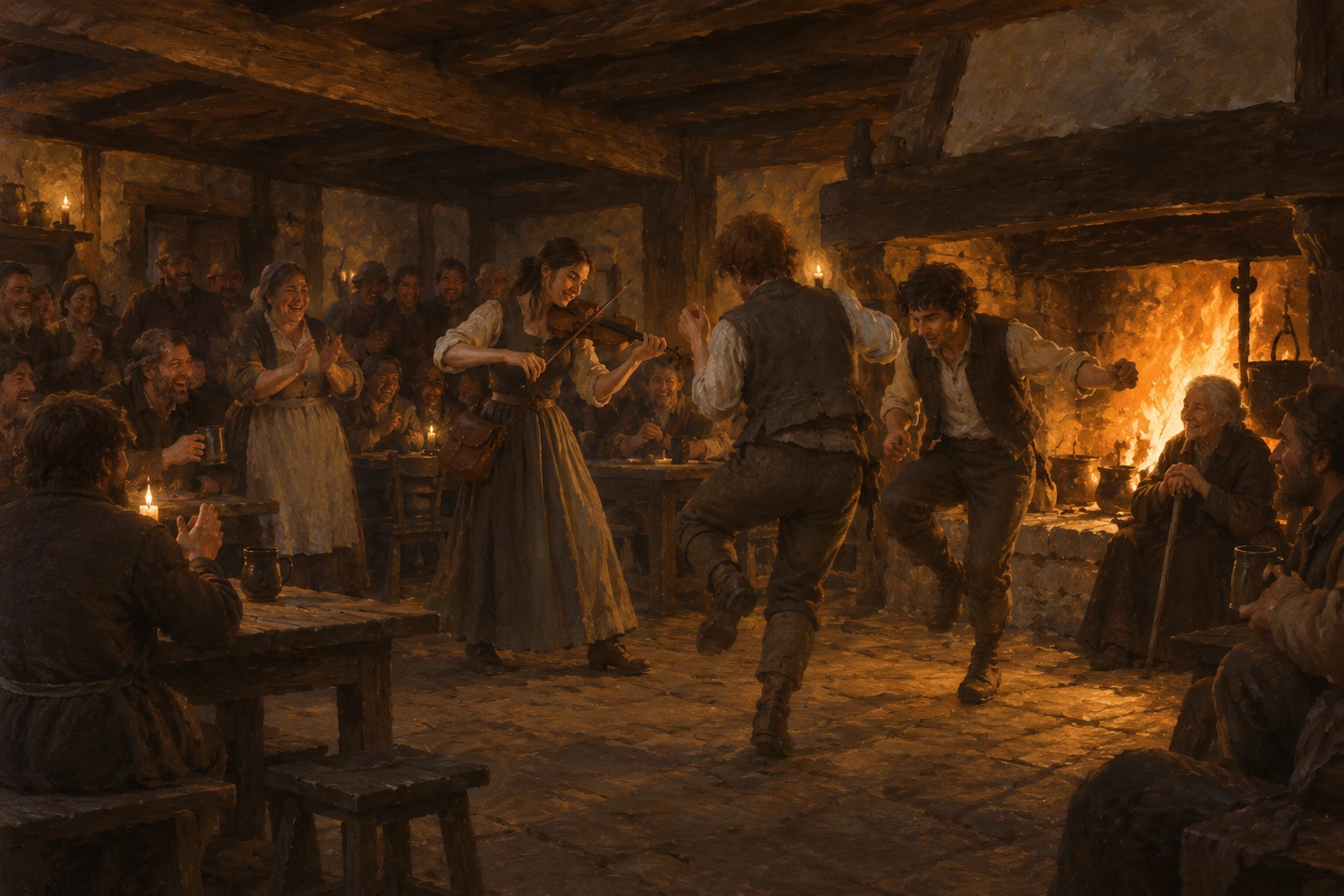
Somebody found a fiddle behind the bar, the inn's own, kept there for exactly these evenings, and put it in Wren's hands before she'd properly finished her cider, without ceremony and without anyone in the room expecting more than a tune or two before the tiles game started up again in earnest.
She played two lighter things first, a jig everyone in the room already knew and a slower air nobody bothered dancing to, testing the fiddle's own ear before she trusted it with anything that mattered. The strings held true. The tiles game stopped without anyone calling for it to.
She tuned it once more against the fire's own crackle and found the old reel almost without meaning to, the one that had come into this valley from somewhere over the mountains long before anyone at this table had been born, the one she had played half of at this same hearth as a girl because half was all anyone here had ever known of it. She played the first half the way it had always been played in Dall, the way her mother had taught it to her before there was any reason to think it would ever be otherwise, and then, without pausing to announce that anything was different, she went straight on into the second half, the one that belonged to a room three hundred miles east and a fire she would never sit beside again.
The two halves fit together the way a hinge fits, as if they had always been meant to close on the same door. Two of the field hands were up out of their chairs before she reached the turn, pulling a third along with them, and the innkeeper's wife left the dog entirely to its own devices and clapped the time out on her own thigh, and by the last verse half the room was dancing something that had no name any of them could have given it, because none of them had ever heard the tune whole before tonight to give it one. The other half of the room kept time with their boots against the floorboards, badly, cheerfully, as a room does with something it has decided it likes before it has worked out why.
The dance itself was nothing anyone had taught anybody; it built itself out of the tune's own turn, a line breaking into a circle and back into a line again each time the second half came round, and the man running the tiles table gave up on his game entirely and stood on his chair to watch the floor instead. Even the innkeeper came out from behind his own bar to see what the noise was, wiping his hands on his apron, and stayed leaning in the doorway through the rest of it rather than go back to the kegs. Sweat stood on Wren's own brow before the reel was halfway spent, the fiddle's neck slick under her fingers, and she did not slow it, because the tune did not want slowing and she had waited long enough to give it what it wanted.
Tansy did not dance. She sat where she was by the fire with her bad hip turned toward the warmth of it and watched, and when the last note went out under the noise of the room, she looked at Wren for a moment longer than she'd looked at anything else all evening, and something in her face came loose and settled, quiet as a held breath finally let go.
"That's the tune," she said. "Whole, at last."
"Whole," Wren said, and the fiddle was still warm under her chin, and the room went on dancing around the two of them into the last of the night.
The end