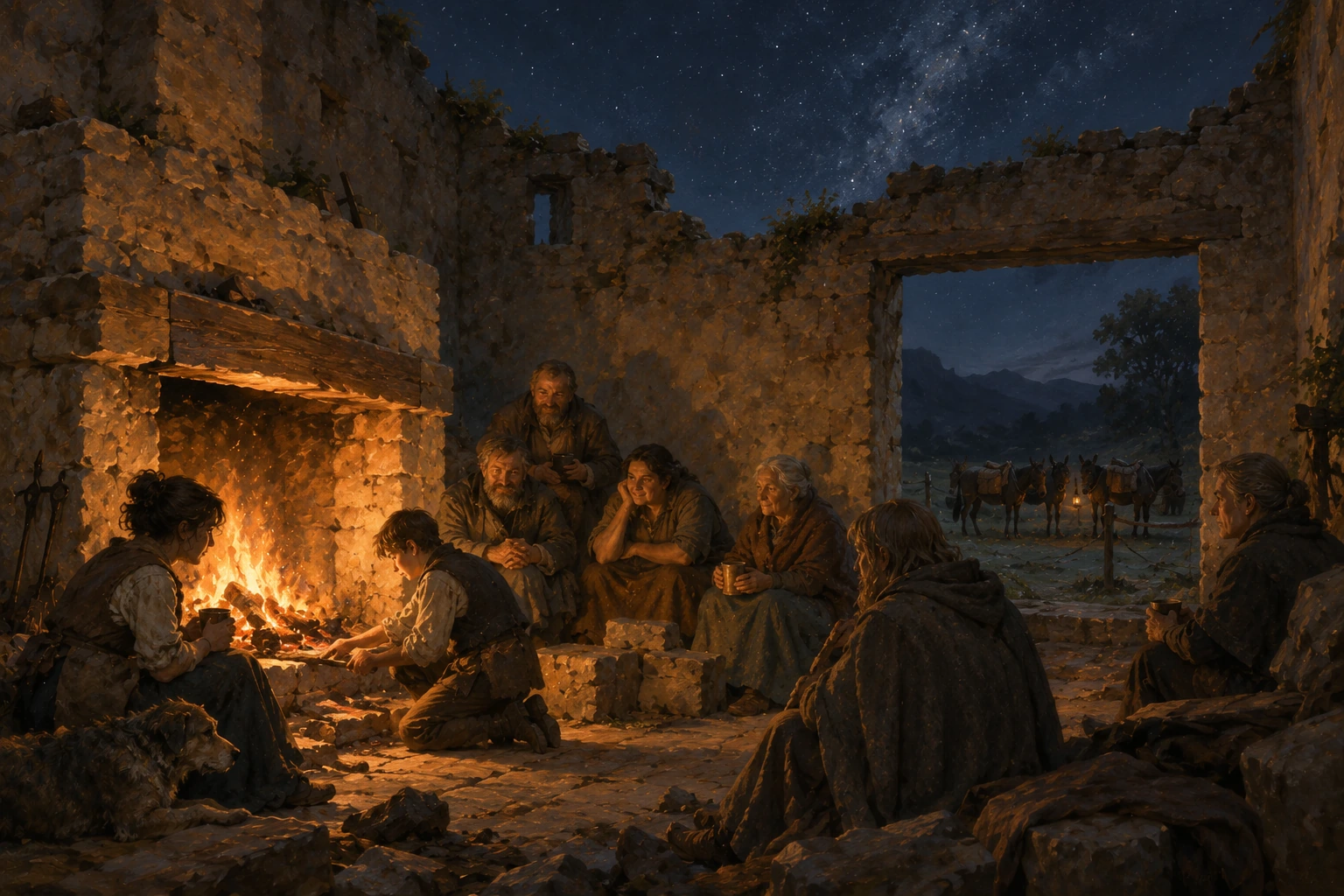
Camp on the Far Side of the World
The last flights of the western stair widened and gentled as they fell, tread after easy tread, until the idea of a stair had worn itself down into a long shallow deliberate slope. It was the easiest walking the Survey had done since the King's Road West ran flat and green out of Merrow — easier than that, Dorrit maintained, because the King's Road West had never had the decency to go downhill for a whole day together.
They came off the last flight in the low gold hour before evening properly declares itself, onto a broad natural shelf where the mountain, as if it too had grown tired of climbing, simply stopped, and let the old west road run out level across open ground into the first valley of Meddan.
Iyene named the moment for what it was, in the dry exact voice she kept for facts too large to dress up. "That," she said, looking back once at the stair falling away behind them into cloud-shadow, and then ahead along the level road, "is the bottom of it. I have surveyed four ranges in my time, and I have never been able to say those words and mean them so completely." Then she went back to walking, because there was light enough left to make miles in.
It was Bracken who found the other thing, and he found it as he found everything, by having his hands on an animal at the time.
The road ran between low terrace-walls with open ground beyond them, good going, dry turf under a skin of old snow. He took Suet off the paving to give a bad stretch of frost-heave a wide berth, and Suet went two steps onto the turf and stopped.
Not a shy. Not a balk of the sort that comes with ears back and a rolling eye. He simply stopped, in the middle of an ordinary stride on ordinary ground, and stood, and then walked back onto the road stones and stood there instead.
Bracken tried Barrow, because Barrow had crossed the Drowned Bridge like a farm lane. Barrow did the same. He did not trouble to try Nettle, who had been watching the whole performance from the head of the string with her ears flat forward and an expression Wren could only describe as waiting to be asked.
"Well," Bracken said, and left it there. He put the string back on the paving and took it over the frost-heave one at a time, slowly, and the mules went across the bad stones without a murmur; and he did not put a hoof off that road again the rest of the evening, or say another word about why.
Ahead of them, perhaps a half mile on, where the shelf broadened and a thin unnamed stream came down off the north height to cross the road in a shallow ford, a shape stood low and long against the darkening slope. It was not, at first glance, obviously a building at all — no more than Fallowmere had ever announced itself as a building to a stranger coming up the west road at dusk, and for exactly the same reason.
"There," said Pip, who had wandered ahead as he generally did once his feet were sure of the ground. He did not point with his whole arm. He only stood, and waited for the rest of them to come up level with him.
"He told us it would be here," Wren said, and felt the words settle into place as she said them. She was thinking of the second stone at the Doors of Cloud, and the comb-mark cut beside it, and her own voice reading it aloud two evenings past. She had thought it a fine and moving thing to say at the time. She had not entirely believed, until this moment, that it would prove to be literally true — that Wystan had walked this exact ground long before them, counted his suppers, and set down a mark that would still be waiting, patient as a held breath, for seven strangers and four mules to come along and need it.
Up close it resolved itself as all good work resolves itself, into more rather than less than it had promised. The way-house was long and low, built along the ground rather than up from it, in the same careful fitted stone as the terrace-walls and the stair. Its roof had long since given up whatever it had once been made of and let the sky in, so that snow lay in a neat pale drift along the inside of the north wall and grass — brown now, but grass, a living thing — grew up through the old floor where the stone had settled and cracked. But the walls stood true and square at every corner Wren could find, and the door-opening, broad enough for two loaded mules abreast, stood entirely without a door.
"No door at all," said Dorrit, running a hand along the worn jamb. "Not fallen off its hinges. Never hung one."
"They didn't," Luel said, coming up last, her staff finding the ground beside her with its old familiar sound. "Way-houses on this road were built without them, the whole length of it, doors pinned open the summer through — a shut door on a road like this one was thought an insult to whoever might be walking it hungry. I told you as much once, a long road back, by a different fire, though I don't suppose either of us thought that evening you'd ever come to stand in the doorway I meant." She looked at the wide opening a moment, and something in her face went briefly, entirely still. Then it passed, folded away rather than spent, and she stepped through into the long shadowed room beyond as easily as a woman stepping into her own kitchen.
Bracken took it in with the flat assessing eye he gave every campsite before he let himself approve of it, walking the outer wall once, hand trailing the stone. "Built and sited like the eastern stages," he said, "only older, and a good deal more of it. Whoever laid this out knew what a laden string needs at the end of a long day, and gave it to them without stinting." He nodded once, which from Bracken was another man taking off his hat.
Dorrit had already found the low half-buried line of stones along the southern wall, a hand's width high in places, swallowed by drift in others, tracing a shape too regular to be anything but deliberate. "Kitchen garden," she said, crouching to lay two fingers along the border. "Set close to the door, out of the worst wind, herbs within a dozen steps of the pot. There'll be something worth digging for under this drift come spring, if anyone's ever up here in a spring to dig for it."
Iyene had gone a little way past the way-house, along the road where it ran on level and true toward the valley's deepening shadow, and stood with her hands loose at her sides, the brass lens on its cord and for once not raised to her eye at all.
"I could take a bearing on that tonight," she said, when Wren came to stand near her, "and I am not going to. The light's nearly gone, and a road that has waited this long to be measured properly can wait one more evening to be measured with a steady hand and a decent lamp." She looked at it a moment longer, running level and pale between its terrace-walls into the dark, and something almost like hunger crossed her face before she mastered it. "Tomorrow," she said, and turned back toward the camp, and did not look at the road again that night, though her eyes drifted that way once or twice at the fire.
And there, against the inner gable, exactly where the builders had set it to catch the room's whole warmth and lose the least of it to the broken roof above, stood the hearth.
It was intact. Not merely standing, as the walls were standing — the hearth was sound, lintel and firestones and draw all fitted together with the same close patient craft that had cut the beacon-cradle at the Hob and laid the sunken causeway under the Drowned Bridge. The same hands, or hands taught by the same hands, building a thing to outlast every person who would ever stand in front of it. A shallow drift of old ash and blown grit lay in its mouth. Above it the flue rose dark and clean into the broken roof, and Bracken, crouching to run a hand up inside the draw as far as his arm would reach, came back with his fingers only lightly grimed.
"Sound as the day it was laid," he said. "They built for time, this whole road. I'll not insult it by doubting it draws."
Pip had already dropped to his knees at the hearth's mouth before anyone had properly finished admiring it, and admiring it was all anyone did. Laying a fire had been Pip's office since the first cold evening out of Merrow, back when he had been all elbows and apology about it, and was now simply a thing that happened whenever the company stopped walking for the night. He gathered kindling with the quick unshowy economy of a boy who had laid several hundred fires and burned his fingers learning every mistake he no longer made, and built it in the hearth's mouth exactly as he built it in the open — small, and true, and patient, tinder first and then the finer sticks laid across in a lattice, leaving the draw its room to breathe.
When it was ready he sat back on his heels and looked up, not because he needed permission, but because some fires want a witness to the lighting even when they do not want a speech.
Alder crouched beside him and said nothing for a moment beyond a small approving look at the lay of the sticks. Then: "That's yours to light, same as it's been since the road out of Merrow. I've nothing to add to it that your own two hands haven't already got in them."
Pip struck his own flint and steel — the small worn set Bracken had pressed on him in the first provisioning week, two of most things, one to use and one to lose, and this one long since become the one he used. The spark caught on the second strike, and the small flame took hold of the tinder and climbed, steady, into the laid sticks above it.
The company had gathered by then, without anyone calling them, into a loose half-circle facing the old gable, and for a little while nobody said anything at all, because the light climbing through Pip's careful lattice was doing everything that wanted saying. It found the old stones of the hearth first, waking a warm colour in grey rock that had known no warmth but the sun's for three hundred winters. Then the soot-darkened stone above the lintel, older soot than any of them, laid down by fires none of them would ever be told the names of. Then, as the flame grew and Pip fed it by careful degrees, the whole low room — walls and broken roof and doorless doorway and the seven faces ranged around it, held together in one small common ordinary light. The draw pulled true the moment the fire wanted it, carrying the smoke up and away into the dark without a stutter of it back into the room. Long unattended, and it had not forgotten for one moment what it was for.
"It still works," Pip said, very quietly, mostly to the fire.
"Everything built honestly does," Alder said, just as quietly, "if a fool with willing hands happens along to remind it." He looked at Pip a moment with something that was not quite pride and not quite anything smaller than pride either, and let it go at that.
There was no old-tongue word spoken over it, no rite, no moment held open for anyone to fill with more weight than it could carry. There was only a fire, laid by a boy who had laid two hundred before it, lit with flint and steel and patience in a hearth that had been waiting without complaint for exactly this. It always had been on this road — the beacon on the Hob, the hand fitted flat to Wystan's cut stone, and now this: the first Meddani hearth to hold a fire since the passes shut, asking nothing of anyone but that it be tended properly, which it was.
Supper was cooked on a hearth built for exactly that by people who had known their trade, and it showed. Bracken's pot hung true over a fire that neither guttered nor smoked the room out. Enna's travel-bread — the last of the second sack, and the last of the bread entirely, kept back, Dorrit said, "for an occasion, though I confess I hadn't pictured quite this one" — toasted at the hearth's edge in a manner it had never quite managed over open ground. Bracken cut it thinner than he would have cut it a fortnight before, and gave it round without remarking on the thickness, and said only, when Pip reached for a second piece and stopped himself, "Take it. Tomorrow's the day we start being clever about the grain, not tonight." What that would look like went unasked. Everyone at that hearth had watched the pannier go over the edge.
The mules were picketed in the old yard beyond the south wall, where a low remnant of fence still stood knee-high in three places and Bracken judged it, with a length of his own rope run between the gaps, "good enough to keep four sensible animals from wandering off into a country none of them have any better sense of than we do."
Luel came to the fire last, as she generally did, and settled a little apart from the ring of them, not from any coldness but from the same old habit of leaving a hand's width of room around herself that Wren had stopped noticing months ago as anything but Luel's manner of sitting. When Dorrit held out a bowl to her — the good bowl, the one with the chip in its rim that had quietly become hers along the road — she took it in both hands and held it a moment without drinking. She looked not at the fire but at the old walls it was lighting, the doorless doorway, the broken roof with its far scatter of early stars showing through.
"The house is glad of us," she said, in the tone of a woman stating a plain fact about weather. Then she drank her soup, and that was the whole of what needed saying.
She did not say anything about the road, or the dark past the doorway, or how far the light was carrying out of it. She did not once sit with her back to the door all evening.
For a while after supper the fire held them in the settled quiet of people who have walked a long way and arrived somewhere worth the walking, each finding some small ordinary thing to do with their hands — Bracken with Barrow's second-best girth-strap across his knee and a bone needle threaded, resetting a stitch that did not, so far as Wren's eye could tell, need resetting at all. He caught her looking and did not pretend otherwise. "Nothing wrong with it," he agreed, working the needle through anyway. "Man likes his hands busy of an evening."
Iyene had a fresh working sheet out on her knee, ruling the first faint lines of it by firelight — the road they stood on, the way-house itself, and the shelf's shape left open and unfinished at its western edge for tomorrow's steadier hand — while Pip had his own scrap of paper and a stub of pencil, drawing the hearth with the fire still in it, his name written in the top corner before he'd drawn a single line, as he had done on every fresh sheet since the coomb.
Dorrit had her herbal open on crossed legs, writing in it left-handed at a third of her usual speed. "Apple first, plainly," she said, to nobody in particular, "and that low ground past the ford would want beans, or I've never read ground in my life — whenever somebody with sense finally gets up here with a spade and the leisure to use it." It was the first plan anyone in the company had made aloud for a Meddan with people living in it again.
Alder sat where he generally sat, a little back from the fire's full heat, and watched all of it.
And Wren, last of all, sat with the satchel across her knee rather than at her hip, and found that she did not want, tonight, to open it — it had waited so long for this fire, and it could rest one evening more at her hip while the fire it had promised burned without her checking it.
The company went down one by one into sleep without ceremony, Dorrit's yawn the signal the rest of them had long since learned to read, and by the time the fire had burned to its steady banked heart the old room held six sleeping shapes and Luel's still one, and only Wren sat upright, the first watch having fallen to her.
Alder did not wait for the turn. He came and sat by her a good while before his own watch was due, and for a time neither of them spoke.
It was Wren who broke it, and she had not entirely meant to.
"I keep waiting to be afraid," she said, looking at the fire rather than at him — "all year I thought I would be, when we finally got here, and I'm not; I took stock of myself tonight, and there's nothing in me that answers to fear at all."
"Fear at a threshold is only respect grown to its proper size for the thing being crossed," Alder said, "and you didn't cross into this country tonight, Wren — you crossed it a keeping at a time, the whole year long, and what you're feeling isn't the absence of a fear you ought to have. It's the simple fact of having already done the frightening part, by inches, without once calling it that."
"Were you afraid?" she asked, after a while. "Before we started. Of coming back to it."
He was quiet long enough that she thought he meant not to answer, which would itself have been an answer of a kind. But he surprised her.
"Not of the west. I was never much afraid of Meddan; I grew up on stories of it kind enough to make a boy curious rather than fearful, and by the time I was old enough to know better I'd spent too many years loving the idea of it to start being frightened of the fact." He turned his ash walking-stick a little where it lay across his knees. "What I was afraid of — and I'll own this only the once, so mind you remember it accurately — was being the wrong man to be handed the road once it finally opened. Every warden before me carried the charge and never got to test it against the ground it was made for. I used to lie awake wondering whether I'd get my chance at last and prove, in front of the very people I'd sworn to bring it home to, that I'd learned all the wrong lessons from it." He almost smiled, in the dry manner that made a joke out of something that had clearly cost him a good deal to carry. "I stopped being afraid of that somewhere around the second time a mule was proven wiser than me. A man can only be afraid of a very large thing for so long before a mule quietly proves him a fool about the size of it."
Wren laughed, softly, so as not to wake the others, and found that she loved him a little more for the confession than she had before it.
"So the charge doesn't frighten you now."
"The charge never frightened me. Only my own fitness for it did, and that particular fear has had a great deal of patient stubborn evidence brought against it this year, from every person at this fire, and I find I no longer have the nerve to keep arguing with the evidence." He looked at her a long moment in the firelight. "The book goes home. That was the charge, from the first evening I heard it said aloud in your grandmother's kitchen, and I used to think 'home' meant a place — a dot on a map, a door we'd stand in front of and say, there, that is the end of the road. It isn't. Home is a kept thing. It's a hearth somebody troubles to lay a fire in. It's a road somebody troubles to walk, and record truly, and hand on to whoever comes after with the not-knowing kept as carefully as the knowing. We lit two fires this year that had waited a long time for someone to trouble themselves over them — one on a hilltop, for courtesy and practice, and one tonight, in a hearth built by hands that never got to meet a single one of ours, and meant for us anyway. That is what going home is. It is not one arrival. It is a habit, resumed."
He rose, and settled his coat, and looked down at her with the small familiar undramatic warmth he had carried since the first morning at the bee-yard gate.
"Go and sleep. I have the watch from here, same as any other night, and there's nothing on it tonight that wants two of us awake for it."
"Good night, Alder," she said, and meant by it rather more than the two words generally carry.
Before she gave over the fire she banked it herself, raking the coals close and heaping the grey ash over them with the flat of a stick until the flame was gone from sight and only a low patient red showed through the cracks.
Dorrit, not quite asleep, watched her do it with one eye open. "There's a phrase for that, back home. For a fire let go down too far, with nobody minding it."
"Going Meddan-wise," Wren said, and found, saying it here, in this room, that the old worn valley phrase sat entirely differently in her mouth than it ever had at the Bridge Inn. "This one isn't, though. It's banked low, same as any fire banked for the night — but there's someone minding it. There's someone who'll wake in a few hours and feed it again. A banked fire isn't a dying one. Not so long as somebody means to come back to it."
Dorrit made a small warm sound of agreement that was not quite words, and was gone within the minute.
Wren did not sleep at once. She sat on with the day-book open on her knee by the low red light, and wrote one short entry.
The book is at my hip and I have not opened it once this evening, and I find I have no need to — it waited three hundred years for this fire, and it can wait one night more for me, and there is a kind of keeping in that as well. The book is home. So, tonight, are we.
She had closed the book and was settling the satchel across her shoulder when she saw it.
She had looked east her whole life, out of a valley that had nothing else worth looking at in that direction, and she had gone on looking east the length of the road, and she did it now from the doorless doorway out of the same habit that had carried her to a map-room window at the watch. There was nothing east to look at but the black wall of the mountain, and the notch cut into the top of it, a shallow bite taken out of the stars.
There was a light in the notch.
It was small, and it was orange, and it did not do what a star does through cold air. It sat exactly where the two shouldering heights leaned toward one another without touching. It was a fire in a doorway, high above her, standing on ground this company had struck its own camp from that same morning.
She did not wake anybody at once, but watched it a good while first, in case it should prove on longer looking to be something else. It did not. Then she found a star to fix it by — the same habit that had made her do it once already, on a hilltop, with a beacon burning down beside her — and went round the wall to where Bracken slept, and touched his good shoulder.
He was awake before she had finished doing it. He came out to the doorway without his coat, stood looking up at it a while, asked her no questions at all, and then gave her the arithmetic, because the arithmetic was what he had.
"Light party. Three riders, four. Not a train — a train's no business on that stair for a fortnight yet and he knows it better than I do." He was quiet a while. "Marle didn't wait for his train, then. He put three men on the road behind us inside a week of our leaving, and he did it because of what he watched happen in that yard, and I'd have done the same in his boots and told myself it was prudence."
He worked it through out loud, in daylight and load, and there was no dread anywhere in any of it.
"We came off that notch at dawn. He's stood in it tonight. That is the better part of one day's road between us and nothing else whatever, and he'll not close it, because he'll want a day up there taking his bearings and another having a good long look at both those stones." He let that sit exactly as long as it needed. "Then a week at the top, bringing his outfit through after him when it finally comes up. So: one day of road, and about a month before anybody with a wedge and a purchase order is standing where we packed that cut. It's a fair clock. It is not a long one."
"You said six days this morning."
"I did." He did not soften it. "I've been minding a clock since the watch and I never turned round and looked up my own back trail, not one morning in four. That's mine, and I'll not do it twice."
"Do we tell them tonight?"
"We tell them at breakfast, we walk at first light, and nobody runs." He looked up at it once more. "We're not being chased, Wren. We're being followed. That's a different thing, and the answer to it is the answer to most things — start earlier, and load properly."
He went back to his blankets. Wren wrote a second entry underneath the first, shorter, in a hand gone worse from the cold.
There is a fire in the door. Bearing and hour below, and the star I fixed it by, and nothing claimed past what I have actually seen. Bracken says a light party, three or four riders, no train yet, and one day of road between us. He said six days this morning and told me to my face tonight that he had been wrong and how, which took him about four seconds and no excuses at all.
I have not written Tolly's name once since the watch. I notice that I have not. I am not sure whether that is cowardice or only the road, and I do not much like either answer. Dill sleeps in that same end of that same house tonight.
We are not being chased. We are being followed. I find I do not much mind which it is, only that there is a difference, and that the difference means we start earlier.
Then she gave over the watch to Alder, and lay down in her blankets with the satchel under her head, and slept perhaps an hour.
She woke because the room was wrong.
Not because of a sound. There was no sound, and that was the first wrong thing; she lay inside her blankets a while working out what her ears were failing to find. The mules. Four animals breathing on the other side of a wall three feet thick had been the floor under every night's sleep since Merrow, and there was nothing there at all.
The second wrong thing was the fire. It was burning. She could see it from where she lay — the coals she had banked, uncovered now and fed, throwing a good steady working light up the old gable stone. And it was not warm. She put her hand out into the room before she was properly awake, and the air over the flagstones took the warmth off her fingers as fast as she could offer it.
Alder was standing between the fire and the doorless door.
He had his stick in his left hand and his right hand open at his side and he was not moving at all, and the light of the fire behind him reached about two-thirds of the way to the doorway and then stopped. Wren looked at that a long moment, because it was the sort of thing a person looks at twice. There was no line on the floor. There was no shadow-edge, nothing thrown by anything. The light went out across the flagstones as light does, thinning steadily with distance — and then, a good arm's length inside the door-jamb, it was not there any more, and past that there was black.
She sat up. Across the room Iyene was already sitting up. Neither of them had made a sound doing it.
"Feed the fire," Luel said.
She was on her feet by the north wall. She had said it in a perfectly ordinary voice, and there was nothing in it that asked to be discussed.
Pip was up and moving before anybody else, because feeding the fire was Pip's office and had been since Merrow. He got the wood from the stack by the wall and built it as he had built two hundred fires, patient, leaving the draw its room; and the flame took the new sticks and climbed and gave out a good hot light, and the room did not get warmer by any amount Wren could feel.
Frost was coming up on the inside of the hearth stones. She watched it happen. Not on the cold walls, not by the door — on the fitted stone at the hearth's own mouth, a hand's breadth from a burning fire, small white feathers of it standing out of the rock and growing.
"Dorrit," said Bracken, from somewhere behind her. "Leave the door."
Because Dorrit had gone for the doorway. Of course she had. The mules were out there, and Dorrit could no more hear four animals stop breathing and stay in her chair than she could hear a child cry.
She stopped. She did not like it, and she stopped.
And Pip — who had done exactly what he was told, who had built the fire and sat back on his heels and given the room every ounce of warmth he had to give — got up and went toward the door, because his flint-and-steel roll lay on the ground beside it where he had left it after supper, and because he was sixteen, and because a boy who has spent his whole year being useful goes and fetches the thing that is wanted.
"Pip."
Wren had known Master Alder seven months. She had heard him talk a frightened mule across a drowned bridge, and hold seven people's names in a dead-cold fog until they came back for them, and tell a room full of hostile strangers, straight out, that he did not know whether the thing he was about to do would work. She had never heard the voice he used on that boy's name.
Pip stopped as though a hand had shut on the back of his collar.
"Sit down. There." Alder had not turned round. He had not raised his voice either, which was somehow the worst of it, because the thing in it was not loudness. "Put both hands on that fire. Say your own name. Keep saying it until I tell you to stop."
Pip stood one half-second longer, because he was sixteen, and because the roll was three steps away, and because nobody in that company had ever spoken to him like that in his life.
"Now."
Wren felt the room take it. Bracken — Bracken, who had sat out four hours of that storm on an open ledge with a rope in his fist and given the mountain its own odds back — was on his feet with no memory of standing. Iyene had her back flat to the wall. Dorrit said, "Alderin—", and got nothing: not a word, not a look, not the smallest turn of his head.
Pip sat down and put his hands out over the fire and said, "Pip Sandover," in a voice with nothing left in it, and said it again, and went on saying it.
And then Luel walked past all of them and stood in the doorway.
She did not go through it. She stood in the opening of a doorless door with the black on one side of her and the failing light on the other, and she began to speak out into the valley, and what she spoke was names.
"Ness Fell," she said. "Wakelow. Glaissel Water, and the ford at Glaissel Water. The orchard on the south terrace. The way-house at the stair-foot. Cael-Amrun."
She said them as she had said the coping stones on the road that afternoon — in the common speech, flat and clear, one after another after another. But where the coping stones had been a woman muttering to herself, this was not. This was a voice pitched to carry across a valley long empty, by somebody who had known every name in it while they still had people standing on them.
She named for a long time. Wren did not know how long. Somebody put a blanket round her shoulders and she never learned who.
Nothing came through the door. There was no shape, no sound, no voice, nothing in the black to see or to refuse to look at. There was only a cold that a good fire could not answer, and a light that stopped short of a doorway, and every animal for a mile lying still with its breath held — and, under all of it, a sense Wren never found a better word for than the one she was ashamed of. The sense of being looked up. Of being a name somebody had gone to a shelf to check.
In the coomb, Alder had told her plainly that there was nothing in it to strike at and nothing that wanted anything from anybody. She had believed him, and she believed him still, because he had been describing the coomb and he had been right about the coomb. This was not that. Whatever the difference was, it was the difference between standing in cold water and being stood next to.
And at some point in the middle of it, she opened the Waybook.
She had not meant to. She had spent the whole evening pleased with herself for not needing to, and had written a fine line about it, and the fine line had been true when she wrote it. She got the book out of the satchel and unwrapped the oiled cloth with fingers she could barely close, and laid it open on her knees in the fire's light; and the ink was dark, and the road ran across the page as sure as the day it was drawn, and set along it in Wystan's small spiked hand were names.
She could not read the old tongue. She had said so all winter and it was still true. But a name is a name in any hand, and a keeper who has spent seven months learning forty letters by inches can sound one out badly, if she is willing to be wrong in front of people.
She read them out. Every name on the page, and then she turned it and read the next, and the next, mangling half of them and knowing she was mangling them. And Luel, without breaking her own list for a single heartbeat, began to say each of Wren's after her, correctly — so that the two of them went down the map together, one voice getting it wrong and the other putting it right, out into the dark, for what Iyene's book afterward recorded as one hour and fifty minutes.
Nobody had told Wren to do it. She had simply gone to the one thing she had.
There was a third voice in that room and Wren did not know it was there until it was not.
Alder had not moved from between the fire and the door. He was not naming with them, and he had nothing larger to give; he had said so plainly at a breakfast table in the east, in a voice with the bottom worn out of it, and made Iyene write it down. What he had left was small and he had been spending it since before she woke — one word, low, in the old tongue, dropped out into the dark at about the rate a man breathes when he is working. She had been hearing it for an hour without once hearing it, the same as she had stopped hearing the mules.
Somewhere in the second hour the light went out.
Not the fire. The fire was burning; she could see the sticks standing in flame and Pip's lattice holding true beneath them, and the flame was doing every single thing a flame does. The light went out. For the space of one breath the room had a fire in it and nothing whatever coming off it, and Wren sat in the black with an open book on her knees and her finger resting on a name she could no longer see.
Then it was back, reaching exactly as far as it had been reaching all night, stopping in exactly the same place, an arm's length inside the jamb.
Luel never broke. She had the next name out on the beat she had been keeping for an hour, and the one after that. Wren found her place with a finger she could not feel and read the next badly, and Luel put it right, and the two of them went on down the page.
The low word at the door had stopped some minutes before Wren noticed the silence where it had been.
She could see him against the firelight, or see the shape of him: the stick in his left hand, and his right hand no longer open at his side. He had put it flat against the door-jamb. He was not leaning on it and the jamb was not holding him up. His hand was simply on the stone, flat, checking it — a man making sure of a thing whose position he had known all his life.
He did not say the word again that night.
It did not end. It left.
There was no moment anyone could point to. The light went a little further than it had been going; and then it reached the jamb; and then it was falling out through the doorway onto the road stones beyond, ordinary firelight on ordinary stone, doing what firelight does. And out past the south wall, Barrow breathed.
Bracken made a sound Wren hoped he never learned she had heard.
Iyene said, in a voice with no professional register left in it whatever: "Could you have drawn one?"
"No," Alder said.
"I know. I wrote it down myself, at the watch, because you made me." She put her head back against the cold stone and shut her eyes. "I wanted to hear you say it in this room."
For a while the room held still. Pip was still saying his name. Alder crossed the room and crouched and put a hand flat on the boy's back and said, "That'll do. Well done. That'll do now," in an entirely ordinary voice; and Pip stopped, and looked up at him, and looked away.
Wren waited for the apology.
She waited through what was left of the night, and through the grey of the morning, and through the packing, and through the whole first hour of the day's road. It did not come. Alder was in every other respect exactly himself — mild, attentive, courteous over the bread, genuinely interested in Iyene's sheet. He said no word about the voice he had used, and offered nothing whatever to explain it; and when Dorrit put it to him directly at the fire's edge before dawn, quietly, in three words — "You frightened him" — he said, "Yes," and nothing else at all, and went out to see to the mules.
Dorrit stood where she was a moment after he had gone. Then she took her bowl round to the far side of the hearth and sat down next to Pip, which was not where she had sat any morning that winter, and said nothing to him either.
Pip had moved first. Wren had watched him do it without understanding what she was watching. He had carried his breakfast round to the cold side of the fire, the side with the draught off the doorway on it, and eaten it there with his back to the wall.
And when Alder came in again with the frost still on his shoulders, Pip stood up.
Not to fetch anything. Not to be useful. He got to his feet beside the fire and stood there and waited, and sat down again once Alder had gone past him to his own place; and it was done in the manner of a boy standing up in a room with somebody's master in it. Pip Sandover had not stood for a living soul in seven months of that road, including a salvage assessor with a charter under his arm.
Wren looked at Alder while it was happening, because she wanted to know.
He had seen it. She was certain of that and could not have produced one scrap of evidence for it — no check in his stride, no glance, nothing anybody could have written down honestly. He did not tell the boy to sit. He did not put a hand on his shoulder and make a small kind joke of it, which he could have done, and which would have worked, and which every soul at that fire was waiting for him to do.
He sat down and took his bread and let it stand.
The mules were standing.
All four of them, in the grey, in the old yard beyond the south wall, on their feet and facing the doorway. Gable, who had lain down to sleep every night of his long and comfortable life and had not once been known to change his mind about it, was standing among them with his head up.
Bracken went along the line and got a hand on each of them and talked to each of them by name for a while, and none of them moved for a good ten minutes, and then Nettle bit him, hard, on the forearm, and drew blood through the sleeve.
"Aye," Bracken said, and let her, and did not pull his arm away until she had finished. "That's fair."
Dorrit could not feel the two smallest fingers of her bound hand. She discovered it trying to take the strap of her own pack and said nothing about it, and Wren saw her discover it, and Bracken saw Wren see. By noon the feeling had come back into one of them. It did not come back into the other, that day or after, and when Dorrit finally mentioned it aloud, a week down the road, she mentioned it in the same flat voice she used for the weather, and would not be got to say more.
And Pip could not account for the night.
He remembered the fire being lit. He remembered supper, and drawing the hearth, and Bracken saying take the bread. He remembered getting up in the dark to fetch his flint-roll from beside the door. After that he had nothing at all until Alder's hand on his back and that'll do, and he said so without drama, in the manner of a boy reporting a fact about himself that he intended to be reasonable about; and then he asked, once, whether he had done anything he ought to be ashamed of, and Iyene said, "No. You did your work," in the voice she kept for anything she meant, and that was the end of the asking.
He wrote his name twice at the top of the next sheet he ruled. Once in the corner where he always put it, and once more, lower and larger, in the middle of the page, before he drew a line.
Wren wrote it down, and said nothing to him about it either.
They had been at the letters since the middle of winter, two or three at a time, in the quarter-hours the road left over. He gave her the shape and then the name of the shape, and a week later asked her for it cold, and did not help her when she stalled. Forty letters. By the foot of the stair she had thirty-one of them and was honest with herself about the nine she did not.
That morning, in the grey, before the packing had properly begun, she got the Waybook out to make her fair copy of the names she had read in the night, and came to a letter she had asked for twice and lost twice, and asked for it a third time, having given up being embarrassed about asking somewhere back around the Drowned Bridge.
Alder looked at it.
He looked at it a while. It was not an obscure letter. It stood in half the names on that page, and it had been in the first six words he ever taught her.
"That is—" he said.
Wren waited, and went on waiting, and felt herself go cold to the wrists somewhere in the waiting.
He did not try again and fail, which she had watched old men at the Bridge Inn do her whole life. He did not make a joke of it, which she had watched him do. He looked at the letter, and then he looked at the doorless doorway, and then he said, "Ask me again this evening," and got up and took his stick and went out to where Bracken was working.
Across the hearth Luel had stopped with her cup halfway to her mouth. She set it down without drinking, and said nothing about it.
She asked him again that evening. She asked a third time a week on, out on the open road, in the plainest voice she could manage, because she wanted very badly to be wrong.
Once, on that same road, she said a name wrong on purpose to find out whether he would hear it. He did not hear it. She never did that again.
A thing had been on a shelf in that man since longer than she had been alive, and now there was no shelf. Worse than that, and she did not reach it for months: nobody has ever held a language up to the light and counted what was missing out of it. You find out a word at a time, by reaching for one, and only if you happen to reach.
That night she got the day-book out and wrote, in the end, one line.
Master Alder could not give me the letter this morning.
And under it, after a long while, a second.
He could not give it me this evening either.
That was the whole of what she put down. She had nothing else about it she was willing to call a fact.
She did not bank the fire.
The sky was greying by then, and the company was up and stirring, and there was no reason in the world not to rake the coals close and heap the ash and let the morning have it, as she had let a hundred mornings have a hundred fires. She knelt at the hearth's mouth with the flat of the stick in her hand and found that she was not going to.
She fed it instead. She built it up properly, the way Pip had taught her without ever knowing he was teaching anybody, small and true and patient, and it took and climbed and put a good working heat into the old room; and then she sat back on her heels in front of it and let it burn.
She could account for three fires from where she knelt, and only one of them was giving her any light to see by.
One stood a single day behind her and high above, small and orange in a notch cut long ago for guests, and it was coming, and it had a name and a face and a sealed paper, and she found that of the three it frightened her least by a distance she would not have believed the evening before.
One lay a great many days ahead and far below, out in all that white — no thread of smoke to be seen at this hour, only a bearing written twice into Iyene's book and once into her own. It did not know she existed. Somebody out there was minding it this morning, the same as she was minding hers.
And one was this one, in this hearth, in a house with no door, on the wrong side of a mountain, in a country where the roads shed their snow first and the mules would not step off the paving, and all of it went unspoken over breakfast. Yesterday evening it had been lit for the first time in three hundred years. Before morning, something had come as far as its doorway and stopped there.
Wren put another stick on, and did not set those two facts down beside each other, and understood, kneeling there, that she was not going to be allowed to leave them apart very much longer.
"Kettle's over," Bracken said behind her, and set it where the morning would want it, and went out to load.
She got up and went to help him.
Out in the yard Pip was at Nettle's head while Bracken worked the near-side strap, holding her steady and talking to her, doing it as well as Bracken himself would have done it. Alder came past on his way to Gable. Pip stood up out of his crouch and waited, and let him by, and went back down to the mule's head after he had gone. Bracken saw it. Alder saw it. Nobody remarked on it, and the strap got buckled, and the load went up square.
The sun came over the notch a quarter of an hour later and put the whole eastern sky the colour of the inside of a shell, and the fire she had fed instead of banking burned on at her back the whole time they were loading, throwing its light out clean through the doorless doorway and a good long way down the road.