The Deep-Delved
Midsummer stood at its own hushed height overhead — the days grown so long by now that Bracken had taken to calling last light "the third supper-time" — and the beacon road began to climb again, gently, toward a hill Iyene's sheet had marked, for want of a better word, simply as the Third. Glaissel lay two days east behind them, it and its long patient fog dropped away together out of sight, and the count was still descending.
They had been slow days. Nobody said why, and nobody set a pace that would have asked Wren to explain herself, and by the second afternoon she could keep up without anyone pretending not to notice that she was keeping up.
It proved a kinder climb than the Fourth's had been: a broad shouldering hill, thickly grassed, its cradle barely canted, its basket-iron sound enough that Bracken pronounced the whole business "very near a courtesy visit." They cleared it by early afternoon, hauled fuel up the last easy slope, and stood back to let Alder give the words the road had worn smooth in everyone's ear, though he never said them as though they had grown ordinary.
"By the charter of the College of Roads," he said, "which runs to the road's whole working — waymark, well, bridge, and beacon — this fire is called, and the line begun again."
There was no household here to take the taper; he lit it himself, and the flame stood up pale and nearly invisible in the strong afternoon light until the shadows lengthened enough to give it back its gold. Iyene logged it standing, her book braced on her forearm. "Lit once," she said. "Keeper wanted." She looked up at the long midsummer sky, still hours from needing the fire at all, and allowed herself something close to a smile. "It'll have the whole evening to prove itself before it's asked to do any real work."
It proved itself sooner than that.
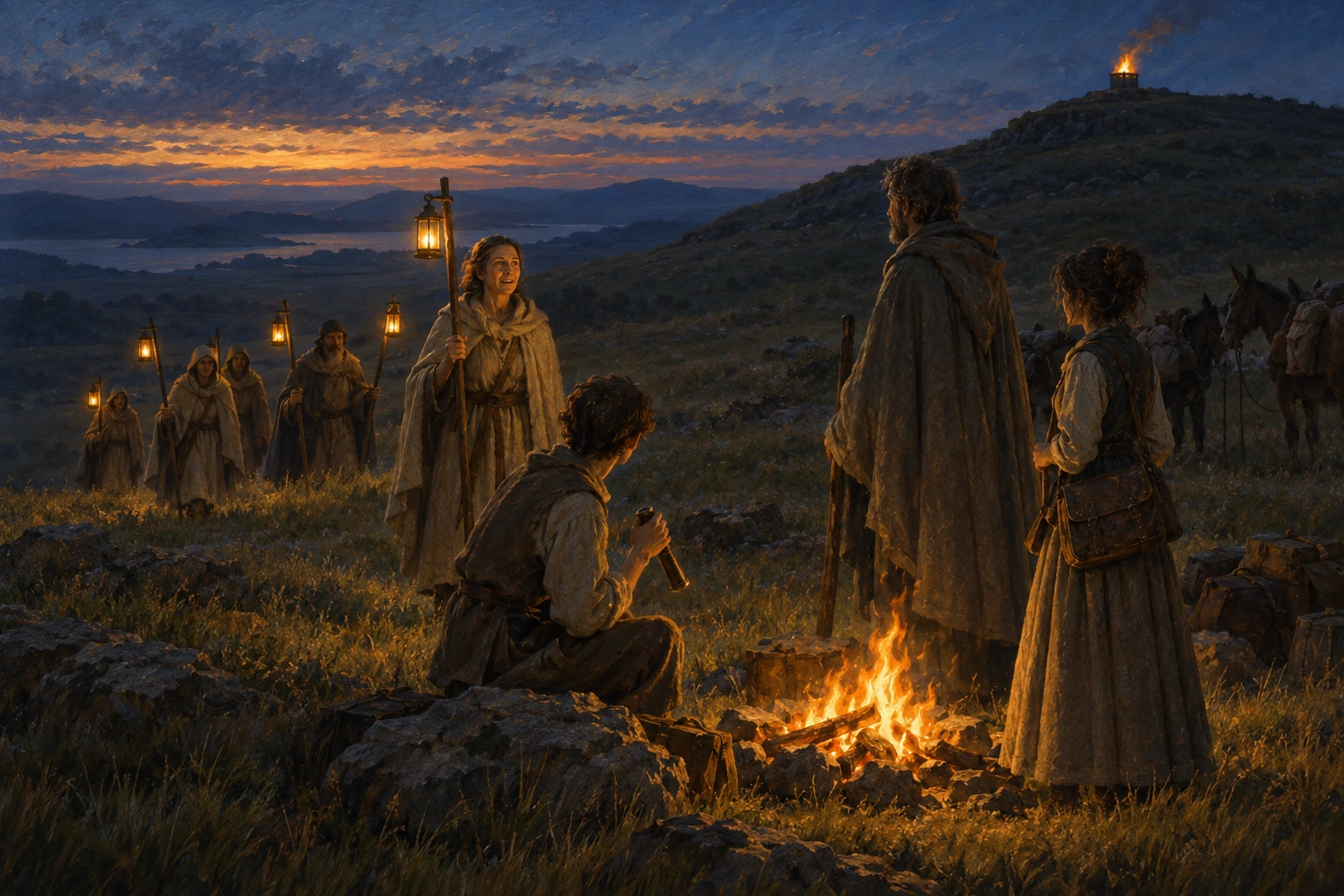
They made camp a little below the crown, on a shelf of level turf with a fair view west, and it was Pip — always Pip now, the glass at his eye before anyone else thought to look — who saw the lights coming up the darkening flank of a lower rise, and did not call out, only went very still, so that the whole camp turned to see what had stopped him.
"Lights," he said at last, low. "Moving. Four — five, I think. Coming this way."
Wren's whole body remembered Glaissel before her mind caught up to it, and for a moment the old fear had her by the back of the neck. Then she looked properly and it let go, because these lights were nothing like that fog. They swayed with the rolling give of something carried by a walking hand, rising and dipping over uneven ground; they were warm, a full living gold, not the fog's flat cold white; and they came with sound — low voices on the still air, and under the voices the small noise of feet finding their way on a hillside in the dusk. These lights were going somewhere, with people attached to the going.
"There," Bracken said, into the quiet that had followed Pip's word, "that's a welcome I haven't had the pleasure of yet this year."
Alder was already on his feet, listening with his whole body the way Wren had seen him listen exactly once before, at the Cold Coomb, though the feeling now was entirely its opposite — telling her before he said a word that whatever came up that hill was, in his judgment, very good news indeed.
They came on steadily, five lamps on five poles, until the shapes behind them resolved out of the dusk into people: cloaked in undyed wool worn soft with careful mending, moving with an economy Wren had not seen in anyone all year — nothing wasted, nothing loud, each step placed as though the ground itself might be listening. The foremost, a woman perhaps Alder's own age, stopped a courteous distance off, lifted her lamp so its light fell full on the company's fire, and called out low and carrying, with the clear quiet of someone long practiced at being heard without being loud.
"Who calls fire on the old line," she said, "and stands to answer for the calling?"
It was not Edda's "Who crosses?" — the words ran differently, carrying a weight and formality Sereth's plain doorway grammar had never reached, an older, more careful cousin of the same question — and Wren felt Alder go very still beside her, the stillness he kept for something he judged worth doing exactly right.
"By the charter of the College of Roads," he answered, giving her the whole of it, "which runs to the road's whole working — waymark, well, bridge, and beacon — this fire is called, and the line begun again. I am Alderin of the College, and this the King's Survey, chartered east of the mountains and walking west under it still: Iyene Sath, Cartographer-Royal, who leads us by that charter; Wren Fallowmere, keeper of a book eleven generations kept against this very road opening; Bracken Hale, our quartermaster; Dorrit Fallowmere; Pip Sandover, apprentice cartographer; and Luel, of the Amarin, who walks with us by her own choosing and no charter's binding at all."
The woman held her lamp a moment longer, her face lit gold from below, careful and searching and, Wren thought, close to disbelieving its own good fortune.
"Then the charter still runs," she said, "and the College still stands, and there are still those in it who give the old words properly, without a syllable dropped for haste. We had begun to hope it, watching your fires climb the line these last weeks. We did not dare be certain until we heard you say it whole." She lowered the lamp, and the formality went out of her bearing all at once. "Come down out of the dark and be known to us under our own roof, where I can offer you a chair instead of a hillside. My name is Fenna, and I keep the lamps, this while, for Stanhope — which is what's left, and rather more than what's left, of a delving that used to answer to a longer name nobody troubles with any more."
They went down by the lamps' own light, off the beacon road and along a track that dropped by easy switchbacks into a fold of hill nobody would have marked from above as anything but ordinary ground, until it opened, with no more ceremony than a change in the smell of the air — cooler, mineral, faintly of woodsmoke and mushrooms — onto a broad stone portal cut into the hillside's own rock, its lintel carved in a plain deep-struck pattern Wren's untrained eye read at once as kin to the College's waymark-cutting, though older.
And there, for the first time anywhere in all their walking of the west, stood a door — heavy oiled wood banded in iron, hung true on pintles worn smooth by more swinging than anyone living had counted, propped open now on an iron hook, warm lamplight spilling out onto the grass.
"You'll find doors below," Fenna said, reading the company's small collective hitch of surprise correctly, "real ones, that shut, and I'd ask you not to take it for unkindness. A way-house door stands open because it's a promise to whoever's walking: come in, at whatever hour. We never kept that kind of road down here. Our doors close because the deep holds its own cold same as the heights hold theirs, and a shut door keeps a hall's warmth where the hall can use it. It's a hearth-door, not a road-door — opened for anyone who knocks with an honest hand, as you'll find tonight, and opened about as wide as a door can go."
Beyond the portal one stairway ran down into the hill, cut wide and shallow enough for two abreast, worn to a soft shine down the center, a groove polished at hand-height where generation on generation of palms had trailed for balance. Small lamps stood in niches at every second turning, and every one of those flames had been burning, in one vessel or another, without a single true night of dark between them, for as long as the beacon Alder had lit that afternoon had stood cold on the hill above.
The stair let them out at last into a hall that took the whole company's breath much as Glaissel had, and for the opposite reason. Nothing about Stanhope was built vast; everything about it was built to the scale of people who meant to keep it warm. Pillars squared and fluted with a plainness that spoke of use rather than show; a floor of fitted slabs polished pale by feet; along one wall a great shallow hearth-shaft drawing a low fire's smoke up into the hill's own body, so the room held woodsmoke without its sting.
People were already gathering, quietly, without crowding — pale, most of them, with the sun long rationed rather than given freely, a healthy pallor and nothing sickly in it; and every one of them moved and spoke with the same careful economy Fenna's people had shown on the hillside, as though each carried a lifetime of the hill's own quiet folded into hand and throat alike.
"There's near three hundred of us, all told, above the cisterns and below them both," Fenna said, when Iyene — already reaching, unconsciously, for the lens at her throat — asked it outright, the way she asked every question that mattered to a map. "A little under, if you don't count the children too young yet to be sworn to a lamp of their own. We've settled, this last while, to about what the halls can comfortably hold and the gardens comfortably feed. It isn't a grand number. It's held."
"It's held for three hundred years," Alder said, quietly, "which is a considerably grander thing than a number."
Fenna looked at him a moment with an expression Wren could not entirely read, then turned to the business of guests. "Sit," she said. "All of you. You'll want supper before anything else, and it's rather more than been kept."
They ate at a long table close by the hearth-shaft, a dark rich mushroom stew built, Dorrit pronounced after close interrogation of the cook, on nothing more mysterious than patience and time. She asked what gave the sweetness at the end of it; the cook said a dried herb from the warm beds and held out a pinch; Dorrit rolled it under her thumb and said, "Yes. That," and went straight on to the next question without naming it. Only Wren, across the table, saw the two seconds she spent going round the hole where the name should have been.
There was, besides, dense sweet-smelling bread; pale forced greens grown in shallow beds kept warm near the hearth-shafts; cistern-water, cold and mineral-sweet, served with a small unshowy ceremony that told Wren, more clearly than anything said aloud, how precious clean water had once been down here.
Near the meal's end, when talk had loosened into the easy overlapping shape of two households finding each other's rhythms, Fenna rose and came back carrying, cradled in both hands with a care that made the whole table quiet, a small stoppered stone jar.
"We keep a few things back," she said, setting it on the board, "against a day worth opening them. I think we've found one." She worked the stopper loose and tipped the jar, just slightly, so the company could see the slow amber weight of what it held catch the lamplight. "Honey. Made before the closing, by bees that don't fly this country any longer — we lost the last of our own hives inside the first hard winter. It doesn't spoil, honey — the one sweetness that outlasts the hand that made it. We heard, on the hill just now, that we had a keeper of bees at our table." She looked at Wren, and set the jar nearer Wren's own cup than anyone else's.
Wren dipped one finger, because no spoon was offered and none seemed wanted, and tasted three hundred years of dead clover and dead heather and a summer nobody living had walked in, gone dark and impossibly, entirely sweet, and found she could not trust her voice for a moment to say anything worth the gift. Dorrit's hand found hers under the table, once, and let go.
"It's good," Wren managed at last, which was true, and hopelessly inadequate, and Fenna's small answering smile told her it had been heard as exactly the right size of thing to say.
The talk turned, gently, to the lamps themselves — to the discipline that had kept every one burning, fed on a slow seep-oil drawn from a deeper working, tended on a rota that ran through every household in careful, unbroken rounds.
"It's cut into the stone above the First Hall's own hearth," Fenna said, when Alder asked whether the charge had a form the way the Fallowmere charge and the Hazel charge both did. "Every child learns it before they're old enough to be trusted near a lamp unsupervised, and every one of us says it, still, on the night we're first sworn to a lamp of our own. Tend the lamp, hold the hall, and remember the sun." She said it plainly, worn past all need of performing. "Three duties, and the last one's the hardest, some Keepings, though it's the shortest to say."
"Remember the sun," Wren repeated, quietly, and did not say the rest of it, though it had arrived whole and unasked: we keep it against the thaw, and when the road opens, the book goes home — worn just as smooth by just as many mouths, three hundred years and a whole mountain range away.
It was later, over a second cup of the cistern-water, that the number came out — offered without ceremony, in answer to Iyene's asking how long the Keeping presently held had run.
"I keep the count myself, this while," Fenna said. "The Eleventh Keeping of the Lamps, since the doors were shut against the closing. Not eleven Keepers the way you'd count a family's line — a Keeping's a stretch of years, not a life, and more than one of us has held the count at once, some generations, when the work wanted more hands than one. But eleven stretches is what the tally comes to."
The number had gone through her like cold water down a well-rope, and she was glad the hall's low light hid whatever her face was doing. It felt too large and too private a thing to hand across a first supper. She set it down instead, silently, to carry with her.
"We keep the same number," she said only, "on our side of the mountains. I don't know what it means. I only know I'd have been sorry not to hear it said."
Fenna looked at her a moment, and did not ask what she meant by we, and Wren understood, gratefully, that the not-asking was its own kind of courtesy.
The records-hall stood a little apart, down a short dry passage lined floor to ceiling with shelving and flat document-chests, smelling of the same old ink and patient dust Wren had grown up believing belonged only to the shelf beside her own chimney-breast.
"Trade ledgers, mostly," Fenna said, running one hand along a shelf. "What went down to us and what came up, when there was still an up and a down worth the trading. And this." She drew out, from a case set apart from the rest, a single wide sheet, and unrolled it flat across the room's one table.
It was a chart, older by its hand and shading than anything the company had yet seen, showing ground Wren did not at first recognize — until Iyene, the little brass lens already at her eye, made a small sound in her throat that meant, Wren had learned over a year of watching her work, something considerably larger than itself.
"This is older than mine," Iyene said, very quietly, tracing a line of hatching with one ink-stained finger held above the vellum rather than on it. "My College never had this. It is a working sheet — kept for use rather than show, which is very likely the whole reason it survived at all." She looked up, and her face had gone bright in the controlled way Wren had seen exactly twice before, and there was nothing elegiac in it whatever; she was looking at a tool. "It is usable. Half the ground west of here that I have been drawing from other people's mouths is on this sheet, measured, by somebody who stood on it. May I copy it? Not take it — copy it, here, by your own lamp, and leave the original where it has always been kept."
"You may do a good deal more than copy it," Fenna said, "if you can spare us the days for the doing. We've precious few hands here that read a hatching-line the way you do, and I'd rather see it in two hands than one, against the day something happens to this hall that hasn't happened to it yet."
Alder gave the hall the charter's own terms a little later, and when he had finished it was not Fenna alone who answered but something nearer the whole hall together, in a low overlapping murmur that resolved, as it settled, into words worn as smooth by Stanhope's use as the formula was worn by his: "So the charter runs, and so we honor it, under this roof and every stone of Stanhope besides, as our people honored the road-law it was born from, in the years before any College carried it — and as we honor it now, that the road has carried it home."
"There is again," Iyene said, quietly, and something in her dry, exacting voice, saying it, carried more feeling than Wren had heard from her since the College map-room.
It was Dorrit who raised the letters, mid-thought, without much ceremony. "You'll want to know there's a post running now, back along the road behind us — hand to hand, no seal and no office, just people deciding a letter ought to get where it's going. It's not reached this far yet. There's no reason on earth it couldn't."
Fenna's face eased into something nearer delight than Wren had yet seen there. "We kept a post ourselves once — runners between the deep halls and the surface holdings, faster on their own feet than any cart. I'd not call your news a novelty, friend. I'd call it a thing coming home. Leave word at the cairn on the road above, where our own watch checks morning and evening for exactly this. We'll see it answered."
The evening's last business was the plainest. Iyene, unrolling her working sheet by the records-hall's lamp, asked what Stanhope knew of the road still ahead: the hills beyond the Third, the ground unwalked.
"We know the line's own hills, near enough all of them, by the fires we've watched climb them from our high vent this month past," Fenna said. "What we don't know — and I'll say it plainly, so you don't mistake our silence for holding back — is the surface road west of here. We've not set foot on it in longer than any living memory can vouch for. Ask what lies under a hill and I'll tell you true or tell you I don't know. Ask what lies past it, and all I can rightly give you is what we've watched from below."
"How far," Alder said, carefully, "is past it?"
"Further than I could honestly reckon in miles," Fenna said. "There's one that burns longer and oftener than any showing-custom I know the shape of, longer than any Keeping here can account for by our own rota. We've never walked to it. We watch it some clear nights from the high vent, and mark that it's there, and let it be that much and no more." She looked at Alder, and at Wren beside him, with no coyness in it at all. "I'll not spin you a story about a hearth I've never sat by. The line itself will show you, walking, before ever we could tell you truly, sitting here."
"It's enough," Alder said, gently, "and more honestly given than most answers twice its length. We'll let the road answer the rest, same as we've let it answer everything else this year."
They climbed back to the surface a little before midnight, by the same fair-cut stair and the same real door, propped open for the length of their leaving; glancing back once from the hillside, Wren saw two figures already easing it most of the way shut behind them, holding the hall's warmth in against a night that would run cool before dawn. One portal. One stair. Doors that closed, and hands that closed them.
Fenna and three others walked them back to camp and left them with a plain goodnight and a promise that the cairn on the road would be watched from now on for whatever word the Survey cared to leave in it. The company stood a while at the fire's edge, watching the five lamps carry themselves down the hillside and out of sight round the fold of ground that hid Stanhope's door.
"There's a fire out west that nobody down there has ever walked to," Bracken said at last, turning back to the flames, "which is, if you want my whole opinion of it, the single most interesting sentence I have heard all year." He began banking the coals, and did not need to say the rest of it aloud: that the road tomorrow, and every day after it, would be walking straight toward finding out.