The Names Carried
Pip had laid everything he owned out on his blanket in the grey hour before the rest of the camp stirred, the way he did at the start of any day that wanted careful packing, and was going through it piece by piece when his hand found the drawing-board.
It was a flat, thin thing, cut and sanded by his own father the winter before he'd left Merrow, a groove worn along one edge where his thumb had always gripped it, and he had carried it the whole road west without once taking it out since some morning back in spring he could no longer put a name to. He turned it over once in the grey light, weighing it as though deciding whether it was worth spending, and set it at the bottom of the pack that would ride on Barrow's off side rather than his own — where the things he was keeping but did not expect to reach for went.
He drew on his knee now. Had for months. There had not been a decision in it that he could remember making, only a morning somewhere behind them when the knee had been there and the board had not, and the drawing had gone just as well, and then a good many mornings after that in which it kept going just as well, until the board itself had become a thing belonging to an earlier, more careful version of himself, one who had not yet trusted his own hand to hold still without help under it.
He had thought, packing it that first morning out of Merrow, that a cartographer's kit ought to run heavy, and that a heavy kit was itself a kind of credential — proof a boy meant business. He knew better now. The board went in at the bottom of the pack all the same, because a thing carried a whole year does not get left on a road just for being no longer needed, and Pip had learned that much from watching the rest of the company, none of whom had ever thrown away anything that still had one good use left in it, even a use as small as remembering.
He did not say any of this aloud. Around him the camp came up in its usual pieces — Bracken already moving among the mules with the low half-word he used instead of names before full light, Dorrit crouched at the fire coaxing yesterday's coals back to flame, Iyene's voice somewhere behind him running through a short list of names under her breath, checking each one against itself as she had every morning since the fold, dry and even and satisfied each time an answer came back whole, and not one word of it aimed at Pip — no question about how he had slept, or whether the crossing sat easy with him this morning, or anything at all about the day just past. It lay behind them the way any hard day's walking lies behind a company that has already walked past it — a road, and not a wound.
The season came at him sideways, in things too small to be a subject of their own: the dew on his blanket had not lifted by the time he rolled it, though the sun stood well up over the fold's far lip by then, and his fingers, working the pack's buckles, wanted three tries at a knot that would have gone first-try a month back.
Bracken settled the day's shape over breakfast in about the time it took to finish a bowl. They would follow the rise south along the road Iyene's glass had traced from the far lip the evening before — five days, near enough, to the built stone they'd glimpsed in that same last light, walking easy, camping early wherever the ground allowed it, and that was plan enough for anybody at that fire.
They broke the far-lip camp before the dew had fully gone and took the road south along the rise Iyene had sighted, and the ground began, within the first hour, to answer the walking in a way it had not since the province: real upland underfoot instead of the low country's easy give, and old graded stone under the road wherever the hillside wanted holding up, someone's careful cambering still doing its work long after the builder's own name was lost. The mules took to the harder footing at once, Suet's ears forward the whole first mile the way they went forward for any ground she approved of.
Bracken walked a good part of the morning with his eyes more on the road's own bones than on the country around it, and said, somewhere past midday, that whoever had built this stretch had meant it to carry real weight for a real while — cambered where the water wanted shedding, packed hard at the shoulders, nothing about it thrown down in a hurry; it was, he said, the kind of road a country built when it expected its own traffic to keep using it, not the kind a country built once and forgot.
Gable found a patch of late clover at the midday halt and would not be moved off it for love or a lead-rope, until Pip, laughing, gave up trying and simply let him finish it, to Bracken's dry approval — "that's a mule with his priorities in the right order" — and the whole company was glad of the ten minutes' rest it cost them either way. The country kept opening ahead of them all afternoon, hill folding into hill, in no particular hurry.
Luel walked that first afternoon a little apart from the rest, her eyes on the ground's own shape rather than on any of them. Alder walked beside Wren without much talk in it, content to let the walking be the whole of the conversation.
The second and third days went by in the rhythm the road had settled into since the province gate — up with the light, walked hard through the cool of the morning, an easy stop at midday, on again till the light began to lean. The upland kept climbing under them by degrees too small to call a climb on any single afternoon, the sheep-cropped ground of the first day giving way, gradually, to a harder-scoured country of thorn and low grey rock, haws reddening thickly along every hedge they passed, rowan going the same deep color a little higher up, seed-heads gone brown and heavy on every verge the mules cropped past without much interest. The swallows that had followed the flax country south of Ashcroft were gone from the sky by the second evening, every last one of them.
On the third morning Alder slept past the camp's own waking for the first time in the whole year any of them could call to mind — through Bracken's low word to the mules, through the fire being built up, through Dorrit's own clatter of pans, and on into full daylight while the rest of them broke camp around him without troubling to lower their voices for it. Nobody woke him. Dorrit set his share of breakfast at the fire's edge where the heat would hold it, said nothing about it, and when he came to himself an hour on, blinking and a little sheepish, ate it exactly as hot as if he had sat down to it on time. He walked the rest of the five days as he had walked most of the year behind them — easy, useful, at the front of nothing and the back of nothing.
Dorrit spent the walking hours of both days doing sums half under her breath — flour against days, dried fruit against mouths, the last of the good cheese against how far a rind could still be stretched — with one eye already on the walled house ahead of them and no more drama in it than there is in any woman totting a larder before company comes. She had Pip help her turn out the panniers at the second night's camp and re-sort them by what would want using first, a task that ran a good long while and left both of them cheerfully arguing over whether the last of the dried apple belonged with the breakfast stores or the emergency ones, and settled, in the end, on both. "Walls and roofs and a good store cellar," Bracken said to her once, walking, in the flat register he kept for anything to do with stores or weather, "is what the season's been arguing for since the swallows went, and I'd sooner listen to the argument now than find myself making it in the dark with the first hard frost already down." Everyone at the fire heard it as exactly that: arithmetic, nothing more.
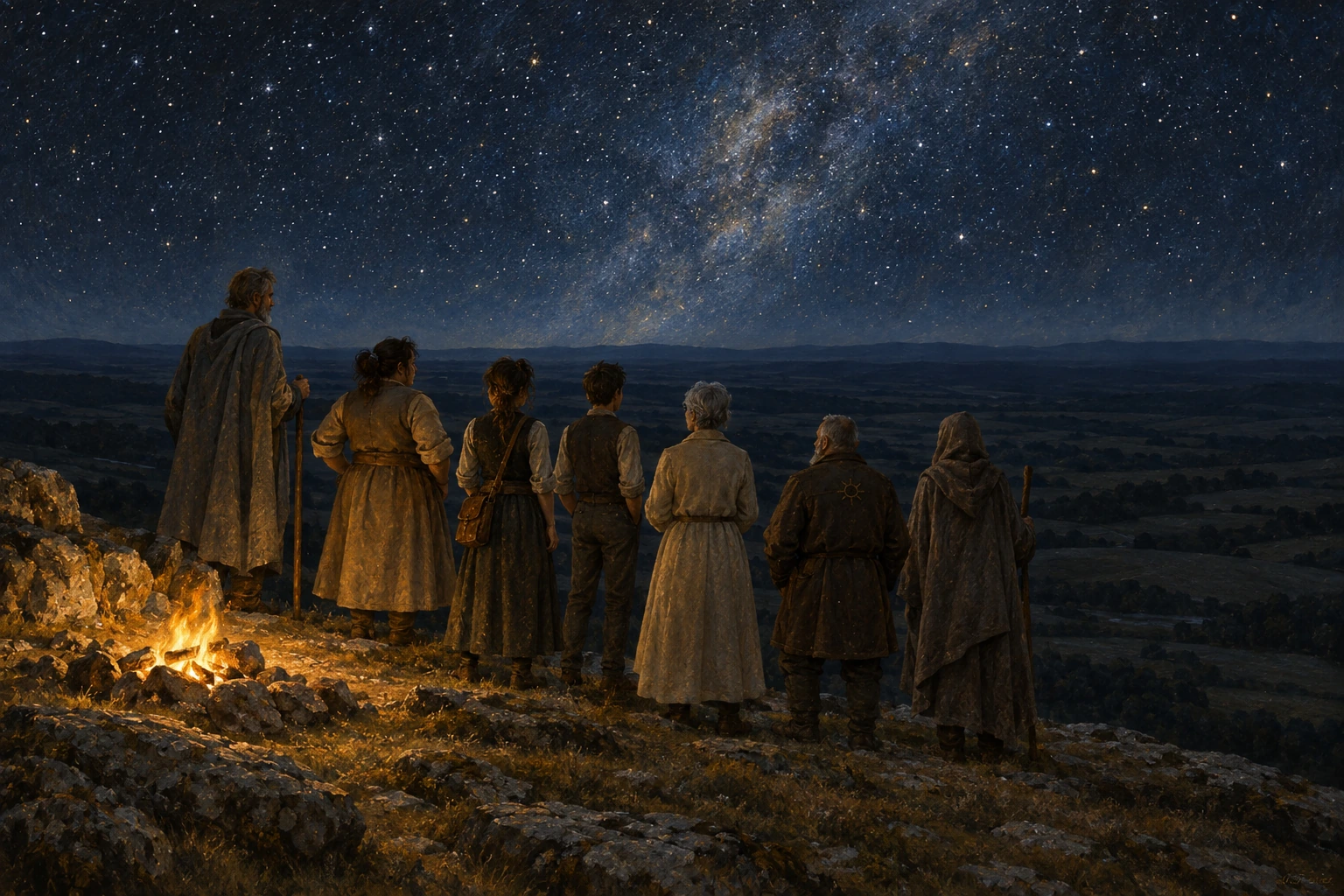
They made the fourth night's camp on the last real rise before the ground began to fold itself into the upland the house stood in — high open ground, treeless, with the whole dark country they had crossed lying north of them under a sky gone properly clear for the first time in days. No wind moved. The stars stood so still and so many that Wren, looking up once before she looked north instead, lost her count of them within a breath and did not try again. Dorrit built the fire smaller than usual and further back from the rise's own edge, without anyone asking her to.
After supper, with the fire built no higher than it needed to be, the whole company came out from its light together and stood a little apart from it, on the rise's own bare crown, to do the counting Iyene had promised them, in her own dry way, since the fold's far lip. They stood in the open with their hands empty and did the whole of the counting by bearing, by memory, and by the plain fact of having walked every mile between where they stood and every hill they meant to name.
Not one of the six fires was within sight of that ground. They lay a fortnight and more of walking behind, folded away under hills that had themselves long since dropped below the rim of anything the eye could reach. Nothing was burning that anyone on that rise could see burn. Nobody said it with disappointment. Bracken said it, in fact, the way he said most true things that wanted saying and nothing more — flatly, once, and then moved past it, because a fire a company cannot see is not, on that account, a fire that has gone out.
Wren stood between Dorrit and Pip with the last of the day's warmth still in the ground under her boots and felt, for a moment, the whole shape of what they were about to do: six fires, none of them visible, all of them real, and a company willing to stand on open ground in the dark and count them anyway, on nothing sturdier than what each of them carried in their own head.
"How many is it, then?" Pip asked, and Iyene answered before the question had finished leaving him — "Five" — and then stopped, and looked out at the dark where the sixth of them stood, and changed it. "Six. Five I stood by and saw lit, under the charter's own words: the Sixth, the Fifth, the Fourth, the Third, and Sereth's own Seventh. The sixth is a good deal older than any of ours, and nobody living lit it; it only ever needed finding. Six, Pip. Not one of the six visible from this ground tonight, and six all the same."
She said it standing, both hands empty at her sides, no working sheet anywhere in reach. "Every mark I have ever put on a page," she added, into the quiet that followed, "I walked to first, with my own two feet, before I trusted my own hand to draw it. I have never, in my whole working life, put ink to a line that came to me only on somebody's telling. I am not going to start tonight, with a whole country I can't see from here." She said nothing further about herself that evening.
It was Dorrit who took the six numbers and made people of them, as she generally did with anything that wanted a plainer telling than the number alone gave. "The Seventh's the Hazels'," she said. "Edda's own hand on the taper, eleven generations behind her when she did it, and Garron standing back trying not to be seen minding it. The Sixth's nobody's yet — lit and left waiting for whoever the post finds to come and claim it, same as a door left on the latch. The Fifth's cradle stands on a footing I helped lever square myself, so I'll claim a little of that one as mine whether it wants claiming or not. The Fourth keeps a whole sleeping city company that never asked for the keeping and is none the worse for having it anyway. The Third's the one that called the lamp-folk clean up out of their own hill to come and see what all the fuss was about. And the Second" — she paused there, the smallest pause, warm rather than solemn — "the Second's got Rafe Rowan sitting under it this very minute, sharing a watch he kept alone nineteen years with the whole seven of us, which is seven more than he's had at his own fire in longer than that." She said the last of it, and did not dress it up any further.
Bracken, when his own turn in the quiet came round, did not reach for the line he had given the company once already, a whole province back, about a country of unlit hearths being a list rather than a wall. He only gave the new half of it, flat. "The list," he said, "has begun answering back." That was the whole of it.
Luel spoke last, and briefly, as she generally chose to. "I walked this road once before, a long while gone, when every one of those hills carried its own flame and the carrying of it was too ordinary a thing for anyone to remark on," she said. "I did not expect, when the fires went dark, ever to walk it again and find them lit a second time." Nobody comforted her, because there was nothing in what she had said that asked for comforting.
Wren, listening, found her own mind gone back for a moment to a hilltop far behind them all — a night she had stood at Wakelow's own true summit and watched four of these same fires strung live across open dark at once, the only time in the whole year she had seen more than one burning together with her own eyes. Tonight she had nothing but bearing and memory to hang six fires on instead, and found, a little to her own surprise, that bearing and memory carried the weight of it as well as sight ever had.
West of the Second, the count just stopped where the walking itself had stopped. Kelder's own quarter stood dark still, exactly as dark as it had stood the whole year, and nobody on that rise looked at it twice, or promised it anything, or said one word more about it than the quiet had already said on its own.
The company drifted back to the fire in ones and twos not long after. Bracken saw to the mules a last time before turning in, running a hand down each of the four in turn more from habit than need; Dorrit banked what remained of the fire down to a bed of coals; Pip was asleep almost the moment he lay down, the day's walking and the evening's standing both caught up with him at once; and Alder settled near the coals with his stick laid flat beside him rather than leaned against anything, the way he generally kept it when the night asked nothing more of him.
Wren stayed out a little longer than the rest, and then came in herself and settled near the banked coals with the satchel across her knees. She took the Waybook out first, opening it as she always did, two fingers held beside the ink and never on it. Wystan's page for the fold showed the road drawn straight through it, unbroken its whole length, in the same fine grey stroke he gave every mile he had walked and trusted, and in the margin, in his own spikier hand, one numeral only: a single day — he had walked it in a day and thought it worth no more remark than that, because in Wystan's own west it had been nothing more than road. She sat with the number a while before turning the page. It was not, she decided, a warning cut into the vellum for whoever came after him to heed. It was an ordinary day's walking, set down as exactly that — and today, three hundred years on, they had gone and made it an ordinary day's walking all over again.
The next page carried the comb-mark drawn true to scale, and beside it, in the same working hand, a name set down plain among the fords and footings, the sort of thing Wystan gave any way-house worth a traveler trusting: Wintergarth. She held it there a moment, said nothing to the fire or to anyone at it, and closed the book.
Then, because the night still had some of itself left and because she found, turning the thought over, that she did not want to wait for a better hour, she took out a fresh leaf and sat with it blank on her knee a while before she began.
She thought, sitting there, of Granna's old rule — don't write home until there is a proper place to write from — a rule she had carried the whole road west without once thinking to question it, the way a person carries any rule handed down with love enough behind it that questioning feels like ingratitude. If she waited for a road to exist before she wrote what she owed, she would have forgotten, by the time any such road turned up, the exact size of the owing. Better to set it down now, while it still weighed what it actually weighed, and let the letter wait in the satchel for the road, rather than make the road wait on the letter.
Jessa —
There is no road yet to send this by, and I am writing it anyway, since if I wait for one I will forget the exact size of what we owe you. Your roll carried us the whole width of a day our own seven names could not have crossed alone, one at a time, the whole day through, and not one of them wore thin in the using. It was your leave, freely asked and freely given, that did the carrying, as much as the names did.
— Wren
She read it back once, found nothing in it she wanted to take out or add to, sealed it, and put it away in the satchel against the day a road ran north again.
Iyene, tidying her own case of pens by the last of the fire, said, unprompted, that the roll and the Ashcroft finding would go east on the first hand that could carry them, whenever that hand turned up, and not one day before. "I've carried paper a good deal further than this for a good deal less reason," she said, and went back to her pens, and that was the whole of what she had to say about it.
The day-book came out last of all, and the entry ran longer than any she had set down since the province gate.
We counted the beacon-line whole tonight, from ground where not one fire in it could be seen — five called under the charter's own words, one found already burning and needing no calling at all, six in all, and I do not think the not-seeing took one particle of the gladness out of the counting. A fire you cannot see, I have decided, is still a fire.
This whole act's work, I find, went out in every direction there was to send it. East, on paper: Ashcroft's own charter, read aloud by leave freely asked and freely given, and a bad claim answered on its own bad arithmetic and beaten by it, never to be spoken of on this road again; Aveleth's shipping books, copied fair, carrying names shut away for generations in a dry room out into a hand that might someday want them. North, into a town's own book, in a hand not mine. Into a keeper's own two hands: told his fire had been seen, and counted, and sung about, on the other side of a mountain range he will never cross, and given, if not a relief exactly, then company enough to make a solitary watch a shared one at last. Cut once into stone, at the head of a valley I will not name here. And straight through the middle of a stretch of ground that would not otherwise have let us across it at all, on the strength of four hundred and thirty-one names that were never ours to begin with and carried us regardless.
Bracken said, a province back, that a country of unlit hearths isn't a wall — it's a list. Tonight he told me the list has begun answering back, and I don't think six words have done more work in this whole day-book.
I found the fold's own page in the Waybook tonight — a single day, walked and thought nothing of, all those years before we walked it in exactly the same day ourselves — and, beside a name I did not have until an hour ago, the house we are walking toward: Wintergarth. The roll, and Ashcroft's own finding against a false claim, ride east with Iyene now, against the day a hand exists to carry them further. And I have written a letter tonight that has nowhere to go yet, and sealed it, and put it away, because I would rather carry the size of a debt a while than wait for a road and risk forgetting it.
We came west to draw a country. What I have learned this summer, walking it, is that a country is not held up by its roads, or even by its walls, but by whether anybody still says its names out loud — and this year we have carried names in every direction there is to carry them, and every single one of them was somebody's, and every single one of them was given rather than taken.
Then she stopped writing, because there was nothing left that wanted saying, and slept sound — the first whole night in five that asked nothing more of her once her eyes were shut.
Wren told them, over the last of breakfast, in one flat sentence, that Wystan's own margin gave the house ahead a name: Wintergarth, set down beside its comb-mark in road-work, the same hand that named fords and footings the whole book through. Nobody asked to see the page, and she did not offer it.
"Garth," Bracken said, half to himself, tasting the word. "Old working word for a walled yard, is all. Built for holding traffic, not for holding anything off." He did not explain it twice.
"That is Wintergarth," Luel said, when Wren looked her way, and volunteered nothing more.
The road climbed through the last of the open upland into a country of short cropped grass and standing stone walls, longer-fenced and more deliberate than anything they had crossed since the province, field boundaries running true to a plan someone had once laid out and no later hand had ever bothered to unmake. Some while before mid-afternoon the house itself stood clear of the land's own shoulder ahead of them: long, low, and built the whole width of a great roofed yard, its walls the color of the hill's own stone, roof-spans wide enough to shelter a market's worth of goods at once, and a gateway at its near end broad enough, by the look of it from half a mile off, to take two loaded carts abreast without either one scraping the post. No chimney showed smoke. The road ran straight at the gateway and, by every sign the eye could gather from that distance, straight through it and out some further gate on the far side — the same grammar as the Province Gate they had walked under a fortnight and more behind them now, built for trade and for nothing else. Its whole height was roof-height, kept to what the spans beneath it wanted and not one course above that, and its long face ran level with the shoulder it stood across, patient as a barn. There was a good deal about it, even at half a mile, that asked to be trusted, simply by having gone on standing.
They halted a good stone's throw short of the gateway itself, still on the open road, with the afternoon light finding every plane of the worked stone and asking nothing back. It was Iyene who said, first, that she wanted the whole face of the place drawn true before anyone's boots had been through it, Pip already nodding before she had finished the sentence; and Bracken, in very nearly the same breath, said he would sooner walk the whole outside of a place like this in good daylight than commit the mule-string to it an hour before dusk with the light going. Neither had needed the other's reason to reach the same halt. Dorrit, already easing the panniers off Suet's back before anyone had formally said the word camp, made the decision a fact before it was quite finished being a proposal. "Camp here, then," Alder said, "and go in tomorrow with the whole day in front of us instead of behind us" — and that settled it, as easily as anything had been settled all week.
They made camp within a stone's throw of the gateway, on ground still bright with a full hour of daylight left to it, and did not go in. Pip already had a fresh leaf out and steady on his own knee, sketching the roofline before the light could change on him. Dorrit had her sleeves pushed back, counting sacks and murmuring sums to herself with Wintergarth standing quiet behind her and no ceremony in it at all — the last full count of a season's stores against the first walls in five days able to hold them, and no more solemn a task to her than any other evening's tally had ever been. Iyene set her folding stool where the whole gateway stood square in her eye and began, without preamble, the first clean line of a drawing that would take her most of the evening to get right. Luel sat a little apart, as she generally did at a first camp, watching the road they had climbed rather than the house ahead of it. Alder went round the whole small camp once, taking his time, and settled at last to see about the fire.
Before full dark came down, Bracken walked up to the gateway itself, alone at first and then joined by the rest of them, one and two at a time, to look without crossing. The gateway, this close, was worn in a way none of the road's long grading had prepared any of them for: two ruts sunk into the threshold stone, smooth-sided and exactly as wide as a laden cart's own wheels, deep enough that Bracken crouched and ran two fingers along the bottom of one without needing to be asked why. "Three centuries of loaded wheels made that," he said, straightening, "going both ways, steady, never stopped long enough to wear it crooked. Whatever this house is asking of anybody who comes up to it, it isn't asking to be feared. It's asking to be used, same as it always was."
They walked back down to the fire together and sat a while in the last of the light with the whole quiet length of the house behind them — a road that ran through it and out the other side, a gateway worn honest by all those years of ordinary use, and seven of them, and four mules, camped a stone's throw from its threshold with the day's light still good and nobody in any hurry to be the first to say what came next.