News from the High Pastures
Fair day dawned bright and unfussy, the light coming up gold over the shoulder of the Cloudwall. By the time Wren and Dorrit and Granna Tansy had loaded the honey-cart — the crock, the jars in their straw, the good scales wrapped in a cloth against jolting — half of Dall was already on the west road ahead of them; they went down to the bridge with baskets and barrows and, in the case of the Hollin boys, an actual pig on a rope that clearly had opinions of its own about the day's arrangements.
The fair-field lay along the river below the bridge, and by the time Fallowmere's cart came down the last of the road it was already becoming the thing it turned into once a year: a town. The sheep-pens went up first, the smith struck sparks for children under the big elm, the ribbon-seller had her stall up before most people had their kettles on, and under it all was the smell of the Widow Callow's griddle, going since before dawn.
Fallowmere's stall stood where it always stood, in the honey-row, and Granna Tansy set it out the way she had set it out every fair of Wren's life — palest clover at one end shading down through the amber of high summer to the dark heather at the other, each rank labeled in her small upright hand. She named her prices in the same flat, final voice every year, and new-married wives from other valleys, trying their luck at haggling, generally discovered within one exchange that they were wasting daylight.
"Heather's dear this year," she told each of them, without apology, "because the bees worked hard for it and so did we," and that, mostly, was the end of the conversation. The heather sold first and best, as it always did.
At the next trestle, Dorrit was doing a livelier trade than either of them, dispensing bundles of dried herb and roots and her own cough-syrup with equal confidence and roughly equal accuracy. By midday the fair had settled into its true business, which was not buying and selling at all, but being together in the sun: the sheep-judging, the miller's knee consulted on the weather, the cider, the tug-of-rope across the shallowest part of the river; and, for a quarter of an hour in the middle of the afternoon, one of Widow Callow's own geese loose through the ribbon-stall and the beer tent, pursued by two children and a dog with no business off its rope, until Dorrit simply sat on it.
It was, in every particular, a day exactly like every fair day Wren could remember.
The high-pasture shepherds came down late, as they always did. By the time Cob Hedley came over the bridge with his dog at his heel, the afternoon light had gone long and gold, and the beer tent had its full complement of the valley's men — putting the world to rights in the way of men who have finished their work and know the barley will keep till morning.
Hobb drew Cob a tankard without being asked, and Cob drank about a third of it before he said anything at all, and then he said, in the same voice he might have used to remark on a gate needing mending:
"Lost three ewes up past the Hollin fold, week back. Went looking."
"Find them?" said somebody.
"Found two." Cob's dog had got itself into a fret over something under the bench, and he reached down without breaking off to work a burr loose from its ear, so that the story came out in pieces, between one hand's business and the next. "Went further after the third than I've gone in thirty year. Up past the last cairn, near enough to where the old road starts — the Stair, you'd call it, though there's precious little stair left to see." He drank again, and let the dog settle at his feet. "There's green up there. Grass. Proper grass, growing where I've only ever seen old snow, even in a hot August. And water running where it's always stood ice — my grandfather's brother lost a horse on that ice once, long before my time, it was always ice." He turned the tankard another slow half-circle, working up to the part he plainly liked least telling. "And here's the queer part, if you want it queer. The green doesn't grow wherever it fancies. It stops dead at the old road-bed — stops at the line of it, mind, not at any change in the ground, for there's none to see — same width the road always was, straight on through the heather, like the grass knows better than I do where the stones used to lie, and I've walked that hill since before I could carry a crook." Cob said all this without any special weight, and looked faintly embarrassed at finding himself the center of eleven pairs of eyes. "Might be nothing. Might be an odd warm spring. I only tell it because it's queer, and a fair's the place for queer things, same as a goose in a beer tent."
That got half a laugh, and no more than half. Perrin Aldwyn, who had spent the morning arguing sheep prices and had none of the patience a full stomach generally supplies, said flatly that Cob had been misreading his own hills for thirty years and this was no different — and said it with rather more edge than a beer-tent ribbing usually carried. Cob told him, just as flatly, to go count the cairns himself if he doubted it, and for a moment the two men looked at each other with more heat in it than either would have owned to sober, before old Naith Ambry, oldest man in Dall by a clear ten years, leaned in between them and gave the story its proper shape, which age alone gave him the right to do, closing an argument neither side had won.
"My grandfather said the very thing," said Naith, in the creaking, satisfied voice of a man about to enjoy himself. "Said he'd seen green above the last cairn, said the pass was thawing, said we'd see travelers out of the west inside the year. I was no more than a boy, but I mind the whole valley talked of nothing else the whole of one winter." He paused for full effect. "Never a soul came down that pass. Not one. My grandfather was wrong as a two-headed sheep, and lived another thirty year without anybody letting him forget it."
This was received with the particular warm satisfaction the valley reserved for a story that confirmed the world was exactly as sensible as everyone had always hoped. And by the time the light went properly long and red over the water-meadows, Cob Hedley's green grass had taken its place alongside the two-headed lamb of the flood year in the valley's comfortable store of good stories — a wonder to be enjoyed, turned over, disputed pleasantly, and set down again.
The shepherds had a poorer story, and it went round the tent quieter. There was more grass on the tops every spring than the spring before, and it was good grass, and the sheep would not put their heads down in it; and somewhere in the last few winters the valley had settled that the last cairn was as far as a man took a flock — which everybody now did, and none of them could have said what year it was decided in.
Going back over the day in the particular way she had of turning things in her mind, Wren found the shape of what she had actually seen.
She had noticed, at the time, only this: that her grandmother had not been in the beer tent when Cob told his story, though half of Dall's older women had drifted there for the pleasure of the telling; and that some short while later, when the wager was being proposed, Granna Tansy was there after all — at the edge of the tent's shade, her basket on her arm, listening with no particular expression at all, the way she listened to weather.
She waited until the story had run its course, and then she went to Cob Hedley — not urgently, a small upright woman crossing a green in the gold light, and asked him one question, quietly, that Wren caught only because she happened to be standing near enough with an armful of empty jars.
"How far above the last cairn, Cob?"
Cob considered it properly, as he considered everything. "Not far. A stone's throw, maybe two. Just where the ground steepens for the Stair proper."
"Thank you," said Granna Tansy, and that was all, and a moment later she had turned away toward the ribbon-stall as though the whole exchange had been about the price of blue thread.
They walked home in the last of the light, Fallowmere's cart considerably lighter than it had gone down, Dorrit talking almost without a break the whole road home in the low contented voice of a woman with a good day's trade behind her.
"Cob's green grass, now, there's a story that'll do the valley all winter. My beans still remember that cold week, mind, same as I told you — I don't say it's anything. I only say it's queer." She said it lightly, and let it go as easily as she'd picked it up.
Granna Tansy walked ahead of them both, upright as ever under the darkening sky, and said very little the whole way home. At the end of a long day she had never been a great talker.
She woke past midnight for water, as she sometimes did, and came down the dark stair in her bare feet, and saw light under the front-room door.
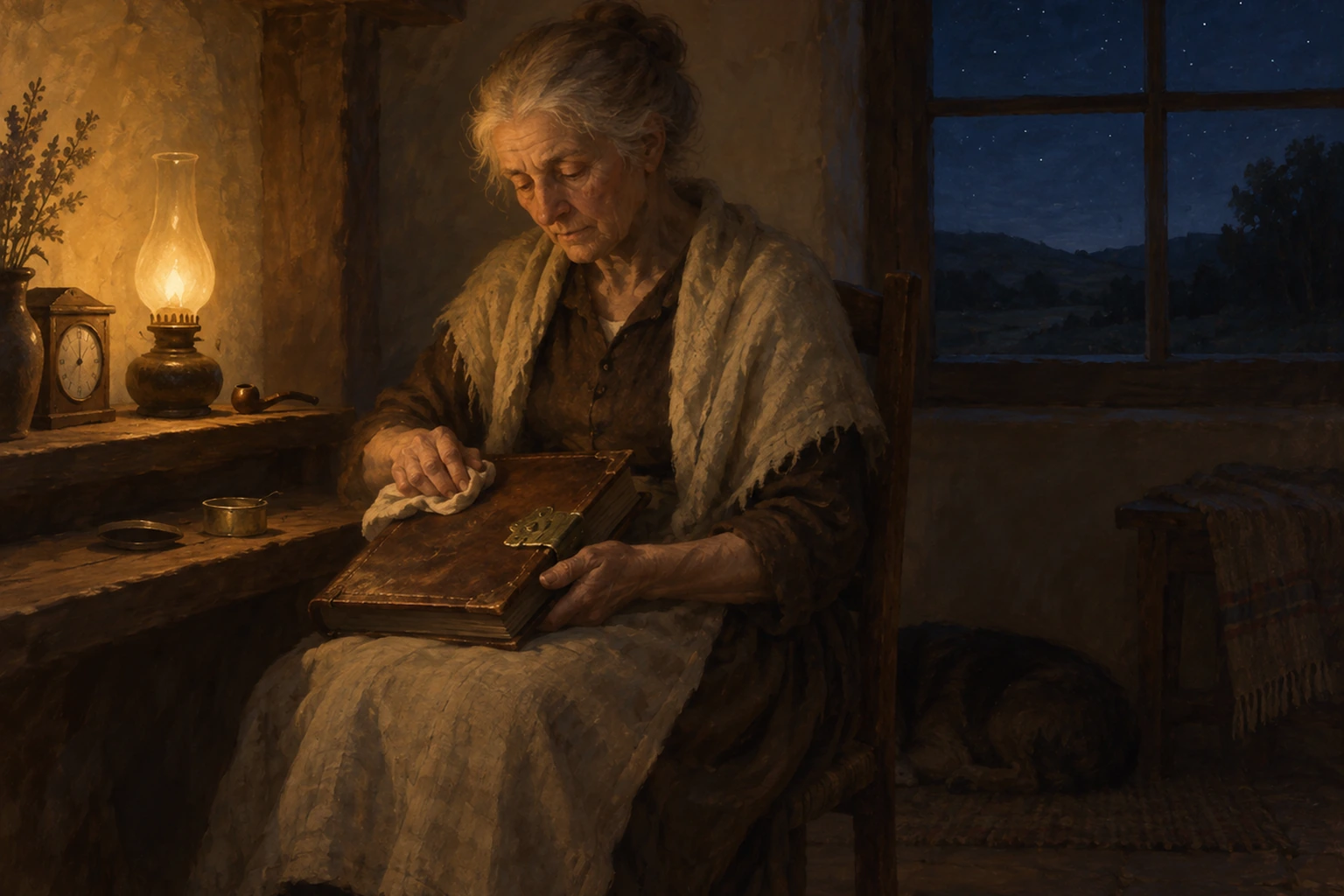
Granna Tansy was at the table, the lamp turned up bright beside her, and the Waybook lay open before her on a folded cloth, its brass clasp unfastened, the tin of boot-dressing and a soft rag set out at her elbow. It was exactly as Wren herself would have set them out, come the proper time in autumn when the leaves turned and the book was due its yearly care. Only it was not autumn. It was the middle of high summer, weeks before the dressing-days Wren had already privately marked in her mind for after the fair; and here was her grandmother working the wax-and-tallow into the old leather with small firm circles of her thumb, patient — as though there were nothing at all remarkable in doing, in August, a job that had been done in October every year of Wren's life.
The smell came to her from the doorway before anything else did — old ink and old leather and now the warm animal smell of the dressing; and under all of it, so faint she could not be sure she had not put it there herself out of long habit, that other smell she had decided as a child was the smell of mountains, cold and clean and a long way off.
The book was open to a page Wren had never seen turned to before — near the back, where the fine grey-inked roads gave out into blank vellum; and there, in the narrow margin, ran a few lines of the spikier hand: the old writing that no one now living could read, that had always simply been there, the way a scar is there, without needing an explanation to be lived with.
Granna Tansy did not look up, though she must have heard the stair. "There's water in the jug on the sill, if that's what's brought you down," she said, in her ordinary voice, going on with her thumb along the spine of the book. "Fetch it and go back up. Long day tomorrow, same as today."
"You're early with the dressing," Wren said. It was the nearest thing to a question she allowed herself.
"A thing kept ought to be kept ready," said Granna Tansy, still not looking up, her hands moving steady and sure in the lamplight the way they had moved over sixty harvests of comb and sixty autumns of this same leather. "Better done before you're asked for it than after. Fetch your water, child."
Wren fetched her water. At the door she looked back once, and her grandmother had already bent again to the page, one gnarled, competent hand smoothing the old vellum flat — entirely herself, a small upright woman in a pool of lamplight with the whole quiet house settled around her. And Wren went up the dark stair with her cup, and had nearly reached her own door when she heard, faint below her, the small dry sound of one more page being turned.
She stood there a moment with the cup cooling in her hand and tried, for no reason she could have named, to call up the old tune, the one with no proper name, that she had known since she was seven years old — meaning only to hum herself back down toward her own room with it, the way she always did on a stair in the dark. For a moment she could not find it. Not the words, for the tune had none; only the shape of it, gone from her the way a face slips from you just as you reach out to greet it. She stood quite still, more startled by the empty space where the tune should have been than she would have been by any ordinary noise in the house. Then, all at once and for no better reason than the first, it was simply there again, whole and familiar.
She stood a moment longer on the stair in the dark, listening, though there was nothing more to hear after that — only the house settling, and, faint below, one more page, and then another.