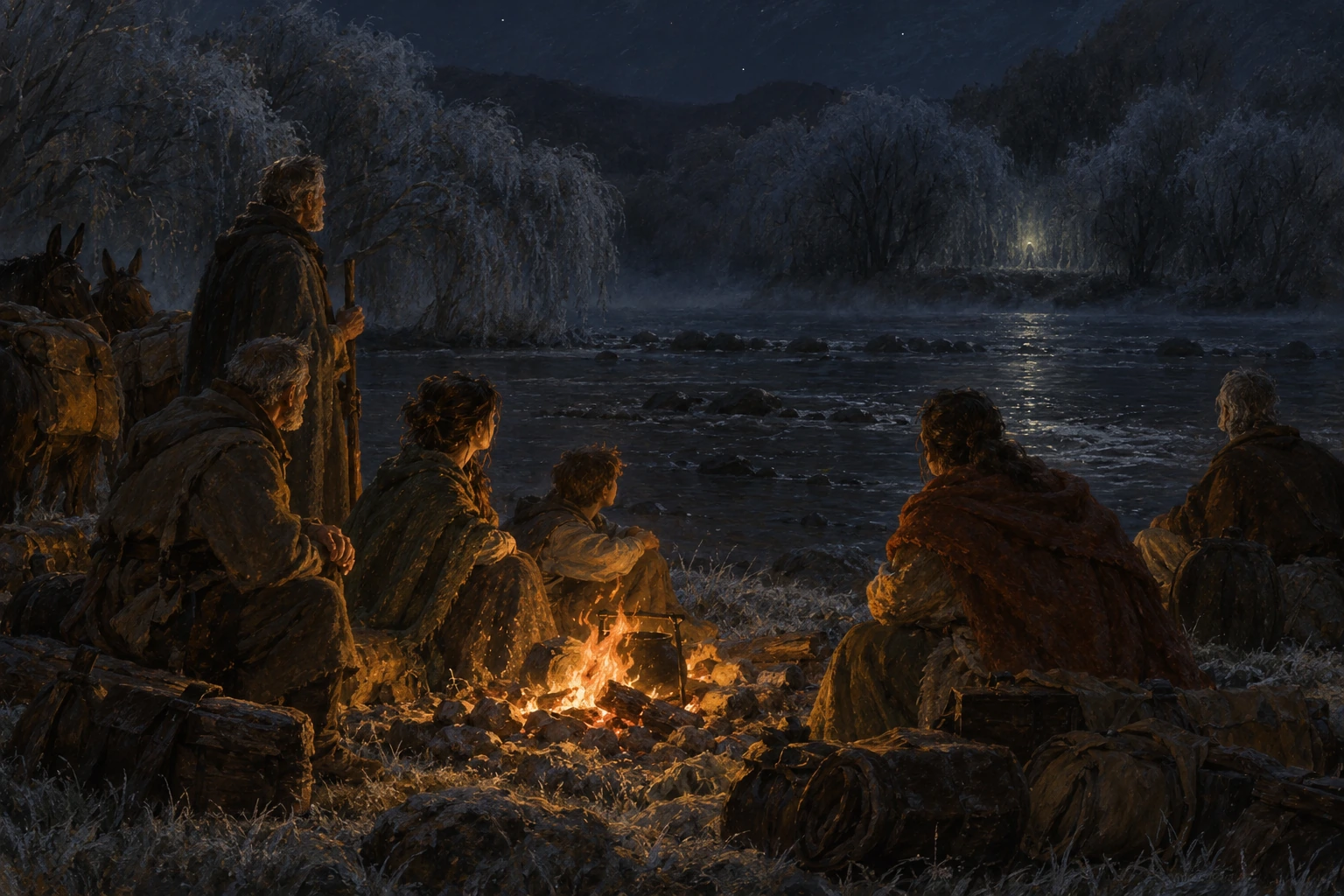
The Singing Ford
It happened, as most things did now on the King's Road West, not as an event but as a rumor that took several days to prove itself true. Somewhere in the days after the Drowned Bridge the land lost interest in being hill country and started, instead, stepping down toward water: the wooded hills flattened and spread. The soil under the grass went from brown to a pale washed grey that Dorrit pronounced, kneeling to crumble a handful between finger and thumb, "old riverwork, this — ground that's been under water more years of its life than it's been dry, whatever it looks like doing now." Streams began to cross the road that had no business crossing a road at all, thin braided things splitting and rejoining among gravel bars and willow. The company found itself fording running water two and three times in a single morning — boots off, boots on, boots off again — until Pip declared his feet had given up expecting to stay one temperature for an hour together and had made their peace with it.
"Mine gave up somewhere around Merrow," Wren told him, "and I've found peace is a bit much to ask. I've settled for a truce."
The rhythm of the days held, which was its own kind of comfort. The fair copy, this far north, had begun to thin along with the road itself — names grew sparser, distances more roughly given, whole stretches marked with nothing but a dotted uncertain line and, once, the single honest word unsurveyed — and Iyene took a visible pleasure in it, the pleasure of a woman approaching the edge of what anyone had troubled to write down.
It was on the second of those crossing-mornings, with the sky low and a rain that had fallen somewhere up in the hills the night before still working its way down to them, that the routine nearly cost them something.
Bracken sounded the braid quick and unceremonious, as he had a dozen before it that same morning — two days of easy fords having worn caution down to habit — and pronounced it fine, no deeper than the rest, and started Suet across. Pip went in on foot behind Nettle, one hand on her lead, the other keeping his satchel of pencils above the waterline. Halfway over, the ground under him simply wasn't there. A channel had scoured itself out in the night's rain, hidden under a skin of water that looked exactly like the shallow water on either side of it, and Pip went under with a short flat cut-off sound that had more surprise in it than fear, and then no sound at all.
The current took him fast, faster than the width of the stream had any business allowing, and rolled him once against a gravel bar before Bracken — three strides away and already moving before anyone else had made sense of what they'd heard — got a fistful of his collar and hauled. They came up together in the shallows on the far side in a tangle of limbs and spray, Pip coughing water and Bracken's own knee opened on the same gravel that had caught the boy.
It was Pip's hand, not his lungs, that turned out to be the trouble. He'd thrown it out to catch himself against the bar as the current spun him, and two fingers had taken the whole weight of the fall. Dorrit had the glove off and the hand turned to the light before Pip had finished coughing, and her face, bent over it, did not soften anything for his sake.
"Broken," she said. "This one clean, this one less so. I can splint them and I can bind them, and neither one is going to mend itself into a hand that holds a pen steady before the leaves are off these trees — could be longer. I'll not tell you different to make the morning easier, because you'll only trust me less the day you find out I lied." She bound it as she spoke, quick and sure, and did not soften her voice to match her hands. Pip, white around the mouth, looked at his own splinted fingers as a man looks at a tool he has just watched break in his hands.
Iyene, crouching by him a while later with the pocket-book she did not open, said only that a hand healed in its own time, that a survey kept its own schedule regardless of anyone's fingers, and that he would learn, this season, what it was to be useful with his eyes and his voice and no pen at all — which was not nothing, and was not the same as fine. Bracken, binding his own knee with the same brisk economy, said, "We'll lose no time for it. We'll only carry it differently," and did not apologize for the ford. He sounded the next four crossings twice each, bank to bank, and took the extra hour out of the midday halt rather than the day's miles.
The country emptied without turning grim, which Wren had not expected and was glad of. They passed a last shepherd's steading on the fourth day out from the bridge — a low turf-roofed house, a woman in the doorway who lifted a hand to them and did not come out, sheep scattered like grey stones on the far slopes behind her — and after that, nobody. The sheep did not vanish with the shepherds. They simply went on being sheep, wilder-looking with every mile, watching the company pass from high ground with the unblinking calm of creatures that had stopped expecting to be minded. Curlews called from the wet ground morning and evening, a long bubbling cry that Dorrit said put her in mind of somebody trying to whistle and laugh at the same moment, and failing pleasantly at both. And the waymarks held faithful mile on patient mile, squared College stone standing up out of grass gone shaggy and untrimmed, as though the road had forgotten itself everywhere except in the one particular that mattered.
On a clear morning near the end of that week — the mornings had begun to run together by then, each one good and none of them quite distinct — she looked north over her shoulder while lacing her boots. Low along the rim of the world she saw a grey serrated line she had at first taken for cloud.
It was not cloud. It held its shape while the actual clouds moved past it, indifferent, fixed against things that only pass.
"Mountains," Alder said, coming up beside her with his stick, following her look without needing to be told what she was looking at. "You'll lose them again inside the hour, most days — haze, or the hills between, or simply not caring to be looked at before they're ready. But they're there now, and they'll be there tomorrow, a little nearer, whether or not you can see them for it." He said it the way he said most true things, without any weight laid on it beyond the fact of its being true. Wren, lacing the second boot, thought of the Cloudwall standing over Dall exactly so, morning after morning of her whole life, the fixed edge of everything. She found she was not afraid of this one, only glad, in the simple unstartled way she was glad of weather that kept a promise.
They came down to the Singing Ford on the ninth afternoon out from the bridge, with the light going long and gold and the river spread out ahead of them wider than any water they had crossed since the Fenwater. But it was shallow — so shallow, and so evenly, gently shallow, that Bracken stopped dead at the top of the last rise and looked at it the way a man looks at a bargain too good to have been honestly come by.
It was a broad ford, cobbled — properly cobbled, not by any mason's hand but by the river itself, which had been rolling stones down out of the hills above and laying them across its own bed here, flat side up, for longer than anyone's arithmetic, until the crossing lay as even and sure underfoot as a threshing floor. The water ran clear and quick over it, singing — an ordinary river-sound, no higher than a mule's knee at its deepest reach. Willows leaned over both banks in a long unbroken line, gone the pale gold of the season, trailing their branch-tips in the current, so that the whole crossing had the look, in that light, of a room hung with curtains left open for the evening air.
"That's indecent," Bracken said, at last, with real suspicion in his voice. "A ford that wide, and that even, and not one soft patch in the whole width of it that I can see from here. In thirty years of finding fords I have never once found one that didn't want testing twice before I'd trust it once."
He tested it twice, wading it himself with his sounding-pole, working slow and methodical from bank to bank while the rest of the company waited on the near shore with the mules, and came back at last dripping to the knee and clearly, almost comically, disappointed in his own thoroughness.
"Honest," he pronounced, a verdict he had gone looking hard to overturn and failed to. "Bottom's sound the entire crossing, no drop-offs, no soft ground, current gentle enough a lamb could stand against it. I don't know what to make of a ford that behaves this well, and I don't like not knowing, but there it is." He looked at the fair copy, which Iyene had unrolled and weighted at the edge of the bank, and tapped the name written there in Hollis's own hand, small and plain beside the river's blue line. "The Singing Ford. And not one word on that page about why."
"Not one word," Iyene agreed, running her finger down the margin where a note might have stood and had not. "Which is either very poor cartography, on the part of whichever fellow surveyed it, or very good manners. I have decided, for my own part, that it is manners, because the alternative offends me professionally." She looked up at the ford, the long light on the water, the willows moving without wind. "We'll camp the near bank tonight and cross fresh in the morning. I'll not hurry a crossing this pretty just to shave an hour off tomorrow."
They made camp above the near bank in the last of the daylight, the fire built, boots drying, Bracken's stew going with a particular attentiveness that evening, as though he meant to give the mules and himself alike a good supper before whatever the ford's name turned out to mean. It was over that supper, plates scraped and the light gone from gold to ash-blue, that Bracken told what he knew.
"Border watch has a name for a year like this one shapes up to be," he said, not looking up from the fire. "A singing year. Every so often — not every year, not even every tenth, near as I ever heard it counted — the watch hears singing off the high water, up along the border streams where the snow-melt runs loudest. Nobody I ever served with claimed to have seen who did the singing, and nobody wanted to. The old hands call it luck. A singing year's a kind winter, they say, an easy thaw, a quiet pass. I never set much stock in border-watch superstition as a rule — soldiers will make an omen out of a crow landing wrong — but I heard three men swear to that one separately, over a dozen years, and not one struck me as a man who told stories for the pleasure of it."
"Every river had a name before it had this one," Alder said, quietly, when Bracken had finished, and did not go on to say what the older name had been, though Wren, watching his face across the fire, had the clear sense that he knew it. Iyene glanced at him — a small, direct look, the kind she gave a figure she suspected was being rounded off — and asked him directly whether he meant to tell them the older name.
"I don't think the river much minds which name it answers to," Alder said, mild as ever, "so long as somebody keeps calling to it kindly. It's had a great many. This is only the one it keeps now." And that, from Alder, in the tone he used for the doors he did not mean to open that evening, was answer enough. The talk turned, comfortably, to whether the mules would take the ford at a walk or want coaxing, and to Dorrit's opinion — offered with the confidence of a woman recently vindicated on the subject of grass — that willow leaning so uniformly toward a crossing had likely been leaning that way since long before any of them were thought of. "Which tells you the water's kept the same manners here longer than most things keep anything."
Wren took the last watch that night, as she generally did. The habit had held since the first night out of Merrow, and so had the four faint lines on her forearm that meant she no longer sat a watch without a brand within reach of her hand, whatever the road looked like at the time. It was some while into it — the fire burned low, the sky gone hard and bright with stars, the company all asleep in their rows with the mules dozing on the picket line — that she first noticed the water sounded different.
It was nothing she could have named at first. The ford still ran, still chattered over its stones as it had all evening. But somewhere under the ordinary noise of it, or woven through it, there was something else — a sound with a shape to it that ordinary moving water did not have, rising and falling, more than one voice moving in and around each other, neither one ever quite still, neither one ever quite alone. It came from across the water, off among the far willows, low and slow and entirely without urgency, in no tongue Wren had ever heard spoken in Dall or on any road since — and yet nothing about it asked to be understood. It only asked, if it asked anything at all, to be listened to.
She sat very still, and found, within a few slow breaths, that whatever this was, it was not trouble. The fire beside her, which had been guttering toward embers, seemed to settle rather than die. The dark beyond it went entirely companionable, and somewhere behind her closed and open eyes at once came her grandmother's kitchen of an ordinary evening, the scales, the jars, the same words said every year, meadow, meadow, lime — not summoned, only simply and suddenly present.
Time went soft around the sound. She did not know how long she sat before Dorrit stirred first — the small catch of her cousin's breath, the stillness of someone waking all at once into something they did not want to break by moving. Then Bracken, a low creak of him sitting up against a pack. Then, one by one, the rest, until the whole company was awake and sitting up in the dark with their heads turned the same way.
Pip's hand, Wren saw across the dying fire, had gone by pure instinct to the pencil behind his ear.
Alder's hand came down over it before it had gone an inch further — not a grip, barely a touch, two ink-stained fingers laid light across the boy's wrist, the same quiet courtesy with which he did most things. Pip's hand stilled, and after a moment came back down into his lap of its own accord, and the boy sat instead simply listening — the fierce attentive stillness on his face that Wren had only ever seen him wear over a difficult line of ink, turned now on something no pencil could follow.
Across the water, low among the far willows where the bank fell into shadow, there was — for a moment, and only if she did not look at it directly — a suggestion of light. Not a flame. A paleness, low and slow-moving, there and then simply not there, gone the instant Wren's eye tried in earnest to find it again.
Once, carried clear across the water on a swell of the song, she caught two syllables, no more — sounds with no weight of meaning in them that she could reach, and yet shaped, unmistakably, by intention. She did not try to hold them. She found, to her own mild surprise, that she did not want to — that wanting to hold them would have been the wrong thing to want.
It ended as it had begun, without any seam to mark the place. Simply, at some point in the deep of the night, the river was only the river again, chattering steadily over its stones, and the fire was only a fire burning low and wanting wood. The company sat around it in the returned ordinary dark with the particular loosened quiet of people who have shared something and do not yet trust themselves to speak of it in anything but a low voice.
Bracken fed the fire. Pip was the last to give ground, blinking hard against sleep rather than be the one to say the evening was over, and one by one after him the rest drifted off where they sat, rather than returning properly to their blankets.
It was Dorrit, of all of them, who broke the quiet first, and broke it gently. "I don't suppose," she said, low, to no one in particular, "that anybody's going to tell me what that was."
"The Amarin," Alder said. He said the name plainly, without ceremony, and let it sit a moment in the firelight before he went on. "The old folk of the mountain eaves. They were here before Meddan was anything but a scatter of farms along this same river, and they were Meddan's neighbors a long while after — good neighbors, by every account that ever reached me, though accounts of them are not a thing that reaches anyone often, or easily." He looked toward the dark water, not searching it, only regarding it. "They remember Meddan the way a person remembers a neighbor lately lost — not as history, but as an absence still felt at the fence-line. Three hundred years is not a long while to the Amarin. I have never been sure it is a long while to a mountain, either, and they have lived closer to mountains than the rest of us."
"You've heard them before," Iyene said. It was not quite a question.
"Twice," Alder said. "Once as a young man, on the border watch myself for a season, long before any of you knew me; and once since, on a road I won't trouble you with tonight. I was the better for it both times, and I expect to be the better for tonight as well, once I've had a day or two to feel the whole shape of it." He turned his stick slowly between his hands, an old unconscious habit Wren had learned to read as thinking made visible. "Their speech was never translated, in all the years Meddani scholars have tried, and it never will be — not because nobody's been clever enough, but because the not-translating is itself the courtesy."
"How do you know that," Pip asked, very quietly, "if nobody's ever asked them and been told?"
"I don't know it the way I know a bearing," Alder said, and there was something in his voice — not correction, only care — that made Wren think he had been waiting all evening, patiently, for exactly that question. "I know it as you come to know most things worth knowing, lad: by watching what respect looks like when it's practiced by people wiser than yourself, and doing likewise, and trusting the reasons will either become clear in time or won't need to. You wanted your pencil a moment ago. That's not a fault in you — it's the whole of your training, and a fine training it is, most days. But there are a few things in this life better held than kept. You do not chase a thing like tonight, and you do not pin it to a page to make it hold still, because the moment you've pinned it, it's stopped being the thing it was and started being your account of the thing, which is smaller, always. You let it be larger than what you can say of it. That's the whole of the craft, if it is a craft at all." He smiled, briefly, into the fire. "A hard lesson for a mapping man to teach. I've had thirty years to make my peace with the parts of the world that won't go down on a page, and I'm still not sure I've finished."
Iyene, across the fire, had her pocket-book out — Wren had not seen her take it out, but there it was, open on her knee, the pencil still in her fingers and not moving. For a long moment she looked at the blank page as if weighing something against something else on a set of scales only she could see. Then, without comment, she closed the book, and set the pencil down beside her, and folded her hands over both.
"There are two kinds of blank space on a map," she said, to the fire in general, in the dry considering voice she used for facts she had only just finished proving to her own satisfaction. "One kind is a place nobody's troubled to survey yet, and it wants filling, and filling it is the whole of my trade and I'll not apologize for wanting to. And the other kind is a place that's been looked at very carefully indeed, by people with every skill needed to fill it, and left blank on purpose, because filling it would cost more than the map is worth." She looked up, and there was nothing unhappy in her face, only a kind of settled clarity that Wren had not seen there before, not even over the Waybook. "I know which kind this is. I find I don't mind it as much as I'd have guessed, twenty years ago, that I wouldn't."
Alder looked at her a moment across the fire, and something passed between them that had no argument in it at all — no ford-depth, no wording of a way-marker, none of the weekly friction Wren had come to think of almost fondly as the shape of their long partnership. He only inclined his head, the way he had inclined it to Wren over a map by the Fenwater, and let the fire have the rest of it.
They banked the fire low not long after, and slept, most of them, better than the interruption had any right to have let them. The ford ran on all night behind them, singing its ordinary river-song alone.
Wren woke before the others, from long habit, in the grey hour when the stars had begun to thin and the willows across the water were only willows again, and sat up to find the Waybook already in her hands before she had quite decided to reach for it — the old morning habit of checking the day's road, done now half by instinct, the satchel's strap already loosened at her hip.
She found the ford in Wystan's hand within a few careful pages, the drawn river running true to the bend she remembered walking the evening before. The ford itself was marked with the same small honest care Wystan gave to every crossing he trusted enough to note — no words beside it, no margin figure this time, nothing but the plain drawn fact of the water and the road continuing on the far side. She had almost closed the book on it, satisfied, when her eye caught something set a little apart from the road, small, in the margin's white space where a keeper's eye went last rather than first.
A single mark, no bigger than her smallest fingernail: a curve, swept and simple, like a wing caught mid-fold.
She knew it at once, the way she knew her own name — the fifth mark, the one Granna Tansy had given her outright along with the other four, and told her in the same breath that its meaning was lost, had been lost before Granna's own mother learned it, and that a keeper's whole duty toward it was to pass the not-knowing on as honestly as the knowing. She had seen it drawn perhaps four times in all her hours with the book, always alone, never beside a well or a way-house or any of the ordinary furniture of a road, and never, until this morning, beside anything she could put a name to at all.
She sat with the book open on her knees a while, in the thinning dark, and let the day-book lie where it was, and let the others sleep, and let the mark be a mark — because thinking hard at it, there with the willows going pale gold across the water and the last of the night's stillness not yet quite spent, would have been exactly the kind of chasing Alder had warned Pip off only hours before. Wystan had passed here. That much the book said, in its own plain way, and said gladly. What else it might be saying, in a hand three hundred years quiet, was not hers to wring out of it by force of wanting to know.
She touched the mark once, lightly, as she had seen Granna Tansy touch things that mattered, without meaning to make a show of it, and closed the book, and wrapped it in its cloth, and put it away before the camp began to stir.
The crossing itself, when the company woke and breakfasted and struck camp in the full grey-gold of early morning, was everything the evening before had promised: wide, shallow, sound underfoot the entire cobbled width, the water running clear and cold and no higher than the knee at its deepest reach. Suet went first as always and crossed without breaking stride; Nettle needed her usual moment of persuading and gave it up as usual once persuaded; Gable dozed his way over, long since decided that most crossings, like most opinions, were not worth the trouble of having.
Barrow walked into the water at Bracken's shoulder with his ears forward and easy, and crossed the whole cobbled width without the smallest hesitation, and stood on the far bank afterward looking, if a mule could be said to look anything past hungry or not, faintly pleased with the morning.
"He's decided fords aren't planks either," Bracken said, to nobody, running a hand down the dun neck. "Twice now inside a fortnight this animal's proven cleverer than my own long habit of doubting him, and I don't entirely know what to do with the thought."
The company crossed after, boots slung and trousers rolled as always, and there was a quietness on all of them that had nothing of trouble in it — a companionable quiet, the kind that sits over a household the morning after a long-awaited guest has finally come and gone, glad and a little worn with the gladness both.
The far bank, when they came up onto it and shook the water from their boots and turned to look back at the ford they had crossed, was the same country they had left, and yet it did not feel, to Wren, entirely the same country.
They made ten good miles that day, north along a road grown thinner still, and it was not until the evening fire was lit that Wren found herself sitting a long while over the day-book with the pen not moving. She had written the ordinary lines easily enough — the ford's name confirmed against Hollis's copy, the crossing easy, Barrow's second good bridge-and-ford in a fortnight. It was the night before that gave her pause, and after a while she understood why: there was no way to set down what she'd been asked, gently, not to pin to a page.
She wrote, in the end, one line, no more:
Singing at the ford in the night. Alder says the courtesy is not to write more, so I will not.
It sat easy, which surprised her, and that was the end of it for the night — she closed the book and banked the fire a little higher against the first real chill, listening to nothing in particular, while somewhere behind her Barrow sighed the long contented sigh of a beast who had, at last, made his peace with water, and ahead of them the mountains held their grey shape against the last of the light, a very little nearer than they had been the morning before.