Not Owed a Door
Wren woke in the black hour before anything in the house had reason to be awake, with no dream behind her and no sound in the room to account for it, and lay a moment testing whether this was truly waking or only the last thin edge of sleep still pretending to be it, before deciding that it was. She had known that much inside three breaths, the way she had once known the difference between a hive gone quiet because the morning was cold and a hive gone quiet because something had got into it, and she was on her feet and reaching for her boots before she had troubled to ask herself why. Her chamber was colder around her than the banked gallery fire below should have allowed it to be at this hour of any night she could remember.
The shutter over her window had worked loose of its catch in the night and stood a hand's width open, and through the gap the yard below showed white in a way it had not shown white the evening before. The first snow of the year had come down thick and windless while the house slept, deep enough already to have rounded the woodpile and the well-coping into shapes the yard did not otherwise own, softening every edge she knew by heart into something gentler and less certain of itself, and a wind had risen since and was testing the roof-ridge now with a low, restless sound, working from one quarter round to another and back again before settling, as she stood listening at the shutter, into the north-east, and staying there with the particular stubbornness a wind gets only once true winter has decided to arrive. She latched the shutter, dressed without troubling to strike a light, and went down the gallery stair with one hand on the cold rail, not hurrying, because she had nothing yet to hurry toward, and reached the bottom of it at the same moment Marta Coyle's voice came up the through-road from the stair-head fire, pitched low, carrying, and without any alarm in it at all, which was somehow the worst thing about it.
"Bracken. Something's on the road."
Before the words had finished travelling the length of the corridor, the mules had already given the same news in their own fashion. All four stood rigid in their standings, facing north, and not one of them stamped or blew or pulled at a tether — not even Nettle, who bit at buckets and sleeves and each other with equal enthusiasm and had never in three months let a strange sound in the dark pass without an opinion about it. She stood with her ears forward and did not move, and it was that silence, more than Marta's voice, that put ice into Wren's stomach before she had even reached the fire.
By the time she got there the household was already assembling out of its various doors, dressed against the cold rather than for sleep, moving with the quiet, drilled competence of people who had rehearsed this without quite admitting to themselves that they had, boots half-laced and coats thrown on over whatever they had slept in, Thomasin lacing one as she walked rather than lose the minutes it would have taken to stop and dress properly, weather having stopped, for the moment, being the thing anybody in that corridor was thinking about. Half of them looked barely awake and were moving anyway, because a household that drills together learns to move before it has finished deciding to. Somebody had already built the stair-head fire up past its banked night-height, and somebody else had the arms down off the wall where they hung between uses — Bracken's blade, Dorrit's staff, the spare brands kept ready against exactly this kind of need — and passed them hand to hand down the gathering line without anyone having to ask twice. Bracken gave out the positions like a man repeating orders he had given somewhere that mattered a great deal more than tonight, complete and needing no second telling: Thomasin and Sim to hold the south gate, in case the north one did not; Marle into the kitchen doorway among the Ashcroft stores, unarmed, and told plainly to stay there. Marle went where he was put without argument and without a word of thanks for being spared the line, and the set of his shoulders going through that doorway said everything his mouth did not. Iyene had the house's twelve ledgers already gathered against her chest before anyone told her to save them, and when Dorrit reached to take the heaviest of the stack off her, Iyene said, "I have it," in a voice that had not properly warmed toward her since Marle's own arrival, and Dorrit let her keep it.
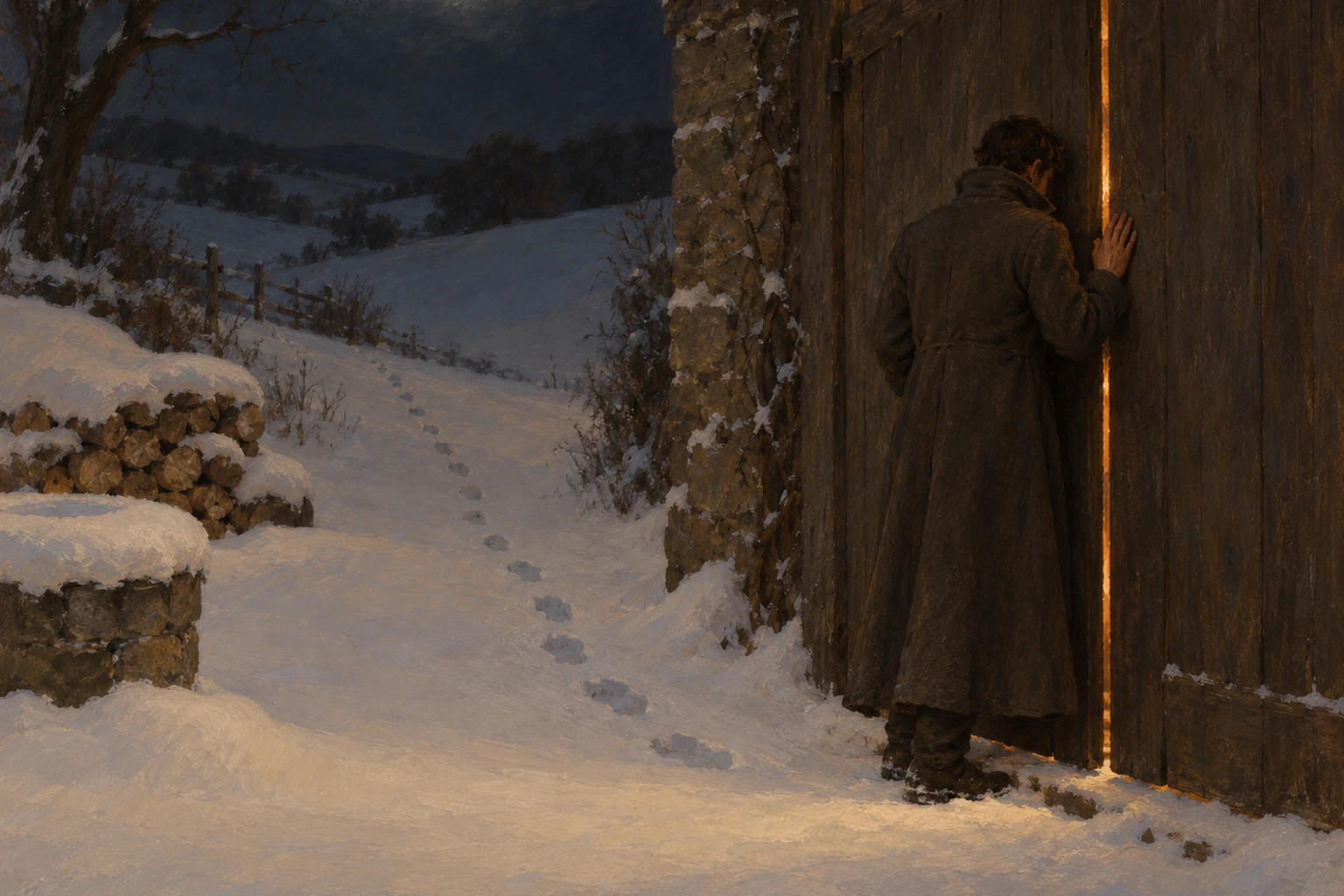
By then the rest of the company had gathered near the near gateway itself, close enough to see through the gaps where the great leaves did not quite meet their jambs, and what came up the road out of the dark, in new snow lit grey by nothing but the snow's own paleness, was a man. That was the whole of the first look at it, and very nearly the whole horror of it besides: a man, walking, in a coat cut long, of the cut a house's own watch had once worn, laced high at the throat, collar turned up against a weather that had long since stopped being able to reach him. Behind him, plain in the new fall, came a man's own tracks, evenly spaced and steady, as though he were coming home up a road he had walked a thousand times before and expected to walk a thousand times more.
It reached the gate and stopped, and finding the leaves shut against it for the first time in longer than anyone alive could set a number to, it did the one thing that emptied the through-road of every sound but breathing: it tried the gate. It put its weight against the near leaf, and when the timber held, it did not strike the wood, or throw its whole weight against it, or make any sound of frustration at all. It moved a pace along the wall instead, and tried again, lower down, and a pace further after that, working the whole width of the gateway the way a man tries a door he is certain, on some level past reasoning, is only stuck, and will open the next time, or the time after, if he is patient and thorough enough about it. It went the length of the gate twice over that way, testing every hand's width of timber in its turn, giving up nothing and hurrying at nothing, and it was that patience that told twelve people at once exactly what kind of thing had come asking at their door.
The brands in their hands burned low and grudging as it worked at the gate, the flame drawing in on itself as flame draws in against a hard frost, though no frost had any business yet being in the air on this side of the timber. Where its weight had come to rest against the sill, pale threads of it were already climbing the stone beneath its feet, quick and fine, though no flake of that night's snow was falling anywhere near enough to account for them.
Alder went forward alone to the threshold while the rest held back in a loose knot around the stair-head fire's light, near enough still to see him kneel at the sill and hear every word he said, because the through-road carried a voice from one end to the other the same way it carried cold.
"I have drawn four lines in my life that mattered," he said, not raising his voice, and did not need to. "Three of them held whatever came against them for as long as I asked. The fourth held long enough for the people inside it to walk out the far side, and no longer than that, and it taught me there is no line that holds because a man wants it to."
Someone close enough to ask it plainly, and blunt enough not to soften it, said, "Will it hold?"
"I don't know," Alder said, without looking up from the sill, and went on with the work in front of him as though the answer had cost him nothing at all to give, though everyone close enough to have heard it knew better than that.
He set his stick down out of the way and began, tracing something along the cold stone that Wren could not properly see from where she stood, low words in the old tongue going with it — and somewhere in the middle of the working his hand paused, half a beat too long, over a shape it should have known without thinking, and then went on in the common speech instead, plain and unglossed, and finished the line. Nobody but Wren, three paces off, saw the pause for what it was.
The line held. Wren felt it hold in the same place she always felt Alder's other workings hold, a kind of pressure taken up somewhere behind the sternum, and out at the gate the thing tried the threshold once, twice, a third time, and each time drew back from it as though the empty air itself had grown a shape it did not care to walk through. Thomasin let go a breath she had plainly been holding since the gate first found its shape against the weight of it, and for the length of perhaps ten slow breaths, twelve people standing in a cold roofed road allowed themselves to believe that this, too, was a thing that had come to their door and would go away again.
Then it failed. There was no sound to mark the moment, no visible give in the line at all, no instant anybody could have pointed to and named as the one where it broke — only the thing came forward a fourth time, unopposed, exactly as though the threshold had never held anything against it, and was inside the gate before anyone standing there had done more than begin to react.
Alder did not curse, or apologise, or call an order to the rest of them. He came up off his knee and stepped back from the threshold he had just watched fail, and for the whole of what followed he spoke only when a direct question was put to him, and then as briefly as the asking would allow. His stick stayed where he had set it down, forgotten at the sill, until somebody thought to bring it in out of the snow some while later and stood it just inside the door, where it waited for him the rest of the night.
Bracken went in low and fast, and the short blade caught it high on the chest and turned it half a step backward — and stopped there. It did not fall. It did not bleed. It came on again before Bracken had his balance back from the first strike, and this time it was Dorrit's staff that met it, iron-shod, swung with her whole weight behind it, and the blow rang off it like iron off a post already driven into frozen ground: hard, and useless, and over in a heartbeat.
"Luel—" Bracken said, breathing hard, and did not need to say more than her name.
She was there already, a brand burning in each hand, working its flank with fire close enough to catch the cloth of it, and the flame took along one sleeve and guttered there, unfed, as though the cloth itself had forgotten how to burn all the way through. It did not flinch from the fire. It did not slow. It came on, past both brands at once, as though neither had been lit.
Snow was coming in through the one bay that had lost its slates, sifting down thin and steady into the long pale stain the rain had left there over three hundred winters, caught sideways for a moment in the brand-light, going on falling as if nothing in the through-road beneath it had changed at all; none of them had breath or attention to spare for it.
Then Wren said the names. Her own. Dorrit's. Alderin's. Iyene's. Bracken's. Pip's. Luel's — the same seven, low and steady, the craft that had held ground under them since the Cold Coomb, that had put a whole undercroft of cold things to sleep at this house's own threshold two months past. It did nothing. It did not check. It did not care. And somewhere under the working of it, with no time at all to stop and think the thought through, it came to her plain and entire: she had the right craft, and the wrong enemy, and knowing that changed nothing about what her mouth was still saying.
It did not go for any of them next. It walked past the five of them at an ordinary man's pace, as a man walks a road he has walked ten thousand times and stopped needing to look at, and went on south down the through-road. It passed the mule-standings, where all four stood rigid and would not turn their heads to watch it go by, and the stair-head fire that Iyene and Pip had banked and stood over with the whole company's spare light, and paused for none of it. At the road's far end it turned off the spine of the corridor, into the low doorway that let onto the kitchen, and stopped there — one whole breath, silhouetted against the last live coals beyond — the way a man stops in a doorway he has stopped in every night of his working life, out of nothing but habit, before going through it or not.
There was exactly one name in that whole roofed house belonging to somebody who had known it as a house rather than a ruin, and Wren was the only person under its roof carrying it. She had read it aloud once already, weeks back, to Iyene alone in the empty clerk's room, sorting the old ledgers into their right order for the shelf they were never going back to, and had thought no more of the man behind it than she thought of any other hand in any other book.
It did not go through. It turned back into the through-road, and this time it did not walk. Bracken was already between it and the kitchen doorway — he had moved before anyone told him to, the same readiness he always showed when something came too near Pip or the mules — and it took him by the left forearm, the same arm the undercroft cold had marked in autumn, and did not let go.
He did not shout. That was the thing Wren would carry longest out of the whole night: he made almost no sound at all, beyond one grunt of effort as he tried and failed to break the grip, and then his breath going short and fast and wrong. Dorrit's voice cut the length of the through-road with a note in it nobody in the house had heard from her before, not a question, an order. "Now. Whatever you're going to do."
Real seconds passed. Not the kind that feel long and are in fact short — actual seconds, countable, one and then another and then a third, Bracken's face going the colour of the snow outside while its whole thin weight leaned steadily into the work of killing him, patient about it still.
Wren stepped in close enough to touch it, which nothing in three months of training had told her was a survivable thing to do, and said the one word she actually had.
"Denby."
Nothing changed at all. The grip on Bracken's arm did not ease by so much as a finger's width. It came to her, in the same breath, that a name alone was a door with no house behind it — she had an initial off a ledger page and nothing more, no first name, no mother, no wife's name to lay beside it, and a door with no house behind it was no door at all.
So she gave it the house.
"Denby. Second watch. This house." Her voice did not shake, which surprised her enough to notice and not enough to stop for. "Meal short a day's baking. North bay wants re-slating before the frost. Wind gone round to the north-east since dusk." The same words, in the same order, that a man had written on an ordinary night three hundred years before, because they were the last true thing he had ever had left to say, and they had gone on sitting inside him, waiting, the whole while.
The grip loosened, finger by finger, until the arm above it simply had nothing left in it that wanted to hold on to anything. Bracken went down onto one knee, dragging air. The thing that had held him let go and stood, upright and alone in the middle of the through-road, for the length of one breath more than anyone in the house would have thought it had left to spend.
Then three hundred years came due on it all at once. It did not fall so much as stop being upright, the particular way a wall stops being a wall once the one stone doing the holding has finally been drawn out from under it — nothing anyone could have stepped back from in time even had stepping back still mattered, only there, and then, in the space of one indrawn breath, not there at all. What was left on the stone afterward was dust, and a coat gone the colour of old ash, and nothing that asked to be looked at twice.
Whatever had gone out of Wren to do that did not leave the way warmth leaves a room. It went through her, in at the hand that had not touched him and out through her left shoulder, through the one cold place on her that twenty years had never warmed. Somewhere behind her a sound went through the timber of the roof itself, low and taut, like a hawser taking a weight it had never been asked to take before.
Then it was only twelve people standing in a roofed road in the middle of the night, in the light of a fire banked for warmth and nothing more, looking at a small heap of ash and old wool on the flags and at each other, the whole through-road gone as quiet, all at once, as it had been loud a minute before. Wren was aware, distantly, of Bracken getting his breath back under Dorrit's hands, of Pip's face gone very white above the stair-head lamp, of Alder standing exactly where the failed line had left him, his own face doing nothing at all. Beyond that she found she could not, for some minutes, make her legs do the simple work of holding her upright, and sat down on the cold flags of the through-road instead, because it seemed, just then, the more honest choice.
Bracken's arm was the first thing anyone tended, because it was the only hurt in the house anyone could see to tend. Dorrit had him at the kitchen hearth before the ash on the flags had finished settling, sleeve cut back to the elbow, and for a moment the skin under her hands stayed exactly the frost-white it had gone in the thing's grip, pale and dry and cold as the sill Alder had knelt at, and did not warm. She worked at it as she had worked at his shoulder two months before, patient, saying little, and it did not warm, and after a long while she stopped trying to make it and bound it instead, without saying what that meant. "Another few seconds," she said once, to no one in particular, not looking up from the binding, "and that would have been the whole of it." She did not soften the words.
Marle asked his question at that same hearth, an hour or so on, once Bracken had been got a cup of something hot and made to sit still. He had followed the fighting only by sound, kept exactly where he had been put, unarmed, behind two shut doors, the whole length of the house between himself and it, and he came through now still colourless about the mouth, moving like a man not yet convinced the floor under him would hold, and stood a moment working out how to say a thing he had said once before, in almost the same words, at another fire on another night.
"I'd like to ask you," he said, to Alder, "what that was."
Iyene did not look up from the sheet she had already begun writing on. Dorrit went on with Bracken's arm. It was Alder, after a silence that ran on rather longer than a silence at a fireside usually gets to run, who gave him the only true thing anyone in the house had to offer.
"I don't know."
Marle looked at him a moment, did not ask again, and went to see about the stores he had been minding all along, his shoulders no less unhappy for having asked and been refused, a man who had spent a whole career being owed answers and had learned tonight, in a strange house that was not even his, exactly how little that counted for.
Iyene had her working sheet out before anyone thought to ask her to put it away, and by the fire's light wrote three short lines in her own small hand: a word of her own trade, gone; the hour, guessed at within a quarter; a note that an instrument which had once read wrong ought to have its wrong reading set down, the same discipline she would have brought to a compass that had swung false on a still day. She went on writing, page after page of the working sheet filling with the same small careful hand it always kept, whatever the night had or had not just done to the rest of the house.
Marta found the gap in herself before dawn — the name of the woman she had shared a wall with at home for eleven years, close enough to hear her cough through the plaster on any given evening, gone clean out of the space where it belonged, so that through the whole remaking of the stair-head fire she thought of her only as next door, and felt the wrongness of that the entire while without being able to mend it. It came back to her over breakfast, whole, as it always came back. "Happened to me twice in the fold," she said, to whoever was near enough to hear, matter-of-fact rather than frightened now that it was behind her. Osric, across the table, only nodded, and said what most of the table already half believed: the thing had brought bad ground in with it, cold carried indoors on a coat, and it would wear off the house the same way it wore off a person, given time and warmth and nothing more done about it than that. It was no foolish thing to believe, and inside a day or two it had settled into the kind of fact a house keeps without discussion, the same as a step that always creaks on the third stair.
Osric himself lost the name of a road out of his own town for most of that same night, a road he had walked more times than he could count, one that ran past his own father's forge and out to the good grazing beyond it, and pointed at where he meant it rather than naming it, twice, in front of people who had no way of knowing what the small gesture cost him, before it came back to him unbidden somewhere in the small hours. He mentioned it once, in passing, over a bowl he did not stop eating from, and let it go at that, as easily as a man shakes a stone out of his boot once he is finally sitting down.
Dorrit's own gap came slower and stayed longer. Twice the next day, reaching for the common name of a plant she had known since she was four years old, one she could have drawn blindfold, root and leaf and every use it had and every ailment it was good against, she found nothing at all where the word should have been, and swore about it both times with a heat that had nothing to do with the plant and everything to do with being made, twice in one day and in front of witnesses, a stranger inside her own head. It was back by the second morning, whole and unremarkable and exactly where it had always lived, and she never connected its going to anything but the ground the thing had walked in on, the same as everyone else at that table.
Bracken's own loss nobody but Wren ever noticed, and she did not know, watching it happen, what she was watching. Over the stair-head fire two nights on, mending a strap by the light of it with his bound arm propped across one knee, he began telling Sim some old story of the border watch — a man he'd served beside, name at the tip of his tongue and then not there at all, gone as clean as a snuffed wick. He stopped mid-sentence, said, "No matter," and picked the story back up around a different man altogether, folding the missing one into whatever shape the tale would still hold without him; only Wren, listening from across the fire, thought anything of a soldier losing his thread over an old tale told too many times before.
Luel offered no account of what the night had cost her, and nothing either to suggest it had cost her nothing. Asked outright, two mornings later, whether she had taken any hurt standing so close to it, she only said, "I am carrying," and went on with what was in her hands, offering no lore to go with the refusal and no grief to go with the lore she wasn't giving. Whoever had asked let it stand, as most things in that house were being let stand now.
Pip lost his mother's face somewhere around the second hour after midnight and did not tell anyone until Dorrit found him sitting on the cold stone of the stair-head, not crying, only still, and asked him outright what was wrong.
"I can't see her," he said. "I know what she sounds like. I can't see her."
Three words more than that he did not manage, and Dorrit sat down beside him on the stair and did not fill the silence with comfort he had not asked for, and the two of them sat a good while like that, watching the fire at the stair-head do the only talking either of them wanted done. By first light, when he tried again without being asked to, her face was back, ordinary and whole, and he did not raise it a second time. He had done, in the meantime, the one thing he knew how to do with a night he did not understand: stood where he had been told to stand, at the stair-head with the lamp, and written it down — badly, by the light he had, on his own leaf, what had come and when and what the household had thrown at it and in what order, and at the bottom, in a hand gone smaller than the rest of the page, the hour his mother's face had left him and the hour it came back. Nobody read it that night.
The snow went on falling through what remained of that night and into the morning after, indifferent to everything that had happened under the roof it was falling on, until the whole yard lay a foot deep and the road either side of the house had gone the pale, featureless white of ground untouched since the fall began. From the second evening on, the north gate began to be barred at dusk rather than left standing on its own hinges, the same as the south gate had always been, and it stayed barred every evening after, the watch grown from one to two without anyone's stated order, only by Bracken quietly setting two names to it on the board where the rota was kept. Sim cut a fresh bar for it out of seasoned timber from the yard's own store inside the week, heavier than the one it replaced, and hung the old one on the wall above the rota board where it could be seen.
Wren paid for the giving in a coin nobody else in the house could see, and so nobody else could argue with, whatever they might have made of it had it come with a visible mark to point to, as Bracken's arm now did. She could not hold a pen the next morning — her hand shook too badly to trust a line to it — and gave up inside three attempts, and put the day-book away unopened, for the first time since the road out of Merrow. She could not get warm, whatever Dorrit built the fire in her chamber up to, coaxed higher than the flue rightly wanted, past what a room that size should ever need to hold a person warm who by rights ought to have been warm already. Dorrit sat with her through most of two long afternoons, saying little, doing the small unfussed things a person does for someone who is, for now, thin and grey and not much use to anybody — a cup left within reach, a blanket resettled, a shutter checked though it did not need checking, the fire fed a stick at a time and never let down to coals — and asked nothing of her in return. Wren slept longer, and worse, than sleep usually manages to be both at once, waking twice in the nights that followed with no memory of what had woken her, and sleeping again regardless, because there was nothing else her body was fit for, and no argument she could have made that would have changed it.
A day and a half on, she was still in her own chamber when the light began to go outside her shutter, too spent yet to be anywhere the house needed her, and lay listening instead to the ordinary sounds of a household finishing its evening without her — footsteps changing over at the stair-head, a low word passed between two voices she couldn't place, Suet shifting in her standing below, the small ring of a pot going back onto its hook somewhere down toward the kitchen. Then came the sound she had been waiting for without quite deciding to wait for it.
The bar went down on the north gate with a single flat knock of wood on wood.