The Corn Country
Bett had breakfast on the table before the birds had properly decided about the day: the elms outside black against a sky gone the color of a robin's egg, and inside, a kitchen already warm and smelling of new bread and bacon fat. "Sit, sit," said Bett, who said everything twice. "You'll want it hot."
Payment was the one difficulty, and it was Dorrit who solved it, as Wren had suspected she would from the moment Torvin's ears went red the evening before at the mere mention of coin. Travelers were taken in at Elmcross without discussion, no more argued over than weather. So Dorrit offered no coin at all. She went to her pack and came back with paper twists tied in twine, marked in her small careful hand, and set them by Bett's plate. "Bean, the climbing kind, for that south wall you've going to waste. Onion, the keeping sort. And this last is a flower from my own strain — took me four years to fix the color — but you fed us at an hour most houses are still deciding whether to be awake, and I judge that fair trade."
Bett looked at the twists a moment, and folded her hands over them as though to keep them from blowing away, though there was no wind in the kitchen at all. "Well, then," she said. That, plainly, was thanks enough.
They were on the road again before the mist had properly cleared the low ground, Torvin lifting a hand from the yard gate, half a wave and half something closer to a blessing, and the three elms of Elmcross dwindling behind them into the blue of the morning.
By noon the country had changed under their feet so gradually that Wren could not have named the mile it happened in, and yet when she looked back the change was entire.
Dall was a valley that held you — steep-sided, close, the Cloudwall standing up on every hand so a person always knew, without troubling to look, more or less where east was and where west. This country held nothing. It opened. The hedges ran for what looked like whole days in a single unbroken line, dividing fields so broad that a man working the far side of one was a smudge, a rumor of a man, and wagons went by heaped with sheaves or rattling back empty for more, the dust hanging in the still air after each one before settling into the crease of a boot.
Big fields, thin hedges, Wren thought, walking — thinner by half than the thick tangled hedgerows of home, which her grandmother kept for the blossom in their season as much as the tidiness, because blossom was bees, and bees were honey. These hedges had been cut hard and low, for the shade they threw on the crop, she supposed. Along a mile and more of them she saw no skep, no hive, no white boxes set back from a farmhouse — and heard none of the low steady hum that had filled every summer morning of her life so completely she had never, until its absence, thought to call it a sound at all.
They got their grain out of this country by the wagon-load, she thought, and never missed what they hadn't got.
"You've got your farming face on," said Dorrit, coming up alongside her with her pack riding easy on her shoulders, for she had, unlike Wren, the gift of never seeming burdened by anything she carried. "I know that face. That's the face you make counting somebody else's hives."
"They haven't got any hives to count."
"No more they have." Dorrit considered the nearest field, a barley stand going pale gold and heavy-headed. "Good barley, though. Flatter land — no shade to speak of, but no shadow either, and shadow costs you a crop's worth of sun. Everything's a trade. Their onion beds want weeding, I'll say that. Passed three gone to grass at the crown you could lose a hen in."
"You've counted."
"I always count. A cobbler can't help looking at a stranger's boots, and I can't help judging a stranger's onions."
"Bear it quieter," Wren said. "You'll have the whole shire's onions reported to Granna Tansy by post before we're out of the county, and she'll want to know why ours don't measure up."
Ahead of them, steady and even, Alder walked.
It was a very particular pace, and not one Wren would have chosen for herself on a long straight road with the whole day open in front of it. It felt, at first, almost too slow to be worth the name of walking: an unbroken stride, the ash stick coming down each time in the same soft double-tap on the packed earth, neither hurrying toward the noon halt nor dawdling short of it.
She had asked him about it the second morning out of Dall — whether he never felt the itch to walk faster on a good clear road with the light behind him.
"I did, once. Young men mostly do." He had not looked round, his eyes on the road ahead. "I walked fast for two years when I was new to the College, because fast felt like industry, and industry felt like virtue, and I hadn't yet learned to tell the two apart. I arrived at the end of every day too tired to write my notes properly, which meant I had walked half of every day for nothing, since a survey not written down is a survey not made." The stick came down, tap, exact. "A pace you have to renew your resolve for every hour is not a pace at all. It's a hundred small decisions strung together, and a man tires himself out making decisions long before his legs give out. This one I could keep from now until the frosts came. It isn't a fast pace. It's a pace that doesn't have to be decided about twice."
By noon she had stopped noticing the pace at all, which was, she supposed, rather the point.
The mornings went easiest — cool, the light coming in low and gold across the standing corn — and the miles in that hour went by almost without being felt. The afternoons were duller going, the dust rising with every wagon, and it was there Wren learned to watch her own feet for the first sign of a blister starting.
"Off," Dorrit told her, that first noon. "Boots off, socks off, socks turned and hung on the hedge to dry, and don't argue — I've seen what happens to a foot that isn't minded on a five-day walk, and it isn't a sight I care to see twice." Alder did the same, his boots set neatly side by side in the shade.
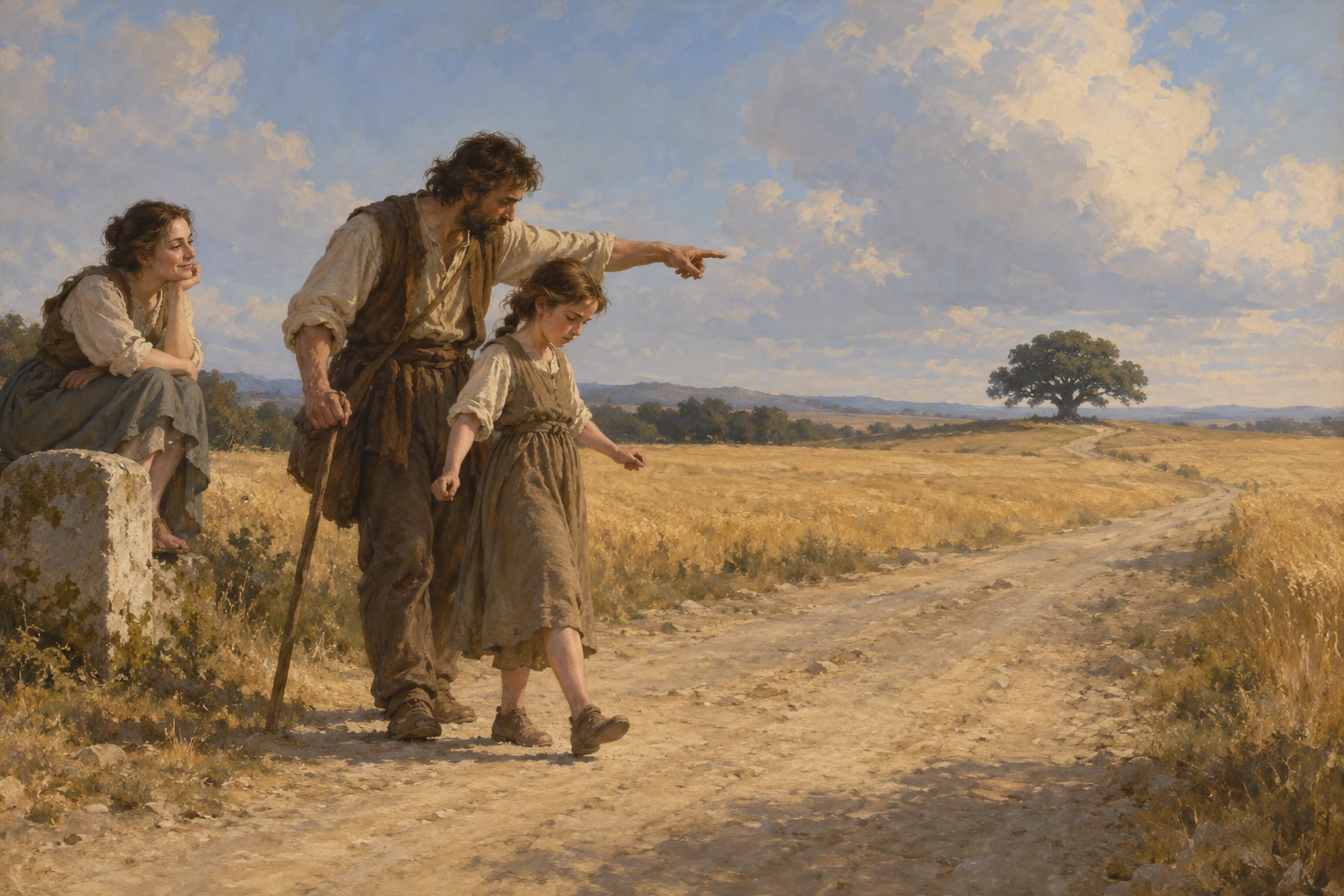
It was on the third morning out of Elmcross, on a stretch of road running dead straight between two hedgerows for what looked like the better part of a mile, that Alder began to teach her waymark-craft in earnest.
He gave no warning that a lesson was about to occur. He simply stopped, at a place where the road ran level and clear, and pointed with the ash stick at a solitary tree standing up out of the hedge-line a good way off — an oak, by the shape of it, isolated and therefore visible for a distance a tree crowded among its fellows never could be.
"Tell me," he said, "how far off you judge that tree."
Wren looked at it a while, weighing the guess before she'd trust it. "A half mile," she said at last. "Perhaps a little under."
"Good. Hold that thought a moment — not the number, the tree itself, fixed in your eye — and count your pace to it. Not your ordinary walking count. A measured pace, the same length stepped out deliberately, heel to toe as near as you can manage without slowing yourself into foolishness. Count in pairs, left foot only, and don't lose the count for talking, though you may talk if you can manage both."
She could manage both, which did not surprise her, since counting through some other business was most of what bee-work was: watching a frame, minding the smoke, keeping half an ear on Granna Tansy's commentary from the gate, and never losing count of which box she'd already opened. She held the oak in her eye and counted in pairs under her breath, and Dorrit, walking behind and sensing correctly that this was not the moment for commentary, for once held her tongue.
They reached the tree at four hundred and twelve pairs.
"And there," Alder said, "is the whole of the craft, or very nearly. You know your own pace — you can find it exactly, once, on a measured stretch of road, and carry the number with you the rest of your life, the way you carry the length of your own forearm. Four hundred and twelve pairs of your pace is a distance. Put that into the plainer units the College keeps and you have, without a chain and without an instrument, put a number on a piece of the world that had none before." He looked at her with none of the schoolmaster in it, only the plain interest of a man watching someone take up a tool he was fond of and finding they held it well. "The trick isn't in the counting. Any fool can count, and does, and lays down maps as bad as their counting deserves. The trick is in the honesty afterward."
"The honesty."
"You judged that oak a half mile off before you'd counted a step. Now you know its true distance from the counting. Compare the two. They won't match — nobody's eye and nobody's count ever match, not mine, not the finest surveyor who ever walked for the Crown — and the gap between them is the day's error. The craft isn't in getting rid of it, because it can't be got rid of by any surveyor living or dead. The craft is in knowing by how much you are wrong, and writing that down beside the number, so whoever reads your map after you knows exactly how far to trust it. A number without its error is a boast. A number with its error is a gift to the next person who has to use it."
She was good at the counting, and unsurprised by its tedium, tedium holding no particular terror for a woman who had spent whole mornings turning frames one after another, watching for the one thing among ten thousand ordinary things that wanted watching for. By the fifth morning Alder had stopped naming the marks for her to sight and checked her counts against his own only after, and found them, more often than not, sound.
It was at the noon halt of that same fifth day, in the thin shade of a hedge with her boots off and her socks drying and the road quiet in the heat, that the other thing came to her — not taught, this time, but arrived at on her own.
She had the Waybook out, briefly, a thing she did rarely and never carelessly: a cloth spread first on the dry grass to keep the dust from it, her back turned a little to the road though the road at that hour held nothing but flies and stillness, and the brass clasp giving under her thumb with its small green sigh. She turned to a page she had turned to before, a stretch of road not unlike the one they now walked, with one of Wystan's figures standing alone in the margin — a plain small numeral, 3, in his spiked economical hand, beside a stretch of way he had marked as level and unremarkable. She had known for weeks that the margin figures were days and not miles — Granna Tansy had said so once, flat, a fact not to be questioned twice — and had taken it in and set it by, closed.
Now, with four hundred and twelve pairs of her own pace fresh in her legs from three mornings of counting, she looked at that small numeral 3 and understood it, for the first time, not as a fact about a book but as a fact about a man. Not three miles, a number glanced at and forgotten within the hour. Three days. Three of somebody's mornings, cool and gold and easy, three afternoons gone dull and dusty underfoot, three evenings when he had stopped, wherever the light found him stopping, and eaten he did not know what, out of he did not know where — and taken out his pen, tired in the particular way five days of steady walking made a person tired, and written a single spiked numeral in a margin, and gone on.
She sat with that a while, the flies loud in the hedge and Dorrit's voice somewhere off arguing amiably with a farmer's wife about the proper depth for setting leeks. Then she closed the book, did up the clasp, and put it away against her hip — no heavier to look at, and considerably heavier to carry.
They spent the fifth afternoon three scythes short for a farmer named Oswin Kettering, who was glad of the help and fed them for it under the shade of a headland wagon. Oswin grumbled, over the cheese, that his corn had come in a full week early this year for no reason he or his neighbors could put a finger to, and the observation passed as weather-talk generally did, leaving no more mark on the afternoon than a cloud's shadow crossing a field.
They slept that night, for the first time since Dall, under no roof at all.
There had been no village within easy reach by dusk, and no farm offering, and Alder had settled the matter with his usual economy, turning off the road at a stand of trees where a stream ran shallow over clean stones, saying only, "This'll do us well enough," in the tone of a man remarking on the weather. Dorrit grumbled about it on principle for the better part of ten minutes — a bed under a roof was a bed under a roof, and grass, whatever anyone said in its favor, was still grass. Then, the moment she had rolled herself into her blanket by the fire, she was asleep so completely and so suddenly that Wren, glancing over, half suspected her of having practiced the trick on purpose, purely to win the argument by outlasting it.
Alder made the camp out of very little: a fire built small and well-placed, wood gathered dry and gathered enough, the ground cleared of stones under where they'd lie. It was a skill as practiced and as loved, in its way, as her own bee-craft — a whole lifetime's worth of nights made easy by knowing exactly what a fire wanted and giving it that and no more.
She lay awake a while after, when Dorrit's breathing had gone slow and even and Alder's fire had burned down toward its coals, the satchel close against her side where it always lay. She looked back over her right shoulder to the north, where the Cloudwall — which had stood over every day of her life until now, filling half the sky, the fixed and permanent shape against which all other shapes were measured — had sunk, in five days' walking, to a low blue line no higher than a hedge, hardly to be told at this hour from the ordinary dark of the horizon.
Home, she thought, was a direction now, and not a wall around her. There was neither grief in that nor alarm, only the strangeness of a thing rightly seen for the first time — the fire gone to its last red coals, the road running on south under the stars toward a country she had not yet the smallest picture of, and the whole quiet sky stood open above her, as it had stood open, she supposed, over every one of the ten keepers before her, on some night, on some road, a very long way from home.