The Strange-Grown
The gulls found them before the sea did — three of them, working a ploughed stretch well inland of anything that could rightly be called shore, and crying about it in a voice Wren had not heard since Dall's own market-day flocks. Bracken had them named before Dorrit could: only birds that had never been told the sea was still two days off.
"Coast road," he said, plainly satisfied that his feet had told him a thing his eyes had not yet confirmed. "You can smell it before you can see it, and you can hear it in the gulls before you can smell it. We're getting there."
They were three days out from Wakelow by then, the road bending southwest in long easy stages through country that had gentled the further it ran from the hill-shoulders — lower folds, thicker grass, hedgerow gone wild but hedgerow all the same. Midsummer stood a shade past its own height, the light still gold and generous into the evenings, the mornings arriving a few minutes later than they had a fortnight before — nothing remarked on aloud, only a thing Wren noted from old habit. On the second morning the road forked, a fainter track running north; Bracken named it, from the little Rafe had said at Wakelow's fire, as running toward Kelder's own quarter, and it went down in Iyene's working sheet as a thing owed and not yet done while the company kept to its own road, which bent the other way, toward the sea.
There had been no letters now for the better part of a fortnight — the post's own edge lay somewhere behind them, outwalked, and a letter would find them again only when the road slowed enough to be found.
It was the fourth morning, well past what should have been the noon halt and still short of it, that Dorrit stopped on a low rise and said, in the voice of a woman awarding herself a prize she had not expected to win before dinner, "Well, will you look at that."
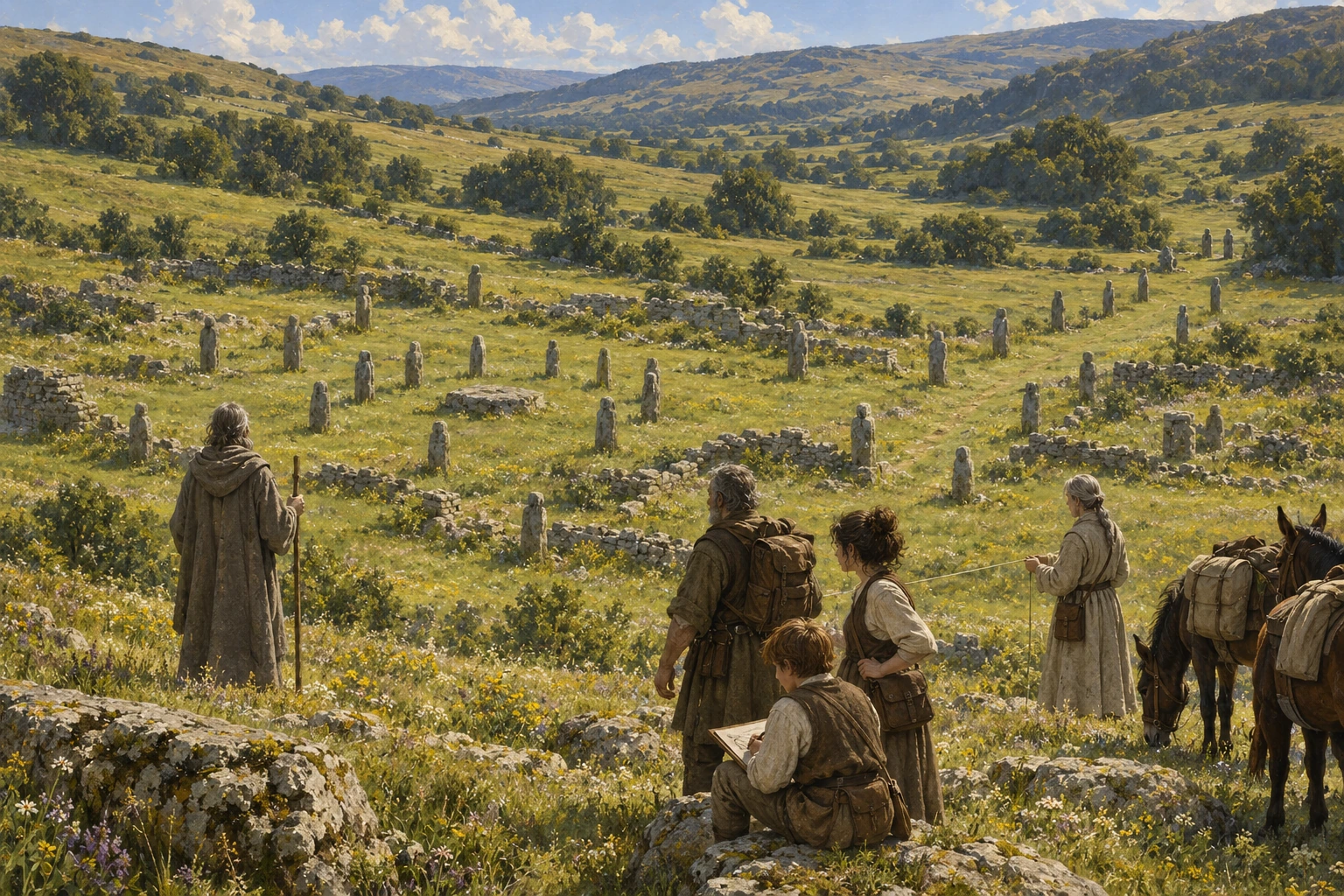
Below them the road ran along the lip of a shallow valley, no more than a long soft bowl of ground, green to its low bottom and up its far side, and everything in it looked, at that hour, like the best ground the company had crossed in a week. The grass stood thick and unbitten by frost, starred here and there with midsummer flower, grown up close around a scatter of standing shapes — grey-brown, the same worn color as the valley's own thorn and stone, lichened, entirely still, older growth banked comfortably at the base of each one — set through the ground in loose ranks that might, from the road, have been trees; and everywhere the ordinary business of a good valley on a good morning was cheerfully underway. Deer sign lay fresh in the grass not twenty paces down the slope — a scraped patch, a scattering of neat cloven prints crossing and recrossing. Birds worked the whole width of it without pause, larks going up singing over ground they trusted without a second thought. Suet and Barrow, given half a chance at the verge, put their heads down and cropped the lip's own good grass with the placid contentment of mules who had found something worth being slow about; Nettle, offered the same grass, ate it without biting anyone over the offering, which struck Bracken, later, as the strangest thing in a strange morning.
"It's somebody's orchard," Dorrit said, already halfway down the first slope before Bracken called her back to the road with a look rather than a word. "Gone properly wild, mind, no pruning in it for a long while — but look at the spacing of it, look how even the rows run, near enough. Somebody planted this, once, and meant to eat off it."
She said it with real pleasure, the particular gladness she brought to any growing thing found doing well against long odds, and for the length of that first look her reading held. It was, by every sign the company had learned to trust over a month of walking dark hills, better ground than Wakelow's own worn slopes or the Third's bare shoulder — good enough that Bracken, walking the verge with an eye already toward where a picket line might go, said aloud, mostly to himself, that they might do worse than call the day early and camp in it.
Nobody warned them off. That was the whole of what Wren could not stop turning over: nothing in the valley asked them to be careful. The same ordinary world that had put a fixed cold fog in a fold of road outside Woldsend, and set every mule on the string flattening its ears a mile off, offered this valley not one single sign. It only lay there being good ground.
It was Dorrit herself who unmade her own reading, within the half hour, crouched at the edge of the slope with her chin in her hand and her satisfaction gone thoughtful.
"That's not right," she said. "Look at the spacing again. I said it was even, and it is — but it's even the wrong way. An orchard's planted by a hand that wants shade for itself and fruit within an arm's reach of a ladder — you get rows, near enough, but you get gaps in the rows too, where one tree took and its neighbor didn't, or where a path was left for the cart. This isn't planted like that. This is planted like—" She stopped, turned her hand over as if the right word might be sitting in her palm. "This is spaced like something that wanted to be exactly this far from its neighbor and no closer, the whole width of the ground, without a single gap anywhere for a cart or a ladder or a dropped seed to have made on its own account. Nothing seeds itself even. Wind doesn't measure."
"By a stride," Wren said, before she had entirely decided to say it aloud, and felt the old lesson come up whole from somewhere years back and a country away — Alder's own voice at a hedge-verge outside Dall, in her first week on the road, showing her how a planted line declares itself by the evenness no wild thing troubles to keep. "That's how you tell a made thing from a grown one, on a verge. Deliberate spacing — by a stride, more or less, the whole length of it. Wild things crowd where the ground favors them and thin where it doesn't. Made things don't care what the ground favors. They only care what the hand that set them meant."
"Then somebody's hand set this," Dorrit said, "and I don't know an orchard-hand living that plants by the stride."
Iyene was already pacing a baseline out along the lip with her cord, sighting off it with her lens and calling her figures back over her shoulder in the flat, measured voice she used for measurements she had not yet decided how she felt about. Pip worked beside her, his own rule out, checking her paces against a second set of his own — Bracken's old teaching, never trust one measure where two can be had — and the numbers that came back, called and re-called and agreed on both ways, sat exactly as even as Dorrit had said: the same interval, near enough a long stride, running the visible length of the valley and showing no sign of tiring before the ground fell away out of sight.
"That's not a wood," Iyene said at last, straightening, the lens come down and her thumb still holding her place on the cord. "I don't say what it is instead. I only say it isn't that."
Bracken called Pip off the measuring before anyone else spoke again, and did it openly, by office and by name, as plainly as he might have called any hand to a job that wanted doing right. "Pip. You're forward with me on this one — I want your eye and your rule both at the lip, not held back at the fire with the mules today. Whatever this ground wants reading, you're the one reads it best of any of us, and I'd rather have you doing it in the open than guessing at it after, from what somebody else tells you they saw." Pip's face did the thing it always did at a compliment landed square and unadorned — a flush he no longer troubled to hide, and a straightening of the shoulders that had nothing showy in it — and he took his place at the lip with his sketch-board already under one arm. Dorrit's mouth twitched toward a smile she did not let land, and that was the whole of anyone's comment on it.
Before anyone went a step nearer, Bracken ran the drill, quick and unfussed, the way he had run it at the Drowned City's own ridge and a dozen quieter times since: names said over, one's own first, then the people who raised you, then office, no ceremony in it and none wanted. Every name came back clean and immediate, no hitch anywhere in the line — Wren's own, then Dorrit's, then round the whole company to Pip's, given last and steadiest of anyone's, ending apprentice cartographer to the Survey, and no I have not forgotten it, Bracken, I never do. Bracken's verdict was a short nod and nothing more. "Ground's not asking anything of anybody yet. We'll keep it that way and see what it does ask, if it asks at all. Nobody past the lip, mind — that's a line, and it holds till I say otherwise. Whether the bottom of that bowl is bad ground or the soundest turf in the west, I've no honest way of telling from up here, and I'll not stand on a road and pretend I have."
Pip drew for the better part of an hour, standing at the lip with his board propped on his own bent knee, taking Iyene's called figures down onto the sheet as fast as she gave them — this standing shape here, that one there, the paced distance between each and its nearest neighbors, the low stone footings running beneath the growth in broken courses, half-buried in turf, unremarked until the measuring made them look twice: a scatter of low walls, tumbled to knee height and less, tracing the shape of a very small steading or hamlet once standing on the valley floor. He drew it as he drew everything: careful and fair to what was in front of him, correcting a distance twice when Iyene called a re-measure, and said almost nothing beyond the numbers themselves.
It was when he inked the last of it — not colored, only the bare lines closed and the spacings marked as figures beside each — that the sheet stopped being a record of a valley and became, without one new fact added to it anywhere, something none of them could any longer look at and call an orchard.
Wren felt it before she understood it, the way a held note goes slightly wrong before the ear can say which note it was. On the paper, the standing shapes were not scattered the way trees scatter even when planted with care. They stood in relation to the low walls beneath them — a loose ring drawn up around one broad flattened stone near the walls' center, worn smooth in a way weather alone did not quite account for; a straight file running along what had clearly once been a lane; single ones set at the gaps where a doorway would have opened; one set apart, near a raised rim of stone that could only ever have been a well's own coping; and at the furthest of those gaps, two together, close, squared to the same quarter. Stripped of the grass and the good light and every kindness the eye grants a valley on a fine morning, it was unmistakably the plan of a gathering.
Nobody said so. That was the part Wren would remember longest — not what was said, because almost nothing was, but the length of the silence that came instead, all of them standing at the lip looking down at a valley that had not changed one particular of its appearance, and then down at a sheet of paper that had somehow found, in the same unchanged particulars, an entirely different thing to be. Her own hand had gone, without her deciding it, toward her satchel and the day-book inside it, and stopped there, unopened. She could not, in that long cold minute, have written one honest line about what she was looking at, and knew it, and did not try.
Bracken's hand had found the grip of the short blade at his belt — unremarked all year until the sixth night past the gate, drawn once against wolves and sheathed again ever since — and Wren watched him close his fingers round it, test its readiness, and then, deliberately, take his hand away again and let it hang open at his side.
"There is nothing here to draw on," he said, low, to no one and everyone. "Whatever this is, it isn't coming at us, and I'll not stand here with my hand on a blade for a thing that isn't asking to be met with one. It only looks like it wants meeting that way, because I don't yet know what it wants instead."
The cold that had sat nowhere in the valley all morning — not in the low folds, not anywhere the company's own long practice at reading such ground had taught them to expect it — was still nowhere. That, Wren understood even then, was the whole and terrible honesty of the fright: nothing about the day had turned. Only the paper had spoken, and the paper did not lie, and there was no way now to unknow what it had said.
It was Luel who moved first, and moved the fright's whole shape without a single new fact entering the valley to help her do it.
She had been standing a little apart the whole morning, as she often did when the company's own crafts were doing the day's work and none of hers were yet wanted, and now she came forward along the lip, past Alder, to stand at the very front of the company — not beside Bracken, not beside Wren, but ahead of all of them, where the ground fell away toward the valley proper, with empty ground on every side of her. Wren, watching her go, found the memory arrive whole and unbidden: a fire a whole country back, on the far side of the mountains, and Luel's own voice saying, without ceremony, When we are across the mountains, I will walk in front. She had said it once, a year and a world ago, and had not spent it since — not at Woldsend's gate, not at the Drowned City's fog — and Wren understood, watching her walk forward now with the same hands that three nights past had given a whole song away and kept for herself only the making of it, that whatever this valley was, it had been waiting, in its own way, for exactly this payment.
Pip's foot came half up before Bracken's hand found his shoulder and stopped it there. Alder's own voice came once, low, and not raised at all: "Not down. Not any of us. She goes as one who is owed the going; we would only go as strangers standing where we have no leave to stand."
Luel looked out over the valley a long moment before she spoke, and her voice carried the same settled weight it always carried when she was about to hand the company something she had carried a great deal further than any of them could see.
"You have been calling this a wood, or an orchard, or a steading gone to ruin," she said, "and none of you have been wrong, exactly, only reading backward from what those things generally are. It is none of them. It is a thing this country had a word for once, and sent east with everything else it sent east, and your own country has kept the word ever since without once being told the whole of what it was for. You say a fire 'goes strange' when it burns down wrong. Your own Edda told you, at her own hearth, that when the closing came some of my neighbors went east, while the road still allowed it, and some gathered inward to whatever hearth still held — and some did neither. She called them the Stayed, and told you honestly that she knew the word only as a thing told, not seen. You have since seen one of the Stayed with your own eyes, in a town whose gate he never left — a watch kept, and at your own hands, at last relieved. This is not that. This is what your own country's word, without its meaning, was always trying to say when it said a thing 'went strange.' They did not keep a watch. They only stayed, and went on staying, until the staying was the whole of what was left to see of them."
She let that stand a while before she went on, and when she did, her voice had not warmed, exactly, only settled, as a voice settles when it has decided to give the whole of a thing rather than a part of it.
"I will tell you what I know and no further, because you have earned a bare telling and would be poorly served by anything dressed up past it. I have never, in all my years, seen one of my own neighbors go strange with my own eyes, until this morning — those who did neither leave nor gather in are not a thing I have stood in front of before today. I can tell you they are people. I will not tell you whether they know it, or whether there is any suffering in it, or whether it ends, or how it began, because I do not know those things, and I have watched too many honest keepers ruin an honest telling by guessing where the telling ran out. I will not do that here."
Alder, beside Wren, was quiet a long moment before he spoke, and when he did it was one clause only, offered without weight, the plainest thing Wren had heard him say all year.
"My own order kept the phrase in its lore a long while," he said, to Luel more than to the company. "I always took it for a manner of speaking — the way we say a field 'goes to waste,' or a man 'goes soft.' I was wrong to take it so lightly, and being wrong that long doesn't earn me a single guess now about the being right of it. I'll say what Luel has said, and no more."
And then, because nothing about the valley had changed and everything about how it was read had, the same low walls, the same worn stone at the center of the ring, the same file along the old lane, the same single figures at the gaps where doorways had opened, the same one set beside the well's coping, and — nearest the ruin's furthest gap, where a doorway might once have opened onto whatever lane had run there — two standing close together, facing the one direction, the way two people stand who mean to go somewhere together and have simply not yet started walking, all read themselves over again, whole, in the space of one long breath, from a plan of a gathering into a village at rest. Every one of them, Wren understood now, was shaped exactly as a person is shaped who has stood a long while and does not expect, any longer, to be moved.
They stood, from the ring to the lane to the well's own rim, all of a height and all of a size with one another — the same evenness the spacing had, carried up out of the ground into the shapes themselves, and as steady a fact as anything else the valley had to give.
Nettle, at the lip behind them, chose that moment to nose thoroughly through Bracken's coat pocket for a crust she had correctly guessed was there, and was neither scolded nor rewarded, only gently pushed off, the whole company's silence unbroken by it and, somehow, made a little more bearable for it.
It was Bracken who spoke next, once the long silence at the lip had run its course, and he spoke in the plain working voice he brought to every hard reckoning, no seminar in it anywhere.
"I've stood a fair few relievings in my time," he said, "and I know the shape of the words that go with one. I had them halfway to my own mouth before I'd properly thought the matter through." He stopped there, and did not say them, and did not begin the sentence again. "A relief wants a post somebody was put to, and a count somebody can close, and a door somebody can open and hold. There's no post here. No gate, no tally-board, no log anywhere in that ruin with a name written in it and a count left open against a day of reckoning. There's nothing owed here in the shape a relief knows how to pay."
"Because nothing here was ever a duty," Alder said. "Woldsend's watcher was put to his post by his own town's own vote. This is a different thing entire, and I think Bracken has already said why, without quite meaning to say it as a doctrine."
Bracken considered that, and then gave the ground its own plain ruling, the words landing like a load finally settled and balanced. "A watch is a thing a person is put to. This was a thing people chose, and went on choosing, until the choosing grew over — the way a lane grows over, or a garden does, once the walking simply stops. There's no word that ends a thing like that, because nobody ever spoke a word that began it." He looked out over the valley a moment longer. "So — what do we do."
"We know them," Luel said, from the lip's front edge, without turning. "We go by quietly. And we leave the sign."
Iyene had her working sheet out by then, and her small memory-book beside it, and she stood a while with her lens raised, working the visible width of the valley in slow careful passes, murmuring figures to herself.
"Sixty-one," she said at last, closing the sheet on one finger to keep her place. "Sixty-one I would swear to before any bench in Merrow, counted clean from where I stand. There are more under the far slope — the ground rolls away past what my glass can honestly answer for, and I will not swear to a number I have not counted with my own eye." She looked up. "And I want it understood that this count is not closed, and I do not mean to close it. A closed count is a thing done for somebody — a family waiting on a tally, a town wanting its dead accounted. There is nobody here it could be done for. So it stands open, at sixty-one certain and more beyond what I can swear."
She reached, out of old habit, for the small brush she carried for a tally-stroke, and then did not use it. "I had thought, walking down to this lip, that I would want a mark for it — the way I made one for Woldsend's own watch, or the four open questions on the reckoning sheet. I find I don't. A mark is a thing a stranger reads without asking — that's the whole use of a mark, that it doesn't require the reader to stop and be told. And this wants asking. I'll set it down in words, in both my books, and anyone who wants to know what it means will have to ask somebody who was here, or ask nothing at all." She wrote as she spoke, her hand steady and sure. "No new stroke. Words only."
Alder gave the ground's one doctrine last, and gave it plainly, without dressing it further than it wanted. "There is nothing here that can be mended, and nothing here that wants mending by us," he said. "That does not make the coming worthless. Somebody had to walk out here and know what this was, or it would have gone on being a wood forever, in every account anyone ever gave of it."
Luel went down alone, some while after the working talk had settled into its own quiet, walking not into the valley itself but along its very head, where the low ground rose again to meet the road's own line and a scatter of plain field-stone lay half-buried in turf. The company held the road behind her, boots planted at the lip's edge without a second telling; Bracken's halt-line, taken there without a word of argument from anyone, had held from the moment he set it, and held now.
She stood a long while at the valley's head before she did anything at all — long enough that Wren, watching, lost any clear sense of how long it had actually been. Then, without announcing that she meant to, she knelt by one flat-faced stone standing a little proud of its fellows, drew a small blade from the shoulder-wallet she carried and had never, in the company's year together, been seen to open for any other purpose, and cut, in one continuous stroke, a mark into the stone's face.
There was no speech over it. She did not call the company down to see, did not explain the cutting to anyone, before or after; she simply rose when it was finished, wiped the blade once on her own sleeve, and put it away.
Wren did not need to be shown what the mark was. She had known its shape since a fireside three hundred miles east of this one and a year gone by her own reckoning — a curve like a wing caught mid-fold, the fifth of the keeper-marks, carried in her family's own hand for eleven generations as a thing whose meaning nobody living could give. She had learned its meaning herself, from Luel's own mouth, at that same fire: a neighbor listened here. Four words, given once, kept ever since.
What she had not expected, watching Luel rise from a stone she had just marked with her own hand, was what it would be to watch the word spoken rather than remembered. Every wing Wren had ever traced in the Waybook's margins — five sightings, perhaps six, across three centuries of Wystan's own careful hand — had reached her only as ink: a shape copied faithfully by a man who found it already standing in the world and never claimed to know what it meant, and passed down through nine keepers after him. She had inherited the mark the way one inherits a word in a language nobody left alive still speaks — known by its shape, unknown by its sound. And here, now, she was watching the sound made. Not copied. Not remembered. Cut, fresh, by the very hand the mark had always belonged to, in front of a thing that had, at last, after three hundred years, been worth the cutting.
She understood, standing there, that every wing in Wystan's pages marked a place exactly like this one — some other valley, some other stone, some other hour when one of Luel's own people had stood a long while in front of something that needed a neighbor and had left the same word behind them. Nine keepers had carried that faithfully, and honestly, as meaning lost, rather than invent a kinder story or a grander one. She had loved them for it once already, the night she first learned what the mark meant. She loved them again now, standing in the actual weather of it, in a way that had nothing sentimental in it and everything true.
"May I draw it?" she asked, when Luel had come back up to the road and the company had begun, without any word passing between them, to gather itself for walking on. "In the day-book. Out of habit, mostly — I don't think it wants keeping like most things in that book, but I'd rather ask than simply take the asking for granted."
"You may," Luel said. "It isn't a thing I give you leave to draw, any more than the valley is a thing I made. I only cut where it was already so. Draw it if you like — it will go on being true whether your book agrees to hold it or not."
They walked on perhaps an hour more before Bracken called the day, well past the valley's rise and out of any sight of it at all, on a stretch of clean ordinary ground that asked nothing of anyone and gave nothing back but an evening. He set the fire himself, low in a fold of ground with a shoulder of hill between it and the road behind them, and when Dorrit asked him, mildly, whether he'd chosen the spot for the shelter it gave from the evening wind, he said only that the wind had very little to do with it.
"I'd rather its light didn't reach back that way," he said, nodding once, briefly, over his shoulder at the dark behind them. The company had spent the better part of a month putting light onto every dark thing it found on this road, patiently, gladly, calling it the whole of their work — and this, for once, was the one place where the kindest thing a fire could do was simply not be seen from.
Wystan's road ran through that valley's ground drawn the same even grey as every other stretch of it — no comb-mark, no ring, no curved wing anywhere in the margin's white space, no figure of any kind set down beside it. Luel's cut stroke was the first mark that ground had ever carried, in the whole three-hundred-year memory of the Waybook.
Dorrit's whole answer to the day was to feed everyone — bread cut generous, the last good cheese unwrapped without being asked for, a pot going that she must have set to boil while the rest of them were still at the lip — without a single word about why, moving round the fire and putting a full bowl into every pair of hands before anyone had thought to ask for one. Wren had seen this from her once before, the morning after Woldsend's own gate was closed for good, and understood it now for what it plainly was: not a distraction from a hard day, but her own whole answer to one, given the only way she knew how to give it. Pip ate with his sketch-board still across his knees, the day's lines closed now and set aside, and said, once, quietly, that he was glad Bracken had called him forward rather than held him back, and did not explain it.
We found the best ground of the whole week this morning, Wren wrote, once the fire had burned down to the hour she liked best for writing, and it turned out to be the strangest thing we have found since the mountains, and I do not think either of those facts troubled to warn the other one it was coming. Dorrit read it as an orchard first, and was right to, because everything about it wanted reading gently, and gentleness is the truest thing she has ever brought to any growing ground. It took a measuring cord and Pip's own steady rule to find the wrongness in it, and it took Pip's own drawing — ink on paper, nothing more — to turn a copse into a gathering before any of our own eyes had managed to see it as one. I have never been so glad of a company that reads a thing slowly and carefully as I was standing at that lip, and never so frightened of what careful reading can, in the end, turn up.
Luel walked at the front of us today, for the first time since the night she told us she would, and Bracken only stepped his own place back a half pace to let her have the road, which I think was exactly right. She named them for us, in words the west already had and had simply never been told the meaning of — the Stayed, the same as Woldsend's own watcher, only these kept no post, no gate, no count. They chose to stay, and went on choosing, until the choosing grew over, and there was no word to end a thing that was never begun with one. We did not relieve them, or wake them, or restore them, and I do not believe there was any help left in the world to give. We only learned to see them, which took the better part of one whole day and cost every one of us something to get there, and then we went by quietly and left a mark at the head of the valley that says a neighbor listened. Luel cut it herself, with her own hand, into a stone that had waited three hundred years for exactly that — and I have carried that mark in ink the whole of my life and never, until this morning, watched it spoken rather than remembered. I do not think I will ever again read a wing in Wystan's own margins as I read one yesterday.
It is the smallest thing we have done since we crossed the mountains — smaller than a relit fire, smaller than a closed count, smaller by far than a shared watch. I am not at all certain it is not the best.
Alder sat a little apart with his stick laid across his knees exactly as it always sat, unused for anything beyond walking, and watched the flames without troubling to say what he was thinking. Luel kept her own place at the fire's edge in her own quiet fashion, neither singing nor humming. The low talk that gathers of itself around a well-fed fire went on a while longer than usual before it thinned out on its own. Somewhere behind them, an hour's walk and a shoulder of hill away, one small new mark waited on a stone at the head of a valley that had never before, in all its long staying, been visited by anyone who came only to look, and understand, and leave a sign, and ask for nothing back at all.