The Blessing of the Roads
The cobbler at the Bridge was not, by trade or temperament, a talking man, which was exactly why the valley trusted what he had to say, on the rare occasions he said anything at all.
"Double-stitched," he told Wren, turning her good boots over in his hands, "and a second sole under the first, since you're not asking me to mend these again come winter. That's road work, and a deal of it." He said this without looking up, and it would have gone no further than his own bench, cobblers being close men as a rule. But Hobb's boy was in the shop at the same moment, waiting on his own father's boots, and Hobb's boy had never in his short life kept a piece of news to himself past the length of the street.
By the time Wren had walked home with the boots under her arm, the cobbler's remark had met a second piece of evidence: Dorrit's seed-paper, ordered special, for varieties the miller's wife had never been asked to set aside — not garden seed at all, but the sort a body carried. And that had met a third, that the Hollin boys had been engaged for the lifting in the bee-yard, "whenever it wants doing, and Granna Tansy to say when." Three pieces of evidence, none of them a secret, adding up at the Bridge of an evening to exactly one conclusion, which the valley of Dall arrived at within a day and a half: that Wren and Dorrit Fallowmere were going somewhere long, and soon, and with the grey stranger lodging above the taproom.
What the valley did not do, and what Wren had half-feared it might, was take offense at the going. It took offense at not having been told.
"You might have said," was how Widow Callow put it, arriving at Fallowmere's kitchen door the very next morning with a face like a woman wronged and a basket of eggs she had clearly meant as an accusation and ended up leaving as a gift. "Three days I've known, and not from you, and me having known your mother before you were thought of. I had it from Sela at the mill, who had it from her husband, who had it, if you can credit it, from a cobbler, who is not a man given to conversation on the best of days."
"We meant to say," Wren began, "only there was nothing settled to say, not properly, until —"
"Until the boots were stitched and the seed was ordered, yes, I've worked out the order of it myself, thank you," said Widow Callow, setting the eggs down with the firmness of a woman closing an argument she has decided, on reflection, not to have. "It's no matter now. We're not about to let you go off without a proper supper in you first, the whole valley's worth, and I'll hear no arguing about it, because I've already spoken to Hobb, and by noon there won't be a soul in Dall who hasn't heard there's a supper wanted at the Bridge three nights hence — wanted by everybody, not asked of anybody, which is a different thing entirely and you know it is."
She was quite right that it was a different thing, and a supper the valley had simply decided upon could not be declined at all; it could only be attended, gratefully, and enjoyed.
Nobody in Dall would press a keepsake on a person leaving, that being soft; everybody would press a useful object on her, with a remark designed to deny that any feeling was involved. Perrin Aldwyn left a coil of good waxed cord at the gate with no note, because everybody knew Perrin's cord. Wren met each delivery and thanked it plainly, understanding every one of them for what it was: a small hard fragment of love shaped into something a person could carry without being embarrassed by it.
The barley was in by then, all of it, which mattered more than it sounded. Master Alder had told Naith Ambry in the taproom his first week that he would not go up to look at Cob Hedley's grass before the harvest was off, and Dall holds a stranger to what he says at a table.
So on the second of the three days he went up. Cob Hedley took him, and three others went along, for three different reasons.
Cob went because it was his ground and his story and he had been called a liar over it in a beer tent. Perrin Aldwyn went because he was the man who had called him one, and had spent a fortnight learning that Dall remembered it. Dorrit went because she had been told, once, that she needn't.
And Wren went because Master Alder asked her to, and he said why, plainly, at the Fallowmere gate that morning, with Granna Tansy watching him from the door and saying nothing whatever.
"You have taken a charge on a night's thinking," he said. "I would rather you had looked at the far end of it before you walk two years toward it. Not the whole of it — nobody looks at the whole of it — but the near edge, on a fine morning in August, in your own hills, with people round you who know the ground."
"Take your father's coat," was all Granna Tansy said about it, and Wren took it.
They went up through the sheep-walks in the cool of the day, Cob leading and Whistle working the slope ahead of him out of pure habit, though there was nothing on that hill to work. Dorrit named the plants as she climbed — bilberry, tormentil, the small tough thyme the bees came a mile up for — and named them more slowly the higher they went, and then stopped naming them, because above a certain line there was nothing growing she had been introduced to. Perrin Aldwyn had a coil of his own cord over one shoulder, for no stated purpose, having gone up hills with a rope on them for thirty years. Alder walked at the back and said almost nothing, and looked at the ground rather than the view.
The last cairn stood where it had always stood, a grey heap the height of a man's chest, its stones settled into place long before any of them were born. Above it the ground steepened, and the heather thinned to rust and lichen and grit, and it was there, coming over the rise with the wind full in their faces, that they saw the grass.
It was ordinary grass. That was the whole of what was wrong with it. It was thick and green and dense as a river-meadow in June, and it ran up the mountain in a straight band about four paces wide, over the shoulder and out of sight, and it stopped at its own two edges as cleanly as a mown verge, with grit and black stone on either hand and nothing in the ground to say why.
It was Perrin Aldwyn who spoke first, in the flat voice of a man paying a debt he had been dreading for a fortnight. "He wasn't lying, then."
"I never am," said Cob. "That's the trouble with me."
Wren had been looking at it a while before she found what else was wrong with it. Nothing was working it. Four paces of deep grass in full August sun, and not a bee on it, not a fly, nothing going up off it and nothing coming down onto it. She had spent her life looking at grass to see what was in it. There was nothing in this.
Alder had gone down on one knee at the edge of it. He worked his fingers into the turf and lifted a handful up, roots and soil together, and what lay under it was not mountain at all. It was stone, laid small and packed close and cambered to shed water, with a kerb of larger stones running true along the edge where the green ended.
"It's a road," Dorrit said. "It's only a road."
"It is a road," Alder said. "There has been ice standing on it since three hundred years before any of us, and this morning it has grass, and I have wanted to stand on one of these since I was younger than either of you." He set the turf back into the hole it had come from and pressed it flat with his palm. "I find I want very much to be back down the hill."
They went up along the edge of it, on the grit, because Alder asked them to, and gave no reason. The band of green ran on ahead over the shoulder of the hill, and where it went over, the ground fell away into a shallow scoop perhaps a hundred paces across, and the road ran straight through the middle of it and out the other side.
The wind stopped at the lip. Not died down — stopped, the way a sound stops when a door is shut on it, so that they were standing in a stillness with the wind still moving the heather three feet behind them. And it was cold. Wren's breath went white in front of her mouth, in August, an hour before noon, and she pulled her father's coat closed and understood what her grandmother had known at the gate.
"Say something," Dorrit said, from six feet off, and her voice came thin and small, as a voice comes across water.
Whistle stopped at the lip of it and would not come on. Cob called him twice, and then once more with the whistle he was named for, and the dog sat down in the heather with his ears flat and shook all over and did not move.
"He's never," Cob said. "Not in eleven year."
"Nobody steps on the green," Alder said.
But Cob was already on it. He had gone out along the road-bed while Alder was speaking, thirty paces or so, with his arm up and back to show them where the kerb ran under the turf, saying something about the width of it that the wind took before it reached them. And then he stopped saying it. And then he stopped.
He did not fall, or stagger, or turn. He simply stood, in the middle of the road, with his hand still half-raised where he had been pointing, and the green all round him and the sun full on his back.
They shouted. All four of them, together and then separately, and Dorrit went up the register into the voice she used across two fields, and none of it made the smallest difference. He did not turn his head.
Perrin Aldwyn went in after him — four paces, five, and he was not a slow man — and came back out at a run, and stood on the grit breathing hard with his hands on his knees.
"I forgot what I was doing," he said.
He said it in the voice of a man who had never once in his life not known what he was doing, and could not get his face back to its ordinary arrangement.
"That's Ivo Vellick," Perrin said. He had gone a bad colour. "That's what that is. I've called that a tale in a beer tent for thirty year."
"Who is Ivo Vellick," said Alder.
"Shepherd out Rushet way, when Naith Ambry was a young man. Walked into good grass on a bare hill and stood in it. Wat Loam went in after him on a rope, and they got Wat back and got him back wrong, and Vellick they never got at all." He wiped his mouth with the back of his wrist. "That's where nobody steps on the green comes from, Master Alder. It's not your rule. It's ours. There's not a shepherd between here and Rushet couldn't give you the two names, and not one of us has ever seen a green."
"It is not my rule either," Alder said. "I had it out of a book. Whoever wrote the book had it off a shepherd." He had not taken his eyes off Cob's back. "How long has he been standing there?"
Dorrit said a minute. Perrin said a quarter of an hour, and was certain of it. Wren looked at the sun where it stood over the shoulder of the hill and found she could not make it agree with either of them.
Alder gave Perrin his stick to hold, which Wren had never seen him do, and walked out onto the green.
He went slowly, and he talked the whole way, and it took her a dozen paces to hear that it was a list. Names, one after another, in no language she had — long-voweled, evenly spaced, given out in the rhythm of a man counting stock through a gate. He got to twenty paces. He got to thirty, near enough to have thrown a stone at Cob's back. And then he stopped in the middle of a word.
He stood a moment. Then he began the list again from its beginning, in the same steady voice, and this time he did not get so far.
He came back. He walked, and he came back straight enough, but the last three strides were not quite the strides of a man choosing where to put his feet, and when he reached the grit he put a hand on Perrin Aldwyn's shoulder and left it there.
"Not enough," he said. His voice had gone to gravel. "That is a roll of hills nobody has stood on in three hundred years, and it holds me and it will not reach him. He has never heard one of those names in his life. There is nothing in them that belongs to him." He got a breath. "He will answer his own. Somebody has to say his own to him, close enough to take hold of him, and I cannot both hold and say."
"I can say his," Wren said.
She had not known she was going to say it, and she was not brave when she did; the answer had simply been lying there in front of all of them. She had stood at the fair with an armful of empty jars and heard the whole of it: two ewes found and one not, up past the last cairn, thirty years on that hill.
Alder looked at her for a moment that went on rather too long.
"Then here is how it is done," he said, "and you will not improve on any part of it out there. You hold my hand and you do not let go of it for any reason, including a good one. If I stop, you stop, and we come back and think again. And you keep something of your own running the whole time — not mine, yours, something you can say without attending to it. The moment you have to attend to it is the moment we turn round."
"I've a tune for that," Wren said.
Perrin Aldwyn had the coil off his shoulder before anyone asked him. He knotted it round Alder's chest under the arms with the sure disgusted competence of a man who knows exactly what a rope is worth in the circumstances and is going to tie it anyway, and he and Dorrit braced themselves on the heather with it, and Dorrit's jaw was set hard, because a rope was no good at all against forgetting. It had got Wat Loam off his hill. It was better than nothing.
The cold came up through her boots at the fourth pace. It was not the cold of a cold day. It came up out of the ground the way damp comes up a wall, and by the tenth pace her feet were reporting the flagstones of a cellar in February, and above her ankles the August sun still lay warm across her right shoulder and not, by now, across her left. Her breath stood in front of her face and hung there instead of blowing away.
She reached for the tune.
It was the reel with no proper name, the one her grandmother had from hers, that Wren had played since she was seven years old and had used the whole of her life for exactly this — for dark stairs, and long lanes, and the last hundred yards home. She went for it the way she would have gone for a handrail.
It was not there.
Not the words, for it had never had any. Not the shape of it, nor the first three notes, nor the place her fingers went for the turn. There was a smooth place where it had lived and nothing whatever in it, and no sense of anything having been taken; there was simply no tune, and never had been, and she knew better and could not prove it. She reached again. She reached a third time, the way a tongue goes back to a gap in the teeth, and her feet had stopped moving and she did not remember stopping them.
Alder's hand closed hard enough on hers to hurt.
She took what was left. The seventh hive, and the paint gone thin at the corners. Her father's hand laid flat over her own small one on the warm wood, teaching her to listen. The tin of wax-and-tallow and the smell it left on her grandmother's fingers. She said none of it aloud. She only held it, and walked, and started saying out loud instead the things that were not hers at all.
"Cob Hedley," she said. Her voice came out flat and slow and belonging to somebody else. "Cob Hedley. Whistle's up on the heather and he won't come down and he's shaking. You lost three ewes past the Hollin fold and you found two of them. You've walked this hill thirty year, you said so in the beer tent to Perrin Aldwyn, and he's here, he came up, he's holding the rope. You come down late to the fair every year and Hobb draws you a tankard before you've asked for it."
She was near enough by then to see that his eyes were open and that he was not looking at anything.
"You told my grandmother it was a stone's throw above the last cairn," she said. "Maybe two, you said. She thanked you and went and bought blue thread."
She got hold of his sleeve, and then his raised hand. It did not close on hers. It was white to the second knuckle and it had the give of a candle.
"Cob," she said. "Where's your dog?"
"Whistle," said Cob Hedley.
He said it as a man says something in his sleep, and then he blinked twice, and then he was looking at her, and he was so plainly and completely frightened that Wren very nearly let go of him. He got one word out — "Where —" — and Alder said, close and level, "Walk," and Cob walked.
Getting out took longer than getting in. He went between them with his boots dragging the turf, and Perrin Aldwyn hauled the cord in hand over hand without being told, walking backwards up the grit, and Dorrit shouted every step of the way, chiefly Wren's name and chiefly at nothing.
They came off the green onto the grit and the wind hit them all at once, warm as bathwater, and the noise of the world came back so suddenly that Dorrit stopped shouting in the middle of a syllable.
The cost of it was counted on the way down, mostly by Dorrit, out loud, in the voice she kept for a thing that was going to be done properly whether anyone liked the doing of it or not.
Cob's boots had saved his feet, which she said twice, both times to Cob, who was not attending. His left hand had not been saved. It was the hand he had been pointing with, white to the second knuckle on three fingers and dead to the point of a pin, and by the time they were down at the last cairn it had begun to come back, which was worse, and he made no sound about it, which was worse again. Dorrit would not let anybody near him with hot water or a fire or a rough rubbing, and told Perrin Aldwyn so in terms that settled the question; she wanted it warm and slow and wrapped, and she wanted him carried, because a man who cannot catch himself with his hands has no business on a scree.
Perrin carried him the last mile on his back. Cob was a small man and Perrin was not, there was no dignity in the arrangement for either of them, and they made the mile in silence.
Halfway down, over Perrin's shoulder, Cob said: "I'd found her, you know."
Perrin went on walking.
"The third one. Standing out there in the green with her head down, eating. Plain as you." He was quiet a while. Then he said, "There's nothing in that scoop but stones. I've known that hill thirty year."
Wren sat down on the heather below the cairn while Dorrit was working, and reached for the tune again on safe ground, in the sun, with the wind blowing and the valley lying green and ordinary a thousand feet below her.
It was still not there.
She found Alder watching her do it. He was grey about the mouth and had his stick back and was leaning on it in a way she had not seen before.
"Something's gone," she said.
"Tell me what."
She told him: a reel, no name to it, nine or ten bars, her grandmother's from her grandmother's, and she had played it a thousand times, and she could not find the first note of it and could not find the shape where the first note had been.
Alder was quiet long enough that she knew he had arrived where she had: of all the tunes in that valley, the one gone was the one he had stood in the taproom and told her came east over the mountains. Neither of them could prove that meant anything. Neither of them was going to stop knowing it.
"Will it come back?" she said.
"I don't know." He looked down the slope at Dorrit's bent back and Cob's wrapped hand. "I told you at the inn that it wants outwaiting and out-remembering. I told you it was a long way off." He set his stick and started down. "It is nine miles from your grandmother's gate, Wren, and I have been letting a great many people hear the word thaw as if it were unmixed good news. The grass is real. The grass is the best thing the College has been told in three hundred years. What I saw today is that the thaw is a lid coming off, and I have no more notion than Cob Hedley what is under it."
"Will you write that to them?"
"I'll write exactly what happened, and they will set it beside four other reports and argue about it till spring, because that is what a slow institution is for and on the whole I approve of it." He went down a dozen paces. "I would rather have been wrong today. I want that said, so that you know I am not enjoying any part of this."
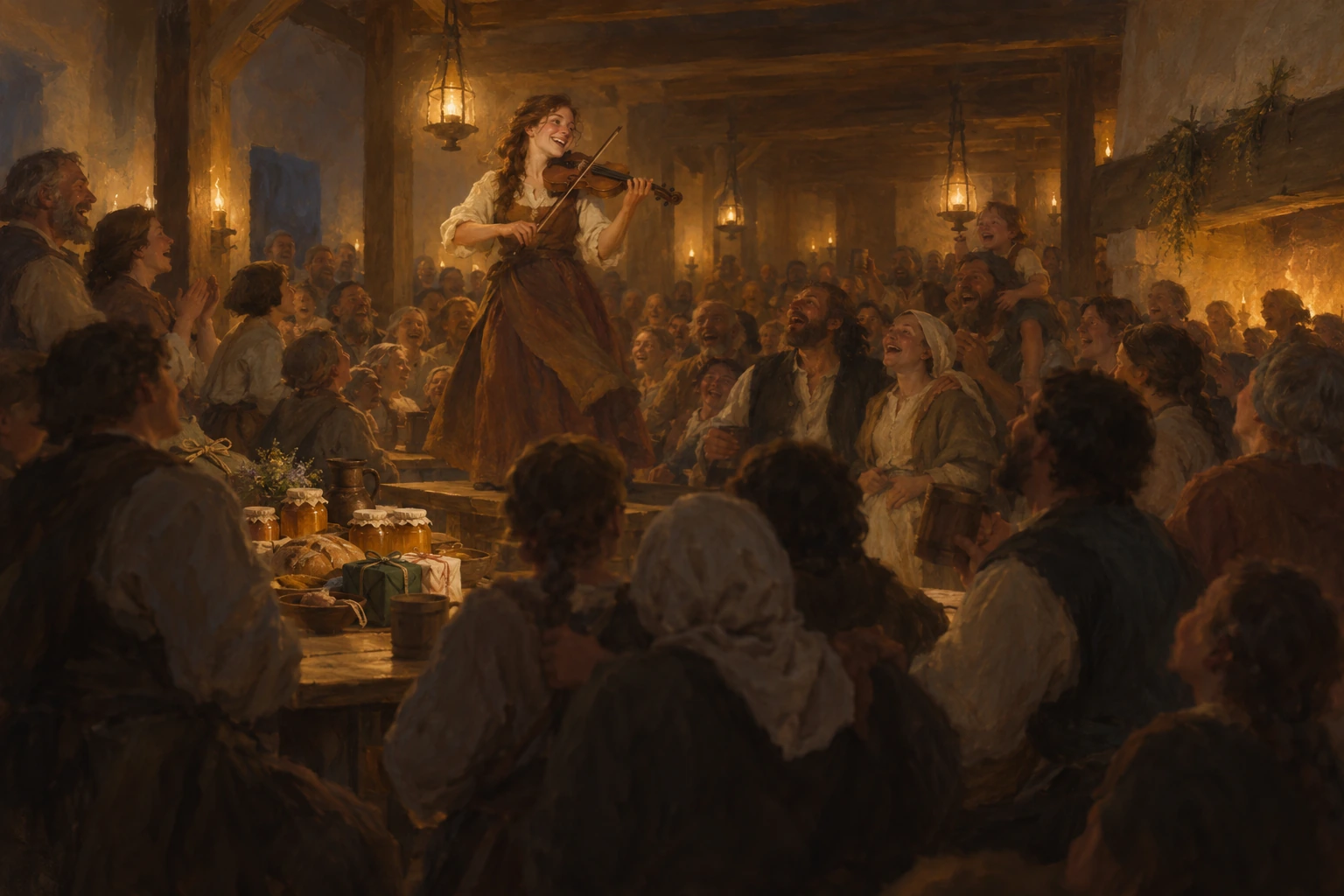
The night of the supper came in clear and mild, and the long room at the Bridge was fuller than Wren had ever seen it — fuller than fair-eve, fuller than the flood year — because Dall had had a day to hear about the hill.
There was a way the valley had always handled a queer story: turn it over, dispute it pleasantly, set it beside the two-headed lamb of the flood year, and go home to bed easier for the telling. It had no way at all with a queer story that had come back down the hill with a man in it. So it did the only other thing it knew, and lit every lamp in the house, and put more food on the table than anybody could eat, and was loudly and deliberately cheerful for four hours.
Cob Hedley sat at the end nearest the fire with his left hand wrapped to the wrist, and Hobb had set a cup with a handle in front of him without being asked and without saying why. Whistle lay under his chair and did not go begging at any other. Dorrit had said, coming down the hill, that the hand would mend enough for a crook and a gate and would not mend enough for two needles, and Dorrit was not often wrong about a hand.
Master Alder sat near the middle of the table, between Hobb and old Naith Ambry, and bore a long and thorough interrogation from Naith on the exact nature of the College of Roads: its charter, its age, and — delivered with the air of a man closing in on the one question that would finally catch a stranger out — whether it paid its Warden in coin or only in satisfaction.
"In both," said Alder, "though I confess the satisfaction comes rather more regularly than the coin," which got a laugh loud enough to carry down the table, and a longer one than the joke had earned, and everybody in the room knew why, and let it run.
It was somewhere between the courses that Hask Farrow set a plain oiled-leather sheath down beside Wren's plate without any preamble at all.
"Whetstone," he said, as though the object might otherwise have been mistaken for something frivolous. "Good one. Not the sort you find at a fair — the sort you find if you know a man who quarries the right hill, which I do, and you don't, which is why I'm giving it and not selling it." He considered her a moment. "You've a decent hand with a blade, for a bee-keeper. Keep it that way."
This was, from Hask Farrow, nearly the warmest thing he had said to anyone in a year, and Wren thanked him for it exactly as gravely as it had been meant.
A little later a pair of mittens came down the table hand to hand, worked so densely they might have turned a knife, and when Wren looked up to find who had sent them, Cob Hedley nodded at her from the fire end.
"Whistle's idea," he called, with a perfectly straight face, and the table laughed, and he let them. "He says a body walking two years in strange country wants warm hands more than she wants sense talked into her, and I couldn't argue the point."
Wren pulled one on. It was warm past any reasonable need of it — the kind of warmth that explained why every shepherd in the high pastures swore by Cob Hedley's knitting. She sat a moment with her hand inside it before she could look up, and what came out in the end was only, "Thank you, Cob," in a voice she did not much like the sound of.
"Aye," said Cob, and drank out of his cup with the handle, and that was as much as either of them wanted said in a room that full.
Perrin Aldwyn said one thing all evening, from three seats down, apparently to his plate. "I told him he'd been misreading his own hills for thirty year," he said. "In this room. I'll not be doing that again."
"You'll do it again by lambing," said Cob. "You do it every spring about the drainage."
"That's different," said Perrin. "I'm right about the drainage," and the two of them settled back into a quarrel forty years old, to the visible relief of everybody within earshot.
And the miller, consulted over the course of the evening on no fewer than four separate weather matters, was prevailed upon at last to deliver his considered judgment on the whole undertaking. He rubbed the knee. He looked at the window, then the door, then, for good measure, the ceiling.
"Fair," he pronounced at last, to a room holding its breath, and let the word sit a good long moment before he added, "— mostly," which brought the house down entirely, Naith laughing so hard he had to be thumped between the shoulders by Hobb.
It was Naith Ambry, though, who was called on properly, once the plates had been cleared enough for speeches, and who, instead of the speech everyone had braced for, began, unaccountably, to tell them about her grandfather.
"Garth Fallowmere," he said, "though he wasn't a Fallowmere by birth, mind, he married into it same as I married into my own good sense — Garth could shoe a horse blind, in the dark, in a temper, and did, once, all three at once, the night the Millbrook mare came in lame at midnight and nobody else would touch her. And he was no talker, not a patch on his wife for that, though I'll say this for him: the man never once in forty years said a thing he didn't mean, which is rarer than you'd think." He paused, in the way that meant the good line was coming. "I mind him telling me once that the mark of a decent road wasn't how far it went, but whether a man could walk it and still know his own name at the end of it. I didn't understand him at the time. Thought it was the drink talking. But I've had cause to think on it since, and I've settled on this: he wasn't talking about roads at all. He was talking about this one."
Everybody in the room had heard about the hill. He said it anyway, looking down at Wren's end of the table — Wren, and Dorrit, and Granna Tansy sitting small and upright beside her with her hands folded and her face giving away nothing at all — and the room, which had been noisy all evening on purpose, was not noisy now.
"So I'll say only this: go on, the pair of you, and know your own names at the end of it, and come back and tell us the roads were fair. Mostly."
He sat, to a general thump of the table that did for applause in that room, and it went on a little longer than usual, and even Perrin Aldwyn kept his eyes on the table rather than the fire end.
Somewhere in the warm noise that followed, Hask Farrow's wife, passing behind Wren's chair with a fresh jug of cider, paused long enough to ask her, plainly, "So you're going, then?"
"Someone has to carry the book," Wren said — which was true in every sense the valley could imagine, and one it could not.
"Somebody had better," said Hask Farrow's wife, entirely satisfied with an answer that told her nothing and everything at once, and went on with her jug.
There was some confusion, inevitably, as to the direction of the road itself, Cob Hedley asking Alder whether they'd be going straight up past the last cairn onto the Gray Stair, as the whole valley had more or less assumed — and asking it, this time, in a room that had gone rather quiet at the mention of the cairn.
"Not directly, no," said Alder. "And not up your hill, Cob, which I hope is some comfort to the four of us who have seen it. We go south first, to the College, to be equipped and sworn, and from there east and up by the old border road, which is a longer way round than a bird would fly it and the only way a Cartographer-Royal's survey is permitted to go." He turned his cup a half-turn on the board. "It will feel, the first week or two, as though we're walking away from the mountains. I find that suits me better this week than it did last."
The singing began, as it always began at the Bridge, with the old reliable pieces, and ran on through the evening until the lamps had burned low and gone the color of the honey itself. It was Widow Callow, in the end, who called for the last of it, standing at her place and saying, to a room that went quiet almost before she'd finished asking: "The Blessing, now, before we lose the older voices to their beds — for we've a going-out to bless tonight, and a coming-home to bless along with it, and I don't believe this room has had cause to sing it in earnest in my lifetime, and I believe it has now."
Wren had heard the Blessing of the Roads perhaps a dozen times in her life, always sung thin and a little uncertain by a room that mostly hummed the tune and left the words to whichever grandmother happened to be nearest the hearth. She took up the fiddle now not to sing it herself, but to lay the tune under the old voices the way a keel lies under a boat, and found the room did not need much laying-under at all. Naith knew it, and Widow Callow, and Granna Tansy, sitting straight and small with her hands folded and her eyes on nothing in particular:
Go safe, go far, and go you well, with the wind behind your feet; may the road rise easy under you, and the strangers you meet be sweet.
But go no road so long, so far, it doubles on its track — for the truest road a body walks is always walking back.
They sang it through twice, the second time with the whole room in it, and Wren, following the last line up an octave, glanced once down the table toward Alder and found him singing the second stanza, low and entire, with no more hesitation over the words than Naith himself had shown. Nobody in that room had taught him. He had not looked, as a stranger singing an unfamiliar song generally looks, at anybody's lips to catch the shape of the next line. It was a small thing, and it caught at her more than it should have, a stranger's tongue moving too easily through her own valley's oldest song.
The last line went up and out into the rafters and came down again in a general roar and a thump of tables that rattled the saucers, and Hobb declared that was that, and called for the cider to go round once more before anybody thought seriously about the walk home.
It was in the general loosening that followed that Wren saw, without meaning to look for it, Master Alder cross to where Granna Tansy sat apart from the noise at the cold end of the hearth, her stick set upright beside her chair the way his own was always set upright by a door. He said something to her, low, that did not carry past the two of them even in that clatter. And Granna Tansy, who had given nothing away all evening, looked up at him a long moment and gave a single nod, small and complete — the kind she gave over a jar held to the light when the honey was exactly as it ought to be. Alder inclined his head to her in turn, the small courteous bow he gave to everyone he meant seriously, and that was all either of them offered. Wren caught the shape of it and none of the words. She had her mouth open for it when her grandmother turned round and asked her to see whether Dorrit had left the good cups out, which Dorrit had not, and which they both knew.
They walked home late, the three of them, under a sky gone thick and close with stars, Dorrit going ahead a little, humming some fragment of the Blessing under her breath and getting the second stanza slightly wrong each time.
"That's done properly," said Granna Tansy, after a while, in the dry, settled voice she used for matters she considered closed, "and no valley does a send-off better, whatever else it lacks. Naith surprised me. He generally does, when he forgets he's trying to."
"He would be pleased to hear that," Wren said, "and insufferable about it for a month, so I won't tell him."
"No," Granna Tansy agreed. "Best not." They went on a way. "Cob Hedley will want feeding through the winter and won't ask. I've a notion the Hollin boys can be got to carry it up without making a performance of it."
That was all she said about the hill. And Wren, who had not told her about the tune and had already decided she was not going to, let it alone: they were both keeping something from each other out of exactly the same motive.
The house, when they came up to it, showed one lamp low in the front window, left waiting for their return. In the hall the bags stood ready where Dorrit had left them that morning — not many, not grand, a keeper's practical share of a life folded small and buckled tight — with a coil of good waxed cord laid across the top of one, where Perrin Aldwyn's gift had found its place. Wren stood over it a while in her stockinged feet, with the whetstone and the mittens and the gathered weight of the evening still warm in her somehow. And she found she was turning over, of everything said that night, not the ham nor the singing but one dead blacksmith's line, walked out of Naith Ambry's mouth and straight into her chest: know your own name at the end of it. It was a handsome thing to say at a supper. She knew now what it cost to be unable to, having watched it from four feet away and held the hand it happened to, and she was going to spend two years walking toward the place it came from.
She took the fiddle down from its peg on the way up, and stopped on the third stair in the dark, and tried the reel once more without the bow — only the fingers of her left hand moving on the strings as they had moved since she was seven.
They did not know where to go.
She stood there a while longer. Then she went up, because the alternative was standing on a stair all night, and laid the fiddle at the foot of her bed among the buckled bags, and slept badly, and told nobody about any of it in the morning.