The Long Night
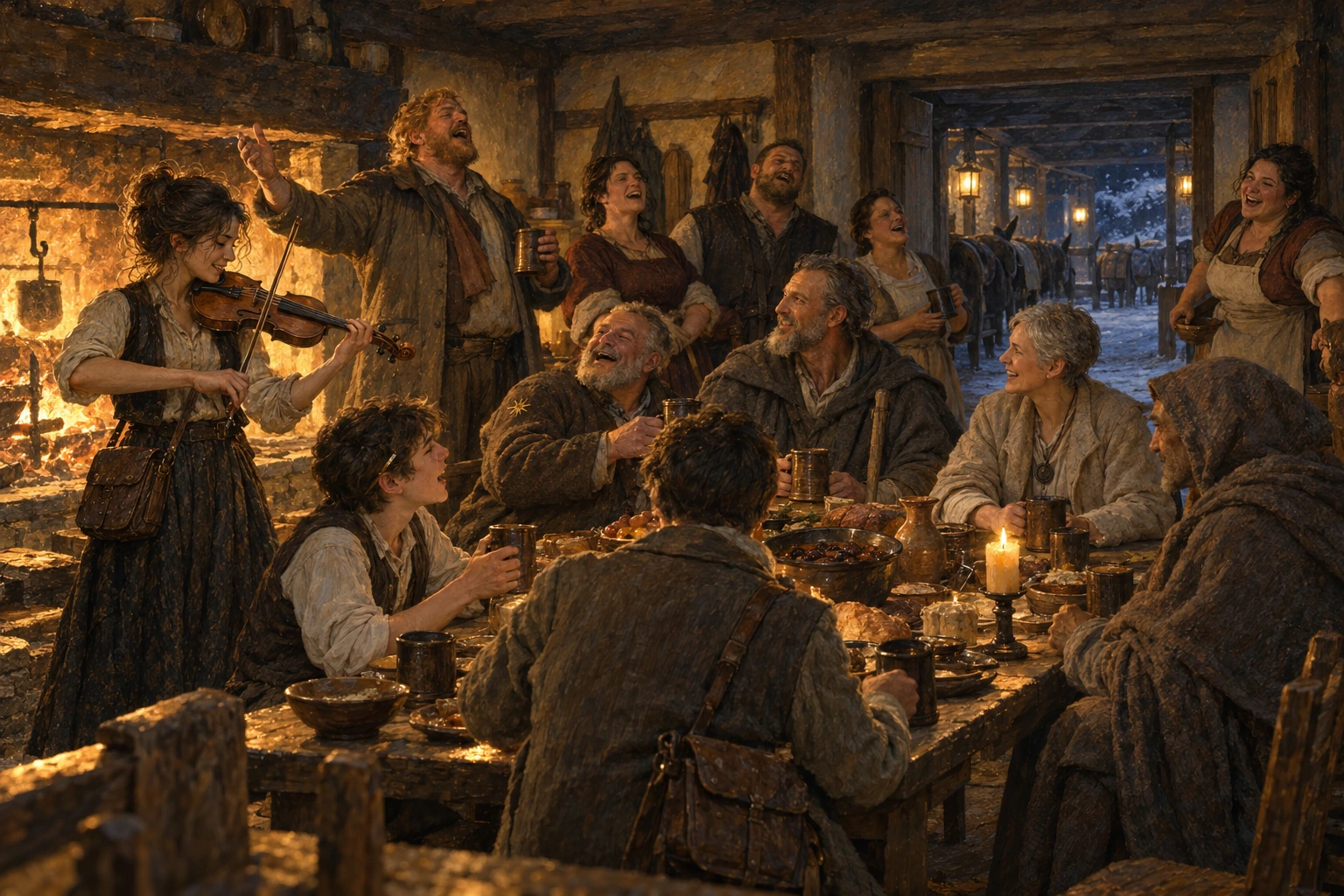
They took the map-room table apart to move it, because a table that size does not turn the corner into the common room whole, and Bracken had learned that lesson badly enough once, years and a country ago, that he still would not let anyone try it twice. Four of them carried the long board and its two trestles the length of the through-road in the cold hour after breakfast, and the house rang with it — boots doubled by the stone, Osric arguing cheerfully with nobody about which end went first, Iyene's flat protest that a table travels better than ink does and would everyone please remember which of the two was in her charge. It was the loudest morning the house had kept in three months of quiet ones, welcomed rather than complained about. There was a reason for the noise, and the reason was a good one, and there would be time enough afterward to miss the quiet if anybody found they wanted it back.
Bracken gave the spending in one pass, the way he gave every figure that mattered, flat and once, at the stores-room door before the carrying even started. Feeding twelve mouths one long night as a feast deserved would cost, between dusk and dawn, close to what four had planned to eat across five ordinary ones: the second sack of dried apple broken into rather than eked out, both flitches down off their hooks together, the honey Dorrit had been doling by the spoonful since the first hard frost poured out that night by the jarful instead. What it left the house, from that morning to the thaw, was tighter than he would have chosen and not so tight that anyone need lie awake counting it. He said so once, wrote the new totals into his own ledger before the fire had fully caught, and went back to work, and nobody thanked him for the arithmetic, because in that house the arithmetic was the thanks.
The bread-oven, built into the kitchen wall's own thickness and never yet fired for what it was built to do, took its first true baking that afternoon — four loaves shaped by hands that knew the recipe better than the oven knew its own use, and the whole house smelled of it by early afternoon, warm and close and strange after so many months of nothing coming out of that wall but stored cold. Osric, Thomasin, Marta, and Sim took the kitchen for most of the day and made it Ashcroft's: a stew thickened dark, Ashcroft's own fashion, a heavy brown bread new to the whole company, dried plums stewed soft in something that was not quite wine. Dorrit, put out of her own kitchen for the first time since Merrow, pronounced herself glad of the rest and hovered in the doorway the whole afternoon regardless, offering opinions unasked and taking not one of them back when they proved wrong.
Marle found his own use for the evening without being asked, which was itself a small wonder. He ruled a clean stores-count sheet for Bracken in his own precise hand, columns square, nothing wasted — the kind of paper Bracken had spent a year distrusting and now took without comment, folded it into his own ledger, and said nothing more about where it had come from. Later, when Thomasin's tally of wax stubs disagreed with itself for the second time that week, Marle produced from the bottom of his own pack a small twist of dried spice he had carried the whole road from the province gate and had never mentioned owning, and set it wordlessly beside the cooking without waiting to be asked whether it was wanted. Both kindnesses were simply used.
Luel sat nearest the long hearth all evening and said little, which from her was its own kind of warmth. Under the noise of twelve people at one table, a low thread of her own speech ran beneath the room for whole minutes at a stretch, in no tongue anyone else at the table could have named, and the fire steadied under it past what the wood alone could account for, and more than one face at the table went briefly somewhere else — Bracken's, caught mid-laugh and gone soft for three heartbeats before he came back to himself and finished the laugh anyway. Whatever it was, it stopped whenever the table's own singing started, and picked itself up again in the gaps between.
It was Osric who stood first, though the four of them had plainly settled the matter between themselves beforehand, in one of the low arguments that had run at odd moments across the whole week and got settled, in the end, the way most things got settled in that house: by leaving well enough alone. Thomasin gave the first note; Sim came in under it a beat later, low and sure; Marta's voice found the top of it and held there. It was Ashcroft's own midwinter song, three centuries old by Osric's own reckoning and never sung outside the town's own walls in all that time, and not one soul at the table had heard it before that night.
The shortest day has come and gone, the longest dark is at our door; we set the kettle on at dawn and count the months to spring once more.
Bread for the table, salt for the meat, a coal kept live from last year's flame; whatever the roads bring to our feet, this house will know them each by name.
So sing the turning, sing it slow, the wheel comes round however long; and every hand that stayed to know the winter through, is in this song.
Wren's fiddle found the tune somewhere in the second verse, feeling for its shape before it committed to it outright, and by the third verse Pip's voice had come onto the chorus from his place at the table's far end, true and unhesitant, a voice the company had heard perhaps three times in a whole year of road. The song did not want remarking on; it wanted singing, and got it, whole, from the first line to the last, and when it finished the room sat a moment in the kind of silence that follows a thing done well, and then somebody called for the next one, and the evening went on.
The night wore on into something looser and less careful than it had started, half the household gone up to the gallery by degrees, the fire let down to its coals, the washing-up started twice and abandoned twice for one more cup. What was left singing by then was nothing so fine as what had come before it — the ragged, half-remembered stuff that gets sung at the tail of any long evening by whoever is still awake enough to want it, and what was still awake enough that night was Bracken, and Dorrit, and Pip, working through a fire-verse the company had carried down off a hill on the beacon road and taught nobody outside itself since.
Load it high, and lash it tight, three valleys home's a long way yet; the fire won't ask how far you walked, only that the wood came home, not wet.
Stack it dry, and stack it deep, under the eave where the frost can't—
It broke there, in the middle of a line, and it was not a voice that broke it.
It was the mules. All four of them stood in their stalls without moving, heads up, ears forward, facing the one direction none of them had any reason to face at that hour — north, up the through-road, toward the near gate that had stood barred since full dark. The room did not need telling what that meant, not anymore. The house had learned it once already, months back, at a cost that still marked half of them, and this time every breath went to moving rather than to asking whether it might be nothing. Iyene had the room emptying toward its drilled positions before the last note of the broken verse had finished dying in the rafters, and from the moment the first person moved to the moment the house stood ready, perhaps ninety seconds passed, fast and wordless and complete.
Both gates held. That fact wants stating early, flatly, because it is the one thing about the night that never came into doubt: the near gate and the far, barred nightly since the cost that had taught the house to bar them, stood shut and stood fast from the first moment to the last, and not one thing that came into Wintergarth that night came in by a door. It came over the yard wall at the south end, where stone met open sky and no bar had ever seemed necessary, and it came down through the one bay along the west row that had lost its slates entire a lifetime before any of them were born, out of the single unroofed stretch in the whole long house — and once it was down, in either place, it was already inside, already in the through-road, already past every line the house had drawn against a door that was never going to be tried.
Alder drew his line at the stair-head, mid-house, in the time it took Wren to cross the through-road to reach him — a length of chalked stone and a low word said once over it, the same craft she had watched hold once before and fail once before, and she did not let herself think, this time, about which of the two it would do tonight.
Thomasin Reed came up the stair-head three steps behind him and stopped and looked at what he had made, which from where she was standing was a line of chalk on a stone floor and nothing else whatever.
"That's it," she said. It was not quite a question.
"That's it."
"And you'd have twelve people put their backs to a chalk line."
"I'd have them north of it." Alder did not look up from the stone. "What they put their backs to is their own affair."
Thomasin Reed had spent a working lifetime deciding whether a thing would hold before she trusted her weight to it, and she had never been asked to trust it to less. She looked at the chalk a moment longer. Then she turned and started moving her own people north of it, and did not tell one of them what she thought. He gathered the household on the line's north face as he drew it, calling names without raising his voice: Iyene, Marle, Luel, Dorrit, Pip with the lamp. Wren he kept beside him, inside the line's own protection, and gave her the whole of that night's work in one flat sentence — hold, watch, and end only what she could name, and name nothing she was not certain of.
The line held. It held the whole night, the one wholly reliable fact in a night that would afterward refuse to agree with itself about almost everything else, and behind it Wren did the work she had spent a winter learning to do. Three times, maybe four, something came near enough the line's edge for her to read it clear in the stair-head fire's light — thin, dressed in a cut gone out of fashion since before anyone living was born, walking a road it still seemed to know — and three or four times she gave it a name off the twelve ledgers she had spent the season reading, low and certain, and each time the edges closed clean around the ending and nothing spilled past her into the room at her back. Four names, four endings, and not one grain of the cost Alder had spent a winter teaching her to hold reached anyone but her.
At the yard wall, Bracken and Osric worked the gap between two fallen courses of coping stone side by side, Bracken's short blade and Osric's own hedging-bill trading the labor back and forth as each man's arm tired, driving back what came over the wall a body at a time rather than trying to hold the whole breach at once. Neither had breath to spare for anything beyond the fighting itself.
At the south end, where the breaches fed straight into the road, Sim and Thomasin held the ground in front of the barred far gate, because whatever came down out of the yard or the bay had to cross that stretch of stone before it reached anyone standing behind the line, and somebody had to make it slow down first. The second spear, carried unassigned in the panniers since the winter-bred were cleared from the undercroft, came out that night and went into Sim's hands, and he used it exactly as Bracken had shown the company, months before — braced, cross-bar low, giving ground only when giving ground bought something. He held a long while.
What took him was one of the many that walked that road belonging to no ledger any house had ever kept, out past anything Wren could have reached from the line even had she known to try, and it happened the way the formula had already taught the house such things could be taken: fast, and once, and past any turning back. Wren did not see it happen. She had it from three people over the days that followed, in three different tellings, and no two of the three agreed past the bare fact of it, and the house never troubled itself to settle which telling was true. Thomasin, a hatchet in a two-fisted grip beside him, held what he had been holding for the rest of the night, alone, and did not fall.
The far end came apart before midnight — not all at once, but by degrees too quick to name a single moment as the one where it went wrong. Osric and Bracken were still holding the yard wall's own gap when the household behind Wintergarth's own kitchen began to fall back north along the through-road, toward the line. Most of them made it. Marta Coyle did not.
She was cut off ten, perhaps twelve, paces south of Alder's line — near enough that the whole gathered household could see her plainly by the stair-head fire's own light, far enough that she stood on the wrong side of the only thing keeping the rest of them alive. One of the faded had hold of her, not to end her — she was not yet a name to be given back — but to take her the slower way, the way the Quiet took the living it caught: not a killing, but a going. Wren had watched exactly this once before, in this same house, in the dark of another night, when it had Bracken by the arm and very nearly finished the taking before anyone reached him in time.
"Hold," Alder said, before she had so much as shifted her weight toward the line's edge, and he said it once, and did not repeat it.
His reason came fast, and it was a good one, and every word of it was true. He could not close an edge he could not draw around, and Marta stood outside the only line he had drawn that night. Nor could the line be moved — a line, once set, held where it was set, and to put one round her he would first have to unmake this one, and while it stood unmade the roof's own breach and the yard wall both still fed straight into the room at their backs, with the night's count not yet finished coming down out of the dark to fill it. What he could promise, if she held, was this: gates covered, house gathered, the line drawn a second time around Marta once there was ground steady enough to draw on — and then Wren could spend, and he could close what she opened, exactly as he had drilled her to let him do across a whole hard winter. He did not explain further. He did not reach for his stick, and he did not name the one thing a whole winter of teaching had taught him never to promise about a line drawn at speed.
The cost of holding was Marta, and everyone in that room understood the arithmetic of it exactly as Alder had just laid it out. Not seconds — minutes. Long enough to be a decision and not an accident, for every person standing behind that line.
Wren went anyway.
She did not decide it so much as discover, a stride into the crossing, that she had already begun. It was Marta. She could not stand there and watch it happen, and not spending felt, in the one whole second she gave herself to feel anything at all, like cowardice — not caution, not obedience, cowardice, plain and unforgivable and hers. She did not look at him again. She stepped over the chalked line at the stair-head, and took three strides south into the dark past it, and that was the whole distance the night's worst mistake ever covered.
She went without a lamp, and the household held its ground rather than break to follow; Pip stood exactly where he had been posted, at the stair-head with the light held steady in both hands, north of the line, and it was that same steady light behind her, thrown long down the through-road, that let her see anything at all of what she was walking toward. His office held him there, and he stayed inside it.
What she did needed two workings in the space of one breath, and that was why it went so far past anything she had learned to aim. She had the name of the thing that held Marta — one of the twelve ledgers' own hands, a name she had read aloud once already, months back, sorting stores in a stair everyone else had been glad to leave to her — and she gave it back, low and certain, the way she had given back three others that same night from inside the safety of a line she was no longer standing behind. And in the same breath, before the first working had finished closing, she held Marta's own name for her, the same working that had once pulled a shepherd off a hillside above Dall and cost her the last tune her grandmother ever taught her — a working she had not attempted since, and had never attempted at all with nothing drawn round either end of it.
Edges open. Nothing closed. Nobody standing ready to contain what came out of her, because the one person trained to do it was three strides north of a line he could not cross without undoing everything it was still holding shut.
The name went out of her and the road went cold.
Not the cold of a winter night, which every soul in that yard had been standing in for two hours already. This came from nowhere and arrived everywhere at once, and the water lying in the cart-ruts between Wren and the thing that had Marta skinned over from one side to the other while somebody was still drawing the breath to shout about it. Pip's lamp went on burning at the stair-head behind her. It stopped being the brightest thing on the through-road.
What was brighter came off Wren, and there was no warmth in it anywhere. A hard grey light that did not throw shadows the way a fire throws them, running up her right arm out of the hand that had not touched anything, the way current runs up a wire.
Something took weight, somewhere, with a sound like a hawser coming taut.
The thing holding Marta folded. It did not fall and it did not fight. Three centuries arrived on it between one heartbeat and the next, and it dried, and went inward, and what came apart on the frozen road was bone and dust and old cloth and a hand still shut on the sleeve of Marta Coyle's coat with nothing behind it any more.
Marta lived.
Every soul in that house saw it happen. Not one of them had ever seen Wren do anything before but kneel down beside somebody and speak too quietly to be heard. It did not feel, to anyone watching, like a reward for anything.
The cost to Wren did not arrive as it had since the gate, and she knew it before she had finished standing — not a wound taken from outside but a cold let in, passing through her rather than around her, in at the hand that had not touched anything and out through her left shoulder and the bone beneath it, gone before she had fully finished standing. She did not look down. Nobody was watching her closely enough, in that moment, to notice that anything had passed through her at all.
The rest of the night has no single shape to give it, because no one person in that house saw the whole of it, and the versions that survive do not agree past the barest outline: the yard wall held once Bracken and Osric got their backs to the well-coping and stopped giving ground; the bay breach thinned to nothing sometime after the second hour, though the number that had come through it went uncounted, nine or a dozen or more depending which telling you trusted; the line held, unbroken, the one fact every account shared. By the grey hour before true light the through-road stood empty of anything but the people who had spent the night defending it, and the house was quiet in a way it had not been since before the mules went still.
Luel gave her ruling before the light was properly up, standing at the yard's own well with her hands empty, and she gave it in two sentences and no more: the dead were burned before they could open their eyes again, every one of them, without exception, because that was the only mercy the closing years had ever found that actually worked. Nobody argued the doctrine. Osric argued the exception.
He would not have it for Sim — said so once, flatly, in front of the whole household gathered in the cold yard, and did not back down when Luel repeated herself, and did not back down when nobody else in the yard spoke either for him or against him. Ashcroft buried its own. Sim was Ashcroft's, dead in Ashcroft's own service, and he would go into ground exactly as every soul from that town had gone into ground for three centuries before the roads ever closed, and Osric would dig it himself, with help or without it.
Bracken settled it, and what he did was not a compromise, because a compromise would have split the difference and this did not: Sim went into the ground, in the yard, that same morning, and the faded dead — nine of them, by the count that finally stood once Iyene had reconciled Bracken's three separate tallies as best she could, which was not very well — went onto open ground past the far gate and burned there before noon, exactly as the closing years had always burned such things. The ruling stood. He dug beside Osric without being asked, and when the grave was filled he sat down next to it with a short heavy blade laid flat across his knees and stayed there the rest of the day, through the burning and past it, until the light went, and he offered no reason for the sitting to anyone who asked, and by evening the house had stopped asking. No marker went over the grave beyond a name cut plain into a flat stone, and the yard had a grave in it from that day forward, the first the house had ever needed.
The losses surfaced scattered and sideways over the days that followed, rather than all at once. Osric found his gone on the second morning and mentioned it once, in passing, over the stores count: the name of a road out of his own town, gone clean out of his head for most of a morning until it came back to him unbidden while he was salting fish. He said so, flatly, and let it go, the same register he had used for every hard thing since the season had turned against them. Bracken lost the name of the man who had taught him his own trade, and did not say so to anyone, and Wren noticed anyway — a story he told often enough that its shape was known, told once more that week with a name-sized hole standing in it that nobody but her seemed to hear. It came back to him mid-sentence on the third day, and he finished the sentence as though nothing had happened, which was, she had learned by now, exactly how Bracken finished every sentence that mattered most to him.
Dorrit's loss took longer to name and cost more to watch: a whole stretch of her own apprenticeship, not the craft itself — her hands stayed sure, her eye stayed exact — but the teachers behind it, whole mornings of somebody standing at her shoulder saying do it like this, gone, and Dorrit angrier about it than she had let herself be about anything the whole winter. She said so once, sharply, over a pot she was scouring harder than the pot required, and went back to work, because the work itself had not gone anywhere, only the memory of learning it, and that distinction was cold comfort and she used it anyway. It returned whole on the fourth day, in the middle of a sentence about something else entirely, and she finished the sentence.
Luel would not say. Asked, gently, once, by Dorrit, whether she had lost anything at all, she gave the same three words she had given once before, months back, at another table after another loss: I am carrying. No lore came with it, and no grief.
Iyene kept the sheet the way she had kept every sheet since the column of dates, dry and dated and without comment, and the finding she wrote into it that week was harder than anything she had found before. North of the line, she noted, losses fell away fast with distance, the same as they always had — a few paces bought real safety. South of it, they did not fall away in anything like the same measure: a person thirty paces south paid close to what a person four paces north paid, distance buying almost nothing once a body stood on the wrong side of the one thing meant to hold the spill in. She wrote the finding once, in her own plain numbers, and drew no conclusion from it, leaving it to stand unglossed for whoever read it after.
Three days on, Osric asked Marta which road home made better sense for carrying the heavier loads in spring — the short way round the beck, or the long way past the forge — and Marta answered, pleasantly, that whichever he liked would suit her fine, and the talk moved on to the next sack. The stores-room heard nothing wrong in it, Osric least of all, and his own not-hearing was the harder thing to watch, since watching for it was still a week away.
The fair copy of the first new map still lay on the long table where it had been finished, and one grey afternoon Marta stopped over Ashcroft's own quarter of it on her way past and looked at it a moment with the same open, friendly interest anybody gives a map of somewhere they have never been — said something admiring about the neat hand it was drawn in, and moved on to help Dorrit with the mending. Wren was standing close enough to see the whole of it happen, and understood, watching her, exactly what she was looking at.
Iyene went back to her twice more that week with a routine question, just as she had gone back to her a dozen times across the winter making the map's western reaches sound — a distance this time, and which side of the beck the square actually stood on. Marta answered pleasantly both times, and answered wrong both times, and the second answer did not agree with the first, and she did not hesitate over either one and did not correct herself when the second contradicted the one before it. Iyene said nothing to her about it. She struck Ashcroft's whole quarter of the map's provenance that same evening, re-sourced it fresh to Osric and Thomasin's telling alone, dated the correction in her own hand, and closed the sheet.
She found Wren afterward, in the map-room doorway, and said the whole of what she meant to say in one flat sentence, the way she said everything that mattered most: "Ashcroft's off my sheet. I've re-sourced it to Vane." She did not wait to see how it landed, and did not soften it first, and did not accuse Wren of anything either, because the sentence was a fact about a sheet, said in the same flat register she gave every other fact about every other sheet she kept. Wren stood in the doorway a while after she had gone, working it out: re-sourced to Vane, because Marta's telling could no longer be trusted; because Marta's own town had gone out of Marta; because of what had been spent to keep her alive, and who had spent it, with no edge closed and nobody standing where the closing was done from. Iyene's sentence was a fact about a sheet. Wren stood with it until she understood it was also a fact about her, and then went up.
Iyene's returned-column filled in steadily, one name at a time, dated as each loss came home: Osric, day two; Bracken, day three; Dorrit, day four; Thomasin last of all, day five, her own working words come back to her mid-sentence while explaining a joint to Pip, the explanation finishing itself before she had fully noticed the words were there again.
Marta had no line on that column. What had happened to her that night was a different thing from the spill, and Iyene noted the difference once, in one sentence, in her own working sheet, and did not write it again: the spill's losses had all come home by the fifth day, and Marta's were not coming home, because they had not spilled — they had been spent. A working with no edge closed takes its fuel from the nearest thing standing, and the nearest thing standing, that night, was Marta: her own name held whole across the taking, and everything that stood behind the name gone to pay for the holding. There is no column built for that. What the map itself had lost sat elsewhere, in the struck line of its own provenance, dated and re-sourced and closed. Iyene's sheet ran on, day after day, name after name, and simply had no further entry to make against the one line that mattered most.
Wren's own reckoning ran worse than the gate had, and worse by a distance that had nothing to do with going backward and everything to do with going too far forward at once — her recoveries had been shortening steadily since the column of dates first started counting them, hours instead of days by the season's own most recent working, and this one broke that whole trend upward in a single night, costing her most of four days before she could hold a pen steady or sit a whole meal upright at the table. Iyene entered the new figure on the same sheet that had been charting the improvement all winter, without comment, and the line it made, breaking sharply up after weeks of running steadily down, was harder to look at than any of the words anyone might have used instead.
And she kept them. Whatever names had gone out through her that night to bring Marta back — a trade, a wife's face, a road out of a town she had never walked — they were hers now, carried rather than lost, heavier by exactly that much and no lighter for any of it having gone anywhere else. She did not speak of it.
She made him say something to her about it eventually — not at once, and not because she planned to, but because the silence itself had become a thing she could not keep working inside of, and on the third day she stopped him in the through-road and asked him straight out whether he had anything to say.
"I told you to hold," Alder said.
That was the whole of it. She waited for what came after — an accounting, a judgment, something to push against — and there was no after. He looked at her a moment longer, and then went back to the rope he had been coiling, and the conversation was finished whether she was ready for it to be or not.
The house did not raise it again, that week or the one after. It spoke to her about the rota, the stores, the roof that wanted proper re-slating before the next hard snow, the grave that wanted a flat stone found and set. Positions were kept exactly as they had always been kept, work was shared out exactly as it always was, and Dorrit sat exactly as close to her at table as she always had. No one turned cold toward her, and no one turned warm either, and it was the second of those two things, more than the first, that she found she could not carry.
Thomasin Reed went back up to the stair-head on the second morning, when the light was good, and got down on her heels over the chalk with her forearms across her knees. It was chalk. She rubbed a little of it between finger and thumb and it did what chalk does.
Then she went and found Alder in the goods-bay, counting what was left of the lamp-oil, and told him she had mended every wall and byre-door in Ashcroft for twenty years and had never in the whole of it put her weight on anything she understood as badly as she understood that.
"And?" Alder said.
"And it held," Thomasin said, and went back to the kitchen.
Marta found her at the mule-standings on the fifth morning, doing nothing more remarkable than checking Nettle's near hoof for a stone that had been troubling her, and said what she had clearly been working up to saying for some days: that she had been told what Wren did for her, out past the line, in the middle of that whole terrible night, and that she wanted her to know she was grateful for it, more than she had words ready to give. She did not remember any of it herself, she said — not the going, not the taking, not one clear thing about the whole night from somewhere in the ordinary singing onward — and she supposed she would tell them all about it once she was truly home again, when it would feel more like a story and less like something she had only been handed secondhand. She smiled, and went back in to the kitchen.
Wren went on checking the mule's hoof, and said nothing back.