The Seventh Fire
Morning came up over Sereth the color of a struck match, thin and orange along the eastern shoulder, and by the time Wren came down the two households were already at the long table together as though they had always eaten there together, which in a manner of speaking, Wren thought, watching Liss ladle porridge into Pip's bowl before he had properly sat down, they now had.
It was Alder who raised it, over the second pot of tea, sideways, as if it had only just occurred to him — though Wren had learned across a year of roads that nothing occurred to Alder sideways that he had not already turned over a dozen times facing forward.
"Your charter," he said to Iyene, "runs to the road's whole working. Waymarks. Wells. Bridges."
"And beacons," Iyene said, not looking up from her tea. "Yes. I had thought of it."
"The Hob was courtesy," Alder said. "And practice. We had a basket, and an evening to spare, and no better use for either." He looked, for just a moment, not at Iyene but past her, toward the window and the grey shoulder of hill that stood behind Sereth's roof like a second, quieter roof. "A thing done once for courtesy is easier done twice for need."
The whole table already understood what came next, though Edda, setting down the bread knife, said it anyway, plainly.
"You mean to light the Seventh."
"If the household will have us do it with them, and not merely for them," Alder said. "It was never ours to light alone. It was never anybody's alone. That was rather the whole of the design."
Edda was quiet a moment, turning her cup a half-turn on the board without drinking from it, and when she spoke it was in the graded, told-not-shamed voice Wren had come to recognize as her family's particular honesty, the one that never dressed a hard thing as anything but what it was.
"It was ours to light," she said. "Eleven generations, near enough as long as your own book's been kept, cousin—" a small nod to Wren, whose hand went to the satchel at her hip and came away again — "and I'll tell you plainly, since there's no honor in telling it any other way: we let it go. Not carelessly. There were winters fuel was dear and hands were few, and a body climbing that shoulder in the deep snow to feed a fire that answered nobody was a body not minding the byre, or the children, or the hearth that fed them. We kept the door. We kept the hearth. The far fire, I'll own, we let starve, and called it sense at the time, and I still think it was sense, for the winters it happened in." She looked at the bread knife rather than at any of them. "Feed the fire, the charge says. I always took that to mean the one under this roof. I am not so sure, now, it didn't mean both, in the old width the words were cut in — that a hearth kept and a beacon dark were two halves of the same failing, however sensible the failing was at the time."
"Nobody at this table," Alder said gently, "has come to grade you for it."
"No," Edda agreed. "But I'll grade myself, thank you, and move on, which is the only use grading a thing is ever put to." She looked up, and something in her face had already turned toward the work of it, as she turned toward any task once the naming of it was done. "What do you call it, then, this hill of ours, in your charter's own tongue?"
"We don't," said Iyene. "That's rather the point of asking. What do you call it?"
"The Seventh," Edda said, "though I'd be hard put to tell you seventh of what. My grandmother said it so often as one word — the way a body says a market-day's name without thinking of the number of days it took to arrive at it — that it stopped being a number in my mouth a long time before it came to me at all. It is simply what the hill is called. I don't believe I'd questioned it since I was the girl's age." She tipped her head at her granddaughter, who was feeding porridge to the dog under the table with the serene confidence of a child who believes herself unobserved.
Luel had been sitting very still, in the particular stillness Wren had learned to watch for, the one that meant something old had lifted its head inside her without yet troubling her face.
"Seven," she said at last, and turned the word over once before she went on with it. "Counted from Kelder's height, eastward, hill to hill — yes. That is where the count would put it. We kept the tale of the numbering on our side of the line, in the west; I had not thought anyone this side of the mountains had kept anything of it but the name, worn down to a single word, as a river wears a stone down to a shape that no longer looks like what broke off the cliff."
"We kept the word," Edda said, "and lost the arithmetic that made it a word in the first place. That sounds a fair trade to nobody, put like that, but there it is."
"It is not the worst trade," Luel said. "A name outlives a number more often than not. Numbers ask to be added to other numbers. Names only ask to be said."
No one reckoned up how many fires the whole chain had held before the frost, or reached for the old song that named a wider total. Wren glanced once at Alder, found his face carefully unhelpful, and let it alone. Some sums, she was coming to think, were kept unspoken on purpose, the way Wystan's blank vellum had been carried unread through eleven generations — not from any fear of what it held, but from a plain respect for how much weight a whole total might carry that a single named hill did not.
"And the other fire," Garron said, from the end of the table, not quite a question. "The far one. Past accounting."
"Stays past accounting," Edda said, "this morning same as last night. I've nothing new to give it, and I'll not pretend to." She looked round the table, at the two households mixed together over one breakfast, and something eased in her, visibly, the plain relief of a woman glad to have said the hard part first and be done with it. "If we're to light the Seventh, we'd best see what state it's kept itself in, all these years without us. Garron. Fetch the mule-string round."
The climb to the Seventh's crown was a different climb from the watching-shoulder's, Wren found, though the two hills stood near enough together to share weather: the watching-shoulder rose easy and rounded, a place a person climbed with a lantern and came down from before the cold got serious, but the Seventh's crown stood a full third higher again, a bare grey knuckle of rock pushing up through the last thin skin of turf, wind-scoured on every face, with nothing between it and the sky but sky. The path up it was old — worn into the rock itself in places, a shallow groove polished smooth by generations of feet before generations left it just as smooth and empty — and it climbed in a long, easy spiral rather than a straight scramble, the way, Bracken observed, a road climbs when whoever built it meant people to be carrying something heavy up it and did not care to hurry them.
"They did," said Garron. "Fuel, mostly. And the basket itself, the once, when it was first set. After that it never came down."
It had not come down in three hundred years either, as it turned out, and had not needed to. They found it standing exactly where a beacon-basket ought to stand, seated in a stone cradle worked into the crown's highest outcrop, canted a very little where long years of frost had worked at the stone beneath it, but never buried, never carted off, never sold to any factor's cart for want of a family near enough to miss it, and nothing here had needed digging out to prove it. It stood the way a good tool stands in a shed nobody has opened in a long while — not lost, only waiting.
"One cracked band," Bracken said, running a hand round the basket's iron rim with the careful thoroughness of a man who had spent a winter learning a forge from Orran and had never quite lost the habit of touching metal before he trusted it. "Riding-band, not the cradle-bolts — those are sound as the day they were set, which I'll own I did not expect of any iron left out three hundred winters." He glanced at Garron. "You'll have a forge down there, for the shoes and the hinges."
"Small one. Enough for a shoe or a gate-strap." Garron's face did something that on another man might have been called a smile and on Garron was simply a slight loosening of the mouth. "I've mended worse than a riding-band on it."
"Then we'll want the basket down for an afternoon, not the whole hill up," Bracken said, and that settled the day's shape: while the fuel-party worked the crown, Garron and Bracken carried the basket itself down on a hand-barrow, the two of them falling into the same easy, half-worded partnership Wren remembered from the watch's smithy — Garron holding, Bracken striking, a strip of good strap-iron heated and drawn and clinched round the cracked band until it rode true again, the whole job done and the basket started back up the hill again before the fuel-party had finished its second load.
That work went to the mules, mostly, and to the children, who carried kindling up the last stretch of path with a solemnity better suited to processing a crown than gathering firewood, each stick held out before them like an offering. Barrow took the heaviest panniers without complaint, as Barrow always had; Nettle registered her opinion of the grade, the load, the weather, and the general indignity of being a mule by biting at the air near everyone's shoulder in turn and connecting with nobody, which Bracken pronounced "about her usual percentage." Suet, who had once carried a beacon-basket a full fortnight of road on her own unwilling back and clearly felt the indignity of doing anything of the sort twice, was given only a pannier of wax and old rag for kindling, and made her feelings about even that modest burden known by sighing, at intervals, with the theatrical weight of a mule who believes herself under-appreciated. Below, at the yard, Dorrit and Liss provisioned the whole climbing party as though it were harvest day rather than a hilltop errand — bread and hard cheese and a crock of the hedge honey passed hand to hand up the path at midday, with Liss's plain observation that "a household doesn't feed a hill by starving the people climbing it."
Luel climbed last, and stood longest at the crown once the fuel was stacked and the basket reseated. She put one hand, briefly, to the basket's weathered rim — the western half of the whole chain had been her people's tending, the count itself kept on her side of the mountains and worn to a single word on this one — and stood a moment with her hand there and her face turned toward the long grey country falling away west below them, and then took her hand back and went down the path ahead of the rest.
By evening the crown was cleared to bare rock a good ten paces round the cradle, the fuel stacked dry under oiled canvas against the night's dew, and the basket sat true in its stone seat with its new band bright against years of weathered grey, waiting, as Bracken said, looking down at it, "for tomorrow evening, and nothing before it."
They climbed again the following afternoon, the whole of both households together, in a straggling easy line up the spiral path that Wren thought, watching the children race ahead and be called back twice, must have looked from any distance exactly as it had looked three hundred years before the frost came — a hillside full of people climbing toward a fire, for reasons that had nothing to do with warmth.
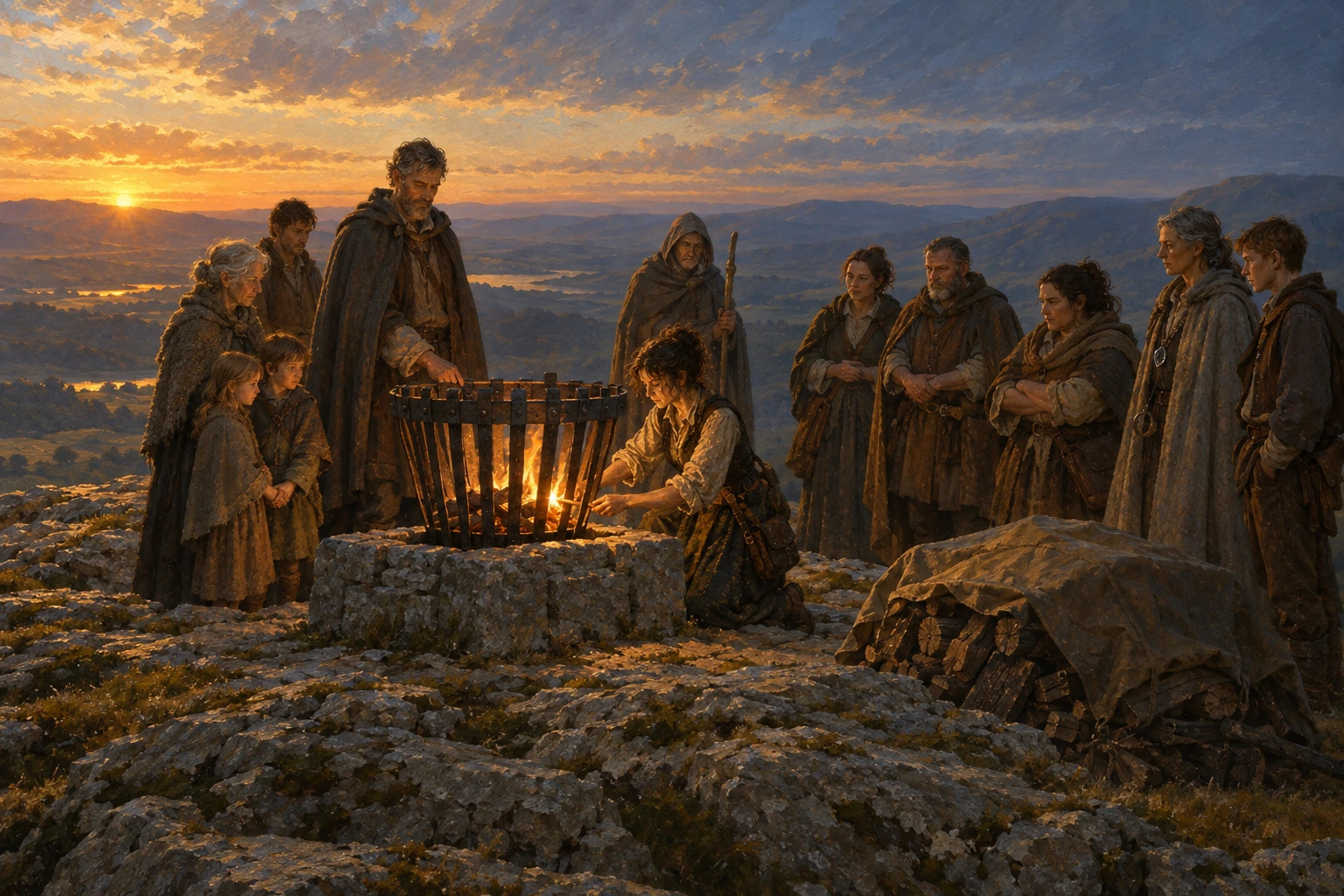
Alder gave the formula at dusk, with the light going long and gold across the crown and the whole company gathered loosely round the cradle, in the same plain shape of words Wren remembered from the Hob a year and a world ago, unaltered by ceremony because ceremony had never been the point of it.
"By the charter of the College of Roads," he said, "which runs to the road's whole working — waymark, well, bridge, and beacon — this fire is called, and the line begun again."
"There's a difference worth saying plainly, while we're all stood here for it," Alder went on, in the same plain voice, "between the two grammars of fire this hill has known. A showing-fire says one thing, and says it to one direction only: this hearth is kept, we are still here, and asks nothing back. A beacon says another thing entirely, and says it the whole length of a line it cannot see the end of: the road is lit. It does not speak to a neighbor's comfort. It speaks to whoever is standing, tonight, on the next hill down the chain, waiting to see whether there is any chain left to be part of."
Then he did not light it.
He turned instead, unhurried, unarranged — the same small stepping-aside Wren had watched him give Luel at the western stone a year before, offered so plainly that it did not read as a gift at all, only as the shape the moment had always been going to take — and held out the taper to Edda.
"The College charters the relighting," he said. "The fire was always the Hazels' to light. Eleven generations owed it that much, at the least."
Edda looked at the taper a long moment, and something crossed her dry, upright face that Wren had not seen there before, in three days under this family's roof — not surprise, quite, and not the plain graded honesty she gave to everything else, but something nearer to a thing long carried finally being allowed to be put down. She took the taper without a word.
The children had gone entirely still, the girl gripping the boy's hand without either of them seeming to notice they had joined hands at all; Garron stood a pace back from his mother with his own face working at something he was plainly determined not to let anyone watch him work at, and did not entirely succeed, and did not seem to mind failing.
Edda knelt, and set the flame to the kindling low in the basket's iron belly, and it took — not with any sudden leap or drama, but catching low and sure and climbing without hurry through the dry wood into the heavier fuel above it, until the whole basket stood full of steady climbing light against a sky gone the deep blue-grey of full dusk.
Luel, standing a little apart with her staff planted before her, lifted her voice — not raised, only carried, farther than its own volume seemed to account for — and gave, as the flame climbed, a single stanza of the lament she had made a year before at another fire, on another road, in the common speech she had given it in expressly to be kept:
They lit the first on Kelder's height, and hill to hill the word was thrown— Ness Fell caught it in the night, faster than any rider's known.
She let the last word stand where it fell, and planted her staff, and the fire went on climbing — a hilltop full of two households and a chartered Survey, and one stanza given back to the fire it was written about, and after that the fire doing the rest of the talking.
They kept the crown that night rather than come down, camped loose around the fire's own light with blankets and the last of the honey-bread, the two households mingled as easily as they had mingled at every meal since the Survey's arrival, and it was some three hours past full dark, with the children long asleep against Liss's side and the talk gone low and easy, when Pip, who had been keeping half an eye on the western dark as he had once kept half an eye on a night watch at the Hob, said, in a voice that tried very hard to sound as though it were not saying anything of particular note:
"There's a light."
There was. Far out past the black bulk of the nearer ridges, low along the horizon in the beacon-line's own western quarter — farther out, Bracken judged after a long silent look, than anything that could be laid to Ness Fell's known smoke, and near enough, though Bracken would not commit to which, to Wakelow's general quarter that the guess seemed almost rude to make more precise than that. It showed steady, held long enough that four separate people had time to be entirely sure of it before anyone spoke again, and then, sometime past midnight, was simply gone — the way a lamp goes out, not a fire burning down.
Iyene had her working-book out and lit by then, and wrote by the beacon's own glow without hurrying and without, so far as Wren could see, a single adjective in the whole of it: a bearing taken as near as darkness and distance allowed; the hour it was first seen and the hour it was last seen, near enough an hour and a half between them; the night clear, no wind, no cloud to account for any trick of light; the flame unconfirmed as to source. She read it back once, aloud, in the same plain voice she gave to any finished working sheet.
"A light, west-by-south, bearing approximate. Showed for the better part of an hour and a half. Clear night, still. Extinguished before moonset. Source unconfirmed."
"Past Wakelow," Garron offered, into the quiet that followed, "or off Wakelow's own high shoulder. I couldn't tell you which from here, and I'd not trust anyone who claimed they could." He said it and stopped there, exactly as he had stopped the night before at the far unaccounted fire, offering the whole of what he honestly had and not one word past it.
The whole company let it lie; they had learned the same lesson at enough different fires now that it had stopped being a discipline and become simply how they were. Bracken said, comfortably, that an answer was an answer wherever it stood; Dorrit said the road ran that way regardless; and the talk moved on, glad rather than solemn, to whether the fire would want feeding again before dawn or could be trusted to bank itself, which Garron judged it could, the wood being seasoned and the night still.
They slept, most of them, in the crown's own lee, with the beacon burning steady above them and the west lying dark and enormous beyond it, and it seemed to Wren, drifting off with the fire's warmth on one side of her face and the cold clean height of the night on the other, an altogether companionable way for a hill to spend its first lit night in longer than anyone at the fire could put a number to — not watched, only kept.
The talk of the province, when it came the next morning, came sideways, as most of the true business at Sereth seemed to arrive.
It was Bracken who asked it, over the fire's cold grey ash and the first tea of the descent, watching Garron coil a length of rope with the settled competence of a man who had spent his whole life being useful to a household and had never been asked to be useful anywhere else.
"You know this country," Bracken said. "Better than any map we're carrying."
"Near country, some of it. Beyond Aldern, less — I've walked those roads twice a year my whole grown life, taking and fetching, but I'd not call myself learned in them as your cartographer is learned in a page." Garron did not look up from the rope. "You'll want a guide, is what you're asking, without quite asking it."
"Iyene will ask it properly, when she's had her tea," Bracken said. "I'm only asking whether there's an answer worth her trouble."
Garron finished the coil, and set it down, and looked, for the first time since the question started, directly at Bracken.
"Well," he said. "It wants doing."
There were no speeches over it, and no weighing of the household's loss against the road's need, and the shape of the bargain, when Iyene did put it properly an hour later, came out nearly as plain as Garron's own answer: through the province and no farther, home again well before the deep winter closed the passable roads, the near country his by right of walking it and the roads beyond Aldern his by nothing grander than willingness and a fair share of Wren's own family's stubbornness about promises once made.
Liss's blessing on it, when it came, was entirely practical, which was, Wren was beginning to understand, the only kind of blessing this family gave anything: a fresh-baked loaf wrapped and set by the door before the matter was even fully settled, a second pair of good boots pulled down from a shelf and turned over for soundness, a list, recited rather than written, of which of the near steadings would feed a stranger on Garron's word alone and which wanted the household's own name spoken first.
Edda's line, when it came, was dry, and came without any surrounding softness at all, which from Edda was its own kind of tenderness. "Eleven generations we've kept a door open for whoever the road sent us," she said. "I don't see why the road oughtn't have one of us walking it back, for a change, and seeing what's on the other side of all that keeping."
The children negotiated their own terms with Pip before breakfast was cleared, with a gravity Wren found herself entirely charmed by: the girl wanted to know, precisely, what he would bring back to draw for her, and would not be put off with "the road" or "whatever's found," until Pip, cornered and clearly delighted to be cornered, promised her a true account, properly drawn — every hill, every ruin, every strange thing worth the paper, set down as honestly as Iyene had taught him to set down a bridge whose soundness could not be prettied past what it actually was. The boy's demand was simpler and, in its way, harder to promise: that Garron come home. Pip promised that one too, gravely, as though it were a matter of the same professional standard as the other.
Wren wrote it up the second morning, with the beacon's smoke — thinner now, banked to a keeping-fire's steady breath rather than the previous evening's full climbing blaze — visible from the yard alongside the hearth's own homelier thread, the two of them rising side by side into a sky gone the pale, washed blue of a fine spring morning.
The hill is called the Seventh, and nobody here had known, until yesterday, that it was a number before it was a name — the Amarin kept the count on their own side of the mountains, from Kelder's height eastward, hill to hill, and Luel confirmed it in three words and let the rest of the arithmetic lie unspoken, which felt right. Some sums, I am coming to think, are meant to be carried whole or not at all.
We found the basket standing, not dug up, not carted off — the west left it be, as you'd leave a good tool in a shed for whoever comes home knowing its use. One band had cracked with the long cold; Bracken and Garron mended it between them in an afternoon, the same partnership Bracken learned all last winter at the watch's own forge, put to new iron on a new hill.
Alder gave the charter's formula, and then did not light it himself. He gave the taper to Edda, unarranged, the same quiet stepping-aside I once watched him give Luel at the western door — because the College charters the relighting, but the fire was always the Hazels' to light, eleven generations owed at the least, and it was the rightest thing I have seen done on this whole road. He said, too, the plainest true thing I have heard said about fire since Sereth's own hearth first came in sight of us: a showing-fire says only that a hearth is kept, and asks nothing back; a beacon says the road is lit, the whole unseen length of it, to whoever is standing on the next hill down the chain. Two grammars for the same flame, and this hill, tonight, finally allowed to speak both of them.
Luel gave the lament's first stanza back to the fire as it climbed, and nothing more, and nothing more was needed.
Hours later, west and a little south, past anything that could honestly be called Ness Fell's smoke, near enough Wakelow's quarter that nobody would put it closer, a light showed for the better part of an hour and went out clean. Iyene's log, copied here exactly as she wrote it, because it is better than anything I could set down myself: "A light, west-by-south, bearing approximate. Showed for the better part of an hour and a half. Clear night, still. Extinguished before moonset. Source unconfirmed." We did not chase it. An answer is an answer, and the road runs that way regardless of whose hilltop it started from.
And in the morning, over cold ash and the first tea, Garron Hazel agreed to walk with us through the province — home again before deep winter, the near country his by long walking and the rest his by willingness alone. Asked why, he gave me the same answer he gave Bracken about the Aldern gate at his mother's own table, one word only changed: Well. It wants doing. The girl has his promise, and Pip's besides, that whatever is found will be brought home to her true and properly drawn; the boy has the plainer promise, that Garron himself will be brought home the same way.
The house looks, this morning, glad and a little smaller — one more chair to be missed at table, one more pair of boots gone from the row by the door — and above the yard, for the first time in three hundred years, two smokes rise together from Sereth's shoulder: the hearth's, and the beacon's, the whole household finally allowed to speak both its languages again, out loud.
She blotted the page, and went down to see what the day wanted of her next.