The Voices
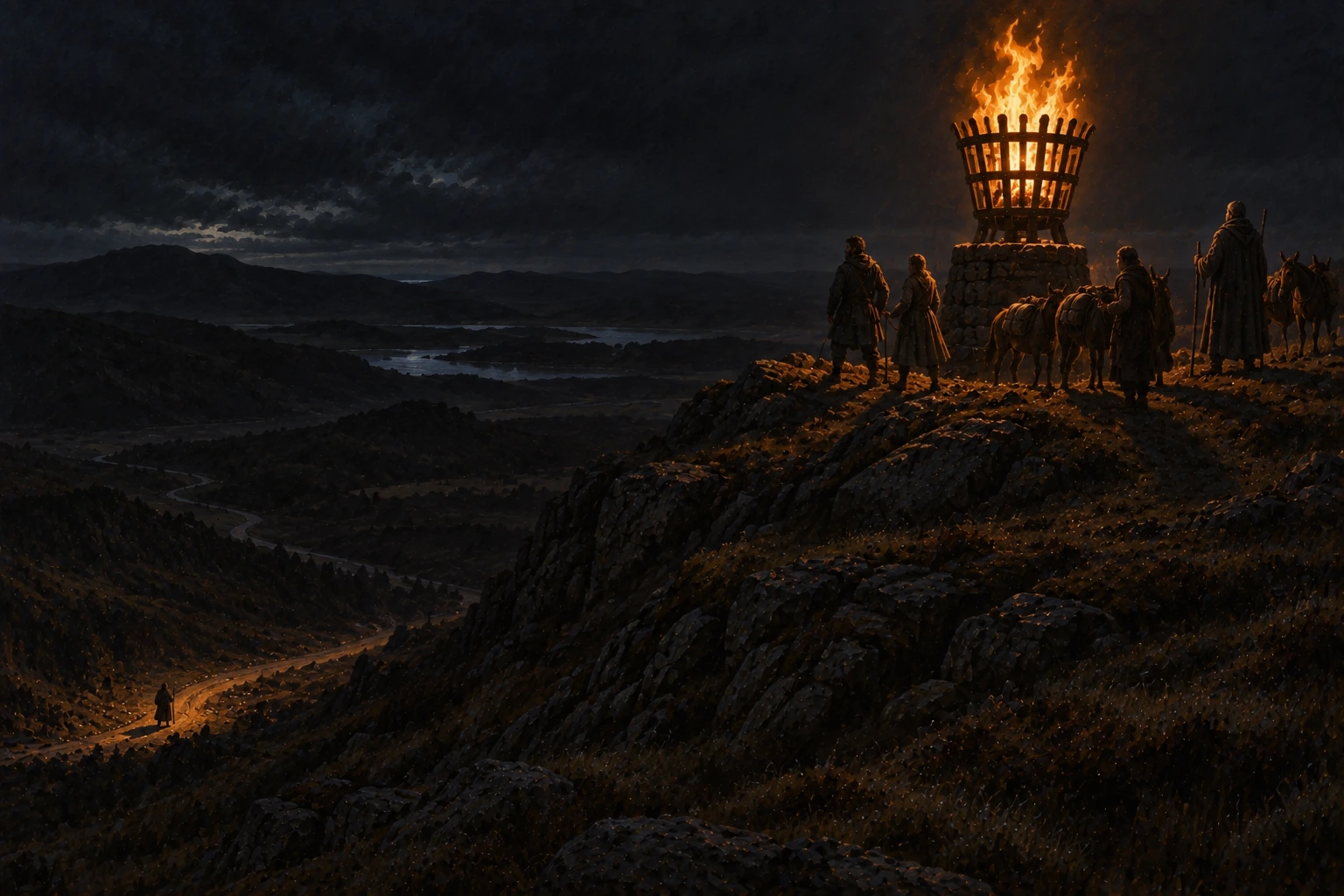
Three hundred years of Cartographer-lighters had laid the courses in this same order and there was nothing in it worth improving, so Pip laid them that way too: dry brush packed at the heart, the heavier lengths over it, the whole of it cradled in iron rods gone the same gray as the rock around them. He had started without being told. By the time Bracken and Ferrit came up the last of the scree with the second armload, the shape of the thing was already recognizable as work rather than as a pile. The hill's crown was bare stone scoured flat by wind that had never let anything grow tall enough to burn on its own, which was the whole reason the iron cradle existed at all — someone, a long time before Alder, before Sereth even, had worked out that a beacon on a hilltop needed feeding from below, because the hilltop itself would give it nothing.
The climb up had taken most of the afternoon, longer than any of them had judged from the lakeshore, because the hill was steeper than it looked and the last quarter of it was loose scree that gave back half of every step forward. Nettle had refused the last stretch outright and been left below with Ferrit's own mule and the bulk of the packs, and the company had gone up the rest of it on foot, in two loads apiece, sweating in the cold the particular way a body sweats when the air itself gives it no credit for the effort. Wren's legs had stopped complaining about it somewhere past the second load. It registered as flat accounting and nothing else: a thing that had once been hard and now mostly wasn't.
"Higher on the north side," Alder said, unhurried, watching Bracken settle the second load. "The wind comes off the lake before it comes off anything else up here, and it comes off the lake from the north."
Bracken shifted the brush without argument, which was itself a kind of answer to how much he trusted the old man's read of a hill he had never stood on before that afternoon. Below them the slope ran down through scrub and old terracing toward the lake's gray shine, and the light was going out of the sky slowly, the gray deepening to a color that had no good name, the sun already behind the western ridge though it would be another hour before true dark. Wren stood a little apart with the basket of kindling-splits balanced against her hip, watching Pip work, and found herself thinking that this was the oldest task the Survey had. Not the mapping. The mapping was new, comparatively; Sereth's own charts were less than a century old in places. This was older. Somebody had been climbing hills and building fires on their crowns since before there was a Survey to send them, and the Survey had only ever inherited the habit and given it a better name.
"Wakelow never went dark," Luel said. She had come up from the lower slope without any of them noticing, which was ordinary for her, and stood now looking not at the cradle but past it, west, to where a second hill rose against the last light, its crown showing the small steady point of a fire that had been burning, by her own account, longer than anyone now living had been alive to watch it. "Three hundred years, and it never went dark. There were people enough at its foot the whole time to keep climbing up and feeding it, even after there was almost nothing left to feed it for." She looked at the hill under their feet, at the cold cradle and the boy arranging wood in it. "This one went dark the second winter after the corridor opened. Nobody left down here to climb it."
"And the third," Bracken said. It was not quite a question.
"Kelder's still dark," Luel said, and did not elaborate. It was as much as she meant to say about Kelder before they were standing on it, and the company left it there.
Sael had gone quiet at the mention of it, the reel-case slung across her back the way she carried it everywhere now, unopened, and Wren thought — briefly, because there was wood still to carry and light going — of the lament's own accounting, two names given whole and one held back, the way a keeping holds back the coin it means to spend last. Kelder first, and then Ness Fell. She had heard Luel sing it at a distance from the Doors of Cloud, two years and most of a country ago, two lines and no more, and here was the second of the two lines standing under her boots with a fire cradle on its crown and no fire in it yet.
"You've never lit one before," Wend said to Ferrit, not quite a question either, hauling his armload of brush up the last rise with his arms wrapped fully around it because he had not yet learned the trick of balancing it on a hip.
"Nobody has, in my lifetime," Ferrit said. He was older than Wend by a few years and carried twice what Wend carried without seeming to notice the difference, the eaves' own labor showing in how little he thought about it. "My grandmother's grandmother might have stood on this hill when it still had a fire in it. I don't know what she'd have made of us doing it again." He set his load down at the cradle's edge, squared it without being asked, and looked back down the darkening slope at the lake. "I don't know what I make of it either, if I'm honest. It feels like borrowing something that isn't ours to borrow."
"It's not yours or ours," Dorrit said, passing between them with a fresh armload of her own. "It's the hill's. We're only giving it back what it's owed." She said it plainly, the way she said most things that mattered to her, and went on to the cradle without waiting to see whether it landed.
They worked through the last of the light without much more talk after that. Ferrit and Wend went down twice more for wood, coming back each time with less enthusiasm and more of it, because the hill did not give up dead brush easily and every armload was earned on a slope that punished careless footing. Ossen carried water up in a skin he had filled without being asked, on the theory — sound, as far as it went — that a fire built in a hurry sometimes needed putting out again before it caught properly, and it was better to have the means at hand than to go looking for them halfway down a dark hill. Dorrit worked the brush into the cradle's lower courses with the same economy she brought to dressing a wound, packing it so the air could still move through it, because a fire smothered by its own fuel was no fire at all, only smoke and disappointment. Once, reaching past Wren for a second bundle, she took the trailing end of a branch out of Wren's hands before it could catch on her sleeve, quick and wordless and entirely practical, the kind of small correction that passed between any two people who had worked a fire together for years, and neither of them made anything more of it than that. Alder stood back from most of the carrying and directed the shape without doing much of the lifting himself; the company had long since stopped expecting him to lift anything when a younger back was near.
The wind came up harder as the light went, exactly as Alder had said it would, off the lake and out of the north, and it made the last hour of work slower than the first, because twice a gust took the loose kindling out of somebody's hands and sent it skittering off across the bare crown, and twice somebody went chasing it rather than lose it over the hill's northern lip into the dark. Pip did not chase anything. He built with his back half-turned to the worst of the wind, the way he had learned to build every fire on the road west of the mountains, and when the cradle was as full as it was going to get he crouched in front of it with Rafe's flint and steel and struck, patient despite the cold working into everyone else's hands, until the third strike threw a spark that caught and held in the driest of the tinder he had packed at the very bottom, where the wind could not quite reach it.
It did not leap up all at once. It crept, first, along one course of brush and then another, orange going to yellow, and for a while it looked like nothing more than a large careful campfire on a hill too cold and too high to be sensible about campfires. Then the wind found it properly, and it stopped being careful.
Wren had seen the company light fires on a hundred nights by then and had never seen one do what this one did, because this one was built to be seen and every fire before it had been built to be small. It went up the cradle's iron frame in a rush that pulled the wind into itself and roared with it, a column of light standing where an hour before there had been nothing but cold stone, and the crown of the hill went from gray dusk to a moving orange that threw everyone's shadow long and black down the northern slope. Sael made a sound that was not quite a word. Wend, sixteen and never having seen a lament-hill lit in his life because there had been nothing to light in it, stood with his mouth open and his face turned up into the heat of it, and did not seem to notice or care that everyone could see him doing it.
"There," Alder said, to no one, or to all of them, or to the hill itself. He was looking west, to where Wakelow's small steady point burned on across the lake, as if measuring the distance between the two fires and finding it, for the first time in three hundred years, shorter than it had been. "That's one less dark hill in the world than there was an hour ago."
Nobody answered him. There did not seem to be anything to say that would not have made the moment smaller than it was, and for a little while they simply stood on the hill they had lit and watched it burn, ten people and the fire between them and nothing else in the whole dark country moving. Wren let herself feel it for exactly that little while — the plain, unearned pride of having built something rather than survived something, a feeling she could count on one hand the number of times the last two years had given her.
It was Dorrit who saw the road first, because Dorrit had learned, since the steading, to keep half an eye on any ground the firelight did not reach.
The road ran along the lake's shore below the hill, the same road they had walked to get here, empty when they'd climbed and empty, as far as any of them could tell in the fire's own light, for most of the time they had stood watching it burn. Then it was not empty. There was no sound of approach that any of them could afterward agree on — Ossen swore later there had been footsteps, ordinary ones, nothing hurried about them, and Ferrit swore just as flatly there had not, and Wren, who had ears for things none of the rest of them could hear, had heard nothing at all until there was something to hear. One moment the firelit road was empty. The next it held a shape standing on it, a good three hundred yards down the slope, not moving, facing up toward the burning hill as still as a man who had simply stopped mid-stride to look at it.
"Down," Bracken said, low, and the company went down without arguing about it, into the crouch and stillness that a season of hard country had taught all of them without anyone needing to explain it twice.
It did not come any closer for a long moment, and in that moment Wren had time to notice the three things about it that mattered, because there did not turn out to be very many more than three. It stood the height of an ordinary man, no taller, no broader, built like any farmer or drover on the road, nothing about the shape of it wrong. It wore a coat, plain undyed wool gone the color of old rope, cut in a fashion Wren had never seen on anyone living, a coat that belonged in a portrait rather than on a road. And though the night had gone cold enough that every one of the ten crouched on the hillside above it was breathing out little clouds of their own breath, the shape on the road was not.
"That's not close enough to be an accident," Alder said. "It saw the fire and it came to see about it."
Then it started up the slope toward them at an easy walk, and it did not need to shout to be heard, because whatever else it was, it had no trouble making itself heard.
"You've lit my hill," it said. A woman's voice, older, warm, almost fond, entirely reasonable. "I'll want that put out again, when we're done talking."
It kept climbing while it spoke, no more urgent than a man walking up to a neighbor's door, and nobody on the hillside moved to stop it, because none of them yet knew what stopping it would take, or whether it could be stopped at all.
"I've come a long way for a short conversation," it said — and the voice was different now, a boy's, young enough that the register alone should have been comic and was not, because nothing else about the delivery had changed at all, the same patient reasonableness carried over into a voice that could not have been more than twelve years old when it stopped being anyone's. "You have a book. I want it. I don't have anything to give you for it — I want to be honest with you about that, because there's no use pretending otherwise to people who'll only find out in a minute that I'm not — but I'm asking anyway, because I've found that asking costs nothing and I have had a great deal of time to learn what costs nothing."
It stopped perhaps twenty feet below where Alder stood at the front of the company, close enough now that Wren could see there was nothing wrong with it at all, and that was somehow worse than a wrong shape would have been, because a wrong shape could at least be looked away from.
Wren had heard the dead before — heard them the way she heard anything on ground the Quiet had touched, a pressure at the edge of something that was not quite sound — but she had never heard three of them speaking out of one mouth in the space of a minute, handed off between voices as a bucket is handed down a line of men fighting a fire, no one holding it a moment longer than they had to. None of the voices belonged to it. All three had once belonged to somebody standing on a road very like this one, and none of the three would ever stand on any road again, and the thing wearing them did not seem to think that was worth remarking on, which told her almost everything else she needed to know before it said another word.
"None of them is yours," Wren said. She had not decided to say it. It came out of her the way the names came out of her now, without much say in the matter, four words that told her more about what she was looking at than a much longer sentence would have.
The thing turned its head toward her — only her, for the first time — and for a moment it did not speak at all, and in the silence something in an old man's voice, cracked and dry, said, almost to itself, "Forty rods. Chain. Forty rods," the flat singsong of a man calling a line down a survey, three words that meant nothing to anyone on the hillside and nothing, apparently, to the thing that had spoken them either, because it went on in the boy's voice a breath later as though nothing had interrupted it at all.
"No," it agreed, pleasantly, to Wren. "None of them is mine. I haven't had one of my own in longer than any of you have been alive to imagine, and I find I do without it better than you'd think. What's yours?"
"No," Wren said again, and did not answer the rest of the question, and felt Alder's attention on her sharpen without his head turning, approval and warning in the same silent breath.
"That's fair," the thing said, in the woman's voice again, unoffended, as if she'd merely declined a second helping at supper. "I ask most people that, when I get the chance. I've collected a great many names in three hundred years and none of you has ever told me the one I actually wanted." It looked past Wren, along the ragged line of the company crouched and standing on the slope above the fire's light, ten faces it did not know and did not, by its own account, need to know. "The book, then. I'll ask you instead," it said, and the voice had shifted again, older, a man's this time, dry as the first had been but heavier, a voice that had once given orders and had not given any in a very long while. "Somebody among you is carrying it. I can feel it the way you'd feel a lit window on a dark road. Hand it down and I'll leave the rest of you exactly as I found you."
"You'll leave us exactly as you found us either way," Alder said. It was the first thing he had said to it directly, and his voice when he said it was not the voice he used for teaching, or for the weather, or for anything Wren had heard from him before. Bracken had already moved, without a word passing between the two men, into the space just ahead and to Alder's right, weight settled low, the short blade that had ridden unremarked at his hip since before any of them had known him now simply in his hand, no flourish to the drawing of it, the way a man reaches for a tool he has used enough times not to think about reaching for it.
Something in the thing's stillness changed, subtly, as weather changes before it can be named as changing.
"You've brought a great many people up a hill to tell me no," it said, in the old man's voice, and there was, for the first time, something in it that was not quite reasonableness — not anger, nothing so warm as anger, but a kind of dry recalculation, a man revising a figure on a page. "I could ask why a beekeeper and a soldier and a handful of eaves-children think a book is worth standing on a cold hill for. I won't. It would only be a way of pretending I don't already know the answer is that it isn't mine to have, and that some people will stand on a cold hill for that alone, and think nothing of the standing."
"You could tell us why you want it," Alder said. "You haven't."
"No," it said, in the woman's voice again, mild, entirely undisturbed by the question. "I haven't, and I won't tonight, and I'd ask you not to mistake the not-telling for a kindness. It costs me nothing to keep it, the same as asking costs me nothing to spend. I've simply found, in three hundred years, that explaining myself has never changed what anybody standing where you're standing chose to do next."
"You could ask why we lit the hill instead," Bracken said, low, not lowering the blade.
"I know why you lit the hill," it said, and for the first time something in the voice — still the woman's, still warm — thinned at the edges, the barest suggestion of a thing that had been waiting three hundred years for somebody to make it necessary to say this and had never expected the evening to arrive. "You lit it because you could. That's the whole of your reason and it's a better one than mine."
Down the slope, at the fire's edge nearest the road, Sael had shifted her stance without seeming to decide to, planting herself between Wend and the open ground below in a way that put a body — hers — in front of the only unguarded gap in the company's ragged line, the reel-case slid off her shoulder and set down carefully, out of the way, where a blow meant for the boy beside her would have to go through Sael first to get there. She did not say anything. She did not need to.
"Sing me something, singer," the thing said, and turned toward Luel, in the boy's voice again, light, almost fond. "You've a word for me. You've had one for a very long time. Say it, and I'll tell you if you've got it right."
Luel stood very straight at the edge of the firelight, three hundred years of her own weight held somewhere behind a face that gave away nothing at all, and said, "No," in a voice that had two words' worth of steadiness spent on saying one, and nothing further, and the thing looked at her for a long moment, waiting, as a man waits at a door he expects to be opened, and the door did not open, and after a moment it let the waiting go and turned back toward the company at large as if the question had never mattered to it in the first place.
"Ten of you," it said, in the woman's voice, counting them as a buyer counts coins laid out on a table, entirely without malice, because malice would have required caring about the answer before it had it. "Six who might fight and mean it, and four who'd surprise me. That's a great many odds for one book, when I've three hundred years to try again on a night that isn't this one."
Nobody on the hillside moved. There had been no time to. The thing was simply not where it had been standing, and the road below the hill, when Wren made herself look at it, was as empty as it had been before the fire ever caught, and the only sound on the whole slope was the beacon burning on above them, indifferent to all of it, and ten people breathing hard in cold air that no longer had anything else standing in it to notice.
Bracken did not put the blade away at once; he stood with it still in his hand, looking down the empty road for a count of maybe thirty, as though waiting to be proven wrong about the emptiness, and when he finally sheathed it his hand was not quite steady doing it, which he did not try to hide. Wend had sat down, hard, on the cold stone, not crying, just sitting, as if his legs had simply stopped taking instruction. Ossen crouched beside him without touching him, close enough to be leaned on if Wend had wanted it, and did not offer him anything else. Sael picked the reel-case back up off the ground and slung it across her shoulder and did not say a word about what she had done with her body a minute before, and nobody asked her to. Ferrit stood a while longer looking down at the empty road with an expression Wren could not read, and then said, to no one, "My grandmother's grandmother," and did not finish the thought, and picked up an armload of the wood they had not used and carried it back toward the fire instead, because it seemed, of everything available to do with his hands just then, the most useful.
"We won that," Dorrit said, low, testing the words as she said them like a person testing ice.
"We didn't win anything," Alder said. He was still looking down the road, though there was nothing on it to look at. "It counted us and decided the arithmetic wasn't worth a fight tonight. That isn't winning. That's being a bad trade." He turned, finally, and looked at the fire climbing the cradle above them, the one clean thing the whole evening had produced, orange against a sky gone fully dark now, throwing its light out over the lake and the empty road and the low dark country beyond both. "Get some rest. We're not stopping here."
Wren counted heads without meaning to, an accounting that had become reflex rather than decision since the steading: Alder, Bracken, Dorrit, Luel, Sael, Wend, Ossen, Ferrit, herself. Eight, and then Pip, already back at the base of the hill banking the small working-fire they'd used to catch the beacon. He had spent the whole of it facing the dark tree line at the column's tail instead of the road that had held everyone else's eyes.
They came down off Ness Fell in the dark an hour later, by the light of the one fire they had lit and would not be putting out, ten of them and the four mules picking their way along a track none of them could have found without it. Behind them the hill burned on into a night that had not seen fire on its crown in two hundred years, a small hard point of orange keeping company with Wakelow's across the black water, with Kelder somewhere beyond both of them still holding its three centuries of dark. They allowed themselves one look back at it, and the once was enough: it was still burning, and it went on burning long after the last of them had gone around the shoulder of the hill and out of its light entirely.