The Tune's Other Half
Pip left the distance-figure at the foot of the page for somebody else to check against a pacing count, the way he had left it every morning for two years, and then remembered, again, that the checking had stopped when Iyene did. He had drawn the ridge they'd crossed the day before, competent and a little cautious, and under it the working sheet carried a blank line where a bearing should have gone. He sat looking at it a moment with his pencil not moving. Then he wrote a number of his own, guessed rather than measured, and did not tell anyone he had guessed it.
Wren watched him do it and said nothing either. It was easier, this second morning, than it had been the first: not because the gap had closed, but because a gap that is walked around once a day for long enough stops announcing itself as a gap and starts being simply the shape of the road. Dorrit built the fire up without being asked and without her usual running commentary on who had banked it wrong the night before. Bracken checked the mules in the order he always checked them, and got to Barrow's girth and stood with his hand flat on the strap for a moment longer than checking a girth required, and then went on to Gable's. Alder made no remark on any of it. He had not, so far as Wren had seen, made a remark on it since the grey hour they'd left the first eaves, and she had begun to understand that this was not because he felt it less.
There were smaller absences too, ones that only showed themselves at odd moments across the day. The bearing-log had gone unmade the previous evening, sitting unopened in the satchel where Iyene's own hand would have filled two full pages by now, correcting the day's error against yesterday's and noting, dryly, which of them had drifted worst. The company's tally of days out from the eaves — a small thing, the kind of number Iyene had kept without seeming to try, the way she kept a dozen other running counts nobody else thought to hold in their heads at once — had gone unspoken for two mornings running, until Wren, walking the shoreline path with nothing better to occupy her hands, worked it out herself on her fingers and said it aloud at the noon halt, and watched Bracken nod at the number as though it were owed to somebody, though there was no one left in the company whose job it had been to ask for it.
They were three days now along the lake's northern shore, in the low houses the Amarin here called, when anyone asked them what to call it at all, only the Long Eaves, a scatter of dwellings roofed so far out over their own walls that a person could stand dry at the door through the hardest rain and never trouble the hinges. Wider country than the first household, and older-seeming for its width — orchards gone half to seed on the south slope, water-troughs cut from single stones and worn concave by hands three centuries dead, a bell of pale wood hung under the largest roof, unrung and unexplained the whole time the company had been there. Bracken had asked, the first evening, in the plain practical voice he used for asking anything, whether any of the household might know the country ahead of Kelder well enough to walk a stretch of it with them.
The answer he got was not the answer to that question. It came from the household's eldest, a man introduced to them only as Doran, spare and upright in a cloak the same shifting grey-brown-and-heather as Luel's, who set down the bowl he was mending and looked at Bracken for long enough that Wren thought at first he had not understood the words.
"We do not leave the eaves," he said. Nothing else, at first — no softening clause, no if-it-were-otherwise. Then, because Bracken did not look satisfied with that alone, and did not pretend to be: "It is not a rule someone wrote for us and left. It is an arithmetic, and we have run it more than once. Sennet went, three lifetimes back, to see the Meddan roads for herself before the frost took them, and did not come home, and no one ever learned what became of her past the second winter. Corren's father went with the last relief the Meddan beacons ever asked of us, and burned with the hill he went to help hold. And you have one of us at your own fire tonight who left, and is not dead only because dying was never the word that happened to her instead." He did not look at Luel when he said it. Everyone else did. Luel went on with the strap she was mending and did not look up, and did not deny a word of it.
"We are not unkind for staying," Doran added, more quietly, as if the first part had cost him something and this part cost him less. "We are only people who have counted. There is a difference between a wall and a scar, Master Hale, and I would ask you to believe we know which one this is, having built neither of them on purpose."
Bracken said, after a moment, that he understood, and did not press it again, and Wren thought that was the most respectful thing she had seen him do in some time — not arguing a grief he had no numbers of his own to set against it.
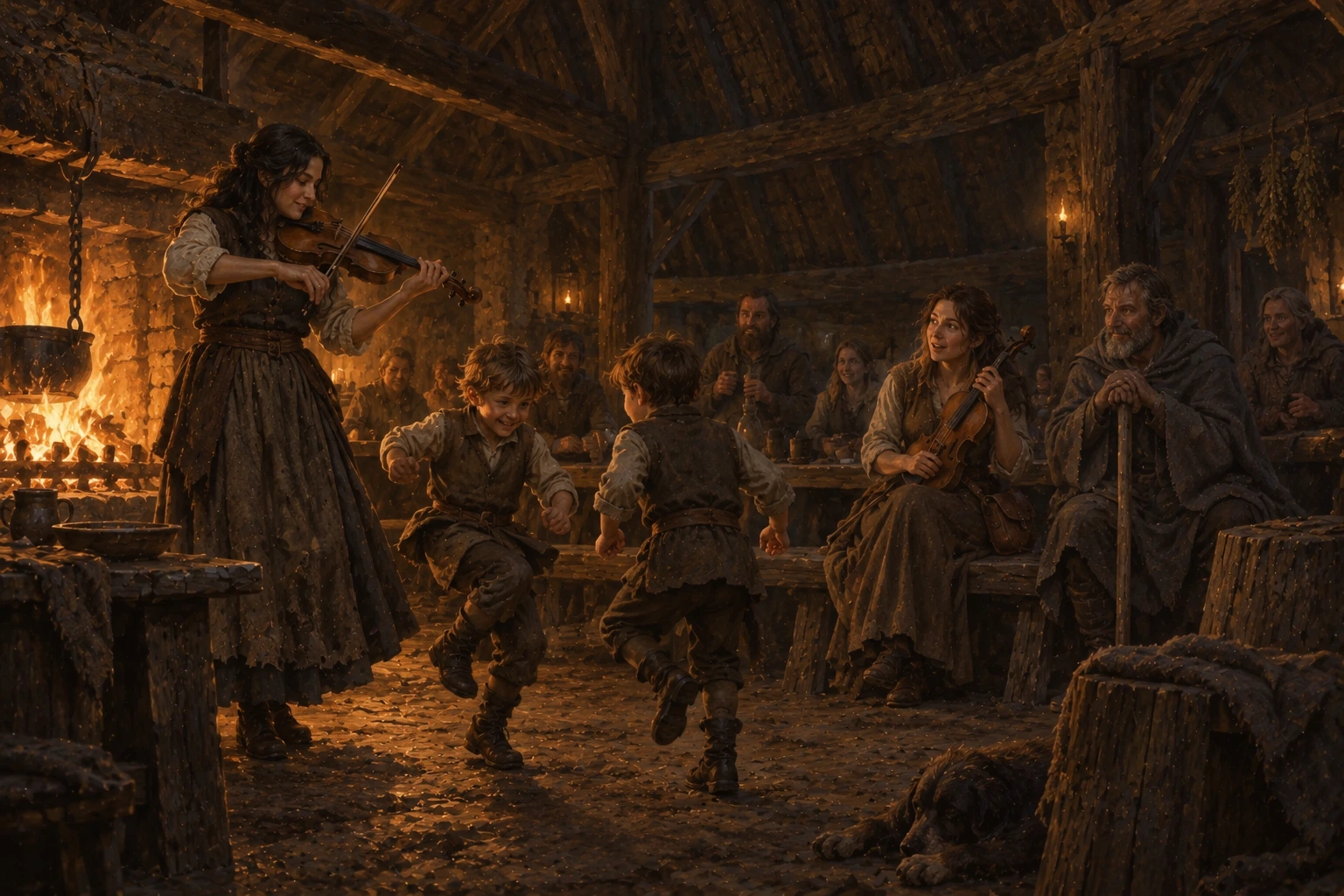
The evening gathered the way evenings gathered at the Long Eaves, which was to say without anyone deciding it should. Supper was taken under the widest roof, at boards worn pale and smooth by hands going back further than anyone present could count kindly: a thick barley pottage with river-fish flaked through it, dark bread still warm enough to steam where it was broken, a hard sharp cheese Dorrit pronounced better than anything she'd tasted since Merrow and then, a moment later, better than anything she'd tasted since home, correcting herself with a small private wince that nobody but Wren seemed to catch. Pip had his slate out before the bowls were even cleared, sketching the roofline against the last of the light, the long unbroken pitch of it, the pale wood bell hanging silent under the ridge; Dorrit's eye caught the sketching once, an old reflex, and moved on without a word. Somewhere in the clearing of bowls a woman began humming without seeming to notice she had started, and a boy fetched a drum no bigger than a cheese-round and began tapping it against his knee, and a girl went and came back with a fiddle.
She was younger than Wren had expected any of them to be — Amarin of no readable age generally, Luel had taught her that much, but this one moved with a quickness that read as youth regardless, dark hair loose down her back, a fiddle waisted narrower through the belly than Wren's own and strung with something pale that caught the firelight and was certainly not gut. Doran's daughter, Wren gathered from the way the old man's face changed when the girl came and sat, unbidden, on the log nearest the fire. Sael, someone called her, asking for a tune, and Sael laughed and said she supposed she could be persuaded, in the tone of someone who had rarely in her life needed persuading to play anything at all.
What she played was a reel — quick, bright, built for feet rather than for listening, the kind of tune a whole roomful of people could pick up the shape of inside four bars and start clapping along to before they knew the name of it, if it had a name at all — a thing the room seemed entirely content to leave unspoken. Two of the boys got up to dance almost at once, badly and happily, and Dorrit clapped time with real enjoyment, and even Bracken's boot kept a beat against the packed earth that he did not, Wren thought, entirely intend to be caught doing.
Wren sat very still and did not clap.
She could not have said, afterward, which bar it was that turned her cold. It was not the opening — the opening was only quick and cheerful and strange to her the way any stranger's dance-tune is strange, pleasant and forgettable. It was somewhere past the middle, where the tune bent, where it should by every rule of a country dance have straightened out again toward the close and did not: it dropped instead into a run of notes that climbed and did not resolve, hung a half-step short of home, and came round again to the top of the reel as if that hanging note were simply the tune's own habit, its particular flavor, the little imperfection a whole village had danced to for so long that nobody left alive remembered it as anything but correct.
Her hands remembered it before her mind agreed to. She felt her own fingers move against her knee in the shape of a fingering she had not made in two years, an answering phrase that came after the hanging note and finished it, and she pressed her palm flat against her leg to make them stop.
She did not go to her case. She did not say anything to Alder, who was two seats down the log with his face turned toward the fire and not, so far as she could tell, toward her. She sat through the reel a second time and a third, while the dancers changed partners and the drum found its stride and nobody in that whole warm firelit crowd knew that the tune they had danced to for longer than any of them had lived was missing its own ending, because none of them had ever heard the other half of it played, and so none of them had ever known there was a half to miss.
It was the fourth time through that her hand went, without her having decided anything, to the case at her side.
She did not play it well. She had not touched the strings in two years except to tune them out of some stubborn housekeeping instinct she could not have defended, and her fingers were slow finding a shape they had once known better than her own name, and what came out under the drum and the fiddle and the general noise of the dance was three notes, four, ragged and quiet and almost lost — the answering phrase, the one that finished the hang, played so badly and so briefly that for a moment she thought no one had heard it at all over the general noise, and was almost glad.
Sael heard it.
The girl's bow did not stop, exactly — it faltered, missed a beat, caught itself, and on the next pass through the tune she played the hanging phrase again and, a breath behind Wren's four notes, played the answer herself, cleaner and surer than Wren had managed it, because she had a whole living hand for it and Wren had two years of not using hers. The reel closed. For the first time in three hundred years, so far as anyone in that room could have told her, it closed on a note that meant to be the last one, round and settled and finished, instead of hanging open into its own next beginning.
The drum stopped. The dancers, mid-step, stopped with it, in the ragged way people stop when the music under their feet does something it has never done before.
Nobody spoke for what felt to Wren like a long time and was probably four or five breaths. Sael was looking at her own hands on the fiddle as though they had done something without consulting her, which in a sense they had. Doran had come half up off his bench. Somewhere behind Wren, Alder's voice said, quietly, not to the room, "There it is," in a tone she recognized — the tone he used when a thing he had wondered about for a long time finally showed him its shape, gentle and a little awed and entirely unsurprised, as if he had known this was coming since long before he could have known any such thing.
"Where did you learn that?" Sael asked her. Not sharp. Only bewildered, and young, and honestly asking.
"From my grandmother," Wren said. "She had it from hers. Eleven of us, that we know of, and I don't think a single one of them ever heard it finish."
"Nor we," Doran said, very low. "We have called it a dancing tune since before my grandmother's grandmother. We did not know we had lost anything, because we did not know there was more to have."
Alder, when the room turned to him for an explanation he plainly was not going to give in full, offered only that a road once ran the whole way between the two halves of that tune, the way it had once run between the two halves of the beacon-line, and that neither people had thought to ask the other how their own half ended, because for three centuries there had been no one left on the near side to ask. Dorrit, practical even now, asked him how he had known to expect it. "I didn't," Alder said. "I noticed, a long time ago, that her half stopped somewhere it had no business stopping. I did not know what would answer it. I still don't know why it took three hundred years and a lake to bring the two halves into the same room. I only know that it did, and that I am glad of it, and gladness is not the same thing as understanding, and I have stopped needing it to be."
Dorrit let it stand, and turned back to banking the fire without asking anything further. Wren, sitting with the fiddle heavy and strange in her own two hands, found she was glad of that too — not of the tune, exactly, not yet, not simply. The last time she had held this shape under her fingers she had been standing on a hill above Dall with Cob Hedley's life going out of him and the only coin she had to spend was the sound now sitting whole and returned across her palms, and she did not know yet what it meant that someone else's three hundred years of keeping had put it back there. She knew only that it had cost something once, and that the knowing of the cost had not gone anywhere at all, and that the tune in her hands was, for that reason, not the same object it had been an hour before.
She set the fiddle back in its case without playing it through again.
Doran found Alder alone by the horse-line an hour later, when the fire had burned down and most of the household had gone in. Wren, coiling a picket-rope nearby that did not strictly need coiling, heard the old man before she saw him.
"She means to go with you," Doran said, without preamble, in a voice that had lost the whole of its earlier evenness. "Sael. Tonight, or tomorrow — she has not said which, only that she means it, and my daughter does not say a thing twice before she does it. You are a man of some craft. I have watched you three days and I know craft when a man carries it the way you carry yours. I am asking you to hold her here. A line, a binding, whatever your work is called — I do not need to understand it. I only need her still standing under this roof a week from now."
Alder was quiet long enough that Wren thought he might simply decline to answer at all. When he spoke his voice had none of the earlier softness in it.
"No."
Doran waited, as if the single word were an opening rather than the whole of the answer.
"I could try," Alder said. "I want you to understand that I could try, and that trying would very likely work, for a while, because I am better at this than most men living and your daughter does not know what a line like that would feel like from the inside until it had already closed on her. And I will not do it. Not with rope, not with fire, not with the smallest working I know how to make. A thing that holds a person against her own will is not a ward, whatever else it resembles. It is a cage with better manners, and I have spent a great many years learning to build the one and not the other, and I do not intend to forget the difference tonight because it would be a kindness to you if I did."
"She is nineteen."
"She is old enough that her own people would have called her a woman grown three hundred years ago, and I expect they still do," Alder said. "I am sorry. I mean that plainly, not as a form of words to close a conversation I don't want to have. I am sorry, and the answer is still no."
Doran stood a moment longer, and then turned and walked back up toward the long roof without another word, and did not look back, and Alder did not call after him, and Wren finished coiling a rope that had needed it least of anything on the picket-line, and said nothing to either of them about any of it.
Wend found Bracken before Bracken found him, which Wren gathered afterward was the wrong order for what followed.
He was younger than Sael, or looked it, restless in the particular way of someone who has decided a thing is coming and is impatient for the world to catch up to his decision. He'd been at Bracken's elbow twice already that evening asking after the mules' loads, the company's route, how many of the Amarin who'd come with the Survey before had fought and how many had only walked, and Bracken had answered him shortly both times and gone back to his work. The third time, near the horse-line, with his mother Yeva's flat "no" not an hour behind him and still plainly ringing in his ears, Wend asked whether it was true a man could learn to use a blade well enough to matter inside a season, if he had the will for it.
"You'll learn to use one well enough to get somebody else killed inside a season," Bracken said. "That's the easy part. The part that takes longer is learning which fights are worth the killing, and you don't get to skip to that part just because you're in a hurry to leave home." He did not raise his voice and did not slow down at the mule's rope he was checking. "You think this is the start of something. It isn't. It's the middle of something that's already killed more people than your whole household has names for, and it does not care how much you want to be brave in it. You'll watch people die who trusted you to be more use than you were, and you won't have time afterward to feel what that deserves, because there'll be another one needing you an hour later. That's the whole of it. There's no other half to that coin I'm keeping back to make it sound better."
Wend's jaw set, the way a young man's jaw sets when he has decided not to let a thing land and it has landed anyway. "I'm still going."
"I didn't say don't," Bracken said. "I said don't go thinking it's a story, because it'll cost you the same either way and it's better to know the price going in." He turned back to Suet's girth and did not soften it with anything more, and did not look up again, and Wren, close enough to have heard the whole of it and unable to think of a single thing that would have made it kinder without also making it less true, found she did not wish he had.
Luel came to the four of them who had decided — Sael and Wend and, it emerged before the night was out, two others whose names Wren set down carefully and did not let herself forget: Ossen, who had said nothing all evening and volunteered last, and Ferrit, Sael's own cousin, who went because Sael was going and did not pretend to any better reason. Luel sat with the four of them apart from the fire, on the low wall above the orchard, and Wren, near enough to hear and not asked to leave, stayed.
"You will want me to tell you it is not so bad as your elders say," Luel said. "I will not tell you that. I left this ground longer ago than any of you can hold in your head as a number, and of the six who went with me that year, I am the only one who can still be found. Not the only one living — the only one who can be found at all, which is a worse thing to be able to say of a person than dead, and I say it to you plainly because nobody said it to me, and I have had three hundred years to decide that was an unkindness, however kindly it was meant." She looked at each of them in turn, unhurried, and none of them looked away from her. "I am not going to ask you to stay. I have no right to ask anyone that, having gone myself. I am only going to tell you the truth of the road, once, and let you carry it with you instead of finding it out the hard way as I did."
She told them, then — not a speech, only a list, spoken low and even: what the cold country between the eaves and Kelder had taken from travelers before, named and unnamed; what a name is worth and how quickly a person forgets they had one, out past the last warm roof; that the world past the mountains did not know or care that they were young, or brave, or loved. She spoke of the ford below Cael Meddan, which she had crossed herself once, long ago, in company that had also been six and was four by the time the water let them go, and named the two who had not made the far bank, plainly, without asking anyone to feel a particular way about hearing it. "I do not tell you this so that you will stay," she said. "I have told you I will not ask that of you. I tell you because a road walked without knowing its cost is not bravery. It is only luck wearing bravery's coat, and luck runs out exactly where you least expect to need it." She did not raise her voice once through the whole of it, and none of the four interrupted her, and when she was done she said only, "That is the truth as I have it. I will not say it again, and I will not soften it if you ask me to."
Ossen looked at the ground for a long while. Ferrit put a hand on Sael's shoulder, briefly, and took it away again. Wend said, low, that he had already told his mother and was not telling her twice.
Sael said nothing at all, which Wren thought, watching her, was its own kind of answer.
They left the Long Eaves at first light, ten on the road where six had walked in, four new ones beside them, and the leaving was not made easy by anyone's trying.
Doran stood at his own door and put both hands briefly on his daughter's shoulders, and said something to her in the Amarin's own tongue, low, that Wren did not understand and did not ask to have carried into common speech, and then he stepped back and let her go, and that stepping back cost him visibly more than the refusal he had asked of Alder the night before would have cost, had Alder given it to him. Yeva did not come to the door at all. Wend looked back at the shut house once, on the second turn of the path, and did not look back a second time.
Wren walked near the back of the column, where Alder fell into step beside her without announcing that he meant to.
"You could play it through again," he said. "Whole, I mean. Now that it's whole."
"I know I could," Wren said. She thought about it a moment more, the fiddle riding quiet in its case against her side, the shape of the answering phrase still sitting strange and returned in her two hands. "I don't think I will. Not yet. It cost something the first time I used it, and knowing what it cost hasn't made it lighter to hold, only heavier in a different place. I'd rather carry it a while before I spend the sound of it on anyone, even myself."
Alder did not press her, and did not tell her she was right or wrong to feel it so, which she had half expected him to do and was glad, on reflection, that he had not.
The path climbed away from the water in long shallow switches, frost still whitening the grass in the hollows the sun hadn't reached, and the four newcomers found the company's pace slowly and by trial: Ossen falling in beside Bracken within the first mile as if he'd walked behind a mule train all his life, Ferrit staying close to Sael's shoulder and saying little, Wend ranging ahead and being called back twice before he learned the column's temper well enough to stop doing it. Sael carried her fiddle slung the way Wren carried her own, high across the back where the case would take the least of the day's jolting, and said nothing about it, and Wren, glancing back once, thought that was its own kind of answer too. They walked on into a morning that was cold and clear and gave no particular sign of what lay ahead of it, the lake falling away grey and flat behind them, and the road running west, as it had every morning since Merrow, toward a country none of them had yet seen and all of them were now, for their own several reasons, walking toward together.