The Stair of Morning
Morning came up cold and hard-edged on the day the Survey left the Watch on the Stones — high-country weather in the first true week of a mountain spring, hard-edged, and very bright — and it was cold enough to make a person's breath stand up in front of her like a small white flag until the sun cleared the eastern shoulder and got properly to work on the frost; and the whole watch was turned out in the yard before the light was an hour old — not a grand leave-taking, only every last soul who could be spared standing about in the cold on purpose because seven people and four mules were going, and it seemed to the watch a thing that wanted proper witnessing.
Harrol did the witnessing in her own register, which was to say with her hands full the entire time. She came down the line with a bundle under one arm and a coil of rope over the other shoulder, and distributed both without ceremony, like bread handed round at a table where the talk is too good to stop for manners.
"The scouts' notes," she said, putting the folded pages into Iyene's hand rather than Wren's, which Wren noted and approved of without saying so. "Every gully they crossed, every stretch they'd have thought twice about with a loaded mule, written plain, because I'd rather you had a dull true page than a clever guess. And this" — the rope, which she set down across his good forearm rather than putting it into his hands, having watched him load a string that morning and drawn her own conclusions — "is Orran's, cured his own way, and he says if you fray it on anything less than solid rock he'll want an explanation."
"I'll want one myself," Bracken said, running a thumb down the lay of it with the pleasure of a craftsman handling another craftsman's work, "before I'll let it fray on anything at all."
He said the rest of it straight, to Orran rather than to Harrol, because it was Orran's rope. "I'll not take this and let you think I'm careful. I lost my spare coil off the Long Shelf in October, into a gully, with the grain and the cheese, and I've walked from there to here on one line. Thirty years I've told every recruit who'd hold still for it: two of most things, one to use and one to lose. I had two. I lost one." He settled the coil against his side. "So I'll take yours, and I'll tell you plainly it doesn't put me back to two. A rope a man's never worked isn't a spare. It's a hope with a lay on it."
"Then work it," Orran said, "and it'll be a spare by the second stage," which Bracken allowed was the sensible answer and did not look any easier for having heard.
Enna's contribution came last and heaviest, a sack of the flat travel-bread she baked only for departures, pressed on Pip specifically, on the theory that a boy who ate as he was growing would see it eaten properly rather than hoarded. Pip went pink and promised he would. Dill stood through the whole of it at the end of the line by himself, saying nothing at all, his eyes red-rimmed, until the very last moment, when he produced from behind his back a small carving of a stair, cut crooked and earnest out of a scrap of picket-fence, with seven little notches along one side that he explained, going scarlet, were meant to be them.
Willem came last of all, and gave Wren no gift beyond a promise. "The moment anything makes it over the road, north or south, it'll chase you. I don't mean to let it start on my watch."
Marle and Mercer stood at the yard's outer edge through all of it, neither part of the leaving nor excluded from watching it. Marle raised a hand as the company shouldered its packs. "A safe crossing to all of you," he said. "I mean that as simply as it sounds." Wren believed him, and said so with a nod.
Every eye in the yard slid past the far end of it, where the forge door stood propped open and a lamp burned inside it, uselessly, in daylight. Not looking took the whole yard some doing. Then Harrol said the thing she had saved until the gifts were done. "The road's been kept from this end," she said, "as long as anyone living here can say — watched, and warmed, and walked out to meet whoever needed meeting. Go and see how well they kept the other."
The company answered it with nods, and shouldered the last of its own weight, and went.
They walked up past the last of the Stones in the hardening light, the watch's low roofs and its small steady lamps — still lit, out of long habit, though the sun was well up — dwindling behind them flight by flight of the rising ground, until a shoulder of rock took the whole picture away at once. Ahead, the pass mouth opened between two grey heights that leaned toward each other without quite touching, a gap the width of a good barn door in a wall built for giants, and beyond it, sudden and entire, the Stair.
It began simply enough, which was itself the first thing Iyene remarked on, crouching at the foot of the lowest flight with her glass already out. "Broad," she said, running a hand along the worn edge of the first step. "The tread's deep enough for a laden mule to set down square, not scramble for a toehold, and the rise is shallow enough to take at a walk rather than a climb. This is not a fortress-stair, built to make an enemy suffer for every foot of it. This is a trade-stair, meant to be walked up comfortably, over and over, by people carrying things they didn't want dropped." She looked up the first long flight, disappearing switchback by switchback into cold blue shadow, with the particular unguarded delight Wren had come to recognize as Iyene's whole professional soul standing at attention. "Somebody planned for exactly us, a very long time ago, and never got to meet a single one of us to be thanked for it."
"They planned for a good deal more than us," Alder said, coming up beside her with his stick already finding the camber of the first tread. "This is the Gray Stair," he said, in the flat steady voice he kept for facts too old to need decoration, "that was Cael-Amrun once — the Stair of Morning."
Luel had come to stand a little apart, at the very foot of the climb, looking not down the flights ahead but up, past all of them, to where the topmost steps stood lost in glare and distance; and when she spoke it was in the soft, quiet register she kept for the things that belonged to her rather than to the road in general.
"On feast mornings, when I was a child," she said, "we climbed to the top of this stair by the other side — the gentle side, the western valleys, where the steps run wide and shallow through orchard country and a child could climb them laughing, with breakfast still on her hands. We went up in the dark, all of us, whole households of us, and stood at the top to watch the sun come up the eastern steps beneath us — this side, the side you are standing at the foot of now. It climbs them in order, if you watch it properly. Flight by flight, the light comes up the stair the way a person comes up a stair, one step and then the next, because whoever cut this face into the mountain cut it to face the sunrise and meant it to be watched doing exactly that." She was quiet a moment, and did not turn to look at any of them. "I did not know, when I was small and cold and glad on that other side, that I was watching the same sunrise you are about to climb into. Nobody told me the two sides were the same stair. I have only understood it since I began walking with people who write things down."
Wren looked up the flights ahead of her — Iyene's trade-stair, Alder's Stair of Morning, Luel's remembered feast — and found the light was in fact doing exactly what Luel had said it would. The sun, newly clear of the pass-mouth's own eastern wall, was climbing the Stair a flight at a time, each broad tread catching gold in its turn and passing the catching upward to the tread above it — a steady procession of light up stone left long untended, and that worked this morning exactly as its builders had meant it to work on their very first one. It was a strange and entirely quiet kind of marvel — not a marvel that asked to be marveled at, only a piece of good work still doing its one job long after everyone who had planned it was dust.
She unslung the satchel and knelt at the foot of the first flight, in the last of the yard's proper shelter before the climb began in earnest, and took out the Waybook.
Wystan had drawn the Stair as he drew everything, in fine grey strokes that gave the shape of a thing without troubling to flatter it — the long climbing line of it switching back on itself flight after flight. A scatter of small marks she now knew by heart ran alongside: a crossed stroke here, a comb-mark there, the whole patient furniture of a road a man had walked and meant someone else to walk after him. At the drawn foot of the climb, in the spikier margin hand, a single figure stood alone.
Three.
She did not have to work at it as she had once worked at a well-mark's figure, a lifetime and a whole summer ago; it came to her at once. "Three," she said, mostly to herself, and then, because the company had gone into the particular quiet it kept whenever the book spoke, "suppers. His own count, coming down — three nights on this stair, from the top to the foot where we're standing." She traced the drawn line once with a fingertip, not touching the ink itself. "He counted his suppers coming down out of the very end of the world, same as he counted them on every ordinary stretch of road that never asked anything hard of him at all. I don't think I understood, until just now, how steady a hand has to be, to keep counting suppers on a road like this one." She closed the book and held it a moment against her chest before she wrapped it away.
The only sound for a moment was the mules' bells at the foot of the stair.
"Three suppers up, then, if the book's arithmetic holds for climbing as well as it held for descending," Bracken said at last, in the practical voice he kept for turning a marvel back into a plan, "which by my own reckoning of these first flights is no bad guess at all. We'll not beat his time and we've no cause to try. We'll take it in the hours the mountain allows us, and no others." He looked up the first long flight, hands already going to Barrow's lead rather than any other beast's. "Barrow goes first."
Dorrit, coming up beside him with her own pack settled, raised an eyebrow at that, remembering exactly which mule had spent six years being called a fool. "The bridge-hater. First on a stair."
"The bridge-hater," Bracken agreed, "who fears one thing in this world and one thing only, and there's not a plank of hollow wood between here and the top of it. Stone doesn't lie to him. A drum does. He'll set the pace, and the rest of the string will take their courage off his own, same as they always have, without ever once thanking him for lending it." He clicked his tongue, and Barrow, dun ears forward, stepped up onto the first broad tread with the unbothered confidence of an animal walking on ground he had already, somewhere in his own private reckoning, decided he could trust.
The day's shape declared itself within the first hour: not by anyone announcing it, but by the mountain behaving the same way twice in a row until the pattern could no longer be called an accident.
The stone was frozen hard and sure underfoot in the early hours, every runnel of the night's ice still gripping tight to the treads it had formed on, and the going, while slow, was as sure as any road they had walked all winter. But as the sun climbed and found its full strength on the upper faces, the mountain began, by degrees, to loosen what the night had bound. Meltwater ran first in threads along the drainage channels cut beside the treads, which Iyene pronounced, crouching to examine one, "the same builders' hand as the Drowned Bridge causeway, working the same trick twice — cut a channel for the water to travel by choice, and it will rarely trouble you by accident." As the morning wore on, it ran in places where the channels had silted or broken, over the stone itself, turning a good tread briefly treacherous until the company learned, flight by flight, which stretches wanted a hand on the rope and which could still be trusted to a boot alone.
It was on one of the doubtful stretches — a broken flight where three centuries of frost had split a run of steps into a scramble of canted slabs — that Bracken rigged the first hand-line, working with the same thoroughness he brought to every ford he had ever sounded. He could not test an anchor as he had tested anchors his whole working life — hanging his own full weight off it from a standing start; his right arm would not do it and he did not attempt it. So he tested them a slower way instead — bracing his back to the rock and driving through his legs against the line, three times on each anchor, and calling Pip in to hang the fourth. It took him twice as long, and Pip, watching from the second anchor, knew better than to say so. "We'll relay the loads across this one," he said, already easing the first pannier free of Suet's back, "rather than ask any beast to carry full weight over ground I wouldn't cross full-loaded myself. Slower, and slower's never cost me a man yet." The company fell into the work without needing to be told twice — Pip and Dorrit passing the lighter loads hand to hand along the line while Bracken led each unburdened mule across on a short rein, Alder taking the rear with his stick finding purchase where hooves could not. Luel moved, Wren noticed, with the easy, sure-footed balance of someone for whom broken stone underfoot was a much older acquaintance than it was for the rest of them.
It was on that same flight, with the rope taut between two set anchors and the whole company strung out along it in the particular close, watchful, unworried way of people minding a piece of work rather than a danger, that Pip's boot found a wet patch where the frost had let go early, and slid.
It cost him perhaps half a step, no more — a lurch forward, one hand already flung out from old instinct toward the rope, and Bracken's left hand closing on his forearm from behind before the lurch had finished happening, steady and sure, the way a man catches a dropped tool rather than a falling person. He had been walking on Pip's left side all morning, and had been walking on the left side of whoever most wanted watching since October, and had never said why. "There," Bracken said, and that was all of it — no cry, no scramble, nothing in it for anyone to remember as more than a boy's boot finding wet stone once on a long day of mostly dry stone, and a hand that happened to already be near enough to matter. Pip laughed at himself, a short embarrassed bark of a laugh, and set his boot again more carefully, and the line moved on.
They halted, as the sun climbed toward its own noon strength and the upper faces began, audibly, to loosen, in the deep lee of a standing rock shoulder that Bracken had marked from below as a good rest-stone almost the moment they'd rounded into sight of it. It was sheltered from the worst of the wind, and, more to the point, well clear of anything the ice above might choose to let go of once the day's warmth had properly worked its way into it. It was there, cloth spread and the noon bread going round, that they heard it for the only time that day: a long low grumbling rush, far off and high up, somewhere on a face they could not see from where they sat. It rolled a few seconds and then simply stopped, and the ordinary business of wind and water closed over the place where it had been. Bracken didn't look up from the buckle in his hands. Iyene noted the hour in her pocket-book without looking up from her bread. "That's the afternoon paying its own toll," she said, "same as the scouts' notes promised it would, and precisely why we're sitting here eating rather than standing there listening. A mountain in a thaw does this every fine day it's given, whether or not anyone's underneath it to hear the doing."
"Best sound in the world," Bracken said, comfortably, "is a rockfall a mile off and a company sat down to lunch." The sound did not come again, and the company ate its bread and its cheese in the cold bright shelter of the rock shoulder with the settled patience of people who had planned, quite deliberately, to be exactly where they were sitting at exactly this hour of the day.
It was in that same halt that Wren, looking back down the flights they had climbed, felt her breath catch on something that had nothing to do with the thin air. The whole of the autumn's walking lay open below her at once, laid out small and entire, a map spread flat on a table: the Watch on the Stones a scatter of grey roofs no bigger, from this height, than a handful of dropped seeds, and the pass road threading away east in a pale unbroken line. Far beyond that lay a thin bright thread that could only be the Fenwater, the same river whose drowned bridge had taught her, a whole season and a whole self ago, that a book could love a road as a person loves one. The whole walked distance of it — Merrow, the corn country, Dall itself, somewhere beyond the curve of the world's own edge — stood folded into that one long look, small enough to hold in a single glance and vast enough that holding it took something out of her she had not known, until that moment, she owned.
"It does that to everyone," Alder said, coming to stand beside her, not troubling to specify what "it" was. "The first good height of any real climb. The road behind goes small enough to see whole, all at once, which a road walking through it never lets you do." He looked out over it a moment himself, in no hurry. "It is, I think, the nearest thing to hindsight a living person is ever given for free."
They climbed on through the afternoon's cooling hours, the frost reasserting itself on the higher stretches as the sun's angle fell away from the steepest faces. It was on the last long flight before the day's stage that Pip, ranging a little ahead with the fire-tender's restless eye he brought to every piece of work that wanted minding, called back that a drainage channel beside the steps had silted entirely shut — a season or two of frost-rubble packed hard into a groove that clearly wanted to be running clear and wasn't. He set to it without being asked, working the choke free with the flat of a stick and his own bare fingers, and when the water finally broke through and ran, sudden and glad, down the channel it had been cut for long before, his whole face went alight with the look Wren had learned to watch for and love in him.
Nettle, meanwhile, had spent the day's climb behaving with a decorum so out of character that Bracken had taken to eyeing her sideways at every halt, as a man eyes a quiet child he suspects of some larger mischief still to come. She bit no one, balked at nothing, and took every roped stretch with a placid attentiveness Wren had never seen her spend on flat honest road. "There's something wrong with that mule," Bracken said at last, flatly, as if reporting a genuine anomaly of nature. "Six years I've known her to bite a man for looking at her wrong, and she's crossed the worst ground of the whole autumn without so much as a bad opinion voiced about it." Dorrit suggested, not entirely joking, that Nettle simply respected a stair on principle; Bracken allowed this was possible, and no less unsettling for being possible.
The way-stage, when they came up over the last rise of the day into it, was a broad landing set into a natural shoulder of the climb, walled on three sides in the same fitted stone as the steps themselves. Its roof was gone entirely to the weather, but its walls stood near enough their full old height to throw a proper wind-shadow across the whole floor of it. A threshold stone lay at the entrance, worn into a shallow hollow by feet that had crossed it, by Iyene's estimate, for centuries before the passes ever shut; and against the far wall stood a cistern basin, cut square into living rock, holding a still clear pool of meltwater fed, she confirmed, from the very drainage system they had walked beside all day.
"A rest-house with no roof and every other courtesy it ever had," Iyene said, standing in the threshold's worn hollow with something close to reverence in her voice, "built by people who understood exactly how far a laden company could climb in a day before it needed shelter, and built it here, on this shoulder, and nowhere less convenient." She looked around at the walls with a cartographer's pleasure in a problem well solved by someone else, centuries dead. "I would give a good deal to have stood at this man's elbow while he chose the ground."
It was Luel who went first to the fallen course along the stage's western wall, where a handful of capping stones had slid from their bed sometime in the last three hundred winters and now lay scattered in the grass at the wall's foot. Without remark, in the quiet way she did most things that belonged more to her own old habits than to anyone else's asking, she lifted one back into its gap and set it level with a small definite press of her hand, the motion of straightening a picture gone crooked on a wall you pass every day. She offered nothing beyond the doing of it, and the company let it stand exactly as given.
Wren found the well-mark at the cistern's near lip almost by accident, running a hand along the worn stone, from a habit picked up without her ever quite meaning to learn it, of touching old work everywhere she found it: a crossed stroke, cut shallow and sure, weathered soft but entirely legible. It did here exactly the same furniture-work it did on every ordinary well from Dall to the Fenwater and beyond. She touched it with two fingers — Granna Tansy's own gesture for things that mattered, with no show made of the mattering — and said nothing of it beyond a quiet nod to herself, because a well-mark at a cistern explained itself as plainly as a doorstep at a door.
Supper that night was Bracken's stew, thickened with Enna's travel-bread crumbled in against the cold, and eaten inside walls for the first time since the watch — a strange, good feeling, Wren thought, to sit at rest inside a roofless house built by hands three hundred years gone, and find the wind-shadow doing its old work exactly as promised — and the watches were set in the usual order, Bracken first from long habit, and it was at the end of his own turn, currying each mule down by lamplight before he'd let himself sit to his own supper, that he paid the string the fullest compliment Wren had yet heard him spend on any of them.
"Four beasts," he said, to Suet mostly, though the whole company was near enough to hear it, "climbed a road today that would have broken the nerve of every mule I trained before I ever met this string, and not one of them put a foot wrong that wasn't caught and mended before it cost anyone a moment's real trouble. I've quartermastered longer than you've been alive, and I'll tell you plainly, there isn't a company in the College's whole roll I'd trade this string for, not for double the coin and a lighter road besides." He ran a hand down Suet's broad neck, and Suet, entirely unmoved by the honor being done her, leaned her considerable weight companionably into the scratching and closed his eyes.
It was Pip who asked the question afterward, over the last of the stew, in the flat curious way he asked most things. "How far behind is he?"
Bracken took his time about it. He had worked the sum out days ago and had been waiting to be asked rather than volunteering it.
"Three weeks to his train, by his own mouth, and that was told us the better part of a fortnight ago. I'll grant him the figure — a man lying about that would lie longer, not shorter." He turned his cup on the stone. "Forty mule-loads is twelve beasts at a proper load, and tools besides, and eleven men who all want feeding twice a day. That outfit can't split a load and relay a broken flight like we did this morning. It hasn't got the daylight for it. Call it seven days on this stair against our four, and that's if the melt's kind and he doesn't lose a load off the third flight, which he will."
"So his train comes over the top the better part of a month behind us," Iyene said.
"The better part of a month. And the top isn't where it matters." Bracken looked into the fire. "What matters is that a train that size doesn't turn round. It gets up over the top of this thing once, and once is enough, because everything it carries stays up. We've four mules and a charter. He's eleven men and a purchase order that doesn't ask where a thing came from." He drank. "I'm not frightened of the man. I'm minding a clock, and I'd sooner mind it out loud at this fire than have the six of you minding it privately at three in the morning."
"How much clock have we got?" Wren asked.
"Daylight and load, same as every clock I've ever kept." He set the cup down. "A month before he's over. Every hour we spend up here comes off it, and that is a reason to walk properly. It is not a reason to walk faster than the ground allows. Those are two different things, and I'll thank this company to keep them different."
The second day settled at once into a rhythm the company trusted like an old habit: awake in the last dark before dawn, climbing hard while the frozen stone held true underfoot. A long halt came through the loudest part of the afternoon, in whatever shelter the stretch allowed, while the mountain, now and then, said so at a safe distance; then came a shorter climb in the cooling evening to a second way-stage, walls and threshold and cistern waiting exactly where careful planning had left them. The stair grew steadily harder — broken more often, its drops on the open side longer to look down — and the company met each difficulty as it had met the first: rope where rope wanted using, Barrow leading where footing turned to a question, loads split and relayed wherever caution outweighed speed. The air thinned by careful degrees, and the company simply slowed to match what was asked of it, no harder to bear than any other toll the road had levied on them the long way from Dall.
The third morning read wrong before anyone could say exactly how. Bracken was up before the light and stood long at the threshold with his face turned east, working his jaw over it — a knot that wouldn't own up to which end wanted pulling first. The wind, steady out of the north-east for two days, had gone quiet overnight and come back round out of the south instead — soft-breathed and warm and entirely unlike itself.
"I don't like a wind that changes its mind before the sun's up," Bracken said, when Wren came to stand by him. "Never have."
Iyene had the scouts' notes out before breakfast. "'Spring storms come up the east face fast — faster, some seasons, than a laden string can make a stage. Mind the wind's backing, and mind it before noon.'" She closed the book over her thumb. "Harrol's own hand. We are, this morning, being minded."
They weighed it in the open, at the threshold, with the mules still standing unloaded — hold the stage another day, or make the next one before the sky decided for them.
Bracken said hold. He said it once, and gave his reasons in the order he always gave them: a wind that had backed in the night, a stage they were already standing in, walls and water and a grain sack still full. "There's nothing between here and the next shelter a man could sit a bad morning out on. A day here costs us a day. A day out on those flights could cost us a good deal more than a day."
Iyene heard him out to the end. Then she said the other half of it, which was also true, and which only she, of the company, was going to have to put a name under.
"A day here costs us a day at the top of the pass, and we have not got days to spend at the top of the pass." She had the scouts' notes still folded in her hand. "Harrol's people logged four storms out of the south on this face last spring and every one of them blew through before noon. We have four hours of frozen stone. The next stage is three." She looked round at all of them and did not dress it up as anything other than what it was. "I hold the charter. I would rather be wrong going than wrong sitting. We move."
Alder said nothing whatever, and put his pack on.
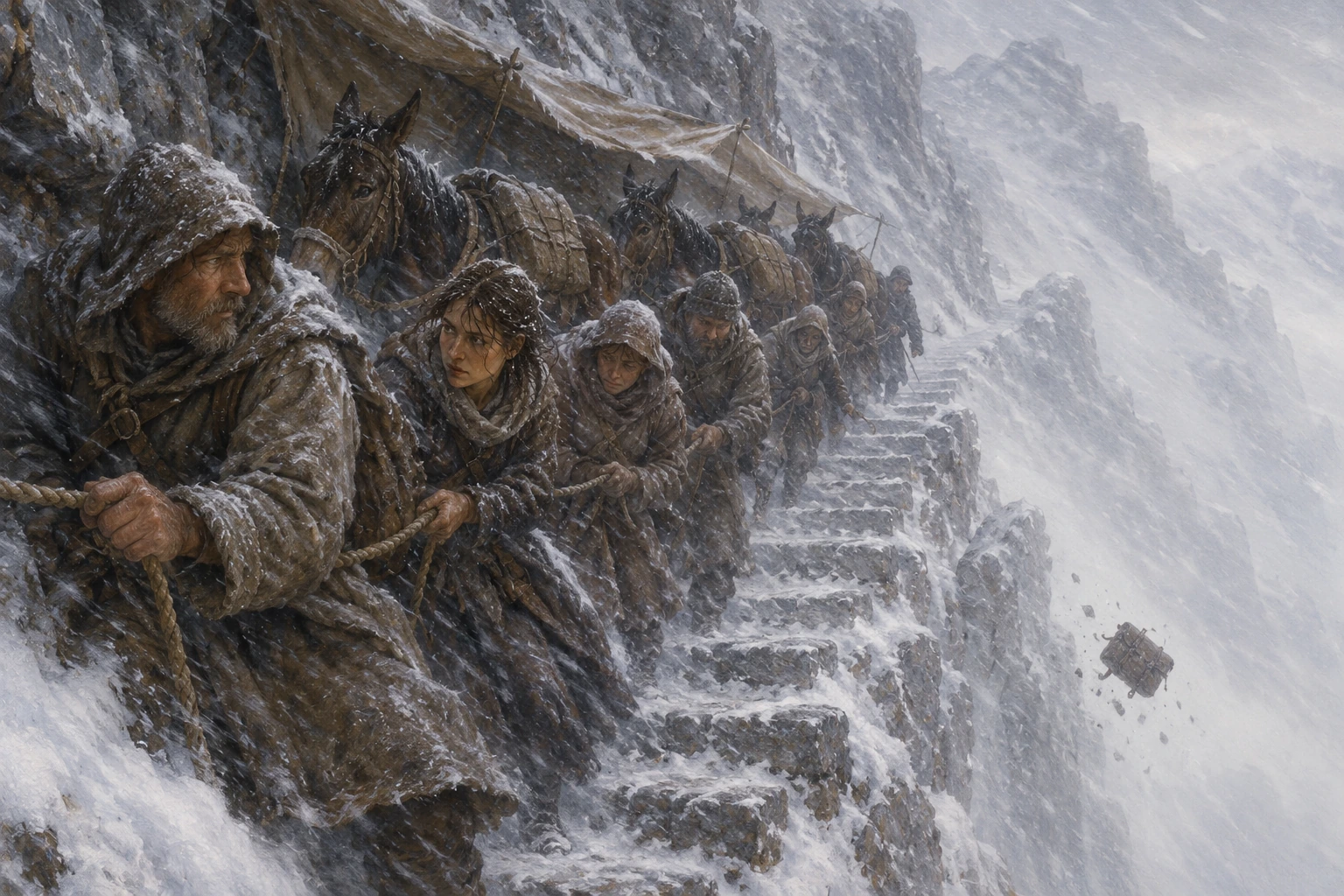
They had gone two flights past the stage when it came up the east face, not by degrees but all at once. It was there, between two shelters neither of them reachable in time, that the storm found the Survey and closed its hand.
Bracken read the ground fast, without panic, and found, within a hundred paces, the one thing that mattered more than comfort: a shallow fold under an overhung shoulder, no wider than half a landing, hard against the mountain on one side and open to the sky on the other. "Here," he said. "Mules first, nose to the wall. Move."
Barrow went in innermost, nose to the rock, and anchored there; Suet, Nettle, and Gable came in behind him nose to tail, lashed each to each on Orran's own rope, no beast free and no gap for the wind to work — Nettle as still and biddable as Barrow, true, this morning of all mornings, to whatever private principle had made her so mannerly all week. Canvas went up low and fast, pegged at every corner the rope could hold, no higher than a crouching body needed, because canvas rigged any prouder than that is canvas rigged to sail. The company roped itself hand to hand along the fold in the grammar the coomb had taught it, against a different kind of losing this time — Alder's hand finding Wren's, Wren's finding Dorrit's — while Bracken and Luel worked the line, checking every knot, saying every name.
The storm was less a thing than a leaning — a wind that came against the fold and stayed there, hour on hour, pressing, and the fold took it and gave nothing back. Its snow had turned to ice-grit driven nearly flat, stinging every seam in a coat like thrown gravel. The white came down so entire that the fold's own far wall, four paces off, stood and vanished and stood again by the second. And the noise did the rest of the frightening — one long rolling voice with no distance left in it, the same voice they had once heard, small and safely far below, at their first noon halt on this stair.
Wren's own breath didn't catch. There was fear, real fear — but a fold gives no room for panic to run in, and a rope gives less. Bracken and Luel walked the line by turns, checking fingers gone white before the white could turn to harm, saying names into the roar until each one answered. "Talk," Bracken told them. "Doesn't matter what. Just don't let it go quiet in your own head." Luel's low wordless thread ran under the noise for whole stretches together, and the names came easier wherever it was nearest.
Well into the worst of it, a gust found the loose edge of the canvas where a peg had worked free, and took the outermost pannier — grain, and the spare kit riding beside it, nothing else — clean off its lashing and away, over the edge and into the white, its going so nearly soundless that the silence of it was worse than any noise could have been.
"It's gone," Bracken said, flat and immediate. "Nobody moves."
Every one of them wanted very much, for one bad heartbeat apiece, to do something else, and nobody did.
The heartbeat that came nearer to costing more than a pannier came a little later, when Dorrit worked hand over hand along the line to reach Pip, whose fingers had gone past complaining into a stillness she didn't like, and her boot found the buried edge of a step and simply wasn't on anything at all. For one whole heartbeat her entire weight hung off one closed fist on the rope and nothing else — and the rope ran. It ran through her hand about the length of a forearm before it stopped, and Wren, four feet off, heard the sound it made going through. Then Bracken's left arm was under her and the anchor held, and she was back on the ledge inside two breaths, and she came back onto it wrong.
She got her boots under her and made no sound at all, and it was the not making a sound that Wren understood first. Dorrit swore at everything; she had sworn at the wind for an hour together. She came over that edge with her right hand held up cupped against her own chest, the grip of someone who has just picked something up too hot, and her jaw set, and nothing whatever coming out of her. Her glove had gone with the rope. She stayed that way — roped in now by a chest-loop Bracken passed round her without asking and without her arguing about it — for the whole rest of the storm. It was Bracken, in the end, who got Pip's fingers back, working them left-handed against his own ribs with the flat patience he gave a cold buckle, while Dorrit sat two feet off and could not.
The storm dropped toward dusk all at once, and seemed embarrassed of itself for having come at all — the wind easing out of its lean within minutes, the snow thinning until the stair reappeared, flight by flight, white and clean and undramatic. They came out from under the canvas stiff and slow, and made the last two flights to the highest stage in the sharpened cold of an evening scrubbed clean by its own violence, roped still, the day's cost written on all of them.
Bracken counted heads the moment the last of them cleared the final step, calling each name and waiting for its answer before the next. Wren. Dorrit — answering, and answering short, which was itself a thing worth noting down. Alder. Iyene. Pip. Luel. Seven, and then the string, each answering in its own fashion, Nettle with a flick of an ear that passed, tonight, for perfect good manners — four, and the whole company standing whole and counted on ground it had not been at all sure, that morning, it would reach by evening.
They made the highest way-stage yet on the evening of the third day, later than the others by an hour and dearer bought by every one of its flights. They stood a while at its worn threshold before any of them went in to the business of unpacking, simply looking east, because the view from this height asked to be looked at before it could properly be set aside for supper.
The whole eastern country lay below them going blue with evening in long soft folds, the Watch on the Stones and the pass road and the far unseen thread of the Fenwater all gathered now into a single dimming distance that no longer troubled to separate itself into named places at all. It was only a single vast good country, walked and loved and left behind a mile and a day at a time, holding its color a little longer at this height than it would down where the dark came faster. It was, Wren thought, exactly the kind of silence the whole day's climbing had earned, and exactly the kind none of them wanted to spend on anything so ordinary as words.
It was Bracken who broke it, looking up the last visible reach of the stair to where the steps climbed out of sight around a final grey shoulder, and gave the company the one bearing they would carry to sleep on.
"The notch stands a day above us," he said, "by the reckoning of everything we've climbed so far, and no more than that. We'll not hurry it, and we'll not guess past it either. One day's climbing, in its proper hours, same as every day before it." The company took the bearing to bed with it.
Pip had the fire going by then, coaxed up in air too thin to be generous to any flame. It was Dorrit, her right hand bound in strips torn off Bracken's own spare shirt because her roll of clean linen had gone over the edge in the pannier, who got Pip away from nursing it bare-fingered, and warmed his hands between her one good palm and the front of her coat until he could feel them well enough to complain about it — the rope-line's debt paid back the other way, neither of them remarking on it beyond Pip's muttered thanks and Dorrit's "Hold still, you're worse than the fire."
It was over that fire, the string counted and picketed against a night gone still and ordinary again, that Bracken gave the day its flat accounting. "One pannier gone," he said, "grain and the spare kit that rode with it, nothing else. I loaded for the ugliest stretch of this road before we left the watch, same as I load for every road, and this is what that buys us on the one morning it's properly asked for: a tighter month of bread and a closer eye on the grain sack, and not one thing worse." Wren thought of a line Harrol had given them at another fire a season back — how the mountain does business, and the mountain doesn't take bribes — and found she believed it more plainly this evening than the evening she'd first heard it said.
Iyene wrote the day into her working sheet before she ate: the hour the storm struck and dropped, its quarter backing south before and swinging east after, the pannier weighed and itemized, no more mourned on the page than a ford's depth was ever mourned — and Pip had his own sheet out beside her and wrote his name into the top corner of it before he ruled a single line, as he had done on every fresh page since the coomb, and Iyene passed him the rule without looking up and without one word about it either way.
"Not one thing worse," Dorrit said.
She was sitting with her back to the cistern wall and the bound hand resting palm-up on her knee and her supper going cold on the stone beside her, and she said it with no heat in it at all, which was what made it land.
"It's a good sack of grain, Bracken, and I'd not want to be short of it. That isn't what I'm answering." She lifted the hand an inch and set it down again. "My roll of clean linen went over that edge with your grain. I've bound this tonight in a strip off a man's shirt and I'll be binding it in the same strip a fortnight from now, because there is not another one on this mountain. And I can't close it. I found that out an hour ago trying to get my own coat off, and I'd take it kindly if nobody helped me with it in front of everybody."
The fire spat once, over a green knot, and the silence held.
"It will come back," Iyene said.
"It might." Dorrit turned her head. "You'd not write that down, though. Not as a fact. You'd write unresolved."
"Dorrit—"
"I'm not being clever at you." She said it wearily, and, Wren thought, entirely without artifice. "I want to say the whole of it once, out loud, and then I would like my supper. You made a call this morning and it was yours to make, and I've never disputed a line of your charter in my life. But we were standing in a house with three walls and a full cistern. And Bracken said hold. I want it said at this fire tonight that Bracken said hold."
"It is said." Iyene had not moved. "And I would make the same call tomorrow, with the same page in front of me. Four storms logged on this face last spring, every one through before noon, four hours of frozen stone against a three-hour stage. That is what I had. I would be a worse leader and not a better one if I let this evening reach backward and change what I knew this morning."
"That," said Dorrit, "is a beautiful sentence, and there isn't a scrap of comfort anywhere in it."
"No. There isn't." Iyene looked at her steadily. "I've none to offer that would be honest."
It did not close. Dorrit ate her supper left-handed and went to her blankets early. Iyene sat over her working sheet a long while and turned no page of it that Wren saw. And Bracken, who had said hold once that morning and had not said one word about it since, mended nothing and argued nothing and did not speak to the Cartographer-Royal at all that evening — did not ask her for the next day's marching order, did not offer her the ground-report she had had off him unasked every night since Merrow. He worked round her, courteously, the way a man works round a piece of furniture. The silence he left when he turned in was a good deal louder than anything Dorrit had said out loud.
He did not turn in, in the end.
Wren woke an hour or so later to feed the fire, and found the two of them sitting against the stage's inner wall in the dark, well out of the light, where anybody who wanted to could pretend not to have seen them.
Bracken had his coat off the right shoulder and his sleeve down and the arm bare in air cold enough to hurt. He was holding it out. Dorrit had her good hand on it.
She worked it a long while, by feel, in the dark, with the one hand she had left — following the line of the joint as she would follow a root down through soil, slow, pressing at things, stopping now and then to let him get his breath back. Neither of them said a word for the better part of a quarter hour.
"Torn," Dorrit said at last. "Not out, and not bruised. Torn, and knit crooked, because nobody would let me look at it in October. It won't ever be what it was."
"No," Bracken said.
"You'd have carried it up the whole of this mountain and down the far side and never said."
"I'd have tried."
The wind moved somewhere above the walls and went on.
"It didn't keep," he said.
That was all of it. Dorrit did not answer him. She went on working the shoulder, and Bracken sat and let her, and Wren fed the fire and lay down again and shut her eyes on the pair of them, having learned something about two people she had known her whole life — that some apologies are three words long and take a season to arrive.
In the morning Dorrit rebound the arm properly, giving the orders while Pip's fingers did what her own right hand could not, and Bracken sat still under all of it and did not once say that it would keep.
She wrote in the day-book that night by the last of a small careful lamp, the cistern's meltwater standing still and dark in its old stone basin a few feet off.
The third day gave us weather instead of stone to reckon with, and the two are not the same kind of honest. It cost us one pannier, grain and spare kit, and it cost Dorrit the use of her right hand — the rope ran through it a forearm's length before it stopped, and she cannot close it, and will not, on this mountain. Dorrit. And Bracken let her look at his shoulder tonight, in the dark, out of the firelight, for the first time since the Long Shelf. He said it didn't keep, which is three words and the only apology I have ever heard that man make to anybody. We argued at the fire tonight, properly, for the first time since Dall, and it did not end in anybody being generous, and I am not going to pretend it did.
She closed the book, and wrapped it, and set it back in the satchel that had not left her shoulder since the watch. Dorrit was still awake across the fire, holding the bound hand palm-up in her lap. Nobody said the storm might come back. It was a thing they would all be listening for, a day's climb above, long after the fire had gone quiet.