First Sight of the West
The color of the dark had changed, and that was what pulled Wren up out of sleep — not a thing that happened to a person very often — and she lay a moment inside her blankets deciding whether she had dreamed it, before she remembered that she had the last watch, and that the last watch was hers to notice such things in.
She had taken it over from Alder in the small hours, by the low banked coal of the fire and a nod that passed between them without either troubling to speak, and had sat since then with her back against the eastern stone, the day-book closed on her knee for once because there had been nothing yet worth opening it for. The cloud-river overhead had gone on pouring west to east the whole watch, that same dusk-colored, faintly self-lit brightness it had worn since nightfall. What woke her fully, in the end, was not any sound — there had been no sound worth the name all night, only the mules' breathing and the fire's small settlings — but the fact that the cloud had stopped glowing from within and started, instead, to catch light from outside itself: low and orange, the color the sun always wore climbing out of the flat lands behind them.
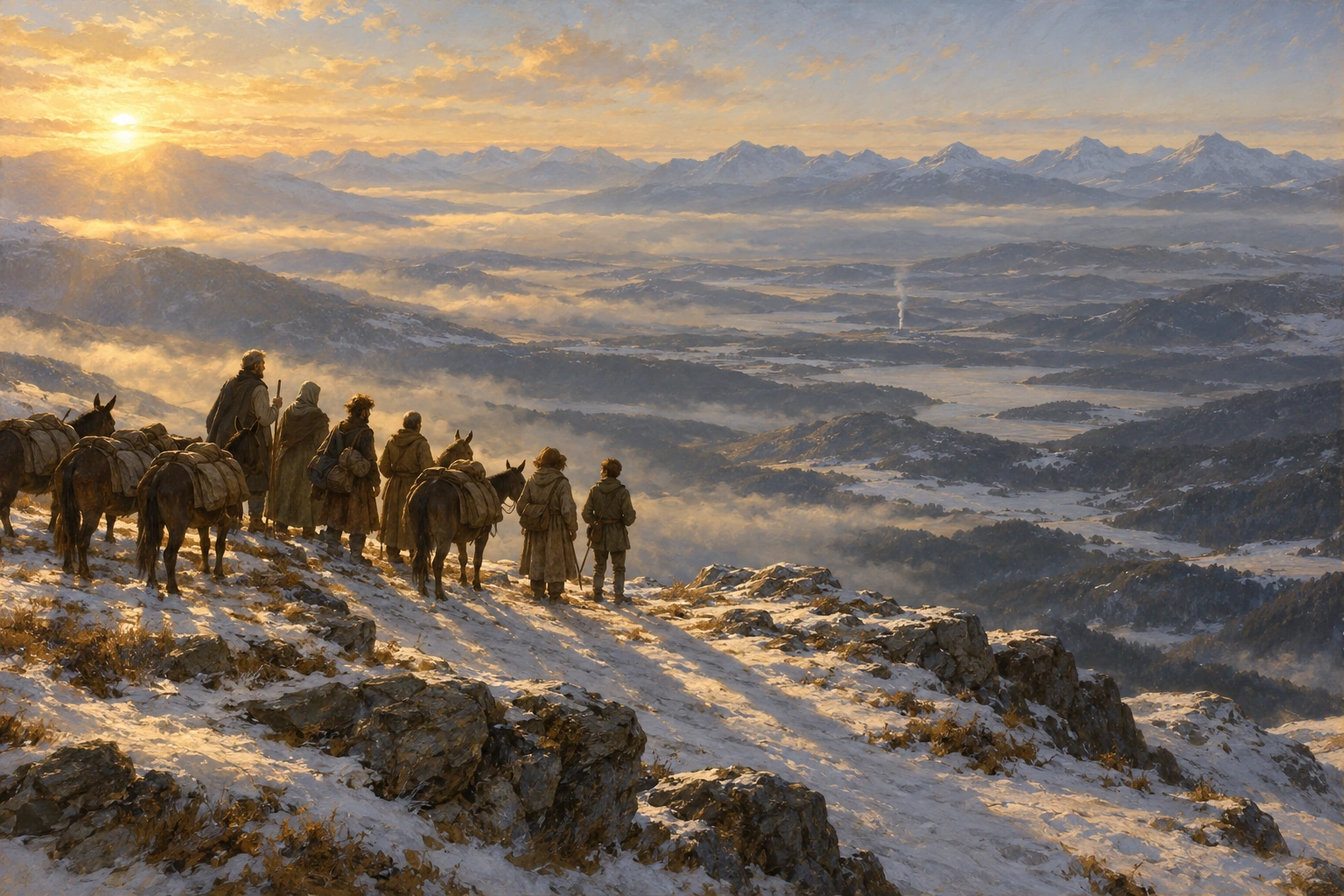
She looked east first, from old habit, and found the sun exactly where it belonged, clearing the mountain's shoulder and throwing their own long shadows forward across the saddle toward the two stones. Then she looked west, and found the wind blowing differently through the gap than it had blown all night — not the long steady exhalation that had fed the cloud-river its whole endless course, but something shorter and more particular, gusting and easing, like a person waking rather than sleeping.
The cloud was thinning.
It did not tear as a storm tears. It thinned like mist off a water-meadow once the sun has been at it an hour — transparent, then patchy, then gone from the middle of itself outward, drawing back toward the two shouldering heights like a curtain off a window somebody has finally decided, after a very long night, to let the morning into.
"Dorrit," Wren said, not loudly, because there was no need yet to be loud, only awake. "Dorrit. Alder. All of you. Come and look."
They came up one by one out of their blankets exactly as they had woken at the Singing Ford, unbidden, nobody shaken by the shoulder or called twice — Dorrit first, swearing amiably at the cold; Pip already half into his boots; Iyene instantly and entirely alert, nineteen years trained never to be caught half-awake in front of a thing worth measuring; Bracken going straight past the fire to lay a hand on Barrow's neck before doing anything else, the mule already awake with his ears already turned west; and last of all Alder, at his own steady pace, who came to stand at Wren's shoulder and said nothing at all, only looked.
Luel was already standing at the western stone. She had not, so far as Wren could tell, ever gone to sleep.
"It does this," she said, without turning around, her voice pitched low and easy, the voice of a woman reporting a plain fact about weather rather than announcing anything. "Most mornings, for an hour or so, while the night wind and the day wind change their minds about which of them is in charge of the gap. I did not think it worth mentioning last evening — it is not a grace granted to travelers, or a door opened specially for guests. It is only the pass's own habit." The wind gusted once more, and the last ragged edge of cloud went streaming east past the eastern stone and away over their heads. "This morning, only, we happen to be standing in the doorway when it does."
There was nothing in it that wanted answering, only watching, and the whole company had already turned to do exactly that: to stand at the western edge of the saddle in the low gold light, their own shadows thrown ahead of them, and watch their own sun — the same sun that had climbed every barley field and every honey harvest of Wren's whole life — pour, for the first time in three hundred years, its own plain light down across the whole unwalked west.
The country came up slowly out of shadow, as a face comes up out of sleep, and for a little while there did not seem, yet, to be words the right size for it.
Below the saddle the land fell away and folded, and folded again, into range after descending range of white — not the hard, weather-beaten blue-white of the eastern snowfields they had climbed through, snow fought for every yard of its holding, but a softer, deeper, more settled white, the white of ground that has never been asked to give up its snow before it was ready. It lay thick on every north face and high shoulder as far as the eye could carry, and where the sun had already found the south slopes it broke instead into long dark patches, bare rock and earth showing through — not a wound in the whiteness, only its oldest and most ordinary habit, practiced here on a scale that made her own valley's whole snowfall look, by comparison, like a dusting shaken from a single tree.
Beyond the near ranges the land went on falling and folding into distance until the same pale haze that hung along every far horizon Wren had ever watched from a hilltop at home took it entirely — and there was nothing else to see in the whole of it. No road ran visibly through any of the folded valleys, though one must, once, have run through nearly all of them. No roof, no wall, no huddle of walls that might once have been a village along a stream. No smoke stood up anywhere, not one thread — a country that might have been simply sleeping, deeply and well, on a morning nobody had yet come to wake it, rather than a country that had died. Wren thought of Granna Tansy's bees settled into their hives at the first hard frost, silent and entirely, competently alive under the quiet, and found that nearer the truth of what she was looking at than any word that came readier to hand.
"It's wintering," she said, half to herself, and found the word fit exactly, as a right word does when it arrives at last after several wrong ones have been tried and thrown out.
"It has been wintering a long while," said Iyene, quietly, her travel-glass already up, her voice carrying none of its usual edge. "Three hundred years is a very long winter to keep so well."
Along the far rim of the world a scattered line of summits rose a shade darker and more deliberate than their neighbors — not a wall, not one continuous ridge, but a chain of separate high shoulders, each standing a little apart from the next, the way a line of watch-fires stands apart along a hillside even when every fire in the line can see every other. Wren did not need telling what they were. She had heard the shape of them once already, a whole winter ago, at a fireside far to the east, in a voice that had given them to her complete and asked nothing back for the gift but the keeping.
Luel came forward from the stone she had claimed and stood at the very edge of the saddle floor, where the worn stone gave way to open air and the whole falling country lay under her with nothing between her eyes and it. She did not speak for a long moment, and when she did her voice carried, for the first time since Wren had known her, a note that was not quite steadiness — held steadiness, the kind that costs something to keep.
"That is Ness Fell," she said, lifting one hand, resting it a moment in the air toward a squat, round-shouldered height along the chain, "and there, the long one, standing a little apart — that is Wakelow."
She said nothing further, and had not needed to.
Wakelow stood exactly as its own name had promised, long and low and set a little apart from its neighbors, and the whole company, without deciding it aloud, went still looking at it, for the length of one full breath, the way a person goes still at a graveside — not from fear, only a wish not to hurry past a thing that had waited a long time to be looked at properly. Wren did not sing the lament, even in her own head; she had been asked once, gently, not to spend a given thing carelessly, and had learned the lesson well enough to keep it without a second telling. But under her own breastbone, unbidden, she felt the shape of it anyway — a hill that had kept its fire lit long after every other hill along that whole chain had let its own go dark, burning on alone into a night that sent no answer back — and she did not need the verse to feel what it had cost that hill to keep faith so long. She thought only, once: there is the one that would not give up first. Then she let the thought go.
Luel turned back from the edge, her face already settled into its ordinary composed lines, whatever had crossed it folded away as carefully as a letter put back in its envelope. She said nothing more about the hills, or herself. The company had learned that courtesy a long road back, at a ford in the dark and at a stone with a bridge cut into it, and it held here exactly as it had held there.
It was Pip who saw the smoke.
He had wandered a little apart, out along the saddle's northern lip, with the restless energy of a boy who could not stand still in front of a wonder without doing something useful with his hands, his own small travel-glass turned on the middle distance for no better reason, he admitted after, than that it had been sitting unused in his pack and felt, this morning, like a thing that wanted using.
"There," he said, and something careful in the pitch of his voice — a boy trying hard not to sound as though he had just found the single most extraordinary thing he had ever seen — brought the whole company to him at something just short of a run. "Down in the fold past the second ridge. Do you see it?"
Wren saw it a half-breath after he pointed, without needing the glass at all: a single thin thread of pale smoke, standing straight and steady in the windless air, rising out of a valley floor she could not see any part of, climbing a long way before some current too high to feel from the saddle bent it gently eastward and let the distance take it. It did not waver, did not thicken or thin as a carelessly fed fire does. It simply stood there, one clean pale line against the white and the far grey haze, exactly as steady as everything else in that vast sleeping country was not.
Wren felt something rise in her chest she could put no single word to — not fear, and not quite joy, though nearer joy than anything else, a gladness too large to hold comfortably still, the way a hive feels on the first warm day of spring when every bee in it wants out into the light at once. She looked, without meaning to, at Luel, and found Luel already looking at the smoke herself, entirely still.
Iyene had her instrument braced and steady within a few heartbeats and took the bearing clipped and exact, murmuring the figures once and writing them a second time into her pocket-book before she looked up.
"Deep in the west," she said, in her plainest professional register, "and a good way south of true — weeks off, across country none of us has walked, none of it visible beyond the smoke itself." She checked the figure once more against her notes. "It sits within a hand's width, on my reckoning, of the quarter Harrol logged her two lights in, and not far from the one I logged myself at the Hob. Which proves nothing whatever, and records everything I have. I'll enter it exactly as I've said it, and no more."
"That's a tended fire," said Bracken, arms folded, eyes narrowed against the light. "Not a grass-fire, not lightning smoldering itself out — those don't stand straight like that, or hold steady this long past dawn. Somebody's built that, and somebody's minding it small and careful — a fire meant to last the day, not just warm a pair of hands. A hearth, most like, or a camp settled somewhere a while." He watched it a moment longer. "Whoever it is knows their business."
"Someone keeps a fire," said Luel, after a silence long enough that Wren had half decided she meant to say nothing at all, her voice holding nothing beyond the words — no grief, no triumph, only a held, careful gladness, the voice of a woman setting a very heavy thing down very gently rather than dropping it. She said no more, and her stillness after, Wren thought, said a good deal more than any second sentence could have.
It was Alder who said the thing the company had already half decided for itself.
"It's weeks off, across ground none of us knows," he said, "and our road runs that way regardless — Wystan's own line points very nearly that direction before it runs off the page's edge. We log it, we draw it, and we leave it exactly where it stands, for the road to answer in its own time." There was nothing solemn in his face, only a settled, practical warmth. "We don't chase smoke. We walk the road we came to walk, and it happens, this morning, to be going that way regardless. That's the whole of the decision, and I don't think it wants making twice."
Nobody argued it — Iyene closed her pocket-book with a small satisfied nod, Bracken went back to checking Suet's girth, and the company turned back to the morning's business.
Wren checked the day's road before the descent began, exactly as she checked it every morning the weather allowed, out of a habit so old it needed no more deciding than breathing — and it was only once the book lay open on her knee, the cold western light falling full across the vellum, that she understood something in the page had changed.
The ink was dark.
Not merely legible, the way it had always been legible under her hands alone, but dark — properly and entirely dark, the fine grey road-strokes gone nearly black, sure-edged the whole visible length of the line, as though the pen that drew them had been set down the week before last rather than a lifetime ago. The small spiked hand of the old-tongue margins, always pale and half-apologetic beside the plainer keeper-marks, stood up off the page now with the same crisp certainty, written by someone who had known exactly what he meant to say. She turned the book a little in the light, half expecting the dark to prove some trick of the sun, and it did not fade. It simply sat there, page after page as far back as she troubled to turn, as though the whole book had spent a long exile with its eyes half-shut against a light too poor to see properly by, and had opened them, at last, at the top of its own country.
"The ink had been old my whole life," she said, quietly, mostly to the book and a little to Alder, who had come to kneel beside her at the sound of something in her voice worth kneeling for. "It was not old this morning."
She held the page out toward him as she always held it — steady in her own two hands, angled to the light, near enough that he could see every stroke without needing to touch it himself. Alder looked a long moment, his eyes moving once down the darkened road and once across the standing old-tongue margin beside it.
"He's home," he said, and nothing more — no working-out, no explanation, only the one short unexplaining line, spoken in the same voice he had used at the chisel-marked stone the day before.
Nothing on the page, Wren was careful to note even to herself, had become readable that had not been readable before. The old tongue's spiked little words stood dark and confident now, but exactly as unread to her eye as they had ever stood — the same handful of shapes she had learned by inches all winter, bridge, well, here, and no more, the rest still as closed as a locked door she had not yet been given the key to. It was not her own learning that had changed; it was the ink. Old, sleeping, page-worn ink, waking at the top of its own country into whatever light had waited there for it — no glow, no warmth under her fingers when she laid them, lightly, beside the darkened lines rather than on them, no motion beyond the bare fact of a color changed. Just ink, dark and sure, as any ink looks the week it is written rather than the century.
Iyene had come to stand a little apart, her own pocket-book already half out of her coat before she stopped herself, visibly, and put it away again.
"I could measure that," she said, half to herself, in the rueful voice of a woman confessing to a temptation rather than resisting one. "Ink-depth, stroke-width, a comparison against yesterday's light. I could make a very tidy note of it." She looked at the book a moment longer, then closed her own book's clasp, the small definite click of it loud in the thin air. "I'm not going to. Some things want recording as what they are, and not as a measurement of themselves. I learned that lesson properly at a ford a long road back, and I don't think this book means to let me forget it twice."
Wren closed the Waybook herself, wrapped it in its oiled cloth, and settled it back into the satchel across her shoulder rather than into any pannier, exactly as Bracken's old unexplained instinct had always insisted it travel; and she found, doing it, that the wonder had not gone anywhere at all, only folded itself quietly into the ordinary shape of the day's next task. There would be time enough to sit with it properly at the evening fire. For now there was a road to walk, and the road, for the first time in the whole history of the book she carried, was running downhill.
The company gathered its packs and mules without ceremony, the ordinary business of a morning's departure grown, by four days' practice, into something close to a settled dance — and it was only when the whole line of them, seven people and four mules, came to stand together on the open floor between the two stones that anyone noticed the company had, without a word from anyone, arranged itself into an order it had not planned.
They stood facing west, toward the second stone, toward Wystan's cut bridge-mark and the comb-mark of a way-house beside it, and toward whatever lay beyond that first threshold of Meddan's own ground — and Bracken, who had led the string every day of the whole climb, simply stepped a half-pace sideways, out of the line of the door, and stood waiting.
In the same instant, without anyone announcing it, one by one they let a space open in front of them that led, clearly and only, to Luel.
She did not hesitate over it, and made nothing of it either. She walked forward at exactly her own ordinary pace, past the first stone with its weathered crossed strokes, past the low sheltered angle where a dead man's chisel had cut a bridge into the door he was shutting behind him, and out past the second stone into the open air beyond it — the first of her people, so far as any of them could ever know for certain, to walk home through that door since it closed.
She did not pause on the threshold to be watched doing something large. She only walked, simply, the way she had walked every ordinary mile of the road behind them, stood a moment on the first western step with the whole falling country opening below her — and then simply kept walking, down and on, as though it had never occurred to her that the moment asked for more than that.
The company followed without a word, Bracken falling in at the rear where he had always walked easiest, and the mules came after, unbothered; and the door, behind all of them, stood exactly as it had always stood — open, unremarked, entirely unsurprised by any of it.
The western steps ran wide from the very first flight, wider than anything the eastern thousand had shown below the highest way-stage, and shallow-rising besides, each tread set so gently after the last that Nettle took the first dozen flights at something close to a stroll, ears forward, offering no comment whatever — which Bracken noted aloud, once, with the flat wonder of a man used to a mule's opinions arriving whether wanted or not.
"Gentle," he said, testing the word, "is not a thing I expected to be saying about any part of that stair."
"They built it for children on feast mornings," Luel said, from a little ahead, not turning. "Whole households, in the dark, climbing to watch the sun come up the far side. You do not cut a stair like that for anyone you expect to carry anything heavier than a basket of breakfast." It was all she offered, lightly, in passing; then she walked on, and the company let her have the silence.
The light followed them down flight by flight exactly as it had climbed the eastern steps three days before, each western tread catching its own brief gold the moment they reached it and passing the color on, tread to tread, below — the same design, Wren thought, still doing the one job it had been cut to do on the very first morning anyone stood on it to watch, only working now for the last of the maps rather than the first of the mourners.
The textures of the west came up to meet them in small, first-hand pieces. Low stone walls ran along both sides of the stair below the fourth or fifth flight, old terrace-work holding back what had once, clearly, been cultivated ground, their courses still square under a soft cap of snow. Dorrit, who had read a whole autumn's worth of turf and hedge-growth on the road behind them, stopped at the second such wall and crouched over a row of low, snow-capped humps set at careful, even intervals.
"These were tended once," she said, laying her left hand — the only one she had the use of — on the nearest hump. "Look how they're spaced — a person's own two arm-spans, near enough, dead even along the whole row. That's not scrub grown wild. That's orchard, planted by somebody who knew exactly how far apart to set a tree so it wouldn't crowd its neighbor twenty years on." She straightened, looking back up the terraced slope with the particular pleasure of a person recognizing good work long after the hands that made it were gone.
"Orchard country," said Luel, a little further down, without turning — "the whole of this slope, once" — and the bare stumps under their white caps stood answer enough, exactly as Wystan's comb-mark had stood answer, the evening before, for a way-house nobody had yet seen.
It was somewhere below the seventh flight that Bracken came up alongside Iyene and gave her the ground.
He did it without preamble and without one word acknowledging that he had not done it in three days. The state of the treads below the next bend; where the melt was running and where it was not; two stretches he would want the string single-filed through; his own estimate of how far the shelf ran before the road went properly level. It was the report she had had off him unasked every evening since Merrow, and had not had since the storm.
Iyene took it, and wrote it down, and said, "Thank you, Quartermaster," in the voice she kept for anything she meant.
Then she closed the book over her thumb and said the other thing, which cost her a good deal more and took her about four seconds longer to arrive at.
"I was wrong on the third morning. You said hold. You were right and I was not." She said it looking straight ahead down the stair. "And I would still make the same call with the same page in front of me, which I have turned over for two nights running and cannot get round. Both of those are true. I have stopped trying to make them agree with each other."
"Aye," said Bracken.
That was all of it. The two of them walked the next three flights side by side without saying anything whatever, which from those two was about as much as the road was ever likely to get.
At the eighth flight Bracken stopped and looked back up the line they had come, at the whole climbing white line of it running up into the notch and out of sight.
"Six days," he said, to nobody in particular. "Seven, for a man travelling light and not minding his knees."
Nobody asked who. Iyene noted the hour, which was, Wren thought, about the only useful thing anyone could do with a sentence like that.
A second way-stage showed itself below the eighth flight, walled on three sides in the same fitted stone as the stair, its threshold worn into the same shallow hollow the eastern stages wore; the company passed it without stopping, saving it for a longer look some later day. The mules went easy the whole descent, Barrow steady at the head of the string, Gable dozing along two behind, and the company itself fell, by degrees, into the particular quiet of people carrying something large and precious with both hands.
They stopped at noon on a broad landing of the stair itself, where the steps widened for a dozen paces into something closer to a terrace than a tread, sun-warmed already through the thin cold air in a way the eastern stone had never managed to be; and sitting down with her bread in her lap, the whole risen west spread out now not below her but around her, Wren found that something in the shape of the morning had changed without her noticing the moment it happened. They were not looking at the country any longer, as they had looked at it from the saddle's high rim, distant and entirely separate from themselves. They were sitting in it.
"Meddan's own children ate their feast-morning bread on steps very like these," Luel said, settling on the sun-warmed stone with the rest of them. "I expect the bread was better than yours. I mean no offense; Enna's is honest bread, and travels well, which is the harder trick."
"I'll tell her you said so," said Dorrit, "and watch her decide whether to take it as a compliment," and the whole company laughed, quietly, in the easy way of people who have been given, in one long bright morning, rather more wonder than they quite know how to hold, and have found that laughter is one of the honest, ordinary places to set a little of it down.
Wren took out the day-book while the bread went round a second time, and wrote three lines and no more, because she had already decided, coming down, that some things want keeping larger than any account of them.
We saw the west this morning, and I do not mean to try and write it. Luel named two of the far hills for us and said nothing else about them, and I love her a little for knowing exactly how much a name carries with nothing added. There is smoke, one thread, very far off, logged and left alone. And the ink woke.
Iyene had spent the halt with her glass on the country below rather than with her bread, and put it down at last with the flat, unsatisfied face she wore for a fact she had not yet decided what to do with.
"The melt isn't lying where it ought," she said. "South faces bare — that's ordinary, that's the sun. But there are bare lines running clear across ground that has no business being bare at all, east and west, straight as a ruled edge, and I can follow three of them the better part of ten miles." She let that sit a moment. "They are roads. I would like somebody to tell me why a road nobody has walked in living memory should shed its snow a fortnight ahead of the field lying beside it."
"Stone holds the day's heat," said Bracken. "Turf doesn't."
"Stone under two feet of snow holds nothing at all," said Iyene, "and you know it as well as I do, and I notice you said it anyway."
Bracken conceded that with a grunt and went back to Suet's girth. Alder, sitting a little apart with his bread untouched in his hand, said nothing whatever — not a word, not a mild redirection, not one of the small level observations he generally offered when a table had run out of answers. Wren wrote the silence into the day-book, because writing a thing down was what she had instead of understanding it.
They came off the last of the terrace-country in the middle of the afternoon, where the stair gave up being a stair and ran out into a long shallow ramp of laid stone between two banks of old orchard.
Wren noticed the sound first, and did not understand for some minutes that what she had noticed was the absence of one.
The eastern stair had answered them the whole climb. Four days of it — boot on stone coming back off the rock face a half-beat late, Bracken's voice carrying the length of the string without his troubling to raise it, Nettle's shoe striking a tread and the mountain handing the strike back. It had answered here too, all morning, flight after flight. Somewhere below the last terrace wall it stopped.
She said nothing, because it seemed too small a thing to say and because she was not certain of it. Then Bracken stopped.
He stood a moment with his head a little on one side. Then he clapped his hands together once, hard, in the open air of a valley walled on two sides by bare standing rock, and the sound went out of his hands and did not come back.
He did it again. Nothing came back.
"That's not stone doing that," he said.
He said it flatly, in his working voice, the one he kept for a girth wanting a new hole or a ford running higher than the note said it would. But he had turned as he said it, and he was not looking at the rock face. He was looking down the road ahead of them, running level and pale between its walls into the folded country; and Wren watched him do the thing she had seen him do exactly twice before on the whole road, at the Drowned Bridge and in the coomb. He counted the company. Not a glance along the line. A count, one to seven, and the mules after it.
"Iyene," he said. "Write the hour."
Iyene wrote the hour.
Then Luel began to talk.
That was all it was at first — Luel, walking a little ahead as she had walked all day, speaking under her breath at a steady conversational pace, not to anybody. Wren came up level to hear it, and what she heard was a list.
"Terrace wall. Coping stone. Coping stone. Apple, and apple, and the gap where an apple was. Culvert. The road." Two paces. "Ness Fell. Terrace wall. The road."
She named everything she went past. She named it aloud, and in the common speech so the company could hear her doing it, and she did not stop, and she did not look round, and she gave not the smallest sign of expecting to be asked about it.
Wren asked anyway, because somebody was going to.
"Luel — what are you doing?"
"Talking," Luel said, and went on doing it.
That was all the answer there was, walking beside her: not evasion, not a joke. It was the literal truth, and Luel had judged that the truth was all she had time to give. She went on down the road naming coping stones.
Behind them Dorrit had started to hum — not a tune anybody knew, and possibly not a tune at all. Wren looked back and found Pip's face, and did not like it, and dropped down the line to walk beside him, and asked him a question about willows that had no answer in it anywhere, and kept him answering it for a quarter of a mile.
And Alder walked forward, past Iyene, past Bracken, past Luel, to the head of the whole line.
He had not walked at the head of anything since Merrow. He was the oldest of them by twenty years, and had spent the whole road telling anyone who asked that a man who wants to see a country properly walks in the middle of it. He went up the outside of the string without one word to anybody, and took the front, and set the pace; and the pace he set was a good deal quicker than the one they had been keeping.
Nobody asked him why. Bracken looked at the back of him for a long moment, and then went and walked at the tail where the mules were, and got his hand on Barrow's neck, and left it there.
The sun was still an hour high. It was, by every measure any of them had the instruments to take, an ordinary bright cold afternoon in a country full of light.
Wren walked in the middle of the line, between a woman naming stones and a man setting a pace, and found that she had stopped being able to hear her own boots on the road.
She could hear Luel. She could hear Dorrit humming behind her. She kept both of those in her ears the whole rest of the way down, and did not once turn round.