Seven Less One
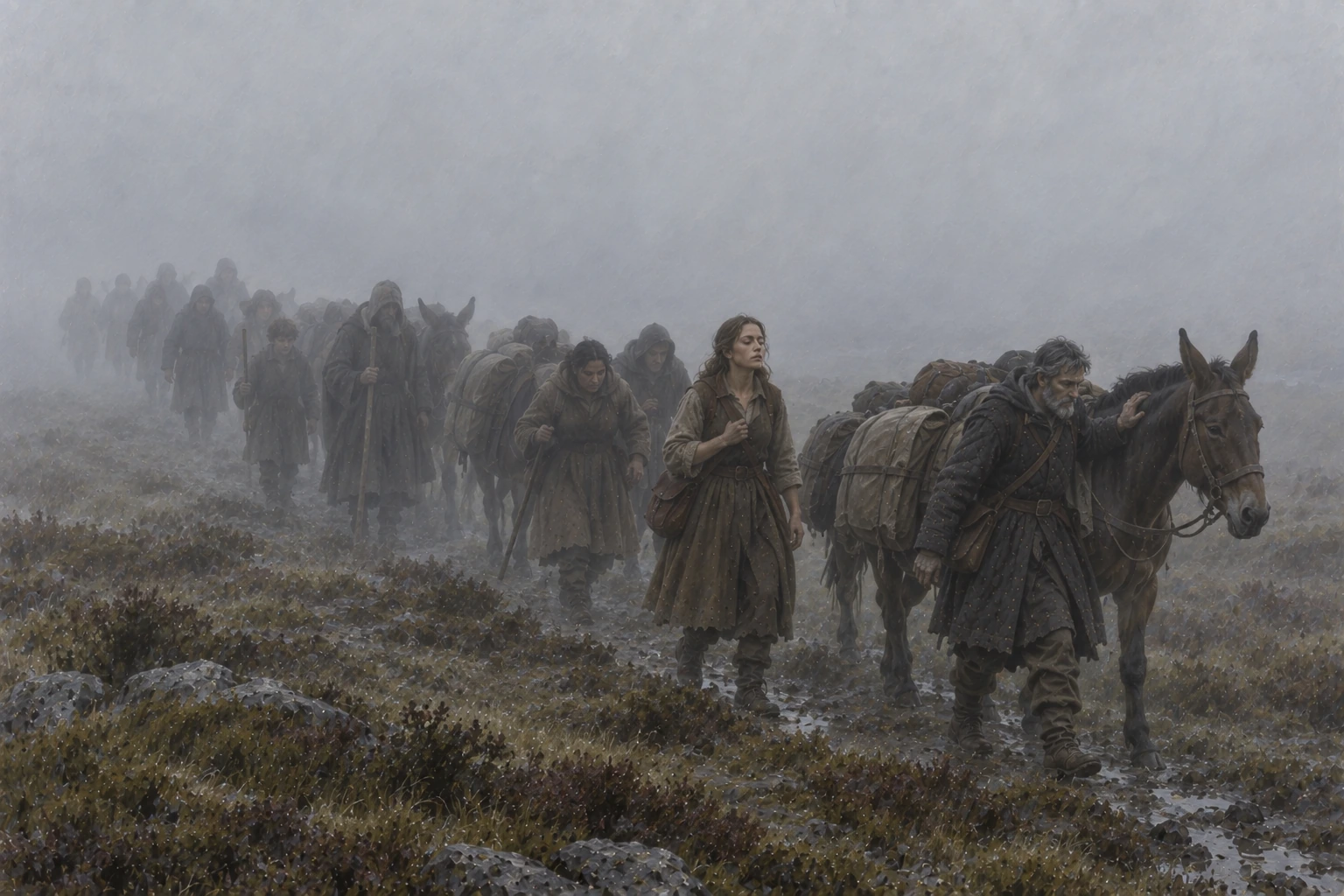
Bracken had counted to nine hundred and forty before Wren realized she had stopped listening to the numbers and started listening to the ground instead, and by then the fog had taken the mules at the front of the line down to shapes, and the shapes down to sound. He walked with his hand flat on the lead mule's neck, not for balance but for information, reading the animal's gait under his palm the way another man might read a scale, and every so often he said a number aloud, which was for Pip, who carried a slate and a nub of chalk and had been told once, before dawn, that his whole job today was to write down what Bracken said and not to ask him to repeat it.
There was no sun to speak of. There had not been one since midmorning, when the road — if the low fold of moor under their feet had ever been a road, which Wren privately doubted — had dropped into a country the color of a rubbed slate, gray on gray on a paler gray where the mist thinned enough to let a slightly different gray through. Iyene would have hated it more than any of them, Wren thought, and then caught herself at the shape of the thought, because Iyene was not there to hate it, was in a chair in the first of the Amarin households, three days back along the lake, with her hip bound and her instruments packed away in a case that had crossed a continent to end up unused in a room with a fire in it, and this ground did not care what anyone would have thought of it.
Wren counted the company the way she always did on bad ground, without deciding to: Alder, somewhere near the middle where he could reach either end of the line in six strides; Bracken at the front with the mules; Dorrit a little behind him, her staff finding purchase before her boot did; Luel walking last, unhurried in a way that had never fooled anyone who had watched her move when it mattered; Pip at Bracken's shoulder with his slate. Herself. Six. Seven, less one, the old shape of the count said in her, the shape it had said every day since they left her, because the company had been seven for two years and would go on being seven in the part of her that counted without asking permission, and Iyene's absence sat in that count like a held breath that never let itself out.
The four Amarin were not in the count, and she did not like the shape of that once she saw it plainly. Sael, Wend, Ossen, Ferrit — ten on the road, and only six of them hers to worry about the way she worried about her own hands.
"Say it again," Bracken said, not loudly, and Pip said it back to him — the number, and the bearing, and the count of paces since the last stop — and Bracken grunted, which from him was agreement, and lifted his free hand to signal a halt.
The column stopped raggedly, the halt running down the line like a jolt down a rope pulled taut from one end only, the newcomers a beat behind the rest of them because they had not yet learned that a raised hand from a muleteer was a command and not a suggestion. Wend nearly walked into the mule ahead of him and caught himself with a hand on its rump, and the mule did not care, which told Wren more about the mule than about Wend.
"Wren," Bracken said. "Ground."
He did not ask her what she heard. He never asked her what she heard; he told her to listen, and left the rest of it to her, because in three years of walking with her he had learned that the question wasted a breath they might need later. She closed her eyes, which she did not need to do and did anyway, because it was easier to trust a sense when the others were not competing with it, and she let the moor come into her the way it always did on ground like this — not as sound exactly, not as anything she could have named to a person who had not felt it, but as a kind of texture laid over the silence, the way a bruise is a texture laid over skin that otherwise feels like skin.
Most of it was only cold. Cold ground, cold air, the ordinary ache of a country that had gone three hundred years without anyone troubling to warm it. But there was a patch off to the left, north of the line they were walking, that did not sound cold so much as it sounded absent — a stretch of ground the size of a barn floor where the ordinary weight of the world seemed to have been set down and not picked back up, and where, if she let herself listen a moment longer than she wanted to, she thought she could hear something that was not quite a name trying to remember whose it had been.
"There," she said, and pointed without opening her eyes, because pointing with her eyes shut was easier than trying to hold the shape of the wrongness and look at the same time. "Forty paces, maybe less. Left of the line we're on. It's wrong the way the coomb was wrong, only quieter."
"Quieter's worse," Bracken said, which was not a question either, and turned to the column. "We go right of it. Everybody stay inside two arm's lengths of the mule ahead of you, and if I say stop, your feet stop before your mouth opens to ask why." He said it without raising his voice, and without looking to see whether anyone had understood him, because he had already decided that either they had or they would learn the cost of not having, and either way the column was moving again inside the length of a breath.
Alder had not spoken. Wren noticed that too, the way she noticed most things about him without meaning to — that he walked a little apart from the front of the line, that his hands were loose at his sides in the particular way that meant he was holding something ready rather than holding nothing at all. And that when Bracken gave the order to bear right he simply bore right with the rest of them, a Master of the College of Roads taking his heading from a muleteer on ground that would have killed either one of them alone. Neither man remarked on it. Wren thought Pip's eyes went once, briefly, from Alder's face to Bracken's back and then down to his slate, as if he had decided the number was worth more than the observation.
They went on like that for the better part of the morning, if morning was still the word for whatever hour it was under a sky that gave no sign of the sun's having moved. Bracken counted; Pip wrote; Wren listened, and said left, or right, or wait, or once, memorably, down — a stretch of ground that sounded wrong not sideways but underneath, as though the moor had a cellar nobody had dug and something in it had not finished falling. They went around that one so wide that the mules complained of the extra distance in the only language mules have, which is a great deal of noise about nothing at all, and Bracken let them complain and did not hurry them, because hurrying a mule on ground like this cost more than the minutes it saved.
What struck Wren, somewhere past the noon that the sky refused to mark, was that neither of the two things anyone was using would have been enough by itself. She could tell them where the ground was rotten. She could not have told them, not for a purse of gold, which direction was west, or how far they had come, or whether the fold of moor ahead of them led anywhere at all; her hearing was a hand held out to catch a man from falling, not a map, and it had never pretended to be one. And Bracken's count — his laborious, murmured, unglamorous count of paces and grades and the weight a mule would carry over each of them, translated in his head into a number of miles he was willing to say out loud — was only as good as the ground under it, and the ground under it had a habit, on days like this one, of trying to kill whoever trusted it too far. Put the two together and you had, not a compass, but something that worked anyway: a man who knew exactly how far his mules had carried their loads since the last stop, walking beside a woman who knew exactly which forty paces of that distance would have killed them, and between the two of them a company that had crossed, by Wren's last honest count, the better part of nine miles of ground that had eaten travelers before and had not eaten anyone today.
It did not feel like a victory. It felt like carrying water a long way in cupped hands, minding nothing else, for so long that the arms forgot they had ever done anything but this.
Sael walked near the middle of the line now, her fiddle case riding high across her back the way it always did, and Wren caught her, twice, with her free hand pressed flat against the case as though she were checking that the thing inside it was still there. The fourth time Wren looked, Sael caught her looking and did not pretend otherwise.
"I keep listening for it," Sael said, low, falling half a step closer. "The wrongness you're hearing. I keep thinking I ought to be able to hear some of it too, since I can hear the tune well enough, and I can't hear a single thing except that the fog swallows my own voice half a stride from my mouth, which it has never done at home in my life." She said it without complaint, only as a fact she was turning over, the way a person turns over a coin to see if the other face explains the first one. "Is that how it's meant to feel? Or is something the matter with me?"
"Nothing's the matter with you," Wren said. "It's not a sense everyone has. I didn't choose to have it either." She thought about saying more — about the mark on her shoulder, about the twenty-one years of not knowing what she was listening with — and did not, because there was no time on ground like this to open a door she would then have to walk away from half-shut. "You'll know the wrongness when it's close enough to matter. Everybody does, eventually, out here. It just costs some people more to learn it than others."
Sael nodded slowly, and the two of them walked on without speaking for a while, the fiddle case between them like a third person neither wanted to name.
It was Ferrit who found the edge of the bad ground with his own foot, an hour or so past the noon nobody could name, and it happened so quietly that half the column did not know anything had happened until it was already over.
He had drifted, without meaning to, a stride and a half out from the mule ahead of him — chasing, he said afterward, a shape in the fog he'd been sure for a moment was a fifth mule they'd somehow miscounted — and his boot came down on ground that Wren heard go wrong under him before her eyes had even found him, a sound like a held note going suddenly, sourly flat.
"Ferrit — back, now, straight back the way you came" — she did not raise her voice either, she had learned that much from Bracken without either of them discussing it, because a shout on ground like this cost more than it warned. He froze instead of moving, the particular stillness of a man whose legs have understood something his mind has not yet caught up to. It was Dorrit, closest to him, who took two fast strides and closed a hand hard around his wrist and hauled him bodily backward onto the line they'd been walking, so that he sat down hard in the frost and stayed there a moment, breathing as though he had run a mile rather than stood still.
Nothing had touched him. Nothing, Wren was almost certain, had come near touching him — the ground there was thin, not opened, a place where the wrongness sat close under the surface rather than through it — but he sat in the frost with both hands flat on solid ground as if he needed to prove it to himself by touch, and when he looked up his face had gone the color of the fog.
"I felt it," he said, his voice pitched to nobody and everybody both. "Under my foot. Like the ground had gone somewhere else and forgotten to tell the top of it." He laughed, once, a short unhappy sound. "I have walked every path above the Long Eaves since I could walk at all, and I have never in my life been afraid of a piece of ground, and I was more afraid just now than I have ever been of anything, and I did not even see what it was I was afraid of. That is the part I don't know what to do with."
"Nobody does, the first time," Luel said, from further back in the line, not unkindly and not gently either, in the flat voice she had used on the low wall above the orchard two nights before. "You will be afraid of it the second time as well. It gets no smaller for being familiar. What changes is that you learn to keep walking with it sitting on your chest instead of waiting for it to leave before you take the next step, because it does not leave, and the next step is the only part of this that has ever been within your choosing."
Ferrit did not answer that, but he got up, and dusted the frost from the seat of his trousers with hands that were not quite steady, and fell back into the line two strides behind where he had been, closer now to Ossen's shoulder than to the gap he had drifted toward. Wren watched him do it and thought: that is what he came out here to learn, though he does not know it yet, and would not thank me for telling him — not that the ground is not dangerous, but that being afraid of it and walking on anyway are two different acts, and a man can do the second one without ever managing the first.
Ossen said nothing at all, the whole time, which Wren had begun to understand was simply how Ossen was built — but he moved half a step nearer the mule train after that, without being asked, and matched his stride to Bracken's counting pace so exactly that twice, when Bracken paused mid-count to work a number in his head, Ossen's boots kept the rhythm going under him without either of them remarking on it, a metronome that had not been asked for and that the column, plainly, did not want to lose.
They crossed the last of the bad ground in the failing of a light that had never properly risen, Bracken calling the final count in a voice gone hoarse with the cold and the hours of it, and when his boot came down on a shelf of stone that rang instead of gave, he stood still for a moment with his eyes shut, doing the same thing Wren did with her ears, only with his feet and his memory of every ridge like it he had ever walked a mule over.
"That'll do," he said. "We're across. Make camp here, not forward — the ground the far side of that stone hasn't been walked by anyone I'd trust, and I'd rather trust none of it in the dark than half of it." The column only began, wearily and without much talk, to become a camp.
Wren had never in her life felt a fire so thoroughly earned. She sat close to it with her knees drawn up and her hands wrapped around a cup she was not, for the moment, drinking from, and watched Dorrit move between the four Amarin with salve for Ferrit's wrist, where Dorrit's grip had left a bruise the exact shape of her own fingers, and thought that of all the marks the day had left, that one at least would fade in a fortnight and leave nothing permanent behind it.
Bracken came and stood near her before he spoke, which she noticed because it was not where he usually stood — usually he crouched by the fire at an angle to everyone, the way he crouched by anything, watching the middle distance out of long habit even when there was nothing in it to watch. Tonight he stood close, near enough that she had to tip her head back a little to see his face against the fire. He had chosen the distance before he chose his words, deliberate about both the way he was deliberate about everything, and whatever was coming was plainly not going to be easy to hear at any other range.
"I want to tell you something," he said, "and I want you to hear the whole of it before you say anything back."
"All right."
"I spent today being an instrument," he said. "Same as I've spent most of the last thirty years being one, one way or another — a scale that tells a man how much his mule can carry, a clock that tells him how far he's come. I know what I'm worth to this company doing that. I've known it a long while." He paused, not for effect, she thought, but because he was choosing the next words the way he chose a ford — by testing them first, in his head, for whether they would hold his weight. "I also know what I'm worth to it spent. I did that arithmetic today too, walking, because there wasn't much else to do with my head while my feet were doing the counting. And the number came out plain enough that I'm not going to pretend I didn't reach it."
Wren said nothing. The fire moved between them.
"If it comes to it," Bracken said, "if you're standing somewhere with the two of us close enough and a use for me in your hands and no time to work out whether there's a better choice — there won't be, and you'll know there isn't the same as I know it now — you use me. You don't spend the seconds deciding. I've already decided it. All you have to do is not waste the time deciding it twice."
"You're not asking me to let you die," Wren said, because she needed, for her own sake, to have said the wrong shape of it once and had him correct her.
"No," he said. "I'm telling you what I'm for, if the day ever comes that being for something costs what it costs. It's not the same thing, whatever it sounds like from where you're sitting. A man doesn't need to be noble to know his own worth to an outfit. He only needs to be honest about it, and I've had thirty years' practice at that particular honesty and no practice at all at the noble kind, so you'll have to take the plain one."
She looked at him a long moment — at the set of his shoulders, at the fire doing what fire does to the lines in a face that did not soften them, at the plain settled certainty of a man who had already had this conversation with himself, alone, on nine hundred and forty paces of bad ground, and had come out the other side of it decided. He was not offering her comfort, and he was not looking for any either. That left her exactly one honest answer, and it was the hardest one she had ever had to say.
"Yes," she said. "If it comes to it. I'll use you."
She had thought, saying it, that some weight might come off her for having said it — that agreement, once spoken, would loosen something in her chest, like a knot finally giving under a steady pull. It did not. It felt instead like taking up a weight she had not been carrying a moment before, settling it across her own shoulders where it would stay. This was the whole of what he had asked of her: not her grief in advance, not her fear, only her word, given once, out loud, to his face, with nothing else offered alongside it to soften what the giving cost.
"Good," Bracken said, and that was all. He did not linger on it, did not look for anything further in her face, did not offer her his arm or his shoulder or any of the small kindnesses that might have made the moment easier and would also, plainly enough, have made it a lie. He turned and walked back toward the mules, to check a girth that did not need checking, because he had settled a piece of business and there was nothing further in it that concerned him.
Dorrit had heard all of it. Wren knew that before she turned and saw her cousin's face, because the camp had gone very quiet in the particular way a camp goes quiet when everyone in it is pretending not to have been listening, and when she did turn, Dorrit was already on her feet, the salve jar still open in one hand, her knuckles white around it.
"No," Dorrit said. "No — I am not sitting here and saying nothing while the two of you stand by my own fire and settle which one of you gets to be the sacrifice, like it's a matter of mule loads and nothing more."
"Dorrit—"
"Don't." Dorrit's voice did not rise, which somehow made it worse, a flat hard evenness that Wren had heard from her exactly twice before in three years, both times over a dying man. "I have spent this whole road keeping people breathing. Every jar in this kit, every hour I've spent learning what grows where and what it's good for, all of it toward the one end of nobody in this company dying if I can help it. And I sit here and listen to the two of you agree, calm as you like, on the terms of your dying, Bracken, as if you'd worked out how many days a sack of oats would last and not a man's whole life, and I am supposed to say nothing, because it was decided reasonably, and reasonably is apparently all that matters now."
"It's not his to give away lightly," Wren said, "and he didn't. You weren't listening for that part."
"I was listening for every part." Dorrit's eyes were bright, and not with anything so simple as tears. "I heard him say he'd done the arithmetic. I heard you say yes before he'd finished asking. And I am telling you both, here, in front of whoever wants to hear it, that arithmetic is not the same as being right, and the two of you have confused those so thoroughly out here that you don't even notice you've done it anymore."
"What would you have her do instead?" Bracken said, from the dark past the fire, not moving toward it, his voice even. "Refuse, and then decide it in the moment anyway, only slower, with less of her wits about her and more people standing near enough to pay for the delay? I've watched hesitation cost more than plans ever have, out here."
"I would have you not ask it of a woman who is twenty-six years old," Dorrit said, "and I would have her not so quick to say yes to it that I couldn't get a single word in before it was already decided. That is what I would have. I know it isn't a plan. I know it's the only plan anyone in this company has, and I hate that I know it, because it means I can't even win the argument I'm having, and I am still going to have it." She set the salve jar down harder than it needed setting, and did not look at either of them again, and went to see to Wend's blistered heel with her jaw set in a line that told anyone with eyes not to try her further tonight.
Pip added a stick to the fire he did not need to add. Luel, across the flames, watched the whole of it with an expression Wren could not read and did not try very hard to, and said nothing at all, which from Luel was its own kind of comment.
Wren sat with her cup gone cold in her hands and thought that Dorrit was not wrong about all of it — that there had been something in the speed of her own answer that she had not examined, that a slower yes might have cost her nothing and given Dorrit the space she had wanted to be heard in — and thought, too, that Dorrit was not right about all of it either, because there was no version of the last three years that ended with nobody ever having to say a hard thing plainly, and Dorrit, of everyone at this fire, had said the hardest things plainly herself, more than once, to people who had needed to hear them.
She did not say any of that aloud. It was not the night for it, and she was not sure, turning it over, that there would be a better one waiting further down the road. Across the fire, Dorrit worked the salve into Wend's heel with hands that were entirely gentle and a face that had not softened at all, and the two things sat together in her the whole time, without either one giving way to the other, the way Wren supposed most true anger did, when it had somewhere honest to land and nowhere honest to go.
The fog had not lifted. Somewhere out past the ring of firelight, nine and a half miles of ground they had crossed today lay quiet under it, wrong in the particular places Wren had learned to name and in others, she did not doubt, that she had not. Tomorrow there would be more of it, and Bracken would count, and she would listen, and neither of them would be enough alone, and both of them together would have to be enough anyway, because there was no third thing coming to make up the difference.
She counted the company once more before she slept, from old habit: six, and four beside them who had not asked to be counted and were being counted anyway, whether she meant to or not.