The Reader's Letter
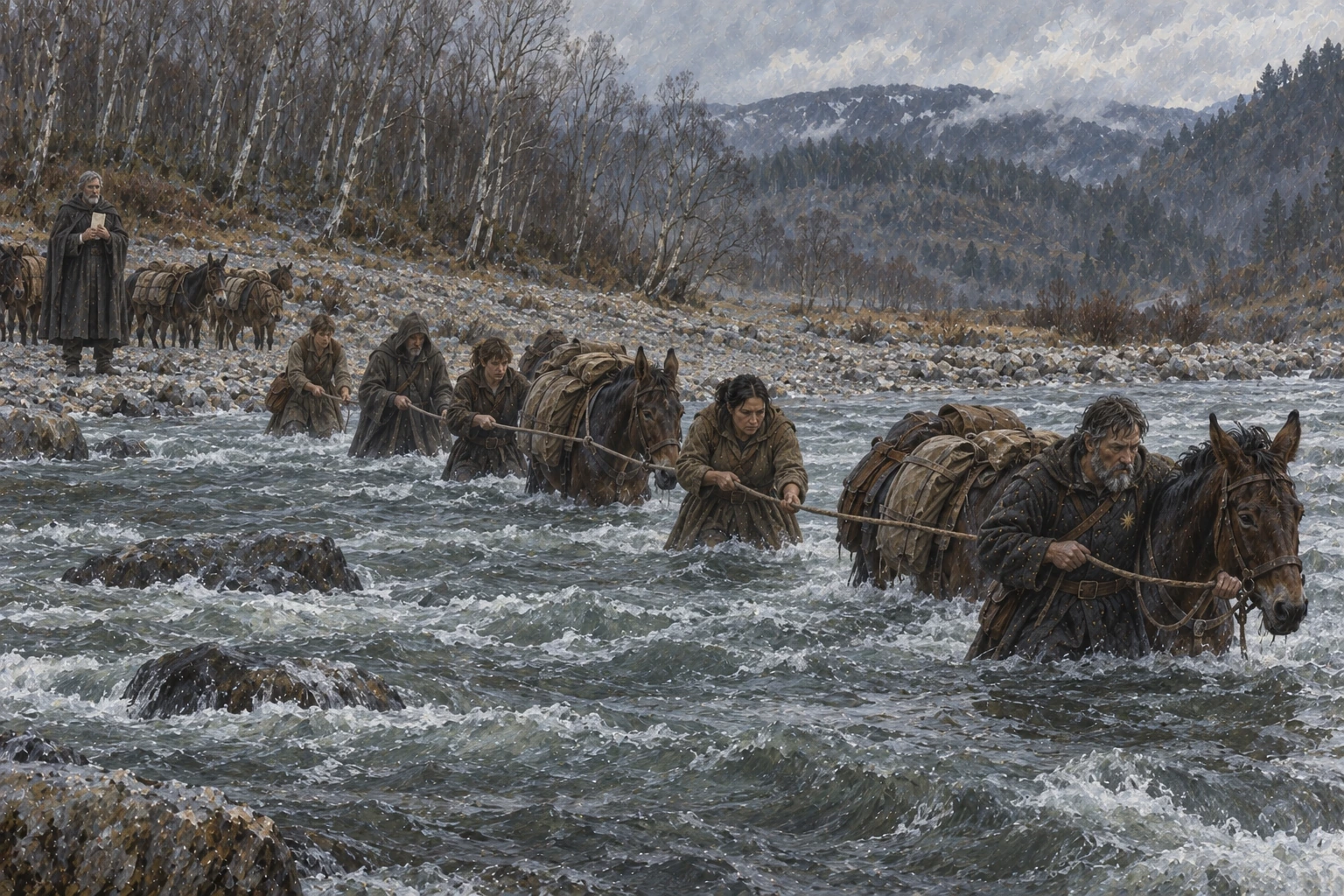
Wren planted both boots against the current and hauled the lead rope tight to keep Barrow from swinging broadside, and up ahead of her Bracken swore once, flat and quiet, in the register he kept for things that needed doing immediately and would not be helped by anyone raising a voice about them. The water came to her waist and no higher, but it moved fast enough that a person who stopped to think about it lost the feeling in a leg inside a minute, which was the whole reason the crossing got done without anyone stopping to think about it. Dorrit went first with Suet, the steadiest of the four. Sael and Ferrit came next with the loaded pair, Ossen holding the guide-rope taut from the near bank so that a boot that slid had somewhere to slide to besides downstream. Nettle came last of the animals and fought the whole width of the river doing it, planting and hauling and once very nearly taking Bracken off his own feet with her, and he cursed her the entire crossing in the low, almost fond voice he used for nothing else in the company, and got her across without letting go of her once. Luel crossed last of the people, unhurried in a way that made the crossing look like a thing she had chosen rather than a thing the water was doing to her, and did not offer a hand to anyone else, because she had judged, correctly, that the crossing needed nothing further from her.
Pip came across between Wren and Bracken, leading nothing, both hands free for balance, and when the current caught him at the knee and he put one hand out against Wren's shoulder to steady himself, the hand that landed there was colder than the water going past both of them. It stayed there only a moment. She noticed it the way a person notices a stone worked into a boot on the ninth mile of a day that already has worse things in it to think about, filed it nowhere in particular, and told herself, without much conviction, that any hand held in that river long enough would come out cold. He was on the far bank and helping Wend with a slipped pack strap before she had finished thinking it.
They lost the better part of an hour to the crossing, mule by mule, and lost the rest of the morning's dry footing with it: every pack that had ridden the far side of an animal came off soaked through, and the loose gravel bar where they finally stood, blowing and dripping in a wind that had found them the moment they cleared the water, was no place to make anything but a working halt. Bracken called it that — a working halt, packs off, gear checked — and the company obeyed the shape of it before anyone had said a further word, because three years of road between them had made the shape more familiar than most conversations.
It was Wend who saw the man on the trail behind them, coming down along the same bank they had just left, alone, on foot, and not hurrying in any way that suggested he had the strength left to hurry. "Somebody's behind us," he said, and did not say it as an alarm, because there was nothing in the shape of one man walking a known road that asked to be one.
Wren knew him before he was close enough to be sure of it — the grey-bearded man who had knelt at Iyene's hip in the long timbered room at the first household, one of the three who had gone over the injury with hands that were sure and without haste, while Dorrit stood at the pallet's foot with her arms crossed tight, watching their hands and saying nothing. He had a staff worn pale along its whole upper third from a grip that had never changed, and a coat gone dark at the shoulders with old rain, and he came on across the last of the gravel toward them at the exact, spent pace of a man who had been walking since before it was light and had learned, at some point in the walking, precisely how much of himself he had left to give the last quarter mile and not one stride more.
Alder went to meet him rather than waiting for him to arrive.
Bracken asked him, plainly and without ceremony, how far he'd come and what he carried, and got both answers back in the same brief, moving-on register the man gave everything in. He did not sit, though Dorrit offered him the one dry stone on the bar worth sitting on. He accepted water and drank half of it and gave the rest back rather than finish it, and when Dorrit asked him, in the tone she used for patients rather than for anyone else, how long he had walked, he said three days, and one of them most of a night, because he had lost the trail once past the Long Eaves in the dark and had not wanted to lose more time than that finding it again.
"How is she," Bracken said, and it was not a question shaped for an easy answer, and the man did not try to give it one.
"She sits in the chair with a board laid across the arms of it and writes," he said. "From first light most days. Longer, some of them. We take the pen out of her hand when the room's gone dark enough that she's writing over her own lines and doesn't know it, because she won't stop for less than that being shown to her." He said this the way he had said the three days, plainly, a fact reported rather than a judgment offered, and did not look at any one of them in particular while he said it. "The room has more paper in it than it did. She had us bring her every old sheet in the house that carried a date — post logs, a keeper's day-book from before her time, two ledgers nobody had opened in years — and she has gone through all of it more than once, out loud sometimes, to nobody, just to hear the order of it. The white-braided woman sits with her most evenings and reads figures back to her when her own eyes have had enough of the page. There is a second lamp in the room now that was not there before, because one was not enough, and a third stool, because people kept needing somewhere to put things down."
"And the hip," Dorrit said.
The man looked at her for a moment, the first time he had looked directly at anyone since he arrived, and said, "She hasn't asked me to carry anything about it," which was not quite a refusal to answer and was not quite an answer either, and he did not add to it, and Dorrit did not ask again. She went back to wringing a blanket over the gravel with rather more force than the blanket required.
He took the letter from inside his coat, where it had ridden dry against his body the whole three days, and gave it to Alder without a word, because it had been addressed to him and he was, of everyone standing on the bar, the one it was plainest to give it to. Wren thought, once, and did not say it: the only person in the whole of the west positioned to have found what that letter held was the one person in it who could no longer stand up on her own, because she was the only one sitting still long enough to look.
They did not stop to read it. Bracken called the halt back into motion within the quarter hour — loads to reset, blankets to wring and hang across saddle-frames to dry as they walked, the day's light already committed to a schedule that did not care what had just come up the trail behind them — and Alder put the letter inside his own coat, against his chest, the way the messenger had carried it, and said nothing about when he meant to open it, and the company understood that to mean not yet without anyone having to say so.
They climbed for the rest of the morning along a shoulder of open ground above the river, the four mules restrung and the gear repacked wet because there was no way to make it otherwise. It was slow, ordinary work, and it asked just enough of a person's hands and feet to keep the mind from doing anything it wanted to on its own: a strap re-buckled here, a load shifted there when Gable took against the weight on one side, Ossen and Wend trading the lead on the guide-rope when one arm tired of it, Sael walking with a hand flat against the reel-case slung on her back as though she meant to keep the damp out of it by touch alone. Bracken said little to any of them, and once, when Wend asked whether they'd stop again before noon, answered him shorter than the question deserved and did not apologize for it afterward.
Wren found herself watching Pip more than she had any particular reason to, without deciding to, the way a person's eye returns to a loose thread without being told there's anything wrong with the coat. He led Suet without complaint, said little, ate the last of the morning's bread without seeming to taste it, and when Wren asked him, once, whether his boots had dried out any, he said they had, and they had not, and she let it go because everyone's boots were the same lie that morning.
At the noon halt — a stand of wind-bent birch on a shelf of ground with a view back down the valley they'd climbed out of — Alder took the letter out again, and this time he did not put it away.
He broke the seal with his thumbnail the way he broke every sealed thing, without ceremony, and read the first line to himself before he read anything aloud, the way Iyene always had and he never had before, and something in his face changed and was put away again nearly as fast as it had come.
"To the Survey, on whatever road you've reached by now," he read, and his voice held the flat, carrying pitch he used for things that wanted the whole company standing still for them.
"I have spent the better part of nine days going back through every dated page in this house, and I want to set down what I found before I lose my nerve about how plainly I mean to say it. I did not need to leave this chair to find it. That is the part I want you to sit with before the rest.
"The Watch's silence comes first. You know this — you worked it out on the road yourselves, months ago, and wrote it in a day-book I have never seen and do not need to. What you did not have, and what I have had time enough in this chair to build, is the distance between each silence and the one before it, set down not in miles but in days, hearth by hearth, the whole length of the King's Road West. The Steading Lamp, a bare day's ride from the Watch by any horse that's ever made the trip, falls silent six days after it. The river country beyond it — the stretch nobody rode out of, silent ever since — falls eleven days after that. Merrow's own outlying word thins by the week from there on, less of it arriving each time there is less of anybody left along that stretch of road to carry it.
"Here is what I want you to notice, because I did not, not for a long while, and I have had nothing to do for nine days but notice things. Those gaps are not miles. Six days does not cross the ground between the Watch and the Lamp at any speed a rider keeps, and it does not cross it at any speed weather keeps either — weather does not observe a road's own order, it does not skip a mile of empty ground to arrive punctually at the next hearth down the line. Those six days, and the eleven after them, are a walking pace. A person's walking pace, on foot, down a road, in the order the road actually runs — not the order a line drawn on a map would run, which is a different order entirely and would have scattered those silences however distance scattered them, with no particular respect for which hearth came first."
Alder stopped there, not because the letter stopped, but because Gable had planted all four feet at the shelf's narrow lip and would not be led past it, and it took Bracken and Ossen both, one at the headstall and one at the flank, the better part of two minutes to walk the animal past whatever it had decided it did not like about that stretch of ground. Nobody spoke while it was happening. Alder held the letter folded against his knee and watched the mule the way he watched everything that needed watching, and when Gable finally went forward, ears still back, he unfolded the page again and found his place without needing to search for it.
"There is a second thing, and it took me longer to see than the first, because it is smaller and does not run every year the same way the corridor does. The mail over the Stair has stopped coming down for two autumns running now. Both times, within the same week — not the same day, but the same week, near enough that I no longer believe it is chance — the pass shuts for the winter behind it. And both times, the following spring, in the same week the pass opens again, something new starts moving on the road below it. To the week, both years, on the opening. Not on any hearth's distance from any other — I want to be plain about that, because I nearly made the same mistake myself and would rather you not repeat it after me. The distances are a walking pace and nothing more precise than that. The dates are the door. Whatever is coming down that road waits for the door to open, the same door, the same season, twice running, and then it walks — and a thing that walks in the order the road runs, and waits for a door to open before it starts, is not weather. I do not know what else to call a thing like that except what it plainly is."
Wren, standing near enough to see the page over Alder's shoulder without meaning to, saw the place where the ink went thin and cramped for three full lines and then opened out again, larger, the letters set further apart, as though the hand writing them had stopped, rested, and begun again with more room given to itself. She said nothing about it, and looked instead at the far ridge until Alder turned the page.
Alder read on.
"You will want to know the rest, and I will give it to you plainly because there is no way to give it to you otherwise. The corridor is the King's Road West. It is the same road this Survey graded and cleared and marked, the one Wystan walked first and we walked after him, the one whose fair copy sits in the College's own chests at Merrow this hour, kept in good order for three hundred years because that is what a Survey does with a road it is proud of. I am not going to tell you that changes nothing, because it changes nothing about what happens next, and I am also not going to tell you it was not the Survey's road, because it was, and is, and every mile of it we ever kept walkable is a mile something else has walked since. I do not have anything to offer you in place of that. I looked for something, the first day I understood it, and there was nothing there to find. I am not writing this to be forgiven for it. I am writing it so that you will believe the dates."
The birch shelf gave them perhaps ten more minutes before the day's climb had to start again in earnest, and Bracken used most of them re-lashing a load that had shifted on Suet's back during the halt, working the knot with his head down and his hands moving with the particular deliberate calm of a man giving himself something to do with his hands rather than with whatever else was in front of him. Sael sat with her reel-case across her knees and did not open it. Wend had gone very still in a way that did not suit him. Ferrit looked at the ground.
"There is one more thing," Alder said, and read the last of it.
"I have had word sent ahead of this letter, to every keeping within three days of this chair that still answers a runner, asking what they can raise and how soon, and I have told them to expect me to raise the rest myself once I am fit to travel it, which I am not yet, and which I do not intend to let stop the asking. I will bring the west's muster up the line behind you, such as it proves to be, and I will have it moving before the season turns if I have to be carried the length of every road it travels on. This is not a thing I am asking anyone's leave to do. It is done, or as done as a thing can be that has not happened yet. — Sath."
Nobody said anything for what felt, to Wren, like longer than it probably was. Alder stood with the letter still open in both hands, not reading it, his eyes on the middle distance past the birches where the valley fell away toward the river they'd crossed that morning, and his jaw worked once, twice, the only part of him that moved at all. It was his own craft the letter had just finished naming, his own road, his own three hundred years of keeping something that had turned out to hold a door as well as it held a country, and whatever crossed his face in that half a minute stopped somewhere short of his mouth.
It was Bracken who spoke first, and what came out of him was not a word of praise, and it was not a word about her hip either. He finished the buckle he'd been working before he said anything at all, set the load down, and only then straightened up to it. "Three days' runners," he said, working it the way he worked any column of march. "Call it a week to raise anything worth calling a muster, another to move it, longer if the roads north of the lake are what they were the last time either of us rode them. She'll have something behind us by the time we're through Kelder, if she's got anyone at all to send." He said it the way he gave every number he trusted, flatly, already three steps further into the arithmetic than anyone else standing on the shelf.
Dorrit had stopped wringing anything. She stood with a half-twisted blanket still in both hands, not moving it, looking at nothing in the middle distance. Wren was thinking the same thing she could see moving behind Dorrit's face: the letter had spent nine days on dates and roads and a road's own guilt, and not one word, not even a small one, not even the kind of joke a person makes about a thing to take the size out of it, on the leg that would not let her stand to raise anything at all. Dorrit folded the blanket the rest of the way without saying any of it aloud, laid it over Barrow's back to finish drying, and went to check the mule's girth, which did not need checking.
Wren felt something she did not have an easier word for than fear, and it did not feel like the fear of a wolf on a dark road or a thing in the trees at Ness Fell, which at least came with somewhere to put your hands. It sat lower than that, in the part of her that had learned, at Thistleton and at the steading both, exactly what it cost to spend more of yourself than you had been asked to spend, and she thought, once, clearly, of thirty-seven names and did not let the thought go any further than that, because there was nowhere further it needed to go for her to know what she was looking at.
Alder folded the letter along its own creases, once, and gave it to Wren to carry, because the Waybook already rode against her, oilskin and all, and one more folded page against the same place was no burden worth arguing over. She took it, and in taking it felt, for just a moment, the place near the last line where the paper had been pressed hard enough that the pen's own point had nearly gone through it — not a slip, not a hand losing its grip, but a hand that had set itself down on purpose and meant every word of that last sentence to leave a mark.
Wend had gone still again, and this time Ferrit moved a half step nearer his cousin's shoulder, close enough to matter and not close enough to be seen doing it. Whatever keepings the grey-bearded man's runners had already reached would reach people either of them had grown up naming.
"We keep off the road itself from here to Kelder," Alder said, and it was not offered as a question. "Beside it, in sight of it, close enough to use it if the ground turns bad enough to need it. Not on it. Not one boot on the metaled stretch of that road until I say otherwise, and I will not be saying otherwise before we have to." He looked at no one while he said it, and looked at everyone by looking at no one, the way he did when a thing was not going to be discussed. "That's all. Get the loads squared. We're losing daylight standing here."
Nobody argued it. The letter folded against Wren's side had already made the argument for him, better than he could have, in the one hand among them that had never given anyone cause to doubt it.
They went on up the shoulder of the hill in the wind, ten of them and four mules, off the good road and along its edge instead, close enough on the climbing ground to see where the King's Road West ran below them, pale and well-kept and exactly as straight as three centuries of careful grading had left it, running on ahead through the gray country toward Kelder and the mountains beyond it. It was the same road whichever way a person meant to walk it, east or west, toward the last of the light or away from it, and there was no way through that country that did not eventually come back to walking some part of it, because the Survey that built it had never left itself, or anyone who came after, any other road to take. Somewhere behind them, days back down that same pale line, a woman who could not stand was already spending what she had left of herself to put more feet on it. Somewhere ahead of them, past Kelder and past the mountains holding it, was the only door any of that would matter to.