Pip Brought Back
Bracken's hand closed on Wren's shoulder before she was fully out of sleep, three fingers and a thumb pressing hard enough to bruise, and she came up out of the blankets already reaching for the knife she kept under the roll before her eyes had properly opened, because it was the grip he used for wolves scenting near the mules and not the grip he used to wake somebody for an ordinary watch turn, and her body knew the difference half a second before her mind caught up to it.
"He's gone." Bracken didn't say it loud. He didn't need to; the whole camp was already stirring around her in the dark, Dorrit up on one elbow, Alder already on his feet with his stick in one hand and his coat half fastened, Sael reaching for her boots without having been told anything at all yet. "I had him at arm's reach. I slept the whole night through for the first time since the coomb, and he's gone."
She was on her feet before she had worked out what he meant, and then she saw the shape of it for herself: Pip's roll flattened and gone entirely cold, no warmth left anywhere in it, the lace of his own boot still knotted in the particular double-loop he always used and had plainly never touched this night at all. Whatever had lifted him out of that bed had not needed to wake him first. He had simply stood, and walked, as a man walks out of a room he has already left in every way that matters before his own feet cross the threshold of it.
Four days of the Hall's ledgers had worn Bracken down further than any of them had said aloud in the hearing of the others — chests forced open with a shoulder and a chisel, charts carried down three flights by the armload, a whole evening spent on his knees over a lock that fought him joint by joint until well past midnight — and for the first time since the coomb he had gone under and stayed under, dead asleep, a hand's width from a boy who had been promised he would not spend one more hour of this alone. He said as much himself, flatly, to no one and to everyone, and then said it again to Alder as though repeating it aloud might yet change what it had already done. Alder didn't answer that part of it. He was crouched at the edge of the warded ground with two fingers spread against the snow, reading it the way he read a bearing line.
"Here. And here." He looked up. "Walking, not carried — his own stride, not dragged, not staggering, not a mark on him to say otherwise. The line's unbroken clean across the gap. Nothing came in for him tonight. He went out on his own two feet, through ground that would have burned a faded thing to ash for trying the same crossing."
"Then he's not taken," Dorrit said, already dragging her boots on over feet that hadn't finished warming. "He's led."
"Both, likely," Wren said, and didn't stop to explain the rest of it, because there wasn't time to put words yet to the thing she had felt moving through her own sleep and mistaken, for the length of one whole breath, for an ordinary dream: a coldness withdrawing from her, like a held breath going out of a room once whatever had been holding it in had gotten what it wanted and no longer cared to stay.
Nobody argued about going. Alder said "we go" in exactly the voice he used for reading off a bearing-check, and that was the whole of the council the camp held before its fires. Sael had both boots laced before he finished the sentence. Ossen already had the rope coiled over one shoulder, unasked. Wend was up and moving on ribs that hadn't finished mending before Dorrit could tell him to stay behind with them, and she looked at him once, weighed whatever she'd been about to say, and spent the breath on something more useful instead.
Bracken said nothing at all. He had his blade belted and his boots laced and he was three strides past the ward's own gap before Alder called him back to wait for the rest of the company to form up around him, and when he stopped and stood there waiting, he stood as a man stands outside a door behind which somebody he loves is dying and cannot yet be reached, which was near enough the truth of it that no one corrected the picture.
The city took them in the same way it had taken them every night since the gate, which had never pretended to be a welcome of any sort. Snow lay unbroken across streets no living foot had walked in three centuries save the company's own these past ten days, and Pip's tracks ran down the middle of the widest of them like a seam torn clean through white cloth, his stride never slowing at a single doorway or a single dark window, no backward look anywhere along the whole visible length of it, as if the looking itself had simply stopped being a thing his own eyes still did for him.
Wren walked with the Waybook's weight against her hip, of no use for anything that was coming, and kept a hand near the satchel anyway, out of a three-year habit that no longer answered to reason. She could feel the wrongness the way she had felt it since she was a child too small to own a word for it, except that here, inside this particular city, it did not sit at the edges of things the way it sat on an ordinary stretch of bad road out past the last honest hearth. Here it ran underneath everything at once, close beneath the surface, the way rot runs under a floor's good boards long before any single board has troubled itself to give.
"Something's still out here," Luel said, from just behind her shoulder, low enough that only Wren caught the whole of it. "Not the one that took him. Its leavings. It never travels anywhere without leaving a little of itself scattered behind, as a careless man leaves gates open."
"How many?"
"More than you'll want, and fewer than you'll need to worry about for long, if what I remember of you tonight so far is any guide at all."
They found the first two at the mouth of a side street, where drifted snow stood deep enough to swallow a doorstep whole, standing the particular way faded stood when whatever animated them had briefly forgotten there was anything left to do: not hunting, not hiding, simply present, furniture left standing in a room that no living hand had entered in a hundred years. One had been a woman once; something in the set of her shoulders still remembered the weight of a yoke she had carried every morning of an ordinary life. The other had been young, no more than a boy, though nothing boyish remained in him now that Bracken's boot found a loose slate underfoot and cracked the sound flat off the housefronts on either side, because both of them turned toward the company at once, and whatever turned in them held none of the yoke-shouldered woman and none of the boy at all, only the single flat attention of a thing with exactly one use left to it and every intention of spending that use before the night let it go.
Alder's stick came up, and a thin line of pale fire ran along the snow between the company and the mouth of that street — not fire that could burn anything living, nothing in it looked capable of scorching so much as a sleeve, but a wall the width of a doorway raised where a moment before there had been an open road. "Through it, if you must," he said, without once looking away from the line he was holding steady with both hands. "It will not stop you going forward. It will stop whatever tries to follow you through."
She went through it.
She did not afterward remember choosing to run. She remembered the yoke-shouldered thing closing the last stretch of distance between them at a speed no shoulders built for carrying water should ever have owned, and she remembered her own hand closing on its wrist before either of them had properly arrived at the meeting, and after that there was no more choosing left in any part of it at all. What came next did not ask her leave and she did not ask its. It simply happened, the way a fall happens once a foot has already left the step behind it and there is nothing left in the world to argue with.
Cold arrived where cold had no business arriving. Not the ordinary cold of the night around them, which could be borne and had been borne all week, but a cold with a direction to it, a cold that was going somewhere and meant to arrive. It came up her own arm from the exact point where her palm gripped bone under threadbare, ancient cloth. The snow beneath both their feet did not melt. It froze harder in a widening ring, as though the ground itself flinched from whatever was passing through her and wanted no part of carrying it. There was no glow anywhere in it. There was light with no warmth at all in it, grey and flat and coming from nowhere she could point a finger at — off the bare inch of air between her palm and the wrist it held, off nothing, off everything at once — running up her arm the way current runs up a wire that has finally, after three hundred patient years, found something willing to carry it all the way through. She did not go looking for the name. She reached for it the way her ear reached for a wrong note gone sour on a fiddle string before her mind had finished deciding the note was wrong at all, and the name was there waiting, small and worn thin and utterly unimportant to any living soul but the one it had once belonged to, and she said it.
It hardly mattered which word it was.
A sound came off the thing's chest like a hawser taking a whole ship's weight at once, one deep note with nothing musical anywhere inside it, and then the thing folded. Not fell. Folded, as a tent folds when every pole holding it up is kicked loose in the same instant, three centuries arriving on it faster than any watching eye could hope to track the arriving. What hit the snow was not a body at all. It was bone gone the color of old horn, and a fall of dust the wind took before it had finished settling, and a heap of cloth so rotted through that even its own collapse made no sound going down.
The boy was already moving.
She turned into him before he closed what distance was left, and it happened again, and this time she felt herself do it — watched her own hand rise and close on a shoulder gone hard and cold as fence-iron left out three winters running, watched the grey light climb her own wrist, heard the low note gather deep in his chest the way weather gathers before it breaks. There was no fear anywhere in the watching. That frightened her far worse, afterward, than the act itself ever managed to. She said his name. Two syllables, no more. He folded exactly as the woman had folded — dust, and bone, and cloth — and was down and finished before the sound of him striking the ground had properly become a sound at all.
A third came out of a doorway behind Ossen with one hand already closing on his collar, reaching for the meat of his throat behind it, and Wren was there before she had crossed the ground required to be there, the whole distance simply gone, spent before either of them had leave to spend it. She did not touch this one gently. She did not touch it in any particular way she could afterward have named or defended. Her palm found what passed, in the dark, for its throat, and the name came up out of some part of her she had never before had cause to reach into — not searched for, not remembered, simply there and waiting, the way solid ground is simply there under a foot already falling toward it — and she said it, short and hard, two flat syllables, and the note came, and the fold came, and Ossen stumbled backward out of the wreck of it with a fistful of collar still bunched in one hand and nothing left inside it worth holding onto.
Three.
She stood at the center of a ring of frozen, blackened snow with her breath coming in short white clouds and her hand still curled from the last grip it had closed, and for a long moment no one in the company said a single word to her or to each other.
Bracken had not moved through any of it. He stood exactly where he had been standing when the third one folded, his own blade still drawn and still wholly unused in his hand, and he was looking at her as a man looks at ground he has just been told is not ground at all but a thin skin stretched over something with no bottom to it whatsoever. It was not fear of the faded on his face; he had killed faded before, calmly, with a clear head and a clean blade, and slept sound the same night after. This was some other thing entirely, and she watched him understand that it was some other thing entirely, and watched him decide, in the same half-second, to say nothing about it to anyone.
"Wren." Dorrit's hand found her arm, not pulling her back, only steadying — the kind of touch you give someone standing nearer an edge than they've yet noticed for themselves. "That's three."
"There were three," Wren said. Her own voice came out steadier than she'd expected of it. "I counted them as I went."
No one answered that directly. Alder let the pale line of fire behind them gutter out with a small sound like a page being turned, and fell into step at her side without a single word about what he had just watched her do at close range, three separate times, in less time than it takes to walk the length of a modest room, and his silence answered plainly enough on its own, one she chose not to examine yet, because there was still a boy somewhere ahead of all of them, walking on his own two feet toward whatever it was that wanted him walking there.
It was Ferrit who spoke first, his voice pitched too fast and a shade too high for the cold to account for on its own. "Is that — will it be like that? If it's one of us that starts fading. Will it look like —"
"No," Wren said, before he could finish asking the question he plainly didn't want answered in full. "It won't look anything like that."
She believed it entirely, saying it.
They found Wend a hundred paces further on, sitting down hard in the snow with one hand clamped over his own mouth, untouched, unmarked, nothing wrong with him that any eye could find. When Dorrit crouched in front of him and asked what the matter was, he took the hand away and said, in a voice gone thin and strange in a way none of them had heard from him before, "My mother's name." He said it again, softer. "I've always had it. I have had it my whole life." His breath came ragged, catching high in his chest. "It isn't there anymore."
No one told him to try harder for it. Dorrit sat down beside him in the snow and put an arm around his shoulders and promised him nothing, because she had no way of knowing it would come back, and because this past hard year had taught her not to spend a promise she couldn't be certain of keeping. Wren stood over the two of them with her own hand still not entirely steady at her side. It had not touched her at all. It had gone looking for the nearest open door standing anywhere near her, and it had found Wend's, and there would be no handing it back to wherever it had come from, and there was no time to grieve it properly either, because Pip's tracks still ran on ahead of them into the dark, unhesitating, straight toward the one building left standing in the whole sleeping city with its own great door thrown open.
The Hall stood black against the snow-light at the top of its broad stair, its doors flung wide exactly as Wren had left them ten days before, and Pip's tracks went straight up the steps and through them without a single print anywhere turned aside to look at a single thing along the way.
Inside, the drafting hall's own skylights let down just enough grey pre-dawn light to show the standing desks in their long silent ranks, the rolled charts still stacked where the company had left them the last morning, the cold hearth Alder had banked days ago and would not need to bank again before they left it for good. Nothing in the whole vast room stirred. Whatever wrongness had walked through this building sometime in the last hour had already passed clean through it and out the far side, and what remained behind it now was only the ordinary silence of an empty hall, which after the street outside felt, for one unguarded moment, almost like safety.
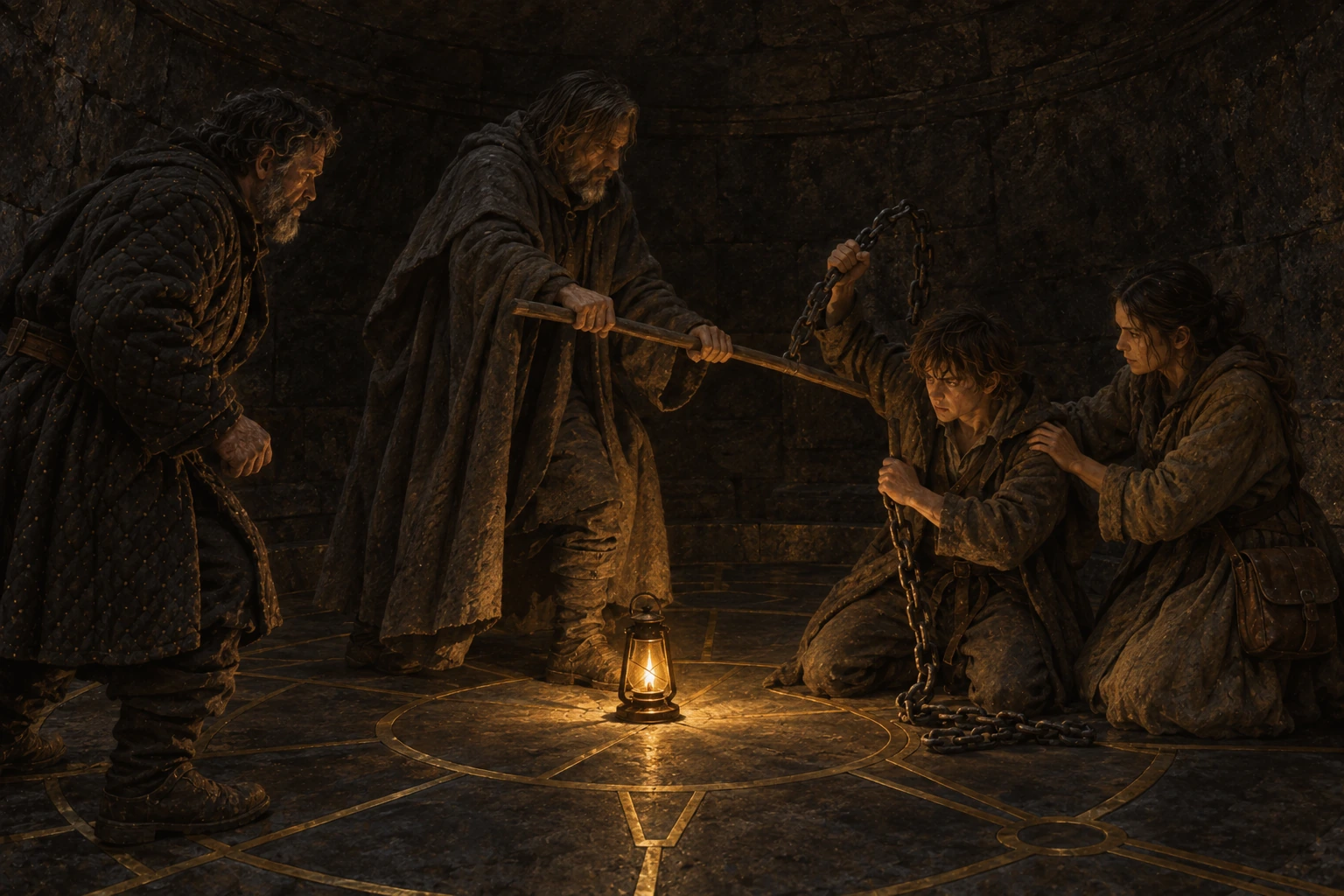
Pip's tracks led straight to the round chamber at the gallery's far end — the brass-floored room where they had found the fourth mark together, where Alder had reached for a shape in the old tongue and closed his hand on nothing at all, where a word none of them had ever heard spoken before had finally been given its first clean voicing in three hundred years. The door to it stood ajar. A single lamp burned inside, taken down from its own bracket and set on the floor at the diagram's very edge, throwing long crooked shadows the whole way up the walls and across the ceiling above them.
Pip knelt at the diagram's center with one of the gallery's own surveyor's chains dragged across his lap, forty links of cold iron he had learned to coil and carry and read a distance from before he had learned much of anything else in this company's service, and he was working the hooked end of it into the seam where brass met stone, patient and utterly without expression, as a man works a lever he has already half-convinced himself will never move for him.
"Pip." Bracken's voice, and he was already moving, three strides into the chamber with one hand already out ahead of him.
Pip turned.
There was nothing of him left in the turning. His face held the same flat stillness the boy-shaped thing in the street had worn, the single unhurried attention of something with exactly one use remaining to it, and the chain came up and around in one wide flat arc with the whole weight of forty iron links behind it, aimed square at the height of a man's own skull, and it would have taken Bracken clean across the temple with everything Pip's body could put into a single swing if Alder's stick had not come down across the chain's own path a half-breath before it could arrive, catching the iron hard enough to knock it sideways into the wall instead of into bone.
The chain rang once off the brass floor and lay still.
Pip did not follow it down. He knelt exactly where he had been kneeling, both hands still curled around a grip that was no longer there for them to hold, staring at Bracken with an attention that carried no recognition in it whatsoever, while somewhere underneath the flat stillness of his own borrowed face something that was not Pip at all watched the whole room with patient interest, as a man watches weather he expects, sooner or later, to pass without ever troubling him directly.
Bracken had not stepped back from any of it. He stood exactly where the chain would have found him a heartbeat sooner, his own hand still out, his face gone the color of old ash in the lamplight, and it was Dorrit who said his name once, sharp as a slap, before he could reach for the boy a second time.
"Wren." Alder didn't raise his voice at all. "Now. Gently, this time."
What he meant landed on her before the words themselves finished arriving. She had done this three times already tonight, and each of the three had taken less than a single breath — hand, and name, and fold, over and done before her own fear had any chance whatsoever of catching up with what her hand had already decided to do without her. She had thought, walking here through the dark, that whatever waited for Pip would want the very same speed from her, faster if anything, because it was Pip, because every minute mattered more than the last one had, because the boy was still walking somewhere none of them could yet see the far edge of.
She knelt in front of him instead, and found that she could not make her own hand cover the last foot of distance between it and his shoulder.
It was not any fear of failing at the craft itself. Her hand knew this work now the way it knew the neck of her own fiddle, without needing to be told where the strings lay under her fingers. It was that not twenty minutes past, this same hand had closed on a stranger's wrist, and then a stranger's shoulder, and then a stranger's throat, and unmade three whole lives in less time than it takes to say any of their names aloud, and now it was being asked to rest, softly, on a boy who had taught himself the beacon-count by lamplight so that he would never be the one who slowed the whole company down, who had signed a single fair copy twice inside one quarter hour without ever once knowing his own hand had quietly stopped belonging only to him, who had asked her, on an ordinary night on an ordinary stretch of road, to check every one of his knots because he no longer trusted what his own body did once the dark had it to itself.
"Wren." Dorrit's voice again, very quiet, not urging her on, only saying her name the plain way you say a person's name to call them gently back into a room they've half left.
She put her hand on his shoulder.
Nothing folded. There was no cold arriving out of nowhere, no light with no warmth in it, no low note gathering to break. There was only her own hand and his own thin shoulder under a coat gone stiff with a night's cold, and the long slow work of finding, underneath whatever had been standing in him and wearing the whole of his face, the boy who was still somewhere inside it. It took the better part of a full minute before she found the first true thread of him at all — not a name yet, only a small warm fact: a boy once handed a slate and told to count, who had gone on counting everything within reach for a solid week afterward out of nothing but simple joy in being able to do it. She held that one fact the way a person holds a lit taper against a wind trying hard to take it, and worked outward from there, slowly, refusing every temptation to hurry any of it.
"Pip," she said. "Pip Sandover." She gave him the whole of it, slow and deliberate, the corner-flourish and the foot-signature both, the true one, the one whose small hooked tail belonged to him alone and to no one else who had ever worn his hands for even a single night. "Apprentice to the Survey. Sworn to the charter with the rest of us. The one who lays every fire and counts everything he can reach. Bracken's watch, and nobody else's."
His breath caught once, hard, like a man breaking the surface of water he had gone under believing he would not come back up from at all.
"There's a beacon standing lit on Kelder right now, and you laid its courses with your own two hands," she said. "There's a fair copy sitting in the day-book with your hand in it twice over, and only one of those two hands was ever truly yours, and we both already know which. Nettle likes you better than she likes anyone else in this whole company and has never said why to a living soul. Your mother —" She stopped herself, and started again, gentler. "You have a whole name, Pip. It's the only one you have ever owned, and it is still yours tonight, and I am giving the whole of it back to you now, slowly, because that is exactly what it needs from me, and because you are worth every slow minute of it."
It took the better part of two minutes more before his own eyes finally found hers and held there, and knew her for who she was, and the chain lay forgotten on the brass floor between the two of them the entire while, and no one else in that round chamber said a single word until it was fully done.
He came back up as a man comes back up from deep water — slow, gasping, grateful for it and ashamed of the gratitude in the very same breath — and the first thing he did once his own two hands belonged only to him again was look down at them as though he had never seen them before in his life.
"I couldn't stop," he said, his voice cracking clean across the middle of it. "I knew — some of it, near the very end, I knew what my own hands were doing and I couldn't make them stop doing it. I wanted to put the chain down so badly. I watched myself refuse to put it down."
"You put it down," Bracken said. His own voice wasn't steady either, not by half. "It's lying on the floor right there. You put it down the second it mattered most." It wasn't entirely true, and everyone standing in that chamber knew perfectly well it wasn't entirely true, and no one corrected him for saying it anyway.
Dorrit checked Pip over with hands that would not quite stop their own shaking, found nothing broken and nothing frostbitten past what an hour's careful warmth would mend, and made him drink from the flask Alder passed across without being asked for it. Pip took it, and lifted it toward his mouth, and Wren watched his hand shake on the way up — not badly, not enough to spill a drop of it, but enough that anyone watching closely for it would have seen the tremor plainly, a fine constant shiver that had not been anywhere in him two nights before, in the fair copy, in the day-book he had kept faithfully every evening since the coomb without once missing a night of it.
No one said a word about the shaking. Pip looked at his own hand holding the flask a moment longer than the drinking strictly required of him, and then he drank, and set it down carefully on the brass, and kept his eyes elsewhere for the rest of the night.
"The chain wanted the brass up," he said instead, staring hard at the diagram rather than at any of the faces around him. "I don't know why it wanted that. I don't know what's under it. I don't think I want to know what's under it, not tonight and maybe not ever."
"Then we won't look tonight," Alder said. "Maybe not for a long while yet. Some floors want leaving exactly where they lie." He crouched, gathered the chain up himself with the same careful patience Pip always gave it, coiled it link over link, and set it back on the gallery rack where it belonged, well out of anyone's reach until morning.
They walked back through the sleeping city in the last hour before a grey and reluctant dawn, ten of them close together where nine had gone out spread thin along a hunting line, and the whole column kept mostly to itself the entire way. Wend walked with his jaw set hard and his eyes fixed somewhere well past the housefronts, testing, every few dozen paces, whether the shape of his mother's name had come back to him yet, and finding, every single time he tried it, the exact same clean absence standing where it had always stood before tonight.
Bracken kept half a pace behind Wren the whole way home, closer than the cold alone required, farther than he had ever walked from her before this night. He said nothing about the distance he was keeping. He didn't need to say a word of it. She felt the gap in it the same way she had felt cold climbing her own arm an hour before — a plain fact with no argument attached to it anywhere, present whether or not a single soul in the company chose to name it aloud — and she made no attempt to close it herself, because there was nothing honest left in her that could have closed it, and because some part of her that had watched her own hand do what it had done in that street understood, better than she wanted to admit even privately, exactly what it was he had suddenly become afraid of.
Once, and only once, Bracken said the other thing out loud, low, meant for no one but himself and overheard anyway: "I had him at arm's reach." Nobody told him it wasn't his fault. He would not have believed it if they had, and none of them tried.
Luel walked at the very rear of the column, silent for nearly the whole distance, which said as much on its own, from a woman three hundred years old who rarely found silence necessary for anything. Once, near the gate into the merchants' yard, she looked sideways at Wren for a long moment — not with fear in it, and not with anything else Wren could have put a single honest word to — and then she looked away again, out over the sleeping roofs, and simply kept walking.
Alder walked point, his stick tapping the packed snow at a steady, unremarkable pace that gave away nothing whatsoever of what the night had cost anyone in it, and said, once, mostly to the road unwinding ahead of him: "We'll ward the yard again tonight the same as every other night we've held it. Double the watch on the gap by the well, starting now, and keep it doubled until we're well clear of this city for good." He left Pip's name out of it entirely, and Wren's too. He set the plain fact of what the night had cost down in front of the company the same way he set down every other fact they needed to act on, and left the rest of it — every last piece of it — for later, or for never, whichever the company itself eventually chose to make of it.
Dorrit walked with her own arm still looped under Wend's, though he no longer needed it to keep himself upright, and kept it there anyway.
Pip walked between Dorrit and Wren the entire way, upright and steady enough on his own two feet, and every hundred paces or so his right hand twitched once at his side, small and entirely involuntary, the ghost of a motion with no chain left anywhere for it to hold onto, and he seemed never to notice himself doing it, and no one told him.
The gate into the yard stood exactly as they had left it hours before, the ward-line unbroken clean across it, and behind it the fires had burned low but not out entirely, and beyond the fires the road east waited, patient and entirely unconcerned, for whatever the company would eventually decide to make of all of this once there had been time enough to decide anything at all.