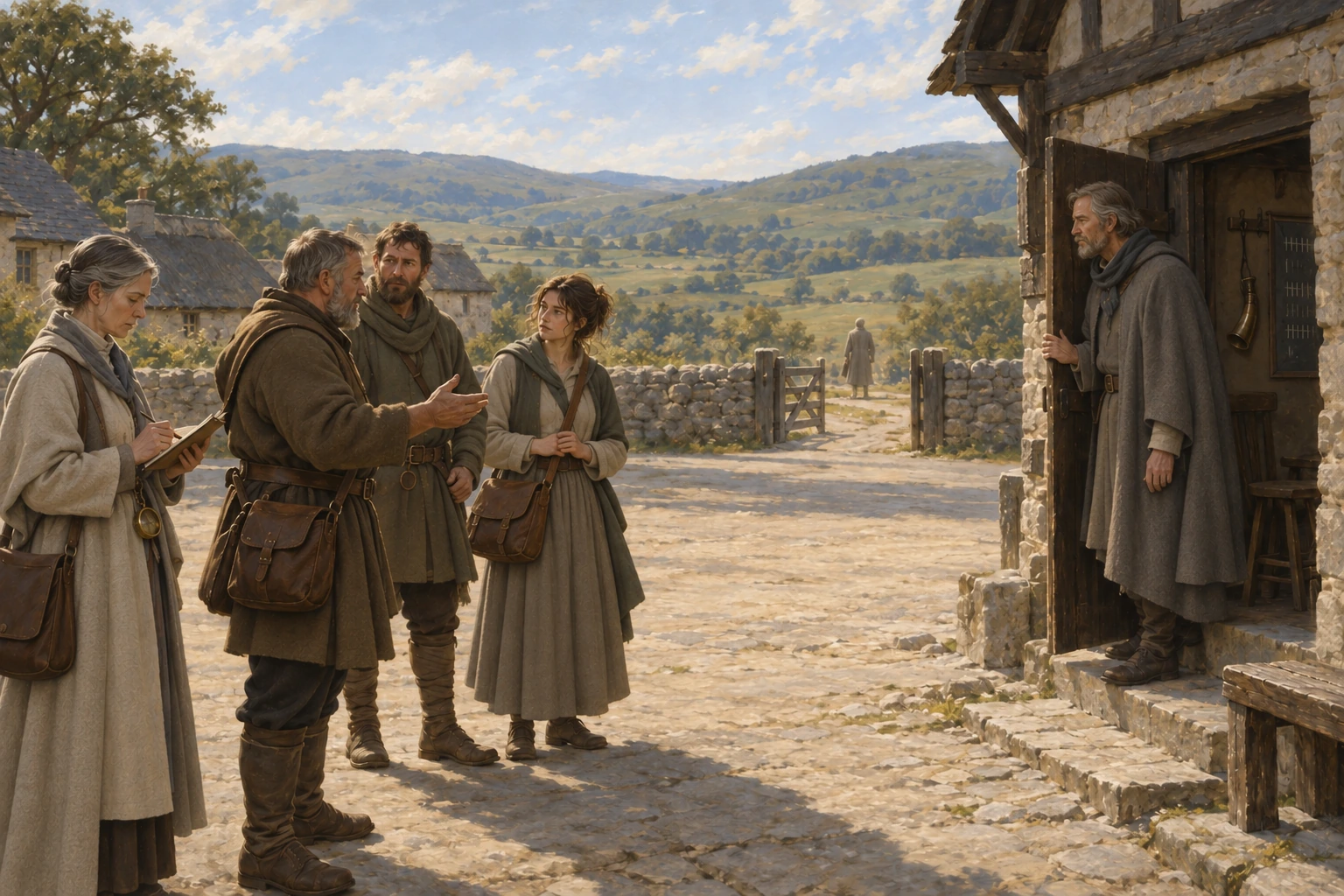
The Hollow Town
Spring had come on properly now, all at once and a little disbelieving of itself, and for two full days out from Sarnholt the western road had given the company nothing but its ordinary springtime grammar: culverts running full with snowmelt, verge-trees in a haze of new leaf too pale yet to call green, waymarks standing up out of last year's dead grass like men who had merely sat down for a rest. Sereth was days behind them, not a year, not even a season — Garron still spoke of his mother's kitchen in the present tense — and the company had settled back into the plain good rhythm of a well-fed, well-led road.
On the morning of the third day the road forked, at nothing more remarkable than a broken fence-line and a lightning-split oak, and Garron stopped there as he had never stopped at a fork before — not to read it, but simply to stand at it, both boots square, in a stillness Wren recognized from the wheelwright's shop at Sarnholt: not Luel's old stillness, but something nearer to a man remembering, without being asked, a rule his whole family had kept so long that keeping it had stopped feeling like a choice.
"This is where we turn off," he said. "My people. Always have."
"Turn off to where?" Iyene asked, already reaching for her book.
"Round." He nodded at the left-hand fork, which climbed a little and rejoined the main road some way further on, adding perhaps an hour of walking for the saving of nothing she could see. "There's a way that goes straight on, through, and there's the way that goes round, and my family's walked the round way so long that nobody living remembers being told why, only that it's what you do." He looked down the straight road, into a shallow green valley that gave, at this distance, no more sign of trouble than any other shallow green valley on a bright spring morning. "We call it the hollow town, when we call it anything at all, and we go round it, and that's the whole of the lore I've got to give you. I'm not ashamed to say I don't know more, and I've never wanted to."
The joke, if it was one, drew no laughter, and they took the straight road anyway, slowly, and the wrongness came on by such fine degrees that none of them could have said where it began.
It began, if it began anywhere, with the birds.
The morning had opened the ordinary way, larks going up out of the wet grass in their usual scattered abundance, and by no single moment Wren could fix, only by a gap noticed backward, the larks were gone, and then the finches, and then even the crows, thinned to nothing over the better part of an hour, until Dorrit said, flatly, "I don't hear anything," and everyone realized at once that this was exactly true, and had been true for some while.
The verge told the second part of it. Along every mile of western road the company had yet walked, spring had done its ordinary indiscriminate work — deer cropping the new growth to a ragged fringe, rabbits worrying the shoots at burrow-mouths. Here it did not. The verge grew up thick and pale and entirely undisturbed, every blade the same uncropped height as its neighbor, as though nothing with teeth or hooves had troubled it in a very long while.
"No deer sign," Bracken said, crouching at it, plain and careful. "Not old, not new. Empty country still has deer in it, generally more of them than a peopled one." He straightened, and put his glass away without using it.
The mules felt it before anyone put a further word to it. Suet's ears went back and stayed back; Gable, who slept through nearly everything, walked with his head lowered and his gait shortened by careful inches; even Nettle let the whole morning pass without taking a nip at anyone's sleeve, and by the time Pip said so aloud the silence about it had become its own small unease.
The cold came last and settled deepest — not the honest thin cold of a spring morning not yet warmed through, but a cold that sat, low and exact, in the shallow folds of the ground the road crossed, so that walking became a matter of stepping down into pockets of it and climbing back out into ordinary spring air, over and over. It lay where fog has no business lying, at noon, under a clear sun, only in the low ground, as if it had run downhill sometime since before anyone living was born and pooled there and never been asked to leave.
None of them put a name to what it was, though everyone, by the time the company halted at midday, knew that it was something.
They stopped short of the valley's true mouth, on a rise where the road still ran in plain sunlight, and ate standing rather than sitting, which was its own small unspoken vote on the morning.
"There's a way round," Garron said again. "Fit for feet and mules both. We could be past this whole business and camped clean by evening."
"We could," Iyene agreed, in the flat considering tone she used for a bridge whose soundness had not been tested either way. "And a town unmapped twice over — once by whatever closed it, and again by us, on purpose, with a charter that says the whole working — is a loss I've never learned to make my peace with, when the loss was avoidable and chose not to be avoided." Her hand rested a moment on the strap of her working sheet, as if the book itself had an opinion.
"That's the charter's case," Alder said, "and it's not the true one, though it happens also to be right. There is an old law of the roads, older than the College that keeps it now — a watch stood must be relieved. Not avenged. Not admired. Relieved. And this one has stood, by every sign we've been given, three hundred years, because everyone who ever knew of it was too few, or too far, or too frightened, to be the ones who came and did it." He looked at each of them in turn. "We are none of those three things this morning. That is the whole of my case, and I'd not blame a soul among you for finding it a harder one to walk on than Iyene's, because it asks more of you than a map ever will."
Garron considered it the length of about forty paces' worth of silence, standing still though the company had already stopped walking. "My family's gone round it every generation back past telling, and I'd as soon not be the one who stops, if stopping means what I think it might mean." He looked at the valley a moment longer. "But I've wondered, walking this road with people who write down every gate my family ever mended, what it would be to finally do something about it, instead of only going round. I'll go in. I'd rather be that generation, if there has to be one."
It was Alder who spoke last, and gave the door-line its meaning at last.
"There's an old line kept in the border watch's own log," he said, "written by some captain none of them can now name, in a bad year, and never explained and never struck out in all that time. Count what comes down the road in a bad year. Not all of it was owed a door. In the closing years, the watch learned, at some cost, that not everything coming out of the west had a right to be let in. That much is true, and it is not the whole truth. A man who stood his post while his whole town filed out past him through his own gate, and never left it himself, though the town he kept it for had emptied out from under him years before — that one was owed a door. He has stood outside of every door there is longer than this company has words to measure it in. If we do nothing else today, we can open him one."
Bracken looked down the road into the valley a while. Then he said, "If we're doing it, we're doing it properly," and the company turned to the business of readying itself.
Bracken ran the readying as he ran a loading-yard: fast, thorough, nothing skipped.
"Five go in. Alder for the craft of it, Wren for the keeping, Iyene for the record, Garron because it's his people's debt as much as anyone's, and myself, because a soldier's habits ought to stand where the trouble, if any, is likeliest to stand." He looked at Dorrit, Pip, Luel. "The rest hold the ring. Clean fire, mules picketed close, and nobody comes down that road after us short of the sky falling — five going missing looking for three is worse arithmetic than five going in and coming out the same five."
"I'll mind the ring," Luel said, and it was not a question. Pip's face did the complicated thing it always did when kept back from something that mattered, and Bracken looked at the fire while it did, and gave him the picket-line to check instead. Dorrit only said, "I'll have something hot waiting when you're through, whatever through turns out to look like," and went to see to the fire-wood as if that settled it, which for her it did.
Then Bracken set the drill. "Names said over before we go in — your own first, then your people's, then your office, same as the Hazels taught us, same as the coomb taught us before that." He waited while each of the five said their own name and the names behind it, plain and steady, as a person counts coin they mean to be sure of. "Once we're in, nobody reads alone. You read, your partner holds your name — says it back, low, whenever you're bent over a page and not minding your own head. A sentry never checks his own relief unwitnessed; a man reading in bad air oughtn't check his own name unwitnessed either. And where the street runs narrow, we go by touch — a hand on the shoulder ahead, so the one behind can watch the ground instead of the person leading." He nodded once. "Right. In we go."
The town let them in without a sound.
It stood in a shallow bowl of green hills, walled round — not high, not grim, only a low field-stone wall no taller than a man's chest, the kind raised in a hundred honest market towns to keep sheep from wandering into the square rather than to keep out anything that meant real harm. The road ran through a gap in it, unbarred, straight up a short street toward a square Wren could just make out at the top of the rise.
The street kept every courtesy a sleeping town keeps — doors on their latches, shutters closed, dust lying in its even unbroken drifts — and every one of those courtesies had gone wrong by being kept too well, too long, too perfectly. Sarnholt had been asleep and disturbed; Aldern asleep and tended. This was asleep in some third way none of them had a word for yet, a stillness with a depth that all of them, without exception, felt in the same place under the breastbone.
They had gone perhaps a dozen paces past the gap in the wall, saying names low and steadily as the drill required, when Wren reached mid-sentence for the next name on her list and found, where Bracken's ought to have sat, a small clean absence — the missing-tooth gap she remembered from the Cold Coomb, except that this time it did not stand alone. She felt for her own name to steady herself on it, the way a person feels for a known step in the dark, and found it not gone — her self was never in question, she knew exactly who she was — but thin, the word itself grown pale and far-off, deeper by a whole register than the coomb's gentlest slip had ever gone.
"Wren." Alder's voice, close and level, and Iyene's hand at her elbow, the pairing having put them together without anyone announcing it. "Say it back."
"Wren," she said, and her own voice came out flatter than she meant it, planed thin, every sound in that street planed the same way. "Wren Fallowmere. Keeper of the — " and the next word simply was not where she reached for it.
"— of the Waybook," Alder said, not a correction so much as a hand passed to steady a step, "kept eleven generations at Fallowmere, in the valley of Dall, by a river that runs low and clear in autumn." And there it was again, whole, hers, restored without ceremony and without any sensation at all beyond the sudden ordinary fact of itself. She breathed once, fully, and they went on.
It was Garron, a dozen paces further, who lost the whole of it at once.
He had been walking steady, his hand light on Bracken's shoulder in the touch-line the narrowing street now called for, his own name-round holding true through two full passes, when he stopped, both boots planted, and opened his mouth, and nothing came out of it.
"Garron." Bracken turned into him at once, a hand flat and firm to his shoulder blade. "Look at me. Not the street. Me."
Garron's eyes found him, wide, his mouth working silently — not what had happened to Wren, a name gone thin and findable at a reach, but the whole craft his own mother had taught him at her hearth-beam simply not there to be reached for, a door he had never in his life found locked standing suddenly and completely shut.
"You've a name," Alder said, low and even, coming round to stand square in front of him. "You learned it as a boy at your mother's own knee, and it is not gone, only further off than it has ever had to stand from you before. Say your own name first. I'll give you the rest."
"Gar—" It broke off half a syllable in, and his hand found Bracken's arm and gripped it the way a man grips a rail on a listing deck.
"Garron," Alder said for him, plainly, "son of Edda, of the hearth-beam charge, of a mother who fed a fire and kept a door and believed a road for eleven generations before you were born to walk it. You are the twelfth to carry that charge, and your name has never, in your whole life, belonged to anyone else."
"Garron Hazel," he said, hoarse, and then again, steadier, "Garron Hazel" — Pip had once said theodolite three times over for that same plain pleasure of a lost thing back in his mouth. Bracken's hand stayed flat on his shoulder, an anchor rather than a comfort, until the shaking in his breath had properly stopped.
"There," Bracken said, quiet. "That's the whole of the craft. Same as catching a man's arm on bad footing. You don't need to understand the ground. You only need to be standing close enough to catch him."
They went on, closer together now, and it was at the top of the rise, where the street opened into the square, that Wren saw him.
He stood at the gate on the square's far side — timber-leaved, standing open, the low garden-wall running to either hand of it — upright, still, shaped exactly as a man is shaped when he has planted his own two feet and means to keep them planted. He was too far off, in that first look, for any feature to resolve: a grey stillness the color of the street's own dust, a shape a person's eye read instantly as a man standing watch without being able to say afterward what told it so. He did not turn. He did not move.
Wren found she could not make him any clearer by looking harder, and did not try a second time.
"That is the Stayed," Garron said, very low, "and I have heard the word my whole life and never believed I would see the thing it named" — and Wren understood, hearing him, that a thing carried as a story for eleven generations had become, in the space of one look across an empty square, simply and quietly true.
"He is not the danger," Alder said, to all of them. "He has done nothing this whole while but stand where duty last set him, and he wants nothing from any of us — not our fear, not our courage, not our company. He is owed something, and we have come to pay it, and there is no fight in that, for either side of it." He drew one slow breath. "One thing, now, before we cross this square, and only the one, and it will cost nothing at all."
He spoke a single word then — old-tongue, unspelled, gone from Wren's ear the instant it left his mouth — and in the same breath her own name, thin and far-off the whole length of that street, came home all at once, whole and completely hers, the way a lamp catches when the wick has only been waiting for the match. She had not asked him for it. He had judged the moment the ground asked least and gave most, and spent exactly what it needed and not one grain more.
Nothing else about him changed. No light, no wind, no visible cost of any kind — only a man who had done a small necessary thing, waiting for the others to be ready to cross with him.
They crossed it together, five abreast, hand to shoulder, names said over softly the whole width of it, and came at last to the low stone building beside the gate — the ward-house — its door standing open, years upon years of dust lying across its threshold in one clean unbroken sheet.
The ward-house was a single plain room, exactly what a gate-keeper of any honest working town might have kept himself in on a wet afternoon: a stool, a horn on its peg, a tally-board gone soft and grey with age, and, on a narrow shelf, a single bound ledger — dusted the same fine grey as everything else in that silent country, and yet, when Iyene lifted it with the same two-fingered care Wren used for the Waybook's own oldest pages, entirely legible, as if the stillness that had kept the street's dust from lifting had kept this one book's ink from fading at all.
"Pairs," Bracken said, and the five of them settled to it: Iyene bent to the log with Garron's hand resting between her shoulders, his voice low and steady, saying her name and offices back to her whether she asked for it or not; Wren beside Alder, a small dry lamp of Bracken's held between them.
The log's header stood plain at the top of its first page, in a hand that had clearly been young once, and a little proud of its own new office:
THE WARD'S LOG OF WOLDSEND, kept faithfully by the gate, for the road's own record and the town's.
Wren read it aloud, once, low, and felt the whole company go still in a way that had nothing to do with fear.
"Woldsend," Garron said after her, testing the shape of it as a man tests a stone he means to set into a wall. "We call it the hollow town, and that's all any of us ever called it, for longer than anyone could count, because none of us knew there was anything else to call it." He said it again, and Wren heard in the saying the plain unglamorous relief of a debt finally, after a very long while, correctly named.
"A town given back its name," Alder said, "before we've given it anything else at all. That is no small thing to have done first."
The log ran on for pages in the same hand, grown steadily plainer with the years, the ordinary faithful business of a gate that once had a whole living town behind it. Then, some two-thirds through, the entries changed all at once, the hand tightening.
The frost has not broken this third year running, one entry read, in Iyene's low voice, Garron's hand steady on her shoulder throughout. The high road is closed for good, by all report, and will not open again in any of our lifetimes. The council has voted to send the town east while the low road still holds.
After that, entry after entry, dated only by the wearing seasons: households counted out, day by day, tallied against the gate exactly as Sarnholt's chalk had once tallied furniture, save that here the thing being counted was people.
The Millhouses out this morning, six, with what they could carry and no more.
Nineteen households counted out this month, one hundred and four souls by the tally-board, the road still holding, though the riders bring worse news of it each week that passes.
Deep in the log's last quarter, Iyene's reading voice thinned, mid-sentence, flat and further off, just as Wren's own had thinned in the street — and it was Garron, hand still steady between her shoulders, who caught it before she noticed the change herself.
"Iyene Sath," he said, in the exact cadence Alder had used on him not a quarter hour before, "Cartographer-Royal, keeper of two books, one for the road's own use and one that owes nobody a use but the truth. Say it back."
"Iyene Sath," she said, and it came home at once, and she looked up at him with something that was not quite a smile and entirely a debt acknowledged, and bent back to the page.
The last entries ran shorter, the tally climbing toward its full count, until at last, at the foot of the page, in a hand grown tired but no less careful, stood the log's final line, alone on an otherwise empty leaf:
The town is out. Count stands open. I will keep the gate until relieved.
The whole company went silent for a long moment. "Three hundred years," Bracken said at last, "and never struck through, because there was never anyone left who could." He looked toward the door, and beyond it, toward the still grey shape in the square. "There is now."
They did it in the square itself, in plain daylight, standing a respectful few paces off — no closer than courtesy asked, no farther than the work required.
Iyene went first, her working sheet open on her arm, her voice pitched for the record and not for effect.
"Nineteen households. One hundred and four souls, tallied out through this gate, every one accounted for, first to last, by a hand that never lost the count nor asked to be relieved of the counting until the counting was finished." She looked, for the first time, directly at the still shape by the gate. "The arithmetic is closed. Every soul who passed through this gate is out, and accounted, and none is owed to you any longer. The count stands closed."
Bracken stepped forward alone, in the plain steady bearing of one working soldier addressing another across whatever gap of years stood between them.
"The count is closed," he said, carrying across the whole square without once being raised. "The gate is kept. Your watch is relieved. Stand down."
Garron spoke next, and it was his voice that carried the plainest weight, his own people's three-hundred-year debt his to pay.
"Woldsend," he said, giving the town its name back a second time. "My family went round you every year of every life we've had to give, and never knew why beyond the going. I am sorry for the not-knowing, though I don't think it was ever ours to be ashamed of. Thank you for the keeping. It's finished now. You can lay it down."
Last of all, Alder crossed the remaining paces and took hold of the ward-house door, and drew it fully open, and stood holding it, the way a man holds a door for someone he has waited a long while to welcome home.
"There is a door for you," he said, quietly, "at last, and it was always owed you, whatever else did or did not earn one in the years since. Go through it, if you will. Nobody stands watch here any longer who has not chosen to."
Nothing burned. Nothing broke. There was no light, no wind — only, between one breath and the next, the plain and total difference between a held breath and a breath let go. The grey stillness at the gate was, quite simply, no longer a man standing watch. It was a gate, and a wall, and a horn on its peg in an empty ward-house, and the cold that had lain in the low ground all morning was, by the time anyone thought to look for it, ordinarily, forgettably cold, the plain unremarkable cold of a spring morning before the sun climbs high enough to burn it off.
Bracken let out a breath he had plainly been holding. "That's a watch stood down, that is," he said, in the voice he kept for a job finished properly.
They latched the gate behind them on the way out, Garron's hand doing it the same way he had latched the wheelwright's door at Sarnholt — a small courtesy owed to a town that had, after so long, finally earned the right to be shut up quiet and left in peace.
The walk back down the street was the same ground, walked the same careful way — and went easier by every measure that mattered, its worst surprises already spent and understood. Not one name flickered on the way out. The birds had not returned by the time they reached the wall, but the light itself seemed, to all of them independently, to have come back to its ordinary spring color, gold rather than grey.
Dorrit had a fire built to a proper blaze a quarter mile up the road, and something in the pot that smelled, from thirty paces off, like every good thing a hard morning could ask a stew to be. She asked no questions of the five as they came into the firelight, only filled bowls in quick succession and pressed one into each pair of hands.
"Eat first," she said. "Whatever it is can keep five minutes for a stew not to go cold twice in one day."
Pip's restraint held until Bracken, between the second and third spoonful, took pity on him. "A watch stood longer than anyone could rightly count. We stood it down. Nobody was hurt, and there was no fight in any of it, and the town's got its own name back, which it hadn't in longer than anybody living could say." Pip's whole face loosened at that, and he asked, in the end, only what the name was, and received it, and turned it over on his tongue as Garron had, quietly, with the reverence of a boy who loved a good fact nearly as much as he loved being trusted with one.
Luel said nothing for a good while, only looked once round the whole ring of them, slowly, as if counting something precious to be sure the count still held, and then said, to all of them at once, "A watch ended is a rare thing to see, in any country, in any age. You've none of you any notion how rare." That was the whole of it, and she turned back to the fire and began setting the night's wood into the order she liked it in.
They struck the fire an hour on and walked a further clean mile before making true camp, well past any sight of the wall or the quiet green bowl the town sat in, and it was there, by the last of the evening light, that Wren took out her day-book and wrote the day up whole.
We went into a town today that my own people, and Garron's, would both have gone a long mile round without a second thought, and I understand now, in a way I did not this morning, that the going-round was never cowardice. Long before any of us were born, the town of Woldsend sent every one of its own people east through its gate while the road still held, all but the man who kept that gate, who would not leave his post because his post had never been relieved. He stood it the whole time the Frost lay on this country, wanting nothing, asking nothing, hunting no one — the deep Quiet never wants; it only keeps whatever it is given — and this morning five of us went in, paired hand to shoulder, carrying nothing more than our own names said out loud and each other's held ready against the losing of them, and gave him the one thing all those years of faithful lonely keeping had actually earned him.
Iyene closed the count: one hundred and four souls, nineteen households, every one out and accounted, first to last. Bracken gave him the watch's own words, soldier to soldier: the count is closed, the gate is kept, your watch is relieved, stand down. Garron gave the town its name back twice over, and his family's three-hundred-year sorry for the not-knowing, though I do not think the not-knowing was ever truly a thing that wanted forgiving. And Alder opened the door of his own ward-house and held it, and told him a door had always been owed him. He went, then. Nothing burned and nothing broke; only the day was warmer after, and the cold went out of the low ground and did not come back.
I lost my own name once in that street, thinner than the coomb ever took it, and Alder gave it back the same way he gave it back once before — one word, unspelled, gone the instant it had done its work, only its warmth left behind. Garron lost his whole, the first time in his life the craft his own mother taught him ever failed to answer, and was brought back the plainer, harder way — by being caught, not by being spared the falling. Neither of us carries a mark from it now. That is the mercy of that ground: it takes nothing permanently from anyone who is not left alone in it to keep — or so I have written it down tonight, on the strength of one town and one gate.
We closed a count tonight that stood open three hundred years, and gave a town back its name, and the only weapons we carried in were our own names, said out loud, in pairs.
Outside the firelight Bracken's watch went round the camp and came back, and the mules shifted along the picket, and all of it was the ordinary small noise of a company that had walked into a frightening place and walked back out of it whole, together, and entirely, gladly, themselves.