The Road North
"Positions," Alder said, before the packs were off, and did not turn round to say it.
Wren kept her eyes on the water running silver over the old cart-ruts and named them the way she had named them at every halt since Wintergarth: Bracken forward at the ford-stones, Dorrit left with the mules, Luel right at the bank, Iyene behind Dorrit with her case still slung across her body. She held the sixth place for Pip and said, without checking it against anything but her own certainty, "and Pip with the mules."
Pip was three paces behind her.
Alder let a full breath pass before he said, "That's twice," and stopped there, offering no more than that — no softening of it, no sharpening either. Pip came forward around her rather than through the gap he had drifted into while her back was turned, and the morning's work went on as though a wrong answer in it were no stranger than a hitch in a mule's stride — worth marking, worth watching, not worth a speech.
The road out of Wintergarth had spent three days deciding whether it still deserved the name. Frost came out of the upland a hand's depth a day, so that ground which had carried a boot all winter took it to the ankle now and let it go again with a wet sucking sound, and every print the four mules laid down that week stayed exactly where it fell, sharp-walled and full of grey sky, until the next hoof came across it or the next day's rain filled it level — which meant that nothing had walked this stretch of the beacon-line since the thaw began without leaving a full account of itself behind, and that the ground was keeping a better ledger than Iyene was. Bracken said as much once, flatly, over a boot-print none of them had made, and the rest of them let the print itself answer him.
Running the drill in full at every halt cost the company real hours on a road they had every reason to want behind them quickly, with Stanhope's silence still ahead of them and the season already turning against slow travel. Bracken kept his pacing whatever the weather did to the afternoon's light, Luel took the yoke on its two days whether the road had been kind that morning or not, and Iyene's column grew by its one entry after every working regardless of how far behind schedule the day's total mileage had fallen. The cost was paid without comment because the alternative to paying it had a face and a name now, and every one of them had seen both.
The road climbed as it went north, bending back out of the low country and up into the same high ground the company had crossed the autumn before: a country of long grey shoulders and standing water in every hollow that had once, by the lie of the walls still showing through the bracken, been somebody's field. It was not a road that argued with the ground it crossed; it simply went where the beacon-line's builders had put it three centuries before there was anyone left living to walk it, up through cuttings still faced in dressed stone gone soft and green at the joints, over becks bridged in single slabs that had not stirred a hand's width in all that time regardless of what the water beneath them had done in the meanwhile. Suet, Barrow, Nettle, and Gable took the climb at the pace mules take every climb the world has ever asked of them, ears working at every sound that was not their own footing and every smell that was not their own sweat and the panniers' oiled leather.
At every halt Bracken paced off the same three marks he had paced since the drill was new, calling the numbers out flat as he set each stone: "Twenty. Thirty. Ten." Twenty strides to wherever the mules were standing, thirty to whatever high ground the road happened to offer that day, and a shorter mark, never more than ten, for the place Wren herself would take up if an ordinary halt turned, without warning, into something else. He set a flat stone at each mark with the same close, unspeaking attention he gave to counting the last of the flour, and moved on to the next without a word to anyone, and by the fourth day out nobody asked him anymore why a morning's rest wanted marking off like a battlefield that had not yet decided to be one. Luel took the water-yoke twice across that stretch of road, the full carry out to the mark and back again at the length of a single halt, and came back from it both times with her shoulders set at an angle Wren had learned, over a whole winter of watching her do it, to read as work done rather than work made to look easy. Wren's own turn under the yoke, on the second afternoon, left her arms shaking long before she was halfway to the mark and further still from being back, the water slopping cold down one wrist with every uneven step the ground gave her. Luel took the yoke back from her without a word of comment and finished the second half of the carry herself.
Iyene kept a column now that she did not read aloud to anyone, a line of figures in her own close hand begun the winter the ledger first opened at Wintergarth's long table, one entry for every working Wren had done since that night. Beside each entry she set a note for how many hours passed before Wren was fully herself again and could be trusted with a knife, a needle, or a full night's watch. At Wintergarth, in the worst of it, that number had run past a full day and well into the next before anyone could say she had come back whole. On the road since, it had been coming down steadily, halt by halt and working by working, and the drill was the unglamorous reason why. Nobody said so. The falling number in Iyene's hand said it.
She had gotten measurably better at the doing of it, over that same stretch of winter and road, than she had been in the autumn when the teaching first turned formal and daily. Wanting to do it had not improved in the same proportion, and by now she had stopped expecting that it ever would.
The land itself gave them little enough to look at besides the road and the work of walking it. Low walls of the old kind ran along the shoulders of the upland in broken lines, marking fields nobody had planted in longer than the mules themselves had a memory for, and here and there a stand of thorn had grown up thick and unclipped inside a wall meant once to keep sheep off it rather than to shelter anything at all. Rain came twice that week, neither time heavy enough to stop the day's walking, and both times left the road glistening long after the cloud itself had moved on past the shoulders of the hills.
One afternoon, while the mules were being led across a runnel too wide and too quick to cross without lifting the panniers clear of the water one at a time, Pip crouched at its margin and, in the corner of the sheet he was meant to be filling with the day's bearings, drew a stone lying half-submerged with a fracture running clean through the whole of it, pale where the break was fresh and darker along the older edges where lichen had already begun creeping back across the crack. Nothing about it changed a single mark on the fair copy he owed Iyene by evening. He folded the sheet away the moment she called the string on again, and the drawing went into his case with the rest of that day's work, and no one else so much as glanced at what he had put down there.
On the fourth day out, at a place where the road crossed the same kind of running water it had crossed that first grey morning out of Wintergarth, Bracken went ahead of the rest of them as he always did on that stretch, and stopped at the water's edge, and did not call back to say why until the company had nearly closed the gap on him. Then, without looking up from the ground, he said only, "Wrong way."
The company closed the gap without waiting to be told to — that itself had become a piece of the drill nobody had ever formally named or written down anywhere, done now without a single word passing between any of them. Bracken was crouched low at the margin of the crossing, looking down at a single print pressed deep into mud that had not yet begun to firm at its own edges: a boot's print, deep at the heel and shallow at the toe, the mark of a walking stride and not a running one. It was set into a road nothing living had walked in longer than any of the seven of them could have put an honest number to. It pointed north, up the road, the direction they themselves were already travelling. It was not old. The edges of it were still sharp enough to catch a fingernail.
They saw him a little after, on the long open slope above the crossing: a figure upright, walking, at a steady pace that neither slowed nor quickened and did not pause to look at anything around it, not the water, not the standing stones off to the west of the road, not the seven of them gathered at the crossing below. The distance gave them time, a good long stretch of it, and for once the company had the use of it rather than the lack.
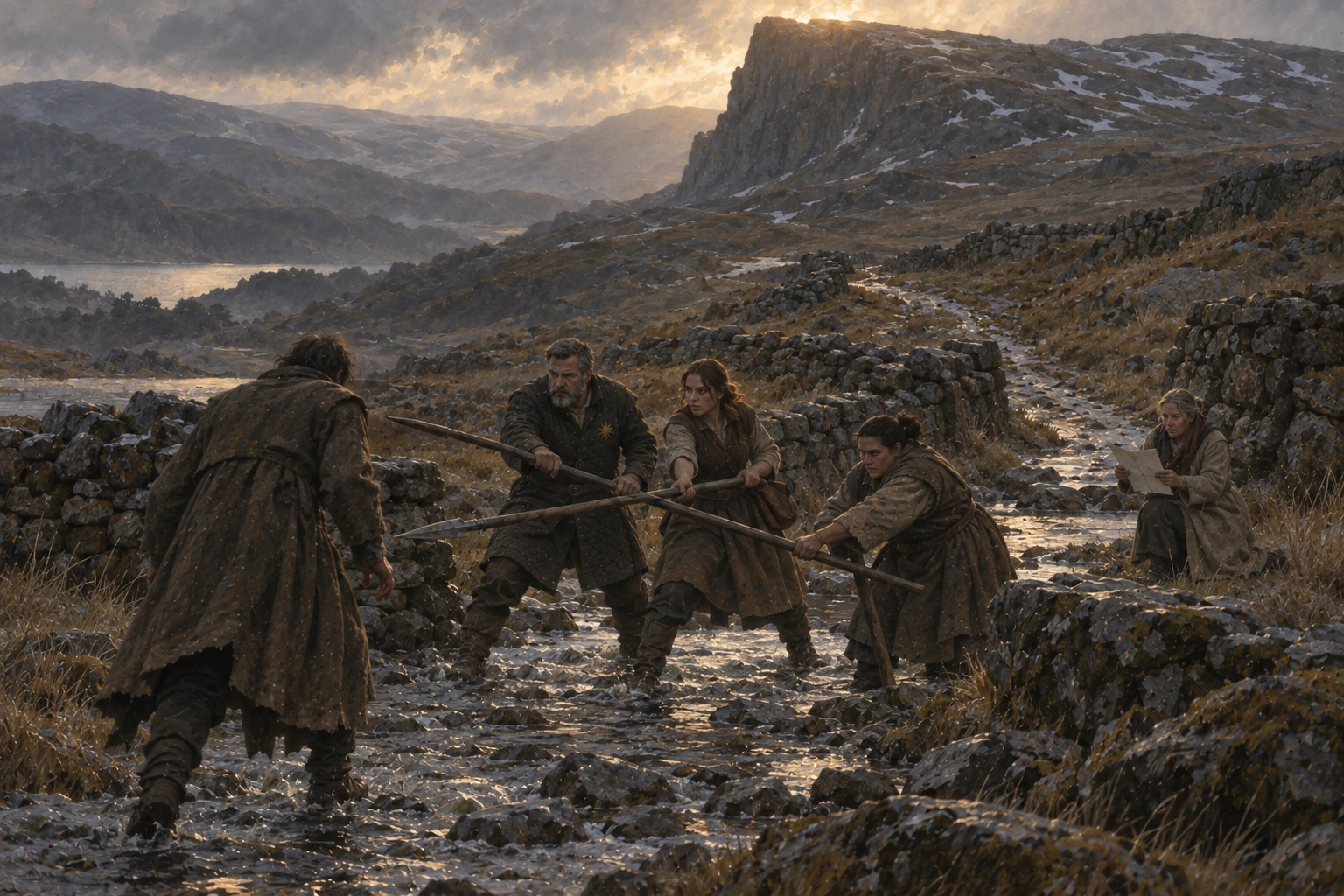
Bracken read the ground the way he read weather before a march, and called it out to the rest of them in short, level pieces, two fingers doing half the work his voice would otherwise have had to do at that remaining distance. The mules and Pip went back along the road to where a stand of bare thorn broke the sightline and gave them something solid at their backs. Dorrit took the water's edge itself, where a season of thaw had firmed the ground enough to hold a footing without giving under a shifted weight, and Luel climbed the higher side of the crossing, so that what light the low afternoon sun still offered would sit behind the company rather than in anyone's eyes for however long the next hour asked of them. "Wren. With me," Bracken said, and the two of them went to the crossing itself, the one place the road narrowed enough between the water and the old stone wall that the length of a spear was worth anything at all to whoever held one there. Luel called down once from the higher ground, the only thing she had to offer that had nothing to do with craft: "Wind's off the west shoulder. It'll carry your voices to him a good while before it carries anything of him to you." Nobody answered her, but Bracken shifted his own stance a half-step to windward before he settled it, which was answer enough.
Alder walked the ground between the company and the water twice over, at his own pace, laying down nothing that Wren's eyes could find no matter how carefully she looked for it. The second time he crossed that stretch of open ground she felt it anyway, faintly, a held breath felt through a shut door a moment before whoever is holding it lets it go.
Wren stood at her own mark with the spear-haft settled into both hands and found, with a small cold surprise that had no fitting place in the minutes remaining to her, that this was the first time in the whole of her life that anything of this kind had ever come toward her while she had leisure enough to choose where she would stand to meet it. There was no door at her back to fail this time, no dark to hide the shape of what was coming until it was already among them. There was only open ground, daylight thinning toward evening, and six people who had each chosen their own patch of it on purpose.
It came on without slowing, up the last pitch of the slope and onto the level shelf of ground the company had chosen for exactly this, until the length of two spears together was the whole of what stood between the road and the seven of them.
Bracken and Wren went forward together to the mark Bracken had already paced out that morning, the two broad spearheads held low and level, the cross-bars turned to take whatever came onto them rather than to let it slide past and up the shaft. It walked onto the bar of Bracken's spear and did not stop for it. The bar took the weight and held and it kept coming anyway, iron against whatever was left of a man, the shock of it running up the shaft into both of Bracken's hands at once and hard enough that Wren saw his boots shift a half-step back into the mud before they found their footing again; and when it turned its shoulder off Bracken's iron and put the whole of its remaining weight against hers instead, the same shock came up into her own wrists, twice over in quick succession, before the two bars together stopped it taking one more pace onto the ground the company had drawn a line around. Even through iron and ash-wood Wren could feel how cold he was, a cold with nothing of the day's weather in it, steady up the shaft into both her hands.
Dorrit came in hard on the third side with the iron-shod staff and set it crosswise low, beneath both spearheads at once, adding more weight to the hold than either shaft alone had been able to give it. Between the three of them it stood at the very furthest end of its own reach — walking, and getting nowhere at all for its trouble — for as long as it took Alder to finish drawing the last of his line at their backs, and for Pip to say, from beside the mules, exactly what he could see of it from where he had been sent to stand.
Pip's voice carried flat and clear across the open ground between them, pitched in the same working tone he used to read a bearing off Iyene's instrument rather than to offer up a thought of his own. "The coat's cut is Stanhope's — deep collar, double stitch at the shoulder, same as the spares we copied off the gate-guard's own kit at the halls last autumn. There's a hook at his hip for a lamp, but no lamp hanging from it. And there's an iron bar at his belt, short, the kind a man carries who doesn't want a hand full when he's opening a door in the dark."
Iyene already had her case open before the last word of it left him, the strap off the buckle before he had finished the sentence, a single folded sheet drawn free of the rest that had not once left that case since it was laid on the long table at Wintergarth.
"Read the third name," she said, holding the sheet flat against the wind trying to take it, and it was plainly not the paper she meant the words for. She looked past it, straight at Wren. "I want to know whether a name written down by a hand that never met him, in another woman's own words, still reaches him at all. Not to end this — the bars will finish it themselves, given the whole of the afternoon if that's what it costs. I want to know whether this is an instrument that will work in any hand that carries it, or whether it only ever worked at Wintergarth because it was you standing close enough to have known the man yourself."
Dorrit's voice cut across the last of it, hard, and pitched deliberately to carry to every one of them standing on that ground. "It's held. Steel and time will end this without her spending one single thing on it that she can't spare. What you're asking, plainly, is whether a person can be used the same way you'd use any other tool you already own, and you do not get to find that out on a man who is already dead, just to prove your point about it."
Alder offered no word to either of them. He stayed exactly where his own line held the ground at their backs, and that stillness of his was its own kind of answer, though Dorrit did not look at it twice, or at him at all.
Wren gave neither of them an answer either. She reached out and took the sheet from Iyene's hand herself, before anyone could decide the matter for her one way or the other.
Fenna's clause sat in writing Wren had never seen with her own eyes until that sheet reached Wintergarth's long table three months before, the ink pressed hard enough into the paper that the letters showed faintly through its own back: Old Dray, who kept the west door forty years.
She said it exactly as it stood written there, and added not one word of her own to it.
"Dray," she said, and her voice did not need to be raised to carry the whole distance of the held ground. "Old Dray, door-warden of Stanhope. You kept the west door forty years."
For the length of one whole breath it answered nothing at all, and the two bars and the staff held their entire weight against him still, unmoved and unmoving. Then he stopped.
The two spears and the staff no longer had anything at all pushing back against them, and the ground between the company and the man was, for the first time since the crossing, simply empty road again with the thaw-water running quietly through it.
He went down where he had stopped. What was left lying on that ground was a body — a man, thin, dressed for a house he had not set eyes on in four months, the short iron bar still fastened at his belt where it had always hung. It was somebody's, and it needed carrying. Bracken bent to take him by the shoulders, Dorrit to the feet, and between them they lifted him clear of the mud.
They carried him a short way off the road to a level patch of ground above the worst of the standing water, and Dorrit laid her own spare cloak over him there before anyone went for the wood, tucking the edges down against a wind that had not yet risen. She did it on her own account and went straight on to the wood-cutting after, the covering just the next item on a list only she seemed to be keeping.
Iyene began the round she had made a settled habit of since Wintergarth, going to each of them in turn on that open ground and asking for one exact thing back, no more and no less. "Strides, Pip. Thorn stand to the crossing," she said, and he gave the number back to her without so much as checking his own sheet against it. She asked Dorrit for the four plants growing nearest the ford-stones and got all four back in order, the fourth corrected once for its country name and given again a breath later; she asked Bracken for the tally of days since Wintergarth's gate and he had it exact, without pausing to work it out; she asked Luel nothing about names at all, because Luel never lost a name to anything, and asked instead for the last line of that morning's drill, word for word, and got it back whole. She put the same question to herself that she always kept in reserve for herself, a column of figures from the winter's own fair copy, and answered it correctly before writing her own name at the very foot of the page beside everyone else's. Last of all she turned to Wren. "The third clause. Fenna's own words," she said, without looking down at the paper a second time to check it, and Wren gave it back to her exactly as it stood written, word for word.
She did the whole of it sitting on a flat stone at the crossing's edge with the case open across her knees, her own fingers gone stiff enough with the cold coming up off the water that the second column of figures came out smaller and less even than the first. She did not pause for that, and finished the round before she let herself do anything about the cold in her own hands.
Everything came back whole, every last piece of it. Iyene wrote the round down in her own hand, closed the case over it, and the company went back to the work of the afternoon without a word of thanks changing hands.
Burning him took most of what remained of that afternoon, and none of it came easily to any of them. Bracken and Pip cut what standing dead wood the slope still had to offer and split it smaller than either of them would have troubled to on dry ground in any other season, because wet outer wood needed real help getting past its own soaked skin before it would take a flame at all. Dorrit found a fallen limb kept dry under the lip of a bank, tucked well out of the thaw's reach the whole winter through, and carried it back to the fire in armfuls without once being asked twice for the favor. A wind came up off the higher ground partway through the work and would not settle, veering enough that whoever was feeding the fire took the smoke full in the face every few minutes regardless of where they knelt, and by the middle of the afternoon Bracken's hands and Pip's both had gone raw at the knuckle from the wet, splintering wood. Neither of them stopped to look at the damage or mentioned it to the other. The fire wanted feeding a single stick at a time the whole way through its slow building, coaxed past every damp patch it met in the wood, blown on by whoever was nearest whenever it faltered, and by the time it was doing the greater part of the work on its own the light overhead had gone from ordinary grey to the flatter, heavier grey that comes down just ahead of evening, the whole of it done in silence, and when it was finally done there was less to show for the afternoon than the afternoon had cost them.
Alder stayed grey through the rest of that day in a way that plainly had nothing to do with the failing light overhead, and short with what few words he spent on anyone. When Dorrit came round at dusk with a blanket taken from her own pack, she said only, "Sit still," and set it across his shoulders without any further ceremony, and he let her do it, and neither of them made anything more of the gesture than the blanket itself already was.
Dorrit did not speak to Iyene again that whole evening beyond what the running of the camp plainly required of her — a pot passed hand to hand, a job named and handed off, nothing in any of it that could be mistaken for warmth between the two of them. The camp had the outward shape of every ordinary evening the company had shared on that road since Wintergarth, and none of the ease of one, and the shape of it looked set to hold long past this single night before it softened again, if it ever fully did.
The mules were picketed closer to the fire than usual that night, on nobody's spoken order, and stood quiet under it with their heads low. The sky cleared as the light went, the way it often did once the wind had spent itself worrying a fire all afternoon, and the hills to the north showed for a while as a darker line against a sky only a little lighter than they were, before both went down together into the same flat black. "Clear till midnight, maybe past," Luel said, and went back to laying out the second night's water ration by feel in the dark.
Bracken went to the panniers before full dark came down and came back carrying both spears, turning them over slow in the firelight, a thumb run along the length of the cross-bar Wren's had taken the worst of that afternoon's shock on. "We'll wrap both bars in wet-hide before the next stretch of road," he said, the way he'd say a strap wanted resewing. "Iron's slower to get a proper grip on when a hand's already wet through. Today was the first day since the drill was new that it actually mattered."
Wren lay awake a good deal longer than the dying fire needed her to that night, turning over nothing she could have put honestly into words, and slept in the end without ever quite deciding for herself that she was ready to. Somewhere beyond the picket a mule shifted its weight and settled again, and the sound of it was the last thing she was aware of noticing before the fire and the hills and the whole of the day went out of her at once.
In the last of the grey light the next morning, before the packs went back on, two of them went with mattocks to where the fire had burned itself out overnight, and cut the wet sod up whole around it, turning each blackened square face down into the ground beneath it, so that nothing would be left standing there that could ever catch, once the company itself was long gone from that stretch of road.
The turned sod lay black side down, damp and ordinary, indistinguishable from the wet ground lying all around it.