The Column of Dates
By the fourth evening it had already stopped being a decision and become a habit: nobody announced it, and everybody did it. At dusk two of them went to the north gate instead of one — that evening it was Sim and Osric, breath showing white above the new bar Sim had cut and seasoned in a week when a week should not have been enough for green timber — and between them they walked the heavy wood into its brackets and let it fall, and stood a moment before turning back toward the house, as though the sound of the bar settling home were a thing worth carrying back inside with them. Down at the south gate, which had never in the house's whole recovered life stood open after dark, the second watch was already lit and set, and would not move again before morning. Bracken had begun writing two names to the board where one had always stood, the board had begun being read that way in its turn, and inside four evenings a household of twelve had agreed, without a single vote among them, that one door and one watcher were no longer a thing this house could afford to keep.
Wren stood at the stair-head and watched the bar go down and did not go to help with it, because Dorrit had told her twice that day already, in a voice that did not invite a third telling, that her hands were staying off cold iron for a week at the very least, and because she had slept badly and eaten less than Dorrit liked, and could still feel, four days on, the cold of that night sitting somewhere under her breastbone like a stone let down a well too deep to hear it land. She went instead to the map-room, where the household's other business of the evening was already laid out along the long table, because Iyene Sath had sent word that everyone who could be spared should be there by full dark and had not said why — and after four days like the last four, that alone was reason enough to go expecting something.
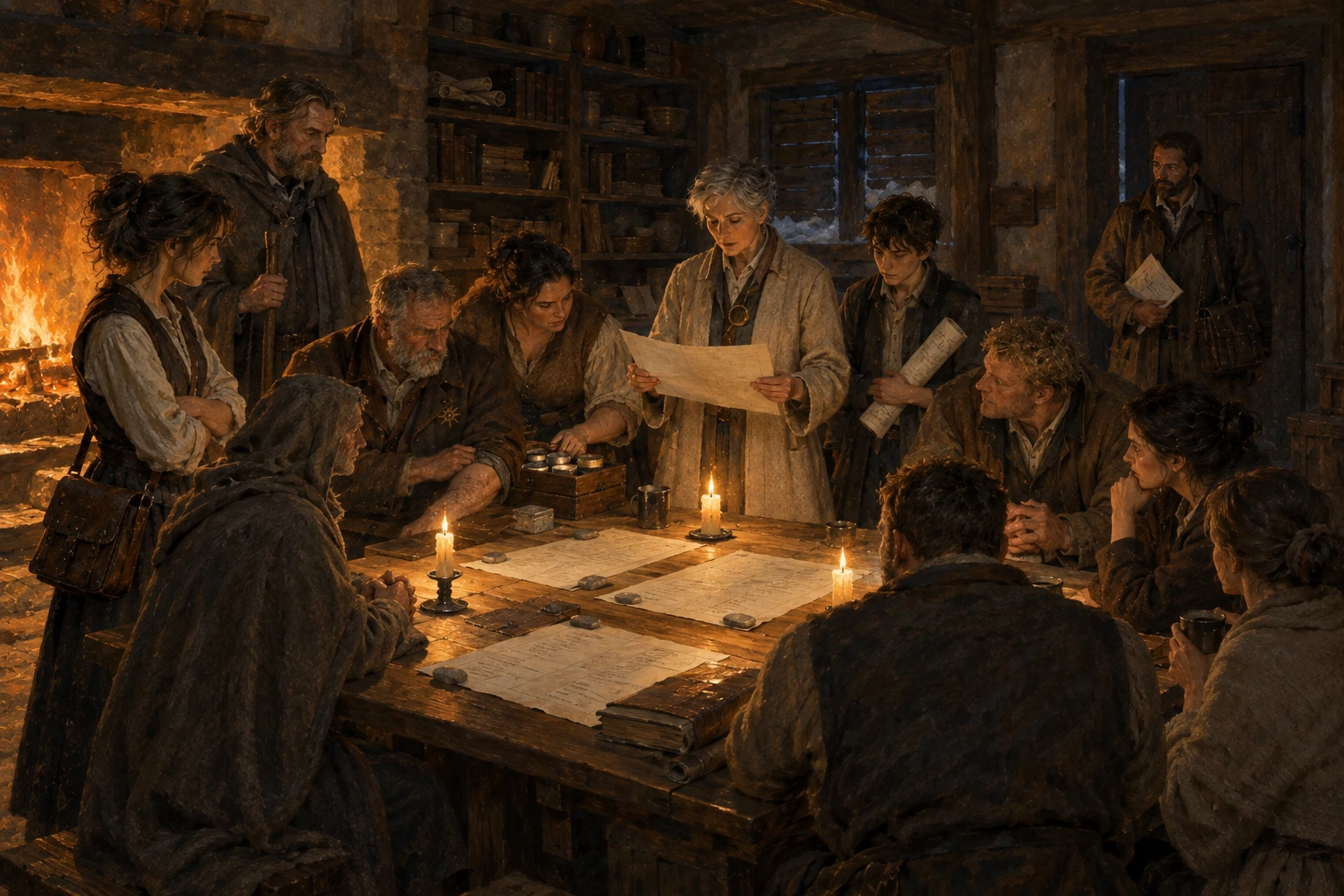
They came in by ones and twos out of the cold — Bracken still smelling of the yard, Dorrit with a lamp and her chest of small tins, Luel already seated by the time anyone else arrived, Pip with his own leaf rolled under one arm as though it might be wanted — and Marle came last of all and stood by the door rather than the table, the way he had stood at most things in this house since the season turned against him, and the room let him have the doorway. The map-room's own table, usually buried under the year's survey work, had been cleared to bare wood for the evening, and the fire had been built up higher than the room strictly needed, as if the house had decided that the night wanted extra warmth in it.
Iyene was at the table's head with three sheets weighted flat under a candlestick at each corner and a fourth in her own two hands, and she did not wait for the room to finish settling before she began. "Four columns," she said, without preamble, "and I'll read them in the order I built them, because the first three are only there to make the fourth mean anything, and I don't want anyone reaching the fourth before they've had the first three to stand on."
"The fold. Six weeks back, four of the Ashcroft party crossing at the deep hour — Osric, Thomasin, Sim, Marta — a hundred miles from this house, and not one person in this room within a week's walk of them. Marta lost the names of the three people walking beside her for a stretch in the crossing's middle hour, and had them back by its end; Thomasin lost the shape of a single word, and does not to this day know which word it was; Sim lost nothing at all. Ten hours between the first loss and the last, no two at the same hour, and no pattern to who and none to when."
She set the first sheet aside and did not look up for the second. "My own. The same fold, a fortnight earlier, with Wren a hundred paces up the column reading the party's own names aloud the whole crossing, because that is the one piece of ground-craft any of us has that answers to that ground. I lost my own name whole for most of that hour, and logged the hour myself, in my own hand, before I had any reason to think the log would ever matter to anyone but me; if standing near her cost something, it did not spare me, and it did not begin with her — there was nothing of hers in it that day."
The second sheet went down beside the first. "This house. Fifteen days of it now, gale and undercroft both, and not one name lost inside these walls in all that time; I would have logged it if it had happened, and it has not happened. The ground here does not cost names."
She lifted the fourth sheet, the one still in her own hands, and held it a moment before she began to read from it, as though she wanted the room to understand that this was the one the other three had been built to carry. "The night at the gate. Ten losses, all of them inside the same few minutes — and not while the thing was fighting. After. Every one of them dates to the breath the name was said in, some of them to the very word, and the sizes fall away clean with distance from one place on the through-road: Bracken at three paces, Dorrit at four, Osric at eight, Marta at twelve, Pip at fifteen, myself at twenty, Thomasin and Sim at thirty-odd paces and nothing, Marle behind two closed doors at sixty and nothing at all." She let that sit a beat. "And since that night: nothing. Three days, twelve people, not one loss between the lot of you. The ground did not change. Something happened once."
"The hours came from Pip's own leaf," she added. "He had them written down before I asked for them, in the dark, standing where he was told to stand — the soundest hour-work anyone in this house has given me all year, mine included." She said it flatly, the way she'd have said a measurement was sound, and went on to the next line before it could be taken for anything warmer than that.
"Two lines I can't close, and I am naming them as holes, not as answers, because I don't have answers, and I would rather say so than guess in front of all of you. Alder stood nearer to it that night than anyone in this house, and I can find nothing lost to him; he will not be drawn on it, and I am not going to make him." She did not look at Alder when she said it, and he kept his eyes on the grain of the table and his hand flat where it lay, and every person in that room read what he had left standing where an answer might have gone, and left it standing. "Luel will not say what she carried away that night, or whether she carried anything at all. I am recording both of them as unexplained, and I am not going to reason past either one, because a ledger that guesses stops being a ledger."
She set the fourth sheet down flat with the others. "The fold's losses have no geometry," Iyene said. "The gate's losses have a geometry, and its centre is a person."
Nobody moved: not a chair scraped back, not a hand drew in off the table's near edge, not one of the eleven other people in that room put so much as a hand's width more distance between themselves and the woman the numbers had just pointed to. If the thought crossed anyone's mind to do it, none of them let it travel as far as their feet.
Before he said anything else, Bracken gave them the other plain fact of the evening, the one that had nothing to do with the ledger at all: the roads had shut earlier this year than the house's own log had ever recorded, the fold lay closed behind the last crossing Ashcroft's pair had made, and no letter, from that night until the thaw, would travel in either direction. He said it in the same working voice he gave to stores and weather, and the room took it as exactly that and no more, and went back to what it had been doing, so that the third clock running in that house that evening went uncounted by anyone in the room. Then he gave them the thing that was not a fact of the season at all, and what he said was not comfort. "If it happens again," he said, into the quiet, "everyone who can be somewhere else is somewhere else. That's not blame — it's arithmetic, same as fire drill, same as flood drill. I'll have positions worked out for it by the week's end, same as I would for either of those." He said it once and did not repeat it, and it was, Wren thought, the most frightening thing said in that room all evening, because it treated her the way a soldier treats a stretch of ground that floods without warning: not with cruelty, only with the flat respect owed to a hazard with a known radius.
Dorrit had Bracken's left sleeve back before Iyene had finished folding her sheets, turning his forearm once under the lamp and letting it go again in the voice she used for a bone that had set crooked and would have to be lived with from here on: "It won't colour again. Not this year, not next — you'll carry it white the rest of your life, same as some men carry a grey streak early." Bracken said something about it at least matching his bad elbow now, and pulled the sleeve down over it himself, and did not say the name of the man he'd lost that night to anyone in that room.
"That's the soundest piece of accounting," Marle said, to Iyene rather than to Wren, once the sheets were gathered, in the flat approving voice of a man discussing someone else's tally rather than a household's fright, "that I have seen out of anyone in this house who wasn't paid to produce it." He did not offer to help carry it further, and did not offer to leave the house over it, and what he meant to do with what he had just heard stayed his own business.
"I have it," Iyene said, when Dorrit reached to help square the sheets, in the same clipped voice she had used to her since the fold, and Dorrit's mouth went tight and she took her hand back, and whatever was still unmended between the two of them stayed exactly as unmended as it had been the week before.
Somebody at the table asked her outright how she had done it. "I don't know," she said. Could she do it again, if it came to that, tomorrow. "I don't know," she said again, "and that's the true answer, not a kind one," and there was not a better one in the room to be had. Could she do it without what it cost the rest of them. "I don't know that either." Nobody asked a fourth question. She was asked to promise nothing, and promised nothing, and the room let it stand the same as it had let the rest of the evening stand.
"What happens," Wren said, once, to the middle of the table, "if I have to do it with all of you standing round me." It was not the kind of question that had an answer sitting ready, and it went on hanging over the table long after the sheets themselves had been put away.
It was Iyene, of everyone, who finally asked the question that gave Luel her opening. "I need a word for the column heading," she said, tapping the fourth sheet once, "if one exists. I have been writing 'the thing at the gate' four times a page, and I don't care for it."
"The faded," Luel said. "That is the word for them, in the speech you keep. I did not give it to you before because a name is a kind of door, and until tonight none of you had any use for the one it opens." She said it without asking whether anyone wanted the rest of the doctrine that came with it, and without offering it either.
"I have seen them," she went on, into the quiet that followed, her hands still and folded the whole time she spoke, as they had been since before Iyene had begun reading. "Not many, and the last of them so long back that I have long since stopped troubling to count the years for it — only the roads that have changed under my own feet since. I have never, in three hundred years of this country, seen one of them get inside a house that was still keeping a door." Nobody in the room reached for either grief or comfort to lay across those two sentences.
"They are people the Quiet took, and nobody reached in time," she said, the way a person states the size of a field rather than its history. "What is left of them thins, and goes on thinning, for as long as it walks. And what is left walks, and it kills, and it means to." She stopped there.
Dorrit's eyes went to Pip, once, and stayed a moment, and came away again, and Wren, who saw her do it, let her have it.
She found Alder after the others had gone, still standing at the table's end where he had stood through the whole of it, one hand resting flat on the wood as though he trusted it to hold his weight a while longer. The fire had burned down to its coals, and no hand had come to build it back up, and the cold coming off the shuttered window at his back was the cold of a shut-in house in a hard winter, not the other kind, and Wren was glad of that much at least.
"You lost nothing," she said. "She said so. You stood closer than anyone and you lost nothing, and you won't be drawn on it, and I want to know why."
"Because I know why, and it isn't mine to give away tonight," he said, and did not look away from her while he said it — the one thing in the whole conversation that seemed to cost him nothing at all. "It will keep until the teaching gives you the answer honestly, which it will, before winter's out. I am not refusing you the truth. I am asking you to let me hand it to you the slow way rather than the fast one, because the fast one would only be a word, and the word would not be worth much to you without the rest of it standing behind it."
"That's not the only thing I want an answer to."
He waited.
"My grandmother," Wren said, "at the door, the day you came to Fallowmere. I saw the two of you speak and I never asked what was said, because it was theirs and not mine, and I have gone eighteen months now thinking that was the whole of my patience being rewarded with nothing at all worth having. Tell me now, all of it — I am done waiting to be told the rest of my own life in pieces I have to go begging for."
He was quiet long enough that she thought, for a moment, he meant to refuse her a second time, and then he told her.
"She said two things to me, and no more than two, in the voice she used for grading honey — the voice, I have come to understand, that woman keeps for facts she has decided not to argue with anyone about. The first was a fact. Your mother died on the floor of that house saying a word, and whatever went out of her when she died went into you, in the same breath, and your grandmother has watched it sit in you for twenty years and never told you what she was watching. The second was a term. I was to teach you to carry it, or I was to leave you at Fallowmere and go west without you, and there was no third road she was willing to grant me." He let that sit a moment before he went on. "I did not swear to her at the door. I told her plainly that I would not swear to a thing I had not seen with my own eyes, and she did not press me, and I have thought since that she respected the refusal more than she would have respected an easy oath. I swore it at the Bridge Inn, at the supper, after the hill — after Cob Hedley, after I had stood on that green and watched you do the thing I had only been told you might one day be able to do. That is what the nod your grandmother gave me across the hearth that night was. I swore two things at that supper: that I would teach you to hold it, and that if I found I could not, I would say so to your face and bring you home myself, rather than let you walk on carrying something neither of us understood."
"And the look," Wren said. "At the supper. The one that went on too long."
"Was a man hearing an eighteen-year-old promise walk into a room and stand in front of him wearing a fiddle and a farm girl's boots," Alder said. "I have nothing more to give you about that room than the two sentences I have just given you, and I want you to hear that plainly, because I know it will not feel like enough. I do not know what happened on that floor beyond what she told me, because I was not there, and nobody living but your grandmother was, and what she carries of it is hers to give you or to keep, on her own road, in her own time, not mine to hand you secondhand out of pity for how little I have."
Wren stood with that for a long moment, and what came up in her was not, in the end, anger at the man in front of her, though it would come out on him because there was no one else within a thousand miles it could reasonably land on.
"She let me walk out that gate," Wren said, and her voice had gone low and hard in a way it rarely went. "She knew what I was carrying, she had known it since I was five years old, and she stood at that gate and watched me go west with a stranger to learn to hold a thing she never had the courage to name to my face. I know it isn't your fault. I know why you kept it — I can see the shape of the reasoning even now, standing here being furious about it. But you are the only person on this whole side of the mountains I can be angry at for what she did, and I am going to be angry at you for it whether that is fair to you or not, because it certainly was not fair to me."
"No," Alder agreed. "It was not." He did not defend himself, and did not apologise for the oath he had sworn, and made no move toward her at all, and she was glad of that too, distantly — the small relief of a kindness offered in the middle of a much larger unkindness she had decided to go on carrying by herself.
They stood a while without speaking, on either side of a distance that neither of them tried to close. Nothing between them mended that night, and nothing was going to; she knew it while she stood there, and did it anyway, because knowing a thing was unfair had never yet been enough, in her experience, to make her stop wanting it.
"There is one more thing," he said, at last, when it was clear she had said everything she meant to say to him and had no intention of leaving the room to him either. "You should hear it from me and not work it out alone in the dark some night, because you would work it out eventually, and it would be crueller that way."
"The tune," Wren said.
"The hill above Dall," he said. "You have always believed the Quiet took it from you that afternoon, the way it takes anything left too long in bad ground. It did not take it. You spent it. It was the price of Cob Hedley's name, the same coin as the gate, only I did not understand what I was watching you do until much later, and by the time I understood it, telling you seemed no kinder a thing to do than not telling you had been." He did not soften the second half of that either. "I have known since that day. I did not say it because I did not know how to say it without making you sorry you had done the only thing that saved his life, and I still don't, and I have decided that not knowing how is not a good enough reason to go on saying nothing."
She left him standing at the table's end and went up alone, and did not look at him again on her way out, and he let her go.
In her own chamber, with the shutter latched against the last of the wind and the lamp turned low enough that the room was mostly the shape of its own shadows, she sat a long while on the edge of the bed with her left hand open in her lap, not moving it toward anything, because there was nothing in the room to reach for and there had not been since the hill. She reached anyway. She had done this before, on the third stair of a house a country away, in the first days after Cob Hedley's rescue, reaching without deciding to and finding a smooth place where the tune used to live and nothing whatever in it. She reached the same way now, left hand rising an inch off her knee before she caught it and stopped. It was still not there, and had not come back in all the months since, though she had told herself, in the early weeks, that it might yet, the way a numbed finger sometimes remembers itself months after the injury that took the feeling from it. She knew now what it had bought. Cob Hedley walked the high pastures again with three good fingers on his left hand instead of none at all, and that was worth more than a reel only her grandmother had ever known the name of, and she sat with both of those facts a long time and found that knowing the second did nothing at all to make the first hurt less.
The teaching began the next morning, at the hour the household kept for ordinary work, in the map-room with the fire built up and the long table cleared of everything Iyene had laid on it the night before, plain as any other morning's work. Snow still lay against the shutters in a hard blue morning light, and somewhere below them Bracken could be heard setting the mules to their feed in his usual unbroken run of low talk, and none of it stopped or changed for what was about to happen two floors above. Alder simply told her, over the morning's first bread, that they would begin at the second bell; Luel only nodded once when the hour came; and the three of them went to the map-room the way three people in that house went to any other chore that wanted doing before the day got on with itself.
"The first thing I am going to teach you is not the power," Alder said, once the door was shut. "It is the boundary. You cannot close an edge you cannot find, and you cannot find an edge you cannot say, without looking, exactly who stands where. That is the whole of the first lesson, and it will take you longer than you expect to learn it, because it sounds like nothing and it is not nothing."
He asked her, without warning, in the middle of an ordinary sentence about the fire and the room's four corners, to name every person in the house and where each one stood at that exact moment, and she got three right and four wrong, placed Pip in the kitchen when he was at the stair-head, forgot Marle altogether, and stood there red-faced with the wrongness of it while Alder said only that she had done it badly and that they would try again in an hour. He asked her a second time before the bell had properly finished its hour, and she was wrong again — Osric's name attached to the wrong door, Dorrit's to the wrong floor — though less badly than before, and Alder told her so without either apology for how hard it was or praise for the smaller wrongness, because neither, he said, would help her learn it any faster.
"Uncontained," he told her once, flatly, in the middle of the second attempt, "this is what happens to you. Not the once. Every time, from here on, until you can find every edge in a room without looking for it." He did not soften it into a warning and did not dress it up as doom, and it landed harder for the plainness of it than any longer speech would have.
Luel's lesson came in the afternoon, and it was shorter, and it asked less of her hands and more of everything else. "You are carrying him now," she said, without preface. "R. Denby. His office, his house, his own last evening — the meal short a day's baking, the north bay wanting re-slating, the wind gone round to the north-east since dusk. Say him once, aloud, the whole of him." Wren did, haltingly, and it cost her more than she expected to say a dead man's ordinary evening out loud in that quiet room. "Good," Luel said, when she had finished. "Now stop. You will want to say it again tonight, alone, and you must not, because a thing visited every night stops being a memory and becomes a house you live in, and you are not going to live in his." Two exchanges, no more, and no lore behind either of them, and Luel left the room without asking whether Wren had understood, because whether or not she had understood was not, this early, the point.
She was bad at both lessons, and the day said so plainly, without apology for how badly and without congratulating her for having tried. Nobody in that house expected otherwise of her yet, and the not-expecting was its own small mercy.
She had not written in her day-book for four nights, and she set that down first, in one clause, because it was true and there was no kinder way to make it not true. Then she set down the arithmetic: ten losses, one geometry, one centre, and the centre was her. She wrote that she could not explain how she had done it, and could not promise she could do it again, and could not promise, either, that she could do it without costing the room around her what it had already cost. She wrote the word faded, and under it, in three lines, what it meant and no more than that. She wrote her grandmother's two sentences and the term attached to them, and did not smooth her own anger out of the writing, because smoothing it out would have made the page a kinder thing than the evening had actually been. She wrote, last of all, one line about the tune: that it had not been taken from her on the hill above Dall, but spent, and that she knew now what it had bought, and that knowing did not give it back.
Then, because it was hers to carry now and not merely hers to remember, she copied a dead man's last written words into her own book, in her own hand, exactly as he had left them:
Meal short a day's baking. North bay wants re-slating before the frost. Wind gone round to the north-east since dusk.
Under it she wrote one line more, and stopped.
I am frightened, and I do not know when that will stop.