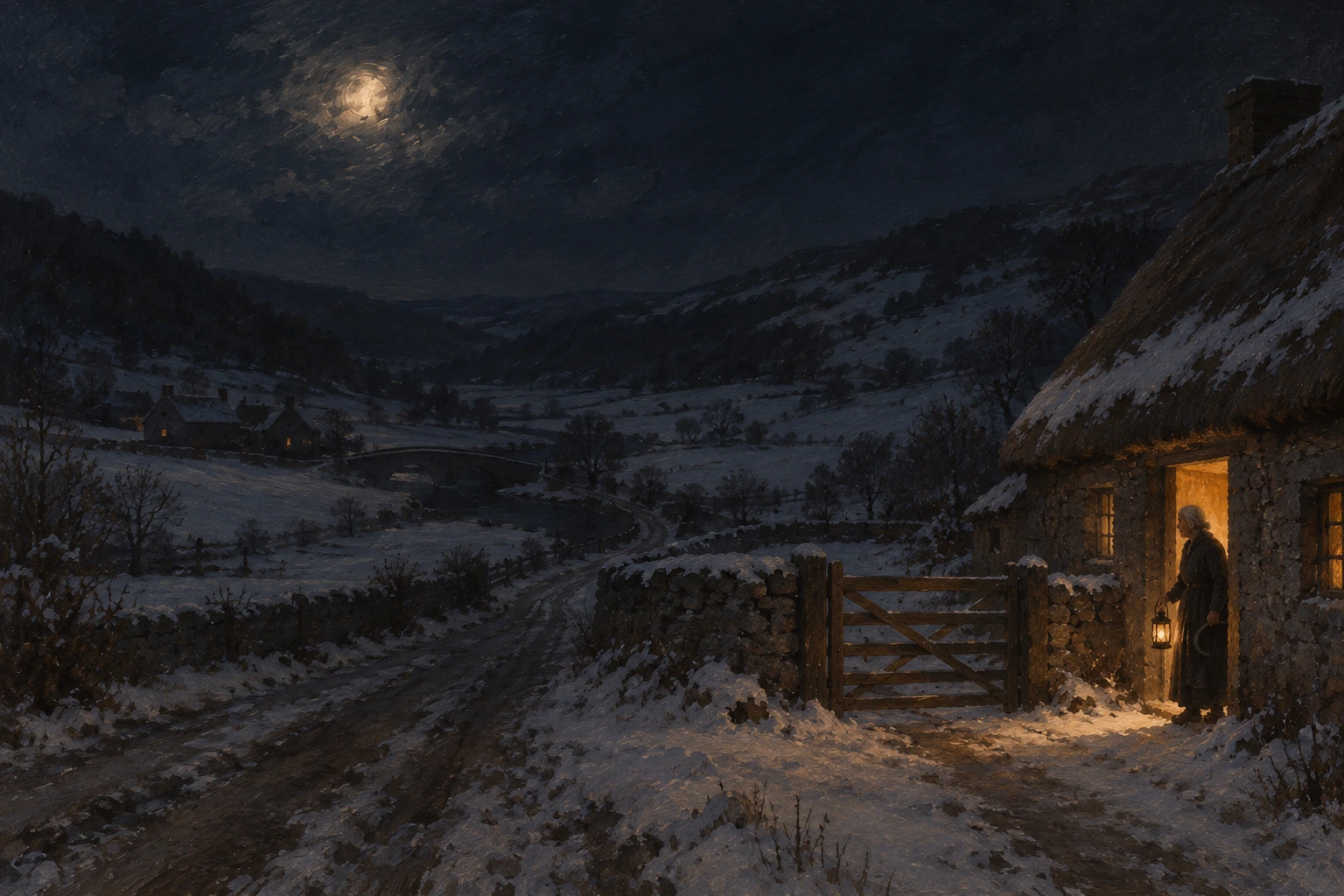
Fallowmere
Tansy set the billhook's edge against the whetstone and drew it down once, hard, the full length of the stone, and did not stop to test it against her thumb the way she had at nineteen. A body did not forget in sixty-three years what a good edge sounded like against good stone, and this one sounded right. She wiped the stone dry on her apron hem, stood the billhook upright by the door where the walking-stick already waited, the two of them leaned together like an old married pair with nothing further to say to each other, and went out to see what was left of the valley before the light went.
She had thought about that door for twenty-one years, on and off, much as a person thinks about a debt that has not come due yet but will. She had considered the old scythe, too long in the reach for a doorway and too easily caught on a frame. She had considered a hay-fork, which Jory himself had once used to good effect on a boar that came through the garden fence in a bad autumn, and had set it aside as well, because a fork wants two clear hands and hers had not been entirely reliable for the better part of a decade. The billhook she could manage with one hand and the stick in the other, and a woman planning to stand in a doorway with her hip the way it was had to plan for that arithmetic before anything else.
Before she went to see what the valley had left in it, she went down the row of hives, because seven of them do not put themselves to bed for a winter merely because the woman who keeps them has a door to mind that evening. She worked the row the way she worked it every autumn of her life, a flat hand against each skep to weigh it, the last of the straw wrapping tucked in tighter against a cold that had not properly arrived yet but soon would, and found all seven heavy enough and quiet enough to leave be until spring. The seventh — her granddaughter's father's start, walked home as a swarm the year before the girl was born — got an extra minute of her hands anyway. She did not ask herself why.
The first real snow of the season had come three nights before, thin and gone by noon, but the ground under it had stayed hard since, and her breath went white the moment she stepped clear of the doorway's shelter. It was a cold that had arrived earlier than the almanac and the old men both expected it to, this third winter, and nobody in Dall who still had a say in the matter had argued with it.
Widow Callow's door was shut and barred from the outside — barred by someone who did not expect to be the one to lift it again. Her washing still hung on the line behind the house, three shirts and a shift gone stiff and gray with three weeks of weather, because a woman leaving in a hurry with a cart already loaded does not stop for linen that will only slow her down, and Tansy had told her so herself, standing in that same dooryard, and watched her go without it. The mill wheel had not turned since Ket Sallow put the sluice-gate down and nailed a board across the door, and the pond above it had begun to skin over at the margins in a way that would have troubled him once and troubled no one now. Cob Hedley's croft stood open-doored and empty, the byre mucked out and swept and left tidy for whoever might need it, which was precisely the sort of thing Cob Hedley would do on his way out of a valley he did not expect to see again, and Tansy had stood in that doorway too and told him to go and told him he was right to go and not told him she meant to be any different from him in it. The Bridge Inn stood dark for the first time anyone living could remember, its sign still swinging faintly on its hook though no hand had lifted the latch beneath it in nineteen days, and the bridge itself, when she crossed it on her way back, gave her nothing but the sound of her own stick against the stone and the water running low and black underneath, telling her exactly as much about where anyone had gone as it had ever told anybody about anything, which was nothing at all, and had never pretended otherwise. Hask Farrow's yard stood empty too, the gate tied shut out of habit more than need.
Two goats that were not hers grazed the near paddock now, left because a family in a hurry cannot walk goats and children both, and she had taken them in without being asked, along with the Hollin boys' geese and Ket Sallow's own cat, because somebody in this valley still had to feed what could not walk itself south.
She had helped every one of them pack. She had gone down her own list — the Hollin boys' mother, Hask Farrow, Perrin Aldwyn's household, the cobbler with his bad knee — and told each of them plainly what she thought and let them make their own arithmetic of it, offering nothing in the way of comfort beyond the honesty of the offering itself, because a woman who has kept bees for sixty-three years knows better than to argue with a swarm that has already decided to go. South, all of them, down the same road her granddaughter had taken two years before, toward Merrow and whatever the muster could still hold together by the time they reached it. The warning itself had come up out of Cheswick a fortnight back with a woman named Bett, and Tansy had sent it on to every door in the valley within the day. She had put her own stores into three different carts without being asked and had not missed a jar of it since.
The lane held nothing moving, end to end. Smoke rose from exactly one chimney in the whole valley, and it was hers.
She stood at her own gate a while, in the cold, looking down the west road the way she looked at it most evenings now, not because she expected anything on it yet but because a woman who has decided to keep a watch keeps it whether or not there is anything yet to watch for. The book was two years gone west in her granddaughter's satchel, exactly where a keeper's book belonged when the thaw the whole family had been waiting three centuries for finally came. "The book is where it should be," she said, to the lane, in the flat voice she used for counting jars. "So am I."
Widow Callow had asked her to come along with the last cart, standing at Fallowmere's own gate with her hand already on the rail, and Tansy had told her no. Not sorry, not stubborn, not brave about it — only no, the same way she'd have told her no about a fair price for a poor jar of honey, because the answer did not require weighing and she had stopped weighing it years before the question was ever asked out loud. Widow Callow had not pressed her twice. Nobody in the valley had, after the first time each of them tried it, and every one of them had gone south anyway, which was exactly what she had told each of them to do.
She went back in before the cold got past her coat.
The rest of the short afternoon went to ordinary work, because ordinary work was the only kind she had ever trusted to keep a body steady through a long waiting. She split enough wood to see her through a week she did not expect to need it for, stacked it dry under the eave where her hands could find it without a light, checked the roof at the one corner that had wanted mending since summer and found it would hold, and carried in the last of the root vegetables from the clamp before the ground froze hard enough to make the digging a misery. None of it needed doing tonight specifically. All of it needed doing eventually, and eventually had a way of arriving faster than a person expected when the person in question was eighty-two and living alone at the end of a valley everyone else had already left.
Before the light went altogether she walked the goats and the geese into the near byre and barred it, checked Ket Sallow's cat had gotten in through the scullery window she'd propped for exactly that purpose, and stood a minute in the yard listening to the ordinary settling sounds a farm makes at dusk when everything in it still living has decided the day is done. There were fewer of those sounds than there used to be, with half the valley's usual animal noise gone south along with the people who owned it, but what was left of them was enough to tell her nothing was wrong yet, which was the only report she had any use for.
Inside, she banked the fire the way she banked it every night of her life, not high, only enough to hold till morning, and filled the lamp from the oil she had been setting by since the leaves turned — three jars of it now lined along the shelf where the book used to stand, because a lamp that failed at the wrong hour was a worse enemy tonight than anything that might come up that road. She checked the door's latch twice, not because once had ever proved insufficient but because her hands wanted the work and she let them have it. Then she sat at the long table with a fresh sheet of paper in front of her and the pen she had not touched since her last letter to Merrow, and looked at the blank of it longer than she meant to.
She had written to her granddaughter a great many times in two years, market to market, and had never managed to write the one letter Wren had actually asked for — at six, and at nine, and at eleven, in the same handful of words each time, because Tansy did not have another word to give her and had known it every time she said no, and had gone on saying no in every letter that followed without once putting the reason for it down on paper. Tonight she had paper enough and nothing left to spend it on but the truth, so she picked up the pen.
Wren —
You asked me at six, and at nine, and at eleven, and I gave you the same answer every time because it was the only one I had that did not cost more than I was willing to pay that day. You stopped asking at eleven. I never told you I knew why you stopped, and I am not going to pretend now that I did not notice. Here is what I have, for whatever it is still worth to you.
I do not know how to write a letter like this one. I have never written one. I am only going to set it down the way it comes and let you sort it after, the same as I've sorted a rough road myself often enough.
She set the pen down there and went to see to the fire, which did not need seeing to, and stood over it a moment with her back to the table before she came and sat down again.
Your grandfather — Jory, though I don't believe I have said that name aloud in this house since — held that door. You never knew him. He was gone before you had words for anything, let alone for him, and no one in this valley ever told you much beyond that he was easy to like, which is true and is also the smallest true thing anyone could say about him. Jory built this table, out of a fallen ash he spent a whole spring arguing with the miller's brother over, on the grounds that a table a man means to eat at every day of his life for forty years is worth a slow argument over the wood. He hung the door he died at, twenty years before he died at it, and never thought that was a joke worth making, though I did, once, and he laughed the way he laughed at most things I said to him, which was fully, and without needing to be persuaded twice.
That February something came up the west road to this gate that had no business on any road in this country, and your grandfather went to the door the way he went to anything that wanted stopping — plainly, without discussing it with me first, because we had discussed it years before and he already knew what I would say. I was behind him in the passage. I did not reach the door. I do not know most of what happened at it. I know the sounds, because I was on the floor by then and could not get up, and the sounds were his voice, twice, and then no voice at all, and then the door standing open on a night with nothing else moving in it.
That is where the hip came from. The valley knows only that it happened the winter I was widowed, which is true as far as it goes and stops well short of the rest.
Two graves went into the ground within the week, his and hers, side by side under the yew at the top of the lane, dug by neighbors because I could not stand upright long enough to hold a spade and would not have trusted my hands to it if I could. The valley was told what the valley has believed ever since: that a hard winter took them both. That is not a lie so much as it is the smallest true thing I could bear to say out loud that week, and I said it so often and so flatly that I very nearly believed it myself before the year was out. Nobody in Dall has ever pressed me for more than that, and I have never offered more than that either.
Life went on after, the way it does whether a person is ready for it to or not. I kept the bees. I kept the book, until it came your turn for both. I did not remarry, in case you've ever wondered and never liked to ask. There was no other man built quite like your grandfather anywhere in this valley, and I found I was not especially interested in one built otherwise.
She got up because her hip wanted the change of it and because the lamp needed no encouragement but she gave it some anyway, trimming a wick that did not want trimming, and went to the door and opened it a hand's width and looked down the west road into the dark. Nothing on it. The cold came in around the door's edge, familiar as a second latch. She shut the door again and went back to the table and the paper.
I found her on the stone by the hearth, and I want you to have this exactly as I have it, not dressed up kinder, because you are twenty-six years old and you have a right to the truth in its own plain clothes. The candles were out, every one of them, and the water in the kettle had skinned over with ice though the fire had been built up not an hour before. The book itself lay open on the floor beside her, pages down, as though it had been let go rather than dropped. Your mother's name was Linnet, and I do not think anyone outside this house has said it aloud in twenty-one years. She was on the floor with no mark on her that I could find anywhere — no blood, nothing broken that I could see — and she was gone all the same, not broken, only emptied, the way a vessel goes when whatever was in it has been poured out and nothing poured back.
You were sitting on the stone beside her. Awake. Not crying. Not hurt, that I could find, except for one thing, which I checked every bath night for the next thirteen years and never explained to you and am not going to pretend I can explain now: a handprint, high on your left shoulder and running onto the collarbone, four fingers and a thumb, the color of old frost, and cold under my hand the first time I touched it and cold every time after. It has not faded. I looked at it last within a week of the day you left this house, when you were near enough grown that I had no honest excuse left for looking, and it was exactly as it had been the morning I first found it.
I do not know what it is. I have had twenty-one years to guess, and every guess has felt like a theft from something that was never mine to explain.
The fire had burned down further than she liked by the time she noticed it. She built it back with the economy of a woman who did not expect to need the warmth so much as need the light, and stood a while with the poker still in her hand before she set it aside and sat back down.
There is one more thing, smaller, and I am only telling you because I am telling you everything else tonight and it would be plain cowardice to leave out the parts that don't hurt as much. That tune you've played since you were seven — the old one with no name, the one I taught you before you were properly big enough to hold the bow steady — was hers. It came down to me the way the book came down to me, and I gave it to you early because it was the one piece of her I still had that a seven-year-old could actually be given, and I never told you that either. Whatever it is worth to you now, it was worth that to me for eleven years before you had it.
She read that paragraph back once, decided it could stand as written, and did not cross out a word of it, though her hand had gone unsteady enough by the end of the sentence that the last few letters leaned harder than the rest. She got up, checked the latch a third time, and put another log on a fire that, this time, genuinely needed it.
I was not in the room. I want that written plainly, because you have likely pictured me standing over her, and I was not. I was on the floor of the passage with a hip that would not hold me, hearing what I could hear through a door I could not reach in time. Everything I have given you tonight is not memory. It is twenty-one years of putting a floor's worth of evidence in the order it must have happened in, the way I would read a stretch of bad road I had not walked myself, off what the ground showed me after. The neighbors who came running at first light, once word got up the lane, saw only what I let them see and asked only what a decent neighbor asks, which was little enough that I have never had to correct a single thing any of them believes to this day. I do not know what word Linnet said, and I have long since stopped believing I ever will. I know she said one, because the room told me that much and because you have carried something in you since that no five-year-old carries on her own, but the word itself went with her, and it is not in anything I found on that floor, and it is not in anything you have ever been able to tell me either. I have made my peace, such as it is, with never having it. I would not ask you to make the same peace. I would only ask you not to spend your whole life hunting for a word that even the woman who—
She stopped there, the pen lifted an inch off the paper, because the sentence wanted an ending she did not have, and she was not going to write a false one onto a page her granddaughter might someday read by firelight the way Tansy had read every letter that ever came to this house. She set the pen down across the unfinished line and did not pick it up again that night.
She ate standing up at the sideboard, bread and a heel of hard cheese and nothing more, because sitting down to a proper meal felt like a decision about the rest of the evening she was not ready to make. The bread was good. She noticed that it was good, plainly, the way she noticed most things now, without letting the noticing turn into anything larger than itself.
A dog barked twice, somewhere down past the mill, carried strange on the still air, and then did not bark again, and Tansy set her cup down without finishing it.
She had learned to listen for that particular kind of quiet a long time before this valley had, though the valley had learned it a good deal faster this winter than she would have liked for any of them. She took the lamp, and the billhook, and the stick, and went to the door, and this time she did not open it a hand's width to look. She opened it the whole way and stood in it, the cold moving past her into the house behind her, and she did not step back, and she did not shut it again.
She had stood in this doorway once before with two people behind her who were no longer in the world, and she found, standing in it now alone, that her legs remembered the shape of the waiting better than her mind did. The cold settled first in the feet and climbed from there. The dark past the gate posts thickened without actually darkening, and a held breath eventually has to be let go regardless of what a person is waiting to hear, so she let hers go, once, long, and watched it hang white in the lamp's small circle before it thinned to nothing. The lane ran west a good way before it bent out of sight behind the shoulder of the hill, and she had walked that bend on a thousand ordinary mornings without once thinking of it as a place a thing might come around, and she thought of it that way now, steadily, for as long as she stood there.
Nothing came for a long while, and she let the nothing be exactly what it was rather than filling it with guesses. She held the lamp low, because a light held too high blinds the one carrying it and gives nothing back in return, a thing she had known since before she was a keeper's daughter, let alone the mother of one, and she kept her weight off the hip that had never been right since the last time she stood in this exact spot doing this exact thing, and she did not sit on the bench by the door though it was there and though her body wanted it, because a woman sitting can be come upon, and a woman standing has already decided what she means to do. She had waited at thresholds most of her life in one shape or another — at the hive's mouth on a cold spring morning to see whether the queen had come through the winter, at the mill door for a weighing she suspected would go against her, at the boundary marker on a hundred ordinary evenings watching a girl walk up from the bee-yard with wax still on her hands — and none of that waiting had told her what this one would ask of her, only that her legs and her hands both knew the shape of standing still through a long uncertainty without her having to think about it, which was, for a body her age with a hip like hers, no small thing to have kept.
Her breath had gone from white to nothing and back to white a great many times before anything in the valley changed. A dog she did not know barked once, far off, past even Cob Hedley's ground, and stopped. An owl worked the hedge along the lane and gave it up for somewhere quieter. The cold thickened by degrees she could feel in her knuckles before she could have named a single one of them, the way weather always told her hands its plans before it troubled to tell the rest of her, and she flexed her free hand once inside its glove and went back to watching. The valley made its small sounds around her — a gate latch somewhere down the lane, worked loose by the wind, sounding in the stillness like a hand asking to be let into somewhere it no longer lived — and none of it was what she was listening for. She knew the difference by the third hour the way she had known it the first time, twenty-one years and a lifetime ago, in this same doorway, with better legs under her.
It came without any sound she could put a name to at first — not footsteps, exactly, though something in its rhythm resolved into footsteps the longer she listened, arriving the way sound arrives out of a fog: not becoming louder, only becoming certain. Then it was on the road — a shape at the bend by the hill's shoulder, walking steadily, at the pace of something that had not needed to hurry for three hundred years and did not know tonight was any different.
She did not go inside. She did not call out. She only waited. She lifted the billhook from where it leaned against the doorframe and held it low and loose in one hand, the stick in the other for her hip's sake and not for the fight's.
It came closer. The lamp caught it plainer as the distance closed — a man's shape, or near enough to one, coat gone to rag at the hem and the rag not moving in a wind that was moving everything else that hung loose in the lane; skin the color a hand goes at the second knuckle in a hard frost, and staying that color, not warming, not whitening further, simply fixed there, the cold long finished with it and moved on to other business. Whoever he had been, he was not walking toward the gate as a man walks toward a door he means to open. He was walking the way water goes downhill, because the ground sloped that way and there was nothing left in him to object to it. She did not know him. Eighty years in one valley teaches a woman most of the faces likely to come down her own lane, living or otherwise, and this was not one of them, which she found, in the small clear part of her mind still doing arithmetic, to be no comfort at all.
She watched it come down the last stretch of the west road toward her gate the way she had watched every other thing come down that road in eighty-two years — plainly, without flinching, because flinching had never put off anything that was coming anyway.
It crossed the last yards at the same steady pace. Then, mid-stride, one foot lifted and not yet set down, it stopped being anything that could take another step. It went down the way a thing goes down when whatever had been holding it up is switched off somewhere else — at once, with nothing behind it to catch it.
She stood in the doorway a long while after that, the lamp guttering low beside her, looking down the west road at the shape that was not moving and was not going to move again. She waited for it to move anyway, because a body does not get to be eighty-two in this valley by trusting a first look at anything that mattered this much, and when it had not stirred by the time her breath had gone white and thinned six times over, she allowed herself to believe what she was looking at. No rider came down that lane to explain it to her. No word ever reached her that winter, or any winter after, that told her why the thing had gone down where it stood instead of at her gate, at her door, or somewhere further up the west road with better cause. She did not know.
She did not go out to it that night. There was nothing in her that wanted to, and nothing in the dark that needed her to, and she had learned a long time before this evening not to go looking for confirmation of things her own two eyes had already told her plainly enough. She stood there instead, in the doorway, with her hip aching and the billhook loose in her hand and the cold going past her into the house exactly as it had all night. Behind her, on the table, the letter lay open where she had left it, unfinished, waiting for a hand that was not yet ready to leave the door and pick the pen back up.