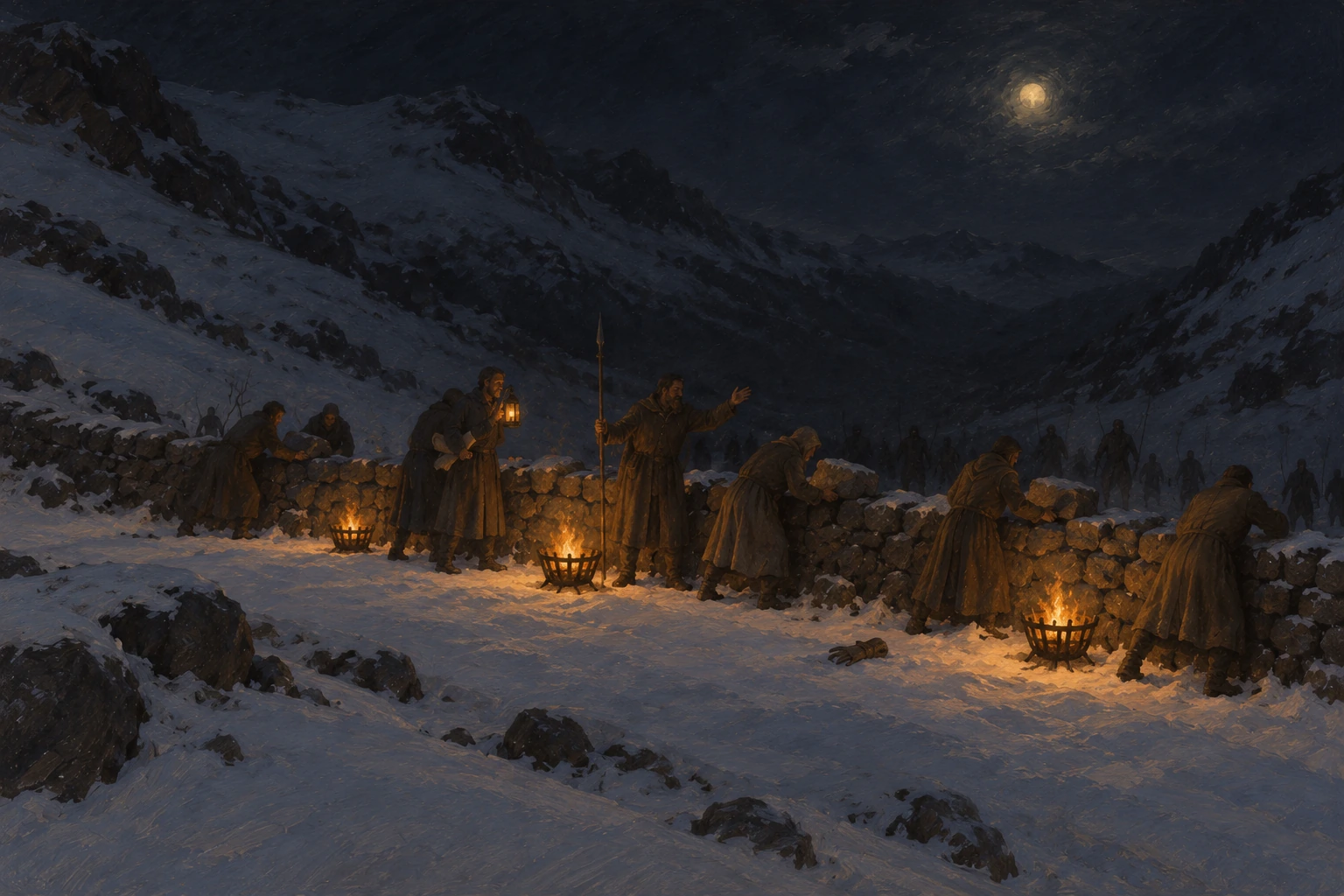
The Stones at Winter's Edge
Willem counted the picket line twice before he trusted the second count, because the first had come up one short and a horse missing from that string was not a thing to let go past a man simply because the light was bad. Nineteen animals stood where twenty should have, breath smoking off their backs in the blue dark before sunup, and it took him the better part of ten cold minutes working down the rope hand over hand before he found the gap: not a missing horse at all, but the brown gelding shifted two pickets down in the night, crowding a mare he'd never liked, and the tally had simply been read wrong in poor light by a man too tired to trust his own eyes. He wrote the correction into the morning sheet anyway, because a wrong count written down and crossed out taught the next tired man more than a right one copied clean, and went to see about the oil.
Above the picket line the pass mouth sat exactly as it always sat that deep into winter, a long grey throat of a gap between two shoulders of standing stone with the road running up into it and out of sight within a hundred paces, snow banked knee-deep against the great standing stones the watch itself was named for and scoured bare again by wind before it could ever properly settle, and it was, Willem had come to think over a year of looking at it every morning of his life, the single most patient piece of ground he had ever stood in front of — patient as a held breath is patient, giving nothing away of what it meant to do with all that waiting until the night it finally did it.
The Watch that winter was not the Watch of a year gone. Twenty-two hands stood the roster now where forty once had, counting Orran and the two who could not properly be called soldiers and never would be — Marle, who could read a stretch of wall the way another man read a page, and old Sennet, past real work but good yet for watching a byre door and shouting when it moved. Nine graves lay in the yard from the first bad night, and beside them, by count Willem had stopped needing to make because his feet knew the distance without asking his head, six more from the months since: not all at once, but one here and two there, a wall bleeding out its people the slow way, because it was being asked to hold longer than any wall was built to hold. The muster from Merrow had sent eleven bodies up the pass in high summer, young and willing and entirely unpracticed, footsore from a road none of them had ever walked before and frightened of a captain whose reputation had reached the capital months ahead of any of them and lost nothing of its edge on the way, and four of those eleven were graves now too, their names entered in the same flat hand as everyone else's and their families three weeks' ride away from ever learning it. Harrol had said, the morning the muster arrived, that she would rather have four good hands than eleven soft ones, and had then set about making the eleven into something harder than soft, because that was the only version of the complaint she ever let herself finish out loud.
The lamb pens stood three-quarters empty against a fold built for twice what wintered in it now, and the smithy burned through iron and charcoal both at a rate that would have horrified the watch-captain of ten years back, whoever that had been, a name lost somewhere in a ledger nobody had time to go looking through. Willem went down the line checking each animal's feet against frost-crack before the light was fully up, because a lame horse in the third week of a bad month was a horse that could not be spared, and because the work itself asked nothing of him beyond doing it properly, which was, more mornings than not, exactly the mercy he needed from a day.
Past the mule-stand, a knot of the younger muster recruits was running the loading drill under a corporal's eye, checking each pack twice against the ugliest stretch of the day's road rather than the flat ground of the yard gate — the same rule Grigg had once drilled into a green boy in this exact spot, three seasons and one death ago, carried on now word for word by people who had never met the man who first said it. A thin boy of perhaps fifteen — Fenn, new up from the spring muster and still more frightened of Harrol's flat voice than of anything that had yet come up the pass road — said the rule back wrong once and right the second time. The corporal told him that would do for one morning and sent him off after water. It was the same as it had always been done, and would go on being done long after everyone who remembered why had stopped being there to explain it.
He found Harrol at the smithy before full light, as he generally did, turning a chain link over Orran's anvil with tongs held in her right hand while her left lay flat and useless-looking on the cold iron beside it, two fingers permanently set under the strapped leather from a night neither of them had spoken of in months. She did not look up from the link.
"Third bay's coping wants resetting before tonight," she said. "Frost got under two stones on the north stretch and I don't like how they sit."
"I'll see to it after the mule count."
"See to it before. The mule count can wait on a horse that isn't going anywhere." She turned the link, judged it, set it down. "Oil's low in the north cradles. Pinnick's — " She stopped short on the name, a half-beat, the way a boot finds a step that isn't there anymore, corrected without comment, and went on. "The lamp-shelf wants filling before dusk, whoever does it. And I want fresh hands on relief tonight instead of the same four who stood it last night. Tell Corr."
"He'll say he's fit for it again."
"He'll say it because it's true, and I still don't want him twice running. Tell him anyway." She flexed the strapped hand once, an old habit that did nothing and that she seemed to do only to prove to herself the fingers were still there under the leather, and picked up the tongs again. "That's all I've got for you this morning."
It was, though neither of them knew it yet, very nearly the last conversation the two of them would have: oil, stone, and who stood relief, delivered the way she delivered everything, with no more weight on it than the anvil carried. Willem went to see about the third bay's coping, because that was the job in front of him, and the job in front of him was the only job the Watch had left to give anyone.
Corr Ashwell was already up on the north stretch when Willem got there, testing a length of hurdle-rope between two fists the way he tested everything, by trying to break it before the night could. He was a broad, sun-cracked man some ten years older than Willem, with a soldier's economy of movement that had nothing to do with the border-watch drills the young Merrow muster had been sent up with and everything to do with thirty years of finding out the hard way which motions got a man killed and which didn't.
"She send you up about the coping?" Corr said, without turning around.
"Says two stones sit wrong on the north course."
"They do. I told her yesterday." Corr set the rope down and looked along the stretch of wall with an assessor's flat patience, the same look Willem had seen him give a strange dog before deciding whether it wanted killing. "Man I served under once had a saying about walls. Wouldn't fight behind one he hadn't personally insulted first, on the theory that a wall you trusted blind was a wall you stopped checking." He nodded at the coping. "Bracken Hale. Kept mules for this outfit's cousins two hundred miles that way, last I heard of him, which was some years back now." He said it plainly, without weight, the flat voice of a man naming a road he used to walk and had no plans to walk again, and went back to the rope without waiting to see whether Willem knew the name. Willem did not, and let it pass.
They reset the two stones together before the light was properly up, levering the old ones free and dressing new ones into the gap with the same method the whole Watch had learned that first terrible night and had been quietly perfecting in the year since: lever, don't lift; guide, don't force; check the seat with the flat of a hand before trusting any weight to it. It had become, by now, less a desperate improvisation than a trade, the way any bad necessity becomes a trade if it goes on being necessary long enough. Willem's own hands knew the work without his head needing to run it, and that fact alone told him more about how long this had gone on than any tally in the morning sheet could have.
"You'll take the post someday," Corr said, apropos of nothing, hauling the last stone into its seat. "Not saying it to flatter you. Saying it because a man who counts a horse twice before he'll trust the count is the kind of man captains get made of, in my experience, and I've served under three."
Willem did not answer that, because there was nothing in it that wanted answering, and because the plain truth was that he had stopped, sometime in the last year, wanting the answer to matter to him one way or the other. There had been a version of himself, once, who would have heard those words and thought immediately of a horse and a coat and a road east he had not been allowed to ride. That version had not entirely died. But it no longer stood at the front of him the way it once had, crowded back by the ordinary daily weight of oil and stone and mule counts, until it had become simply one more thing carried rather than one more thing argued.
They finished the north stretch together in a companionable silence that would have been unthinkable a year ago, when Willem had still measured every order Harrol gave against the one order he believed she had gotten wrong. Corr wiped the mortar dust off his hands against his thighs and looked out past the pass mouth at the grey line of the mountains, unimpressed by them in the way of a man who has looked at the same mountains every working day for thirty years and stopped finding anything in them worth a second glance.
By midmorning the whole Watch was at some version of the same work: two hands mending harness by the byre, three more hauling scree-stone up from below the pass mouth on a sledge Orran had built specifically for the job after the first winter proved a man's back would not do it alone for long. Marle spent the morning at the map-table with the fair copy spread flat under two ink-stones, marking off which bays had taken fire two nights running and which had gone untouched — a discipline nobody had asked him to keep and that had saved, by Willem's own reckoning, at least one bad night from becoming worse. He was a narrow, ink-stained man who startled at loud noises and had never, in his year at that wall, picked up a blade. He knew the exact location of every stone, every coil of rope, and every half-full oil jar on that whole stretch of ground better than anyone who had actually laid the stones, and on a wall like this one that turned out to be worth more than a blade most nights.
"South corner's thin," he told Harrol at midday, not looking up from the sheet. "We took eleven stones off it two nights back and only put four back. I'd move reserve there before dark, if it were mine to move."
"It isn't," Harrol said, "but you're right, so it's moved," and it was done inside the hour.
The dark, that far into winter, came down hard and fast around midafternoon and did not lift again until well past what any calendar would call morning, and the Watch had learned, across a year of it, that the enemy's numbers rose and fell with no pattern anyone had managed to chart except that worse nights followed worse weeks, and this had been the worst week since the first. Three attempts in five nights already, each smaller than the last, each costing something anyway — a hand's forearm laid open to the bone on the second night, a length of hurdle lost entirely to fire on the third. Harrol had read the pattern the way she read every pattern, without comment, and doubled the relief roster and moved half the reserve stone up from the scree below the pass mouth two days running. A captain who waited for the fourth night to prepare for the fourth night was a captain burying more people than she needed to.
Willem took the west stretch that night, as he generally did, with six hands under him and Corr two bays down holding the center with eight more. Marle stood behind the whole of it with the fair map rolled under one arm and a lantern shielded low against his chest, moving along the inside of the wall at something between a walk and a trot, calling out what he alone seemed to carry whole in his head: which bay had solid coping left and which had been picked nearly bare two nights running, where the last full oil cradle stood, which stretch of hurdle-rope had gone soft with damp and would not hold a third night's use. He had never held a blade in his life and everyone on that wall knew it. It did not matter in the slightest. The thing that killed a defense faster than any single breach was a captain sending a fresh crew to a bay that had nothing left to fight with, and Marle simply never let that happen.
It began, as it generally began, with the lamps: not the beacon shelf's own line, which burned steady and full-fed all that winter as it had every winter since the road opened, but the smaller watch-lamps along the wall itself, guttering low and quick in a way no draft alone accounted for. Someone rang the smithy's iron bar, out of old habit though the alarm had stopped meaning anything new to anyone in months, and the whole west stretch came up onto its feet at once, the way it now did without anyone needing to give the order.
They came up out of the dark below the pass mouth in numbers Willem judged, in the first confused half-minute, at perhaps a dozen, and revised upward twice more before the shape of the night was even properly begun. Steel did nothing to them. It never had. The Watch had long since stopped reaching for it first. Coping-stones went over the wall in the old rhythm — lever, guide, drop — pinning what they could pin, and fire-baskets followed close behind, Orran's forge broken open and running at a pace that would cost the smithy a fortnight's banked heat it would need again before spring. Orran himself worked the bellows two-handed, sweat freezing in his eyebrows the instant it left his skin, shovelling coal into the iron carrying-baskets faster than any two of the young muster hands could run them out to the wall, and said not one word the whole hour beyond the count of baskets going out the smithy door.
The muster boy Fenn held his own bay alone for the better part of ten minutes when the hand beside him went down with a wrenched knee on the ice, working the lever with both arms shaking and his voice going high and thin every time he called for the next stone, and he did not once let go of the wall. Nobody thought to praise him for it afterward, because there was no time that night to praise anyone for anything, and because holding a bay for ten minutes alone had simply become, over the course of one very bad year, the ordinary thing a frightened boy of fifteen was expected to do and somehow did.
Harrol's voice carried the length of the wall that first hour the way it always did, flat and even and utterly without room in it for argument. "Marle. Reserve stone, south corner, now — Willem's short there and doesn't know it yet." A breath later, to two hands frozen over a jammed lever: "Don't lift it. Lever it. Again." And then, when a hurdle gave somewhere on Corr's stretch and his own voice came up the wall gone entirely flat with the effort of not letting panic into it: "Corr. Three hands, west of you. Go." Later still, when a muster boy froze mid-stride with a fire-basket half-raised and no clear notion of where to throw it: "Fenn. Third bay, not the second. Move." He moved. She gave no reason after any of it, and no one on that wall that night needed one; a year of nights like this one had taught them that Harrol's orders came already tested, and the only sensible response to a tested order was to obey it before she finished giving it.
A fire-basket went over near the third bay too soon, catching the underside of the wall itself rather than what stood beneath it, and Willem heard Marle's voice cut through the confusion with a precision that would have surprised anyone who had not spent the last year learning to trust it: "Second cradle, not the first — the first's oil went thin two nights back, it'll gutter before it catches." A hand redirected the basket on the strength of that alone, and it caught, and held.
"West bay's holding," Willem called back, when Harrol's voice came down the wall asking for it by name, and it was, for a while, in the ordinary sense that holding meant that winter: costly, ugly, and not yet lost.
The word came to him wrong, the way it would only afterward seem strange that a fact so large could arrive so small and so mistaken. A boy named Fenn — fifteen, up from the spring muster, more frightened than any of them but standing his ground anyway, which was the only virtue the Watch had ever asked of the young ones — came pelting down the inside of the wall from the direction of the center bay shouting that Corr was down, that Corr had taken something bad on the south stretch and someone needed to come. Willem left his own bay to two of his steadier hands and went at a dead run, and found Corr Ashwell very much alive and swearing at a gashed forearm that would want stitching by morning but was nothing worse than that tonight, wrapping it himself with a strip torn off his own shirt because there was no one free that instant to do it for him.
"Not me," Corr said, when he understood what Willem had come running for, his voice gone strange with the effort of not letting the pain into it. "Wasn't me went down. It was — " He stopped, and something crossed his face that Willem had not seen on it before, not in a year of watching that face take whatever the night gave it. "Go on. Go and see. I'm not the one you're wanted for."
He did not, even then, say the name, as though saying it himself might make some part of it more true than it already was, and Willem ran the rest of the stretch not knowing what he was running toward, only that the boy had gotten the fact half right and the wrongness of the half he'd gotten right sat worse in Willem's chest with every stride than a clean piece of news would have.
Somewhere behind him the fighting went on without breaking stride, because it could not do otherwise; he heard Marle's voice still calling bays and oil-cradles, and a fresh fire-basket catch somewhere to the south with a low percussive whump, and none of it slowed for what he was running toward, and none of it should have.
He found the truth of it in pieces, the way the whole night had come to him in pieces. Three hands stood over something on the ground near the third coping-bay. They were not fighting. That alone was wrong; no one on that wall stopped fighting for anything short of the wall itself failing. A fire-basket lay overturned and guttering where it should have been thrown. And there was Harrol's strapped left hand, unmistakable even in the bad light, open and still against the frozen ground, the leather still buckled tight around fingers that had not moved in a year and would never move again now regardless.
She had gone down, one of the hands told him afterward, in the space of time it took to shift a coping-stone from one grip to another — a breath, less. She had been reaching to guide the stone's fall exactly where three months of practice told her it needed to go, and something had come at her out of the collapsed dark beyond the wall's own light, from an angle no one on that stretch had been watching, because everyone on that stretch had been watching the stone. It was not slow. No long minute of fighting for breath. No last words spoken to anyone standing near enough to carry them forward. She had simply been there, giving the wall exactly what it needed of her as she had given it exactly what it needed every night for a year, and then she was not.
The wall did not stop. It could not: three more waves were still coming up out of that same dark, whether or not the person standing at the center of them had a name anyone could still call to. Some part of him that belonged to the boy who had once argued a weather log and been overruled on it took hold of the rest of him and set him moving before he had finished deciding to move.
"Get her clear," he said, to the three hands still standing over her. "Gently. Off to the side, out of the working. Now." And then, because the wall wanted him and would go on wanting him regardless of what had just happened twenty feet away: "Third bay needs two more on the lever. Go. South corner — Marle, is the reserve stone up yet?"
"Coming," Marle called back, his voice cracking once on the single word and steadying on nothing at all, because there was no time that night for it to steady on anything else.
They obeyed him, all of them, the two on the lever and Marle with his reserve stone and the hands who carried her clear, and Willem noted, distantly, in some part of his mind that had gone very cold and very clear, that they obeyed him instantly and without question, the way they had obeyed Harrol an hour before, and that there was no time that night to feel anything about what that meant.
The rest of the dark went on the way the worst nights always went on, hour into hour, coping-stone into fire-basket into rope, until the shapes coming up out of the pass mouth thinned and stopped coming, and the east edge of the sky went from black to the particular flat grey that meant, at last, that the Watch had held again. Six more of theirs were down before it was over — two who would mend, two who would not walk the same again, and two more graves for the yard, one of them Harrol's — and Willem walked the whole length of the wall twice before he trusted himself to believe the numbers, the way Harrol had always walked it, because that was simply the job now and there was no one else standing whose job it more properly was.
Marle found him at the third bay a little after first light, the fair map still rolled tight under one arm though there had been no time in the night to open it, his face the color of old ash and his hands not quite steady. "The reserve stone's half gone," he said. "I'll want three days to know what we can spare for the next stretch." He went to see about it before Willem had managed to answer him. Behind him, Corr Ashwell stood with his wrapped forearm cradled against his chest, watching the yard the way a man watches ground he has fought over more than once, and said nothing at all for a long while.
Orran had the forge already lit again by the time the light was properly up, banking it low rather than letting it die, because a cold forge in that week was a mistake nobody could afford to make twice, and he did not ask what it was for. He knew, the way the whole Watch now knew without being told, exactly what the fires along the near side of the yard were for and exactly why they were kept apart from what burned on the far side past the picket fence, and none of them had ever once asked Harrol how she had come to know it in the first place. It was simply the drill now, the way the coping-stones were the drill, learned in blood on one terrible night and kept ever since without a single word of explanation attached to it.
Willem gathered what remained of the Watch in the yard before the day's real work started, the way she had always done it, and found that his voice, when it came, sounded steadier in his own ears than he had any right to expect. He said the five names once, plainly, the way she had always said them, the way she had taught the whole Watch without ever once explaining that she was teaching it: "Vann. Corliss. Aldous. Petrik. Hew." A short pause, no longer than the pause she herself had ever allowed between one dead name and the next. "Harrol." He did not stop on it, and moved directly into the day's first order, because that too was the shape she had left behind for him to fill.
"Corr. Two fires, either side of the flat stone with Tolly's name on it." He did not need to say more than that; Corr was already moving before the sentence finished, his good hand already reaching for the wood. "Ours goes on the near one."
Nobody asked whose name went with hers into that ground, because everybody standing in that yard already knew it, and no one said anything more about it than the ground itself needed said. She was buried where the yard had always buried its own, between the same two fires that had burned there since the first bad night, with no ceremony written into the morning and none held. There was too much else the day wanted from all of them to spend any of it standing still: the mule count still owed a proper tally, the wounded still owed their splints, the reserve stone still owed its three days' reckoning, and none of it would wait on grief simply because grief had, for once, more than earned the waiting.
The wounded were seen to first, as they always were: a hand with a wrenched knee splinted and set on a stool near the forge for the warmth of it, another with a burn along one forearm packed in the same grease Enna had once rendered by the crock-load for exactly this weather, and that somebody, mercifully, had kept up making in her place without anyone needing to be asked. The two who would not walk the same again sat together near the byre door, not speaking, watching the yard as though it belonged now to somebody else's war. Willem went to each of them in turn before midday and told them plainly what the Watch would need from them now instead of what it no longer could. A captain who let an injury go unaddressed for kindness's sake was a captain who let a person become a burden to themselves by neglect.
He went to the hearth-hall alone, once the count of the living and the count of what remained in the smithy's stores had both been taken and both entered. The room was empty and cold, the noon fire not yet built up, the long table bare of everything but the smell of a hundred suppers eaten there in the year since the first bad night, and Willem stood a moment just inside the door before crossing to the shelf, because there was a version of the rest of the afternoon in which he did not have to be the one to open that book, and he let himself have that version for exactly as long as it took to cross the room and no longer. He found the current volume of the log exactly where it always sat, its spine worn soft from a year of hands that had needed it every evening without exception. He turned to the last page written in Harrol's own flat professional hand, dated the evening before, and read down it until he came to its final line — a number, plain and unglossed, set down against the tally of stone spent and stone remaining, closing the entry the way every entry in that book had closed since long before either of them had ever stood a watch there at all: with a count, and nothing more than a count.
He dipped the pen and wrote the next line in the same form, because that was what the log had always asked of whoever held it, and because there was nobody left standing in that yard whose job it now more properly was than his.
Twenty of us stood this wall last night. Fourteen stand it tonight. One captain among the six we lost.