Down the King's Road
An hour short of noon, Bracken called a halt no one had asked for, on a bare shoulder of upland with open ground falling away on three sides of it, and let his own pack fall from his shoulder without a word about the mules, the light, or anyone's boots — the only reasons a halt had ever needed before that morning.
Wren read the choice for what it plainly was, ground a person could see across in every direction that mattered, and did what the rest of them did, which was to make camp four hours short of the day's usual measure and ask him nothing further about it. Dorrit unslung the panniers. Luel climbed to the highest rise of the shoulder and stood there a while, looking at nothing anyone else could name, before she came back down and started on the fire. Iyene wrote the hour at the top of a fresh page in her own hand and left the line beside it blank, because no reason had been given her to write there.
The upland itself gave the halt its excuse without anyone having to invent one for it. Thaw-water stood in every hollow the old field-walls still marked out, bright and shallow and going nowhere in particular, and the ground between one wall and the next had softened out of a season's frost into something that took a boot to the ankle and let it go again slowly, with a small sucking sound Wren had stopped remarking on somewhere around the fourth day out of Wintergarth. Snow lay only where the sun never quite reached it, thin grey seams along the north-facing folds of the hills, shrinking a little more each day and not yet gone from any of them. It was, by every measure the company had used all winter, good ground for seeing trouble coming and poor ground for anything to hide in on its way toward them.
The mules took the early halt as they took most gifts the road offered them, without remark: Suet found the driest hummock within reach and stood on it, Nettle put her nose down into a tuft of new grass barely worth the cropping, and Barrow and Gable stood head to tail against the rising wind, the way mules always seemed to know how to stand before anyone else had noticed the wind was rising at all. Bracken did not sit down with the rest of them. He walked the whole shoulder of ground twice over before he let the fire get properly started, out to its furthest edge and back, reading something in it he kept to himself, and when he came back at last he said only that the ground would do, and went to see about the ropes.
The drill went first, as it went at every halt now, and it took nothing from her.
Wren named them without looking: Bracken forward at the mark he had already paced for the crossing that wasn't there, Dorrit with the mules, Luel at the high ground, Iyene a half-step behind Dorrit with her case still slung, and Pip at the short mark, ten strides off, exactly where the drill was built to keep him. Every name came home whole and quick, no drag on any of them, nothing she had to work to find before it landed where it belonged. She ran it again an hour later, unbidden, because open ground made the running easy and easy ground was a thing worth using while it lasted, and once more before the light began to go, and each time the names came back the same way: entire, unclaimed, costing her nothing whatever to hold.
It was not the same as the ground behind them. A halt that used to cost somebody something small — a name half-lost and found again within the hour, a plant's country-word slipping and returning by supper — now returned every name whole, every time, without exception.
Iyene set down each result as its own line, the way she set down everything, and by the third running she had stopped writing no loss and begun writing nothing.
"It isn't giving anything back," Alder said, flatly. "Ground stops costing when there's nothing left on it to cost."
The drill went on exactly as it had before he spoke, and the afternoon's light moved on with it.
By the middle of the afternoon Bracken had stopped talking, which was the surest sign in the whole company that he had found something worth reading on the ground rather than merely walking over, and Dorrit fell into step beside him unasked, because the two of them had learned each other's readings well enough by now to trust a silence for exactly what it meant and no more.
He crouched first at the edge of a bank where the turf had worn through to bare earth, and pointed without looking round to a scored line climbing it: heel-scars, deep and repeated, set at the same angle each time, and not one mark anywhere coming back down the same slope. A little further on, where a runnel cut the old road in two, Dorrit found the same story told a different way — the crossing scuffed to soft mud at exactly one place and nowhere else along twenty yards of bank that offered easier footing on either side, as though whatever had used it had never considered using anywhere else at all. Further on again, a rut in the road-bed held a print walked through more than once: the first mark long since blurred by a second laid square over it, and a third over that, each one a little shallower than the one before it as the thaw kept softening what the boot ahead of it had pressed firm.
Bracken measured the rut's own depth with two fingers laid flat against it, much as he might have tested a rope for fraying before trusting a full load to it, and turned the whole stretch over in his mind before he spoke a word of it aloud. Dorrit, meanwhile, crouched a second time at the runnel and drew a thumb along the mud where the crossing narrowed, showing Wren the smooth, compacted skin that water alone could never have pressed there — only weight, walked over the same narrow track again and again until the ground gave up arguing about it.
Bracken looked at that last one a long moment, in the tone a man uses when he is confirming a price he has already paid rather than only now learning what it cost him. Not many, he said, working it over between his teeth before he let any of it out loud — not one, either, and not one night's worth of walking, but weeks of it, layered one thaw over the last. And all of it, every scar and scuff and print from the bank above Wintergarth to the ground they stood on now, running the same way: north, and east of north, back toward the pass none of them had set eyes on since the company turned off it in autumn. Between the two of them, over the whole of that stretch of afternoon, Bracken and Dorrit built a picture out of nothing but ground: not the passage of one thing running for its own life, and not twenty things scattered wide by a bad season's weather, but a use, repeated and patient, the same feet finding the same footing on the same nights across the length of a whole winter, as unremarkable to whatever had made it as a path worn smooth between a house and its own well.
"That's the fourth one crossing there," Pip said from beside the mules, the only thing he said the whole of that afternoon. "Same place each time."
Nobody asked him how he knew it was the fourth and not the third or the fifth; his sheet had the marks on it in his own small hand, dated against the days, and any of them could have read it for themselves if they had wanted the number confirmed rather than simply believed.
Behind them, and a little south of them now that the road had begun bending of its own accord, the beacon-line stood exactly as the company itself had left it: hill after hill of small steady points holding their own against a sky already going the colour of wet slate. East of it, past the last hill any of their own hands had ever set a fire on, there was nothing at all to answer it — no glow low against any fold of ground, no second light keeping the first one company the way the west's own line had kept itself company all winter long. Wren counted eleven points from where she stood, the same eleven the company itself had lit and relit through a whole winter of walking, small as beads strung along the dark hem of the land, and did not count how many the east owed them in answer, because the number owing was nothing at all.
Pip had taken to watching that stretch of sky every evening since Wintergarth, a habit picked up looking for smoke on a hill and never quite set down again, and he watched it now the same as any other evening, without a word, and went back to the mules' evening feed when there proved to be nothing in it worth the watching.
They walked the whole of the next day under a sky that could not decide between rain and merely threatening it, the road climbing along the shoulder of the same broken upland, and the ground gave them no more and no less than the day before had given them: the same scars, the same single-minded prints, the same absence pressing against a drill that kept coming back to her hands full. The mules took the worst of that day's ground without complaint, as they always did, though Suet stumbled once at a soft patch and came up with a foreleg black to the knee, mud clung thick as wet plaster on a lath, and had to be walked at the rear of the string until the worst of it worked loose an hour on. By the time Bracken called the day's last halt, the wind had begun arriving in hard gusts off the high side of the ridge, and the sky ahead of them had taken on the flat, bruised look of something that meant to arrive before dark rather than merely pass them by at a distance.
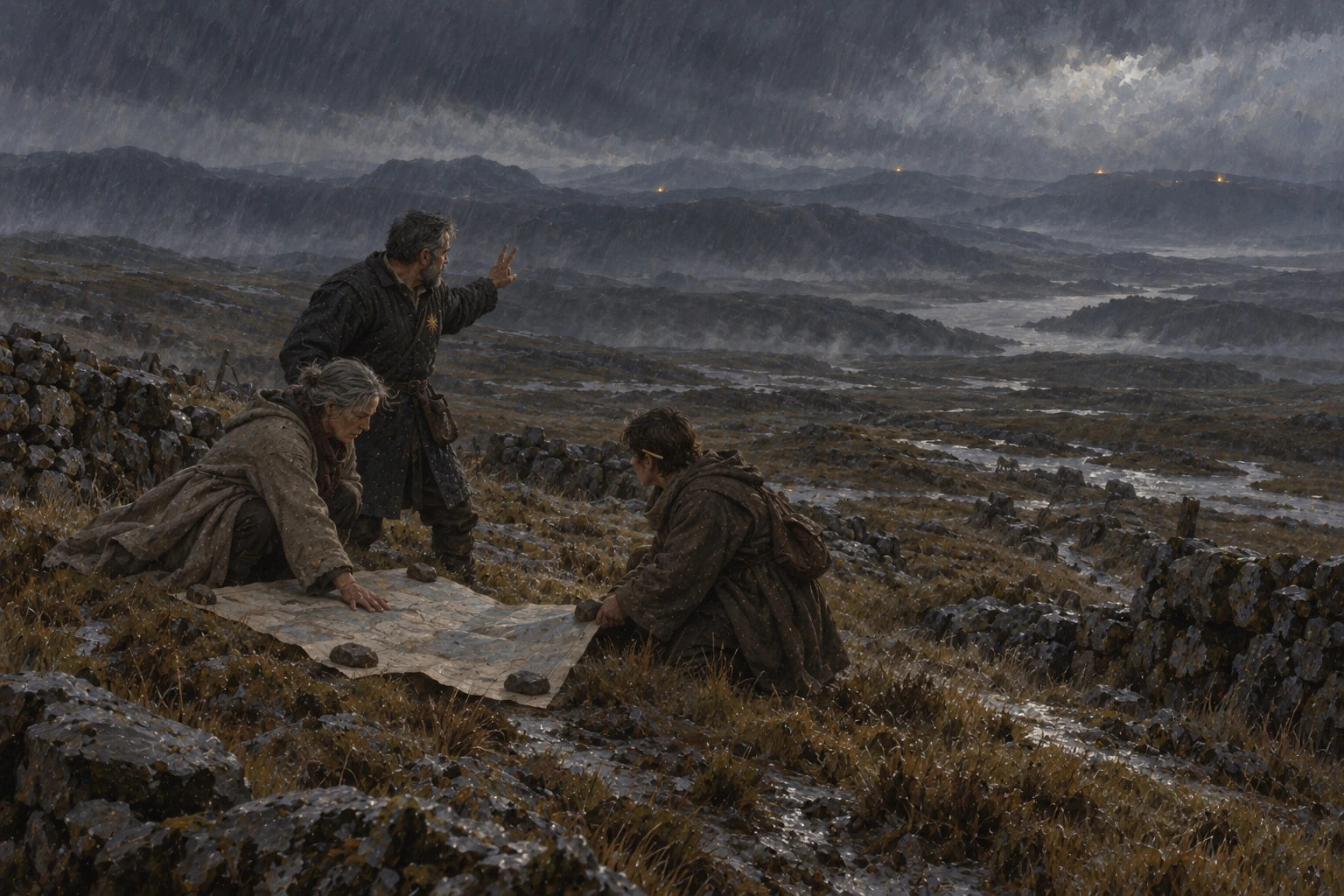
They found no shelter worth the name anywhere on that stretch of ground, and so the map went down where the ground allowed it: a strip of turf between two of the old field-walls, flat enough to serve, with the wind coming across it in gusts strong enough to lift any loose corner within the first minute of trying. Bracken and Dorrit weighted the oilcloth's outer edge with what loose stone the ground offered before Iyene had so much as opened her case, working fast and without being asked, because a flattened square of waxed cloth in that wind would otherwise have been carried off before anyone thought to chase it.
Iyene knelt at the oilcloth's edge with the master sheet already half out of its case, and said, before anyone had so much as set down a single stone, that she did not want it out in weather like this at all, that a wet corner on that particular sheet was worth more to her than any three other things the company carried between them, and that she was going to lay it out anyway, because there was no table for a hundred miles in any direction and the light would not hold itself back waiting for a better one to be found. She unrolled it face down first and ran two fingers along the reverse, checking for damp before she trusted it to the turf, then turned it over and let the wind take the first fold of it before Pip caught the corner in both hands and did not let go of it again for the length of the whole evening.
Four stones went down at the four corners, river-smoothed and heavy enough to hold against the first gusts, and the sheet lay pinned but not still beneath them, its whole surface stirring faintly, the stir no different from a held breath moving a person's chest even when they mean to keep it from showing at all.
Iyene turned the sheet so its blank quarter faced the company rather than the western half she had spent a winter filling, and began there, at the part of the country no one's boots had ever put a line onto. The western half lay folded under itself for the moment, out of the wind's reach and out of anyone's looking — a whole country of fires and roads and named ground, put away so that the four bare lines on the other side of the paper could have the evening to themselves.
"Four things are written here," she said, touching each without needing to look down and find it, "and not one of them is a finding. The mail that never came down the Stair last autumn. The watch's rider that never came after it. Marle's four short circuits, run and never returned. And nothing at all out of the pass itself since." She let the wind fill the pause rather than her own voice. "Not walked. Not confirmed. Four lines, and a blank country behind every last one of them."
Bracken did not wait to be asked for his part of it. "It isn't the walking we need to measure," he said. "A column that marches from first light and beds down before dark hands the day back — to sleep, to supper, to a watch somebody has to stand and would rather not. Call that ten hours, if the road's kind to it. There's fourteen more in a full turn of the sun that we hand away every day of our lives without thinking twice about the giving. Something that doesn't need any of that keeps the whole of it, the day and the night both, and asks nobody's leave to."
The wind found a new angle to come at the sheet from, hard enough that Dorrit put a boot down flat on the nearest stone to keep it from walking, and away to the south the beacon-line's own small lights, the only lights anywhere in that whole darkening country besides the one Bracken had ended his own sentence beside, went on holding their ground exactly as they had held it every night since the company itself had lit them.
Iyene wrote it down before she answered him, the pen moving in short strokes she did not trouble to make even against the wind.
"I need days, not miles," she said, the nib already squared over a fresh line. "Your own road out, start to end, the way you actually walked it. Nothing about what waited at either end of any stretch of it. Only the count."
Wren gave it to her the way she had learned to give Iyene anything worth the giving: plainly, and in the order it had happened.
"Two days out of Dall, onto the south road. Four more through the corn country to Marlford. Five from Marlford to Merrow. Three out the West Gate to the Drowned Bridge. Three more to the Singing Ford. Four from the Ford up to the Last Inn. Three last, from the Inn onto the Stones, to the Watch itself."
Iyene wrote each figure as it came and did not stop to check one against another until the whole of it lay on the page in front of her. Twenty-four days, start to finish, by Wren's own count of her own boots on her own road once — a number neither of them said aloud a second time, because the page already held it better than either of their memories needed to.
Luel, quiet since the sheet had first come out, spoke now, short and level. "I have watched things cross country before, in my own years, and none of them stopped for a bad crossing or a bad night — a living thing stops; these do not." She let that sit a moment before she added the rest of it. "Nor do they tire: I watched an old one cross a whole valley floor in the length of one night and it did not slow, not once, until whatever it wanted stood in front of it."
Iyene set the pen down, and picked it back up again before anyone could mistake the pause for hesitation about the figures rather than about herself. Her fingers had gone stiff enough with the cold coming off the wet turf that the nib skated a little on the first stroke she tried after, and she wiped it on her own sleeve and started the line again.
"I refused to build a rate once already," she said, naming neither the night nor the room it had happened in, since everyone at the sheet already carried both. "I refused it off a tally of the dead, in a warm house, in midwinter, because a count like that has no direction in it — no north in it, no south, only more or fewer. What's in front of me now has a direction on it. Ground that gave nothing back yesterday and heel-scars all pointing the same way this morning are not a tally. They're a road, and I know a good deal more about putting a number to a road than I know about putting one to grief."
She looked down at the sheet rather than at any of them for the next part of it. "I could be wrong about the whole of it. I want that said before I set down a single figure." A little later, the pen already moving across the page: "I don't trust this number, and I'm going to write it down anyway, because a number I don't trust is still worth more to us tonight than none at all."
Bracken turned the figures over in his own head the way he turned over any column of march. "So we're saying, by next winter—"
"Months," Iyene said, flat, before he finished the word. "Say months, Bracken, or say nothing that means anything."
He took the correction the way it was meant and started the sentence over. "Twelve months. Perhaps sixteen. Call it fourteen, and know that fourteen is a guess dressed up to look like a number."
Alder, from where he stood a little apart with his stick planted hard against the wind, said only, "That much, I'd credit."
Iyene ran a finger down the sheet's blank quarter, naming each point as though she were walking it herself for the first time in her life. "The Watch, first. Then a day down the road, the lamp on the steading. Then the river country, and the ford under it. Then Merrow, or near enough to it that the difference won't matter much to whoever's doing the counting. Then the shires, however far the shires happen to reach this year."
She stopped there, her finger resting on the last blank inch of paper before the sheet's own worn edge, and the first fine spit of rain crossed the ground between them, small dark spots opening one at a time across the pale turf. The wind filled the pause that followed, snapping one loose corner of the oilcloth hard enough that Pip's grip on the map tightened without anyone having to tell him to hold on.
Then Wren said the rest of it, because it was hers to say, and not anyone else's.
"Dall."
One word, and she did not add anything further to it, because there was nothing about Dall written on that sheet for her to add to.
"Enough for tonight," Alder said.
The rain that had been threatening the whole evening arrived while the last figure was still drying on the page, coming in off the high ground in a hard slant that had the whole company moving before anyone said a word about it. Iyene blotted what she could of the ink, rolled the sheet from its blank edge inward so the wet quarter would dry against itself rather than against the whole of the west it had taken her a winter to draw, cased it, and drew both straps down tight before she let herself straighten out of the crouch she had held the entire while. Pip did not loosen his grip on the corner until the case itself was buckled shut, and then shook the cramp out of both hands and went to see to the mules, who by then wanted no telling twice that the weather had finally arrived.
Supper that evening was taken standing, under what cover the panniers themselves could give against a rain that had settled in for the night rather than merely passing through it, and nobody lingered over the meal as they sometimes did on a kinder evening. The fire itself failed twice before Dorrit coaxed it back with a double handful of kindling she had thought, that morning, to keep wrapped dry against exactly such a night, and once it was drawing properly again most of the company had already gone to whatever task waited nearest the little warmth it offered.
She did the rest of it herself, later, away from the fire's own light, with a candle-stub Luel had given her without being asked and the Waybook open on her knee instead of the map, because the map gave directions and it was days she needed now, not directions.
The book's cover had gone soft and dark at both bottom corners from eleven generations of exactly this kind of holding, the leather worn thin enough there to show a paler line beneath where the grain had once run unbroken, and the whole of it sat lighter on her knee than its own thickness ever suggested it should. Somewhere behind her the fire cracked once, wetly, around a piece of wood that had not dried through, and further off a mule shifted its weight and let out a long breath through its nose, and neither sound troubled the candle's small flame enough to make it duck.
Wystan's own hand ran days-walking figures in the margin beside nearly every page he had ever drawn, small spiked numerals set close against his lines, and Wren read down through five of them by the candle's short light, checking her own spoken count against a dead man's stage by stage until the two of them agreed to within half a day on every stretch but one, where his own figure ran a full day longer than hers, and she let his stand, because he had carried the book its whole way home once, start to finish, and she had so far only carried it half of hers.
She wrote the entry short — a keeper's habit and not a comforting one, meant to be checked against rather than read for comfort. The total she and Iyene had built at the sheet: twelve months at the shortest reckoning, sixteen at the longest, fourteen set down as the figure she would use herself if pressed to choose one. The months already spent since the autumn the letters stopped: five by the driest count, six by the most generous. And the remainder, plain, at the foot of the page, with the working shown above it exactly as a keeper's family had shown its working for eleven generations: not less than six months. Not more than ten, if it does not stop for anything at all.
She did not sign it. A day-book entry never wanted signing, and she had watched her own hand write every word of it once; that was enough.
She closed the book but did not carry it with her, and left it lying against her own pack exactly where it had lain the whole evening, because a task was waiting on her that had nothing to do with figures — Barrow's off-fore hoof wanted picking out before the ground froze hard again overnight — and a keeper's other work went on regardless of what her own hand had just finished setting down.
Some while later, while Wren still crouched over the mule's hoof with the pick cold in her fingers, Dorrit crossed to where the pack lay against the wall's cold stone, opened the day-book to the page still holding its crease, and read it standing in the last grey light, one hand flat against the paper to keep the wind off it before she had finished. She closed the book again exactly as she had found it, corner square with corner, and set it back down against the pack at the same angle it had been leaning at before her hand had ever touched it.
The next day's walking went just as the two before it had, the ground giving nothing back and the trail still running its one direction, and that whole evening's ordinary jobs got done a little early and a little wrong: a knot tied once and then tied again for no reason anyone gave, a pot pulled back from the coals a beat later than it wanted, bread turned twice when once would have served it, a picket-line walked and checked a second time by the same hand that had already checked it. The two things that might have followed a finding like that — raising it, or arguing over it — simply did not arrive, and the evening went on instead as evenings did, jobs handed round and taken up in their turn, the rain settling into a steady, ordinary patter against the little shelter of oiled cloth Dorrit had strung between two of the panniers.
It was full dark, and well past the hour the work was needed, before Bracken went to the panniers and re-slung two of the loads that had ridden well enough all week exactly as they had before, buckles found by feel in the near-dark rather than by the little light the fire threw that far, his hands finding the straps they had set a hundred times over without needing his eyes to help them do it again. The rain had eased to a fine, persistent damp by then, enough to darken the leather under his fingers without troubling the knots he was making of it, and he worked through both loads twice, though the first pass had left neither of them any looser than the second found them.
They walked on west in the morning, the mules loaded in the same order as every morning before it, and no one among the seven of them called it anything more than the day's ordinary work continuing where the day before had left off.
Gable's off-side strap sat a hole tighter than it needed to, rebuckled twice since midnight, and left that way.