Provisioning
The morning after the charter, Merrow went on exactly as it had the morning before — carts rattling over the bridges, the merchants' hall clock striking its own hours — and Wren found, a little to her own surprise, that this was precisely as it should be. Nobody rings bells over the washing-up.
The washing-up, in this case, was provisioning, and it began before she'd finished breakfast.
"You'll want old clothes," Dorrit said, arriving in the doorway already dressed for exactly that, a smear of something dark at one elbow. "Bracken says the stable yard by mid-morning, and I don't think he means for us to admire it from a safe distance."
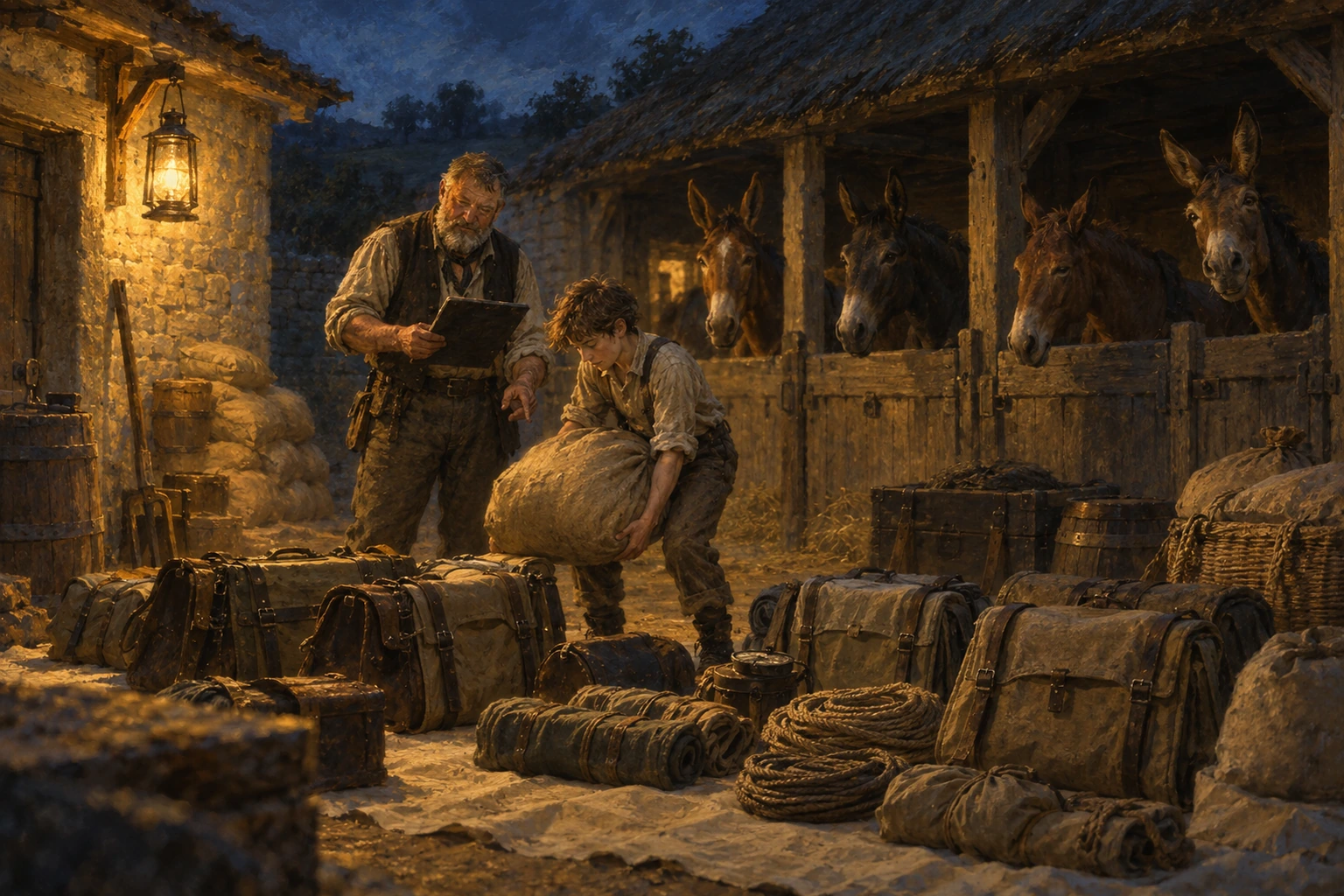
He did not. The yard had the look of a room mid-turned-out — sacks and rolls and coils ranged along the rail in no order Wren could read yet, the four mules at their picket with the resigned patience of animals who had done this before, and Bracken in the middle of it with a slate and a stub of chalk, looking up at them with the satisfaction of a man about whom something long-planned was finally, properly, beginning.
"Good," he said. "You're early. That's worth knowing about a person, and I'd rather learn it now than on a mountain." He tapped the slate against his palm. "Come and be useful. There's no better way to learn a load than to carry one."
What Bracken called the doctrine — though he never used that word himself, only Wren, privately, in her own head — began with a rule she had not expected.
"You don't load for the road," he said, laying a hand flat on Suet's neck. "You load for the ugliest stretch of it. Anybody can balance a pannier for a flat mile. The load you want is the one that'll still be sitting right on the worst hundred yards of the whole journey, in the dark, in the wet, with an animal under it who's had enough. Find that stretch before you pack. Pack for it. Every easy mile after is a gift."
He worked down the rail as he talked, checking a girth here, correcting Pip's grip on a rope with two words and no scolding at all. "Nothing that clanks goes on Barrow near water. A pot lid loose in a pannier is nothing on dry ground and a small disaster on a plank bridge with a mule already unhappy about the planking. Load him quiet, and last, so the quiet things sit on top."
"There's a shape to a good load," he told them, later, when the sacks and rolls had begun sorting themselves under his direction into four smaller piles. "Heavy low and centered, so the weight rides the spine and not the shoulder. The things you'll want at midday on top, not buried — there's no quartermaster living who hasn't dug through a whole pannier at noon hunting the salt and found it under the tent-pegs, and sworn an oath he'd rather not repeat before present company." He said this with a dry glance at Dorrit, who grinned, which was in itself a promise she'd repeat it later.
"And weight against days. Knowing which pounds you'll thank yourself for on a wet night three weeks off, and which you packed only because they made you feel safer standing in a warm stable yard where nothing's gone wrong yet." He weighed a coil of good rope against a coil of the thinner sort. "Two of most things, where it can be managed. One to use, and one to lose. Not three. Three is a man provisioning against his own nerves rather than against the road, and I've buried good mules under nervous men's stores before now."
Pip, listening with the fierce attention he brought to everything Bracken said, went very slightly red around the ears, and looked hard at his own boots, and thought of the reams of squared paper waiting on his desk.
Pip's own kit took the better part of an afternoon, and Bracken conducted the whole business with a gentleness that no longer surprised Wren at all. He did not raise his voice, or hold any item up for the yard's inspection. He sat with the boy at the desk-turned-worktable in the corner of the yard, the three hand-stitched instrument rolls laid open between them, and went through his stores item by item, asking rather than pronouncing.
"These," he said first, running a thumb along the stitching of the nearest roll, "are good work. Better than good — I'll say it plainly once, because plain praise is worth more than a mouthful of it. You cut each pocket to the tool. That's a quartermaster's instinct in a boy who's never quartered a thing in his life." He set the rolls aside, deliberately, in the pile that plainly meant these travel, and Pip's face did the thing it did — the fierce, unhappy red going, this time, the other way, into something closer to simple light.
Then he turned to the rest of it: the second inkwell, the third pencil past the two already behind Pip's ears, the reams of paper cut and squared far past any reasonable need.
"Weight is time," Bracken said, turning the spare inkwell once in the light, "and time is weather, out on a road, in a way it never quite is in a College gallery. Every pound you carry that you don't need is a pound some mule's carrying instead of grain."
"I wanted to be ready," Pip said, low. "For anything."
"You are ready. For the work. That's the whole of what readiness is worth out there — not a spare of everything, but knowing which one thing you actually need and where your own hand'll find it in the dark. You've got that already in these rolls. The rest of this" — he gestured at the pile that would not travel — "is nerves wearing the shape of caution, and every one of us packs a bit of it the first time out." He smiled, briefly, at some private memory. "Cut it to what you'll use. That's not less care. It's care aimed properly, which is harder to learn than having it at all."
Pip cut his kit by more than half that afternoon, without another word of argument.
The rest of the fortnight's provisioning went by in the ordinary give-and-take of a busy yard, most of it easier than the mule yard had been, and one piece of it a good deal harder.
Dorrit's medicine chest took longer, and went a good deal less smoothly.
Bracken came to it two days after Pip's rolls, with the same slate and the same quick kindly manner, and lifted the lid expecting much the same conversation he'd had with the boy — an eager keeper of good things, and a quartermaster's job to help her see which of them she could do without. He lasted about as long as it took to lift out the second jar.
"Two kinds of willowbark," he said, turning one and then the other in the light, "and I'll wager they do the same work between them. That's a jar you can leave, and a fair pound of weight saved besides."
"They don't do the same work." Dorrit said it evenly enough, the first time — the tone of a woman correcting a fact rather than defending a feeling. "The pale is for a fever that's still rising. The dark's stronger, and slower, and you give it once the fever's broken and the body wants easing down rather than fighting harder. Give a person the wrong one at the wrong hour and you've either done nothing at all or a good deal more than you meant to."
"Two willowbarks is still two willowbarks to carry up a mountain."
"Two willowbarks is the difference between a man walking again in three days and a man not walking again at all, and I'll thank you to let me be the one who knows which is which, since it happens to be the one thing on this whole Survey I actually know better than you do." Her voice had gone tight on the last of it, in a way Wren had heard perhaps twice in twenty years — not loud, Dorrit was rarely loud when it mattered, but flattened, the warmth gone out of it the way heat goes out of a coal turned to ash.
Bracken set the jar down. "I didn't say you didn't know your trade."
"You said it the way you said it to Pip. Cut the spares, keep the one thing that matters, and never mind that his spares were an inkwell and mine are the difference between a wound that closes clean and one that doesn't." She was not shouting. It was, if anything, worse than shouting — the particular quiet of someone who has decided, mid-sentence, that being reasonable about this would cost her something she wasn't willing to pay. "I have buried people over a jar somebody decided was one to lose, Bracken. I don't say that to win the argument. I say it because it's true, and because you asked me to trust your doctrine on the strength of it working beautifully on a boy's pencils, and pencils and fever-root are not the same kind of thing, whatever they weigh the same."
There was a silence of the kind that does not, in a busy stable yard, actually stop anyone else's work — Pip kept coiling rope at the rail, careful not to look up; a groom led a horse past without slowing — and yet it felt, to Wren, entirely loud.
"Pack it as you see fit, then," Bracken said at last, in the flat voice of a man retreating from ground he was no longer sure he'd had any business standing on. He did not say he was sorry, because — it was plain in his face — he did not yet fully believe he'd been wrong so much as outmatched, and a man like Bracken said sorry readily for the first and rarely, on the spot, for the second.
"I generally do," Dorrit said, and turned back to her chest, and did not look at him again for the rest of the morning.
Wren, coiling rope a little further down the rail with no particular reason to be listening and every reason not to say so, found she minded the silence more than she'd have minded the argument going on longer. "She buried people, Bracken," she said, not loudly, when he passed her a while later with an armful of grain-sacks and nothing to say to anyone. "Let her keep the extra jar."
"I heard her the first time," Bracken said, and did not slow his step. It was not an answer so much as a door pulled to for the moment, to be opened again, if it opened at all, somewhere further down the road than a stable yard in Merrow.
The chest went, in the end, low and centered on Suet's near side, exactly as full as Dorrit had packed it and not a jar lighter, and Bracken never raised the matter again. Iyene's own kit was chosen fast and alone, the good glass left behind for a smaller, uglier one that would survive a mule's bad step where the fine one wouldn't; the fiddle was judged, after Bracken's one uncertain question, to be stores rather than baggage, and given its place on Gable's undemanding back. Wren bought fresh oiled cloth and dressing in the market for Granna's sake, as she'd been told to and nearly forgotten, and did not mention it to anyone, because it was not the kind of thing one mentioned.
On the last evening the panniers stood ranked in the yard by lamplight — dark on the left, light on the right, each one weighed and known — and Bracken walked the row a final time with his slate, though Wren suspected he could have given the weight of every load in that yard blind by now. Then the yard emptied for supper, and the lamps went out along the scriptorium wing one after another, and the mules dozed at their picket in the last of the day's warmth.
She came back down an hour after full dark, because she wanted to see it once with nobody in it.
It was a good sight. Eight panniers standing in two ranks under one lamp, and every one of them holding something somebody had argued about. She was still looking at them when Nettle's head came up.
Then Barrow's. Then all four at once, ears hard forward at the north wall, and Wren turned round with her heart already going before she had worked out why.
A man sat astride the coping with one leg over, and two more were already down in the straw. The third dropped while she watched, badly, and swore at his own ankle — and it was that, the ordinary sound of a man swearing under his breath, that undid her stillness altogether.
"Yard's empty," one of them said.
"It isn't," said Wren.
They looked at her. There was a moment in which she might have gone for the gate, and she did not take it, because the mules stood between her and the gate and one of the men was already moving to cut the corner. The lamp was behind her, so that she could see them and they could see her, which was the worse of the two arrangements.
The one who had spoken came forward three steps and stopped — not a large man, and not a drunk one, with a knife out held low and turned in, for work rather than for show, and it was the plainness of it that frightened her past anything about his face.
"Third door on the west stair," he said, to the others, not to her. "That's what we were paid for."
"Wrong room," Wren said. Her voice came out level and she had no idea where she had got it from.
"Aye," he agreed, looking at her hip. "I can see that."
They had come for a room and found the road instead, and the difference between those two things was four feet of straw.
"Just the bag," the one with the bad ankle said, almost kindly, and that was as far as any of it got.
Where Bracken came from she could not have said — out of the near stall, or the lane, or the dark under the wall. Only that the yard had three men standing in it, and then it had two, and the sound in between was short and flat and nothing whatever like the sound she would have imagined.
He had the loading-pole in both hands, six feet of ash, and he used it as a man uses a tool he has held ten thousand times. The one who had dropped badly took the butt of it across the shins and went down and stayed down, holding his leg. The second came in at Bracken's off side and Bracken simply was not there any more; the pole came round, and the man decided in the middle of a step that he had other business, and went at the wall so fast he left skin on it. The one with the bad ankle followed him over without a word.
It had taken less time than lacing a boot. Bracken had not shouted. He stood with the pole across his body and his weight low, and his breathing was the only part of him that had changed.
The first man had not run.
He was standing where he had stopped, ten feet from her, and he was not looking at Bracken at all. He was looking past both of them to the gate, where Alder had come through and was standing under the lamp with his stick in his hand and his coat unbuttoned, as though he had got up from a table and walked out without troubling to finish his sentence.
"You'll want the wall," Alder said. "Not the gate."
"I'll go by the gate."
"No," Alder said, "you won't." He set the iron ferrule of the stick against the flagstone at the gate's mouth and said one word Wren did not catch.
Nothing happened that she could see. The lamp did not so much as gutter. The man took one long stride for the gate and stopped as though he had walked into the side of a barn in the dark — not thrown back, not struck, only arrested, with one foot still lifted and nowhere in the world to put it down.
Wren was watching his face. That was the part she kept. It went from a working man's irritation to something with no bottom in it, all in the space of a breath, and then he backed four steps without turning round, and turned, and went over the north wall the way he had come, and the last of him was one hand on the coping and then nothing.
The man with the broken shin was still in the straw, making his noise.
"Bracken," Alder said.
"Aye," said Bracken, and that was the whole of the conversation.
They found Ansell at the foot of the west stair with his arm bent where an arm does not bend and the stair door shut behind him. He was the College's night-porter, sixty-one years old, and he had heard the wall go and gone straight to the third door on the west stair because that was where the College put its guests, and had held it with his shoulder while somebody on the far side worked at the hinges with a bar, and had gone on holding it until they gave up on the door and went for the yard instead. Wren asked him why, later, and he looked at her as though the question had come out in another language, and said that it was his door.
Dorrit set the arm on the kitchen table with Bracken holding the man's shoulders and Pip, white to the lips, holding the lamp exactly where he was told to hold it and not an inch off. It was a clean break and it went back well, and Dorrit said so twice, in the flat cheerful voice she kept for people who were frightened. Wren went out to the yard afterward and was sick behind the water-butt, and came back in and took the lamp off Pip so that he could sit down.
The strap had been cut. She did not find it until she took the satchel off to sleep: a clean slice three-quarters through the leather an inch below the buckle, done in the dark, in about a second, by a man she had been looking straight at. The book had never left her hip, and had been one good pull from doing so.
Bracken re-stitched it at the kitchen table at two in the morning with his tongue between his teeth, doubling the cut section over a strip of new hide and running a saddler's stitch down both edges, so that it came back to her heavier and thicker and exactly the length it had always been, with a hard ridge of new work under the buckle where her thumb would find it every time she reached for the clasp. "There," he said. "It'll outlast the bag now."
Iyene came down with her working sheet and asked five questions and wrote the answers on it, which was as near to fussing as anyone saw from her that night.
"They were not the Relic Court," Alder said. "They were three men and a bad ladder, and somebody at Marlford's fair-field paid them out of what he made buying a carved box off an old woman. But they will sell what they saw here tonight, because it is the only thing they have left to sell. Inside a month there will be a man in the capital who knows the Fallowmere Waybook is real, that it is out of its house, that it is going west, and roughly when." He said it as flatly as the weather. "That is what tonight cost. It is a good deal more than a strap."
Iyene wrote that down too.
Nobody was arrested. There was no magistrate, because a magistrate would have wanted a fortnight and the charter did not allow for one; the man with the broken shin was carried off by the College's own people and gave a name that was not his, and that was the end of the official part of it. The King's peace, Wren noticed, was worth precisely what a piece of paper is worth at eleven o'clock at night in a walled yard.
In the morning she paid Ansell's keep out of her own coin — six weeks of it at the College's rate, argued down from the eight the clerk wanted and up from the nothing Ansell would take — and it was not enough, and she knew it was not enough while she was counting it out, and counted it out anyway. Then she stood a while at the rail with the satchel at her hip and her thumb on the new ridge of stitching, looking at the north wall by daylight: hip-high on the lane side, a good ten feet on this one, and no use to anybody at all. Behind her Alder and Iyene's voices carried low and companionable across the yard, still arguing some last small point of the road neither would give up before the Frost itself, as though nothing whatever had happened in it.
The road started in earnest within the hour — west out of the city, and then toward the mountains, six of them and four mules and whatever the seventh turned out to be, somewhere on the road ahead of them still.