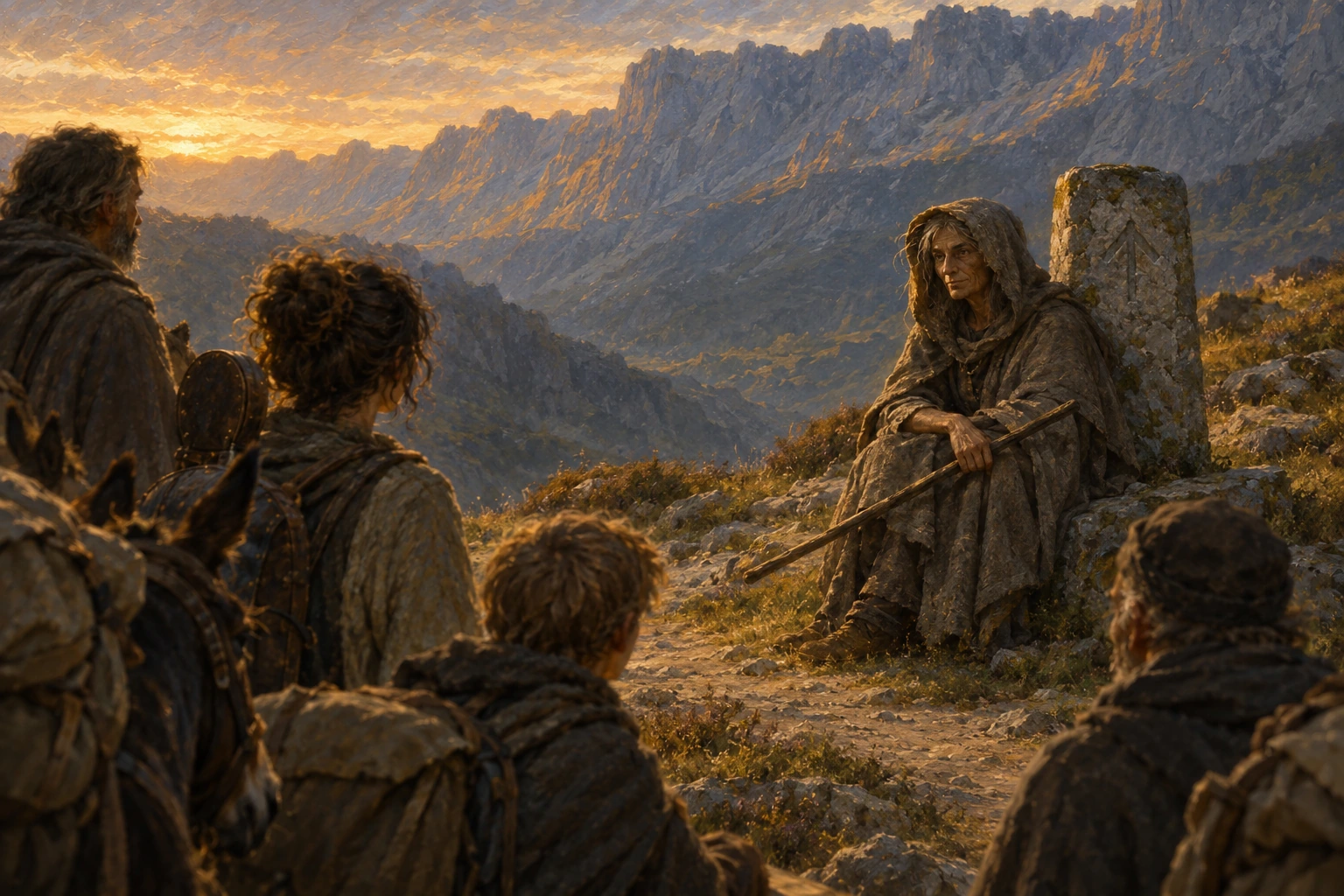
Luel
The road turned to climbing in earnest north of the Singing Ford, doing it much as the flat river-country before it had turned itself, mile by mile, from woodland to water: not by any single hill worth remarking on, but by a long patient tilting underfoot that the legs noticed before the eye did. The willows fell away within the first day. The ground firmed and rose in easy shoulders, heather starting to show black-purple among the grass, and on the second morning Wren woke to find her own breath standing in front of her face in a small pale cloud, the first of the year, and lay a moment watching it before she got up to see to the fire.
"There it is," said Dorrit, from two blankets over, in the tone of a woman greeting an old and only moderately welcome acquaintance. "I told the beans a fortnight back it wasn't done with us yet, and here it is, proving me right at an hour I don't care to be proven right in." She breathed out a cloud of her own and inspected it critically. "Frost-breath. My grandmother swore you could tell how hard a winter meant to be by how early the first one came — though she also swore you could tell it from a goose's walk and a cat's back, so I never put much weight on the method."
It was the first ordinary complaint anyone had made since the ford, and Wren was glad of it — proof of nothing except that the company was still itself. They had gone quiet after the crossing, carefully rather than unhappily, the quiet of people still turning a fine thing over; and it was Dorrit, predictably, who broke it first and oftenest, complaining about her boots, arguing with Bracken over a bald patch on a slope, singing scraps of the Bee-Wife's Round until Pip, without meaning to, was singing them too.
The mountains stood all day now, no longer lost by noon, a little nearer each evening than the evening before — patient in a way Wren had decided she liked, the same patience the Cloudwall had always kept over Dall, only walked toward now instead of merely lived beneath. The fair copy thinned, by the second afternoon, to little more than the road's own bare line running on toward the watch, everything off it given over to one honest word, unsurveyed — a gap nobody remarked on, because the Waybook, consulted in the same breath, went a good way further yet.
It was on the third evening, the light going long and the air carrying the hard-edged clarity that comes before a real frost, that they came over a low rise and saw, standing alone where the road bent to meet the next shoulder of ground, a squared College waymark of the ordinary kind — and, sitting against its base with the ease of someone who had been sitting there a good while and expected to go on sitting there a while longer, a figure.
Wren had been looking at the road ahead, gauging the last half-mile against the light; and then she looked again, for no reason she could have named, and the figure was simply there, as much a part of the waymark's furniture as the lichen on it. Bracken's hand went, briefly and by pure old-soldier habit, to the grip of the blade at his hip, and eased away again, because whatever the figure was, it was not, on any reading a person could give it at forty paces, anything to be alarmed of. She sat too easily for that. She sat the way Granna Tansy sat by a cold hearth on a night when nothing was wrong at all, only waiting.
She rose as they came up the slope, a single unhastened motion with no visible effort in it, the way a heron rises off water. She was slight and straight, and of no age Wren could have put a number to — not young, and yet nothing suggested old either, only finished. Her skin and hair were both a weathered grey-brown, close in tone, the color of old wood left long to sun and rain until the grain shows clear; her cloak was some shifting shade between grey and brown and heather that never quite settled on being any one of the three. Her eyes, dark, held the last of the firelight-colored sun a moment longer than eyes had any business holding it — nothing uncanny in it, only that one small lingering. Her hands, folded over the head of a bare pine staff, were small and neat, and clean of any obvious labor, though Wren did not take them for idle hands. Besides the staff she carried only a small shoulder-wallet of soft undyed hide.
"You crossed the ford kindly," she said, before anyone had found a word to open with, in a voice low and old-fashioned. "It was noticed."
"Was it," said Alder, at last, recognition arriving a half-beat behind the ear that had already caught it — and Wren, looking at him rather than the stranger, saw, for one unguarded instant before he mastered it, an expression she had never seen on his face before: something young, something almost unsettled, gone again too quickly to be sure of.
"It was," the woman said, something dry and private in her face reaching her eyes before it reached her mouth. "Good evening, keepers of the road. I am called Luel, among people who trouble to call me anything at all, and I have come some way to find you."
"Have you," said Bracken, in the tone of a man deciding, provisionally, to be practical about a thing until it gives him reason not to be, and set about introductions — himself, the mules, Iyene, and Pip, whose eyes had gone round and fixed and who had, Wren noticed, entirely forgotten to be embarrassed about it — and Dorrit, who studied the newcomer the frank way she studied a strange plant before deciding whether to eat it, then asked, in the flat direct way that was entirely her own office:
"Forgive me — is it she, or is there a better word I ought to use? I'd rather ask plainly and get it right than guess and get it wrong for a fortnight."
"She will do," said Luel, the private amusement deepening a shade. "It has done for a great many years, and I've never found it wanting for the work it does. Ask me again in a century and I may have a different answer, or I may not, and either way you'll have asked kindly, which is the greater part of what a word like that is for." She looked at Dorrit a moment longer. "You are the one who reads the ground. I was told there would be one of you."
"I read gardens, mostly," said Dorrit, frankly delighted, "but I'll take the compliment as offered."
It was at this point, introductions not yet finished, that Nettle — who had stood the whole while with her ears back, her reputation entirely intact, having bitten Bracken twice that week alone on matters of principle — pulled her lead taut, walked its length unasked, and put her head down against Luel's shoulder with a long ordinary sigh, as though against a fence post she had known her whole life.
Bracken found his voice somewhere, and had to go looking for it twice.
"Thirty years," he managed at last, "with mules. Thirty years, and that animal has bitten me for offering her a better oat than she was owed, bitten a College fellow for standing too close to her own shadow, and bitten me again not a week past for scratching an ear she'd asked me to scratch five minutes before — and now she does that." He looked at Luel somewhere between deep suspicion and deeper respect. "I don't suppose you'd tell me what you did to earn it."
"Nothing," Luel said, laying one small hand briefly along the mule's jaw, asking nothing of the animal at all and seeming, for that reason, to be given everything in return. "She has simply decided I am not a stranger. Mules are not often wrong about that."
"She bites strangers on principle," Bracken said, faintly, to no one.
"So I understand, and I find I respect the principle. A world with rather more of it would want for rather less."
They made camp at the waymark, the ground being level and no good reason to walk on past a fair stopping-place. Bracken built the fire a shade higher than the evening's chill wanted, as if a stranger — even a wanted, unalarming one — earned a slightly better showing of the camp's ordinary comforts.
Luel ate little: a few spoonfuls, slow, with the attention of someone tasting a thing for its own sake. She held the bowl a moment before the first taste, turning it once as if to see it from every side — courtesy, Wren thought, not caution.
"Thyme," Luel said at length, to Bracken, "and something else beside it I've no common word for — a root, bitter, meant for the stomach rather than the tongue, though it does the tongue no disservice either. Whoever added it knows her craft."
"That'll be me," said Dorrit, sitting up very straight with the pleasure of a woman correctly praised by someone under no obligation to notice. "Fever-root. My grandmother's word for it, though I'd wager it isn't the name you'd give it."
"It is not," Luel agreed, "though it is a good name, and wears well on the plant. I like a great many of your names, once I've learned them. You have a gift for calling a thing honestly what it does." She looked, then, toward Alder, who had said little and seemed, to Wren's private interest, to be taking rather longer than his usual measure to settle a spoon in his hand. "You have listened twice," Luel said to him, simply, a fact already agreed between them and merely stated. "Both times well."
"I had hoped it showed," Alder said, and there was, under the familiar dryness, something Wren had never heard from him before — not unease, but a careful humility kept in reserve for the very few people before whom his own long practice at being unshakeable does him no good. "I did not know it had been remarked so far from where I did the listening."
"We remark on a good deal more than we're generally given credit for," said Luel, and let the matter rest; and Wren, watching them across the fire, thought that there was a whole long unwritten margin to Alder none of them, herself included, had yet been shown more than a corner of — and found the thought pleased her more than it troubled her, the way a locked door pleases someone who trusts the house behind it is a kind one.
It was Iyene, practical as ever, who put the direct question the company had been circling. "You said you came some way to find us," she said, pocket-book out of habit rather than intention, resting closed on her knee. "What is it you've come for?"
Luel weighed the question — not, Wren thought, deciding whether to answer, but how best to give the answer its proper shape.
"My people watched you at the ford," she said. "Not only the singing — that was given freely, and I'll say no more of the giving than that. We watched how you walked our country. You crossed water that was ours to sing over without asking what the song meant. You held a boy's hand still rather than let him set it on paper. You closed a book of your own rather than fill it with something that wasn't yours to keep." She looked, briefly, at Iyene, then Pip, gentling for each. "That is not a small thing, to people who remember what it costs when it is not done. A great deal has been taken from us, over a great many years, by people who meant no particular harm and did a great deal of it regardless. You did none of that. It was noticed, and minded."
"And so," said Alder, "you've come to walk with us."
"Because the road you walk goes toward Meddan, in the end, however many years it takes; and a road walked toward a lost neighbor ought not go unaccompanied by someone who still remembers the neighbor. There is a good deal you will need telling that no map will give you and no charter can require of anyone — and I am willing to tell it, on the road, as the road gives occasion, rather than all at once and badly around a single fire. Some of it is telling you will want before you need it. Not everything that stayed in my country went quiet when the cold came, or went gently. When we are across the mountains, I will walk in front." She turned her staff once. "I name myself the seventh of your company, if the company will have me, and will let the rest show itself in its own time."
"Seven," said Bracken, slowly, something crossing his weathered face that was half a smile before he let it be one. "I like the sound of that number early, and I like it a good deal better now it's come round to being true."
"That was the toast," said Dorrit, sitting forward. "The charter supper — Bracken drank to seven, and Iyene corrected him to six, until we'd collected the last of us on the northward road. You said it plain as anything, months before there was a ford to cross or a soul in sight to collect."
Iyene, for once in Wren's memory, took a visible moment before answering.
"I did say it. I remember thinking, even as I said it, that it was rather more than I had any business claiming — a cartographer ought never promise a feature she hasn't yet surveyed. I've no explanation that would survive a fair cross-examination, and I'll not pretend to one now merely because it's come true." Something almost rueful crossed her face. "I believe I simply hoped it, out loud, at a table of people I had every reason to hope well of. Hope said plainly at the right table does a surprising amount of the map's real work — though I'd thank you all not to put that in writing anywhere I might later be held to it."
"It's already written," said Wren, before she'd quite decided to speak, and found every face turned toward her, mild and friendly. "In my day-book, from that very supper. I didn't know it was the sort of line a person ought to keep an eye on. I only knew it felt like the kind of thing that wanted keeping."
"Then you have a good instinct for what wants keeping," said Luel, turning her dark eyes fully on Wren for the first time, "which is, I think, rather more than half of what your office is for." Her gaze went, briefly, not to Wren's face but to the satchel at her hip. "You carry a thing that remembers my neighbors."
"I do," Wren said, after a small pause. "It's mine to carry. Not mine to give, and not mine to show past the first page unless a person's earned it — but I think, from what you've said tonight, you may have."
"Good," said Iyene, before Luel could answer, satisfaction clear in her voice — the satisfaction of a precise mind finding an old piece of language finally doing the work it was built for. "Because I wrote the charter myself, word by word, over a great many candle-stubs, and I recall a clause I privately thought at the time more hope than function — a company of six sworn, and such guides as the road provides. I put it in because Alder asked me to, and because some small unreasonable part of me liked the idea of a clause that existed for a guest who hadn't yet arrived." She looked at Luel the way a craftsman looks at the exact use her own careful work was made for. "I don't believe I've ever in eleven years been so pleased to find a piece of my own drafting necessary rather than merely tidy."
"Then I am within the letter of it," Luel said gravely, "as well as, I hope, its spirit," and something in her tone made Dorrit laugh outright, and Pip a beat behind, and the whole company settled, all at once, into the simple unremarkable fact of being seven around a fire instead of six.
The lore came slowly, drawn out a fragment at a time by whatever question the hour raised, so the evening had the shape less of a lesson than a long, easy conversation. It was Pip who started it, unable to hold the question in once the stew was cleared. "What was it like," he asked, and then, catching himself, reddening, tried again, smaller: "Meddan. Before."
Luel was quiet a moment, turning her staff, and when she spoke it was lighter and warmer than Pip's question seemed to have braced for, and considerably more devastating for being so.
"There were orchards in the high valleys," she said, "on the south-facing slopes where the frost came latest, and they kept a winter apple there — small, hard as a green plum in autumn, sweetest the day the first true snow fell, which the growers timed their picking by, rather than any calendar. I have eaten one exactly once since, kept a very long while by a very careful hand, and I would not tell you what that cost the keeping of it, because the telling would be its own kind of taking." She looked into the fire. "The road below carried wool out of the high pastures, and glass, and a blue dye found nowhere else in the world, taken from a shell-fish off one stretch of coast, in one season, by families who had done the taking so many generations the coast itself seemed to have grown used to it. It went east into Meddan's markets, and further east again, into your own country — though I don't imagine your country remembers now where the color in its oldest cloth first came from."
"Way-houses stood along it, much as your College's do, though older, and built to a different taste — low and broad, doors pinned open the whole summer, because a shut door on a road like that one was thought an insult to whoever might be walking it hungry. And in the high valleys, on feast mornings, the children climbed a stair — the Stair of Morning, cut into a shoulder of rock facing due east — to stand on its topmost step and watch the sun come up the last of it, because the builders had set it, generations before, at exactly the angle that let the light climb step by step ahead of the climbers, so a child standing on the right step watched the sun arrive at her own feet before it arrived anywhere else in the valley." A small private warmth crossed her face. "It is a very silly, very lovely thing to have built a stair for, and I have never once, in all the years since, stopped thinking well of the people who built it."
Wren, listening, thought of a saying she had known her whole life without wondering hard at its shape: going Meddan-wise, said of a fire burning down with no one left awake to feed it. Alder had given her the bones of it once, at the Bridge Inn — a chain of beacons, gone dark hill by hill. She had taken it then as a fact worn smooth by use. She understood now she was about to hear it given back with its original weight still on it, warm rather than worn.
"There was a line of fire along the peaks," Luel said, as though she had heard the thought and simply continued it. "Baskets, iron, set on summits that stood in sight of one another the whole chain's length, tended by whichever household lived nearest and counted the tending an honor rather than a chore. They were lit for the feast days, so a traveler two valleys off could see, without being told, that this was a particular night; and lit, differently, for warning, when word wanted carrying faster than any rider — hill to hill, each keeper watching the next hill's light rather than the road below. It was, I think, the nearest thing your people and mine ever built together without quite calling it that. Meddan tended the eastern half of the chain, and we the western, and neither side much troubled to draw the line between them, because the light didn't care, and neither, in the end, did we."
"And then the cold came," Alder said, quietly, not a question, when she let the silence stretch.
"And then the cold came," Luel agreed, and went no further — no cause given, no shape put to it, nothing offered that might turn the fact into a story with a villain in it. "The passes closed, one after another, over a single hard winter, and the road grew quieter before it grew silent, the way a hive goes quiet before it goes still" — a glance at Wren, something almost like an apology for borrowing the comparison before Wren had offered it — "and the beacons went dark, one by one, hill by hill, because there is no keeping a fire on a summit for a country that no longer sends word up the mountain that it is still there. Some went out within the first hard month. A few burned longer, kept by households who had not yet given up hope of an answer, or could not bear to be the ones who let their own light go first." The fire between them popped and settled, and no one moved to feed it. "The last of them burned a long time — longer than any of the others. I do not know, even now, who kept it, or why, past any reasonable hope of an answer, only that it burned, and was, for a good while, the only light left along the whole dark chain of the mountains."
Nobody asked what became of it. But Pip, who had held his questions better than anyone all evening, lost his grip on this one. "What was it," he asked, low, "that came. If it wasn't weather and it wasn't a war — what do you call the thing that closed the passes?"
Luel was quiet long enough that Wren thought she would let the question pass entirely, as she had let so many pass already, gently, without ever quite refusing them. But this one she did refuse, and did it clearly, which was somehow worse than the not-answering. "We have a word for it," she said. "I know the word. I have known it three hundred years, and I have said it perhaps a dozen times in all that while, and never to someone who could carry it further than the person I said it to." She looked at Pip, not unkindly, and there was nothing in her face that asked to be pressed. "I will not give it to you tonight. Not because I doubt you'd keep it carefully — I think you would. Only that some words are heavier carried than kept, and I have not yet decided this is a fire that wants carrying it any further than this valley." She let that stand, and did not soften it with an explanation, and it was a different silence from the others — not courtesy this time, but something closer to caution, worn as old and as evident as the staff across her knees.
Nobody asked again. Pip looked into the fire, and Iyene's pocket-book stayed shut on her knee, and the not-asking was a courtesy Wren was still learning how to pay.
It was some while later, the fire built up once more, Pip's questions long since given way to a listening quiet, Dorrit briefly asleep against a pannier and woken by her own snore, that Wren, greatly daring, drew the satchel into her lap and asked whether Luel would allow her to show something.
"You may show," Luel said. "Though I'll not touch it. That much I think you already know without my saying so."
"I do," Wren said, glad of the knowing — glad the book's law held here exactly as everywhere else, a fixed point in an evening that had otherwise turned a good deal of what she'd thought fixed on its head. She drew the Waybook from its cloth and turned the pages herself, back to the Singing Ford — the river drawn true to its bend, the ford marked in Wystan's plain hand, no words beside it — and, in the margin's white space, the single curved mark like a wing caught mid-fold. She held the page toward the fire, not entirely trusting her voice.
Luel looked at the mark a long moment, longer than anything else that evening, though nothing in her stillness suggested distress — only the attention a person pays an old friend's face come upon unexpectedly in a stranger's house.
"I know that mark," she said. "It is not yours — I mean no discourtesy; it is not a keeper's mark, whatever your book's tradition has, in good faith, made of it, for want of a better account. It is ours. Set here and there, wherever one of my people has stopped long enough, and stayed still enough, to be worth marking — the way you might leave a hand's print in wet clay, not to claim a place, but to say a particular true thing about it." She looked up to Wren's face. "As near as your speech will carry it: a neighbor listened here."
"Your book's first keeper knew it," she went on. "We remember him — Wystan, was it not; your tongue still shapes the name close enough to know it by. He walked kindly, through country not entirely his to walk, and wrote down everything he found true, ours included, without troubling to ask us what it meant first. That is a rare restraint in a man who spends his life writing things down. We minded the writing a good deal less, from him, than we have from most who came after."
"He copied it," Wren said slowly, working the shape of it out loud. "He didn't invent it. He found it, already there, and set it down honestly, because it was true, and because someone might someday want to know it was there, even without knowing what."
"Just so. The four marks your keepers are given outright are his own craft — a well, a way-house, a beacon-hill, a bridge, the honest furniture of a road a man walks and measures. The fifth was never his to explain, because it was never his to begin with. It is a courtesy, returned. He found it standing in the land, the way a traveler finds a good spring already dug by hands he'll never meet, and rather than claim it, he wrote down that it was there, and let it be as much a mystery to his own children as it had been to him — the most honest thing a man in his position could have done with it."
"Thank you," she said, the smallest and truest thing available, and closed the book, and wrapped it, and set it back at her hip.
"You are the first of your line I have had the pleasure of telling," Luel said, something under the old-fashioned formality unmistakably, quietly glad. "I am glad it was told at a fire, and not merely read off a page at some later, colder hour."
It was Iyene, watching with the alertness of a woman who has just watched a blank space on the map fill itself in without her lifting a pen, who asked — gently, for Iyene — whether Luel might sing something of what they had heard at the ford, now there was a whole night ahead and a fire steady enough to hold it.
Luel considered the request with the same patient care she gave every question, and answered it to all of them at once, in the tone of someone setting a simple fact on the table before the gift that followed.
"What you heard at the ford was given in our own tongue, and will stay there, because the not-translating of it is the whole of the courtesy — your companion has already told you as much, and told it truly." A glance at Alder. "But a song made new, tonight, for this fire, is a different matter, and I find I have one in me that wants the making. I will give it to you in your own speech from the start, because it was never anyone's but mine to give, and a gift is not a taking. I ask only that you understand the difference, and not mistake one for the other."
She set her staff flat across her knees and folded her hands over it, quiet a moment with her eyes on the fire; and when she began, her voice — low, taking its own time, carrying no tune any of them could have hummed back afterward and yet unmistakably a song — filled the space around the fire much as the singing at the ford had filled the dark across the water, though this time the words were entirely, simply theirs to keep.
They lit the first on Kelder's height, and hill to hill the word was thrown— Ness Fell caught it in the night, faster than any rider's known.
They lit them bright for harvest home, lit them thin to say the snow, lit them so no one need roam farther than the light would go.
Then the frost came up the water and the doors we loved stood still, and the fires went out, and none came after, neighbor-dark to neighbor-hill.
Kelder first, and then Ness Fell, and the small hills, one by one— but Wakelow held its watch so well it burned a long time, burning alone.
The last line hung a good while over the fire before anyone moved to break it. Pip's hand, which had drifted once toward the pencil behind his ear, fell still again on its own before Alder's had any need to reach for it.
"This one is given," Luel said, into the quiet, before anyone found words to ask. "Keep it, if you like — set it down, sing it again, teach it to your children if the road ever leaves you settled enough to have any. It was made to be kept. That is the whole difference between it and what you heard across the water, and I would rather you understood the difference than merely felt it."
"I'd like to write it down," Wren said, low, "if I may."
"You may, and I hope you will. A song not written down is only as safe as the last throat willing to sing it, and these days I like a little more safety than that, where I can genuinely get it."
They settled the watches, later, in a shape none of them had used before, having never had seven to arrange around a single night. Bracken proposed it simply, and Luel, asked whether she wished a turn of her own, shook her head, the same dry private warmth in it.
"I do not sleep, not as your company means the word, and a watch set apart for me would only waste a good sleeping-turn one of you could better use. I will sit with whoever holds the fire, each night, in my own fashion, and you need set nothing down for me on your rota at all." Bracken, who had expected an argument and had none prepared for its absence, allowed after a moment's consideration that this seemed an excellent arrangement — the satisfaction of a quartermaster who has just had a line struck cleanly off a list at no cost to anyone.
Wren took the first turn, glad of the excuse, and sat a long while with the day-book open on her knee, the fire settled low but steady, Luel a quiet shape a little apart on the far side of the flames, as easy in the silence as in any other weather.
She noticed, a little into the writing, that Alder had not gone to his blanket with the rest. He sat a small way off from the fire's main light, his stick laid bare across his knees rather than leaned where he usually left it, and he was not reading, and he was not resting, and he was watching the dark beyond Luel's shoulder with an attention Wren had not seen him give to anything since Merrow — not the loose, patient watchfulness he wore on an ordinary road, but something narrower, and older, and entirely without its usual courtesy.
"You're not sleeping," Wren said, low, more observation than question.
"No," Alder said, and left it there a moment, his eyes still on the dark. When he did look at her it was with a curtness that startled her more than any sharp word would have — not unkind, but final, a door shutting rather than a door merely closing. "Write your book, Wren. I am only listening for something I don't expect to hear tonight, and there's no good reason for both of us to lose the sleep over it."
She wrote a while longer and did not ask again, though the question sat in her the rest of the watch, small and cold, refusing to be set down with everything else. When she glanced up once more, near the middle of her turn, his hand had gone to the stick across his knees and closed there, briefly, the knuckles standing pale in the firelight, before it eased again and he seemed, all at once, to remember himself, and looked over at her with something closer to his ordinary face.
"Forgive me," he said. "That was short of me, and you'd done nothing to earn it." He left the reason where it was, and she let him leave it. An apology given in good faith was sometimes the whole of what a person owed you; the reason behind it was a separate debt, payable, if it was ever paid at all, on its own schedule and not hers.
This time, unlike the night at the ford, the pen did not hesitate. She wrote the seventh's name and the manner of her coming, and the charter's old waiting clause finally answered; she wrote the wing-mark's meaning, plain, in her own hand, for the first time in eleven generations set down rather than merely passed on unexplained; and she wrote, in full, every line of the lament, given expressly to be kept.
She looked up once, near the end of the writing, to find the mountains standing black and near against a sky thick with early frost-stars, closer by far than they had stood the evening of the ford; and beside her, still and patient, watching the same dark shapes with the stillness of one who had watched them far longer than anyone else at the fire, Luel sat on, keeping the small ordinary watch of a neighbor come home to walk the last of the road with people who had, without quite meaning to, become worth walking it for.