The Doors of Cloud
They woke, on the fourth morning, to air that tasted of nothing at all — no woodsmoke, no wet stone, no green — and Wren lay a moment inside her own blankets working out what was missing, and found there was nothing missing at all; the air itself had simply grown too thin and too clean to carry much of anything, the way a very old, very good broth is sometimes so clear a person mistakes it, for one spoonful, for water.
The way-stage's walls held the cold in their own stone rather than keeping it out, so that rising was a matter of deciding to be cold in a new position rather than escaping the cold at all; and the company went about the last morning's ordinary business — bread, and the mules' grain measured out by lamplight, and packs shouldered in the particular practiced order three days of climbing had taught them — with the settled economy of people who no longer needed telling how a mountain morning was to be managed. Bracken had said as much as needed saying the evening before, and the saying of it twice would only have spent breath better kept for climbing.
They came out of the stage's threshold onto a face none of them recognised.
The storm had left the whole upper reach under new snow, and it had not left it as ordinary weather leaves a stair — a tread bare here, a drift banked there, the shape of the thing still arguing its way up through the white. It had smoothed the entire visible climb into one blank pale ramp running from the stage's shoulder to the last grey rise, and the ramp gave the eye nothing whatever to hold on to.
Bracken went up thirty paces alone with a sounding pole and came back down a good deal slower than he had gone.
"It isn't depth," he said. "Depth I can work with. It's that I can't tell you which of it is stone. There's a drop on the open side under all that, and I can't tell you where the edge stands from here, and I couldn't tell you standing on it either."
Iyene had her instruments out and had put them away again inside the minute, which Wren had never seen her do. "I can give you a bearing on the notch to a quarter degree," she said. "I cannot give you a stair. Nothing I carry measures what is under snow."
The scouts' notes went no higher than the second stage, and said so, in Harrol's own hand. Every craft the company owned had run out inside ten minutes of each other, and the seven of them stood in the threshold's worn hollow with nothing left to try.
"I know this face," Luel said.
She was already unwinding the scarf from about her throat, and folding it, and stowing it away in her pack — an ordinary bit of housekeeping done in the middle of a mountain, and the most alarming thing Wren saw all that morning.
"I am not going to move the snow. I have never been able to do that and would not want to." She said it flatly, to Bracken rather than to any of the rest of them, because Bracken was the one whose trade had just failed. "There is a song for climbing this stair. Children sang it going up in the dark from the other side, because a child who is counting is a child who has not stopped walking. It names the flights. Every flight on both faces has a name, and the song puts them in their order."
"A mnemonic," Iyene said.
"Call it that, if it helps." Luel turned to face the white. "Sung properly, a person hears the names in the order the ground has them. That is all it does. It does not tell you what is safe. It tells you what is there."
She gave no signal, and did not stand anywhere in particular to begin. She simply turned her back on all of them and sang it out at the blank face, low, in the old speech, in a tune with too many turns in it to be anything but a counting song.
Nothing on the mountain moved. Wren watched for that and it did not happen — the snow lay exactly as it had lain, unstirred, and the wind went on about its own business overhead. What changed was in the looking. The ramp stopped being a ramp. Under the new white there began to be a difference, no more than a shading: a fractional flatness where a tread lay beneath, and a fractional softness where there was nothing under the snow but air and a long grey morning. It was there the whole time and none of them had been able to find it. Once Wren had seen it once she could not stop seeing it, the way a word heard in a foreign sentence stays a word for ever after.
"There," Pip said, and his voice went to pieces on it. "There — and there — it goes up left and then it turns—"
"It turns twice," Luel said, between one line of the song and the next, without breaking the tune to say it, which ought not to have been possible and was.
She went up in front of them, and she named the flights as she went.
"The Ninth. The Tenth, which is called Aren's Rest."
"Who was Aren?" Dorrit asked.
"A woman who sat down on it, in front of everybody, and would not be moved." Luel did not turn round. "I never met her. My mother's aunt never met her. She sat down on that step before there was any stair at all on your side of this mountain, and the song has carried her up it every feast morning since, and there is nothing else left of her anywhere in the world. The Eleventh. The Twelfth, which has no name and never had one — the song leaves a silence where the name would go, so that everybody climbing knows there is one missing."
Wren climbed behind her with the satchel across her shoulder and the whole face resolving itself flight by flight under a tune she knew already she would not be able to hum by evening. She had spent a winter at a fireside being told that Luel was old — the bare fact of it, flat as a distance printed on a map. This was not that. This was the distance walked.
The song stopped somewhere below the last grey rise, and the stair stayed legible after it, which Wren had not expected.
The last flights out of the stage were the steepest yet, cut into a shoulder so narrow that the stair ran, for a stretch, along little more than a ledge with the whole grey fall of the morning below it on one side and a wall of naked rock close enough to touch on the other. The company took them roped, Barrow leading as he had led every doubtful stretch since the foot of the climb, his dun ears forward and his feet finding stone sure as a hand finding a familiar latch in the dark.
There was one reach of it, high up, where the tread narrowed to less than the width of a laden mule and the drop on the open side went down further than the eye had any business following. Bracken said what he thought of it in four words, none of them long. Luel walked out onto it alone and unroped, ahead of everyone, and turned at the far end, and put out her hand.
"I will walk in front," she said. "I told you so at a ford. I have not changed my mind since."
They came across it one at a time with her hand in theirs. Dorrit came last, and took Luel's hand with her left because her right would not close on anything.
The air had grown honest about its price by now, and the price that morning was breath — a tax levied a little higher with every hundred feet, so that even Iyene, who had talked her way up half the mountain with a cartographer's inexhaustible curiosity, fell to counting her steps in silence and saving what wind she had for the climbing.
The light, when it came, came strangely. It had been ordinary morning light below the last shoulder — hard, and very bright, the sun still low and orange over the long fall of country behind them. But as the stair bent round the final rise, the light ahead of them began to whiten and thicken, as though behind a very fine curtain, until Wren found she could look almost straight at the place the sun ought to be without narrowing her eyes at all, because something between her and it was already doing the narrowing for her. She thought, for a confused half-step, that a fog was coming down off the height above them. Then Dorrit, a few paces ahead, said, in a voice gone suddenly careful, "Wren. Look up," and she looked up, and understood that it was not coming down at all. It was going past.
The notch opened above the last flight the way a door opens onto a room already lit — no threshold to cross first, no warning of a change, only stair and then, three steps later, no more stair, only a long floor of wind-scoured stone running away between two shouldering heights into a light too bright and too moving to be called either sky or ground. Wren came up over the last rise with her breath already spent by the climb and found she had none left over to spend on the sight in front of her, and stood, as the whole company stood, for what felt a very long time and was probably no more than the space of a few slow breaths.
Cloud was pouring through the gap.
It came from somewhere beyond and above them, west and up, in a broad unbroken river of white and pale gold, streaming east across the saddle's whole width at a walking pace, close enough overhead that Wren felt she could have reached up a hand from the highest step and drawn it back wet. Where it met the eastern light it did not darken or thin as ordinary cloud would, but stood lit through and through, glowing the soft, moving, endlessly various gold of a lamp seen through linen, so that the whole saddle floor lay bathed in a light that came from nowhere fixed and changed by the second, brightening and softening and brightening again as the great slow river of it rolled overhead. And beyond it — beyond the near edge of that streaming brightness, where the west should have opened out below them as the east had opened out three nights before — there was nothing to see at all. Only the cloud, wall after wall of it, lit and moving and entire, closing the whole world beyond the saddle's far rim behind a curtain no eye could see past and no wind, that morning, troubled to draw back.
Wren stood in it and felt the moving air on her face, cool and clean and carrying nothing she could name — not smoke, not green, not any smell of a valley at all, only the plain mineral cold of very high places. This was as far as looking went. Whatever lay beyond that wall of lit mist would stay exactly as hidden as it had been every day of the whole autumn's walking, and would go on being hidden until the cloud itself, in its own time, chose otherwise.
"Well," said Bracken, at last, in the voice of a man setting down a very heavy pack, "there's the notch."
It was Luel who named it, coming forward at last from the rear of the line where she had climbed the whole last stretch in a silence even quieter than the company's own, and stopping at the true crest of the saddle with her face turned into the streaming light.
"We call this the Doors of Cloud," she said. "As near as the common speech will carry it — there is no single word for it in your tongue, and I have never found one that did not lose something in the crossing." She lifted a hand, not pointing, only holding it a moment palm-up in the moving brightness, testing it for rain that was not there. "It wears its weather like a door standing open, do you see it? Not shut against you. Not a wall with a gap forced through it. A door is not a wall. A door is where the house expects to be entered." She was quiet a moment, and the cloud went on pouring past her, gilding and re-gilding the line of her shoulder. "Your watch on the east side has no name for this place at all, beyond the one plain word for a gap in a ridge. I have always found that the truer half of the story — not that the west named its door so gently, but that the east forgot, long enough, that a door was ever what it was."
Iyene had already gone a little apart, out onto the open floor of the saddle, walking it slowly, eyes down, reading the stone itself before she looked at anything standing on it — and it was her voice that broke the quiet next, pitched for the whole company rather than for any one of them.
"This was walked hard, once, and by a great many feet," she said, crouching to run a bare hand across the stone underfoot, worn smooth and faintly channeled in a long shallow groove that ran the whole visible length of the saddle floor. "Not a fighting road. A trading one, same as the Stair below it — the wear's too even, too centered, no sign anywhere of a line dug in to hold a defense. People walked here and back again, market-fashion, for longer than I'd care to guess at without better light to see it by." She straightened, turning slowly on the spot, and it was in turning that she stopped, and looked twice, and pointed.
"There," she said. "And there."
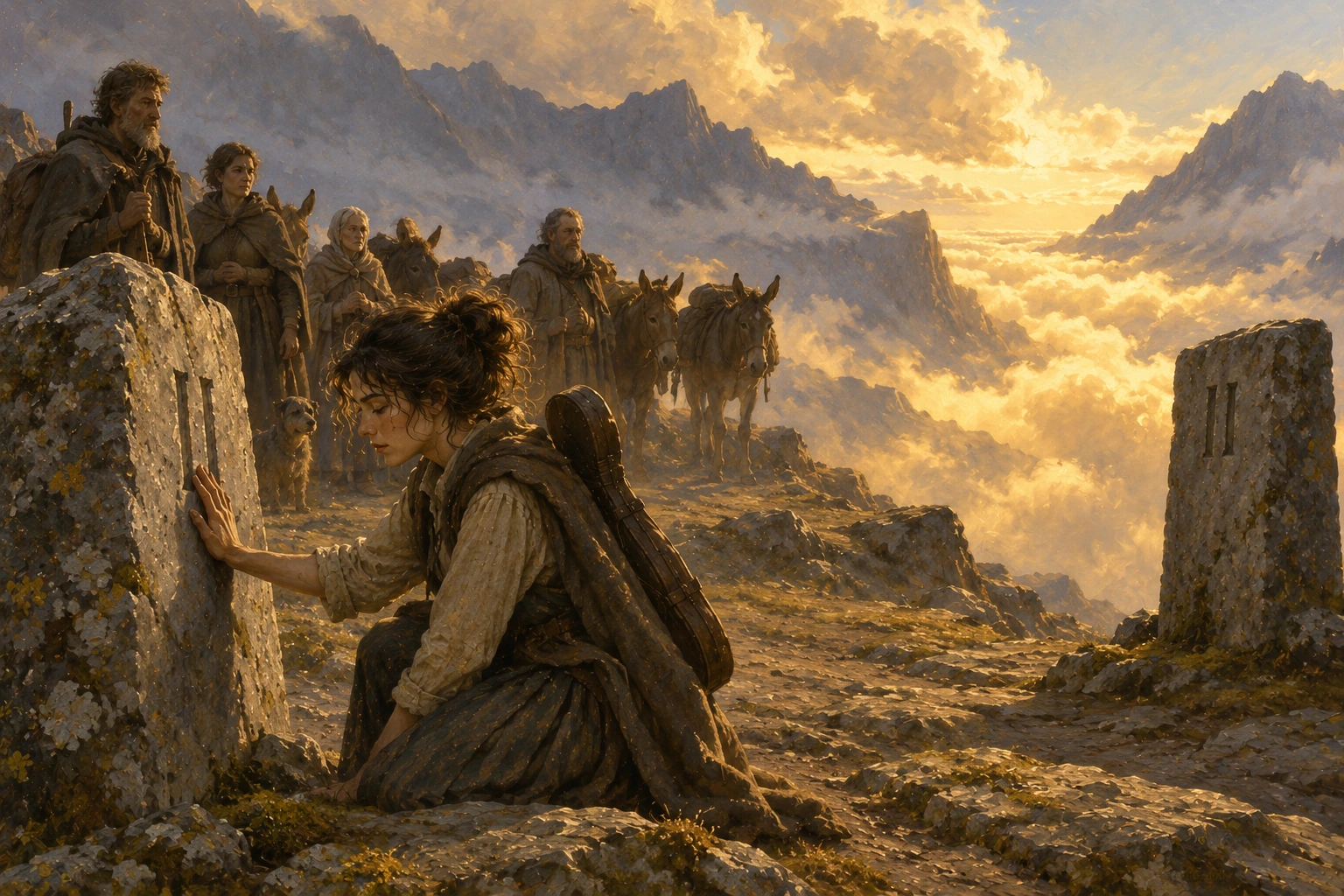
The two stones stood a few dozen paces apart on the open floor of the saddle, squared and settled and so nearly the same height and cut that a person coming up on either one alone might have taken it for any ordinary waymark on any ordinary stretch of the Stair below. Then the second showed itself out of the drifting mist a little further on, and all at once the two of them were clearly a pair, the ground between them meaning something the stones themselves had been cut only to mark.
Pip found the second one first, calling back through the moving light in the pitch of a boy who has just noticed something and has not yet decided how large a thing it is; and by the time the whole company had gathered into the space between the two markers, the sense of the place had already settled over all of them, unspoken and mutual.
Iyene walked the space between the stones twice, from one to the other and back, counting her own paces under her breath, before she stopped exactly at the center point and stood there a while with her satchel open on the ground and her working-board balanced across one forearm, not yet drawing.
"I have surveyed a great many borders," she said, at last, to nobody in particular and to all of them at once, "and every single one of them, before this morning, was built to keep somebody out. A ditch. A palisade. A river with one narrow crossing kept under a garrison's eye. Something meant to be got past only with permission, or force, or luck." She looked from one stone to the other, and then down at the bare worn stone beneath her own boots, two waymarks and the bare walked ground between them and nothing else at all — no gate, no wall, no ditch, no watching eye. She crouched, and began, at last, to draw — the two stones, the paced distance, the bare open ground — in the same plain exacting hand she gave to every true thing she found worth the recording. "I mean to draw this exactly as it stands," she said, without looking up. "I don't believe it will need improving."
The nearer of the two stones — the one they had climbed up to first, its road-side face pocked and softened by the same east wind that had worn the Stair's own treads — carried a scatter of familiar marks along its worn shoulder: a crossed stroke, half-lost now to weather but readable if a hand knew where to look, and the comb-toothed shape that meant a way-house somewhere near. It carried, too, the plain patient furniture of a road that had been kept, once, by people who meant travelers after them to find their way without asking. Wren touched the crossed stroke with two fingers, briefly, the old habit her hand kept without troubling her thinking for permission, and moved on toward the second stone, the one standing a few paces further west, into the moving light, with the cloud already curling close about its upper edge as though testing it.
She went to it with the care every mark on the road had taught her, half-kneeling to bring her eyes level with the low, sheltered angle of its east face, where the weather would have done the least of its work — and it was there, low down, cut deep into stone still sharp-edged in its own protected corner, that she found it.
For a moment she only looked.
It was not a small thing, not margin-furniture scaled to the width of a written page — it was cut large, and cut deliberate, each stroke as long as her own hand and driven deep enough that the shadow it threw in the shifting light seemed almost a second, darker mark laid over the first. Two lines, straight and parallel, set square across the whole face of the stone the way a bar is set square across a road. She had seen the shape a hundred times in the Waybook's own margins, small and quick and inked in a moment's pause between one stride and the next. She had never seen it made like this — made to last, made to be found by torchlight or starlight or no light at all, made by a man who meant it to be readable long after his own hand had stopped being able to make anything at all.
"That's a bridge," she said, and heard her own voice come out low and entirely steady, "in Wystan's hand, plain as the word itself."
She had said very nearly those same words once before, at the well-side of a drowned crossing, over a river she did not yet trust to be kind. She heard the echo of it now, the same shape carrying a weight it had not carried the first time — because the first time she had been reading a plan for a road still ahead of her, and this time she was reading the last thing a man had done before the road behind him closed for good.
The cloud went on streaming past the stone's upper shoulder, gilding and dimming and gilding again, and the wind that carried it moved cold and clean across the whole small silent gathering of them.
It was Alder who broke it, coming to stand at her shoulder and looking down at the cut strokes for a long moment before he spoke, in the flat steady voice he kept for the oldest and least decorated of his facts.
"The same man," he said, "who wrote, in a margin three hundred miles east of here, that someone would want a road again — cut this, into the last stone of his own country, on the day he was leaving it for good." He was quiet a moment. "He did not carve a farewell. He did not carve a warning, though he had every right to one, standing where he was standing, with what he must have known was coming up behind him. He carved a bridge. He marked the door he was walking out of, and shutting, as a place where a crossing still stood — not ended, only waiting." He looked at Wren, not at the stone. "I don't think there is a great deal to add to that. I think it says the whole of itself, and says it better than I could."
Dorrit reached out once, briefly, and laid two fingers against the stone's cold shoulder, and drew them back again without a word. Pip looked at it a long time with the particular stillness he kept for moments his usual chatter knew better than to fill. Iyene had stopped drawing entirely, her pencil resting unmoving against the board.
Wren knelt lower, until she was level with the mark itself — and it was in that closeness that she saw the thing she had missed at first: one stroke of the two showed a second cut laid almost exactly over the first, a hairsbreadth off true, as though the chisel had skated once on the cold stone and the hand behind it had steadied and struck again rather than let the line stand crooked; he had been human about it, his hand cold, or his nerve wavered once, and he had done what any honest craftsman does with a stroke gone slightly wrong — struck it again, and gone on, and finished the work anyway.
She drew off one glove, and set her palm against the stone. The cut lay cold and certain under her hand, and she fitted her fingers along the two long parallel strokes without being told how, feeling the small recut hesitation under her smallest finger — where a hand long gone had once, briefly, been afraid, or cold, or simply human, and had gone on regardless.
Then she drew her hand back, and drew her glove on again, and stood, and stepped back from the stone to let the company breathe again.
She knelt again, satchel unbuckled, and drew the Waybook out into the strange shifting gold of the saddle's light, and opened it to the last drawn page her thumb found by habit rather than by counting.
Wystan's road ran, in his own fine grey strokes, up through the drawn shape of the Stair and out onto a short level stretch that could only be the saddle itself — the two stones set clearly on either side of the line, drawn small and square and exact, exactly as she had just found them lying. Then the line simply ran on, westward, off the very edge of the page, into pages she had turned all her life without ever once having a road to read them by, because there had never, until this morning, been one.
She did not turn further. The brief her whole training had taught her — Iyene's brief, Alder's brief, her own long habit of margin-craft — was to read what the road in front of her offered and no more. The road in front of her, this morning, offered exactly one thing beyond the drawn stones themselves: beside the second stone, the first stone of Meddan, in the same small spiked hand that marked every way-house from the Fenwater to here, sat a single comb-toothed mark.
A way-house. Here, at the very first stone of the whole unwalked west, before a single mile of that country had been crossed by anyone now living, before there was any way of knowing what waited beyond the cloud at all — a mark that meant, in every other place she had learned to read it, that somewhere near, someone had once kept a door open for a traveler.
She looked at it a long moment, and said only, quietly, mostly to the book itself, "The whole west, and he marked it a way-house from its very first stone." She set her thumb against the comb-mark's little row of teeth, and let it rest there a moment, and took it away.
She closed the book, and wrapped it, and did not open it again.
Luel, through all of it, had stood a little apart from the rest of the company, at the very edge of the saddle's western reach, close enough to the streaming cloud that its passing edge caught faint gold along the line of her hair. She had not come to look at the stone, or the mark, or the book, though Wren was certain she had missed none of it. She stood instead with her face turned fully into the moving light, looking west into the wall of lit mist that hid, behind it, a country she had not stood this close to in longer than she had ever once said aloud to any of them. For the length of one long breath she was entirely still, in a way Wren had not seen her still before — not the easy stillness she kept at a fireside, but something held, and deep, and hers alone.
There was nothing in it yet to see but cloud, and the cloud went on going past her, west to east, at its own walking pace.
It was Bracken who spoiled the afternoon, and he did it deliberately, and apologised for the spoiling before he had said one word of the thing itself.
"I'd rather say this in daylight than at the fire," he said. "How long before somebody else kneels down at that stone?"
"Say the whole of it," Iyene said.
"Right." He put his hands on his knees. "That is a signed piece of work by the last King's Surveyor of Meddan, cut into the first stone of Meddan, four days above a border watch. There's a man six days down that stair carrying a sealed purchase from a Merrow factor that reads goods recovered west of the watch, and no qualification after it. He's civil, and he's lawful, and I've no quarrel with him personally. He's also got eleven diggers coming up behind him who never met him and never met us. And a face of granite is a thing a man can take off a stone with a wedge and a morning."
Wren felt the whole afternoon go cold in a way the wind had nothing to do with.
"They wouldn't," Pip said. "It's a bridge-mark. It isn't worth anything to anybody who—"
"It is worth whatever the last one of its kind is worth," Iyene said, "and it is the last one of its kind, and I have written valuations on a great many things I would rather not have." She had gone very still. "Bracken is right and I would give a good deal to make him wrong."
They argued it out on the open floor between the two stones for the better part of two hours, which was exactly the right ground to be standing on for it.
Iyene never moved off where she began. "Record it. Exactly. Bearing, dimensions, a rubbing, a drawn plate, and every word of it in the Survey's return under my own name." She said it without any decoration at all. "A thing on the record has a name and a place and a keeper. An unrecorded thing has nothing but its own luck. Every relic I have watched ruined was ruined in the dark."
"And the return's read at Merrow," Bracken said.
"The return is read at the College."
"By fellows. Who talk. In a city with a factor in it." He was not enjoying himself. "I'm not calling your College dishonest. I'm saying a page that tells the world exactly where a valuable thing is standing — on ground nobody can reach inside a month and nobody can hold at all — is a map for whoever gets there first. And it won't be us."
Pip had gone to the stone twice while they talked, and came back the second time with his hands full. "You can pack it," he said. "Grit, and dead lichen, and the wet off the snow. Fill the cut level and let it dry hard. It weathers out inside three seasons and it never touches the stone — I'd put nothing on it that bites." He looked round at them all, pink to the ears. "It isn't clever. It's what a man does to a chisel-mark he doesn't want a buyer seeing, and I know it because my father did it to a plate he was ashamed of."
"No," Dorrit said.
She had been sitting on her pack with the bound hand resting palm-up on her knee, and had not spoken through any of it.
"Say it," Iyene said, and it was not a challenge; she clearly wanted it said.
"He cut that where anybody could find it. That's the entire point of the thing. That's what we all stood about this morning being moved half to pieces over — that he cut it deep, and low, and where a cold hand could find it in the dark, on the day he was walking out for good, for people he was never going to meet." Dorrit's voice did not rise once. "We've been up here half a day and we're going to fill it in. First through the door in three hundred years, and the first thing we do to it is put mud in a dead man's handwriting. I'd sooner take the risk. I'd sooner a thief cut it out of the rock than we hid it."
Wren heard her cousin out to the end of it, and found, standing there, that she disagreed with her about something that mattered for the first time in her life.
"It isn't hiding," she said, and had to make herself keep going, because everyone turned. "Hiding it would be not writing it down. I'm the keeper. I'll write it whole — every stroke, the double cut on the lower line, the depth, where it sits on the face — into the Waybook's own margin in my own hand, where it goes on being exactly what it is, and where every keeper after me reads it whether the College likes it or not. Iyene keeps it whole in the memory book she started at the Hob. Two records, both true, neither of them going anywhere near Merrow." She looked at Iyene. "And the College return says the saddle is surveyed and the western marker is unsurveyed. Which is a hole in an honest page, and I know precisely what I am asking for."
"You are asking me," Iyene said slowly, "to write the word unsurveyed about ground I have paced with my own boots."
"Yes."
They had all been waiting on Alder, who had said nothing for an hour and a half. He said it now, and he said it without a scrap of comfort in it.
"I could have warded it." He turned the stick once in his hands. "A line round a single stone is the smallest thing I know how to draw, and I have drawn one for a great deal less than this. I told you at a table with breakfast in front of you that I could not draw another before midsummer, and I had Iyene write it down precisely so that nobody would look at me this afternoon and hope. You are looking at me anyway. I have nothing." He let that sit. "This is what that costs, and it is costing it here, in front of me, and I would very much rather it were costing something of mine."
Nobody said anything kind to him about it, which was the second courtesy he had asked of them that month.
Luel spoke last, from the western stone, where she had taken no part in one word of it.
"You are burying a door-post so that the door may go on being a door." She did not sound as though she were taking a side. "My people have done stranger things for smaller reasons, and I shall not think less of you." A pause. "It will not be the last thing you hide out here. I would rather you noticed the first one. I see that you have, so I have nothing else to say about it."
Iyene stood a long while with her working-board flat along her forearm and nothing at all drawn on it.
"Pack it," she said.
She did not say it warmly. She got the two words out and then stood looking at the second stone with an expression Wren would not have cared to have turned on her.
"Understand what I am doing, because I do not intend to say it twice." She was speaking to all of them and looking at none of them. "I have surveyed nineteen years and I have never left a true thing off a page — not a hard one, not an embarrassing one, not one that cost a friend his commission. It is the only article of faith I have ever held without arguing with it. I am going to write unsurveyed about ground I have paced, in my own hand, under my own seal, because Bracken is right and I cannot make him wrong." She put the board away. "I want it minuted that I did not vote for this. I want it minuted that I did it anyway. Those are two different facts and I'll not have them entered as one."
Bracken looked at her then, for the first time in two days.
"Cartographer-Royal," he said, and nothing else.
"Quartermaster," said Iyene, and nothing else; and it was not a repair, but it was the two of them standing in the same room again.
Pip mixed the first batch wrong. He had grit and snowmelt and a scraping of ash and no binder worth the name, and it went into the cut grey and slack and sat there looking exactly like something a person had put there.
He was crouched over it with his ears going scarlet when Dorrit got up off her pack.
She crossed the saddle floor and took the bowl out of his hands, left-handed, without a word. She looked into it, and went to her own chest, and came back with a fistful of dried moss out of a jar and a pinch of something Wren never saw the name of, and worked the lot together with the thumb of her one good hand until the stuff took its colour off the stone itself. Then she gave the bowl back to Pip, and walked to the mule line, and stood with her good hand on Barrow's neck for the rest of it, and did not look round once.
"I'll not put my own hand to it," she had said, when Iyene asked her outright. "I'm not going to tell any of you you're wrong, because I don't think you are, quite. I'd just rather not be able to remember doing it."
Wren did the packing herself, because it seemed to her that if the work was going to belong to anybody it had better belong to the keeper — the same hand, ungloved, that had lain flat in those two cut lines that same morning and had felt the small human hesitation under her smallest finger. She filled the strokes one at a time, working the stuff level with the ball of her thumb, and it was the worst piece of work she had ever done well.
They finished it by lamplight, and burned most of what oil they had left doing it, which Bracken noted aloud once, in his flat accounting voice, and did not repeat. When it was dry enough to leave, Wren stepped back to look, and could not find it.
That was the entire point of it, and she stood there for a while being sick about it.
Iyene wrote it up whole that night in the small book kept for memory alone — plate, dimensions, the double cut, the depth in the third of an inch — and then wrote the return's line into the working sheet in the same steady hand, and did not falter over it: saddle surveyed and paced; western marker unsurveyed. Two words of that line were a lie, and she had chosen both of them herself.
They pitched camp that evening in the lee of the eastern stone, where its bulk broke the worst of the wind funneling up through the gap and left a long calm shadow on the saddle floor wide enough for the whole company and all four mules together. It was Dorrit, watching Pip drive the last picket-stake home with a mallet she could not have closed a hand round, who said the thing that had been sitting, unspoken, in all of their chests since the stones were found.
"We're camping in the door," she said, straightening, and looking from one stone to the other with something between a grin and a kind of quiet astonishment. "The very door. First guests in three hundred years to treat the doorstep as a doorstep instead of a wall to be got past in the dark." It was exactly true, and it wanted saying warmly rather than solemnly; and the saying of it settled something in the camp, so that the ordinary business of supper went forward in unusually good spirits, for people camped higher and thinner-aired than any of them had ever slept before.
It was over that supper that Pip asked Luel whether she would sing the climbing-song again — slowly, if she would, and only the once, so that he could get the names of the flights down before he lost them.
"No," Luel said.
Pip, who had spent a year learning exactly which questions this company answered, did not ask twice and did not sulk about it, and went back to his fire. Wren set down the flights she could still hold and got four. By morning she had two. By the noon halt on the far side of the mountain she had only Aren's Rest, and found that she did not much mind. It had been given to be climbed on. It had not been given to be kept.
The fire wanted coaxing that Pip gave it with the same patient attention he gave every stubborn flame, feeding it in small careful increments until it caught and held steady against air too thin to feed it as generously as lower ground would have. Enna's travel-bread went round, dense and dark and entirely equal to the cold. The mules stood blanketed and unbothered at the picket line, Barrow already dozing on his feet with the settled confidence of a beast who had earned his rest, and even Nettle, for once, offering no comment on the arrangements. Orran's rope, coiled dry and set carefully out of the damp, lay ready by Bracken's own pack for whatever the following day's descent might ask of it. Overhead the great slow river of cloud went on pouring west to east, dusk-colored now as the light behind it failed, glowing faintly still along its lower edge though no sun any of them could see was left to light it — a soft, moving, entirely wordless brightness, neither east's color nor west's, only the door's own, going on being exactly what it was whether or not anyone was left awake to watch it.
Wren took the second watch, as had become her habit, and sat with her back against the eastern stone's cold shoulder and the day-book open on her knee, the small lamp turned low to spare the oil and her own eyes both.
And this evening we filled it in. I want that written plainly and not gently. We packed a dead man's handwriting with grit and dead moss and the ball of my own thumb, because there is a lawful assessor six days below us carrying a sealed paper that does not ask where a thing came from, and eleven men coming behind him with tools. Bracken made us look at that in daylight, and I am glad he did, and I disliked him for the better part of an hour for it. Iyene has written the word unsurveyed about ground she has paced with her own boots, which I do not believe she has done once in nineteen years, and she made every one of us hear her say she had voted against it before she did it. Dorrit would not put her hand to the work and would not tell us we were wrong, and both of those are hers to keep and I shall not argue her out of either.
Master Alder could have drawn a line round that stone. He cannot, because he spent what he had at the watch, on a long house full of people, one of whom was Assessor Marle's own clerk. He told us so this afternoon without one word of comfort in it. I have decided I would not trade that night for this stone, and I notice that deciding it has not made this evening any easier to sit through.
It is on the page — his mark, whole, every stroke of it, in this book and in Iyene's, twice over and both true, and neither one of them going anywhere near Merrow. That is all I can do for it. It also happens to be the entire thing I am for.
She closed the book, and banked the small lamp, and sat a while longer with her back against the cold true stone, one bare-gloved hand resting, without her quite deciding it, on the satchel where the Waybook rode. Overhead the cloud-river went on pouring past in the dark, lit by nothing she could name. She did not know yet what waited on the other side of it. She found, turning the not-knowing over once more before she woke Dorrit for the next watch, that for the first time on the whole long road, she did not want to guess.