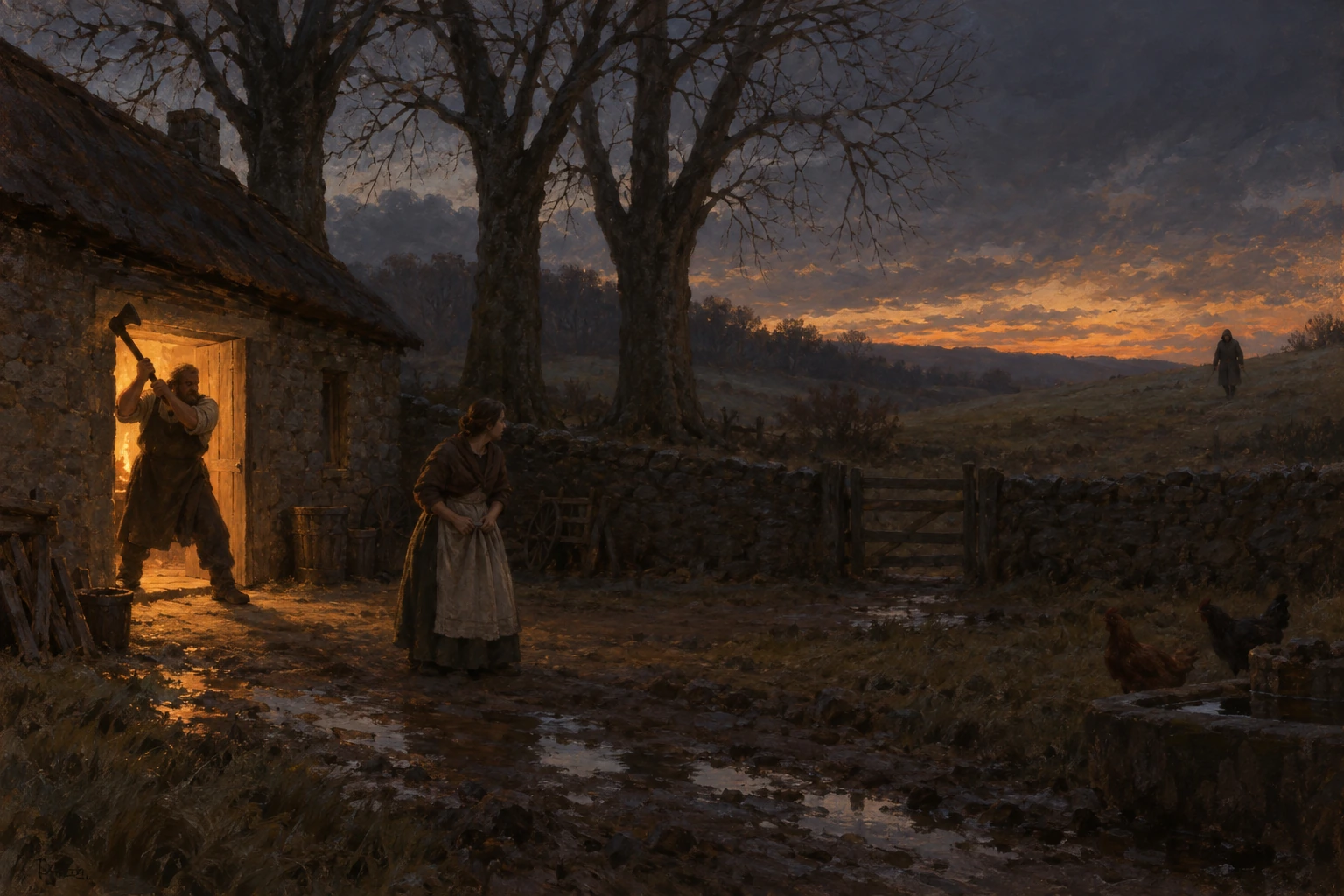
The Door at Elmcross
No one had come down the south road in going on a fortnight, and a farm that lived by taking people in had no other way to notice an absence than by its linen. Bett stripped the two spare beds for the third time that month, because bedding left made up too long went musty whether anyone had slept in it or not. She turned the mattresses. She put them back exactly as they had been, and stood a moment in the doorway of the near room feeling the flatness of good sheets nobody was going to be grateful for. It put her out, the way a slow week at market put her out. It did not frighten her. There was nothing in an empty road to be frightened of, only a great deal of washing done for nothing, and she said as much to Torvin over supper. He agreed with her. Neither of them thought about it again that day. Whoever came down that road was, most years, the only company the two of them kept besides each other, there being no children of their own to fill the table instead, and that had never seemed a small thing to either of them, not in thirty years of keeping the door for whoever walked up to it.
The kitchen at that hour was the whole of the house that mattered. The table ran the length of it, scarred pale in three long grooves where forty years of knives had been drawn straight instead of at an angle. The fire had been built up early against a chill that had come in hard the last three nights, the first real frost of the year sitting white on the yard by morning and burned off by nine. A pot of mutton and turnips worked itself soft over the low end of it, out of habit more than need, there being nobody that week to feed it to besides themselves. Outside, the hens had already put themselves up for the night without being told, the way they did once the light started to go, and the yard beyond the window was settling into the stillness of a farm that had finished its day and was only waiting now for the two people inside it to finish theirs. Three old elms stood over the gate outside, black now against a sky going the deep bruised blue that came an hour before true dark, and had stood there long enough that the parish had never called the place anything else. It was not an inn, and had never been an inn, not by charter or by trade, only a low stone house that had taken in walkers on the south road for so many generations that it had become one by habit, worn into being the same slow way a field path turns into a right of way, by nothing more than enough boots, and the door at the yard end stood open behind Bett as she worked, as it stood open most hours of most days, because a house that made its trade taking in whoever came down the road did not get in the habit of shutting itself against them first.
Torvin came in from the yard with a bridle over one shoulder and a look on his face that said the strap had beaten him again. He sat at the table's near end without being asked, took up his knife and a scrap of harness leather, and went on beating it without another word of preamble, because that was how he always started a conversation with his hands before he started one with his mouth. He was a big man gone soft in exactly the places a farmer goes soft, and his ears — Bett had watched this for thirty years and never tired of it — went a deep, helpless red at the first mention of anything owed in coin. It had happened three times that autumn already: a drover short a night's lodging who tried twice to press a coin on him and got, both times, a hand waved off so fast it looked like swatting a fly, and a red climbing Torvin's neck that had nothing to do with the fire. Money embarrassed him the way weather embarrassed nobody. Travelers were fed and bedded at Elmcross without a word said about payment either way, the whole business settled and never discussed, the same as you didn't discuss whether it would rain.
"You'll ruin that strap arguing with it," Bett said, not looking up from the beans she was stringing.
"It's ruined already. I'm only finishing the job."
"You said that about the gate hinge in the spring, and I'm still oiling it myself."
"The hinge holds."
"The hinge holds because I hold it," she said, and he laughed, low, without stopping the knife, and that was as close as either of them ever came to settling the argument, which was older than the strap and the hinge and most of the roof over their heads, and which neither of them wanted to win, because winning it would have meant one of them admitting the other one was right more often than not, and admitting that would have taken half the pleasure out of thirty years of not saying so.
The beans she was stringing had come off the south wall, climbing beans on poles Torvin had cut and set the spring before last, and they had done well enough this year to fill two full crocks besides what they ate green, which was more than the wall had ever managed before. The seed for them — a twist of onions of the keeping sort besides, and a flower she had no name for — had come from a woman who'd stayed a single night some years back and paid for her bed in seed rather than coin, the twists tied in twine and marked in a small careful hand, and the flower had come up true two autumns running now, a color she'd never seen before on that stretch of ground, in a shape that held its head up even after a hard rain, which was more than could be said for most of what grew along that wall. Bett had thought little of the woman at the time beyond noting that a traveler who paid in seed instead of silver was, whatever else she might be, no fool about what a farm actually wanted. This autumn's crop off the wall was the first honest proof the seed had been worth taking, and Bett said so out loud anyway, mostly to hear it confirmed.
"Heifer's off her feed again," Torvin said, without looking up.
"She's always off her feed the week before the frost sets."
"I know it. I'm only telling you."
He told her most things that way — not because she needed telling, but because a day's small facts wanted saying to somebody, and she was the somebody, and had been for thirty years, the same as he was hers. He was proud of exactly one thing that Bett had ever managed to get him to admit to, and it was not the farm, and not the wall, and not even the house that had taken his own grandfather's name off its lintel stone. It was that no ram in three parishes had ever needed roping to load into his cart. He talked to them first, low and patient in a manner he kept for nothing else in his life, and they went up the ramp for him in a way Bett had never seen them go up it for another man. He never told anyone how it was done. Not out of secrecy — he had no better account of it himself, and a man does not explain what he cannot account for.
"You could charge for that, you know," Bett said. "Men would pay good money to see it done."
"Then they'd be paying to watch a man talk to a sheep, and I'd be taking coin for it, and you'd never let me hear the end of either one."
"No," she agreed. "I would not."
They sat a while longer that way, Torvin working the strap past any hope of saving it and Bett finishing the beans, the fire settling into itself and throwing its light no farther than the near half of the table. At the gate, seeing off whoever had lodged with them, he had a habit of lifting one hand that was not quite a wave and not quite anything else Bett had a word for either, something he did without appearing to notice he was doing it. She had watched him do it to more strangers than she could count and never asked him what he meant by it, because some things in a marriage keep better unasked.
It was full dark, near enough, when he came in from shutting up the stock, later than usual, near on an hour behind his own habits. The heifer wouldn't come into the byre for love or a double measure of grain, he said, planting her feet at the gate and putting her head down at nothing he could see, and the old dog had gone at the yard wall barking fit to wake the dead for a quarter of an hour before he shut him in the scullery to stop the racket carrying to the road, and he said all of it the way he said everything that went sideways on a farm, an ordinary complaint about an ordinary nuisance, one more thing the evening had thrown at him on top of the strap and the frost, nothing that wanted more from her than the moon being wrong for beasts this week, which was what she gave him, and neither of them gave it a thought beyond that. The dog went on scratching at the scullery door a while, then stopped, and the house went quiet in the way it was quiet most nights.
The door stood open still, the way it had stood open all that day and every day before it, the cold not yet hard enough to make shutting it worth the bother. Torvin took the hatchet and a basket of split wood out to the block by the door while there was still light enough to see the grain, splitting kindling the way he did most evenings at that hour, a job that wanted doing at dusk and no other time. Bett was at the table clearing the last of supper when she heard him stop mid-stroke, the axe left standing in the block, and looked up to see him looking past her, out through the open door into the yard, at nothing she could see from where she sat.
She got up and went to see what had stopped him.
A man was coming down off the high spur behind the house, not up the road at all, down through the top field that beasts hurried through and had never had a proper name beyond that — the top field, ill-feeling ground, a place a person crossed quickly and did not linger on. He wore a long hooded riding-cloak, the hood back, of a cut she had not seen on a living man in all her years at that gate, and boots laced to the knee the way she'd seen only in her grandmother's stories of a harder, colder road than the one that ran past their door now. A man dressed for a road, and dressed wrong for it — she could not have said more than that, and did not try. That was as far as Bett's reading of him went, and it was as far as it needed to go, because Torvin had already taken the axe back up out of the block.
He did not shout. He did not tell her what he had seen. He did not ask her to look, or say a single word about the man crossing their own top field toward their own open door.
"Go on round the back," he said, in his ordinary voice, the voice he used for telling her the byre wanted latching or the hens wanted shutting, "and see to the water barrel before the frost gets at it."
She was three steps toward the scullery before she had decided to go anywhere at all, because that voice had moved her the same way for thirty years and asked nothing of her mind on its way to her feet. It was not until she was through the back door and into the cold that she understood she had not chosen to leave him standing there. Nobody had asked her whether she wanted to go. She went anyway.
She knew the ground the way she knew her own hands, because she had walked it a thousand times over with a bucket in each one. Past the water butt, where the ground stayed wet even in a dry summer and she'd twisted her ankle on it twice. Round the corner of the byre, where the heifer still stood rigid at the gate with her head down, and would not turn to look at anything. Over the stile at the bottom of the garth, the top bar loose since spring and never mended. Into the ash scrub beyond it, where the ground rose just enough to put a stand of trees between a person and the yard. She crossed that whole stretch inside the time it took her to think about crossing it, the way you cross ground you have never had to think about, her breath coming hard and short and her own feet, in the dark, more certain of the way than she was, and went down into the trees, and did not stop until the dark of them was fully around her.
From there she could see the lit doorway and nothing else. The fire inside threw its light out across the yard in a long yellow wedge, and Torvin's shape filled the doorway, axe held up in both hands the way he held it at the block. For one held breath nothing in the yard moved at all. Then the axe came down, and came up, and came down again, and somewhere in the middle of it there was a sound that was not the sound wood made under that axe, and was not any sound she had a word for either. Then the doorway was simply a doorway, with the fire still burning behind it and no one standing in it.
She did not go back. She did not call out, and nothing called out to her. She stood in the ash scrub with the cold coming up through her boots and her arms wrapped around herself, watching the lit doorway stay lit because there was nothing left in that house to put the fire out. The frost came down hard sometime in the second half of that night, whitening the grass at her feet while she stood in it. She did not go back before morning. There was nothing in her that would carry her legs that direction in the dark.
At first light she went down. The door still stood open, the fire long burned to ash on the hearth, and in the yard, a little short of the step, lay the axe, exactly where it had gone. Beyond that she was given, and took, nothing more. She did not go closer to the doorway than she had to, and looked at it only the once.
She could not have buried him if she had wanted to; she knew that before she had finished crossing the yard. She had no way to lift him and no way to dig ground already going hard with frost, not alone, not in a day, not in ten. The nearest hands were nine miles south at Cheswick, the nearest roof of any kind besides her own. North ran past her own front step, past the very stone she was standing on, and there was no making herself walk that way twice in one morning. South was not a choice so much as the only direction left that wasn't. Dall lay two days further on past Cheswick, if it came to that, though it did not need to come to that yet. She took nothing from the house but a shawl and the little money kept in the tin behind the flour bin. She left the door as she found it, open — there was nothing left inside that house to mind it shut — and walked.
Nine miles is a morning and most of an afternoon to a woman who has walked farther on worse ground, and she covered it without stopping longer than it took to eat the heel of bread she'd had the sense to bring, the road running long and empty and pale the whole way, the season's first hard frost still white in the ditches where the sun hadn't reached, the hedges stripped bare and the fields either side of her turned and waiting for winter same as any other year. A crow worked one of them the whole first mile, following no plough, finding whatever a crow finds in ground already gone hard. She did not cry on that road, nor talk to herself, and for the whole of those hours she let herself think no further than the next mile in front of her, because thinking past it meant thinking about what was behind, and there was no profit yet in that.
She reached Cheswick with the light going: four low houses and a smithy set close around a lane that widened for no better reason than that it always had, smoke standing straight up out of two chimneys in the still evening air, and somewhere behind one of the houses a dog answering another dog three doors down, the plain evening business of a place too small to need a name for most of what happened in it. She knocked at the first door with a lit window, which was Kate's.
Kate was a broad, capable woman a little younger than Bett, with flour to the elbow and a look that took in a stranger at her door in a single long pass, needing no second one to decide what wanted doing. She heard the whole of it standing in her own doorway with the evening going cold behind her, asked nothing twice, and took her in without more discussion than Torvin himself would have made of it — the first thing all that day that had felt like anything she recognized.
Cheswick held eleven souls that autumn, all of them grown; the young had gone south for work years before, the way the young from a place that small always did, and no one commented on it any more than they commented on the frost. Ned, who kept the only cart worth the name for three miles round, was at Kate's table finishing his own supper when Bett came in, took one look at her, and needed no telling that she had walked a long way for a bad reason. He put his spoon down and left it down until he'd heard why. A smith two doors along came by within the hour to hear it for himself, wiping his hands on a rag the whole walk over. A woman across the lane brought a second loaf without being asked, because a house with a stranger in it wanted more bread than it usually kept, and stood in the doorway a while after, not knowing what else there was to offer a woman in that state besides bread and a place to sit.
They believed her that first night, plainly and without argument, because nothing about the telling of it looked like invention, and a woman does not usually enjoy the thing she has just described. Kate put her at the table and would not let her up to help with the washing, twice, the second time more firmly than the first, and Bett sat with her hands in her lap doing nothing, which was harder to make herself do than the whole day's walking had been.
She did not sleep much that first night, though Kate's bed was better than her own and the house quieter than any she had slept in for years, the small sounds of somebody else's roof settling in the dark enough by themselves to keep her listening long past the point of sense.
Ned yoked his own horse before it was fully light the next morning and brought two of the Cheswick men with him besides, and a cart with a shroud folded in the bed of it, because that was a good day's work given freely to a woman who had asked for nothing but hands, and the four of them walked the nine miles back beside her without once making her feel she owed them for it, talking of ordinary things the last mile or two, the weather and the state of the road, as if a woman walking home to bury her husband were owed at least that much normal conversation.
The door at Elmcross stood open exactly as she had left it. There was no man in it, and no man anywhere in the yard or the house or the byre they could find, and nothing at all to put in the cart. The axe lay in the grass where she had told them it would lie, which was the one thing about the whole story that the evidence in front of them agreed with her about, and it changed nobody's mind. One of the Cheswick men said, gently enough, that a man who could walk away from his own axe hadn't been as dead as his wife believed, and got a good deal of agreement for it. Ned crouched by the block a while, turning the axe over once in his hands and setting it back exactly as it had lain, and said, in a voice meant to close the matter kindly rather than argue it, that Torvin would turn up. Men did, sometimes, after a bad fright — gone a day or two wandering before their heads came back to them.
One of the others asked whether a man in a fright might not have taken himself off toward Dall instead, there being more of a town there to lose himself in, and Ned allowed that he might, and that either way there was nothing more to be done about it standing in a cold yard.
He meant it as comfort, and it was the kindest thing anybody said to her in those three days, and he was right.
They took her back south before dark, the cart moving faster than the road really allowed, and Kate lent her a coat at the door that evening — an old brown one, gone soft at the elbows — because Bett had come away from her own house with nothing in her hands at all.
The second night, in Kate's spare room with the fire banked low and the house settled around her, Bett let herself hope. It was the only mercy the three days gave her, and she took it without asking too closely what it was made of. Perhaps he had simply wandered, as men sometimes did after a bad fright, and would come walking up Kate's lane within the week looking sheepish about the whole business, and she would have something sharp to say to him about the fright he'd given her, and he would take it the way he took all her sharp words, patient and a little pleased with himself for having earned one, and would not be forgiven it for a good week yet, and would not much mind that either. She lay a long while turning that thought over in her hands like a stone she wasn't ready to put down, working out what she would feed him first and whether she would tell him about the seed's first crop before or after she told him what she thought of him. She slept better than she had any right to. She woke once in the night not knowing for a moment where she was, and remembered, and did not weep, and went back to sleep anyway.
Three came on the third night, down the lane past the smithy in the last hour before anyone thought to shut a door against the cold, and Bett was at Kate's window when the first of them passed beneath it. She knew the long hooded cloak before she knew anything else about the shape wearing it, the same wrong cut she'd watched cross her own top field two nights before, and behind it came a second shape, and behind that a third, one she had never seen before in her life.
The second of them she knew by his coat, and by the particular way he came up a lane, shoulders a little forward of the rest of him, the same walk she'd watched cross a farmyard for thirty years. He carried nothing. The axe was nine miles north in wet grass where she had last seen it, and his hands, when they reached the first man in the lane — the smith, who had come out at the noise with a wood-axe still in his grip from splitting his own kindling — were empty. They did not need to be anything else. He took the smith by the forearm and did not let go, and the wood-axe came down against him once, and it marked him no more than a blow lands on a fence post, and was not swung a second time.
Bett was down the stairs and into the lane before she had decided to be, the same way she had gone through her own back door two nights before, her bare feet finding the cold cobbles without her looking down to place them. She stopped an arm's length from him, close enough that she could have touched the cloak, close enough to see the frost standing white on the shoulders of it though no frost was falling anywhere else in that lane, and said the whole of what she had.
"Torvin." She said his name the way she had said it every morning for thirty years, without ceremony, because it had never needed any. "Torvin of Elmcross. You split kindling at that door every evening without fail, and mended a strap at my table not three nights back, and no ram in three parishes ever went up your ramp roped, and the heifer's off her feed again, and you lifted your hand at that gate to more strangers than either of us ever counted, and I am Bett, and I have been your wife for thirty years, and you are Torvin, and this is who you are."
Nothing in the shape she was speaking to so much as paused. It did not turn its head. It did not slow by the space of one breath, or check the working of its hands, wherever they were bound next. She had given it everything she owned that could be said aloud in a lane in the dark, and none of it reached whatever was left inside that cloak to be reached.
She ran. Uphill, off the lane and away from the houses, into the dark above Cheswick, and this time nobody was buying her the ground with an axe and a doorway. She knew to the step, running it, exactly what that meant.
The rest of the night she had only in sound. A door going in, somewhere below her. A voice she thought was Kate's, cut off in the middle of a word. Somebody shouting a name twice and then not again. The wood-axe once more, and then not again either. A second door, further off, and then a third. Something dragged, or something falling — she could not have said which, only that it was heavy, and that it stopped. Once, a long while, nothing at all, long enough that she let herself think it might be over, and then one more sound, small and homely and worse for being small, a shutter banging loose in a wind that had not been blowing an hour before. She lay in the frost-stiff grass above the lane with her hands over her own mouth. She did not look. She did not move, not until the sounds had been gone long enough that she no longer trusted her own ears to tell her whether they had truly stopped.
In the first grey light she looked down into the lane and counted. She got as far as nine before her eye caught on a coat she knew — Kate's, the good blue one she'd worn to the door two evenings before — and past it, a moment on, a man's boots she knew for Ned's. She stopped counting there. There was nothing left to count toward that she wanted to arrive at.
She did not go down. She turned north instead, on the road, in Kate's borrowed coat, with nothing else in her hands, and walked the way she had walked the day before and the day before that, because it was the only motion left that still made sense.
Her hands found the coat's pockets somewhere in the first mile, cold enough by then to want the warmth, and closed on what somebody else had left there without thinking to empty them: a length of twine, a brass thimble worn smooth on one side, a stub of chalk gone soft at both ends. She walked on with her hands closed around them, and never took them out to look.