Setting the Watch
Meal short a day's baking; north bay wants re-slating before the frost; wind gone round to the north-east since dusk. — R. Denby, second watch. Nothing to report.
That was the last line written in the book, and for three hundred years nobody had read it as the last of anything, because nobody had read it at all. It sat exactly where its writer set it down, in the company of eleven others bound the same way, stacked in a stone recess in the kitchen wall that had not held a fire since long before the ink itself was dry — the bread-oven, sound and dark and bone-dry the whole while, which was precisely why the last keepers of Wintergarth had chosen it, of every void in the house, to keep something in rather than burn something in it.
Dorrit found them on the fourth morning after the gale, on her knees at the oven's mouth with a rag tied over her hair, expecting nothing more from the dark of it than years of accumulated soot and dead ash to haul out before she could trust the thing to bake in. Her hand found leather instead of grit, and then the square, stacked corners of more leather behind it, and she sat back on her heels and announced, in a voice that brought the rest of the kitchen round to look, that somebody appeared to have gone and put a library where the bread ought to go.
It was Wren who filled in the second half of it, an hour later, standing in the clerk's room with a lamp held close to the long empty shelves they had all walked past twice a day since the gate came down. Looked at closely for the first time, the shelves carried a clean row of pale rectangles in the dust, exactly the size and spacing of books that had once stood there and had not stood there for some while. Somebody had cleared them deliberately, she said — not lost the books, not sold them, but taken every one of them off the shelf built for them and carried them to the one stone void in the house the roof would never fail, and shut the door on them, and gone. No note was left to say why. Nothing in the books themselves, so far as any of them read that morning, thought one had been needed.
There were twelve of them altogether, ranged by weight and by the darkening of their leather from the newest to the oldest, and the oldest was a slim thing bound in something that had once been fine calf and was now closer in color and texture to the stone it had lain beside for longer than anyone at that table could say. Bracken lifted them out one at a time, with the wary care of something that might not survive being hurried, and set each on the long table in its turn, and by the time the twelfth and thinnest lay at the end of the row, the whole company had gathered round it without anyone calling them to.
They carried the topmost volume — the fullest, the least yellowed, evidently the one most recently in use — over to better light than the last hand to close it had ever had cause to hope for, and read backward from the final page: a tally of meal and salt fish, a note on a byre door wanting a new hinge, three lines on a mule gone lame and mending, a week's weather set down in the same dry hand day after day, and then, on the last written leaf, the entry about the north bay's slates and the wind coming round, signed by a name none of them had ever heard before. Under it lay only clean vellum, ready that same morning for whatever the day brought next, and never given it. It read exactly like every page before it: a day's small business, set down by a competent hand at the end of a day like any other, and nothing in the writing itself said otherwise. Dorrit closed the cover over it the same way she would have closed it over any other day's accounting, and went to see about the oven's flue, since a good oven, found or not, still wanted testing before it could be trusted with bread.
Nobody designed a rota that evening. They read one, and took it up.
The rule itself, once they knew where to look, took a good deal less time to find than the finding of the books had. Every volume back to the earliest, brittle and dark-paged near its own beginning, split the night the same way: a first watch from dusk to the small hours, a second from the small hours to first light, and after each one — not the next morning, but before that fire was let go down — the name of whoever had sat it, entered under the last line however badly, in whatever hand happened to be holding the pen at the time. It was not a system so much as a habit older than anyone now sitting at the long table, and reading it aloud there, Bracken allowed that he saw no reason on earth to improve on it.
He put himself down for the first watch before anyone else could offer, which drew no more than a nod from Dorrit; it was the one duty in the house his arm could still manage whole, being good, at present, chiefly for holding a mug of something hot and not a great deal besides. He had already discovered as much hauling a sack of Dorrit's onions in from the yard two mornings running, made one joke about it at his own expense, and did not make a second.
Iyene took the books a different way, laying them open beside her own working sheets, and by the second evening had found what she had plainly been looking for without quite admitting she was looking for it: a full run of years, kept faithfully by hands that had never thought of themselves as recording weather, showing the date the roads either side of the house closed altogether each season after the first hard frost, near enough the same handful of days year on year to be trusted as more than luck. Set against this year's frost — a night old already in the yard's shadowed corner, though not yet anywhere the noon sun reached — it gave her a number of days, not a great many, in which a laden company or a laden cart could still be trusted between here and anywhere else. She told Bracken the number before she told anyone else, because it was exactly the kind of fact a quartermaster could use, before anyone else needed the worrying of it.
What none of the ledgers offered, however faithfully questioned, was an answer to the arithmetic Bracken had put into the yard's evening air a week before and left standing there unclaimed: seven people and four mules could not winter on what four mules had carried in, however carefully the store-room was rationed, and no rota in any book, however old, was going to feed anyone.
The rota, at least, ran itself from that first evening on, and ran well. Two watches a night, as the ledgers said, first and second, and the house settled into keeping them with the unfussed ease of people doing a familiar chore in an unfamiliar kitchen — Iyene and Pip took a turn between them the second night, Dorrit and Wren the third, Alder sat one alone, and the nights themselves offered up nothing worth reporting, exactly as the ledger's names mostly had before them. Mornings themselves had turned honestly cold by then: breath showed at the yard well before the sun cleared the roofline, the trough wore a skin of ice some mornings that wanted breaking before the mules would drink, and the day's wood-gathering had stopped being an errand and become, in the space of a week, a standing occupation with its own hour and its own two pairs of hands. None of it was a change in the season. It simply was the season, doing what an autumn does once it has stopped pretending otherwise.
It was Pip who saw them first, on the sixth morning, up on the loft-floor over the goods-bays where he had gone to count roof-slates for Bracken's own private reckoning of what winter might yet take from them. Away up the length of the through-road, through the near gateway's opening, he made out four shapes on the road north, small and slow and unmistakably afoot, at a distance no company crosses casually. He came down the loft ladder faster than the ladder strictly approved of, and said so to whoever stood nearest, which was Dorrit, who set down what she was doing and went to find Alder without hurrying, since there was, as she pointed out, no version of this news that four people walking openly up a daylight road required anyone to run about over.
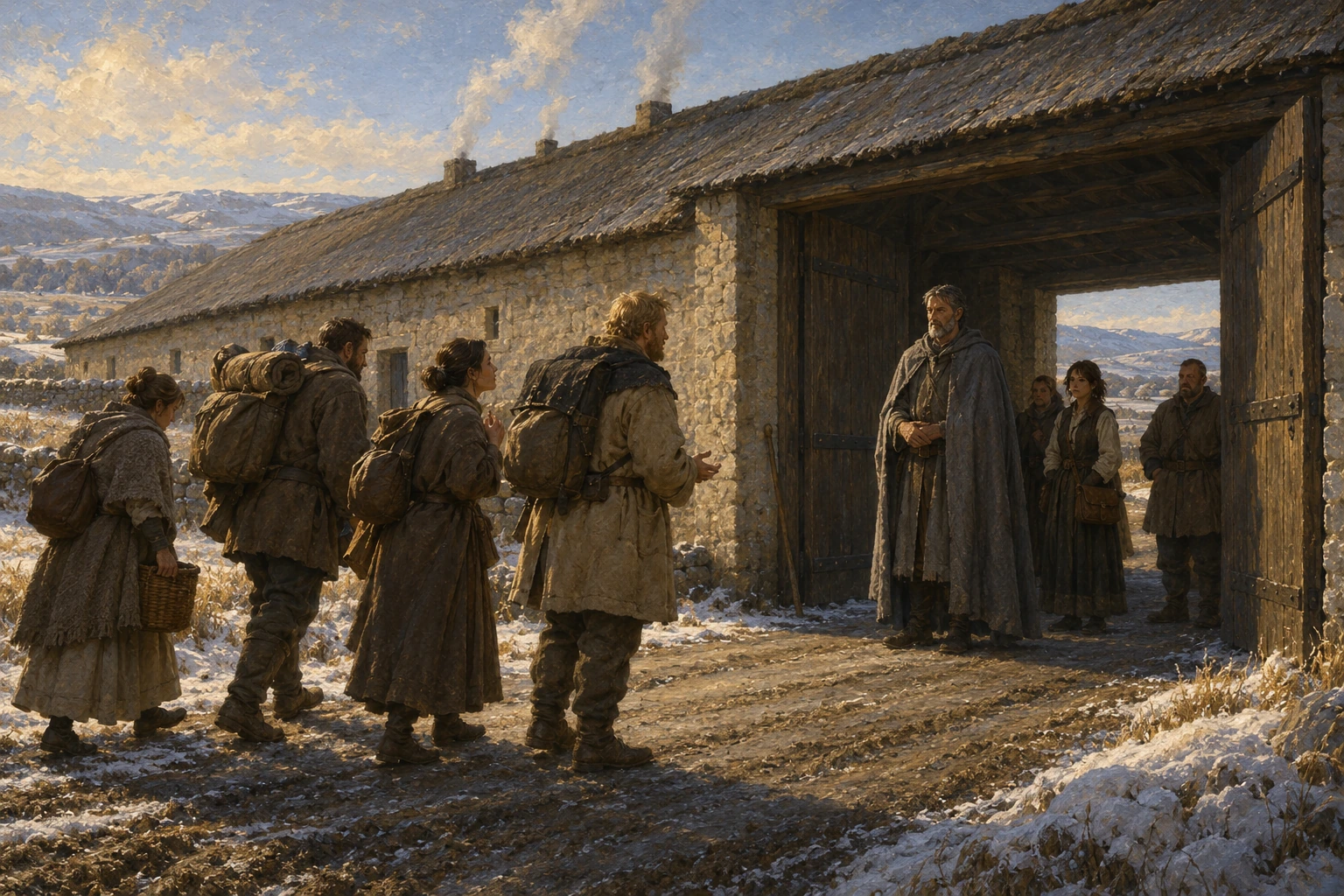
Alder went out to the gateway alone, the house's own sense of manners seeming to require it of whoever stood nearest its threshold, and the company gathered behind him in loose order rather than a line, watching four figures resolve, over a slow hour's walking, into four people — travel-worn, laden a good deal lighter than that road ought to have left anyone, and unmistakably glad to see a roof with smoke standing off it. He stood with his hands loose at his sides and his stick left leaning inside the gate where he had set it down without seeming to notice he'd done it, and Wren, watching him wait there, went back over the whole year behind them and could not find a stranger he had met on a road without that stick in his hand.
The morning itself was doing nothing to hurry anyone: a low sun that had not yet troubled to clear the yard wall, frost still holding white and stubborn in the shadow of it while the open ground beyond stood already bare and dark with thaw, the whole width of the road north empty behind the four travelers as far as the eye found any use in following it. Bracken had spent the first hour of daylight, as he now spent every first hour, walking the wood-store's tally with a piece of chalk, and had come to the gate straight from that reckoning with the chalk still forgotten in his good hand.
Bracken, beside her, said under his breath that four on foot, this far south, this late in the season, meant either very good news or very bad, and that he'd put his money on the good, since the bad kind generally ran rather than walked.
The foremost of them, a broad, sandy-haired man with a canvas coat gone dark at the shoulders, had not yet said one word to anybody when Wren, standing back by the gate's inner wall with Dorrit, heard herself say his name before he had given her any way of knowing it.
"Osric Vane," she said, not much above a murmur.
He turned his head at it. "That's me," he said, sounding faintly startled to be answering to it here of all the places it might have found him, and let it go at that. She could not have told him how she knew. She had read his name aloud once before, into a whole day's walking of empty air, and had never thought of it as belonging to a man who might come up a road.
The other three came up behind him in the same travel-worn order — Thomasin Reed, dark-browed and quick-eyed, already sizing up the gateway's construction the way a market woman sizes up a stall before she rents it; Sim Padgett, broad through the shoulders and saying little, carrying the heaviest pack of the four without apparent difficulty; and Marta Coyle last, walking with the careful attention of someone testing ice, one foot set down and then the next.
Alder met them at the gate's own threshold rather than beyond it, so that a guest could say afterward he had been welcomed at the door and not summoned through it. "You've come a long way to find a roof," he said, "and found one, which is more than the road generally promises anybody up front."
"We were told there might be one," Osric said, "and told it plainly enough that we believed it, which is why there's four of us and not forty. Ashcroft doesn't send more feet than a claim's worth of trusting."
"A sound policy," Alder said, "and I hope you'll find the trust was earned before the week's out." He asked nothing of them there at the gate — no accounting, no explanation of the crossing, nothing but their names, given round at the threshold in the ordinary way — and stood aside to let them through into a yard with smoke standing up off two hearths and the smell of Dorrit's kitchen already reaching the gate to meet them.
Nettle, true to her own long-standing principles, took an exploratory nip at the nearest sleeve before anyone thought to warn its owner, and was roundly ignored by everyone who already knew her, which offended her considerably more than the miss itself.
"Four, and all of them still themselves," Luel said, once the introductions had run their short course, and went back to the fire.
Bracken said very little at all, which from Bracken was its own kind of statement; he simply took the heaviest of the four packs off Sim Padgett's shoulder without asking whether he wanted it taken, and that was the whole of his welcome, and worth, from him, a good deal more than a speech would have been.
Dorrit's welcome took the opposite shape. Within the quarter hour all four of them were seated at the kitchen's long table with bread and hot broth in front of them whether they had asked for it or not, Dorrit standing over the lot of them exactly as she stood over anyone she had decided needed feeding before they would be permitted to say anything further of substance — which by now included most of the company's own visitors, and, apparently, all of Ashcroft's.
"Four, safely arrived," Iyene said, which was the whole of her own greeting, and went back to what she had been doing, an economy the company had long since learned to read as high praise.
It came out that evening, at the same long table, the way such things come out once people have eaten enough to stop bracing themselves against the telling of them.
They had crossed on the same craft the company had taught Ashcroft's own clerk that summer — the town's own second roll, four hundred and thirty-one names of its own copying, made because they were Ashcroft's names and Ashcroft might write them out as often as it pleased. It had ridden the whole way in Thomasin's satchel and had not once needed opening. They were their own neighbors; they knew them by heart, and gave them out one at a time, and never gave the same one twice. The fold was a road now, Osric said plainly, for anyone willing to walk it with names enough in their mouths to spend, and Ashcroft meant to go on treating it as one.
None of them had gone into it lightly. Marta admitted, without much made of the admitting, that somewhere in the crossing's middle hour she had gone a long stretch of road unable to put a name to any of the three people walking it beside her. She knew them perfectly well. She had nothing to call them with — a clean small nothing where each of them ought to have been — and did not like to break into the reading to say so, and so walked on that way a while in the sound of other people's names, and then had all three back at once, whole, without ever quite catching them coming. It had frightened her considerably more than it had apparently damaged her, a distinction she was still visibly working out for herself at the table while the broth went cold in front of her.
Thomasin added, when Marta had gone quiet again over her broth, that she herself had lost nothing worse than the shape of a word she'd been reaching for, a small, everyday forgetting no different from the kind that happens to anyone at the end of a long day, gone before she'd fully noticed it missing. Sim said only that he had kept his own name the whole way through by the simple expedient of not much liking the idea of losing it, and that he didn't propose to examine the method any further than that in case it stopped working the next time he needed it.
Bracken, who had said little all evening, said only that he was glad the town had sent four and not one.
The terms themselves were settled the following afternoon, at the same table, with considerably less ceremony than the subject seemed to deserve.
Osric had come, it turned out, with Jessa Linden's own leave to speak for the town in exactly this kind of arithmetic, and Bracken met him at it plainly, the two of them working through the figures aloud, without flattery, and without either one pretending the numbers said anything they didn't. Pip kept the tally as it was given, chalk marks on a scrap board propped against the wall, and both sides took his figures as the figures.
Bracken had made one attempt that same morning to swing a grain sack up onto his own shoulder as he'd swung a thousand of them before the undercroft took its toll of his arm, and had set it back down again; Sim had it up and moving a moment later, and neither man made anything of the exchange, which suited Bracken considerably better than sympathy would have.
Ashcroft would carry over what stores it could spare while the ground still allowed the crossing — three sacks of meal to start, salt fish packed in its own brine-barrel, a chest of dried roots, wool enough for four more people's worth of winter — and would send the rest of what was promised close behind it, before the season thought better of the arrangement. In return, Wintergarth would stand kept and lit the whole winter through, worth a good deal more to a town wanting its southern road proven than an empty house waiting on spring could ever be; and the four who stayed would earn their own keep at it, on the rota same as anyone else, rather than sit the season out fed for nothing. Bracken put it in the plainest terms he had: eleven mouths were only a bigger problem than seven for as long as eleven pairs of hands weren't doing eleven people's worth of the work, and he did not propose to let that be true for a single day of the winter ahead.
Thomasin shook on the figures with the same once-down motion Bracken used to close a deal with a mule-trader, and then reached across for the bread, and that, as far as either side was concerned, was the whole ceremony the matter required.
Alder's own contribution was a single sentence, offered once the figures were settled and not before. "I have watched a great many bargains struck in my time," he said, "and I have found the fair ones are generally the shortest. I have rarely seen a shorter one than this."
By supper it was settled past discussing further: Osric, Thomasin, Sim, and Marta would winter at Wintergarth, and the house that had held seven people and four mules a week before now held eleven people and the same four mules, which Dorrit observed, dishing out a supper that suddenly needed to stretch twice as far and somehow doing it anyway, was exactly the kind of arithmetic she preferred — the kind that came out better than it had any right to, because more hands had joined the making of it.
It was Marta, two evenings later, who produced the letter — a single folded square from the bottom of a pack she had otherwise emptied, travel-soft at its creases, addressed in a hand Wren's whole body recognized a full breath before her mind caught up to naming it.
They gave her its road in the order they had it. It had gone down the valley to Merrow in the spring by the same post that carried every other letter out of Dall, and west from Merrow to the border watch, and over the Gray Stair while the Stair stood open, in a watch-rider's saddlebag, under a promise Willem had made there about any letter that got over the road in either direction. Down the far side it went onto the steadings' relay that had carried the company's own letters all that summer — Aldwick, then Millgate — and so to the Hazels' door at Sereth, and past the Seventh's own fire burning above it. Then west, out through the Province Gate and onto the beacon road: under the Sixth and the Fifth, standing lit and unkept; to Stanhope beneath the Third, whose watch had taken to lifting word off the road-cairn above their halls again, morning and evening, as they had not done since before the closing; and on past the Second's fire, which had never gone out. Where the road bends off the hills toward the sea it went in the packs of Ashcroft's own people, who had begun that summer to walk north up the empty coast country to see what stood at the end of it. Four days inland from the sea it came to Ashcroft, and waited there in Jessa Linden's keeping until a party made ready to go south. Somebody down the table observed that the road ran both ways now, first time since anyone living could remember it doing so, and somebody else said that it did. It was, Osric said, only the road doing what a road does once enough people have troubled to keep it open, and went back to his bowl.
She read it alone first, in the gallery chamber she had claimed for her own, by a single candle Dorrit had pressed on her without comment — her grandmother's own household law, read the news once for the news and once more for the hand it came in, being one Wren had never needed teaching.
Wren —
The bees are away in the white clover and doing exactly as bees ought this time of year, which is to say working themselves half silly and taking no advice from anyone, least of all me. I have let the two old skeps go another season rather than knock them for the wax, since a hive that has earned its rest may as well have it, whatever Ket Sallow thinks he knows about the arithmetic of that.
The bridge is mended. The Hollin boys gave it their fortnight as promised and a good deal more besides, and it stood the whole of the rest of the spring water afterward without so much as a complaint, and I have told them so to their faces, which has made them insufferable at the bridge for a week running and shows no sign yet of wearing off. Widow Callow's plums have set early and thick and she has decided, in the way she decides these things, that early is a bad sign rather than a good one, and nothing anybody says to her about it is going to change her mind before the picking does it for her.
Naith Ambry's grandson has got himself engaged to the ribbon-seller's youngest, which the whole valley is treating as roughly the season's entire news, and I will confess to you privately that I have enjoyed watching everyone pretend they are not delighted by it nearly as much as I have enjoyed being delighted by it myself.
I have had no word from you since the letter that told me of the fifth mark's meaning, and do not look for any before the mountain thinks better of itself, whenever that turns out to be. I was never one for fretting over a silence I couldn't do anything about, and I don't propose to take it up now, at my age, over a silence that was always going to run long. Write when the road hands you something worth the walking of a page all this way to me, and not a day before — you'll know the difference when it comes, same as you always have.
The book is where it should be. So am I.
— G.T.
Dorrit — the goat has had kids, three of them, all with the Millson goat's exact opinion of a fence and none of yours. I have named the worst-behaved of the three after you, since it seemed only fitting, and she answers to it a good deal better than you ever did.
— G.T.
She read it a second time before she came down, for the hand as much as the news, and then read the last two paragraphs aloud to Dorrit at the kitchen table, who laughed outright at the goat, the same unguarded laugh she had given the last two times one of Granna's goats had found its way into a letter, and then went quiet and pleased in the particular way she went quiet and pleased over any news of home, and asked to hear the line about her own name a second time, which Wren gave her.
Two mornings after that, when two of the four made ready to cross back north for the rest of the promised stores while the ground still allowed it, Wren brought out the letter she had carried sealed in her satchel's outer pocket since the crown night above the fold, addressed to Jessa Linden in her own hand, and gave it to Sim Padgett, asking only that it reach the Reader's own hand and no one else's. She had written a new one to Granna the evening before, and gave him that as well. He nodded, tucked both letters where his own pack would not crush them, and said he would see it done.
The day-book came out that same night, and the entry ran long, because there was a great deal of the last ten days that had wanted setting down in full and kept getting interrupted by more of itself arriving before she'd finished with what came before.
We found the house's own books this week, stacked away dry and whole in the cold bread-oven of all places, which turns out to be exactly the sort of sound, forgotten corner a person puts a thing they mean to keep rather than a thing they mean to burn. The last hand to write in them set down an ordinary day — meal, and a bad hinge, and the wind backing round — and then the book stops, and I don't believe there is anything more honest I can write about that than to say it stops exactly the way any day's page stops, without knowing it is the last one. We did not invent a new way of keeping watch here. We read the house's own rule out of its own book and took it up where it left off, which felt like a far larger thing to do than inventing anything would have.
Four people walked here this week from Ashcroft, across ground that a year ago would have kept anyone from ever reaching us at all, on the same craft we taught their own clerk in the summer, and none of them made a great matter of having done it, though I don't think any of us who haven't tried it ourselves are entitled to an opinion about how large a matter it was. The fold has a road through it now for anyone with names enough to spend on the walking of it, and Ashcroft means to go on using it, and I find that a stranger thing to have helped make true than almost anything else we have done since we crossed the Stair.
We came to terms with them over an afternoon, aloud, with the whole arithmetic on the table where both sides could see the length of it: they bring stores, we keep a lit and living house on their road through the winter, and the four of them earn their own place at our table exactly as the rest of us earn ours. Nobody thanked anybody for it, which I have decided is the surest sign a bargain was fair.
And a letter came with them that has been travelling since the spring, over the Stair and down every relay and every relit fire between here and the coast, carried the last of its way by people who did not know they were carrying it to me particularly until they arrived. Granna knows nothing of any of this. She cannot. She wrote into a spring that had no news of the west in it at all, and what came out the other end, months and a whole country later, was an ordinary letter about bees and a goat and a wedding, which is either the smallest thing that has happened to me all week or the largest one, and I have not yet decided which, and I am not sure it matters which I decide. I carried a letter of my own a good deal longer than hers was ever carried, waiting on a road to give it to, and this morning I gave it away to a man walking north; and tonight I put hers into the pocket mine has been riding in since the crown night, and did not think very hard about why that seemed the right thing to do.
I wrote home again last night, and had the letter to Jessa Linden by me already, and gave them both this morning to two of Ashcroft's own people going back across the fold for the rest of what's promised us. Nobody has predicted whether either letter beats the passes shutting, and I find I don't especially want them to. A letter that arrives when it arrives, carried by whoever happens to be walking that way with room in their pack for it, seems to me the truer kind of letter than one that keeps a fixed appointment.
The house kept a book once, and the book stopped, and I don't think whoever stopped it knew that was what they were doing. The only thing any of us did today that will matter in a hundred years' time is write the next line under the last one.
Nobody had written in the book since the morning they read the rule out of it. It had lain open on the clerk's-room table for a week with a pen across the fold of it, and been walked past a dozen times a day.
Bracken fetched it down off the clerk's-room table that night, once the kitchen had emptied and the candles had mostly gone to their sockets, and wrote the first new line it had carried in three hundred years sitting alone at the long table, with the pen held the way a man holds a tool he doesn't often need and doesn't quite trust himself with. The kitchen doorway behind him stayed empty the whole while. It took him longer than the writing itself seemed to warrant, and what went down under the last old entry, when he was done, was four words and his own name, in a hand no one would mistake for a clerk's:
Fire kept. Door shut. — B. Hale.
Wren found the book still lying open when she came through afterward for a candle: two ordinary lines, one under the other, with three hundred years of nothing whatever in between them.
Luel, passing through the kitchen on her way to wherever she spent her own nights, paused only long enough to say that the house had a household in it now, and not only a house, and then went on.
The stair-head fire that night was banked low and long-burning, turf over the coals and the draft shut down to a finger's width, and Bracken sat the first of it, having put himself down for the watch that morning, with Thomasin Reed for company, since the house's own rule made no distinction between a watch kept by one of its oldest hands and one kept by its newest, so long as both of them knew how to sit still and stay awake.
They said very little for a while, which suited them both. The fire wanted almost nothing of them, banked as it was to hold rather than to blaze: a log turned, the draft checked, nothing more. Down the through-road, one of the mules shifted in its stall and went still again. Thomasin held her hands out to the fire, then broke the quiet first, nodding at the small flames between them.
"This the whole of it, then? Sitting up?"
"Sitting up, and minding the door," Bracken said. "Rest of the house does the sleeping."
"Seems a fair trade, some nights."
"Most nights," Bracken agreed, and let the fire do the rest of the talking for a while.
It did.