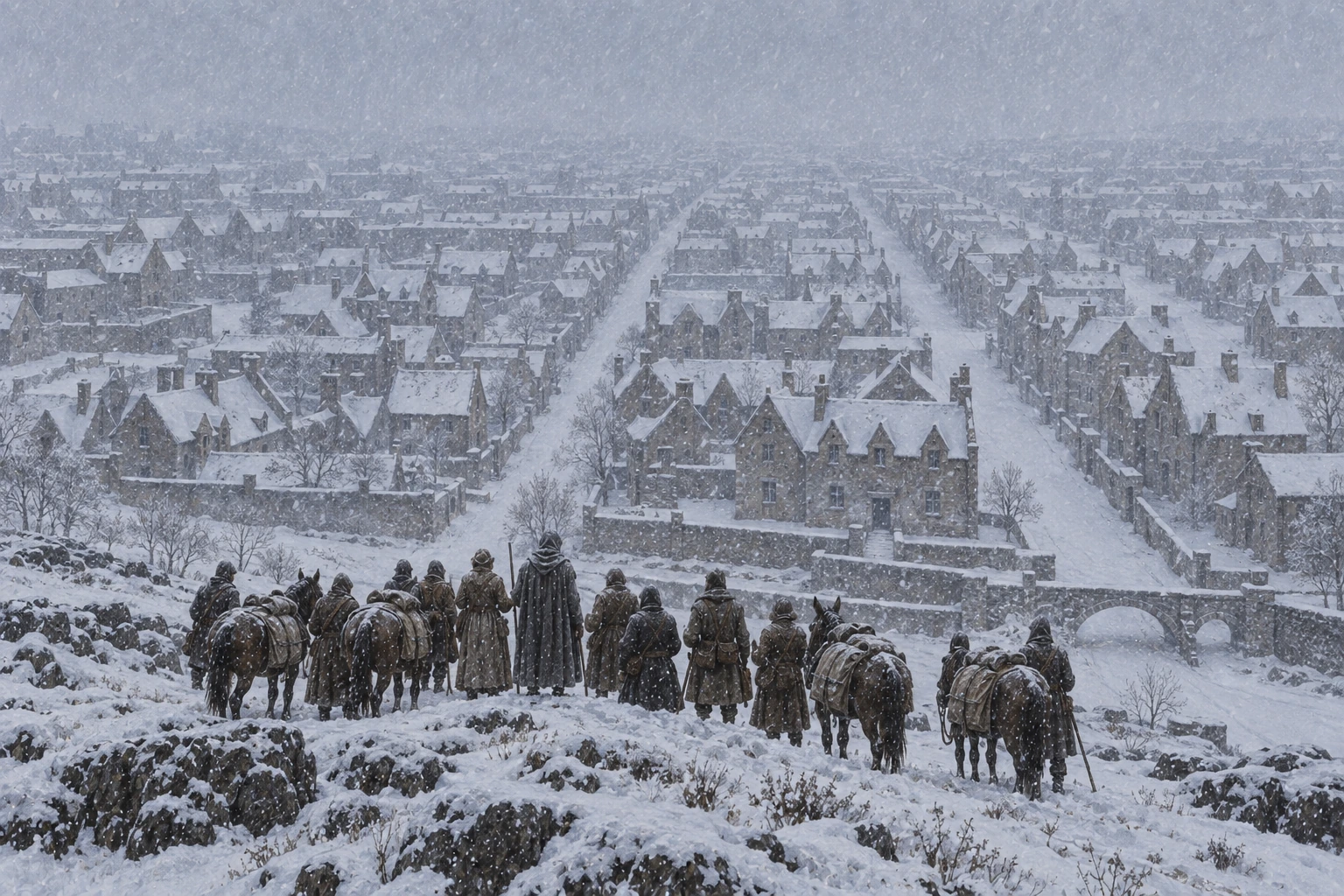
The Sleeping Capital
"If the mules smell water," Bracken said, "they'll tell us a good deal sooner than Wren will, and it won't cost them a name to do it." He hauled the second knot tight on Gable's near-side pack as he said it, not troubling to see who was listening, and Dorrit laughed the short laugh she kept for mornings when her hands were too cold to be properly amused by anything. Wend, walking stiff on the side where his ribs still complained of Kelder, said he'd back the mules over the keeper any day of the week, present company excepted, and Wren said she'd take that wager and lose it happily, because a mule had not once been wrong about water in the whole history of the Survey. It was an ordinary exchange, the kind that had carried them through eleven months of mornings, and not one of them made anything more of it than that, because the alternative was looking too long at what lay ahead of them on the road.
They had known for two days it would be today. Wystan's own margin-count had put the city four days past the last drawn stretch of road, and the fifth day had come up grey and windless, with snow beginning an hour after first light — not falling so much as arriving, fine and constant, the first real snow any of them had walked in since the Gray Stair. It did not build. It only kept coming, settling white on shoulders and pack-straps and the backs of the mules' ears, and by midmorning the whole company had gone the pale, blurred grey of a page left out in weather.
They came up over the last rise together, all ten of them, and stopped without anyone giving the order to stop, and looked at Cael Meddan lying whole and silent below them in the falling snow, roofs and towers and the long pale lines of its streets going back and back until the snow took the far edge of it and gave nothing back. The company stood in silence for the length of about forty breaths. Then Bracken said it was a fair size of a town, in the flattest voice he owned, and they went on down toward it because there was nothing else to do with a city that size except walk into it.
The gate was not a gate so much as an absence — two towers still standing to either side of the road, and between them a space wide enough for six carts abreast, and no doors in it at all, because doors of that scale had apparently never been thought necessary in three hundred years of a country that trusted its own borders. Ferrit looked up at the towers going by on either hand and said, mostly to himself, that he'd pictured something grander, and Sael told him this was grander, he simply hadn't noticed yet, and neither of them was wrong.
Under the arch the snow stopped falling on them for the length of perhaps eleven strides, and in that strip of dry stone floor Pip's boots made the only sound any of them heard, a small flat scuff-scuff that none of them would have marked on an ordinary road and that all of them marked here, because there was nothing else for it to compete with. Dorrit, walking beside the leading mule, said without any particular weight to it that somebody ought to see about getting a fire going before the light went, the same words she said most evenings on most roads, and it took her most of a breath to hear how badly the sentence fit the room it had just walked into. She did not take it back. It was, Wren thought, exactly the sort of thing a person said walking into any strange town at the end of a hard day, and the wrongness of it here was not that it was foolish but that it was so entirely correct, so exactly the sentence the day called for, in a place built to end that sentence for good three centuries ago.
They stood a while just inside, all ten of them, in a silence that outlasted even Bracken's patience for silences, while the snow went on falling everywhere except the strip of ground the gate towers still kept dry.
It was Wren who first understood, walking the first street beyond the gate, that the wrongness she'd been braced for since the rise was not the wrongness she had found. She had pictured — everyone in the company, she thought, had pictured, though none of them had said so aloud on the road down — something closer to ruin: fallen roofs, fire-scoured walls, the honest, ordinary wreckage a town takes when something comes for it and it fights and loses. Cael Meddan had none of that. The first house past the gate stood entire, slates unbroken, a chimney-pot still set true on its ridge, its door shut and its two front shutters latched from the inside, the small iron hooks visible through the gap where the wood had shrunk a hair with age. The second house was the same. So was the third. Somewhere past the fourth or fifth, Wren stopped counting. The counting itself had begun to frighten her worse than any single house could have on its own — not a street of the dead, but a street of the departed, every door closed by someone's own hand on their own way out, in an order that looked, walking it, like neither panic nor plan. Only like people, one after another, doing the same ordinary thing at the end of the same ordinary day, and none of them ever coming back to open a door again.
There were no bodies. There was, in the whole first street, nothing at all to bury.
At a house near the street's end, one shutter had warped a finger's width off true, and Wren, without quite deciding to, put her eye to the gap. A table stood inside, set for a meal nobody had come to eat: two bowls, a loaf gone to hard grey dust, a knife laid down mid-cut and never picked back up. A child's shoe sat under the table's far leg, alone, its mate nowhere in view. She did not say what she had seen. She stepped back, and Dorrit, watching her face rather than the shutter, did not ask, and the company walked on.
Alder walked the street with his hands loose at his sides, saying little, and once, at a house whose shutter had been barred from within rather than merely latched, stood a long moment reading the bar's angle the way another man might read a wound. He said nothing about what he read there. Bracken, coming up behind him, looked at the same bar and said only that somebody had known enough to be afraid before whatever it was arrived, which told them a good deal less than it seemed to and a good deal more than any of them wanted carried into the evening.
The recognition came on them one at a time after that, and it came harder than any of them had expected, because none of them had been able to say in advance what it would feel like to walk into a drawing.
Pip found it first, an hour past the gate, on a building whose lower course had been worked in a pattern of interlocking chevrons he had copied out of Wystan's own hand perhaps forty times without ever quite believing it was a real thing that real hands had cut into real stone. He put his own palm flat into one of the grooves, fingers spread to the pattern's width, and stood like that long enough that Dorrit came over to see what had stopped him. He didn't say anything about the chisel-marks, or the three hundred years, or the man who had cut them. He said only that his hand fit, in a voice gone thin and strange, and took it away again as if the stone had been hot.
Bracken's came an hour after that, on the second street they took west off the gate, where the paving ran a long straight grade downhill toward what might once have been a market. He stopped without warning, the way he stopped for a bad river crossing, and studied the slope of it with his eyes narrowed the way he studied a load he hadn't yet decided how to lash. "One in nine," he said, to the street rather than to any of them, "maybe one in eight at the steepest stretch," and then, before anyone could ask him how he knew, "Wystan ruled this street. I've looked at the grade lines on that page more times than I've looked at my own hands this year, working out where a cart could and couldn't go on the roads we do know. I could have told you the pitch of this hill from a book, standing in a valley three months' walk from here, and would not have thought I'd be fool enough to come and check it." He did not sound pleased with himself. He sounded like a man who had just discovered that a thing he'd trusted at a great distance was, up close, exactly and disquietingly true.
Wren's came at the square itself, where the street opened out onto a wide paved court with a dry stone basin at its center and buildings going up three and four stories on every side, windows glazed floor to floor in small diamond panes that had somehow, against every reasonable expectation of three hundred winters, mostly held. Cut into the lintel over the court's far arch, in letters worn shallow but still legible under a thin skin of snow, was a word she knew before she had finished reading it, because she had sounded it a hundred times off a page in her own hands on the road behind her. "Aemuth," she said aloud, not meaning to, and then, because Alder was looking at her and waiting, "That's what he called this square. In the margin, three separate times, always the same word, and I never knew whether it was a place or a person or a kind of stone until right now, and it's this. It's just — this." She could not explain what it did to a person, saying a word off a dead man's page and then standing inside the thing the word named. She did not think there was a way to explain it that did not sound smaller than it was.
Luel's came last, and differently, because Luel's did not come from the book at all.
She had walked the whole distance from the gate without speaking, which struck none of them as strange, because Luel often walked whole days without speaking. But at a well-head three streets past the square, a low stone ring with an iron windlass rusted solid at its crank, she stopped, and put one hand flat on the stone rim, and stood there long enough that Wren came back for her.
"There was a woman here," Luel said, "who sang while she drew water, badly, on purpose, because it made the children laugh." She did not say when. She did not say who. She took her hand off the stone and walked on, and her face, when Wren caught up to her, invited no further question, and Wren asked none.
They found ground for the first camp in what had been a merchants' yard two streets short of the square, walled on three sides, roofed on the fourth by an arcade whose slates had mostly held, and Alder walked its perimeter twice before he said anything, boots crunching the thin new snow, breath showing white and steady.
"This is deep ground," he said finally, to the company generally, in the voice he used for facts rather than warnings. "Deeper than Wintergarth. Deeper than Kelder's crown, I think, though it wants no fighting to prove it, which is a mercy of its own kind. We ward properly tonight, and every night we're inside these walls, and no one sleeps outside a finished line, whatever the hour, however tired the hands doing the finishing."
No one argued. None of them had expected to.
The working took the better part of two hours, and Wren had done it enough times now, across enough bad ground, to know exactly how it would feel by the end of it and to be tired in advance of the tiredness, which did not make the two hours pass any faster. Alder walked the yard's perimeter with a stub of chalk-white stone worn down almost to nothing, laying a line along the base of the walls that had to be continuous, unbroken by so much as a boot-print through it, which meant walking it slowly, crouched, in cold that had already put a crust of ice into the folds of his cloak by the time he was a third of the way round. Where the wall gave out — the arcade's open side, and a gap where a gate had once hung and hung no longer — he cut the line instead into the frozen ground itself with a narrow iron blade kept for exactly this, working the point through crust and half-thawed clay a hand's width at a time, breath coming harder there than anywhere else on the circuit.
Wren walked a pace behind him the whole way, and at every place the line changed direction, every corner and every gap, she said a name.
She had carried names enough now, from enough towns and enough years, that she no longer had to search for one; they came up the way water comes up a well that has been drawing steadily for a long time, in whatever order they had settled at the bottom. She said them low, not for effect, for the ground itself: a cooper's name, a woman who had minded geese, a boy who had died young and been mourned by people three hundred years dead themselves. Each one she gave the ground and did not take back. It was not spending, not the way the fold at Kelder had been spending — nothing in her went cold or grey doing it — but it was work all the same, the particular fatigue of holding a great many separate weights in her mind long enough to set each one down exactly where it needed to go, and by the time the circuit closed she was as tired in the legs and the eyes as she had ever been from a full day's walking.
The line held. She felt it hold the way she had learned to feel these things — not as light, not quite as sound, but as a settling, the ground going quiet the way a held breath lets go.
Alder straightened at the closing point, put both hands briefly to the small of his back, and looked out at the line they had just finished the way a man looks at a fence he has built and expects to stand.
"That is the largest ground I have ever put a line around in one working," he said, to Wren specifically, flatly, the way Bracken reported a day's mileage. "It will hold. I want you to know both those things are true at once, because most nights only one of them is."
He did not say it had cost him anything. He picked the chalk stub back up, turned it once in his fingers to check how much of it was left, and went to see about the second, smaller line Wren would need to lay alone around the mules' own corner of the yard before either of them called the night's work finished.
The fire, when they finally had one going in the yard's dry corner, felt like the first honest warmth any of them had had in a week, and for a while the talk around it was ordinary enough to surprise even Wren, who had expected the city to press on their voices and found instead that four walls and a held line did what four walls and a held line always did, regardless of what lay beyond them. Dorrit re-wrapped Ossen's hand, which still would not close fully around anything narrower than a mug, and pronounced it neither better nor worse than the morning, which from Dorrit counted as good news. She mentioned, once, flatly, that her chest held nothing anymore that would help it faster than time already would — the rimewort had gone at the steading, and there was no more of it to be had this side of a spring that was still two seasons off — and went on wrapping the hand anyway, because a wrapped hand healed straighter than an unwrapped one whatever else was true. Sael took her fiddle from its case and did not play it, only held it, tuning by ear against nothing, the strings too cold yet to trust.
Pip sat nearest the fire of anyone, wrapped in two blankets against a chill the flames didn't seem to reach him through, and took no part in the talk. He had the day-book open on his knees, per his own habit, and a stick of chalk in his hand, and he was three lines into the day's copy when his hand simply stopped, mid-stroke, all at once, more a clock's stop than a hand's tiring. He looked at the half-finished letter a long moment. Then he closed the book, carefully, and set the chalk down beside it, and offered no word about why. He did not need to. Bracken, across the fire, watched him do it and did not ask either, only reached over presently and moved the book a little nearer the flame, so the leather would not stiffen in the cold overnight, a small ordinary kindness that had nothing to do with the hand and everything to do with the boy attached to it.
Luel sat a little apart, as she generally did, mending a strap that did not, so far as Wren could see, need mending. Sael watched her do it for a while, then asked, carefully, whether she remembered this particular yard from before. Luel said she did not think so. This had been a merchants' quarter, she said, and merchants moved their custom about the way water moves about a stone, never quite the same course twice; she could not have named every yard in it three hundred years ago any better than a stranger could today. It was, Wren thought, the first thing all evening that had sounded almost like relief.
Wend sat with his ribs held carefully, one arm crossed low over them the way he'd carried himself since Kelder, and told Ferrit, in the particular deadpan the two of them had settled into somewhere back along the King's Road, that a city this size ought by rights to have a proper inn in it somewhere, with a proper fire and a proper roof, and it was a poor showing of hospitality that none of its remaining residents had come out to offer them one. Ferrit said he'd take it up with the residents directly, and Sael told them both, without looking up from her fiddle, that she'd sooner sleep in the snow than in anything with a roof still on it in this particular town, and that ended the joke before it could go anywhere it oughtn't.
Bracken took the first watch with Ferrit, the two of them at the yard's gapped corner where the line ran thinnest, close by the coldest edge of the ward. It was two hours in, past midnight, with the fire down to embers and most of the company asleep, that Wren woke to Bracken's voice saying Ferrit's name a second time, then a third, in a tone she had not heard him use before — not raised, not urgent exactly, but working, the tone he used talking a spooked mule back off a bad step.
She was up and across the yard before she had finished waking. Ferrit was standing exactly where he ought to have been standing, spear grounded, eyes open, and entirely, frighteningly still, looking at Bracken with the blankness of a man asked a question in a language he no longer owns.
"Ferrit," Wren said, and nothing happened, and she said it again, plainer, the way she said any name she meant to be heard. "Ferrit. Doran's kin. The Long Eaves. Sael's cousin, who came because Sael was going. Ferrit."
He blinked, and the blankness went out of his face all at once, the way frost goes off a window in a warmed room, and he said his own name back to her, quietly, as if checking it against something, and then said he was sorry, though neither of them could have said what for.
No one made a speech about it. Bracken finished the watch with him regardless, standing closer than the roster called for, and in the morning the fire held its own silence on the matter, though Wren saw Dorrit look at Ferrit twice over the porridge, and saw Ferrit notice her looking, and saw the two of them let it pass between them without a word either way.
The second night's warding went faster and cost more, in the way of most second times at a hard task: faster because Alder and Wren both knew the shape of it now and wasted no motion finding their feet again, and costlier because the first night's tiredness had not fully left either of them by the time the second night's asked for more of the same. They had found, that day, a smaller court off the main square, three walls of dressed stone and a fourth of rubble Bracken judged sound enough to camp behind, and Alder walked it once instead of twice before he set to work, trusting his own reading of deep ground now the way he trusted a bridge he had already crossed.
She gave the ground eleven names that night, fewer than the first night's circuit had wanted, because the court was smaller, and found the eleventh harder to reach than any name had been in a long while, sitting a moment with her eyes shut over it before it came up whole. She did not mention the delay to Alder. He did not ask about it, though he paused at the same corner a half-breath longer than the ground required, and she thought he had noticed it happen and chosen to let it be hers to carry rather than his to remark on.
In the morning her hands shook lifting the porridge pot, a small thing, gone by the time she'd eaten, and she let it pass without remark. Dorrit noticed anyway. Dorrit noticed most things eventually; it was simply a question of which morning.
The line held that night as it had the first. Luel sat up long after the rest of the company had settled, her back to the warded wall, doing nothing that any of them could see or name. Wren asked her once, quietly, whether she felt the ground pressing at the line the way Wren did. Luel said only that she had felt worse ground than this hold nothing at all, and better ground than this fail by morning, and that neither fact was any comfort to offer a person trying to sleep — so she would say no more of it tonight.
Pip walked the whole of that second morning at Alder's elbow, per the standing rule since the road below Kelder, and said almost nothing the entire distance. Once he asked, apropos of no particular street, whether a chainman's rod was the same length here as at home, and Alder told him it was, exactly, to the inch, the measure having outlasted the country that invented it. Pip nodded at that as if it settled something, and did not ask anything further. Bracken, walking a little behind the two of them, caught Wren's eye once and said nothing at all, which between the two of them had come to carry the whole of a sentence on its own.
They came on the Hall the next afternoon, three streets in from the square Wren had named aloud without meaning to, at the top of a broad shallow flight of steps that climbed to a doorway easily twice the height of the gate they'd walked in under two days before. The street leading to it ran wider than any they had yet taken, and straighter, and along its last stretch stood buildings taller and plainer than the merchants' houses nearer the gate — offices, Bracken guessed aloud, or something closer to a college than a market, built by people who had wanted room to spread paper flat and space enough between desks that no one's elbow found anyone else's. Every window along that final stretch was glazed the same small diamond pattern as the square's, and every one was dark. No smoke had ever stained these particular chimneys, so far as Wren could tell; these were work-hours buildings, built for daylight, and daylight was all they had ever needed.
There was no mistaking what stood at the top of the steps. The lintel above the door carried the same chevron pattern Pip had put his hand into on the first morning, cut larger and deeper here, flanked on either side by a device none of them had seen before — a compass rose worked in low relief, its eight points running out to the door's own frame as if the building had been drawn before it was built, and the door beneath it standing shut, whole, unbroken, exactly as its makers had left it. Two iron rings, green with three centuries of weather, hung either side of the frame at the height a bar might once have run between them, though no bar remained to be seen; whatever had sealed this door, it had not been sealed the crude way the shuttered houses nearer the gate had been sealed, and none of the company could say from the steps alone what had been used instead.
Wren stood at the bottom of the steps longer than any of the others, the Waybook's weight against her hip suddenly a different weight than it had been the whole rest of the road — not heavier, exactly, but more awake, a hand held near a fire feeling the heat before it feels the burn. She did not want to be the one to climb those steps first. Some part of her had already settled, quietly and without argument, that she would be.
They stood at the foot of the steps a while, all ten of them, in snow that had thinned to almost nothing since morning, and none of them moved to climb them.
"Tomorrow," Alder said at last, and it was not a question, and none of them made it one. They turned back toward the court and the evening's line-work, and left the Hall standing above the square behind them, its great door shut on whatever three hundred years of silence had done to keep it that way.