The Beacon Road
West of the gate the road changed its manners, and it did so within the first mile, in a way Wren felt before she could have said what she was feeling.
It was early summer now in earnest — the light long and easy from before breakfast to well past supper, the dew burned off the grass by the time anyone thought to notice it had been there — and the road itself ran wide and confident under that light, cut and cambered by hands that had never doubted a cart would want the width. That much was familiar; the near province had taught them to expect good bones under bad weather. What was new was everything the road no longer ran past. No verge-trees, planted by some vanished household in a line too deliberate to be wild. No boundary-stone, notched to a private reckoning nobody living remembered. No worn place at a gate where boots had once turned in for the night, season on season. The hedges that had walled the near province's lanes into something homely simply were not there; the land opened instead into long unbroken swells of grass and scrub running up to skylines the company had not yet earned the right to name, and the road crossed them like a single held note across a silence.
"It's the opposite of the trick," Wren said to Luel, on the second morning, when she had turned the feeling over enough times to find the words for it. "Coming into the near province, the road kept getting thicker with sign — more marks, more names, more people who'd have an opinion about the weather. This is the same road unwinding the other way. Every mile we walk it gets barer, not richer."
"You have it exactly," Luel said. "You are walking backward through three hundred years of forgetting, at four miles an hour, in the wrong direction to call it forgetting. It is remembering, from where we stand. But it will feel like the other thing for some while yet, and I see no virtue in pretending otherwise to you."
It was not an unfriendly bareness. That, too, Wren noted that evening in the day-book, because it seemed a fact worth keeping honest: the country did not feel abandoned so much as unvisited — a room, not a ruin. The grass grew rich and unbitten by anything but wild grazers; the streams ran clear over stone that no boot had disturbed the fording-place of in longer than the company's whole lives put together. The game, when they saw it, took some days to name properly, because none of them had words ready-made for an animal that had simply never been taught to be afraid.
A stag stood in the road itself on the third afternoon, not forty paces off, and watched them come on with an interest that had nothing of alarm in it — ears forward, head up, chewing — until Bracken clapped his hands together once, hard, more from a soldier's tidiness than any real worry. The stag startled at the sound the way a child startles at a door slammed in another room: with surprise, not dread, and was gone up the slope in three easy bounds that looked more like curiosity satisfied than danger fled.
"There's your whole answer, right there," Bracken said, watching it go. "Nothing out here has learned what a man is for. Give it another hundred years without one, and it wouldn't have learned it then either." He said it lightly, and went back to reading the ground, which he had been doing these last two days without anyone remarking on it — a long, careful study of the softer patches at every stream-crossing, the kind a man gives ground he expects to have an opinion about later.
He found what he was looking for on the fourth morning, crouched at a mud-bank below a spring, and called Wren and Alder over to see it rather than simply telling them, because Bracken's teaching, like most of his convictions, ran through the hands first.
"Wolf," he said, laying two fingers beside the print without touching it, to give the scale. "A big one, and not alone — count the overlay here, that's at least four running the same line, maybe more, spaced loose, only traveling together." He straightened, wiping his fingers on his trousers. "I've seen wolf-sign my whole soldiering life, and I'll tell you what I've never seen: sign this bold, this close to a made road, laid down by anything that had the least notion a road meant people. These prints don't avoid us. They don't know to."
"Is that a danger to us?" Wren asked, because it seemed the plain question and Bracken was a man who preferred plain questions.
"Not tonight, and likely not for some nights yet," he said. "A pack that's never met a mule-string doesn't know to want one, any more than that stag knew to run before I clapped. But four beasts on four legs smell a great deal of meat walking slow on four more, and sooner or later curiosity in an animal that's never been taught fear turns into something with teeth in it. I'd rather we did the teaching, on our own terms, before the country tries to teach itself to us instead." He looked round at the long empty grass, unbothered. "We'll double the watch tonight. Only sense, same as checking a girth before you trust it."
Wren slept easily enough over it. That, too, was the book's own habit by now: name the thing plainly, set the precaution in place before the need for it arrived, and let the ordinary evening go on being ordinary around the precaution, rather than around the fear. He briefed the whole company at the fire that night — not gravely, only clearly, same as any change in tomorrow's route — on where each of them would stand if a watch-call ever came, and had them say their own stations back to him once each, and then once again, until every answer came without a pause for thought. Pip's station was the simplest and, Bracken said, the most important: stand at the mules' heads, keep talking to them low and steady, and do not, under any circumstance whatever, leave them for any other cause on earth.
"Even if something needs a hand," Pip said, wanting to be sure of it.
"Especially then," Bracken said. "A spooked string with nobody holding it is a worse danger to this company than anything four wolves could manage on their own, and you're the one I trust most to remember that when it would be easiest to forget it. That's not a small job I've given you. It's the job the whole rest of us depend on you doing exactly as told."
Pip only nodded, and stood a little straighter for the rest of the evening, and Wren, watching him, thought that Bracken had found, without any particular ceremony about it, exactly the right words for a boy whose whole flaw, since the day they'd met him, had been trying too hard at things nobody had properly asked him to try at. Here, at last, was a thing asked of him plainly, sized to his hands, and he took it up with both hands.
The reckoning sheet came out that night too, and went on coming out each evening after, in the place Garron's own fork-knowledge had held until the gate: Iyene's tally of distances walked and reckoned, checked now against Luel's line-lore rather than a living man's memory of which fork wanted which turning. It was slower work than Garron's had been, but sound work, and the gap read less as loss than as a different shape of the same trust.
"There's a fork ahead a day," Bracken said once, low, half to himself, looking at a place on the map where two tracks parted around a fold of hill. "I'd have asked Garron which one keeps its footing in wet weather." He did not finish the thought aloud. It passed through the company like a held breath and was let go, and Iyene took both branches on trust and had Bracken scout the near one himself the next morning, which settled the matter as well as any man's memory could have.
They came to the Sixth on the fifth day, and Wren knew it for what it was a full hour before anyone said so aloud, because the hill did what every beacon-hill they'd yet climbed had done: it stood apart from its neighbors in a way that had nothing to do with height and everything to do with intention — ground shaped, however roughly the centuries had worn it, by people who had meant it to be climbed, and cleared, and lit.
"The Sixth," Luel confirmed, when they stood at its foot. "By the old count, west of Sereth. If it ever wore a name of its own before the numbering swallowed it, I do not carry that name, and I do not believe anyone living does either. It is the Sixth, the same as the Seventh is the Seventh — a number worn smooth into a word, same as before, only this time with nobody left even to remember it was ever anything else."
The climb was a short, honest half-day's work, and the crown, when they reached it, showed the same story Sereth's had shown, only plainer: scrub grown up thick where long neglect had let it, a scatter of old windfall timber gone silver and light as bone. Under all of it, when Bracken and Dorrit had cleared enough ground to find it, the stone cradle stood square and sound, canted only a little from all that patient weather, holding its basket the way a good boot holds a foot that has long since stopped filling it.
They fell to the work with the ease of a thing now practiced rather than discovered, and Wren, clearing brush alongside Dorrit with her sleeves rolled and her hands already black to the wrist, found she could name the whole shape of the day before it had finished happening to her, as she could once have named a harvest morning before the first frame came up. The crown cleared; the cradle read for soundness; the basket's needs taken in hand. This one wanted a new riding-band, its old iron gone to a soft red crumble that came away at a touch, and Bracken and Dorrit between them drew and clinched a fresh strap from the forge-kit Sereth's own lesson had taught them to carry.
At dusk they gathered at the cradle's foot, and Alder gave the formula the same as he had given it at the Seventh, the words worn smooth by exactly one prior use and none the less true for that: "By the charter of the College of Roads, which runs to the road's whole working — waymark, well, bridge, and beacon — this fire is called, and the line begun again."
There was no household here to hand the taper to, no Edda standing a pace back with eleven generations behind her eyes. Alder lit it himself this time, without ceremony beyond the formula already spoken, and the flame took the dry brush kindling and then the seasoned wood beneath it and climbed, steady, into the first true dark the Sixth's crown had held in three hundred years.
Iyene logged it standing, her book braced on her forearm in the firelight, and read the entry back once, plainly, because it was new and wanted saying aloud the first time so that everyone present had heard it in her own voice before it went down as the act's settled form. "Lit once," she said. "Keeper wanted." She looked up from the page. "That's the whole of it, and I think it's honest to say so rather than dress it in more words than it needs. We are not founding a household on this hill tonight. We're lighting a promise and posting it east, the same as any other letter, and trusting the country to grow into the answer in its own time."
"Who does keep it, then," Pip asked, "once we've walked on?"
"Nobody, for now," Iyene said. "And that's not a failure of the lighting, only an honest account of where the keeping stands tonight. The letters go east on the post same as always, and every fire we light gets its name carried the same way Sereth's own name travels now — to Sella, to Sereth, to every tending family within reach of a runner, so that in time, the line grows keepers the way a garden grows from seed thrown a season before anyone thinks to walk back and see what took." She closed the book. "The wake of stars isn't a chain of watchmen we're leaving behind us, Pip. It's a promise we're mailing home, one hill at a time, and trusting the east to answer in its own good time, same as it answered Sereth's own showing-fire two generations after a man climbed a hill with more hope than sense."
They watched the dark for an answer anyway, because watching had become its own small ritual by now, the whole company settled round the crown-fire with their backs to its warmth and their faces to the west. No light showed. The dark country ran on unbroken past the Sixth's own small new flame, hill behind hill behind hill, entirely dark, and the company took it for the shape of the truth they had been told to expect rather than for a disappointment — this was unkept ground, and unkept ground, having no household in it, did not answer a first knock.
What did show, when Wren turned to look back the way they had come, was Sereth's own fire, small and steady and impossibly far already, a single warm point holding its ground against a great deal of distance and dark between.
"There," she said, quietly. The whole company had already turned to look, as if the fire behind them had called them all by name at once. Two lights now, kept and counted, the first two stitches in whatever the wake of stars would eventually become. They let it stand at that, without dressing it up any further. It seemed grand enough as it was.
The drill Bracken had briefed at the last camp came due on the sixth night, exactly when the whole company least expected it and precisely because they had been ready for days.
They had made camp in a shallow fold below the Sixth's western shoulder, a day's walk on from the lighting, in ground Bracken had liked well enough for water and shelter and liked rather less, he said plainly at the fire, for the long dark rise behind it that gave a wolf a clean run downhill with the wind at its own back. He had doubled the watch again without being asked to explain why, set the mules picketed close within the ring of the fire's light rather than loosed to graze at the circle's edge, and gone over the stations once more before anyone settled. Dorrit's staff within reach of her bedroll; Wren's own place at the fire's near edge with a brand ready to hand; Alder a little apart where the dark came closest; Luel between the mules and the black beyond them; Pip already at the mules' heads before he was told to be. Bracken himself walked the ring's whole circuit with the flat patience of another day's work, dressed up in starlight.
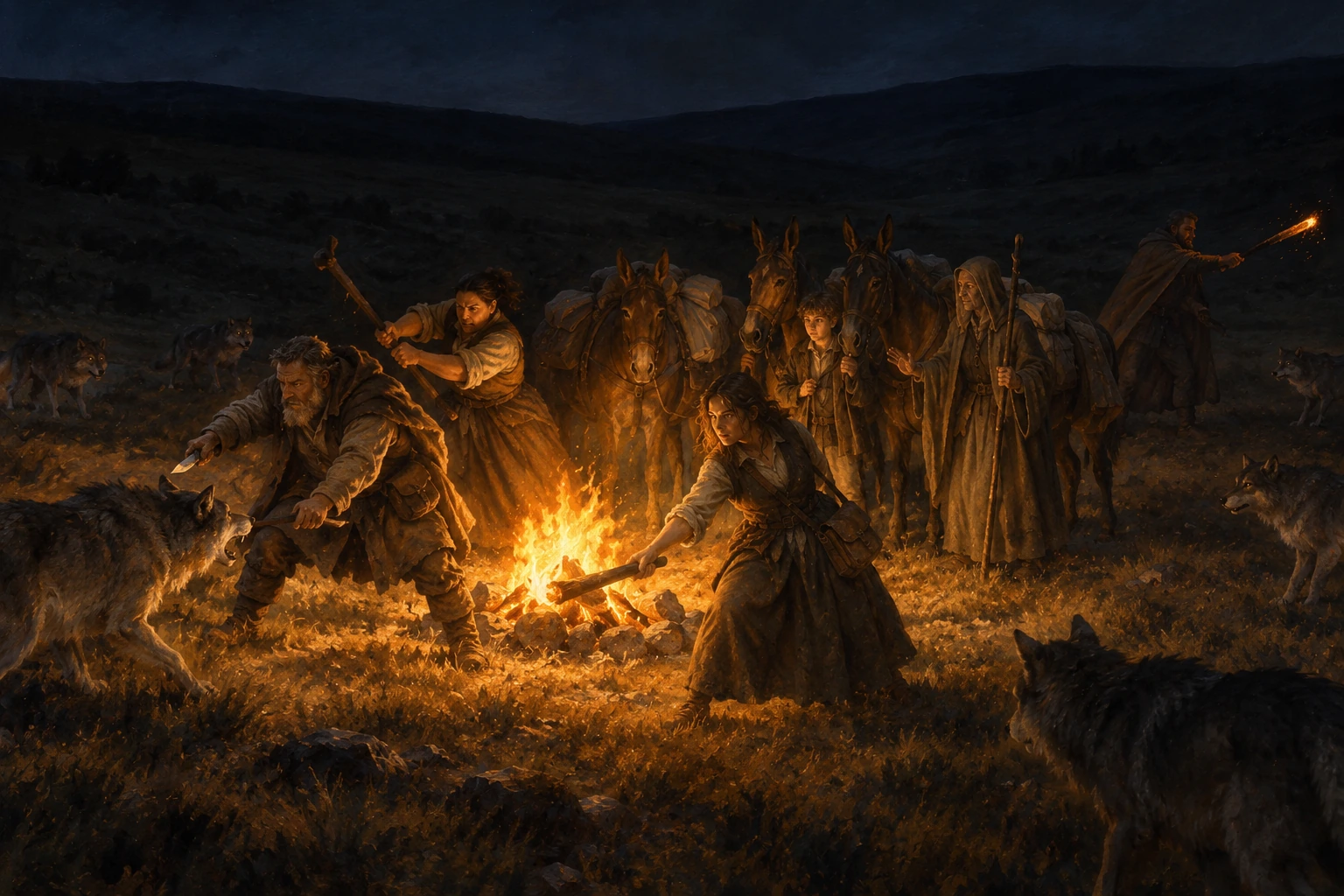
The moon had set some hours before the fire had properly settled to its coals, so that when the wolves came, they came into a dark thick enough to swallow everything past the firelight's own short reach. Wren's first knowledge of them was not sight at all but Suet's scream — a mule's scream, which is not like any other animal's — and every one of them was on their feet before the sound had finished leaving her throat.
After that the night did not organize itself into anything so tidy as a story, and Wren, trying honestly to set it down two mornings later, found she could only give it to the day-book as it had actually come to her: in pieces, fast, loud, and never out of anyone's control even when it felt, in the middle of it, entirely out of her own.
Bracken's voice first, flat and carrying over everything else — "Stations! Fire up, brands out, hold the mules!" — and then the fire itself, fed all at once from the standing wood-pile until it leapt high and orange and threw the whole camp into hard black-and-gold, and in that light the shapes came clear: four of them, five, low and grey and fast, circling wide of the flame's reach and testing the picket-line's edge the way water tests a bank, looking for the one soft place.
One found it, or thought it had, and came in low at Barrow's flank, and Bracken's short soldier's blade — carried, unremarked, the whole year through, and drawn now for the first time anyone in the company had seen — met it in a single motion that ended before Wren had properly registered it had begun. The wolf went down and did not get up, and Bracken was already turning, unshaken even now, to the next place the line wanted holding.
Dorrit met the second with her drover's staff, iron-shod at both ends against exactly this kind of country, swung with the whole weight of a woman who had spent a working life moving heavy things exactly where she wanted them. The crack of it against bone carried clean over the noise of everything else; the wolf yelped once, short, and reeled off into the dark and did not come back that night. A third came at the fire's near edge where Wren stood her ground with a burning brand held low and steady the way Bracken had drilled her, more frightened than she had ever privately admitted to being capable of and doing the one thing she had been told to do regardless — thrust the fire forward, hold the line, do not step back — and the wolf broke off from the flame's own heat and reach before it ever closed the distance, wheeling away with a snarl more of surprise than fury.
Alder fought with fire and nothing else, brands snatched burning from the pile and thrown or thrust in short, economical arcs, driving two beasts wide of the mules with nothing but flame and his own flat, steady aim; and Wren, catching sight of him once between one heartbeat and the next, saw him doing nothing more, and nothing less, than any of the rest of them — no word spoken over the flame, no working laid on it, only a man with good aim and a burning branch, exactly as plain as Bracken's blade or Dorrit's staff.
Luel's voice ran under all of it the entire time, low and even and never raised, a single unbroken line of sound pitched for the mules alone, and Nettle and Gable and Suet, screaming and plunging at the start of it, had steadied by the drill's own middle to something still frightened but no longer wild, held there as much by that voice as by Pip's hands at their heads and his own steady murmur alongside it.
It could not have lasted more than a few minutes by the honest count Bracken gave afterward, though it did not feel, living through it, like anything that could be measured in minutes at all. The pack took its dead and its hurt as a lesson before it took anything else, and broke — first the one Dorrit had struck, then the others following it out past the fire's reach and up the dark slope and gone, entirely, into the country that had bred them and had not, until tonight, ever had cause to teach them different.
Nettle, for her part, delivered the night's one piece of comedy well after its danger had already passed its own worst point, and delivered it with the flat unbothered timing of a mule with strong opinions about being frightened: a straggler, already breaking off and half turned to flee, came too near her heels on its way past, and she planted one hind hoof squarely into it with a thud that carried clean across the camp, and the wolf did not get up quickly, and did not come back at all.
"That's my girl," Dorrit said, into the ringing quiet that followed, in a voice not quite steady yet but trying gamely to sound as if it were, and it was exactly the right thing to say, and exactly the moment to say it in.
Nobody slept again that night, and nobody pretended to want to.
They built the fire higher still and sat close around it through what remained of the dark, and the shaking came to each of them in its own time — Pip's hands, when he finally let go of the mules' headropes, trembled a good quarter hour before he had them steady enough to hold the tea Dorrit put into them unasked; Wren found her own knees would not hold her weight the first time she tried to stand, and sat back down and let Alder's hand rest a moment on her shoulder, which was the whole of what either of them said about it. Bracken alone seemed entirely himself throughout, though Wren noticed, watching him check the picket-lines a second time and then a third, that a man could be steady and still be checking.
The cost, when it was properly counted at first light, came to less than any of them, in the frightened middle of the thing, would have believed possible. Barrow carried a shallow gash along one flank where a claw had caught him in the first rush, bleeding freely but no deeper than the flesh. Bracken and Dorrit cleaned and dressed it together at the fire, Bracken holding the mule steady with a hand and a low word while Dorrit's needle did careful, practiced work; he would be sound within days, Bracken judged, and stood square enough already to bear a light load by noon. Dorrit herself carried a bruise blooming dark along one forearm where a set of teeth had closed on wool and canvas and just barely missed the arm beneath, and displayed it at breakfast with more pride than complaint. "I've had worse from a rose bush," she said, turning it in the morning light for general inspection, "and got considerably less thanks for surviving the rose bush." Nothing of the kit had gone further than scattered — a pannier knocked from its stack, a cook-pot rolled into the dark and retrieved unharmed after sunrise. Every mule stood in its traces by full light, frightened still and shying at shadows they would not ordinarily have minded, but whole, every one of them, and fed, and led on.
Two lay dead where the fire's light had shown them fall, and a third, Bracken judged from the blood-trail, would not travel far or well; none of the company went looking for it. The debrief, when it came, was Bracken's own plain professional accounting, given at the fire over the last of the tea — wounds, watches, what had worked and what wanted tightening — and it held not one word of apology to the dark, nor one word of guilt for what the dark had cost in return.
"They tested us because they'd never been tested back," Bracken said, working a whetstone along his own blade's edge as he spoke, unbothered, the sound of it steady and ordinary in the new daylight. "Same as that stag. Same as every deer that's stood and stared at us instead of running. A country three hundred years without a man in it forgets, right down to the bone, what a man's for — and forgetting isn't malice. It only looks like malice from the wrong end of a bad night."
Alder, sitting a little apart with his own tea cooling untouched in his hands, said the one thing he said all morning, and said it plainly, without weight laid on it beyond what the words themselves already carried. "Nothing out there hates us," he said. "The country has simply forgotten what a fed fire and a picket line mean. We have just begun reminding it — and a reminder, given plainly once, is usually enough."
They walked on that same day, later than usual and slower than usual. Barrow carried nothing until noon, and then only the lightest of the panniers, and bore it without complaint. The mules startled twice at nothing, animals who had learned, overnight, a fear they had never needed before, and were gentled each time with a hand and a low word and walked on. By evening the ordinary rhythm of the road had begun, cautiously, to reassert itself, as a bruise fades before it has finished aching.
The Fifth stood two days further on, and the company came to its relighting with the whole rhythm now proven twice over and needing no fresh explaining, only the doing.
The crown here had weathered harder years than the Sixth's. The cradle's stone footing had cracked clean through at some winter's worst frost and settled crooked, and Bracken spent the better part of an afternoon with Dorrit and a bar of green wood for leverage, re-seating the whole footing square before the basket could be trusted to sit true above it. By dusk the crown stood cleared, the cradle re-seated and sound, the basket filled and ready.
Alder gave the formula a third time, word for word as before, and lit the fire himself, and Iyene logged it in the same two words she had given the Sixth, spoken now without needing to be explained a second time to anyone present. "Lit once," she said. "Keeper wanted." She looked up from the page and out at the dark, and something in her face, Wren thought, watching her, had eased since the first uncertain saying of it — not because the words had changed, but because the company had, by now, come to trust what they meant.
Full dark found them gathered as before, backs to the new flame, faces east, and this time the dark did not disappoint them: two lights showed, small and steady and impossibly patient across all that distance, the Sixth nearer and the Seventh fainter and further behind it. Two fires now stood witness to a third just kindled, the wake of stars grown to three full stitches long and drawn, this time, on the actual dark of an actual night rather than merely reckoned on Iyene's careful sheet.
Wren found the map in her mind and the horizon in her eyes telling the same story at last, without her needing to check one against the other twice, and set the day-book on her knee that night with more to put in it than most nights managed.
The count descends as we walk it, she wrote. We have come now to the Sixth and the Fifth, worn ordinal names same as the Seventh was, and if either hill ever carried a truer name of its own, nobody living remembers it well enough to give it back. Both are lit — lit once, Iyene's log says, keeper wanted — for this is unkept ground, with no household waiting at either crown to take the taper from Alder's hand, and the fire we leave behind us is a promise mailed east rather than a post we mean to man ourselves. In time, Iyene says, the letters carrying each new fire's name will find their way to keepings that will grow to claim them. Tonight there is no answer from the dark ahead of either hill, and none is looked for yet. But behind us, now, two lights burn instead of one, and the wake of stars we are laying down has, for the first time, become a thing the eye can see rather than only the map can promise.
And between the two lightings the country tried its teeth on us, honestly, exactly as Bracken had warned it eventually would. Wolves that have never met a man came at the mule-string in the dark hours, bold with all that time of never having been taught different, and we met them with brands and blade and Dorrit's good iron staff, and held the line. It cost us less than it might have: a gash along Barrow's flank, already healing clean; a bruise on Dorrit's own arm, worn since with more pride than complaint; scattered kit, all of it found again by morning. Two of the pack did not survive the testing, and a third went off hurt and was not followed, and the rest took the lesson and did not come back. Dorrit did not grieve the wolves, and Bracken did not preen over the fight. Bracken's own accounting of it, given plain at the fire afterward, held no more weight than an account of mended harness would have held, and that, I have come to think, is exactly the right size to hold such a night in. Alder said the truest thing of the whole morning, and I set it down here so I do not lose the exact shape of it: nothing out there hates us. The country has simply forgotten what a fed fire and a picket line mean, and we have only begun reminding it, and a reminder, given plainly once, is usually enough.
The dark country has begun to answer for its dark, one hill at a time — and we have answered for ourselves, once, with fire and iron, and both answers held.
The pen went back into its roll, and the day-book after it, and the fire damped down to a low red that would hold till morning. The camp had already gone about the business of settling without her: Suet chewing somewhere behind her at her usual unbothered rhythm; Pip's low breathing, asleep well before his own watch was properly due; Bracken and Luel off toward the picket-line, dividing the coming night's stations between them in short, easy sentences. Two fires burned behind her now instead of one, small and patient across all that folded dark ground, and a third stood freshly kindled at her own back, and somewhere ahead, unlit and unnamed and entirely unafraid of them still, the country went on descending, hill by hill, toward a count that would, in its own good time, run all the way to Kelder and beyond it. She was asleep before she had finished being glad of any of it.