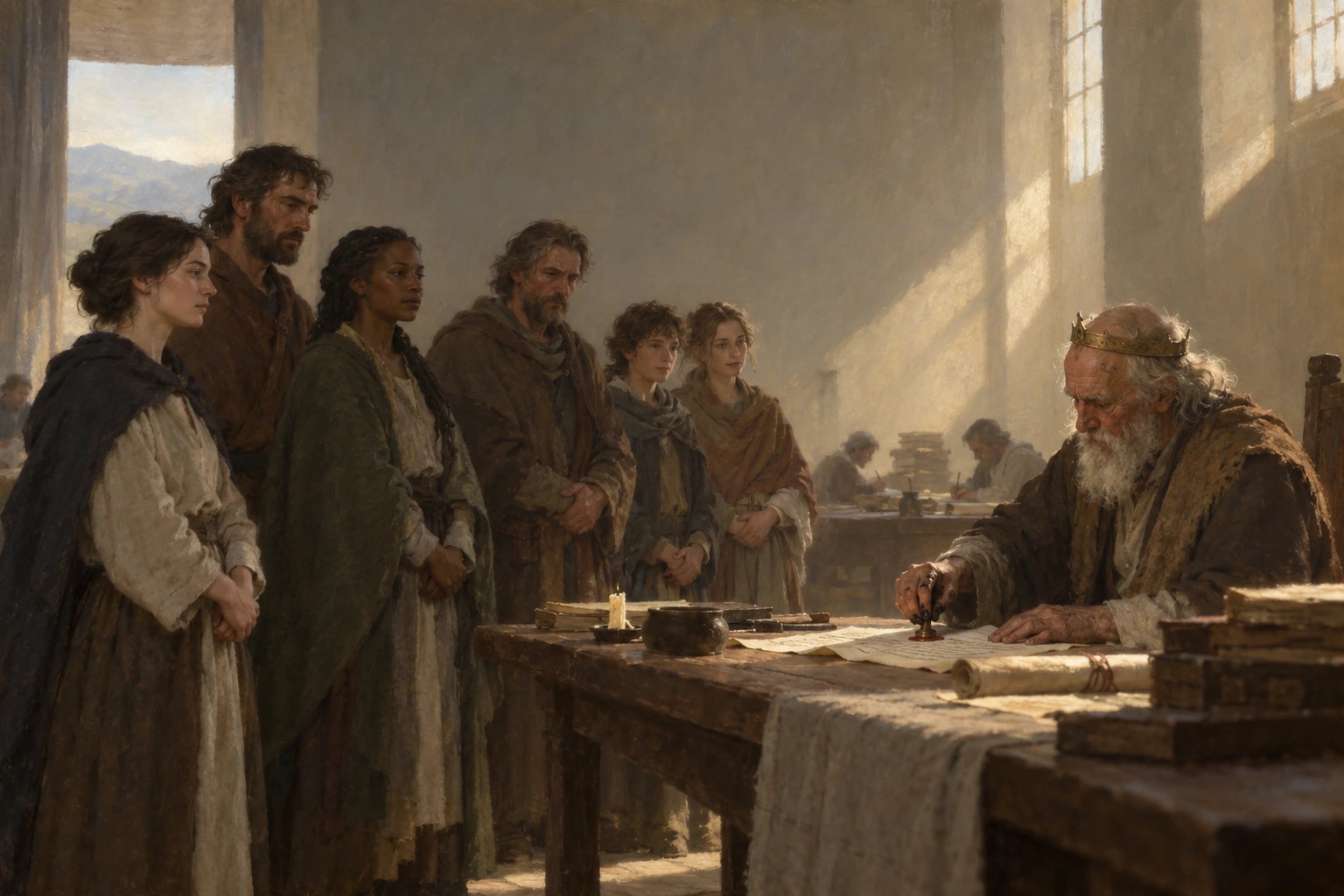
The Charter
The College kept its own weather, quite separate from whatever the sky outside was doing — a climate of ink and lamplight and turned pages that did not much care whether the morning was grey or gold, so long as the light was good enough to draw by.
Mornings she spent in the map-rooms under a patient scholar named Stane, who had the gift, rare in a teacher, of never making her feel slow. He set her first to copying a line already drawn — a stretch of the south road she and Alder had walked themselves, so that her pen and her memory could check each other. A steady hand, she learned, was not the same thing as a slow one, and a line drawn with the whole arm came out truer than one worried over stroke by stroke. "You've the hands for it," he told her on the third morning, in the tone he kept for any tool well used. Wren took it for the compliment it was: in her family a compliment about hands was a compliment about work still to be done, not work finished. By the end of the week she could set a bearing off a landmark and true it against a second sighting, and Stane had stopped checking her arithmetic for her, which was plainer than anything he could have said.
Evenings she kept the day-book, a line at a time, the small clothbound spine going soft now at the corners. The copying lessons went in, and a wrong turn in a corridor that cost her twenty minutes and taught her the map-chests better than any tour could have, and Dorrit's reports from wherever Iyene had set her to writing down forage-lore, which came back more indignant and more delighted by turns — "she's had me arguing with a man about whether sorrel's worth eating twice in one day, and winning."
She met the mules before she met the man who kept them, which was entirely as it should be.
The College's stable yard lay behind the scriptorium wing, walled on three sides and open on the fourth to a lane wide enough for a loaded cart. It smelled, under the hay and the leather, of harness-oil worked in recently and well. Three mules stood along the rail when Wren and Dorrit came through the gate on Iyene's instruction to "go and be looked over," and a fourth put its head out of the near stall to see what the noise was, all four regarding the newcomers with the frank assessment of animals who had seen a great many strangers and formed opinions about most of them.
"That's Suet," said a voice from inside the stall, before either of them had said a word, "and she'll let you scratch her ears if you ask nicely and don't loom, which you're not doing, so you're already ahead of most. The dun one's Barrow, and he does not care for bridges, which I mention now so you're not surprised by it later. Nettle bites, on principle, not temper, so don't take it personal when she does. And that's Gable dozing in the corner, who is old and wise and has decided the rest of us are more trouble than we're worth, and I can't argue the point."
The man who came out to join them, wiping his hands on a rag that had clearly been white once, was not tall — shorter than Alder, built along broad low lines, the kind of build meant to carry a great deal of weight without complaint. He was somewhere in his later fifties or beyond, weathered the deep even brown of a man who had spent his life outdoors rather than merely visited it, with grey at his temples and in a close-cropped beard, and hands broad and careful and marked with the calluses of rope and leather rather than plough or pen.
"Bracken Hale," he said, and did not offer his hand, because it was still greasy with the harness-oil, and nodded at it instead by way of explanation. His eyes went, briefly and without hurry, from Wren's boots to Dorrit's and back — not rude, only thorough, the look of a man checking a load's balance before he'd trust it on a hill road. Something in his face eased, very slightly, as though a question he hadn't troubled to ask aloud had been answered.
"Good boots," he said. "Both of you. Broken in proper, not new-bought for the occasion, and re-heeled at least the once, by the wear of them. I've had recruits arrive in boots so new they'd have had blisters through the Merrow gates and not a mile beyond them, and I always know within a week which ones asked their feet's opinion before they packed and which ones didn't." He said it the way Granna Tansy said "oiling weather" — a remark that was not quite about what it was about — and it reached her a half-beat late: she had just been welcomed.
Dorrit, who had gone straight past the boots and directly to Suet's ears, was already making the low friendly sounds she made at a good milking cow, and Suet was leaning into her hand, having decided on very little evidence that this was a person worth the trouble of liking. "He's a lovely fellow," she said. "What is he carrying?"
"Grain, mostly, and the heaviest of the tent canvas, because he doesn't mind the weight and doesn't sulk about it, which is more than I can say for some," Bracken said, with a glance at Barrow that Wren would have sworn was reproachful. Barrow, as if he had understood it, put his ears back and looked pointedly at the middle distance. "I've kept mules the better part of thirty years, one string or another, border watch and after, and I've learned to trust a mule's opinion of a road a good deal further than I trust a man's — a mule's got no reason to flatter you about either the weather or the footing."
"You talk to them like they answer back," Dorrit observed.
"They do," said Bracken, entirely serious, "just not in words, which is more than I can say for most people who do use them." He turned back to his rag and the harness he'd been working, and that was the whole of the interview: not unfriendly, not warm exactly, but settled, as a scale settles once the last weight is on and found to balance. Later, walking back across the yard, she asked Alder — half in jest — whether Bracken had always talked to his animals so.
"He was married a long while to a woman who answered back a good deal better than most people manage," he said. "I think he has never seen much reason to lower his standards since." He said it lightly, as he said most things that mattered. Wren, filing it beside the boots and the rag and the four names already learned, thought she had met in one morning a man she would trust on a mountain long before she had any particular reason to, which was, she supposed, exactly what a quartermaster was for.
The empty desk in the gallery — bare but for its unlit lamp, chair pushed neatly in, the one thing in the whole warren of the College that had looked like a held breath — was not empty when they passed that way again three days later.
He came up out of whatever he was bent over so fast that a pencil went skittering off the desk's edge and two more, tucked behind his ears, very nearly followed it. He caught the desk instead, with both hands, as though it might otherwise escape, and stood blinking at them — a tall boy all wrists and knees, with the unfinished look of someone who had grown a hand's width faster than his coat had managed to keep up with. His fingers were black to the second knuckle with old ink and fresh, and there was a smudge of the same across one cheekbone. Behind the two ears that had kept their pencils he had a third tucked somewhere in his hair, entirely forgotten.
"You're the keeper," he said, to Wren, with the particular breathless certainty of someone who had rehearsed the moment a great many times and was determined to get it right now that it had finally arrived. "I'm Pip. Pip Sandover. I've been assigned — that is, Cartographer Sath has done me the very great honor of — I have the desk," he finished, rather more simply, as though the sentence had run out of runway before it found its proper landing, and looked immediately mortified at himself for it.
"So I see," Wren said, and found she liked him already, in the specific unguarded way one likes anyone caught trying too hard — not despite the fumbling, but a little because of it.
The desk, she saw now, was not merely occupied but thoroughly colonized. There were instrument rolls, three of them, stitched by a hand that had clearly taught itself the trick and improved with practice, each pocket sized to its tool. There was a second inkwell in case the first ran dry at an inconvenient hour, and a stack of paper cut and squared with a neatness that suggested more evenings than were strictly necessary spent getting the corners exact. It was the equipment of someone determined not to be caught wanting, by anyone, ever, for anything — and Wren knew the ache behind that kind of readiness, having packed her own satchel with something of the same anxious thoroughness the morning she left Fallowmere.
"He made the rolls himself," Bracken said, arriving behind them with a coil of rope over one shoulder and the air of a man checking on a piece of cargo he'd already decided was going to be trouble and worth it. "Wouldn't let the leatherworker do it, not even the stitching. Took him the best part of a month of evenings."
"I wanted them to fit the instruments properly," Pip said, and then, in a rush, as though the subject having been raised he could not now let it go unexplained, "the College ones are made to a general size, you understand, to fit whatever a fellow happens to be issued, but if you cut a roll to the specific instrument — I measured each one twice, and then a third time because the first two didn't quite agree — you lose almost no time at all fumbling for the right pocket in poor light, which Cartographer Sath says is the difference, in the field, between—" He stopped himself, visibly, the way a cart stops when the brake's thrown too hard, and went a fierce, unhappy red. "I'm sorry. I do that. Alder — Master Alder said I might, if I felt I was doing it, simply stop, so I'm stopping."
There was a small silence, of the kind that could have gone either way, and it was Dorrit — Dorrit, who had wandered in behind them with a sprig of something green still tucked behind her own ear from the morning's forage lesson — who filled it.
"My cousin measured her satchel-strap four times before we left home," she said, comfortably, hitching herself up to sit on the edge of the empty desk beside his, as though she had known him a year rather than a minute, "and cried about a book of pressed flowers for a full quarter-hour the night before, which she'll deny, and I'll not press her on it because everyone's entitled to one soft evening before a hard road. You measured your pencil-rolls three times. I'd call that restraint." She looked at his stack of paper, cut so exactly square, and nodded at it with real, warm approval, gardener to gardener, craft to craft. "That's good clean work, that corner-cutting. Takes patience. Most people your age haven't got the patience for it — I hadn't, at sixteen, not for anything that didn't grow."
"It was three times," Wren put in, from the desk's far corner, "and I don't deny the flowers at all. Only the quarter-hour. It was considerably less than that, and I'll thank my cousin to stop rounding up."
Pip looked at her for a moment as though she had handed him something he hadn't known he needed and wasn't sure he was allowed to keep. Then, slowly, some of the wound-tight readiness went out of his shoulders, the way it goes out of anyone finally believed. "Thank you," he said, simply, and this time the sentence found its landing without help.
Later, when they had gone, Alder told her the rest of it. The seat had stood empty the better part of a year because Iyene had turned away, one after another, a procession of well-spoken young men whose fathers held office and who wanted the title of Cartographer-Royal's apprentice a good deal more than they wanted the work under it. She went on turning them away until a boy who bound books for his living near the bridge-market was found, three evenings running, sitting in the College's public gallery with a borrowed pencil and a sheet of his own paper, quietly correcting — accurately, and without being asked — a copyist's error in a wall-map's river-course that nine senior fellows had walked past without noticing. "She hired him on the spot," Alder said. "Which will tell you a good deal more about Iyene Sath than it tells you about the boy — though it tells you something about the boy as well."
The charter itself came four days later, on a morning bright and cool with the clean light of early autumn, and it happened with almost none of the ceremony Wren had half braced herself for and every bit of the warmth she had not thought to expect.
The King's Hall stood near the merchants' hall: plain grey stone within and without, its single long room floored in worn flagstone and hung with old faded charts rather than any banner or blazon. There was no throne to speak of, only a chair somewhat finer than the others set on a single low step, and a herald whose whole ceremonial function seemed to be reading names aloud clearly enough to be heard, which he did plain as a clerk reading a ledger.
King Osmund came in through a side door with two attendants and no more fuss than Bracken made entering his own stable yard — a man well into his sixties, spare rather than stately, in a plain unornamented coat, his circlet worn a little crooked as though he had put it on himself and not troubled to check a glass. Wren noticed his hands before she noticed the crown. His first two fingers were marked with a faint permanent stain she recognized at once, having watched Alder's hand do the same work for three hundred miles. Ink. The King of the realm had ink-stained fingers, and read the Survey's charter through himself, silently, top to bottom, before he signed it, the way a careful farmer reads a lease before he'll put his name to it.
He paused once, partway down the page, at a clause Wren could not read from where she stood, and looked up — not at Iyene, who had drafted it, but at nothing in particular above the assembled company, with the stillness of a man doing a sum he had done before and had never enjoyed doing again. Then he signed, and the stillness went with the pen.
"Iyene Sath," he said, when he had finished, "leads by this charter as she has led by deed for eleven years, and I'll not waste this good company's morning telling her her own business, which she'd only correct me on regardless." There was a low ripple of amusement at that, Iyene's own mouth twitching in what Wren was beginning to recognize as her version of a laugh held politely in reserve. The King went on, simply and without pomp, to the matter itself: that the Survey walked, by this charter, under the King's own peace on every road it took; that its warrant ran to the road's whole working — waymark, well, bridge, and beacon — and to whatever the keeping of those required; that no toll-keeper or bridge-warden in the realm might hinder it, nor any lord's man turn it back; that the King's granaries and way-houses stood open to it at a fair reckoning wherever it passed. And that its charge — he did not ask what the charge was, and did not so much as glance at the satchel at Wren's hip, though she had half expected, despite everything Alder had told her, that he might — was its own affair, kept under its own authority, as it had been kept for three hundred years before this morning and would, he trusted, go on being kept a good while after it.
Bracken was named quartermaster then, with a nod he returned exactly as simply — no more ceremony spent on it than the fact deserved, the fact itself having been true for a month already. Pip was named apprentice cartographer and went the fierce unhappy red Wren had already learned to expect of him, though this time it was pleasure working the color up his neck. Iyene's hand came to rest briefly on his shoulder, which settled him better than any words could have.
Then the King's eyes came to Wren, and stayed there a moment longer than they had stayed anywhere else in the room, kindly, with the same close attention she had watched him give the charter's own small print.
"You're the keeper," he said — the third time in a fortnight someone had said those words to her as though they explained everything. This time she only nodded. "I'll not ask you what it is you keep, nor how it's kept. Those are not the Crown's questions, and never have been, as generations of Cartographers-Royal have told my grandfather's grandfather so, politely but very firmly." A small dry warmth crossed his face, there and gone. "I came to my own charge much as I understand you came to yours — not by choosing it, but by being the one left standing nearest when it wanted carrying. I've spent thirty years learning that the keeping is the whole of the honor, and precious little of it is the sort that gets sung about afterward. Do it well. That's not a King's command. That's one tired custodian's word to another, and you may value it exactly as much as that's worth to you."
"I will," Wren said, and found, saying it, that it came out steadier than the fair-field vertigo she'd half expected, because it was true, and because he had asked for nothing more than the truth of it.
For a moment, no longer than a breath, something moved behind the King's practiced ease that the hall's warmth did not reach — not doubt, exactly, but the strain of a man carrying a weight he had long since decided not to set down in front of witnesses. It was gone before she could have sworn to it, and he turned to the herald and asked, in his ordinary voice, whether the morning's business was finished.
Dorrit, presented a moment later and instructed by the herald in an undertone as to the correct depth of the correct sort of bow, achieved something that was not quite a bow and not quite a curtsy and had, by her own later account, elements of both a barn-dance and a fall narrowly avoided. "There," she said, "that's done, and I don't suppose I'll be asked to do it twice" — and the King laughed outright, a short surprised bark not unlike Iyene's own.
It was over inside the half hour. The charter was rolled and given into Iyene's keeping, and the King went out by the same plain door he had come in by. The six of them stood together afterward in the cool flagged hall — Wren, Dorrit, Alder, Iyene, Bracken, Pip — a company now in fact as well as in name, looking at each other with the slightly winded, delighted expression of people who have just watched something ordinary turn into something that mattered.
They ate that evening at one table for the first time, in a low-beamed room off the College kitchens that Bracken swore was the only place in Merrow that plated a proper stew and didn't apologize for the size of the portion.
Bracken sat nearest the door out of old habit. Dorrit installed herself between him and Pip with the evident intention of drawing both into conversation before the bread was gone, which she achieved within four minutes by asking Bracken, straight-faced, whether Barrow's opinion of bridges extended to bridges with good handrails, on the grounds that a mule with taste ought to be encouraged.
"He has views on handrails I won't repeat at table," Bracken said, entirely serious. Pip laughed before he could stop himself — a startled, unpracticed laugh — and looked briefly astonished at his own daring. Nobody made anything of it, which was exactly the kindness the moment wanted.
Alder and Iyene, seated across from each other as though by long habit, spent a good part of the meal in the argument Wren was coming to think of as their native tongue: tonight, the proper wording of a way-marker for a road neither had walked in a decade, Iyene insisting on precision to the half-mile, Alder observing that a traveler lost by half a mile had troubles a marker couldn't cure. "They've had that argument, or one exactly like it, every week for eleven years," Bracken said, low. Pip watched them with the naked hunger of someone memorizing something he hoped to grow into, until Iyene caught him at it and told him, dry as ever, that he'd learn the trick faster by joining the argument than admiring it from the shore — which sent him into a flustered, delighted attempt at an opinion on hill-hatching that both of them, with visible restraint, treated seriously.
"To the Survey," Bracken said eventually, over the last of the stew, lifting a cup of nothing stronger than the College's own small cider, in the plain unceremonious way of a man who has made a hundred such toasts to a hundred such companies and knows exactly how much weight the words will bear and no more. "Seven of us, charter and all, and may the passes be kinder than they usually are, which isn't saying much, but it's what I've got."
"Six," Iyene said, correcting him with the particular relish of a point freshly scored, "until we've collected the last of us on the northward road, which you know perfectly well, Bracken Hale, and counted past anyway."
"I like the sound of the number early," Bracken said, unrepentant, and drank.
Wren sat a while after the last of the guests had gone, the lamp low, Dorrit already asleep in the good chair with her stockinged feet toward the stove exactly as she had been a fortnight before.
Down in the stable yard a lantern was still burning. She could see the shape of Bracken under it from the window, a girth laid across his knee, working the leather over with his thumb an inch at a time — a strap that had been sound that morning and would be sound tomorrow, gone over tonight for no reason except that he liked the feel of a thing he could answer for. Somewhere on the far side of the building a boy was very likely re-squaring a stack of paper that did not need squaring, and an old argument about hatching was still going, low and companionable, through some other wall than this one. There was a charter rolled in a cupboard with the King's name on it, and it had bought them exactly none of that.