The Eaves of the Amarin
The trees changed before the slope did, which was its own kind of warning, if any of them had still had the attention left over to read it as one: the ordinary climbing pine of the last three days giving way, without any clean line a mapmaker could have drawn, to older growth, wide-boled and dark-barked and spaced as if something had once walked between them with intent, and the ground under the hurdle's runners went from stone-cut trail to a springing brown mat of needle-fall that took the weight more kindly than anything they had carried Iyene over yet.
They had been three more days at it since the keeping, and the days had stopped announcing themselves as separate mornings and started running together into one long practiced motion — lift, brace, call the change at a hundred paces, lift again — until Bracken's right shoulder had a particular hitch to it now that came at almost exactly the same point in every hour, a small mechanical failure the whole company had learned to time their own steps around. Wren had stopped watching for it. She had started listening for it instead, the half-beat catch in his stride telling her a corner needed changing before he would ever have asked for it himself.
Iyene rode the hurdle with her splinted leg lashed still and her upper body propped on the last of the dry bedding, and she had gone, over those three days, from directing the lashing's tension to simply enduring the road, which Dorrit read — correctly, Wren thought — as the worse sign of the two. She spoke less. When she spoke it was short and exact, a bearing called out from habit rather than need, the pacing count of a stretch nobody had asked her to measure, offered and then let go, as though some part of her could not walk past a fact without setting it down even now that setting it down cost her something to say aloud.
The mules climbed it worse than the people did, in their own fashion. Barrow took the thinning air with his usual flat patience, head down and legs steady, but Gable balked twice at nothing either Bracken or Dorrit could find on the trail ahead of him, planting all four feet and rolling one eye white until Luel came back and stood a hand's width from his nose without touching him, saying nothing that Wren could hear, until he consented to go on. Nettle bit no one at all for the better part of a day, which Bracken called the single most alarming thing that had happened to the company since the keeping, and meant it only a little as a joke.
Dorrit had stopped sleeping through a full watch some days before that and no one had needed to be told why: she took the second half of every night herself now, unasked, sitting close enough to the hurdle to hear Iyene's breathing change, and rose each morning with the particular grey heaviness of a woman rationing her own rest against a need she had already decided came first. She made no complaint of it.
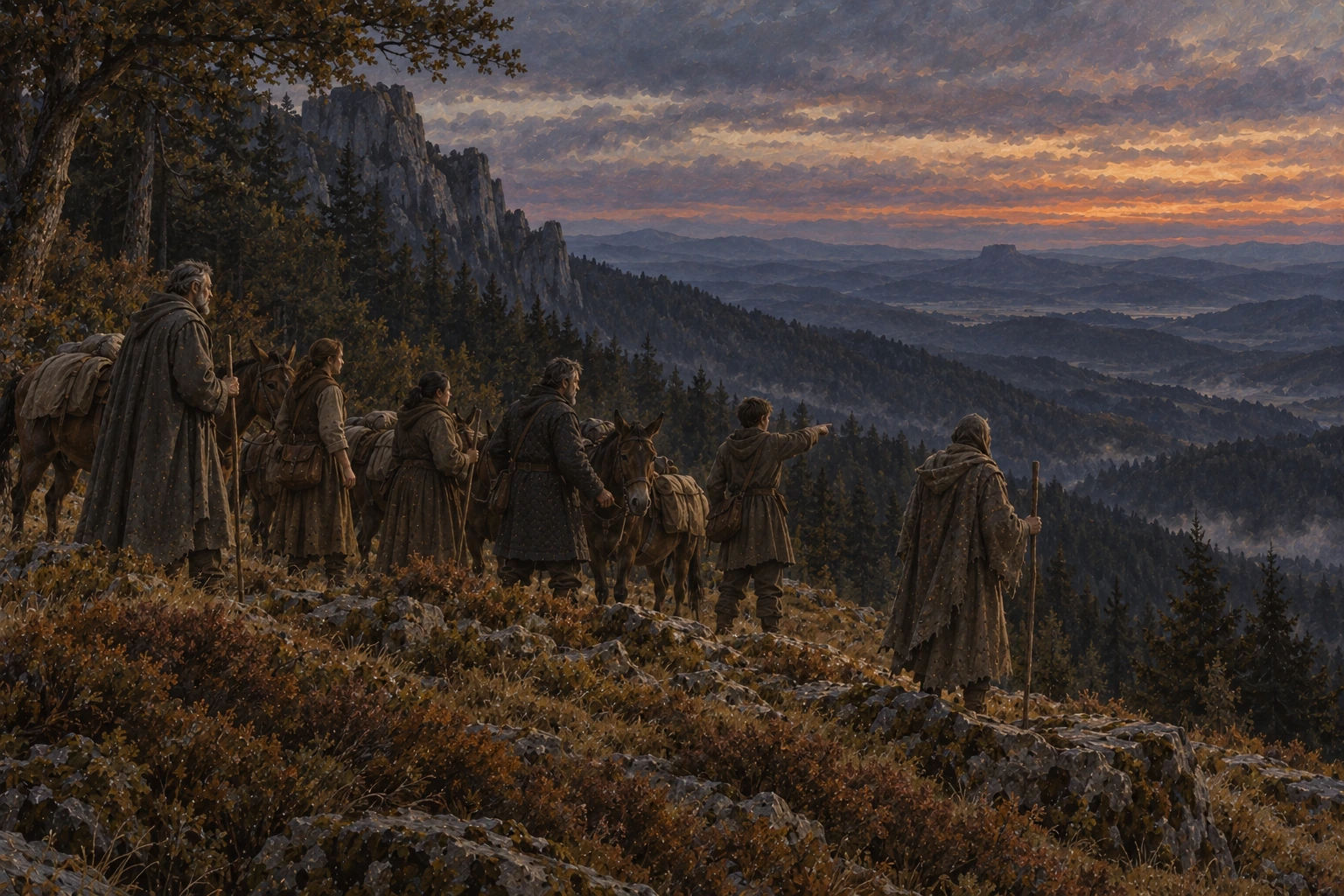
The climb crested onto a long shelf of open ground before the trees closed again, and from there, for the first time since the keeping, the company could see west and down into country that fell away in dark folded ridges toward a horizon gone the color of an old bruise with the sun somewhere behind it. Pip stopped without being told to, the way he always stopped for a view before anyone else had decided the view was worth stopping for, and pointed, not because anyone needed the direction shown but because pointing was what his hands did with a thing his eyes had already claimed. Far off, alone among a scatter of lesser hills, one shape stood darker and squarer than the rest of them, unlit, unremarkable to anyone who had not carried its name two years and a country. Luel's eyes found it a half-second after Pip's hand did and stayed on it a moment longer than the rest of the company gave it, and then she walked on, and the company walked with her, and the hill went on standing there behind them the way it had stood for three centuries, dark, unanswered, waiting on nothing that any of them could give it that morning.
They reached the eaves themselves a little before the light went. There was no gate, no wall, nothing that announced a boundary crossed — only the trees thickening once more into a stand old enough that its crowns had begun to meet overhead in a true roof, and under that roof, set low and grey and unglossed among the trunks, the first shapes of dwelling: timber and undressed stone, roofed in bark and turf rather than shingle, none of it larger than it needed to be, none of it built to be seen from any distance at all. Smoke rose from perhaps a third of the chimneys. No lamp burned in any window that Wren could see, though the light inside some of the doorways suggested fire enough for warmth without any wish to advertise it further.
They were not greeted at any door. They were simply, at some point in the last hundred yards of the approach, no longer alone among the trees — a handful of figures standing at odd measured distances among the trunks, not blocking the path and not stepping onto it either, watching the company come on with the patient, unsurprised attention of people who had known exactly how long the climb would take before the company had known it themselves. Most of them did not stop what they were doing to watch. A man planing a length of ash went on planing it. Two women carrying a loom-beam between them carried it past the hurdle without breaking stride, and neither so much as glanced at Iyene's face, which struck Wren, once she had noticed it, as its own kind of answer to a question nobody in the company had asked yet. Farther in among the trees a forge stood open-sided and lit, its hammer going in a steady, unbroken rhythm that did not falter for the company's arrival any more than the loom-beam had; nearer the path, someone had left a net half mended over a low rail, the bone needle still threaded through the last worked row, as though the mending would simply resume the moment there was time for it and not one moment before. Nothing about any of it looked built to be admired. It looked, Wren thought, like a place that had been getting on with its own work for longer than anyone's arrival could interrupt.
Luel stopped a dozen paces short of the nearest of them, an old woman with a single white braid laid forward over one shoulder and hands folded in front of her the way a person folds hands they have decided, for now, not to use for anything. Neither of them moved for what felt to Wren a very long moment and was probably closer to three or four breaths. Then the old woman spoke, in the common speech rather than in the song-tongue Wren had heard Luel use only twice in two years, as though the words were being chosen deliberately plain so that none of the company standing behind Luel would miss a syllable of them.
"You went," she said. Not a question. Not, as far as Wren could hear in it, an accusation either — only a fact laid down the way Iyene laid down a bearing, flat and exact and offered without apology for its own weight.
"I did," Luel said.
"For how long, this time."
"I have not counted it. I have not counted anything, this while." Luel's voice held steady, but something in the set of her shoulders had gone the way Wren had seen it go only once before, at the door of the school two years and a country ago, still and careful in a way that cost more than it showed. "I am not certain that not-counting was a virtue in me. I have had a great deal of time on the road to wonder."
The old woman looked past her then, at the company, at the hurdle, at Iyene's face turned sideways against the bedding with her eyes open and watching everything with the same flat attention she gave a coastline that had come out a degree off true. Whatever passed across the old woman's own face at the sight of Iyene lasted less than a breath and left nothing behind it that Wren could read. "You have brought us a broken thing," she said, to Luel and not to the company, "and asked us to mend it, and I expect you have not told them yet what mending we do and do not do here."
"I have not had the chance," Luel said, "and I would not have told them wrongly if I had."
"No," the old woman agreed. "You never did tell anything wrongly. That was never the trouble with you." She turned then, at last, and looked directly at Wren, the first of the company she had chosen to look at by name of face rather than by group, with an attention that felt less like welcome than like a ledger being opened to a new page. Behind her, a broad grey-bearded man had already come to stand at the hurdle's foot and was looking down at Iyene with a professional, unsentimental interest that reminded Wren, oddly, of Dorrit at her most useful. "Bring her in before the cold settles. The rest of it can wait for firelight."
They laid Iyene on a low pallet in the largest of the timbered houses, a single long room with a hearth at its center and smoke finding its own slow way out through a vent in the bark roof rather than a chimney proper, and three of the Amarin — the white-braided woman and two others, the grey-bearded man and a younger-seeming woman whose age Wren gave up trying to guess after the first look at her eyes — went over the injury with hands that were sure and without haste and entirely without ceremony, pressing along the hip and the dead leg exactly as Dorrit had, exactly as thoroughly, and arriving, after a silence that went on rather longer than Dorrit's had, at very nearly the same answer. Dorrit herself stood at the pallet's foot through the whole of it with her arms crossed tight over her chest, watching their hands.
"The hip will knit crooked, if it knits at all cleanly," the grey-bearded man said, to the room in general, in the tone of a man reporting weather rather than delivering news anyone wanted. "The leg answers nothing below the knee and I would not promise you it ever will. We can slow the worst of what's coming — the fever, the wasting, the rot that follows a wound like this if it's left carelessly — better than most, I'll say that honestly, because we have had three hundred years of nothing else to practice on but our own dying. We cannot give her the leg back. I would not have you carry false hope up this hill a second time on my account, when the first climb already cost you what it cost."
"I did not come for false hope," Iyene said, from the pallet, in the same flat voice she had used since the doorway at the keeping. "I came for an honest count. You have given me one. Thank you."
Alder, standing near the hearth with his hands loosely clasped and his weight settled the way it settled when he meant to say something that would not be easily taken back, waited until the three Amarin had finished and stepped back before he spoke at all. "There is a thing beyond her care that we came up this hill hoping to ask for," he said. "You will have heard, by whatever road your own news travels, what is happening in the east, and what is beginning to happen along the line your own people tended once beside Meddan's, hill by hill, before the frost closed it. We do not ask lightly. We would not have carried a broken woman four days up a mountain and asked lightly."
"We know what is happening in the east," the old woman said. "We have known it longer than you have, in all likelihood, and by a road that owes nothing to riders or letters." She did not soften the answer that followed it by so much as a breath of delay. "We do not leave the eaves."
"Not even now," Bracken said. It was not quite a question either.
"Not even now. Not for the east, not for the line, not for Kelder standing dark these three hundred years while we sat close enough to smell the smoke it used to carry." Something in her voice, when she said the hill's name, had weight to it that the rest of the sentence had carefully not shown. "It is not a preference we hold today and might hold differently tomorrow, that you could argue us out of with a better argument than the one you have brought. It is what we are. A tree does not leave its own root system to go and stand somewhere the wind has need of a tree. We would not be ourselves, past the tree-line, in any way that would do you good if we went."
Bracken looked as though he meant to press it once more, and the grey-bearded man spoke before he could, not unkindly but without leaving any room in it either. "We have heard the argument before this evening, soldier, in every shape a clever tongue can give it, across more winters than your whole charter has years. It does not improve with a fresh telling." Bracken shut his mouth on whatever he had been about to say, and the muscle in his jaw worked once, and he said nothing further, which cost him, Wren could see, a good deal more than silence usually did.
The old woman let that sit a moment, and then, without turning her head, without any change in the level plainness of her voice, she added, "Some of us have gone anyway, from time to time, across three centuries. That has not made the ones who stayed wrong to have stayed."
Whether that last sentence had been meant for Luel went unasked and unanswered. Luel herself said nothing at all, and stood exactly where she had stood since the doorway. The fire between them popped once and settled, and stayed low.
Wren did the arithmetic herself, that same night, sitting apart from the others with the day-book open on her knee and the fire's light just barely reaching the page, and she did it not because anyone had asked her to but because it had been sitting half-finished in her for three days and would not let itself go unfinished a fourth. The long room had gone quiet around her — Pip asleep near the hearth with his sketch-case still under one arm, Dorrit sitting with her back to the wall a little apart, awake but silent, watching the pallet the way she had watched it since they arrived.
Iyene gave her the first number without being asked, from the pallet, in a voice that had found, for just this, something almost like its old precision back. "Fourteen months," she said. "That was the figure at Thistleton, and nothing since has moved it more than a week either way. Fourteen months from the frost's first break in the east to a countryside with no one left in it who remembers to burn its own dead before dark. We are some months into that clock already and cannot buy back the months we have spent, only the ones ahead of us." She paused, and when she went on her voice had dropped into the register she used for a thing she had said before and would not enjoy saying a third time. "Every week we are slower than we might be is not an abstraction. It is a number of towns that do not learn in time what Thistleton learned too late. I have given you that number twice already, in two other rooms. I am not going to be able to give it to you again after tonight, so I would rather say it once more, plainly, while I still can."
Wren wrote the figure down, though she already carried it, because writing it steadied something in her hand that speaking would not have.
The second number she had to find herself, and she found it exactly where she had known it would be, in the fold of the torn page she still carried from the cooper's town: thirty-seven names, unspent, four cleared against forty-one found, and every mile she walked west without spending herself down to nothing was a mile bought against some later town's ledger at a price only she could set, and no other soul could pay it in her place. She had learned, since Thistleton, precisely how much of herself a single clearing cost and precisely how much recovery a single night's rest bought back, and the two figures, set against each other, made a plain sum: she could go fast, and arrive spent and useless for whatever waited at the end of the road, or she could go carefully, and arrive whole, and arrive later, and the lateness was not free either. It bought funerals of its own, priced in Iyene's own first number.
The third clock had no figure attached to it at all, which was what made it the worst of the three. Somewhere ahead of them the Gray Stair would shut with the first real snow, the way it shut every year of every life anyone in that room had ever lived, and no council had voted for that closing and no enemy had set it as a deadline to be argued with or bought off or outwaited. It would simply happen, on its own schedule, indifferent to whichever of the other two clocks the company had chosen to serve, and whatever stood on the wrong side of the mountains when it happened would stand there alone until the thaw, however that argument between speed and cost had gone in the meantime.
Alder came and sat near her while she was still looking at the page, not to speak, only to be near the counting, the way a man sits near a fire he has already decided he cannot make burn any hotter than it is burning. He looked at what she had written and offered no correction, which told her more than correction would have.
"They pull against each other," Wren said, finally, not quite to him.
"They do."
"Nobody has told me which one to serve."
"No," Alder said. "I do not think anyone can, honestly, and I would trust less any man who told you he could." He was quiet a moment, watching the fire rather than the page. "You will serve all three badly, some days, and one of them worse than the others on the days you are tired, and there is no arithmetic waiting at the bottom of this that comes out clean. I am sorry for it. I would give you a cleaner sum if I had one to give."
She closed the book without answering him, because there was, for once, nothing true left to add to what the numbers had already said better than either of them could.
They left in the grey hour before true morning, because Bracken judged the cold cleaner for walking than the thaw of midday would be on ground none of them yet knew, and because none of them, if they were honest about it, wanted the leaving stretched out past the length it needed.
Iyene had asked, the evening before, to keep her instruments — the travel-glass, the folding rule, the pocket-book with its two years of her own hand in it — rather than pass them on. "I am not finished working," she had said, flatly, when Dorrit had looked at her as though about to suggest otherwise. "I have a hill and a valley and three hundred years of people who have gone all that while without anyone to measure them properly. I intend to make a start on it from this pallet, if my hands still answer, and I will not do that with borrowed tools." What she gave over instead, the last thing she did before the light was fully up, was smaller and stranger than any of them had expected: her spare reading-lens on its cord, pressed into Pip's hand without ceremony, and one sentence of instruction — hold it a hand's width off the page, not closer, no matter how small the mark — delivered in exactly the voice she had used to correct his angles for two years, so that for one moment the leaving did not feel like a leaving at all, only like the next morning's lesson arriving slightly early.
The mules were loaded in the same grey light, Barrow and Gable first as always, Suet fretting under his girth the way he fretted every morning whether the load was heavy or light, and Nettle biting Pip once, hard, on the forearm, for no reason anyone could find, which felt, this particular morning, almost like a mercy — one ordinary small cruelty in a morning that otherwise had none of the ordinary left in it. Bracken knelt by the pallet last of all the men, and offered nothing about the shoulder or the road or the carrying, only set one hand flat and briefly against the pallet's frame, near her good shoulder, and took it away again, and that was the whole of it between them. Luel stood a little apart, her own people close enough to see her standing with the company rather than with them, and said her farewell to Iyene in the song-tongue, low and short, three or four notes more than words, which Iyene received with her eyes closed and did not ask to have translated.
There was no speech, and no promise that they would see her again. The not-reaching sat over the little clearing outside the long house more plainly than any spoken goodbye would have. Dorrit knelt beside the pallet a long moment and did not touch the splint at all. "You'll want to be walking when we come back through," she said. "I'd not have you comfortable in the meantime." Wren watched the two of them and thought, watching, that this had been the moment when something between Dorrit and herself might have been set right too, if either of them had reached for it — and neither of them did, and the gap between them left the clearing exactly as wide as it had been on the beacon road, uncrossed, unclosed, carried west with the rest of what they carried.
They were an hour down the far slope, the eaves already lost behind a fold of trees, before the hole made itself plain. Pip laid out his sketch of the ground they had crossed the way he always laid it out, propped on his knee at the noon halt, and waited, the pencil still a moment in his hand, for the small correcting sound that had come at exactly this point in the work every day for two years — an angle to be adjusted, a distance to be squared against a pacing count nobody else in the company knew how to keep. It did not come. He waited a breath longer than the waiting needed, and then he finished the page uncorrected, the far ridge drawn a hair too shallow, the distance between two landmarks left to guesswork rather than measurement. He closed the case. He made no mention of it to anyone. No one asked him to.
They camped that night on a shelf above a long dark stretch of water that Bracken judged, by ear and by the flatness of the wind across it, to be a lake rather than a river, though none of them could see its far shore in the dark to be certain of anything more than its sound. The fire burned low and was let burn lower, because for the first night in nine days there was no argument for keeping it high, and one by one the shapes of the company settled into their bedrolls around it, Dorrit last, as always, checking the pickets before she too went still and breathing evenly within the hour.
Wren lay awake past all of them, on her back with her eyes open to a sky gone fully dark and close with stars, listening to the water she could not see move against a shore she could not see either, and it was some while into that listening — she could not afterward have said how long, nor had she tried to measure it — that she heard, thin and carried strangely across the flat black distance of the lake, a handful of notes strung together in a shape her own hands had not been able to hold for two years.
She did not sit up. She did not reach for anything, not the fiddle wrapped and silent in its case at her side, not Dorrit's shoulder an arm's length away, not even the breath she might have used to say a name into the dark. The notes came again, farther and thinner the second time, or perhaps only harder to hear over the sound of her own blood, and then the water took the sound the way water takes any sound eventually, folding it back into itself until there was only the lake again, moving against a shore she could not see, and the stars, and the small ordinary sounds of five people breathing around a fire burned down to almost nothing.
She lay there a long while longer with her eyes open, the fiddle case cold and unopened at her side, and around her the five sleeping shapes of the company breathed on into the dark, unwoken, exactly as they had been breathing a minute before.