The Assessor's Winter
Ink that has stiffened in its well does not announce itself. It goes down looking the same as it always does, and shows what it truly is only a stroke later, when a line that ought to run clean and thin comes off the nib fat, or skips, or stops half drawn, because the cold has thickened it past the point where a hand can feel the difference before the damage is already on the page. Three ruined lines into the fair copy's second sheet, Iyene set her pen down and said, in the flat voice she kept for facts rather than complaints, that the room would have to be got properly warm before another stroke went onto good vellum, and that getting it warm would cost fuel the house was counting by the day.
Bracken heard the arithmetic out once, standing in the map-room doorway with an armful of split wood he had not yet decided where to put. Wintergarth burned through a winter's wood at a rate the twelve ledgers themselves recorded, year on year, close enough to trust; a fire kept high enough, long enough, in one room to let ink run true would eat into that reckoning at a pace he could have named to the day, if anyone had wanted it named. Nobody wanted it named twice. He carried the wood in, built the fire up past what the room usually needed, and did not raise the matter again for the rest of the winter — a concession made once, in his own working voice, and never argued after, himself included. He shifted his grip on the last split log as he set it down, favouring the left arm without seeming to notice he was doing it; the skin above his wrist had stayed the frost-white it had gone the night at the gate and had never warmed back to its own colour since, and he changed how he carried a weight to spare it the way a man changes how he steps to spare a bruised heel, without comment from him or from anybody watching him do it.
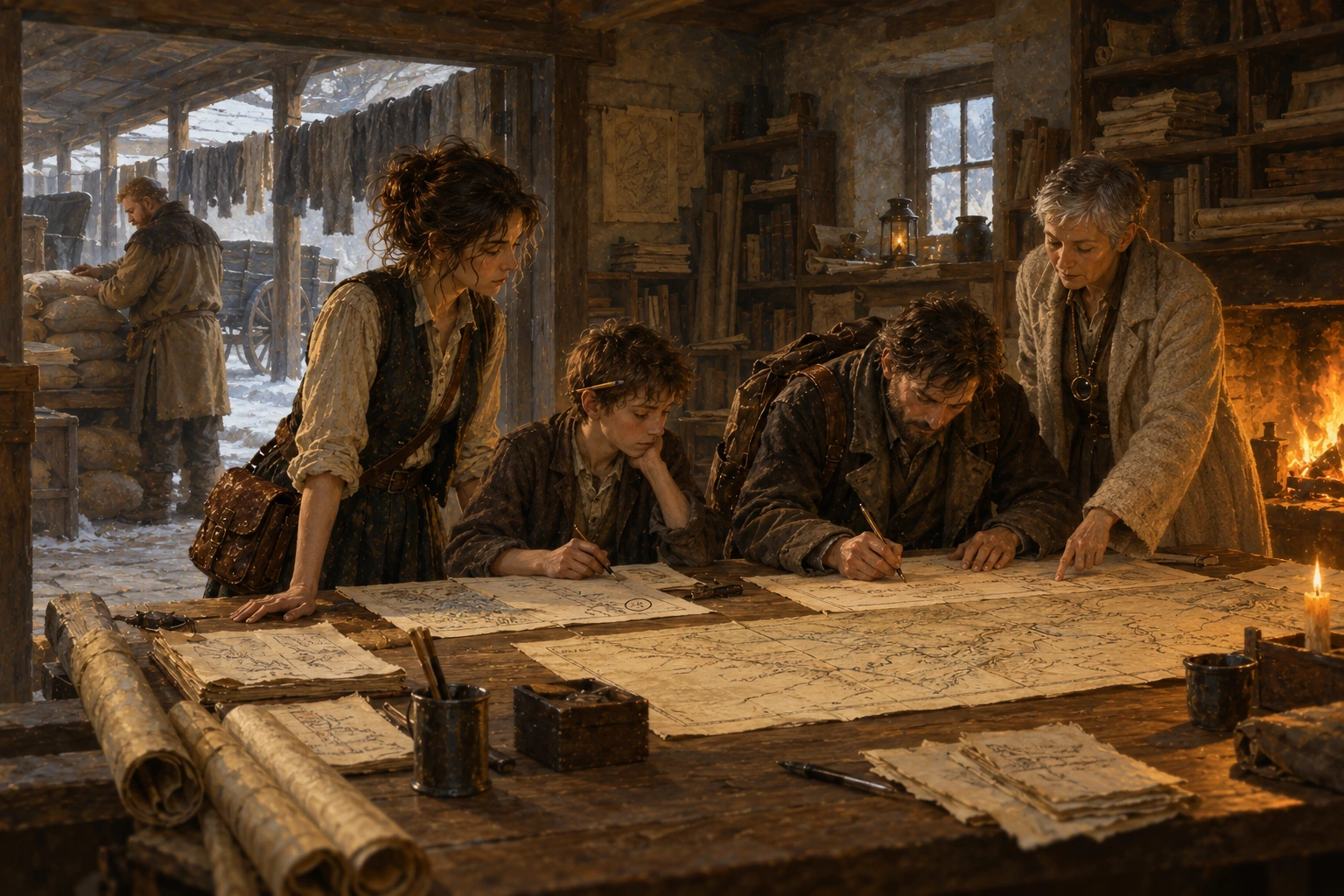
The map-room had been Iyene's since autumn and was, by the second week of true cold, Marle's as much as anybody's. The master sheet — six of her own working leaves, pasted and weighted true, corrected over two years of walking country nobody east of the mountains had walked in three centuries — was too valuable and too fragile to travel; a fair copy would go to the College's own chests instead, ruled and lettered clean enough for a clerk who had never set foot west of Merrow to read without a guide standing over his shoulder. Marle's hand was the best in the house, and he said so without vanity, the way a man states a trade fact that happens also to be true: twenty years of rendering tallies a court might have to read had left him precise in a way no one else at that table had ever had reason to become. He ruled the sheet's margins and lettered its names; Iyene stood at his shoulder and corrected the substance, a phrase here, a distance there; Pip drew.
The division held for three weeks without a word needing to be said over it, the three of them at the long table most mornings while the rest of the house moved around them — Osric counting sacks of meal against twelve mouths in the next bay, a voice somewhere down the through-road arguing a point of construction with nobody in particular, the smell of the fire Bracken had built too high mixing with wet wool drying on a line strung the length of the goods-bay. Pip's face had been his own again for some weeks now, and the house let it be, without comment. Then, copying a bearing off the fourth working leaf, Marle set two figures down reversed — a transposition small enough that Iyene, reading past it twice, missed it both times. Pip did not. He laid his own leaf beside Marle's, the true figure ringed once in a corner where nobody but the man reading it would ever see the ring, and went back to his own drawing. Marle looked at the two leaves a long moment and entered the correction himself, in his own hand, rather than have the sheet taken up and redrawn from the fault. In a trade built on rendered returns that a court might one day have to trust, a man correcting his own error rather than concealing it, or worse, letting someone else's clean hand quietly replace the evidence of it, was the whole of the compliment his craft knew how to pay.
Alder tested her the way he had tested her most days since the column of dates, without warning and without ceremony, in the middle of whatever the room happened to be doing. "Who's behind you," he said once, mid-morning, not looking up from the leaf he was reading, and Wren answered without turning: Dorrit, at the hearth, two strides off; Pip beyond her at the table's far end; nobody at her own back closer than that. She was right. Two days later he asked it again, differently — who stood nearest the door, who farthest, who between — and she gave the room back to him whole, without looking, and got that right too. Alder said only, "That's twice," and went back to his own work, though it was the first time since the ledger's own morning that she had passed the test at all.
The paper problem came to the table on an ordinary evening, raised by Iyene the way she raised everything that mattered: as a fact about paper rather than a fact about anyone's feelings. A survey sheet drawn by a chartered party that had been out of contact with its own College for nearly two years, carried east by one man, arriving with nothing behind it but its own makers' word, was not proof of anything. It was a claim, and a claim went into a chest and waited there for confirmation that might be a decade coming — while the council's word from the autumn, signed by three and witnessed by nine and unsigned by the one man in the house whose signature the law would actually credit, carried exactly the same defect, and worse. What would answer it, she said, was an assessor's countersignature: the very line that had run blank on a salvage warrant once, and broken it. Iyene did not explain the connection; she looked once at Marle and let the silence finish the sentence for her.
"I cannot give you that," Marle said, and it was final rather than cold, delivered in the same register he used for every figure he had ever entered in a ledger. He had not walked the ground the sheet claimed. His own circular — the one Iyene herself had carried east and could quote back to him now from her own copy, word for word, without troubling to consult it — forbade him to endorse any route, holding, or site west of the province gate until it had been walked and found masterless in fact, not merely in form; any tally rendered ahead of that finding was rendered without him. "You are asking me to break the argument that saved a town," he said. "I would not do it for a warrant, and I will not do it for a map, however much better a case the map makes for itself."
"I'm not asking you to break it," Iyene said. "I'm asking what you can honestly sign, that isn't nothing."
That, he allowed, after a moment, was a different question, and one he had not yet decided he had an answer to. "Give me the terms of your own gate again," he said, "the ones you had me agree to before I ever slept a night under this roof." Iyene did not need to reach for the paper; she gave it back to him from memory, word for word, the same terms she had set him the evening he arrived, and he heard the whole of it out without interrupting, and said only that he intended to keep every clause of it exactly as given, whether or not anybody in the house thought to check that he had, though by then nothing in the house looked like a thing that still needed checking.
Marle offered the circuit-book himself, unasked, some way into the second week of the negotiation — the first thing he had volunteered since he had walked in off the north road with nothing on his back but what he carried there. An assessor's office ran on rendered returns: a rider walked a circuit at a fixed interval east of the province gate and rendered a tally at the end of it, and the interval was the whole of the discipline. His own book carried the past summer's circuits — the ten-day round out of the gate, the longer swing that touched Aldwick and came home by way of Millgate — and which of them had rendered on time, which late, and which not at all. At the time he had entered the failures as ordinary attrition: a bad season, a rider who quit without notice, a road washed out by weather that would mend by autumn. Of eleven circuits run that summer east of the gate, four had come in short — one late by a week, three not at all — and Mercer, his clerk, had noted each against the standing form in the same hand he noted everything else in, without a mark to say any one of them troubled him more than the last. He had not commented further, because commenting was not his trade, and had said so plainly when Iyene asked him why the book had sat closed in his pack for a whole winter before he brought it to the table.
The finding, when Iyene laid his dates beside her own four lines in the map's blank eastern quarter, was drier than her own and worse. Her column recorded one autumn silence, relayed twice removed, unwalked, unconfirmed. His recorded a whole season of them, first-hand, kept by a man with no theory to fit them to — and the failures did not scatter evenly across the summer. They clustered, and the cluster began earlier than the autumn her own silence belonged to. Iyene entered his dates beside her own, in the same sparer hand, with the same discipline: provenance stated, not walked, not confirmed. Two entries now, from two different trades, agreeing without either of them having compared notes until this table. She did not draw a line east of the province gate. She never would, on this evidence or any she had yet been given. Marle, asked plainly what he thought the cluster meant, said he did not know and would not guess, and had held that position since the night the whole household sat in council over it, and held it now for exactly the same reason.
Luel's lessons ran alongside all of it, short and physical, the carrying rather than the naming. She had Wren carry a filled water-yoke the length of the through-road and back without setting it down, twice a week, correcting a shoulder or a stride and saying little else while she did it. "You are not carrying water," she said once, the yoke's ropes cutting a line Wren could feel through her coat. "You are learning what a weight feels like at the hour you stop noticing it is a weight, because that is the hour it starts costing you something you cannot see going." Another day she watched Wren set the yoke down at the through-road's end, said, "Better," and walked back up the road ahead of her. A third day she simply took one end of it herself for the last stretch, without being asked and without explaining why, and let go again at the door. There was no lore in any of it, no old country named, no word given for anything: it was carrying, drilled daily, the way any working skill is drilled.
Bracken raised the stores problem the way he raised every stores problem, flatly, at breakfast, with figures rather than complaint: twelve mouths and four mules did not winter on what seven and four had planned to carry, and the goods-bays were near their limit, and the house had a dry cold-room three centuries deep, barred since the very morning of the fight that cleared it, that nobody had gone down into since. Deep winter changed the arithmetic; something had to give the house more room, or the room they already had would have to hold more than it currently could.
Sim carried the bar itself out to the yard once it was off, said it would do for kindling and nothing better, and went back to his own work without being asked twice. The bar came off the door on a bright, hard morning, for the first time since the winter-bred were burned on the ground past the far gate. Alder went first with a lamp, then Bracken, then Wren, with Dorrit and Iyene at the stair-head above, a sheet of paper and a pencil already in Iyene's hand. The stair itself ran narrower than the through-road above it, worn to a shallow trough down the centre of each tread by feet long since gone to dust themselves, and the lamp-light climbed the walls in a small moving circle that never quite reached the corners. The stone was cold in the plain way stone is cold; it smelled of stone and nothing else, and every breath came back visible in the lamp's light before it thinned into the dark above. Wren's task, set for her flatly by Alder the evening before, was to name the ground — the stair, its head, and the door, and no more of the house than that — and to hold it named while the space below was searched and cleared.
She had the house's own twelve ledgers brought down beside her and read the names off their own pages rather than out of memory, laying each one down the way a mason lays a course of stone: three centuries of men and women who had stood this house's watch, one after another, their offices and their years and the last ordinary thing any of them had thought worth writing before their watch ended. R. Denby's name came up among them, in its turn, no different from the twenty names before it or the twenty after. She gave it in the same voice she had given the twenty before it, and the work went on.
The edges closed. Nothing moved. There was no sound in the dark beyond the party's own footsteps and Bracken's lamp finding a fallen barrel-stave, a crate gone soft with damp long since dried out of it, a stretch of floor dry enough to plan a store on. Somewhere above them a mule shifted in its stall, hooves loud through the old stone. Bracken worked the room methodically, corner by corner, the way he had worked every unwalked room since he was a boy learning the trade off older soldiers who had not all lived to grow old themselves, and said aloud what he found as he found it, so that Iyene's pencil above never had to wait on him. They searched the whole of the near undercroft in under an hour, found it empty of anything but dust and old air, and climbed back into daylight having met nothing at all — which was the entire point of the morning, and which Wren found harder to feel easy about than she had expected to.
Iyene met them at the stair-head with her sheet already ruled into a plain table, and did not ask a general question of the room. She asked each of them, one at a time, for something specific: a name they had carried down, a word of their own trade, the thing Bracken had told them to hold ready if it came to that. Bracken gave back his own name and Dorrit's and the mule Suet's, all whole; Alder gave back the stair's name exactly as Wren had set it, unprompted; and Wren gave back all twelve ledgers' worth, in order, without missing one. Nothing was missing. Iyene wrote that down too, in the same hand she used for everything else, and closed the sheet.
By supper Wren was tired in the ordinary way a day's work tires a person, and ate what was put in front of her, and went up early. By the next morning she was herself. Against the night at the gate — when she had not been able to hold a pen the day after, could not get warm, and had been useless for nearly two days running — the figures Iyene set down beside each other in her own ledger told their own story and wanted no comment laid over it: hours, this time, instead of days.
She said only one thing about it, flatly, over supper that evening, with the spoon still in her hand. "Doing a thing I chose, in a room I controlled, against ground that wasn't fighting me — that isn't the same as the other thing. I know the difference." Alder, across the table, did not tell her she was wrong, and did not tell her it would be easier the next time, or that she had done well; he said only, "I know," and went back to his bread.
Alder waited until the ledgers were back in their case and the others had gone up the stair before he said anything about it at all.
"That is the first one you have closed clean."
"I know."
"Then I will tell you the other thing now, while you have no reason on earth to want it." He set his hand flat against the cold of the stair wall. "There is a faster way to do what you did tonight. It does not want an hour, and it does not want the edges. It wants about half a second."
Wren waited.
"I will not teach it to you and I will not describe it to you. You will find it yourself, if you are ever frightened enough, because it is not difficult. That is the whole of the trouble with it." He took his hand off the wall. "It is not difficult, and it works, and there is nothing anywhere inside it that stops."
"Stops where?"
"Anywhere," Alder said. "You would learn where it stopped afterward. If you were there to learn it."
He went up. Wren put the last of the ledgers into the case and closed the lid down on them and stood a while in the cold with the lamp.
The first exchange between Iyene and Dorrit came early that same week, short and without warning. Iyene, passing through the kitchen with her sheets under one arm, stopped at the table long enough to say that she had entered a correction into her own gate-day notes — the terms she had set Marle in writing the first evening of his arrival now carried a line beneath them, in her own hand and dated, stating that the assessor's ledger had proved of use to this house across the winter, and that she wished it recorded so. She offered it as a fact entered into a record, nothing more, and did not wait for an answer. Dorrit, elbow-deep in a bowl of oats, said only, "Took you long enough," not gently, and went back to the oats.
Marle's own attestation was settled in one sitting in the same cold room, and it did not take long. Iyene proposed the first wording herself, aiming high because she believed the house deserved the strongest paper it could honestly get: that the ground recorded upon the sheet had been surveyed with due care by a chartered party and found to be as represented. Marle read it once and set it down. "That endorses content," he said. "I have not walked the ground, and I will not put my name to a claim about it, however carefully you have dressed the claim."
Her second offer came narrower: that he had been present at the sheet's making, and that its working leaves had been drawn from ground each maker had walked. Marle took a pen to it himself before he would agree to sign anything built on it — the first cut — striking walked and setting reported walking above it, because even that much, he said, was more than he was entitled to swear to on his own authority; a maker's own word for her own boots was the maker's to give, not his to borrow. Iyene let it stand. Then, satisfied the wording would hold, she offered one closing clause of her own, small and warm and reasonable on its face — that the house itself believed the sheet sound — and Marle struck it a second time, flatly, the cut that cost him something and the only one he hesitated over before making: whatever the house believed was the house's to say, in its own hand, and not his to lend his own name to holding up. In its place he added the one clause he judged himself plainly entitled to make: that he himself had walked, and could himself attest to, exactly one stretch of road recorded upon the sheet, and no further mile of it than that.
He wrote it out fair, in the hand Iyene herself had watched teach a whole sheet its letters, a fresh nib set at his elbow before he had to ask for one:
I attest to the following, and to nothing beyond it: that I was present in this house through the whole of the winter's making of this fair copy, and watched it made, leaf by leaf, from the working sheets of Iyene Sath, Cartographer-Royal. That its makers are the persons named in their own charter, and no others. That the working leaves were drawn from ground their makers report having walked, on their own word and no other's — which is the whole of what I am able to say of the ground itself. And that I myself have walked, and can myself attest to, one stretch of road recorded upon this sheet: the north road from the province gate to this house's own gate, and no further mile of it than that, in either direction. I do not endorse the ground. I endorse the sheet, the road under my own boots, and nothing further. — Marle, Assessor.
Iyene read it through twice, said nothing about the man, and allowed herself exactly one line about the instrument: that she had drawn a great many countersignatures in her working life and had rarely seen one that gave away so little and settled so much. It was, Wren thought, watching the ink dry, the same countersignature line that had once run blank on a warrant and cost a man his claim on a whole town's own cups; filled now, in a hand that would not say a word more than it had earned the right to say, it would ride east answering to the west instead of the other way about.
Pip signed his own sheet two mornings later, at Iyene's instruction, given in one flat sentence: it was his work, and a maker signs his work. He wrote his name in the corner as he had written it on every fresh sheet since the coomb, and then a second time, under his own drawing on the fair copy, in the place where a maker's name goes, in full — Pip Sandover — the letters even and steady, and set his pen down. He went back to ruling the sheet's next line as though it were any other morning's work.
The second exchange came weeks later, the day's light thinned by the week to a handful of grey hours and shortening still, close enough to midwinter now that the household's evenings had begun filling, in a small unspoken way, with wax husbanded against the feast and stores counted twice for the same purpose, and one running disagreement among the four Ashcroft arrivals over which of their own songs the night ought to open with, settled by nobody and revisited most suppers — Marta asking Dorrit, one evening, whether a particular dried root would want soaking before the feast or after, and being told, at some length, that it would want both; Thomasin recounting the wax stubs after Osric's own tally disagreed with itself twice running, both of them blaming the lamplight rather than each other. Dorrit found Iyene at the map-room table one evening, sorting the last of the fair copy's spare leaves, and set a mug of something hot at her elbow without being asked. Iyene said, without looking up, that the tea was appreciated. Dorrit said, "It generally is," and went back to the kitchen.
Iyene kept the figures on a single sheet at the table's corner, updated after every working since the night at the gate: how long it had taken Wren to come back to herself, each time, counted first in days and then, gradually, in hours, the column running downward across the whole width of the page, one unbroken line with nothing else drawn anywhere beside it. Wren found it there one evening and read it over Iyene's shoulder: days shrunk to hours, week on week, a whole winter's teaching drawn as one falling line. For the first time since the night at the gate, she went up to bed carrying something that was not fear.