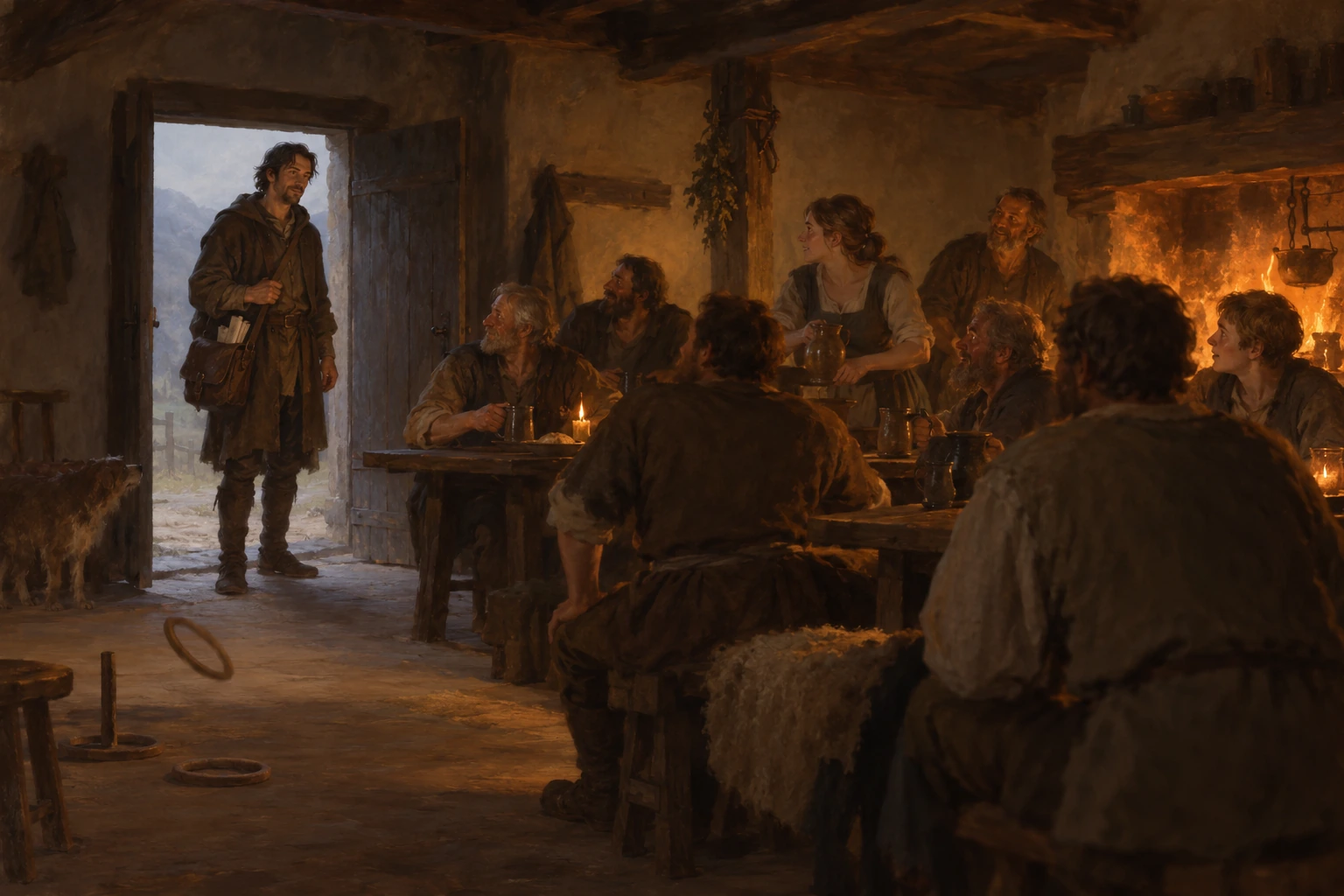
The Grey-Cloaked Guest
One morning the fields under the Cloudwall stood gold and upright and full of larks, and the next the reapers were out along the west road with their scythes swinging in that low easy rhythm that looks, from a distance, like men bowing to something none of them can see. By the third morning there were stooks standing in rows like a market-day crowd caught mid-conversation, and the air had gone thick and sweet with cut stalks and dust, so that even the bees at Fallowmere seemed to fly a little drunk on it, weaving home heavier and slower than their clover-runs in June.
It was into this week, four or five days after the fair had packed its awnings and gone, that the stranger came, and word of him reached Fallowmere the way word reached Fallowmere about anything not already known to every soul in Dall by breakfast: sideways, and improved in the telling. A man on foot, with a stick and a grey cloak despite the weather, who'd paid Hobb for the week entire in good coin and hadn't said what his business was, though Hobb had asked him four different ways.
"A wool-buyer," said Dorrit, already certain. "Or a tax man, though a tax man generally announces himself before he's finished his first pint. This one thanked the Widow Callow for her bread twice, and asked could he have the making of it, which she thought very odd indeed. A poet, then. Either way I mean to have a look at him before the week's out, and so does everyone else in Dall."
She was, on this point as on most, entirely correct. By the end of that same day the man at the Bridge Inn had become valley property, a subject everyone had an opinion about and nobody had actually asked — very likely no good at all, according to Naith Ambry, though Naith allowed this was what he had said about the last three strangers through Dall, two of whom had turned out harmless and the third his own future son-in-law.
Wren saw him before she met him. She had gone down to the bridge on an errand for Granna Tansy, and there, on the low wall above the water, sat a man with his boots off, set beside him heel to heel, working a leather strap through his fingers, mending something that had given long service and deserved better than a quick job. He was perhaps fifty, or looked it; dark hair going iron at the temples, a plain coat gone thin at the cuffs the way cloth goes when it has crossed more country than closets, and hands ink-stained at the first two fingers, in the grey-black way that comes only from years at a nib.
He looked up as she passed, not quickly, and said good morning to her in a voice that had traveled a long way and worn agreeably smooth in the traveling. That was all that passed between them. She was most of the way home again before she found she was still turning over the fact that his boots had been worn nearly through at the sole, on both feet, evenly, the way boots wear on a man who has walked a very great distance in a very straight line.
By the second day he had a name, and the valley had given it to him with the speed it gave nicknames to anyone who stayed longer than a market-day.
"Alder," Dorrit reported, arriving at Fallowmere's kitchen door with a basket of beans and news enough to fill an evening twice over. "Master Alder, he says, though he says it like a man tired of correcting people on it. A scholar, of some college of roads, down in the south, which nobody here has heard of and which he doesn't seem the least put out about. He held the ladder while Hobb saw to the loose shingle over the taproom, which nobody's asked him to do in four years of that shingle being loose, and got the whole history of the bridge out of him besides, and thanked him for it after, proper thanks. I'll tell you" — she set the basket down with a thump — "he is the easiest man to like I have met since your grandfather, rest him."
"A college of roads," said Granna Tansy, from her chair by the window, and went on with her mending: the one person in the kitchen not the least surprised by any of it.
He asked about roads all that week, not urgently but steadily, so that by week's end half of Dall had fielded one question or another and none of them thought it odd.
He asked Cob Hedley, who came down off the high pastures on the fifth day to see to a lame ewe, whether the old track above the sheep-walks was still walkable clear up to the last cairn.
"Walkable enough for a man who don't mind his own company," Cob said. "Goes to pieces past the cairn, mind. Always has. Past that it's the old way up, what they call the Gray Stair, though there's precious few now could tell you why. I went a way past the cairn myself, not three weeks gone, on account of the grass being greener up there than I ever recall it, and water running where I don't recall water running before. A man on his own don't go far, not with the light the way it turns on you above the tree line."
By now this account had traveled the valley three or four times over, gaining a shepherd's hut where there had been none, and Alder had heard it told by at least three people who had never themselves been near the high pastures. He listened to every version with the same open pleasure and corrected none of them.
"You don't mean to go up and see for yourself, then," Naith Ambry said to him once, testing a stranger's honesty. "Seeing as it's roads you study."
"I mean to see a great many things before I'm done," Alder said, "though not before the barley's in, and not without asking a good deal more about the way first. A man who studies roads learns early that the ones that look walkable from below are not always the ones that are. Your own grandfather saw green past the last cairn, I'm told, and looked for travellers out of the west the whole of one winter, and none came, and he was a good deal wiser afterward for it. I'd rather arrive at the same wisdom with less walking, if the valley will lend it to me for the price of a few evenings' conversation."
Naith, who had not expected a stranger to have caught that story secondhand and remembered it whole, allowed this seemed a fair trade — as near to an official welcome as Naith Ambry had extended to any newcomer in twenty years.
It was on the sixth evening, in the long room of the Bridge Inn, that the old words came up, as they will in any room where enough tired people have settled to talk of nothing in particular.
Hobb's fire had gone low and sullen with green wood, and the Widow Callow, passing with a tray, remarked that it was "going Meddan-wise" — the old valley phrase for a dying fire, said so often that nobody in the room could have told you where it came from.
"Meddan-wise," Alder said, as a man repeating a pleasing word to himself. "Now that's an old saying to have kept so well. Do you know where it comes from?"
"No more than I know where 'sharp as a Millbrook bargain' comes from," said Hobb. "It's just the saying. My mother said it, and hers before her."
"There was a beacon-line once, a long way west of here, along the old mountain road," Alder said, "hilltop fires, lit to pass word faster than any rider could carry it, one answering the next down the whole chain." Hobb, only half listening, chose that moment to attack the sullen fire with the poker, and a shower of sparks went up the flue loud enough that Alder had to raise his voice a little to carry over it, which he did without any sign of minding. "And there came a winter that didn't end when it ought, and the beacons went out one by one, hill by hill, over a great many years, until there was no one left at the far end to light the next fire, and no one at this end who any longer expected to see it lit. So a fire that dies before its time came to be called going Meddan-wise, after the country the beacons used to answer from."
"That's a deal of certainty," said Naith Ambry, from his corner, in a voice that carried more edge than warmth, "for a saying nobody living has ever troubled to ask the meaning of before you came asking it for us. It's easy telling a valley what its own words mean, when the valley's got no way to check you on it." There was a short pause in the room, the kind that happens when somebody says aloud a thing several people had been thinking privately.
"It is," Alder agreed, without any heat in it at all, "and you're right to weigh a stranger's certainty light until he's earned the carrying of it. I didn't make the tale up to please anybody — the College keeps the old muster-rolls of that beacon-line still, names and hill-stations both, and a man can check a good deal against a roll that doesn't care whether he's pleased or not. But I'd rather you doubted it a while and came round on your own account than took my word over your own grandmother's fire." Naith, who had braced for an argument and been handed a piece of plain agreement instead, grunted something short of a concession and went back to his cider, and the room, easy again, let the conversation move on within the minute to whether the Aldwyn boy meant to enter the plowing at the harvest games.
Wren, sitting near the hearth with her fiddle case unopened on her knee, did not move on with it quite so easily. She had said the phrase herself a hundred times without a thought in her head beyond the fire it described, and here it had turned over in Alder's mild voice and shown her, for one moment, a long cold hillside country with its lights going out one by one and no one left to relight them.
She played that night, the middle of the week, as she always played the middle of the week at the Bridge Inn: The Miller's Waistcoat first, then Rain on the Thatch, and then, because the fire had put her in mind of old things, the reel her grandmother called simply the old tune, the one with no proper name, that Wren had known since she was seven years old.
Alder did not sing, though half the room did by the second turn, only listened with his whole attention, his ale going warm and forgotten at his elbow. It was only after, when the room had thinned, that he spoke of it at all.
"That last one is older than Dall," he said. "It came east, over the mountains, a long way back — I've heard something near it twice before, once in a place you won't have heard of, and the second half was different there. Slower, and in a different key entire, as though it had started as two tunes that only later agreed to travel together. It's a fine tune either way. Yours has kept the better shape of the two halves, if you'll let a stranger say so."
"I've played it since I was seven," Wren said. "My grandmother had it from hers."
"I don't doubt it," said Alder, and smiled, and thanked her for the evening's music, and said good night, and went up to his room; and Wren walked home under a sky gone thick with stars, turning the thing over — a tune she had played a thousand times, suddenly grown a second half she had never heard, somewhere over a mountain she had never seen.
He came up the west road himself two evenings later, on foot as he did everything, saying to Hobb only that he meant to see how far the road ran before it gave out. The west road ran out at Fallowmere and nowhere else, and so it was no great mystery that he came there.
Wren was in the bee-yard at the evening hour, doing the last quiet round of the hives before dark, and heard the gate before she heard his step. He was standing well back from it, at the yard's edge, past the low stone wall where the bees came and went — not because anyone had told him where the flight-line ran, but because he had simply stood and looked before he came further, the way a careful man looks at a door before he opens it.
"Good evening," he said, from where he stood. "I'm told this is the last farm on the road, and I own I wanted to see it for myself, roads being rather my business. I hope I haven't come at a poor hour."
"You've come at a good one," Wren said, straightening from the hive she'd been minding. "They're settling now. It's the safest time to be near them, if you don't mind standing where you are a moment more."
"I don't mind it at all," he said, and did not move, and watched instead while she finished her round and came at last to lean on the wall near where he stood, the light going down gold behind her and the last bees coming home heavy and slow along it.
"How does a person come to be trusted by them?" he asked. "I've watched you a moment now, and there's no fear in it on either side, which I confess I find more interesting than most of the roads I've come to look at."
"You start slow," she said, "and you don't change your mind halfway through a thing, because they know if you do, better than you know it yourself. My grandmother says a bee has no patience for surprises, and that's the truest thing anyone's told me about them. You move like you've already decided, and decided kindly, and you keep to it. Bees will tell you plainly, and quickly, if you've got it wrong, which I've always thought was a kindness in itself."
"A kindness in itself," Alder repeated, as though turning the phrase somewhere behind his eyes to keep it. "I think that's the best account of the trick I've heard, and I've asked a fair number of beekeepers over a fair number of years."
He did not ask to go nearer the hives, nor to go inside the house, though the door stood open behind Wren onto the front room, and Granna Tansy was visible there at the window in her usual chair, watching the yard the way she had lately taken to watching the road.
The two of them — the old woman at the window and the grey-cloaked man at the wall — looked at each other across the yard for a long moment, and neither called out nor lifted a hand; and then Granna Tansy bent back to her mending, and Alder turned his eyes to the darkening row of hives.
"I'll thank you for your time," Alder said, straightening from the wall, "and for the evening's education. I've learned more about honest work this week than in a good many months before it." He inclined his head and turned back down the road, and was gone round the first bend before the color had quite left the sky.
Wren finished her round of the hives alone, in the blue hour when the last bees had gone in, thinking not of the beacon-fires nor of the grass above the last cairn, but only of a tune she had played since she was seven years old, and a second half of it living somewhere over a mountain she had never seen.
Down the dark road behind her, in the good end room at the Bridge Inn, a lamp burned late over a satchel of papers.