The Province Gate
Late spring had gone, somewhere in the last few days, into that first easy stretch of early summer when the light lingers an hour past supper and the dew doesn't lie past breakfast. The company had been walking in it since the night of the letter, four days now, the road running level and known between hedgerows gone from blossom to plain green, the mules content, the mapping settled into the kind of rhythm that had stopped announcing itself as work some while back and become, instead, simply what the day was for.
They took their last full meal under a roof at a steading Liss had named for them at Sereth's own gate and never needed naming again, because Garron's word carried it the whole way. They were an old man and his even older sister, keeping a stone house and a flock of geese with more opinions than sense, who fed the company bread and new cheese and a great deal of leisurely gossip about a neighbor's disputed hedge-line, and asked nothing at all about the mules, the maps, or the company's business, on the settled theory, offered by the sister without prompting, that "anybody Garron Hazel brings to my door has already been asked enough questions by the road to last them a season." They were gone again inside two hours, provisioned a little heavier and no wiser about the hedge dispute's outcome, which nobody minded in the least.
The rest of the day went as the act's later days had all gone: two more of Liss's steadings passed and greeted, briefly and in kind, no new ground broken, only old faith paid out a little further along its own line; a well found, tested, and marked; a bridge crossed and its span paced by Iyene rather than merely counted, because she had never let a lesson she'd given go unpracticed on the person she'd given it to. Pip walked most of the morning at her shoulder with the province sheet itself spread flat against his forearm, learning the fair-copy hand she wanted for it — not the quick working notation any of them could read, but the slow, patient, legible thing a map became when it was meant to outlive the person who'd drawn it.
"Lighter on the hatching," Iyene told him, for perhaps the fourth time that morning, "and closer together. You are not shading a hillside. You are telling a stranger, forty years from now, exactly how steep it was, without being there to argue about it."
"I know," Pip said, in the tone of a young man who had, in fact, known this for three lessons running and was only now beginning to feel it land somewhere below the knowing. He bent the nib a fraction flatter, and the next line came out finer, and closer, and right, and he looked at it with the particular startled pleasure of someone catching himself in the act of having gotten better at something without quite noticing the getting.
"There," Iyene said, and went back to her own sheet — from Iyene, the whole of the compliment, and worth more to Pip, Wren privately thought, than a page of praise from anyone less exact.
It was midafternoon, and the road climbing by slow degrees toward ground none of them had walked before, when the second letter overtook them — not with Tuck's headlong three-mile sprint this time, but carried at an easy, businesslike trot by a boy none of them had met, a nephew of Sella's sent along the same relay because, he explained, his aunt had "had a thing worth saying and a runner going that way regardless." He handed the folded scrap to Bracken, refused to be talked into staying for more than a cup of water, and was gone again before the company had properly worked out his name, on the theory, plainly inherited from the same household, that an errand carried was an errand finished and not an excuse for a sit-down.
The letter itself was three lines, in Sella's own blunt hand, and Bracken read it aloud without ceremony, because there was none to be had in it.
Fennick has told every soul between his gate and the sheepfold that name of yours twice a day since the boy ran it to him, and shows no sign yet of wearing out the sound of his own voice on it. Tell the girl at Sereth her account had better run long — he means to have the whole of it by heart before autumn. — Sella.
"There it is," Iyene said, folding her hands over her pocket-book without opening it, which was as close as she came, most days, to letting a thing simply be a thing. "A post that answers itself twice in a fortnight without anyone founding it a second time on purpose."
"It's not an institution anymore," Bracken said, tucking the scrap into his own coat rather than the company's shared satchel, for no reason he offered and none that was asked for. "It's just the way word travels here now. I don't know when the second thing stops being remarkable and starts being ordinary, but I believe we may have just watched it happen."
Garron, walking a pace ahead with Barrow's lead loose in one hand, kept his eyes on the road, but the corner of his mouth had gone up in the particular way it did when Fennick's name came up, and stayed there most of the rest of the afternoon.
They camped that evening on the last rise short of unknown ground, with enough daylight left in the sky to make a proper occasion of what needed making one, and Iyene — without being asked, and with the particular ceremony she allowed herself perhaps twice a season — cleared the flattest stretch of turf by the fire and unrolled the whole of the province sheet. She weighted its corners with four stones chosen for their evenness rather than their nearness, because a woman who drew straight lines all day did not like her map's edges lifting crooked in a wind.
It was the first time any of them had seen it whole rather than in the day's working increments, and Wren, crouched at its edge with her hands loose on her knees, found she had to look at it twice before she could properly take its measure.
There was more of it than she had let herself notice, page by page, walking. Kept fires stood marked in a small steady hand across a third of the sheet's width — Sereth's own, and Aldern's mended gate beside it though no fire burned there yet, and the Seventh's crown a little apart with its own new symbol, a ring with the rising stroke doubled, for a beacon relit rather than merely known. Sleeping towns lay marked in a lighter ink, waiting, Aldern chief among them, its dry fountain and its unlit hearth and its whittled horse all folded down into one small patient sign that said only asleep, not lost. Deep ground was bounded, honestly and without apology for the boundary's own uncertainty, in three places where the company had learned to mind rather than measure. One tally-stroke stood closed, square-crossed, small and plain, against a name that had not existed on any map three months before: Woldsend. Four more stood open beside four names that carried, still, no more certainty than a family's long practice of going round them — Stillwater Ford, Wetherfold, Ninewell, Elder's Cross, each one a question set down honestly as a question, and none of them answered, and none of them, Iyene had made plain more than once, any less real for standing unanswered. And through the whole of it, thin and patient as a single road, ran the post's own new line, Sereth to Millgate to Aldwick and onward, the first thread of word that had crossed this ground in three centuries, drawn now the same as any road that carried real traffic, because it did.
"There it is," Wren said, and found she had said it in very nearly Iyene's own words from the letter that afternoon, and did not correct herself. "The whole of it, in one sheet."
"The whole of the act, at any rate," Iyene said, with the particular dry precision she reserved for a thing she was, in fact, extremely proud of. "The country goes on considerably further than my ink does tonight."
Wren looked at it a while longer, the fire warm at her back, and found the words arriving, not sought after but simply present. "It was one held breath when we came into it," she said. "The whole province, holding still, the way a thing holds still when it has forgotten it's allowed to move. And it's begun, mark by mark, to breathe again. I don't know that a map can properly show a thing breathing. But I think this one comes as close as ink is likely to."
Nobody answered her at once, which was the truest kind of agreement the company gave.
It was Garron who broke the quiet, and when Wren looked up she found him not looking at any of them but down at the sheet itself, at his own province laid out small and exact and entirely finished under Iyene's careful hand — the road he had walked his whole life reduced to a line no thicker than a hair and yet, somehow, none the less true for the reducing. Wren thought, seeing his face in the firelight, that there was a particular kind of homecoming in seeing your own ground written down properly at last, entire, for the first time — not smaller for being drawn, but for once in three hundred years, safe from being forgotten by anyone who had never walked it at all.
"It's a strange thing," he said at last, "watching a whole country get finished on a page in less time than it takes to walk it once end to end. I don't know as I'll ever get used to it. I don't know as I'd want to."
"You don't have to get used to it," Iyene said, and there was no edge in it. "You only have to let somebody else carry it a while, now that it's done. That's rather the point of a map."
Garron sat a good while longer than usual with his eyes on the sheet before Dorrit's insistence on second helpings drew him back to the fire proper, and she let him take his own time getting there.
The gate showed itself the next afternoon from a long way off, the way anything Meddani-built showed itself from a long way off in this country — not suddenly, but by slow accretion, a paleness against the hills that resolved, mile by mile, into a shape too regular to be anything but made.
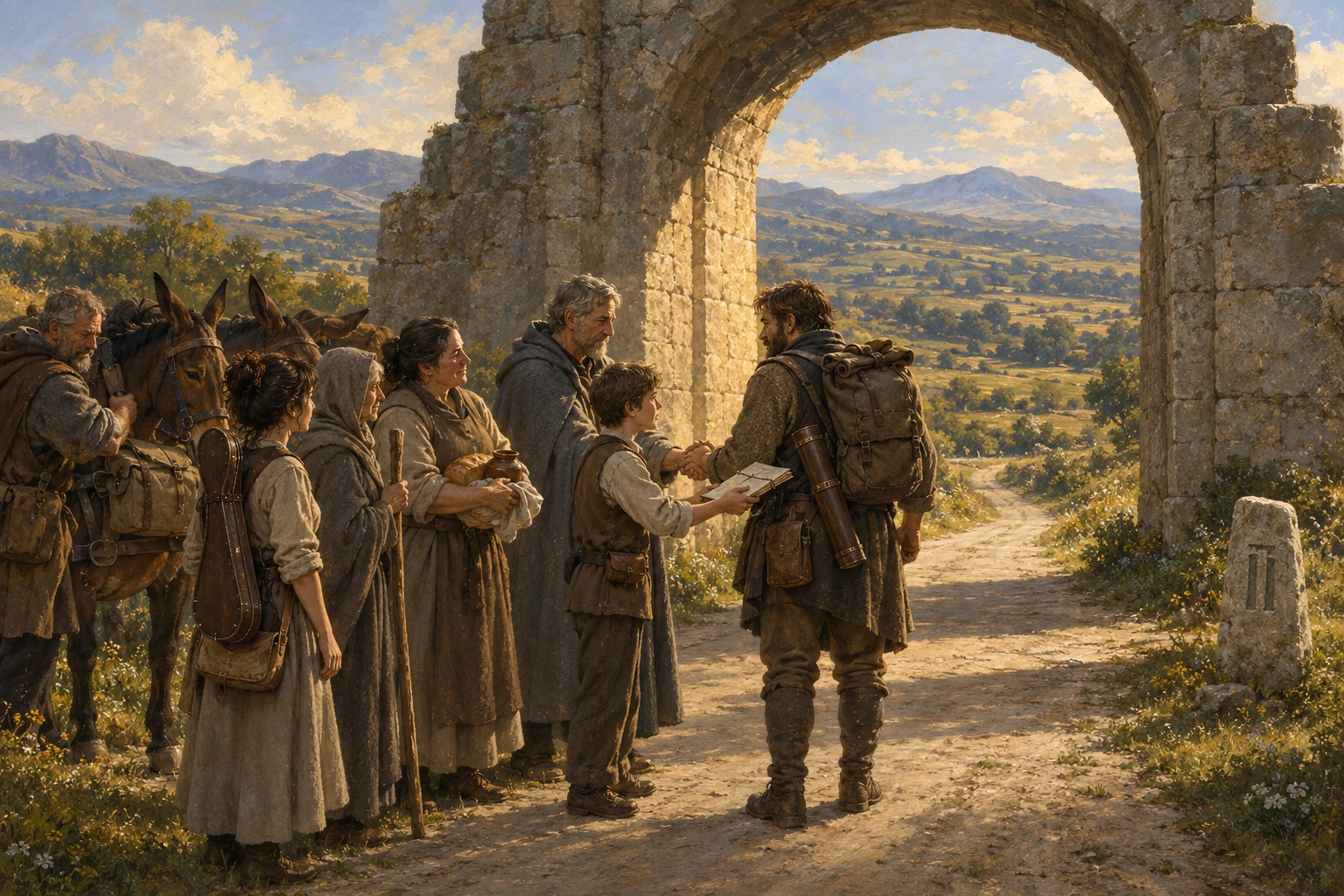
It stood astride the road itself, a single high arch of the same honest, over-built dressed stone the company had learned to recognize a mile out by now — wide enough, Bracken judged aloud before they'd properly reached it, "for two loaded carts abreast and a herd of goats besides, and built by people who never imagined a day this road would carry less than that." No wall ran from it in either direction; no ditch, no gatehouse with arrow-slits, no fortification's grammar anywhere about it — only the arch itself, tall and clean and weathered to the color of old bone, standing welcome over the road the way a good door stands welcome over a good house, built to be walked through laden rather than defended against anyone walking through it at all.
"It's Merrow's own gate," Wren said, before she had quite finished thinking it, and found, once said, that it wanted no further explaining to anyone who had walked out under the west road's arch a year and a world ago. "Or as near its twin as makes no difference. The same stone. The same hand, I'd swear to it, or one taught by the same hand."
"Built for the same trade," Alder said, "raised at the other end of it, by whoever built Merrow's own gate to greet what this one was built to send. Two doors, a whole country apart, both saying the same thing to whoever passed beneath them: this road expects you back."
Bracken walked its whole width twice before he'd say a word, running one hand along the dressed joint where the arch's crown met its shoulder, and when he did speak it was in the particular hushed, delighted register he kept for stonework that had earned it. "Look at the coursing on this," he said, to nobody and everybody. "Not a joint out of true after more winters of frost than anybody's bothered to count, twice a season, and no mortar failing anywhere I can find it. Whoever cut this meant it to stand until somebody with better reason than weather came and took it down on purpose. I don't believe anyone ever has."
A College waymark stood at the verge just beyond the arch's shadow, weathered but legible, cut in the same deep, generous, slightly flourished hand as every western mark the company had learned to read this year — the same four signs Wren had known since she was nine years old, spoken, as Iyene had once put it, in a different accent than her own.
Luel stood a while at the arch's foot with one hand flat against the stone, not speaking, and when she did speak it was only the one line, offered and not glossed. "My people walked under this arch with laden backs, once, in both directions, more times than any song of ours troubled to count. It is good to walk under it again with hands as full."
Iyene logged it in her working sheet without ceremony — a gate, Meddani-built, the western sibling of Merrow's own, sound — and Pip drew it in three quick, sure lines from where he sat cross-legged in the road's dust, his own knee, as it had been on a hundred pages before this one, intruding without apology into the sketch's lower corner. Wren, glancing over his shoulder, only smiled, and Pip, catching the smile, did not bother even to look sheepish about it this time, which she thought was itself a kind of arriving.
It was Garron who called the halt, a little beyond the arch's western shadow, in the flat, unceremonious voice he used for anything that mattered to him most.
"This is as far as the province runs," he said. "And as far as I run with it."
Nobody argued, and the terms had stood since Sereth's own yard, spoken plain the morning after the beacon: through the province, home before deep winter, and the province, everyone had always known, ended somewhere, and here, it seemed, was the somewhere.
Pip went first, before anyone else could properly begin, producing from the bottom of his own satchel a flat, carefully sewn packet of his best pages — bound along one edge with waxed thread in a stitch Dorrit had taught him three weeks back for exactly this purpose, though he had let nobody watch him prepare it. "It's the account," he said, holding it out and then, in the same breath, half withdrawing it again. "The true one. Properly drawn. I've done the mended gate, and the Seventh alight, and Woldsend's own gate the day it was relieved, and Millgate, and — well, everything, really, every hill and every ruin and every strange thing that seemed worth the paper, and I know it isn't — that is, I did the best hand I had, but a proper illustrator would have —"
"Pip," Garron said, and took the packet out of his hands with a gentleness that ended the sentence more thoroughly than any argument could have. He untied the thread with careful fingers and turned the first few pages slowly, and whatever he found there he did not say aloud, only nodded once, twice, and refolded it with the same care Wren used on the Waybook's own oldest leaves. "It's a fair thing," he said at last. "A proper account, same as she asked for. I'll see it delivered exactly as it's drawn, and I'll not let her shorten her opinion of it on the strength of your own doubting it, either."
Iyene came next, with the province sheet itself rolled and cased in a stiff leather tube she had clearly had Bracken cut and stitch for this exact purpose some days back, without telling anyone why. "A fair copy," she said, handing it over with both hands, the way she handed nothing else in her whole working life. "The whole province, kept fires and sleeping towns and deep ground honestly bounded, the four reckoned places marked as questions and not resolved into anything they haven't earned yet — for Sereth, and for every tending family whose long, unwritten going-round made half of it possible to draw at all. It was never wholly ours to keep. It only wanted somebody with ink to set it down."
Garron held the case a long moment before he trusted his voice to it. "My mother kept a door open three hundred years on the strength of believing a road," he said. "I don't know what she'll make of being handed the road back, drawn."
"Ask her," Iyene said, "and write and tell me. I've been wrong about people's reactions to my own work before, and I expect to be wrong again."
There were letters besides — Dorrit's, sealed with a great deal more ceremony than its size seemed to warrant and addressed, everyone understood without asking, to Liss and her beans both; a short note from Bracken that he handed over without comment and that Garron did not open in front of anyone; and Wren's own, folded small and given without a word beyond for Edda, its contents nobody's business but the two women who would eventually read and answer it, though Wren had written, near its end, one line she thought Edda alone would properly understand: the boy's message stood answered before either of us could send it — tell him his father is not home yet, but he is coming, and this time he is bringing the road itself along with him to prove it.
Bracken and Garron's own parting went the way their whole friendship had gone from the first forge at Sereth onward — in half-sentences, offered sideways, over the mules rather than at each other directly. "Mind Suet's off fetlock," Bracken said. "It'll want watching a season yet." "I'll watch it," Garron said. "Mind your own back on that stair, coming home again someday." "I intend to." "See that you do." And that, between the two of them, was very nearly the whole of it, and both men seemed entirely satisfied with the exchange.
Dorrit, for her part, had already been provisioning him for the better part of an hour without saying so directly, and by the time the goodbyes proper began Garron's own pack had grown by a loaf, a wedge of hard cheese, a twist of dried fruit smuggled from stores nobody remembered authorizing, and a small crock. Dorrit pressed it into his hands with the flat, unarguable authority of a woman who had fed an army of cousins her whole life and did not propose to send a man three hundred miles home on good intentions alone. "You'll eat before you're hungry," she told him, "and you'll eat again before you think you need to, because a man walking alone forgets to stop for himself in a way he'd never forgive in anyone else. I've packed accordingly."
Alder said the least of anyone, and it was, in its way, the most.
"Go home, Garron Hazel," he said, and took the younger man's hand in both of his own for a moment, no more. "You have earned every mile of the walking, and every mile of the arriving after it."
Garron nodded, and looked round at the whole of them once — Wren, Dorrit, Alder, Iyene, Bracken, Pip, Luel, the four mules standing patient in their traces — the way a man looks at a room he means to remember precisely as it stood the last time he saw it whole. Then he shouldered his pack, settled it once with a small practiced hitch, and looked back east through the arch he had just watched them all pass under, toward a province that was, for the first time since anyone could remember, mapped, and lit, and known.
"Well," he said. "It's been doing."
He turned, and walked back through the gate the company had only just come out of, east, toward Sereth and Sella's steading and Aldwick and a boy who had been told, twice now, that his father was coming — while the company itself stood facing the other way, west, into ground none of them had walked, the two of them parting at the one place on the whole road where going home, for a moment, meant walking in both directions at once.
They camped that night in the gate's own lee, on the western side, where the arch's shadow gave a little shelter from a wind that had begun, gently, to come up off the higher ground ahead. At dusk, before the fire was properly built, Wren climbed the low rise just beyond the road's shoulder with Luel beside her, and looked, for the first time as a thing seen whole rather than glimpsed in pieces, at the country the rest of the road meant to take them through.
It stepped down and away from them in long ranks, hill behind hill behind hill, blue going to grey going to a blue-black that was very nearly the color of the sky closing over it, and on not one of those ranked hills, so far as either of them could make out in the last honest light, did a single fire show.
"That's a great deal of dark," Wren said, not unhappily, only stating the shape of the thing plainly, as she'd learned to this year.
"It is a great deal of ground," Luel said, "that the line once ran the whole width of, hill to hill, before the closing took it hill by hill in turn. It slept out there the same as Sereth's own hill slept, before you came and asked it to wake. Kelder is out there somewhere past the reach of tonight's eyes — six fires west of Sereth's own hearth, by the old count that outlived the counting, if the counting still holds true this far. I do not say that to trouble you. I say it because it is the truest thing I know about what is ahead of us, and I have found, this year, that the company prefers the true thing plainly said to the kind thing said around it."
Bracken had come up the rise behind them without either woman hearing him, and stood a moment with his hands on his hips, looking out at the same dark ranks with the flat, appraising eye he gave any stretch of unfamiliar ground before deciding how to feel about it. "A country of unlit hearths isn't a wall," he said, to the dark as much as to either of them. "It's a list. A long one, I'll grant you, and none of it drawn yet. But every hill out there is a hill somebody once knew how to light, and we've had some little practice, this past while, in reminding hills how."
Behind them, back east through the gate's own arch, one small light had begun to show against the last of the darkening sky, low on a shoulder of hill they all three knew without needing to name it, and would go on knowing whether or not they ever stood close enough to warm their hands at it again.
"Sereth," Wren said, and Luel had already turned to look at it, and Bracken's hand had come to rest, without his seeming to notice it, on the College mark stitched at his own shoulder.
Nobody named the whole of what waited in the dark ahead. Iyene's voice, drifting up from the fire below, was already deep in some plain, practical argument with Dorrit about tomorrow's route and the placement of the first western beacon-hill on the day's line of march. The ordinary sound of it — ink and stew and a mule complaining mildly about her picket-rope — carried up the rise and settled the dark ahead into exactly the shape Bracken had given it: not a wall, not a warning, only work, waiting to be walked to and lit, one hill at a time, the same as every other hill this company had ever come to in the dark and left, by morning, a little less dark than they'd found it.
Wren wrote long that night, longer than her custom, because the day, she told herself, settling the day-book on her knee by the fire's last light, had rather more in it than most days managed, and wanted the room.
We reached the province's own gate today, and it is Merrow's gate's own sibling, raised by the same hands or hands taught by them, at the far end of the very trade that built its twin — the road's two ends, at last, seen to answer each other. Behind us the near provinces stand mapped, and allied, and lit, and relieved where relieving was owed, and posted, hand to hand, the length of a road that carried no word at all three months ago and now carries it daily, unremarked, as a road ought. Iyene's sheet holds the whole of it — kept fires and sleeping towns, deep ground honestly bounded, one watch's count closed and four still standing open as honest questions, and a thin new line of post threaded through the middle of it all, as real a road now as any drawn in stone.
Garron Hazel left us at the gate, home-bound at last, exactly as he promised the morning after the Seventh was lit — through the province and no farther, and the province ends here. He carries Pip's true account, properly drawn, sewn and cased against three hundred miles of weather; Iyene's own fair copy of the whole province, for Sereth and for every tending family whose long, unwritten going-round made half of it possible to draw; our letters, mine among them; and, I think, though no map will ever show it, the whole of what this act was for, carried home in one pair of steady hands. I do not believe I have ever watched anyone walk more surely in a direction than Garron Hazel walked back through that gate today, east, while the rest of us stood facing west.
Ahead of us the beacon country goes down in ranks of dark hills as far as the light would let us see, and not one fire shows anywhere across the whole of it tonight. Bracken named it truest, standing on the rise: a country of unlit hearths is not a wall. It is a list. Behind us, through the same gate, one small fire shows plain against the last of the sky — Sereth's, kept, that was not lit a season ago and now will not, I think, go dark again in any of our lifetimes.
Ahead of us stands a whole country of hearths waiting to learn the same trick. We go to teach it, one hill at a time.
Off toward the dark Luel's soft wordless watch-hum went on, and Suet chewed her patient way through the last of the picket-line grass, and the road ahead stayed exactly the ordinary shape it had been all evening — which was, Wren thought, very nearly the kindest thing this whole year of walking had ever let her feel about a country she had not yet set foot in.