The One Door of Stanhope
The cairn above Stanhope's halls had been built by people who meant to keep coming back to it, and for four months nobody had.
Half its stones had gone down the slope side, not shifted by frost but knocked loose by feet that had never troubled to notice them underfoot, so that the little collapse ran downhill in the same lazy scatter a careless boot leaves behind it rather than in the tumbled heap a real winter would have made of it. What was left of the top course still held the flat gray weight-stone Fenna had set there in midwinter, and under it, gone soft and pale with a whole season of weather, the oiled scrap she had wrapped her sheet in before Ashcroft's own walkers carried it east and down into Wintergarth's kitchen. Nobody had lifted the stone since to look beneath it, and the collapse below it had gone unmended too, though the road plainly wanted it, both absences their own kind of answer before a single person on the King's Road side of it said a word about anything.
Dorrit reset two of the fallen stones anyway, without being asked, which did nothing for the cairn and something for her own hands. Bracken turned his back on the rest of it and looked instead at the ground the cairn had always overlooked, which was the ground that mattered now, and looked at it for longer than the view alone could account for.
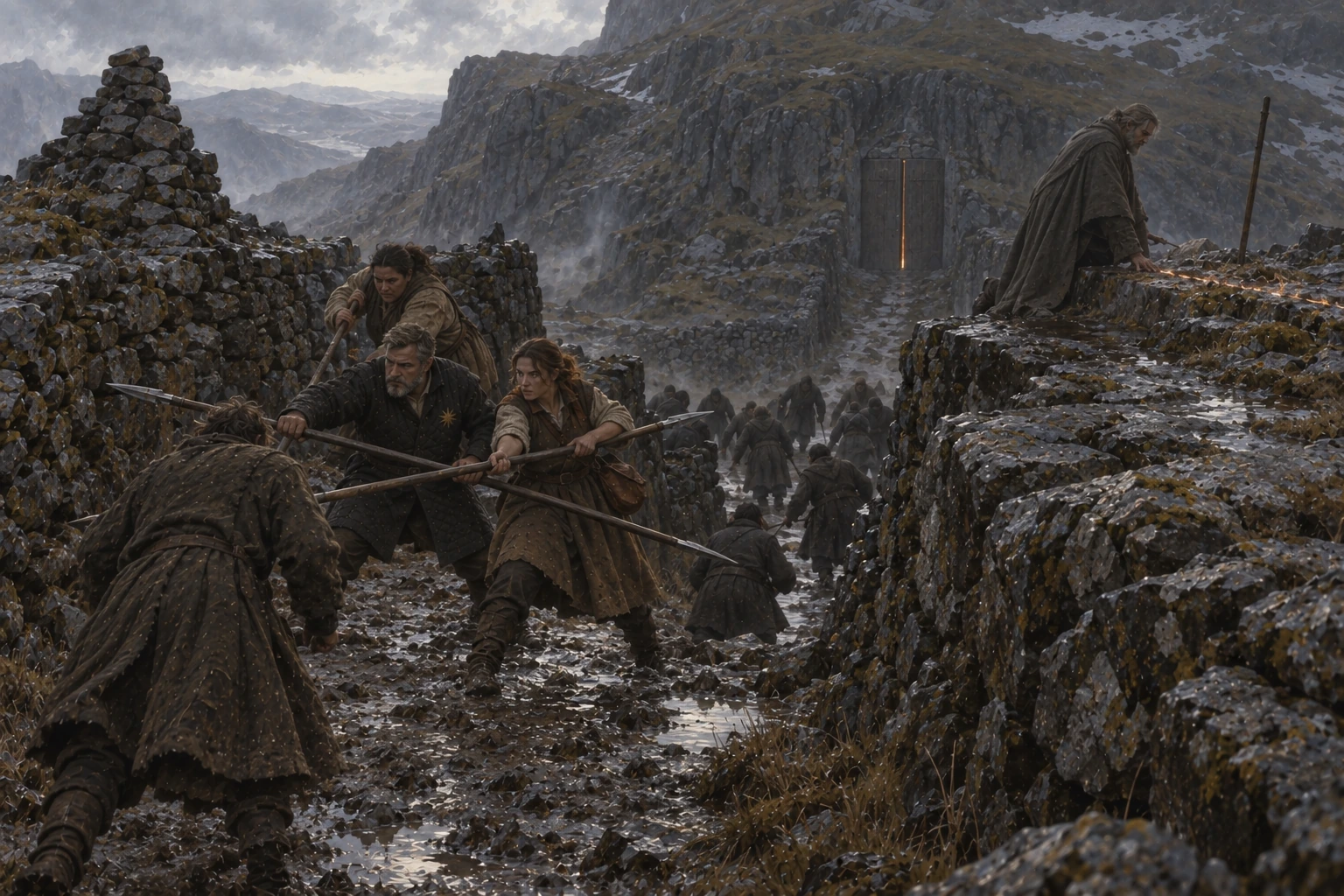
Below the cairn the hillside folded in on itself and ran down toward a stone step nobody from this side of the road had seen since midwinter, and the fold had had four months to wear a life of its own into the ground it held. The grass was gone from it altogether, worn past root and into bare wet clay by feet that had walked the same short stretch of it since before the first hard frost broke; a single path ran flat and shining from the step at the fold's low end back up to its mouth and down again, beaten so often and so evenly that it might have been laid by a mason with a plumb-line rather than by whatever now kept it that way through nothing but repetition. The road-cairn's scattered stones made a smaller kind of sense from up here: feet had come as far as the road itself, at some point in those four months, and had never carried anything back down to mend what they had knocked loose going up, because whatever walked that path was not going up to check on a cairn, and had no reason in it that a cairn could answer to.
Twelve of them stood or moved along that worn ground below, plain in the flat morning light. Each wore Stanhope's own cut of coat and apron, cloth cut to a pattern Wren had seen once already at a long table underground, worn now the way any coat wears after four months of the same weather and no fire to dry it by. Each carried some one piece of a trade at the hip or the belt — an empty lamp-hook, a door-warden's short iron bar, a cutter's apron gone stiff with old stone-dust — and that gear was the clearest thing about any of them, and the only thing about any of them a living eye could put a name to from this distance. They left a man's tracks in the churned ground and gave away nothing else. Nothing about them was warm, and nothing about the fold was either, though the sun stood well up by then and had done what it could for the rest of the hillside around it.
They spent close to an hour above it before anyone moved to go down. Bracken paced the rim three times over, from the cairn to the fold's near lip and back, counting his own strides against nothing in particular and stopping twice to look at the same stretch of ground a second time as though it might have changed its mind about being difficult. Iyene counted the shapes below twice, low under her breath the first time and getting eleven, then again, slower, moving her lips over each one in turn. "Eleven," she said, and then, once more, flatter, "Twelve." She gave the company only the second number aloud, though she wrote both of them down in the same hand and left the first uncrossed. Alder walked the fold's edge reading it the way he read any ground he meant to draw a line across, choosing a place near the step and another near the mouth and a third between them, testing each with his stick before he trusted it with his weight, and kept his own counsel about all three until he was satisfied with them together. Dorrit turned the whole chest out onto a spread cloth, checked it against a list she plainly already knew by heart without once looking down at her own hands doing it, and packed it again in a different order that made sense only to her. "Everybody's kit gets checked before we move, not after," she said. Pip, who had said almost nothing since the cairn, had a scrap of paper flat against one knee and was drawing the fold from where they stood — the step, the path, the narrow places, the single line down that kept the most rock at a person's back the whole way — and when Bracken finally asked, "So how are we getting down there," Pip held the paper out instead of answering, and that was the line they took, without anyone thanking him for having already done the thinking the rest of them had spent the hour arguing toward. Bracken laid the rest of the plan out afterward in the same working nouns he used for loading a mule: himself and Wren's spear on the bars first, Dorrit's staff and the rope behind them, Alder's line drawn wherever the ground gave him room to draw one, and Luel free to go wherever the gap opened next. It was a good plan, built out of a whole winter's drilling, and every one of them agreed to it before they started down.
Bracken led the four mules back up to the road himself and tied them there, nose to tail, and left them alone. "Nobody stays to mind them," he said, once. "There's worse below than a lonely mule, and nobody to spare for one." The point stood unchallenged.
The fold from above had looked like ground a person could walk down without much trouble, and the fold underfoot was neither of those things. It narrowed hard past the first twenty strides, the path running along a shelf of wet rock with the hillside close on one side and a drop of no great height but real unfriendliness on the other, and the thaw had turned every flat stretch to standing water and every slope to something that took a foot out from under whoever trusted it without first testing it the slow way. The drill they had built all winter — a stride-count for the mules, a mark for the highest ground, ten paces held clear around Wren no matter what else was happening around her — wanted room that simply was not there, and every one of them knew it inside the first fifty strides, though nobody said so until much later, when there was breath to spare for saying anything at all. Before they were halfway down, the seven of them stood closer together than they had in any working fight since Wintergarth, close enough that Bracken's elbow found Dorrit's twice without either of them meaning it to, and there was nothing to be done about that which did not cost more than it saved. Iyene, whose place in the drill was always well back and always clear, spent the whole of that descent within arm's reach of Wren instead, because there was no ground behind them wide enough to fix it.
They ended nothing on the way down. There was nothing to end it with — no name for any of the shapes now closing the narrow path from both directions at once, only the work of keeping the path itself open long enough to keep moving along it. Bracken's spear and Wren's own held two of them at the cross-bars, backstopped by Dorrit's iron-shod staff and a length of rope strung ankle-height between two hand-holds Bracken found in the wet rock without being told to look for them; the things came onto the bars and kept coming, and were shoved back, and came on again, patient in a way that had nothing behind it a person could rightly call patience, because patience answers to something and this answered to nothing at all. Alder drew a line at the shelf's narrowest point and held the far side of it alone for as long as it took the other six to get past him, which was longer than any of them liked and shorter than it might have been. "Six strides," he called once, flat, when Iyene came near the edge of it. "No more than that." Twice, going down, it did not look as though they would reach the bottom of it at all: once when the rope gave at a hand-hold, singing once, thin and taut as an over-tuned fiddle string, with two of the twelve within a spear's length of the gap it left, and Bracken re-set it one-handed while holding the nearer of the two off with the other, calling "Hold there — hold!" to whoever had the rope's far end; and once when Dorrit's staff skidded on wet stone and put her down on one knee with nothing between her and the closest of them but Luel, who carried no iron and needed none to put a body two strides back the way it had come, quick and quiet and without a word wasted on it either before or after.
They came out onto the portal step with mud to the knee on every one of them and nothing behind them ended, only held. That was the whole of the plan's first hour: not a victory, only ground kept long enough to stand on, and the door still shut in front of them exactly as it had been from the cairn.
The doors themselves stood in their plain deep-struck frame, hung and closed exactly as they had a year before, and Alder gave the charter at them with no breath left over for the giving of it. "By charter sworn at Merrow, a company of six, and such guides as the road provides," he began, and said the whole of it, out of order in one clause and correcting himself without stopping to apologize for the correction — Iyene by her charter style, Wren as the keeper of a book eleven generations had kept against this very road opening, Bracken and Dorrit and Pip and Luel each in their own turn, named as he had named them a year ago to a hall that answered him with one voice — and being out of breath did nothing to the words themselves. They came out exactly as old and exactly as whole as they had the first time, whoever was saying them and whatever state he was in while he said them.
Fenna's voice came back through three inches of hung timber, and there was no hail in it, and no warmth either.
"Old Dray died of a door opened at the wrong moment," she said. "I have three hundred behind me, and I will not open this one while any of them stand in that fold."
It landed on Wren like a dropped stone, and by the small stillness that came into Iyene's face beside her, it landed there too. Neither of them spoke of it. There was no room in the next several minutes for anything but the door.
Wren set her own spear down against the stone, because whatever came next was going to want her hands for nothing but this, and put her back to the door.
"Fenna. I need their names."
There was no question back through the timber, and no pause long enough to call a pause. Fenna understood what was being asked before the sentence had properly finished. She did not ask why, and she did not ask what would be done with them once she gave them. Wren had done this correctly a dozen times since Wintergarth, and every one of those times had cost her less than this one already had before a single name had been said, though nothing of that showed in her face. Fenna began.
There was no ceremony in how she gave them, and no order that meant anything but the order she could bear to give them in, which was not the order they had died in and was not any order that meant something to anyone standing outside that door.
"Sallow," she said, the word flat and immediate through the timber, as though she had been holding it ready a long while and was glad, in some way that cost her to be glad of, to finally have somewhere to put it. "Who mended the north stair for thirty years."
Wren said it back once, whole, at a range of perhaps four strides — the nearest of the twelve had come that close while Alder's line held the rest off the step — and stopped where she stood, with nothing more to add to the two words and no instinct to add anything.
It stopped too. It went down as a body, recognizable, four months dead, and somebody's, and Bracken had it up over one shoulder and off the step before anyone had to look at it twice. That was the whole of the rendering it would get, here or anywhere after in this fold or any other: a body, somebody's, carried, and later covered.
Weld was not close. "My second cistern," Fenna said, and then, before anyone could ask which of eleven remaining strangers that meant, "the one working the fold's far side, nearest the mouth. You'll know the apron; cistern-men wear it different from the rest of us, cut shorter in the leg for the wet stairs. And Marsh — the lower stair, day turn. And Pell, past both of them at the mouth itself — she tallied the mushroom rooms." Getting Wren within reach of Weld meant going back up the path they had only just fought their way down, Dorrit's staff and Wren's own spear clearing a lane a stride at a time while Luel walked backward at her shoulder the whole distance so that nothing behind them went unwatched. "Left side," Luel said once, low, and Bracken shifted his own ground a half-step before she had finished saying it; Marsh, meanwhile, had wedged itself into the gap between the portal's stone jamb and the fold's own rock, and would not come free on its own no matter how the ground shifted around it. "Get your shoulder under it — now," Dorrit told Bracken, and between the flat of the staff and his own bare strength and a good deal of swearing on his part, it came. Both went down in their turn, one shortly after the other, and there was no time inside either delivery for anyone to remark on how much longer each had taken than Sallow's had.
Pell was the farthest of the eight, out past the beaten path's own end where the fold widened again toward the road proper, in ground none of them had yet had reason to cross. Reaching it meant Wren walking the whole way herself with Bracken ahead of her and Iyene and Pip closing the ground behind, the wet clay taking every footprint and holding it the way it had held every other print in that fold for four months running. She said the name once the ground let her get close enough, and did not need to say it twice, and turned straight back toward the step without waiting to be told to. Between Pell and whatever came next, the ground itself gave them a few minutes of trouble that had nothing to do with names at all: a stretch of the beaten path had gone to standing water past the ankle, and getting Wren back toward the step meant finding a drier line at speed, with Bracken testing each stride ahead of her rather than trusting ground he had already crossed twice that same morning.
By then the grey that had come into Wren's face somewhere around Marsh had not gone out of it again, and her hands had stopped answering quite as fast as they had at the step, a half-beat's lag that Bracken noticed and let pass without comment. Alder had been carrying more of the line's own edges than she was since before Pell went down, holding position and boundary at once while the rest of them worked, a fact obvious enough on its own that it needed no comment either. There was too much else wanting doing.
The next of them wore a scorched apron with both hands empty at the hip, and Iyene called the shape of it through the door, flat and exact, the same voice she used for a bearing she meant someone else to write down correctly the first time.
"Thrift," Fenna said. "She kept the forced-green beds."
Wren said it. Nothing came of it at all — no slowing, no falter, nothing to say the name had reached anywhere it needed to go.
Iyene called the burn pattern back more exactly a second time — high on the left side, not the right, and running to the shoulder rather than stopping at the collar — and Fenna corrected herself in four words. "Chettle, then. Say Chettle." He had fired the second hearth-shaft for years, and the greens beds had never scorched a coat that particular way, and she should have known it from the first description if she had not been listening for a name rather than for the apron itself. Wren said Chettle, and it went down, and the first try was treated as nothing worse than a name that had turned out to belong to somebody else standing nearby.
The real Thrift came seventh out of the fold but sixth from the door, and this time the same words found the right shoulders on the first saying, and she went down without needing to be told twice, close enough to the step that Bracken barely had to move to reach her.
By the time Thrift was carried clear, Alder was holding the whole of the line himself — position and edge both, the ground and the company's own spacing within it — while Bracken and Dorrit did the work of bringing each remaining name within Wren's reach. His sentences had gone down to single words between one order and the next, and he leaned on nothing, because there was nothing there in that open ground to lean on, and he paid for the holding in some coin none of the seven asked him to account for.
It was in the middle of working Ockley free of the fold's narrowest bend that one of the four still unnamed got inside the company's own spacing, close enough behind Wren that Dorrit put it down off her with the flat of the staff before it had covered the last two strides between them. The staff took the whole of the check in both wrists at once, a jolt that ran up through her forearms and set her teeth together. "I'm still standing," she said, and kept swinging, and did not stop to look at either hand until there was a moment to spare for it, which there was not for some while yet.
"Ockley," Fenna said, once the ground was clear enough to hear her again over whatever had just happened on the other side of it. "He ran the west quarter's lamps. And Culliss — she carried word between the halls, and knew every stair in this place better than I do myself." Both went down inside the same handful of minutes, one on the step itself and one dragged the last few feet to it by Bracken's own hands, and that was eight.
Wren opened her mouth for whatever came after Culliss and found nothing behind it to open it with — no name, no weight, nothing that would have carried as far as the timber, let alone past it into the fold where it was needed.
"I've nothing left," she said, and that was all of it. Bracken had her by the arm and off the step before the sentence finished landing, already moving her toward whatever came next rather than toward another name.
Iyene went round the rest of them anyway, close to the doorstep with the fight still not finished around them. Bracken gave her a stride-count off the top of his head, exact to the pace. Pip redrew the fold's own line from memory in the margin of his first drawing, and it matched, stroke for stroke.
Dorrit named the four plants she kept dried in the same inside pocket, and got to three.
She said the three again. The fourth place in the order stayed where it had always been and stayed empty, and she stood on the step in the middle of a fight she was still holding one end of and reached for a word she had been saying since she was nine years old. She could see the leaf. She could see the cut edge of the root, and the particular brown the water went when it steeped, and the shelf in her grandmother's back kitchen where the jar had stood with no label on it, because nobody in that house had ever needed one. There was nothing behind any of it.
"Which one," Iyene said.
"I don't know," said Dorrit. "That's what you're asking me. I don't know which one it was."
Iyene did not put it in the day-book. She got the case open against her hip one-handed, found the private column, and set the loss down there with the hour beside it, and beside that she wrote Culliss — because Culliss had gone into the timber four minutes before in Wren's voice, and there was nothing else on that step it could have been.
Dorrit read it upside down and did not like where it sat. "Put it in the one everybody reads," she said. "If it's costing us, I want it costing us where the others can see the bill."
Iyene let that stand, and turned. "Give me something exact," she said to Alder, in the same flat voice she had used on the other three. "How are you doing this." His answer was one word, "Carefully," and it was not an answer of any kind she could write down. She did not ask him a second time.
Four still stood in the fold, and Fenna would not give them to anyone, however the door was pressed.
"I don't know them," she said. "I won't guess." That was all of it, and it was enough, and the matter ended there.
What was left took longer than the eight had, together, and it was worse by every measure that mattered to the five people left to do it. "Iron first," Bracken said, short of breath himself by then. "Fire after, when iron's done what it can." There was no name to end any of it — only iron, and weight, and at the last, fire, worked by five people who had nothing left between them but their own arms and whatever was still left in them to use those arms with. Bracken's short blade did what a blade does and no more, over and over, against something that did not bleed for the trouble; Dorrit's staff, swung two-handed now with both wrists already gone stiff and wrong, did the same work at the same cost, paid a second time. A length of the descent's own rope went round what iron would not put down, and held it while Luel worked it back off the step with a brand in each hand — the whole of her fighting grammar, no more and no less of it than that, and enough. "Back — all of you. Give me the ground," Alder said, and they gave it to him. His fire was the one large thing he did that whole day, called up along the ground itself where the last of the four had gone down and would not stay down no matter how much weight was set on it; it finished, in a breath, what the iron alone had only managed to slow for the length of that breath and no longer. The fourth of them took longest of all, driven back three times before the fire finally caught and held long enough to finish the work, and by the end of it the five people doing that work had stopped speaking to each other in anything but single words themselves. When it had done its work he stood a long moment with both hands braced on his own knees, head down, before anyone thought to ask whether he could still stand at all without them.
The doors did not open easily even once there was nothing left outside to keep them shut against. The bars and props inside had swollen fast to their sockets over four months of wet air with nowhere to dry out to, gripping their own channels the way ice grips a jar lid it has had all winter to seal, and shifting them wanted both sides working at once, Stanhope's own hands driving from within and Bracken's shoulder and a length of iron bar from without, each blow answering the last through three inches of timber neither side could see past or judge the force of. The first prop came free by degrees, grudging the whole way and giving up half an inch at a time. Twice the work stopped altogether while Stanhope's own people shifted a second beam that had swollen crosswise in its own channel, and both times the company outside could hear nothing through the timber but effort, no voices at all, which told them more about how few hands Stanhope had free for it than any figure Fenna might have given them. The second prop came free the same slow way, if anything slower. "Together — now!" Bracken called through the gap, timing his own next heave to whatever answered from the far side. The third came all at once, with no warning in it that anyone on the outside could have read in time, and its own considerable weight came off the door's edge and across Bracken's right knee where he stood braced on the step to hold the door from swinging back on the hands still working it from the other side.
He did not go down. He said one short word that was not a complaint, and kept both hands on the door until it stood fully open, and only then sat down on the step itself, rather suddenly, and let somebody else take the weight of it from there.
Dorrit had the knee out of its boot and strapped before full dark, working by firelight with her own wrists still taped stiff from the fold and paying them no attention at all beyond what the work itself required of them. "It'll hold you standing still, for the rest of your life," she said, flat and short, a trade's own verdict and nothing more. "It won't run again, and it won't take a slope at any real speed, ever, and nothing I do to it tonight changes either half of that." Bracken's answer was about the strap's own tightness, nothing else. "That side's wanting taken in a half-turn more," he said, and he was still talking about the strap when Dorrit finished and moved on to whatever else wanted her hands that evening.
Fenna herself came out onto the step once the doors stood open, the first sight any of them had had of her as anything more than a voice through timber, and the first thing she gave them was a number.
"Near three hundred," she said. "Above the cisterns and below them both. A little under, counting only those old enough to be sworn to a lamp of their own. We brought the lesser ways down ourselves, once. Old Dray was on the wrong side of it." She had the figure ready before she had anything else to give them — no greeting, no thanks, nothing about the eight or the four who had cost the company the whole of the afternoon — because she was a keeper of lamps, and a keeper of lamps counts before she does anything else at all, in any hour and under any weight. She offered nothing more, and the moment closed itself over.
The First Hall itself stood exactly as it had a year before — the worked stone pillars, the wide shallow hearth-shaft drawing what smoke there was up into the hill's own body, the same wall-niches ringing it that had once each held a small steady flame of their own. Twelve of those niches had gone a whole season without a sworn keeper, tended by whoever happened to be nearest at the hour rather than by any one hand, the oil topped up and the wicks trimmed by cooks and cistern-hands and children too young to be sworn to the work themselves, so that not one of the twelve had ever actually gone dark even while its rightful keeper stood outside dying in the fold below it, and that afternoon the lamps were given out again, one at a time, to whoever stepped forward to take one. There was no speech in any of it, and no line of people waiting to be chosen. Each person took up a lamp and said the same four words Stanhope had used at this for longer than any single Keeping could account for with any certainty — "I'll keep this now" — and that was the whole of the ceremony, because in Stanhope's own reckoning it was not a ceremony at all, only work that wanted doing and hands enough at last to do it.
One of the twelve went to a boy small enough that both his hands were needed to manage the lamp's weight, and too young by Stanhope's own reckoning to have been sworn to one in the ordinary way of things. Jole said the four words anyway, in a voice that had not yet decided what it would sound like when it was grown, and the hall let him keep them exactly as he had said them.
Four of the twelve lamps went to people whose names Stanhope did not have either. The company was given no reason for that, and the hall itself clearly felt none was owed. A hall that would not leave four of its own dead unclaimed after four months underground was not going to leave four lamps dark for the want of a name to set beside them.
"Four are still dark," Pip said quietly, before they were given out, counting the niches the way he counted anything, and then they weren't dark any longer, and he let the count stand at that.
Stanhope came up through its own door into full daylight for longer than anyone below could put a number to, and the first work of that afternoon was not rest, though every one of them who had done the fighting could have used some. Twelve bodies lay under cloth on ground still wet from the morning's work, and Stanhope carried its own out to be buried, in ground of its own choosing above the fold, without asking the company for a single hand in the doing of it, though several were offered. It took most of what remained of the daylight, working in twos and threes along the same worn path the fighting had used that morning, on ground chosen by people who already knew which part of that hillside was theirs to use for it.
They did the work the way people do something they have had far too much practice at, in a season that had given them nothing else worth practicing, and did not want anyone watching who had not stood a lamp-rota under that same hill through the whole of the winter that made this necessary. The seven of them stood back at the fold's mouth and let it be done without them. Dorrit was the only one of the seven any real use at all in what came after — a strip of clean cloth handed across when it was wanted, a hand steadying a board when a second pair of hands would help and not intrude — and even she was careful to be asked first, every time, before she offered a third.
"Let them be," Luel said once, low. "This isn't ours."
The light had gone long and gold across the whole of the fold by the time anyone thought to stop working at all, and one of Stanhope's own had wandered out into the middle of it, apart from the rest, still carrying what she had been given that morning.
She stood in full afternoon light, lamp burning in her hand, and no one told her to put it out.