The Dark Hill
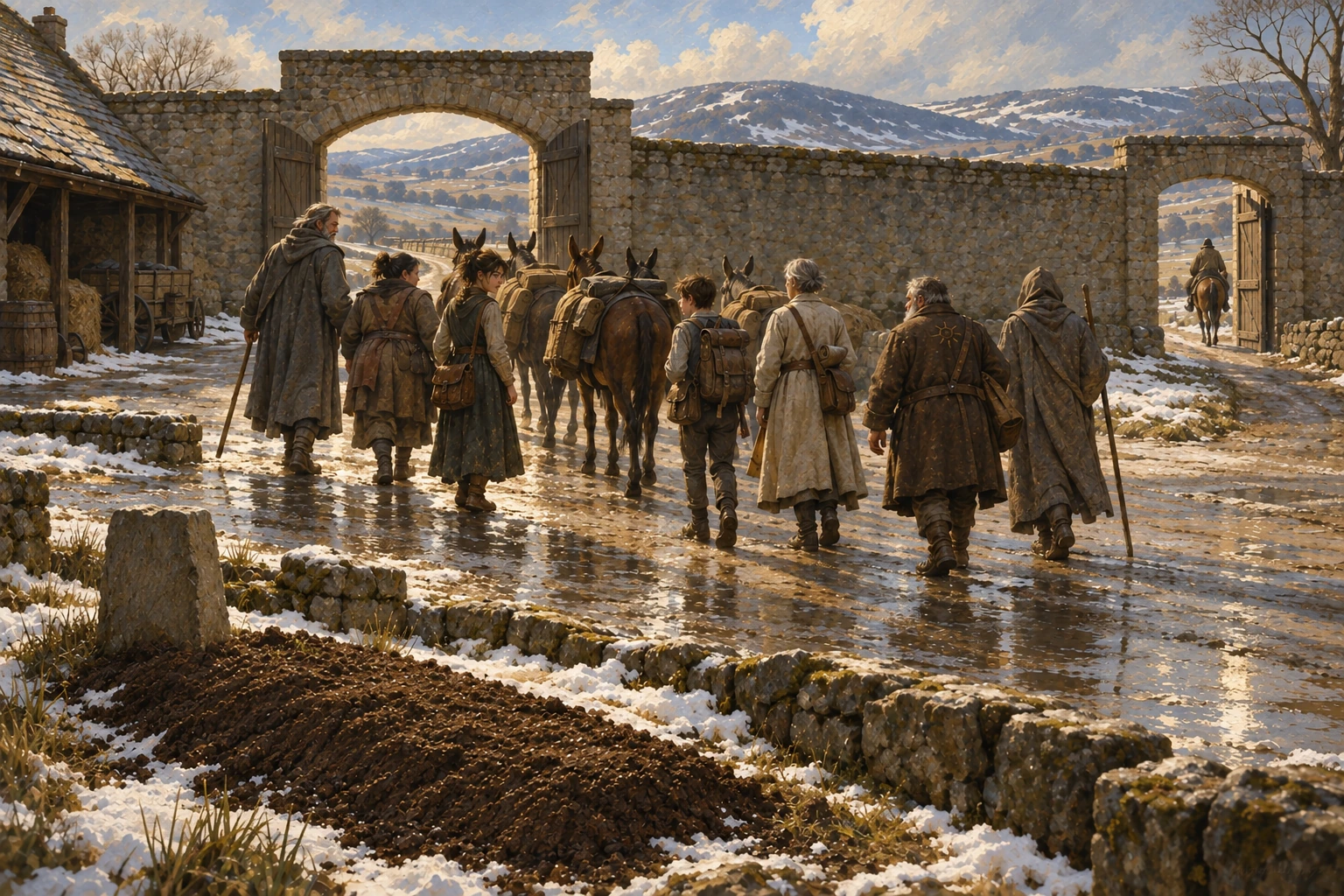
The snow came off Sim Padgett's grave before it came off anything else in the yard, and not by any special mercy — only because the ground under a grave settles lower than the ground around it, and low ground catches a season's first true warmth before high ground ever feels it. Wren found the dark ridge of it under a scatter of retreating white on a morning when the light itself had changed without anyone announcing that it had: hard, clean, thaw-light, off the standing water in the yard's low corner and off every wet stone in the wall, the kind that made her narrow her eyes though nothing about the air was warm yet. The grave itself had settled into a long shallow trough, healed over at the edges the way a scar heals over, closer to the ground each week than the week before, and would go on settling until it was no longer a mound at all but only a place in the yard that stayed slightly greener than the rest of it, come summer. She had not gone out to look at it. She had gone out because the light was different, meaning to stand in it a while before the house woke and found work for her, and instead she found herself doing sums.
She carried more names now than she had before midwinter — Marta's among them, and R. Denby's, and half a dozen others that had gone from ink on a ledger page to something permanently hers — and some mornings, doing sums like this one, the extra weight of them made itself felt, plain and physical, before she had done anything at all to earn the feeling.
The house's own log gave the date such things happened, an old quartermaster's habit going back longer than anyone now living could account for, and by that reckoning the fold had opened eleven days later than the earliest year on record and nine days earlier than the worst of them — not a good year, and not the worst one either, which was as much as any single figure in that log had ever managed to say about a season before it was over. Eleven days more, by the same reckoning, before the road down from Sereth could be expected to carry anything at all. A handful more again before the Gray Stair, open now for its first true season since the company had walked it the other way, could be expected to send down whatever the year's first crossing owed the valleys below it — a rider, if there was one to send; a packet of letters, if any had survived a winter in a satchel; nothing, if nothing was what the mountain had this year. She did the sum twice, just as she did every sum that mattered to her, once quickly and once slowly, and got the same answer both times, and stood a while longer over the grave with the answer in her hands and nothing to do with it. The mules stamped somewhere behind the byre wall, impatient for their morning feed and indifferent to the season's arithmetic, and the small working sound of it — hoof on packed earth, a headcollar chain shifting — was the thing that finally moved her, more than any figure she had reached twice running. Somewhere behind her a door opened and closed, unremarkable as any morning, and she let the sum go and turned back toward the house, the wet ground giving a little under each step in a way the frozen ground had not given all winter.
It was Bracken's shout from the north gate that ended the stillness for her — three words carrying the length of the yard, riders on the road — and the house answered at once, doors and footsteps and Pip's boots taking the stair two at a stride, so that by the time Wren reached the gate herself the party was already close enough to count. Four mounts, a led mule under panniers, and Ashcroft's own colors on the lead rider's sleeve, faded by a winter's travel and legible enough regardless, the mud of a hundred miles dried to a pale crust on every hem and fetlock. The riders themselves were hollow-eyed and saddle-sore and grinning anyway, glad of a hard crossing behind them rather than worn down by it.
There was a page of good business before there was anything else, and the house gave itself over to it without reserve. Stores came down off the mule in the loose, glad confusion of a delivery too long awaited — salt, oil, a crate of green glass bottles Iyene claimed before anyone else had noticed them, a bolt of grey wool nobody had expected and everybody was glad of. Osric, Thomasin, and Marta had the riders by both hands before the panniers were half unbuckled, asking after this house and that road and the old miller in the same breath, and getting answers that were mostly good and only sometimes not, weighed and traded back and forth as any winter's news gets weighed and traded when the people asking have gone half a year without any of it. Names came out that meant nothing to the rest of the company and everything to the three of them — a smith's apprentice married, a boat lost off the point and its whole crew walked home safe, a winter fever that had gone through the lower town and spared the children, mostly, which was the part Osric repeated back twice to be sure he had heard it right. A roof had come down under the wet snow and been mended before the frost set again. A child had been born at the ford-house, healthy, named for nobody in particular. Two old arguments had been settled and one new one started, over a fence line that had never seemed worth fighting about the previous autumn. The riders themselves wanted feeding before they wanted questions, and got both at once, bread and cold meat pressed into their hands between one sentence and the next, and the talk ran on in the easy overlapping way of people who trust that whatever they forget to ask will get answered anyway before the day is out. It was, taken as a whole, an ordinary winter's worth of news from a real town, and every person in that yard who came from Ashcroft heard it as the gift it was.
Someone had already seen to the mounts, feet and wind checked with an unhesitating hand and pronounced sound enough for a night's rest and no more, which was all anyone had asked of them. It was the eldest of the four riders — weathered past guessing, Ashcroft's coast-country plain in her voice and in her wind-cracked hands both — who drew Osric aside once the panniers stood empty and put into his hands a single folded sheet, waxed once at the seam and waxed a second time over the first seal where damp had gotten under it, and told him where it had come from: the road-cairn above Stanhope's own halls, lowered to it, by the look of the cord still knotted through the fold, from the same high vent the letter spoke of, and that stretch of road above it had gone unwalked all winter until the thaw made it worth walking again. Osric turned the sheet over once, read the single line of direction on its outer fold, and did not open it there in the yard. He carried it in, instead, to the long table, and the good morning went out of the house like a held breath finally let go.
The household gathered without being called, the way it had gathered for every piece of real news all winter, boots still muddy from the yard and coats not yet shed, filling the benches and the space behind them until there was nowhere left in the room that was not somebody's shoulder or somebody's back. Nobody sat near the hearth that morning, though the hearth was where the warmth was; the whole crowd of them drew instead toward the long table, as if the words wanted to be heard close rather than heard warm.
Iyene read it, because Iyene read every document that came into that house as a matter of course, standing at the head of the long table with eleven people gathered close enough to hear a voice pitched low. The hand was small and even, pressed hard enough into the page that the words showed faintly through the back of the sheet.
To whoever finds this and can carry it: I keep the count myself, this while, so that it will be told true, or not told at all.
The halls are shut against the through-road, both ends, since the first hard frost. What tried the east door in midwinter has not moved off since, and the deep rooms behind it have one way in and the same one way out, and everyone below the second stair knows that arithmetic as well as I do, and does not say it aloud any more than I mean to here.
The dead, by name, as I have them: Marsh. Pell. Sallow, who mended the north stair for thirty years and would let no one else near it. Weld. Old Dray, who kept the west door forty years and would not leave it even when I told him to leave it.
We only watch it, some clear nights, from our own high vent — the Second's own fire, unlit now for the first time in three hundred years by any count this house keeps. It went dark on the ninth night of true winter and has not been lit again on any night since, clear or otherwise, and I have no more to tell you about that than the bare fact of it, because I have no more than the bare fact myself.
I am writing by what light we can spare, and the light is going, and there is nothing further I know to set down, walled up as we are. The halls hold, for now. That is the whole of what I have.
There was no name signed under it, no farewell above the last line, no request anywhere in the whole sheet for anything at all. It stopped the way a voice stops when the breath behind it runs out mid-thought, and Iyene lowered it and did not read on, because there was nothing more printed to read.
The fire worked at a green log in the hearth with a small wet complaint that went unnoticed on any ordinary evening, and for the length of that silence it was the loudest thing in the room. Marta's hand had stopped on the edge of the table and did not move again for a while. Osric looked at nothing in particular, his jaw set, and nobody in the room went near him. It was Bracken, in the end, who broke it, not with a word about Stanhope but by asking, in his ordinary working voice, whether the riders wanted their mounts stabled or turned straight round for the province gate before the light went — a small practical question that gave the room somewhere to put its hands, and the room took it gladly.
Nobody spoke the name that belonged to that fire, because those at that table who had come down the beacon road had stood under Wakelow's light themselves and eaten at the fire of the man who kept it, and what a fire gone dark on that hill meant did not need translating for the rest. Luel had gone very still at the reading, her hands flat on the table's edge, and did not sing that evening, not even the low thread of nothing-song she kept running under most suppers; and Alder looked, for the length of one held breath, older than Wren had ever yet seen him look, and then was himself again, or near enough that only she noticed the difference.
Nobody asked why a fire that had not gone out in three centuries might go out now. It was not a hard question to think of; it was only one the house was in no hurry to answer, and it let the silence stand rather than reach for a guess that would only have dressed itself up as a comfort and been worth nothing at all as a finding.
The evening closed back over the gap after a while, the way water closes over a dropped stone — not because the gap had been filled, but because a house that means to keep functioning has to close over such things eventually, whether they have been answered or not. Cups were gathered. The fire wanted feeding and somebody fed it. Supper was eaten, and thin conversation restarted itself in fits at one end of the table and then the other, and by the time the last of the household went up to their own beds, the room looked exactly as it always looked at that hour, and looked nothing at all like a room that had heard what it had heard that morning.
The Stair had its own silence, and it took longer to notice, because a road's silence does not announce itself the way a sheet of bad news does; it simply failed, morning after morning, to produce the one thing every person in that house had been quietly counting on it to produce.
The mud alone would have told anyone who needed telling that the season had turned, thick and dark along every path the household used daily, sucking at boot heels and drying, some mornings, into ridges hard enough to twist an ankle if a person forgot to watch their footing. The north road ran wettest of all, low where it crossed the old ford below the gate, and it was there, more than anywhere else in the yard's daily round, that eyes went without quite meaning to, morning after morning, checking a stretch of empty track that stayed exactly as empty as it had been the morning before.
"This was the week," Iyene said, two mornings on, at the map-room table with the year's log open in front of her, in the same flat voice she used for any figure she had already checked twice. "By every year this house has ever recorded, the first crossing comes down within a week either side of now, once the Stair's clear enough to hold a boot. It has never once failed to send something down — a rider, a packet, word of some kind, even in the worst years on this page." She turned the log a quarter turn, so that whoever wanted to check her figure could. Nobody did.
Nothing came. No rider crested the head of the Stair that week or the one after; no packet turned up at the province gate; no traveler, ragged or otherwise, walked into Wintergarth's yard with a season's worth of news from the far side of the mountains, as the whole house had quietly let itself hope one might. The road that had been the year's one great hope since autumn simply gave nothing back, and the house learned, without anyone declaring that they had learned it, to stop watching the north road for something that was not going to come down it that week.
"Willem swore any letter that made that crossing would be carried on, either direction," Bracken said once, low, to Iyene alone, at the stores-room door. "That promise still stands, far as I know it."
"Then whoever's meant to be keeping it isn't in a position to this year," Iyene said.
"Man can't carry what never reaches his hand," Bracken said, and that was the whole of it — no blame laid on anybody, and no guess offered for what had kept the promise from being kept, or for what had kept it instead.
The council that followed was short and even-voiced, and it changed nothing about the road agreed on back at midwinter. Word of it had gone round the house within the hour, as such things always went round a house that size, and by the time the table was reached everyone already knew roughly what would be said at it, which did nothing to make the saying of it easier and may, if anything, have made the room quieter than it would otherwise have been. It met in the map-room by daylight rather than firelight for the first time all winter, the same thaw-light that had stood Wren over the grave that morning now falling flat and unkind across the long table, showing up every water-stain and candle-scorch the dark months had hidden. Outside the window the yard was loud with meltwater finding its own paths off the roof, a steady dripping percussion under everything said at that table, indifferent to the room and its business, as weather always is. Iyene stood at the map's own table with her working sheets squared in front of her and gave the arithmetic again, once, in the same numbers as before, because the numbers had not changed and nothing since had disproved them: every week of delay was a week the count east of the mountains got to grow before anyone on this side of them could do a single thing to stop it, ten becoming twenty within a season and forty the season after that, and by two winters the word wanted for it would not be tens any longer. Fenna's sheet she unfolded and laid on the table beside her own, where the room could see the length of it, and left it lying there while she talked. She did not read the names out. The column of them ran the same shape as the column of her figures, and every person at that table could see both at once. She did not soften the figures for the room, and the room did not ask her to. When she had finished she folded her hands over the sheet, because there was nothing further in the numbers to say, and she alone at that table looked as though the road ahead cost her nothing at all to choose, because for her, of everyone in the house, it did not.
The road itself was not decided that morning. It had been decided in autumn, reasoned out around this same table with Wystan's own message and three centuries of the house's own keeping laid side by side, and nothing in the Stanhope sheet or the Stair's silence changed a single mile of it. What had changed was only the reason for walking it, and the whole weight of the council's short hour went into that difference and nowhere else. A road chosen for reasons was, this morning, a road chosen for fear as well, and the reasons were exactly as sound as they had been in autumn and no longer, by themselves, quite enough to carry the room on their own.
It showed itself in small things, the way weather shows itself first in how people hold their shoulders. Bracken spent the morning checking gear that did not need checking, buckles he had checked the week before and would check again the week after, working them with his left hand as readily as his right though the left had stayed paler than the right since midwinter and would go on staying that way, and his eyes going more than once toward the north road and the border country beyond it that had been his before it was anyone's. He said nothing about the border, or his old company, or anything east of the province gate at all, and checked the buckles again.
Dorrit, at the far end of the table sorting dried roots into their travelling jars with more care than the roots required, did not say the name of her own valley, or the name of the aunt who kept it, and when Iyene asked her a plain question about how many jars the road wanted, she answered it plainly and did not raise her eyes from the sorting. Her hands were steady the whole while. It was only the set of her mouth, drawn a little tighter than the work called for, that gave any of it away, and only to someone who had spent two winters learning to read her.
Wren made the call for Fallowmere the same way she had made it in autumn — without argument, without a word offered in its own defense — because the arithmetic that made it right had not stopped being right just because it had started to hurt worse to hold. She did not say the name of the valley either, or the name of the woman waiting at the far end of it, and found, saying nothing, that the silence cost her exactly as much as speech would have and bought her nothing back for the difference.
Alder said the least of anyone at that table, and what he did say fit in four words, agreeing with Iyene's figures and adding nothing to them, and there was nothing in the four words that invited anybody to ask him for a fifth.
Dorrit's jars, once counted and stacked, drew Iyene's eye a moment too long, and Iyene said, without looking up from her own sheet, that the count still ran two jars short of what the road wanted. "Then find me two jars," Dorrit said, not sharply, but not warmly either, and set the last one down harder than it needed setting, and the small cold space between them, unmended since autumn, stayed exactly as unmended as it had been the day before.
Nobody had yet told Wren she had been wrong at the gate at midwinter, and nobody had told her she had been right, and she had long since stopped expecting either.
Nobody won the morning. Nothing in it mended. The company left the map-room agreeing on a road they had already agreed on in autumn, holding together in the unhappy manner of people who have chosen the harder thing with their eyes open and found that choosing it rightly does not make it weigh any less to carry out.
Marle rode out first, two days later, in the gray hour before the Ashcroft party's own departure, because the province gate lay along their road and there was no sense sending him alone when company already went that way. Osric had spoken for a horse out of Ashcroft's own string before the question was ever raised in the house, one clause folded into a longer accounting, and the winter's ledger had already paid for the mount before the question was ever put to anyone.
He carried two things east: the fair copy of the map, rolled and cased against the weather, and the council's own written word for the College, folded inside the same case. Iyene handed both to him at the gate with no more ceremony than she would have used handing a courier a stores manifest, and said only that the sheet wanted delivering whole and the letter wanted delivering read, and that she trusted him to see to both. Marle checked the case's oiled seam once with his thumb before he took the reins, the same small habit he had used on every ledger he had ever carried across a season of wet roads, and said, without looking up from the buckle, that he would see them there. That was the whole exchange. Nobody made him a friend of the house that morning, and he did not ask to be made one, and the gate closed behind his party no differently than it had closed on any ordinary errand all winter; and he looked back once from the first rise in the road, the same rise every rider out of that gate looked back from whether they meant to or not, and then faced east again and did not look back a second time.
Osric spoke for Ashcroft before his own party rode, standing at the long table just as he had stood at it in autumn to strike the season's first bargain, and struck this one in the same register: a party of Ashcroft's own would winter at Wintergarth every year from now on, whatever number the house's own needs called for, because a kept house was a road same as any other, and a road wanted keeping on both ends or it was not a road at all. He set the terms out one at a time, the same dry accounting he had used in autumn — who fed which fire, whose charge the stores were, how the two households' watches would sit against each other through a winter neither of them had lived through before — and Iyene entered each clause as he gave it, without comment, the way she entered every clause anyone in that house ever gave her. He offered none of it as kindness, and none of it was taken as any. Among the small clauses too minor for anyone to remark on was the yard itself, and what stood in it now, to be kept swept and sound the same as any working corner of a working house.
Marta packed her own things without help and without hurry, humming under her breath at odd moments as she had all winter, folding what little she owned into a bundle small enough to carry on one shoulder the whole road down. She asked Dorrit, cheerfully, whether the dried root she'd been given for her mother's chest complaint wanted steeping or chewing, and Dorrit told her steeping, and Marta thanked her and asked nothing further, trusting the answer the same way she trusted every answer anyone in that house gave her. When Thomasin said, over the folding of a blanket, that she meant to walk close beside her the whole road home so as not to lose her footing on the thaw-mud, Marta laughed and said she supposed she'd manage well enough on her own two feet, but that she wouldn't say no to the company. Nothing in Marta's face suggested there was anything further to say. She thanked Wren once more before the loading began, for a thing she still could not remember doing anything to earn, and said she would tell it properly once she was truly home, and Wren said nothing back, and went on buckling a strap that did not need buckling.
Pip spent most of the last morning repacking his drawing case though it had already been packed correctly the first time, squaring the leaves inside it over and over until the corners lined up to his satisfaction, and said, to the case rather than to anybody in the room, that Merrow's roads would have thawed out by now too. There was nothing to answer that would not have been a comfort with no truth behind it, and he did not seem to expect an answer, and went back to squaring his leaves.
Luel stood a while longer at the gate than the rest of the company, after the last of Ashcroft's mounts had turned onto the north road, looking east past the province gate and the border country beyond it as though she could see clean through both, and then turned, without a word to anyone, and went to help Bracken with the last of the loading.
Wren's day-book that evening ran short, and she let it run short.
The Stanhope sheet: the halls shut, the dead named, the Second's fire out since the ninth night of winter and not relit. Nobody knows if the halls held past the writing of it.
Nothing came down the Stair this year. The promise made at its foot is not broken, only unkept, and nobody knows by how much.
Rafe Rowan.
Grandmother's name is Tansy, and I did not write to her because there was no road for the letter to travel, and I do not know whether that will still be true by the time there is one.
I still cannot say the arithmetic to Marta's face, and no one has asked me to.
She closed the book without reading it back, and set it under her hand a while before she put it away.
The company went west in the cold clean hour after the Ashcroft party's own dust had settled on the north road, Suet and Barrow and the other two mules loaded and stamping at the gate as they always did on a morning that asked them to work. Bracken banked the great hearth low rather than putting it out, as the house had banked it every night that winter and would go on banking it whether anyone stood there to warm their hands by it or not. Nobody looked back at the gate for longer than it took to be sure it was shut.
Seven walked west that morning. One rode east. Behind them both, the road ran toward a valley neither could reach.