Quill's Weight
They came up over the last rise of a long climb inland — chalk track and low windbent thorn the whole way, the coast road bent off behind them into memory and the sea with it, four days gone now, every mile of it the sort of going Bracken had called, without much needing to be asked, "an easy walking, and nothing in it worth a page" — and stopped, all seven of them and all four mules, because the wide shallow fold of ground below them was full of people.
Dozens of them, at this distance, doubled to scores the longer anyone looked: bent rows the whole width of a broad pale field, pulling something up by the root and laying it in swathes behind them, the swathes gathered by others into bundles, the bundles carried on backs and in barrows to a line of low dark pools at the field's foot where more hands again stood to their knees in water that smelled, even from here, faintly and unmistakably of rot. It was the far side of midsummer, the second hay long in and the light coming deep and yellow by late afternoon, as it does once a year has stopped climbing; and this — Wren understood it before anyone named it for her, from four winters' worth of Dall's own field-talk — was flax, pulled green and whole rather than cut, laid to dry, and about to be laid again in those dark foul-sweet pools to rot its stalks apart from its fibre.
None of them had seen this many hands on one crop since Merrow's own market fields, and for a long moment nobody spoke at all.
"Ashcroft," Luel said, at Wren's shoulder, before anyone asked. She did not point. "Its homely name and its older name are the same word, worn only a very little across all that time — because this town never left long enough to need two."
Wren held one word behind her teeth and did not say it: she had heard this name once before, on a shoulder of hill above Sereth, in a Hazel's own counting of the west's kept fires — an old visit's account and a fire that still showed, told by people who had never walked there themselves. Sereth had reckoned it a hearth-family and a light. Sereth, it turned out — and this was the whole of what Wren allowed herself to feel about it, standing on the rise with the pull of the whole field going still no more than a moment before it went on again — had reckoned wrong, in the one direction its own telling had simply missed.
"That's not a keeping," Bracken said, low, doing the same arithmetic Wren was doing and reaching a plainer number. "That's a town."
Nobody came out to meet them. That was the first and largest thing Wren set down that evening, before any of the rest of it: no table laid in a doorway, no formal procession with lamps, no voice raised in question at the road's edge. Ashcroft was up to its elbows in its own flax, and it absorbed them, the way a full basket takes one more egg without anybody having to reorganize the basket.
A woman straightening from a row nodded them toward the low roofline in the fold's center, said something about the hall and somebody being with them presently, and bent back to her work before the company had finished thanking her. A boy pushing a handcart of green stalks pointed with his chin at a barn when Bracken asked after stabling, and did not stop walking while he did it. Twice more, walking the working street between garden plots and low stone houses, they were greeted in exactly this fashion — noticed, named a direction, returned to — and by the time they reached the market-hall itself Wren understood that this was not indifference. It was four hundred people with a harvest at its most demanding hour, extending precisely as much courtesy as the hour could afford and not one grain more, and meaning every grain of it.
Bracken's reading of the street took him the better part of ten minutes and cost him almost no words at all: retting-dams set downwind and downhill of the drinking well, tools racked rather than dropped, the barn roofs sound, the well-coping worn to a shine that only came of daily use by hands that trusted it. "Somebody here knows their business," was the whole of what he offered Wren, "and has known it a long while." He did not turn it into a survey. Nettle, tied in the barn's shade with a manger of the town's own hay under her nose, kept her teeth to herself the whole afternoon, which Bracken reckoned the handsomest compliment the place had yet been paid.
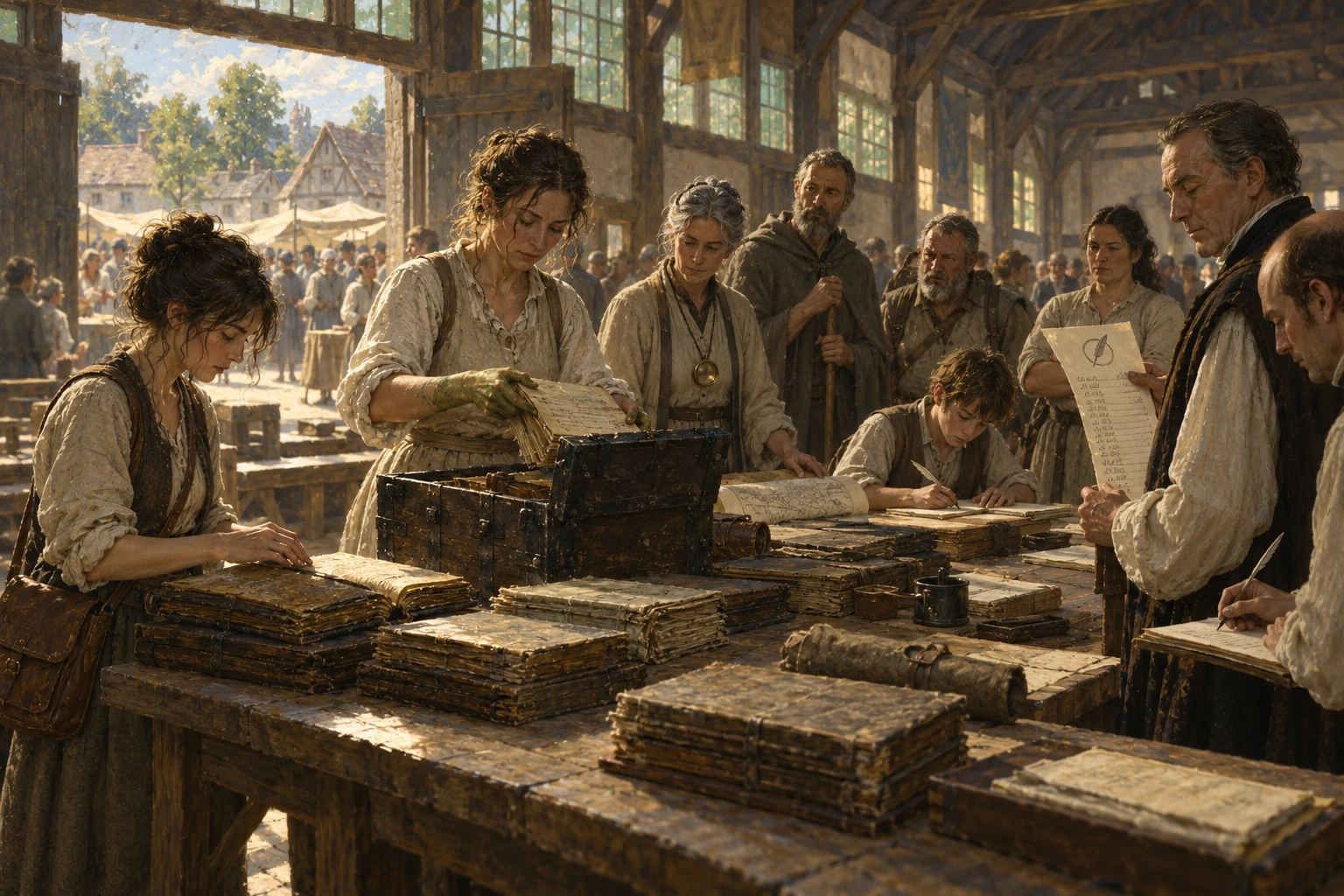
The hall itself was long and low, timber and packed chalk-and-flint, its one great table bearing an iron-bound chest at its center — not raised, not curtained, not set apart on any plinth or shelf higher than the table's own working height, but there, the way a bread-crock is there — set down to be used, not admired. Wren's eye went to it and stayed a moment too long to pretend otherwise.
"You're wondering about the chest." The woman who said it had come in behind them unheard, hands green to the wrist with flax-juice, sleeves rolled, hair coming loose from its tie in the day's heat — younger than Wren had expected anyone in this office to be, no more than thirty-five by her face, though her voice carried a stillness older than that. "Everyone does, first thing. It comes out for a signing, or for a dispute settled. This is neither, not yet, so it stays shut a while longer. I'm Jessa. I read for this town, such reading as it wants." She looked them over once, slow and thorough, took in Alder's stick and Iyene's satchel and the mules being led toward the barn beyond the window, and said only: "Somebody will bring you supper at the field's edge, same as everyone gets it. You'll want to wash first. The well's sound."
That night, at the porch of the hall with the last of the light going long and gold across the flax rows, Wren worked out privately what had been nagging at her since the road's edge: Ashcroft had given them no hail — no Who crosses?, no formal challenge at any threshold — and no keeping-charge had come up anywhere in anyone's speech, nothing in the shape of the Hazels' three plain verbs, or the fire-natured lines cut into Stanhope's stone and Rafe's own lintel. She turned the absence over the way she turned an oddity in a hive gone briefly quiet, and came, before the fire burned down, to something she thought might actually be true: a charge was what a promise shrank to when there was nothing to write it on and no living hand left, over the long absence, to write it to — and a hail was what one kept door invented for itself when it was standing alone against a whole empty country. Ashcroft had never lost its paper, and had never been only one door. Its promise had never had to shrink to fit a mouth, because it had never stopped fitting a book. She did not write this down as a discovery to be proud of. She wrote it down because it seemed, once she had thought it all the way through, true enough to keep.
The evening's news went round in one loose overlapping telling — Wren's part, Bracken's, Alder's, folded together at the field's edge while stew went round in bowls too hot to hold for long. Ashcroft, it turned out, had heard nothing of any of it: no post had ever reached this far south of the beacon road (their own tracks ran east and north, to country the company had not walked), no word of this summer's relightings, no name for Sereth or Stanhope or the sleeping harbor four days gone. Sereth's hearth, Stanhope's lamps, the beacon-line waking hill by hill, and — in one clause among a dozen others, given no more weight than the rest — Aveleth, the harbor town where some had sailed west-over-sea meaning to come home when the road was lit; nobody in Ashcroft looked west at the mention of it, or asked to hear it twice, or hoped aloud, because it was one true thing among many true things told at the end of a long working day, and the town took it exactly that size. Jessa, for her part, gave back one thing only, and did not make an evening of it: her own people held a memory, generations old, of a journey east once made, to a place with a way-house and a door that never shut, though no name for it had survived the telling. Wren gave it to her without dressing it up, because it cost nothing to give: Sereth; it was still there; eleven generations. Jessa nodded once, confirming a thing she had already half-believed, and the moment closed itself without ceremony.
Dorrit spent the evening not talking about any of it, on her knees two rows into the flax with three Ashcroft women who had shown her the trick of the pull without being asked and been shown, in exchange, exactly nothing she didn't already half-know about a green stalk. Her hands went home that night the same green as everyone else's.
Wren took the Waybook out alone, once the fire had settled and the field had gone fully dark. Wystan's page showed Ashcroft drawn at a town's own size — the street, the hall, the fold's shape, the retting-line — where she had half-expected, after so long a distance, a single mark for a single hearth. The margin carried one numeral only, no words beside it. She sat with that a while: the oldest book in the world had had the scale right the whole time, and the west's own living memory, telling it forward mouth to mouth for three hundred years, had worn it down to a hearth and a light. She kept it to herself, and put the book away.
The carts came up the north road on the second morning, mid-forenoon, while the whole field was still at the pull.
Nine men on foot beside four heavy carts, and ahead of them on a sound-looking mule, a lean man in good weather-clothes with a leather roll under one arm and a clerk trotting to keep pace at his stirrup. He did not dismount at the field's edge and wait to be greeted. He rode into the square itself, drew rein, and asked — to the air, to whoever would answer, in a voice pitched for exactly the carrying it needed and no more — who spoke for the holding.
The field emptied into the square behind him without anyone giving an order to empty it. Wren watched four hundred pulled and half-pulled rows go still, watched the retting-dams' wet crews come up out of the water and start toward the hall at an even, unbroken walk, and understood before a single word of business had been spoken what the town was afraid of, because it was written on every face crossing that square in exactly the same terms: not for themselves. For the green-paned windows of the hall, forty-odd of them, old glass gone the soft pale color of a shallow pool — Wren alone knew, from a lakeside city four hundred miles and half a summer behind her, where glass like that had first been blown, and said nothing, because Ashcroft had no name left for the place and wanted none today. For the tools racked true in the barn. For the long table itself, worn to a shine by hands long gone and hands not yet born. Nobody in that crowded square looked afraid for a single life. They looked afraid, entirely and without apology, for their things, and their dead's things, still in daily and unremarkable use.
The man had a leather roll of papers, and a schedule of lots — Wren caught the shape of it over Iyene's shoulder later, a long numbered list in a clerk's careful hand — and somewhere down that list, numbered like the crockery and the hinge-work around it, the carved house-marks cut into every lintel in the town.
Bracken saw it too, and did not wait to be asked before he told them what it meant. "I've walked a hamlet where marks like that were pried whole off the door-frames," he said, to Jessa, in the same flat voice he'd have used to report a bad ford, "and carted off numbered, same as this. What's left after isn't a gap. It's a scar — raw and pale, right down to the fresh wood, because the wood under a lintel-mark never saw weather in all that time and doesn't know how to go grey like the rest of the frame around it." He did not say more than that. He did not need to. The square, which had not understood a warrant or a schedule of lots five minutes before, understood a raw pale scar over its own front door completely, and went very quiet indeed.
"The charter speaks for it," Jessa said, when the man asked his question a second time, no louder than the first. She did not raise her own voice to answer him. She sent a boy for the chest.
It came out on two men's shoulders and was set on the long table exactly where it had sat the day before, unremarked, with the hall's own doors standing wide and the square packed up to them, so that whatever was read at that table would carry to both at once. Jessa opened it herself, lifted out the topmost of many sewn gatherings — vellum darkened at its earliest leaves to a rich brown, paler and fresher toward the back where the newest hands had signed — and read, in a slow carrying voice that filled the hall without straining for it, the town's own founding clause:
"Be it known that Ashcroft is held. Every hearth beneath is answerable for the whole of it; and every hand that holds it sets its name below, in its own hand, that no one hereafter need wonder whose ground this was. And when a hand can no longer write, the next hand writes, and the reading is done over."
She let it sit a moment before she went on. "Twelve times since the closing, by our own reckoning, every twenty-five years and whenever a household is new-made or ended, every adult here has set their own name below that clause, or below whatever clause came before it, further back than our own dating knows how to name a year for. This book is older than the Frost itself. It has never gone a generation unsigned."
Alder gave the Survey's own charter then, once, and did not linger over it — the College's charge to the road's whole working, the sworn business of mapping and lighting and, by now, standing where a stranger's witness was wanted; words the company could by this point have finished for him in their sleep, and words this hall did not need whole, only enough to know by what standing anyone here proposed to make sense of a book that was not theirs.
Then Iyene stepped forward and, before she so much as opened her own working sheet, said the one thing any claim brought to this square owed it, aloud, first. "I want it understood, before I read one further word here, that I hold no standing over Ashcroft, and claim none. Nothing in my own charter reaches this far. What I do hold is a way of setting your book's own words down so that a man in Merrow who has never walked this ground would still be bound to hear them. If you would rather I lent you that, you have only to say so. If you'd rather construe your own charter yourself, in your own voice, that answers every bit as well, and I'd think the better of you for it."
Jessa looked at her a long moment — not unfriendly, only weighing it. "You're the second stranger to stand in this square with a paper in your hand and a claim to being heard," she said. "Give me one reason I ought to let you read my own book back to me."
"None but this," Iyene said. "Your charter is written to be read here, by your own people, for your own purposes, and it has done that faithfully for longer than anyone can count. It was never written to be heard in Merrow. Mine has. I'm not offering to hold your book for you. I'm offering to carry its meaning somewhere it was never built to reach on its own."
Jessa considered that a moment more, and then nodded, once. "Then read it with me. Not for me."
Wren was called forward last, before Iyene turned to the man's own paper. She opened the earliest gathering with the two fingers she had held beside ink her whole working life and never laid flat upon it, and gave the square her craft, item by item: ink browned deep at the founding leaves and dark and fresh at the last; the sewing-stations of three separate re-bindings, each a slightly different hand's work, each done to make the book last rather than to make it look old; vellum prepared three distinct ways across what must have been centuries, each preparation belonging entirely to its own gathering and none of it borrowed from another. And then the one finding that mattered more than all the rest of it together: the same hand, followed forward gathering by gathering, signing as a young and confident stroke in one leaf and, some pages and evidently some decades later, as a slow and shaking one in the next — over and over, name after name, with no gap anywhere a forger's book could ever have troubled to fake. "I won't put a year to it," Wren said, to the square and not only to Jessa. "I'll only say it's older by a very great deal than any paper on this table, and that in all that time it has never stopped being signed."
Iyene construed the charter next, and she did it the way a good instrument does the work it was made for: without heat, without haste, and — Wren understood only afterward how carefully this had been held to — without one single note in her voice that asked anyone in that hall to enjoy watching her do it. "This charter is three centuries the senior of any warrant that could be brought against it," she said, "and that alone would answer most claims. But it is not merely old. It is current — signed in hands standing in this square this very morning, renewed inside living memory by people standing here with the morning's flax still green on their hands. The answer to a charter is a better claim, arrived first. This one arrived before the Frost, and has been renewed every twenty-five years since, most recently by the people you are looking at."
Only then did she turn to the leather roll itself. Yardley, the warrant named him — salvage-master, chartered under a standing purchase whose mark she had copied twice before: a quill drawn small within a plain ring, headed now a third time over a hand she had never met. She let her eyes rest on it a moment longer than the reading needed, and said nothing about it at all.
The first defect she gave without softening, and let it sit. "Your own warrant runs, by its own words, to holdings found masterless. This one is held — held, and has been held without a single lapsed generation, for longer than your charter's whole trade has existed. Your own paper excludes this ground before it ever reaches it."
The second she read straight off the schedule's own heading, and read it twice to be sure the hall had heard the date correctly the first time: a hundred and sixty-odd lots, numbered, described, and valued in the clerk's own careful hand, dated eleven days before the man had ever set eyes on Ashcroft. "You wrote your inventory," Iyene said, "before you arrived to take it."
It was somewhere in the pause after that, with the square gone very still and the man's face gone very carefully unreadable, that Dorrit said the thing everyone else had been walking around all morning, in a voice that did not shout. "You've come to take the cups off their grandmothers' shelves," she said, to the man directly, "and you've brought a clerk along to write down what they were worth while you did it."
The third defect Iyene took her time with, because it was, in its own small way, the whole of the morning's business. She turned the warrant over to its foot, where an assessor's line ran blank — no countersignature, no seal beside it, nothing where the trade's own standing rule required a district assessor's instruction to be carried. Tipped in behind it, in a clerk's own tidy copying hand, was a circular, dated that summer:
"To all holders of warrant in the western district: no route, holding, or site west of the province gate carries my endorsement until it has been walked and found masterless in fact, and not in form. Any tally rendered ahead of that finding is rendered without me. — Marle, Assessor."
Iyene read it through once, aloud, and set it down. "I don't believe," she said, mild as milk, to the paper and not to the man behind it, "that I have ever once had the pleasure of finding my own argument already made — and made rather better than I'd have troubled to make it myself — by the other side's own assessor." She let that be the whole of it. Beside the circular, tucked in the same fold, a second note from some Merrow office complained, in passing and in no more than a sentence, that the western assessor's refusals had already held up three warrants that season. She read that one to herself only, and passed it once, without comment, to Wren, who understood it for what it was and put it down again unremarked.
Pip copied the whole of it at a hall table while the man watched him do it — seal, blank line, circular, the inventory's own damning date — letter for letter, in the open, exactly as the practice had always meant to be used. The man spoke against it once, low. "A warrant pressed publicly," Iyene told him, not unkindly, "is a public instrument. I've already read the whole of it aloud. The copy is a courtesy to your own record, nothing more." He did not try a second time.
Bracken gave his own reading last, and it was the shortest of the morning. "Nine men," he said, to no one in particular, "and four carts." He looked once round the square, crowded now with every soul the flax-ground and the retting-dams had emptied into it, and gave the second number just as flatly. "And better than three hundred and fifty pairs of feet, by my rough count, standing here this morning with nowhere better they'd rather be." That was the whole of what he had to say about any of it, and it was enough.
The man's crew began harnessing without being told to. Nobody in the square advanced a step, or raised a voice, or formed anything that could fairly be called a line; the square simply stood, full and quiet, and the arithmetic of it did the rest of the morning's work on its own. The nine men who had walked in as diggers walked out as diggers, unblamed and unnamed by anyone, not one of them told what date sat on the schedule folded now back into their master's roll.
The man himself asked one question only, once the last cart was hitched, looking at Iyene's own working sheet rather than at Jessa. "You mean to set this down."
"I do," Iyene said.
He said nothing else at all. The carts turned back north, and by early afternoon the square was only a square again, dust settling where four hundred people had stood and not one of them cheered, or called after the carts, or said a single word that could be mistaken for satisfaction at another man's arithmetic coming up short. Iyene set the same kept-fire mark beside Ashcroft's name in her working sheet that she had set beside Sereth's and Wakelow's — nothing new struck for a town this size, only the town's scale and its charter and the day's finding carried down in words, in both her books, where words could hold the whole of it better than any mark could. At Aveleth she had declined to total a room full of names, because a dead book cannot honestly be totaled by a stranger's hand; here the number came to her whole and unasked-for, because a living charter counts itself. She entered the finding that same afternoon, and made, with Pip's hand alongside her own and with Jessa's leave freely asked and freely given, a fair copy of the charter's operative clause and the town's current roll — four hundred and thirty-one adult names, Jessa Linden's own hand signing it true beneath the last — to be carried east on whatever post could someday reach this far. It was the town's own act, offered rather than taken, and Wren set that down too, later, as the thing about the whole morning most worth keeping.
Alder said one thing to Jessa that afternoon and nothing else about the morning at all. "Your own charter did that," he said. "We lent you a second reader, and no more than that. I'd not have it remembered here any other way."
The road south was settled before supper, without argument or ceremony. Jessa gave it the same way Fenna had once graded a question at Stanhope's own table — bounded to exactly what she knew, nothing claimed past its edge. Her own people's knowing ran, she said, to a particular grey stone standing two days south of the last of the flax-ground, and a stream a half-day past the stone, and past the stream, nothing at all, because Ashcroft did not go south and had not in living memory; the fold the road ran through was the only crossing between the chalk and the way-fortress country for many days in either direction, and past the stream this town had simply never had reason to look. Alder asked whether the company meant to take it. Nobody argued, and that alone settled it more thoroughly than a speech would have. "It wants doing," Bracken said, in the old grammar, and the evening moved on to other things.
The field filled again before the dust from the north road had settled, without a word said about any of it. The town went back to its rows and pulled flax until the light went, and the company knelt down in among them and pulled too, and it took no more than a few minutes for the day to become, entirely, the working day it had always meant to be. Wren spent the last of the light on her knees in a field of pulled flax with her own hands gone the same green as four hundred strangers' hands beside her, having said almost nothing since morning that anyone would trouble to remember. Not one person in that field asked the company a single question about what had happened in the square. She noticed it once, turning it over as she had turned over the missing hail the evening before, and did not explain it to herself past the noticing: a whole town, practicing at scale the same grace Sereth had once practiced on two travelers at a supper table, letting a thing be told when it was ready to be told and not one hour before.
Ashcroft is not the hearth-and-a-light Sereth's own telling made it, Wren wrote that night, by the last of the fire. It is a town, four hundred and thirty-one signed hands and however many more not yet old enough to sign, and I do not think anyone at Sereth was careless in getting it wrong; I think a town this size, kept this quietly, this far from any road that carries news, is exactly the kind of thing an oral memory shrinks without meaning to. Its charter is not shown for show. It comes out for a signing, or a dispute, Jessa told us, on the first evening, before either of us knew a dispute was a morning off — and I have watched it come out now for both. The overlap of hands down its gatherings, one steady young signature becoming, pages later, one shaking old one, with no gap anywhere between — that is the proof no forger could ever build, and I mean to carry the trick of reading it the rest of my working life.
Iyene's finding is entered in both her books, and a fair copy of the charter's own clause and of the whole current roll goes east with us, signed true in Jessa's hand, to wait on a post that can someday reach this far. The three defects sit plainly enough in my own hand, set down because they ought to be set down and not because I take any pleasure in the setting: his warrant excluded held ground by its own words; his tally was dated before he ever walked here; and the assessor whose line he needed blank had already written, in his own hand, weeks before any of us reached this fold, that no tally taken ahead of a real walking counted for anything at all. Marle's line sits under that circular unglossed, and I mean to leave it exactly that unglossed in my own account, because I think whatever it is doing, it is doing it quietly, off any page any of us will ever be shown.
Iyene asked leave before she read a word of Ashcroft's own book back at Merrow, and Jessa gave it in her own time, having first made her say outright why she should have it at all; and I think that asking mattered more, in the end, than any of the law that came after it — a town's charter beat a warrant this morning, but a town's own yes is what let the beating happen at all.
Ashcroft has no charge in three parts, as the Hazels have, or Stanhope's lamps, or Rafe's own hill; and it hailed us with no door-word at all, as Sereth had, or Wakelow. I believe now that both absences come from the one cause: I still believe what I decided that first evening: the charge and the hail are the same absence, worn into two different shapes by two different kinds of loneliness. Ashcroft's promise never had to shrink, because it never stopped having a book to be written in. Its charter simply is its keeping-text, whole, and wants no second sentence beside it.
Wystan's own page had the scale of this place right three hundred years before any living mouth did — a town, drawn as a town, one bare numeral in the margin and not one word of explanation, as though he had known, walking it once, exactly how much a place this size did not need saying about it.
Partway down the page she copied Jessa's own words back to herself, the ones spoken quietly at the field's edge once the carts were long gone north, offered before anyone in the square had thought to ask for them: if he comes back, we'll do the same thing again, and it will take less time. No dread rode on the sentence at all, going down. It sat on the page settled, and finished, and entirely unafraid of being true twice.
The carter who sold us the beacon-basket, on the road out of Merrow a lifetime and a mountain range ago, told us once that Factor Quill had never in six years shaved a single weight off a loaded cart — that his scale ran true the whole time, and no thumb was ever laid on it, in any of it. I have turned that over most of this evening, kneeling in flax with my hands too tired to hold the pen steady. A man can run a true scale his whole working life and never trouble to ask what it is he has actually got sitting on the pan, and this morning somebody finally set a charter down on the other side of his, and his weight came up light, and he could not argue with the arithmetic of it, because arithmetic was the one thing in the whole world he had ever agreed to be bound by.
At full dusk, before the chest was shut for the night, Jessa took up the pen herself at the long table and wrote, in her own hand, in the current gathering, while the last of the field's noise settled outside into the ordinary sound of a town going in to its supper:
This day, in the twelfth signing's own year, nine men came under a warrant to take what is held here, and were shown the charter, and heard it read, and went north again with nothing. The Reader construed it with help freely asked and freely given, by strangers who claimed no standing over us and were given leave all the same. No hand was raised on either side, the whole morning through. The flax came in that same evening, forty bundles past what stood stooked the night before.