The Wound Named
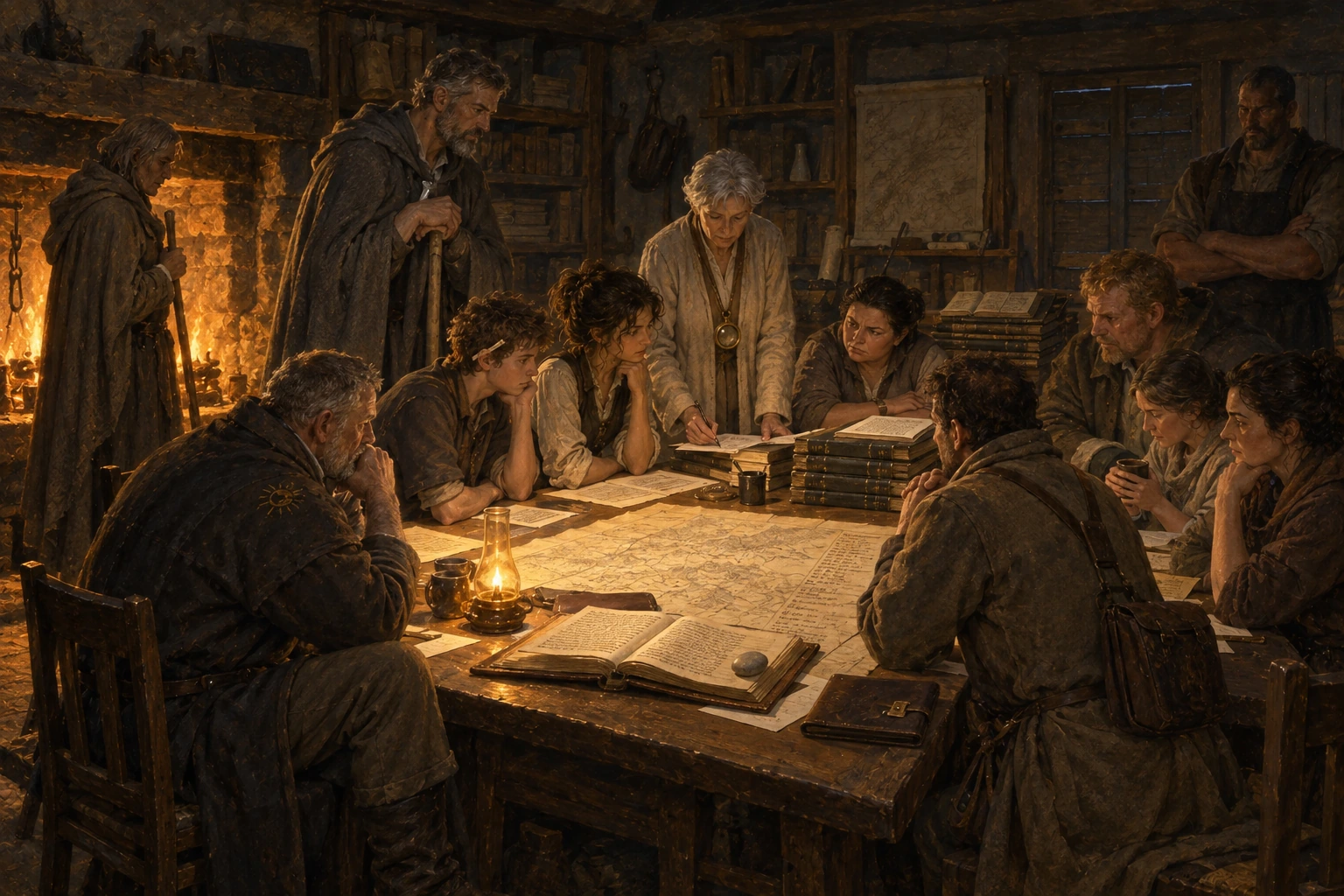
Five things lay along the map-room's long table before any of the twelve who owned them came in to stand beside it: the Waybook, open at its fifth leaf and weighted at one corner by the smooth grey stone that had ridden up from the yard for exactly that use; Iyene's master sheet, the first new map of the west, its whole eastern quarter given over to four lines in her own smallest hand; the house's own ledgers, twelve of them stacked square at the table's far end, the topmost open to its last written line — a day's baking short, a north bay wanting re-slating, the wind come round to the north-east, signed by a man long dead, who had asked nothing of whoever read it next; Iyene's four working sheets from three nights before, the column of dates; and Marle's own circuit-book, closed, set at his own elbow rather than the table's centre, and left lying there the whole evening. One thing was missing from the five, and the man it belonged to said so himself before the evening had truly begun: Osric Vane had nothing of Ashcroft's own to lay beside the rest, because Ashcroft's whole history of keeping had never in three hundred years been written down. It had only ever been done.
Twelve people filled the room across the next quarter hour, in twos and threes, until every chair and bench the house owned was accounted for and Pip had gone down for two more besides. Bracken banked the fire high enough to last the evening without tending and took the chair nearest the door, old habit, his left forearm pale along his knee, paler than it had been before the night at the gate, where anyone who wanted to could see it and nobody did. Dorrit took the bench across from Marle without appearing to choose it, and Marta sat between Osric and Thomasin with both hands around a cup she did not drink from all evening, and Sim came in last of anyone and stood against the wall by the window rather than take the chair Pip had carried up two flights for him.
The map-room had never held this many bodies at once, and the long table that usually gave Iyene's sheets the whole of its surface now gave up a third of its length to elbows and the backs of chairs pulled in tight enough to touch. Lamplight caught the grey stone at the Waybook's corner, and the brass clasp beside it, and the twelve spines of the house's own ledgers stacked at the far end; it was more of that house's history laid out on one board than any of them had seen at once, and every person settling into a chair looked at it and then looked away from it and found something to do with their hands.
Iyene stood at the table's head rather than take the chair somebody had left her, and did not sit down again until she had finished saying everything she had come prepared to say.
"There are five things on this table and one thing beside it that isn't," she said. "I want them taken in an order, because taken any other way we'll spend the night arguing which fact came first instead of finding out what they add to. First, the ledgers — the oldest witness in the room, and the least likely to have an opinion about what it saw. Second, what came off the fifth leaf, because it's the newest, and it's the reason we're sitting here tonight rather than any other night this winter. Third, what Luel can tell us that neither the ledgers nor Wystan thought to set down. Fourth, the arithmetic, once we've something worth putting a number to. Fifth" — she did not look at Marle when she said it — "whatever that book wants saying, if its owner decides he wants to say it."
She sat down once she had finished, and for a moment the only movement anywhere in the room was Pip squaring his leaf against the edge of his knee.
Past the shuttered windows, shut fast against the cold and left that way, the snow that had shut both roads eleven days before still lay across the yard in a single unbroken crust, deep enough in the lee of the north wall to have buried the bottom rail of the fence Bracken had mended in autumn, and it would go on lying there, by every account any of the twelve at that table could give, for longer than any of them had patience to wish it gone.
Osric stood, sat down, and stood again before he managed a whole sentence, the third attempt proving no better than the first two at giving him anywhere to put his hands.
"I don't have anything to put here," he said, "and I'm sorry for it, because everyone else at this table's brought something with weight to it, and I've walked in with two empty hands. Ashcroft's kept its fires three hundred years and never written down why, or when it started, or who first said it had to be done. My grandfather couldn't have told you; his couldn't either — I asked him myself, as a boy, thinking there'd be a good story in it, and got told there wasn't one."
"How far back does the fire go," Bracken said. "Not the story. The fire."
"Nobody knows," Osric said. "That's rather the whole of what I'm telling you."
He sat, finally, in the chair he had twice already half risen from, and Thomasin reached over without being asked and set her hand flat on the stack of ledgers at his elbow, which was as near to a comfort as anyone offered him that evening, and was, from a woman who rationed her comforts as carefully as she rationed everything else, considerable.
"Tell them the rest of it," Thomasin said, without looking up from the ledgers under her own hand. "The names."
Osric obliged her, shorter this time. Every house in Ashcroft kept a fire lit through the dark half of the year, past any real use for warmth by midday, and every rider going north said aloud the names of the last three farms he had passed, whether there was anybody on the road to hear him or not — his own father had done it riding to market, and he had thought it a habit, the way a man clears his throat before he speaks, until this week. Nobody in Ashcroft had a word for what any of it was guarding against; they only did the guarding, the same as their fathers had, and theirs before them, back further than anyone could count.
Wren gave the room what the fifth leaf had given her, in fewer words than it had taken Wystan to write it. The order the roads had gone quiet in — traffic first, then silence, then the cold moving in behind it, and not the reverse the household had first guessed and gone on believing for most of a week before Iyene's own tables quietly disproved it; and the Hall's own standing order to every field surveyor it had, unexplained twice over two letters and obeyed regardless: write down every name a living mouth will give you, and keep writing them down for as long as you are able. She did not read the leaf aloud a second time; she said what it had told them, and let it sit on the table beside the ledgers without dressing either one up to match the other.
"Three hundred years of two people doing the same thing," Iyene said, "on two sides of a mountain, neither one knowing the other existed, and neither ever told why. That's the first thing on the table, and I want it said once, before we move to the second."
"When do we leave for it," Bracken said.
The room had already turned to Luel, and a quartermaster's question does not compete well against a question about what is loose in the world.
"The second thing is Luel," Iyene said, and turned, for the first time since she had begun speaking, to look at someone other than the table.
Luel had not moved from her place at the fire's edge since the room filled, and did not move now. "Your Edda has a true doctrine," she said, "and I want that said before anything else: she told you it lies, not hunts, and she told you it's ground, the way standing water is ground, and a person minds it the way a person minds a flooded ford — with sense, not dread. She was right, for her own country, and she said so herself, in the same breath, and none of you carried the second half of it home with you."
The table did not answer at once, because not one person at it had carried the second half home, and every person old enough to have heard Edda's letter read aloud in this same house knew exactly which half Luel meant.
"'What's further under than that, I've no word for at all,'" Wren said, and it came out of her before she had decided to say it, and Luel looked at her once and did not correct the quoting.
"Under enough ground, long enough, lying stops being the whole of what a thing does," Luel said. "Something that only lies does not reach up through a doorway; something that only lies does not put a man's own shape back on its feet, walking, decades and decades after his own burying. Whatever waits under the deep ground stopped being weather a long while before this house was ever built to stand against it."
"She was not wrong," Alder said. Four words, and no more.
Luel went on, in the manner she always used, memory rather than lecture: the faded were not sent; nothing commanded them, nothing gathered them under a single hand; the ground made them, the way frost makes ice, out of people the Quiet had taken and nobody had reached in time; nothing stood over them, and nothing gave the order. They walked because whatever was left in them still could, and what was left could be fought, and refused, and ended, because it still belonged to a person and not to a plan. She said all of it in the same low, level register she used for everything else, pitched no higher at the end of it than at the beginning, so that the largest thing said in that room all evening came out at the volume of a woman reporting the state of a road.
"Who sends them, then," Iyene said, setting her pen down as though the answer might want both her hands free to hear it.
"Nobody sends them," Luel said, from her place at the fire, without turning her head to say it.
"Something has to," Iyene said, not looking up from the sheet in front of her.
"Nothing does," Luel said, and looked back into the fire instead of at her.
"A pattern this consistent has an author," Iyene said, "and I've spent eleven years reading a country by its pattern rather than its telling, and I have never found a pattern that consistent with nobody standing behind it holding the string."
"This one has no string," Luel said, "and I have looked for one longer than your college has stood."
Iyene did not answer that, which for Iyene was its own kind of answer, and wrote something in the corner of her own sheet, too small for anyone across the table to read upside down.
The fire wanted a log for a good while after that and did not get one, until Pip got up from his corner and fed it, unasked, because it wanted feeding and the room had gone cold.
Thomasin asked her question a while later, in the voice she used for pricing a wall before deciding whether to lean on it.
"How many is it, right now, that you know of; how fast does one become two; how long does a thing like that hold before it's more than any watch could stand against."
Iyene took a fresh sheet and set the question down in her own hand before she attempted it.
"I don't know how many there are right now, and nobody does, and anybody who gives you a figure is giving you a guess dressed as a count. But I can give you the shape of it, if you'll let me work it in front of you rather than hand you a finished number to take on faith."
She waited, pen raised an inch above the sheet, for someone in the room to tell her not to bother.
"Go on, then," Marle said, from near the door, without moving from where he stood.
Iyene drew a line down the sheet's centre: one faded thing had come up the road and been ended in this house, three nights before, by name, and before that night, it had walked longer than any ledger in the room could confirm, and in all that walking it was on record as having reached exactly one door and failed to open it before it was stopped. But every faded thing this house had ever heard of, going back to Sereth's own count and Ashcroft's own fires, had been a person the Quiet took and nobody reached in time, which meant the number did not sit still; it grew by exactly the number of people the Quiet took before anyone reached them, every season, for as long as the Quiet had ground left to take them from.
"Show me," Bracken said. "Numbers. Not the shape of them."
Iyene wrote a column of figures, small and even, and read them aloud as she wrote. Say ten, this year, across the whole west, taken and not reached — a low guess, and she'd want it lower if she could honestly argue for lower. Say each of the ten walked a season before it found a door, the way the one that came here did. Say each one that found a door and was not stopped took, in turn, one more person from behind it before anyone could end it, because that was what the house had watched happen three nights before, in the one case any of them had actually seen. Ten became twenty within a season, and twenty became forty within the next.
The pen's scratch was the only sound in the room by then, small and steady against the paper, and even Dorrit had gone still on her bench to listen for it.
"Compounds meaning what," Dorrit said, leaning forward off a bench she had barely shifted on all evening. "Say it straight."
"Meaning it doesn't stop," Iyene said. "Say the east offers more doors, more people, less warning, and nothing that knows to bar a gate at nightfall. The number doesn't grow after that; it compounds, and by two winters we are no longer speaking of tens. We are speaking of hundreds, over a country that has never needed to defend a door against anything at all."
Bracken looked at the fire, and Marta looked down into her cup as though the answer to something might yet be found in the bottom of it.
"Show your working again," Marle said, "slowly — a chain's only as honest as its weakest link, and I'd like to know which one is yours."
Iyene showed him. It held.
She set her pen down and said one more thing before anyone could move the evening past the numbers.
"Every week between tonight and the thaw is a week that number gets to grow before anyone can do a single thing about it. I want that said plainly, once, because it will not get any less true for going unsaid."
The roads had been shut since before the fifth leaf was ever opened, and would stay shut a good while yet, and there was no argument at that table, however well made, that could put a single person on a single road one day before the season allowed it.
Marta spoke into the quiet after, and her voice did not fill the room the others' had.
"Is Ashcroft going to be all right."
She said it plainly, without dressing it in anyone else's words. "I share a wall with a woman there; her name went out of me the night at the gate, same as some of the rest of you lost things, and I had it back by breakfast. And I have not stopped thinking since about the morning it doesn't come back, and her not knowing I'd lost her. Ashcroft's west of a fold that only learned this year it could be crossed at all. I want to know if it's going to be all right."
"Ashcroft is west of the fold, which puts it—" Iyene began.
"Let her finish," Bracken said, quietly, and Iyene stopped, and looked at Marta, and did not finish her own sentence either.
No honest answer to give her existed at that table, and Osric, first to feel the lack of one, would not lie to her in its place; he looked at the ledgers, and then at Marta, and held her eye the whole time he gave her nothing, which cost him visibly to do. For half a second every face at the table turned the same direction, toward Wren, without anyone deciding to do it, and Wren had nothing to give any of them either.
Iyene came back to it a while later, once the room had moved on to other business, and said, low, to Marta alone, that she had been wrong to cut her off, and that the order of the evidence had mattered to her more than it should have in that particular minute, and she did not put it any more gently than that; she said what she had done, and let Marta hear it said, and went on to the next thing, because there was still a great deal of table left in front of them and the night was not going to wait on either woman feeling better about it.
Alder spoke next, and began as he always began: what he knew, stated first, and then what he did not, in that order, and no further.
"I can tell you what the west built, because I was raised inside what was left of it by people who never stopped teaching the habit. Fires kept on hills where nobody needed the warmth; roads walked by people with nowhere in particular to walk them to. Names said aloud at doorways, at crossings, over graves, for no reason any single one of those people could have given you if you'd stopped them and asked. Osric's own grandfather couldn't tell him why the fire mattered; mine could have told me, and chose instead to teach me the keeping first and the reasons after, because that was how it was given to him in his own turn."
"And the east," Bracken said, before the silence following Alder's list could settle into something that had gone on a beat too long already.
"The east has none of that," Alder said. "Merrow, Sereth before its own thaw, the shire towns, Dall — farm country, market country, and not one kept fire on a hill in any of it, because none of it ever—"
The word was not there.
It was a small word, the kind that does most of a sentence's real work while asking for none of its credit, and every person at that table who had ever tried to hold a whole thought together under pressure knew exactly how it felt to reach for one and find the space where it should have been standing empty instead.
He stopped in the middle of the sentence, in front of twelve people, and the room felt him stop exactly as it had felt him stop three nights before, over the fifth leaf, though there was no leaf in front of him now to blame it on. He offered no explanation, and did not reach for his stick, and did not look at Luel, who did not look back at him either. He began the sentence again, in the common speech, because the word he had reached for the first time was simply not there to be reached for a second.
"Because none of it ever needed to," he said, "and none of it knows that it does now."
The second try landed worse than the first, and everyone at the table heard the difference. Wren, three feet down the table with the book still under her hands, had watched this happen to him twice before, and let it go by a third time.
"The comparison is the whole of it," Alder said, once his voice had steadied. "Generations of keeping on one side of the mountains, none at all on the other, and the one road between them stood shut and unwalked the whole while, until this year."
The room had gone quiet again by then, the particular quiet of people who suspect an evening is not finished with them yet, and it was into that quiet that Bracken spoke.
"That's mine," Bracken said, and waited until the room's eyes had actually settled on him before he went any further.
He did not stand, and his sentences ran shorter than anyone else's at the table, as they always did.
"There's one road over the mountains that was never kept. No names on it. No fires. Nobody's walked it since before anyone at this table was born, near enough, until this year, when we opened it."
"The Gray Stair," Iyene said, before he had to be the one to say the name himself.
"The Gray Stair." Bracken looked at the table, not at any one face on it. "Before anyone writes this down: I can't prove it. There's a man at the eastern foot of that pass. Willem. Border watch, my old company, and before we left he swore to carry any letter that came over that road, either direction, to anyone who'd carry it on. If the road runs west to east the same as it runs east to west, whatever's using it isn't waiting on a letter."
Iyene's pen stayed where it was, an inch clear of the paper, for longer than she generally let a pen hang.
"That is the worst thing anybody has said at this table tonight," Iyene said, "and I believe every word of it."
She wrote for a moment, and then turned the sheet round on the table so that he could see what had gone onto it.
"It goes down as a question with a date on it, and not as a finding, because a finding built on a man's name and a fear is one I cannot defend, and this sheet is going to be read by people who never met you." She set the pen across the inkwell. "Here is what would settle it, and I want it on the same line. Whether anything at all has come west over that road since we came west over it. And whether the autumn's mail went east and stopped, or never went at all."
"Nobody's going to walk that road to find out," Bracken said.
"No," Iyene said. "That is going on the line as well."
Bracken had said what he came to say, and did not repeat it, and the room let his fear sit on the table where he had set it down.
Dorrit threw her question across the table as she threw most things.
"Dall's east," she said, "my family's east, and so's Wren's. What about going the other way."
Her question drew no answer; Bracken, whose old company held the near side of that same road, and who had just said a name he had not said since the road out of Merrow, looked at the fire and went on looking at it, and the silence that followed Dorrit's question belonged to him and to nobody else in the room.
The argument the question wanted could not be had, not that night and not for months to come, because deep snow kept the whole household from walking anywhere, and a quarrel with no road under it has nowhere to go; it was left exactly where Dorrit had thrown it, and the evening moved past it the way a river moves past a stone it has no present use for wearing down.
Pip had kept the record the whole evening, unasked, and set his pen down before he spoke, which was the only ceremony he made of it.
"Does it hurt them," he said, "the faded — does it hurt, being what they are."
It was a boy's question, and not one grown person at that table would have thought to ask it in those words, or would have got it out of their mouth in that shape if they had; and Luel answered him as she answered every question put to her, with an event rather than a lecture, though this time the event was a good deal smaller than any she had given the room all evening.
"There is nothing left in them to hurt," she said, "and everything that could be hurt is what went, first, before they ever stood up again. Until the name goes back, and then there is, for as long as a breath takes to leave a body, and then there is nothing again, because there is nothing left to carry the hurting."
Dorrit did not look at Wren, and the room went on.
Thomasin asked the question that followed on from Pip's naturally enough — what a household ought to do with its own dead, after, so they didn't stand up a second time the way the man at the gate had.
Luel would not answer it.
"I'll answer that," she said, "when it's asked by somebody standing over a body, and not a minute before, because it isn't a thing a person should have to carry until they need it."
Bracken's jaw set, and the matter went no further that night.
The road to Cael Meddan was reasoned out last, once the fire had been fed twice more and the candles had burned past their first quarter.
Iyene laid it out as she laid out everything on that table, provenance stated before conclusion: whatever was doing this belonged to the west; the people who had understood it best had kept their records at the Hall the vellum named; there was not one person on this side of the mountains, in that room or out of it, who had an answer better than a guess; and if an answer existed anywhere at all, it existed where the answers had been kept.
"A direction is not a reason," Marle said, "and I want the difference entered."
"Say what you mean," Iyene said, setting her own pen down to give him the whole of her attention.
"Three ifs stand between this table and that shelf," Marle said. "The Hall stands; the records kept; the records answer. Grant all three and you hold a hope with a road attached. I don't render hope as a return. I never have, and I'm not starting on the best table I ever sat at."
There was no answering it, and the room did not pretend otherwise.
"You're not wrong," Iyene said, after a moment, "and I want that on the record too, in your own words, and I'll enter them myself." She took up her pen and wrote while he spoke his objection over a second time, slower, so her hand could keep pace with it.
The room went ahead anyway, though no vote was ever called, because there was nothing yet the snow would let anyone act on, but the decision sat down at the table all the same, plain and unargued, every person in the room having reasoned a way to the same place by a different road and found the others already standing on it.
By then the candles had burned low enough that Pip had lit a fourth without being asked, and the fire had gone through most of the wood Bracken had carried in before supper, and every person still awake at that table wore the stillness of people who have said everything they came prepared to say and are only now discovering how much further the evening still has to go.
"When do we leave," Bracken said again, in the same flat voice as the first time, and got the same answer as the first time, which was none at all.
Sim spoke once, late, from his place against the wall, and it was the only sentence he gave the room all evening.
"None of us can walk anywhere for three months," he said, "so whatever we've decided tonight is about the spring, and I don't see the use in going on as though it were about tomorrow."
He was right. It ended the meeting.
The council's word went down on a single sheet, in Wren's hand, while the fire burned low and the rest of the household waited on her: what had been seen at this house, on that night, set down in few words; what it was, so far as twelve people had worked it out between them; what the west's own keeping showed, set beside what the east lacked and did not know it lacked; the road proposed, and the reason for it, given as a direction and not a certainty, and said so; and Marle's objection, entered last, in his own words, exactly as he had spoken them.
Iyene signed first, in full — Cartographer-Royal, by charter, the whole style — and passed it to Alder, who signed only his own name, exactly as he had signed every book he had ever put his hand to; and Osric signed for Ashcroft, on Jessa Linden's leave, and held the pen a moment after the last stroke, as though the signing weighed more than his own name usually did. Wren was not asked to sign it, and did not offer to.
Marle did not sign, but he read it through once more, by the same lamp the rest of them had signed it under, and gave it back squared to the edge of the table.
Wren's day-book, written after the rest of the household had gone up:
The council's finding is written and signed by three, and witnessed by nine, and it says less than any of us wanted and more than any of us expected three nights ago. Marle would not sign it, and was right not to, and I find I think none the less of him for it. Marta asked a question tonight that nobody at this table could answer, and I was one of the people who couldn't. I have nothing else worth setting down.
The snow had not let up in the night, and by the time anyone else was on their feet it had filled in every path the household had cut the morning before, so that the yard looked, for the first hour of daylight, very nearly as unmarked as it had looked the week the company first walked into it.
The household came down late that morning, later than the winter usually allowed it, and found Bracken already at the map-room table with a sheet of his own, ruling columns by hand: he was working out marching order — who walked where in a string of twelve and four mules, over ground none of them had seen, for a road that would not open for three months at the soonest and might not open even then, and that would want the loads balanced and the standing rota fixed long before a single boot went over the threshold. Iyene's map lay at his elbow, unrolled to its western edge, and beside it a second sheet where he set down, in his own steady hand, the order the company would walk in come spring: himself at the head, the mules behind him, Alder at the rear where his eyes did the most good, Wren and the book kept always between two people who could reach her inside three strides.
The columns were their own answer, and he went on ruling them straight until the household came down around him and the morning's ordinary work took the table back.