Wintering Down
Nobody closed the high road. It was left standing open after the last cart came down off the pass mouth, and the snow had it inside the week and did not give it back; and that was all the ceremony winter got at the Watch on the Stones.
The rest arrived as a hundred small closings, each reasonable on its own. The flocks came down off the high ground and were folded close in the walled yard; the wood-ricks along the south wall grew by daily labour until they stood over Bracken's head, split and stacked and roofed with turf against the wet; and the waymarks capped white one by one up the visible slope, each stone wearing its small neat hat of snow a day or two before its neighbour did.
Wren walked the wall alone in the blue hour before supper and let herself think, briefly and without sorrow, of the Hob two days east under this same snow — the basket seated true in its cradle, unlit and not needing to be, and it would be there in the spring. That was enough of a thought to be going on with.
Then word went round the hearth-hall that Orran's cousin Willem meant to make his last run down to the Steading Lamp before the road shut for good: two days down and two back through the drifts, weather willing, and after him nothing until the thaw; and it was generally agreed a fine excuse for letters, and the whole watch spent that week putting off the writing of the thing until there was, at last, no putting it off further.
Bracken's winter resolved itself into the smithy, where Orran kept a forge going against the cold, and the two of them fell into an argument about rivets versus doubled stitches that each had clearly been having, separately, with other men, for thirty years, and was delighted at last to have properly with someone who answered back correctly.
He took the heat for the shoulder rather than anything else, standing his right side to the forge by the hour with his coat off and his sleeve pushed up — and he did it in the smithy, which was the one warm room in the watch that Dorrit had no reason to walk into.
Because Dorrit was not treating him. She was treating everybody else — Enna's knee, a young watchman's whitlow, Orran's cough, both of Willem's chilblained hands, and every child brought to her by a mother who had heard she was good. Bracken's arm she left exactly where it was. She set a jar on his kit one evening in the third week, without a word or a note. It sat there unopened for nine days. On the tenth it was gone from his kit and back on her shelf, and neither of them said a syllable about it.
The stores took longer to settle, because a household run by two rightful captains must sooner or later argue about its own ledgers: Harrol kept hers in a hand as plain as a fence-post; Bracken kept his in a private shorthand nobody but Bracken had ever fully cracked. The two books were laid open side by side one wet afternoon and reconciled, column by stubborn column, while the rest of the hearth-hall found reasons to be elsewhere. Bracken wrote his side of it left-handed, slowly, in a version of his own shorthand gone large and childish. Harrol read every line of it without one word about the hand it was in.
"Your column runs short on the salt fish and long on the flour," she said at the end. "Same as it did twelve years back."
"And your column's never been wrong," said Bracken, not looking up, "which I've always found suspicious in a woman who claims not to enjoy being right."
That was the dispute, settled as most things at that hearth got settled: a dry line traded, and the work going on.
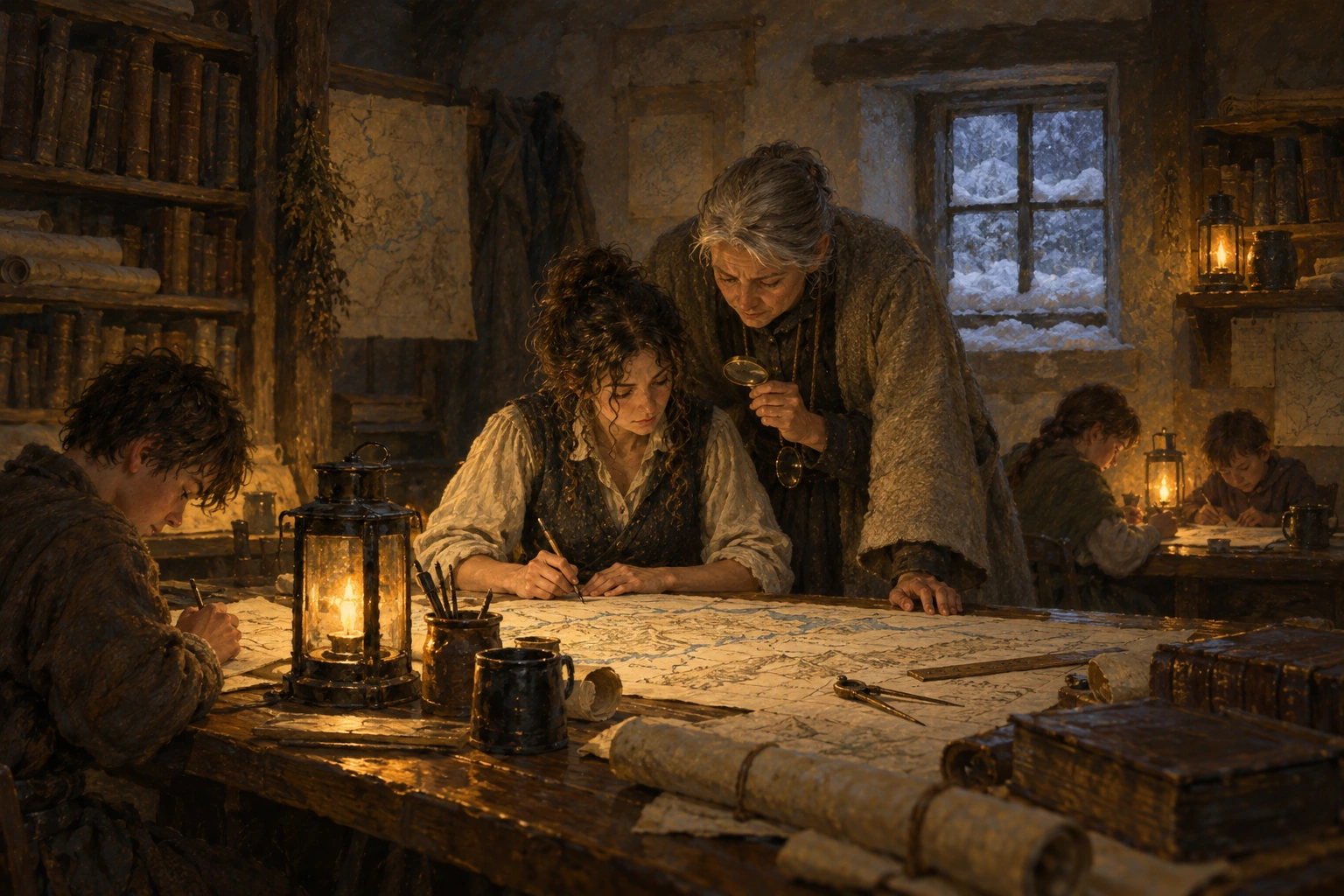
The watch cleared a room for Iyene within the first fortnight, and it became, without anyone deciding it should, a school. Alder took Wren through the old tongue's letters most mornings, slow work and frank about being slow, and by the season's turning she could pick perhaps one word in six or seven out of Wystan's commoner margins — enough to feel the spiky old hand was a hand and not merely a pattern, nowhere near enough to trust herself with a full line. "It comes in inches," he told her once, "and a person who tries to take it in feet generally ends up owing it a limb." She did not open the Waybook to the coomb's own unread margin that whole winter.
Pip's winter folder came back from Iyene's review with six words that would carry him, Wren suspected, the rest of his working life: this is College work. I would sign this. Bracken, passing the table with a coil of rope, glanced down at the boy's ruin-drawing and said only, "That's a proper page, that is," and went on without waiting for an answer.
Pip had begun writing his own name at the head of every fresh sheet before he ruled it — small, and neat, and tucked into the top left corner: P. Sandover, in the place a man writes his name inside a book he means to keep — and it went down before the date, before the heading, before the first line of work. Eleven sheets in the winter folder meant eleven small signatures the College would never find a use for. Wren had seen one page of his, once, ruled and waiting and holding nothing at all. She did not particularly want to see another.
The letter took her the better part of a week of evenings, which surprised her, given how easily the writing of most things had always come; but it was written for a woman three hundred miles south who read every letter twice, once for the news and once for the hand.
She began it three times and threw two beginnings in the fire, because they reached too soon for the largest thing before the smaller ones had earned their place around it, which was not how anything was ever properly said at her grandmother's table; and what she finally sent, in the last hour before Willem's saddlebags closed, ran a good deal shorter than her drafts.
The inn at the border keeps a book of its own, Granna — every traveller who has stopped there down all the years has signed it, name after name — and in the oldest volume, among drovers and shepherds long gone to dust, there is a name I think you will know before I finish writing it. Wystan Fallowmere. His own hand, plain as any entry beside it, and next to it a small figure — a 2. I expect it will need no explaining at all to you, of everyone alive.
The basket we found is home now, seated in its own stone cradle on its own hill, long overdue and none the worse for the waiting.
And here is the largest thing, and I have been three evenings getting it plain enough to set down. You always told me the fifth mark had no meaning anyone living could give it, and that the not-knowing was itself the honest thing to pass on. It does have a meaning. A friend of the road told me — one with the right to know it and the right to give it, which I did not have and never claimed. It means a neighbour listened here. That is all of it, and it is a small thing to have carried unexplained so long, and a large one to hand back at last to the woman who taught me to carry it truly. You kept a promise nine keepers before you never knew they were keeping. I only get to be the one who tells you what it was.
You wrote that I should write when there was something worth the paper, and that I would know. I think, this time, I did.
Dorrit's own line went in beneath it, added with the particular satisfaction of a woman settling an old score at a comfortable distance: Granna — I hear you've had the whole winter with nobody to blame the goat's mischief on but yourself. I do hope you're managing.
Willem took the satchel of the household's correspondence and rode out at first light, collar turned up, his mule's breath standing in the cold; and within the quarter hour he was a dark speck going down the long white road toward the Steading Lamp, and eventually toward Dall, and a kitchen and a shelf where a book waited to be oiled.
Wren stood at the yard wall until the speck was gone into the white. No answer would come this side of spring; the road that carried a letter out did not carry one back until the world thawed enough to let it. She found she was entirely easy about the wait. She had said the thing that wanted saying, and somewhere south of here, whenever the thaw judged it time, a letter was going to arrive in a warm kitchen and be read twice — once for the news, and once for the hand — by a woman who had waited nine keepers' worth of not-knowing to be told.