The First New Map
Standing at the turn where the through-road's iron mule-rings gave way to the first stall, a person could have heard most of Wintergarth's household without troubling to look for any one piece of it. Bracken's voice, low and argumentative, was talking a fourth sack of meal out of a reckoning that would only yield three, and somewhere behind him Alder's stick tapped once against stone and went quiet, the sound of a man who had stopped to look at something and then gone on. Under it came the small metal chime of Iyene's dividers, set down and picked up against the clerk's-room table, twice, then a third time. Dorrit's knife went through something root-bound in the kitchen in fours — four strokes, a pause, four strokes more — and Osric Vane laughed once and cut it short, as though he had remembered whose house he was laughing in. Marta Coyle asked Dorrit something about the root, low enough that the answer never carried past the doorway. Somewhere above the goods-bays Pip's mallet found a nail that did not want finding. Under all of it, patient and unbothered, four mules breathed the long even breath of animals who had decided, some days back, that a roof over a manger was a settled fact and no longer worth remark. It was, taken together, the sound of nine people and four mules going about an ordinary morning in one building, and it told a listener everything about the house except what any one of them was actually doing.
Wren was not listening for it. The yard's stones still carried the night's frost in their shadowed halves, white and stiff underfoot where the sun had not yet found them, though the open ground beyond the near gateway had thawed dark by mid-morning the way it now did every day and would not, much longer. She crossed the through-road toward the clerk's-room door with the Waybook riding her hip as it had ridden it for most of a year, her breath showing pale ahead of her the last few steps, and let herself in without knocking, because the room had stopped being a room anyone knocked at three mornings before.
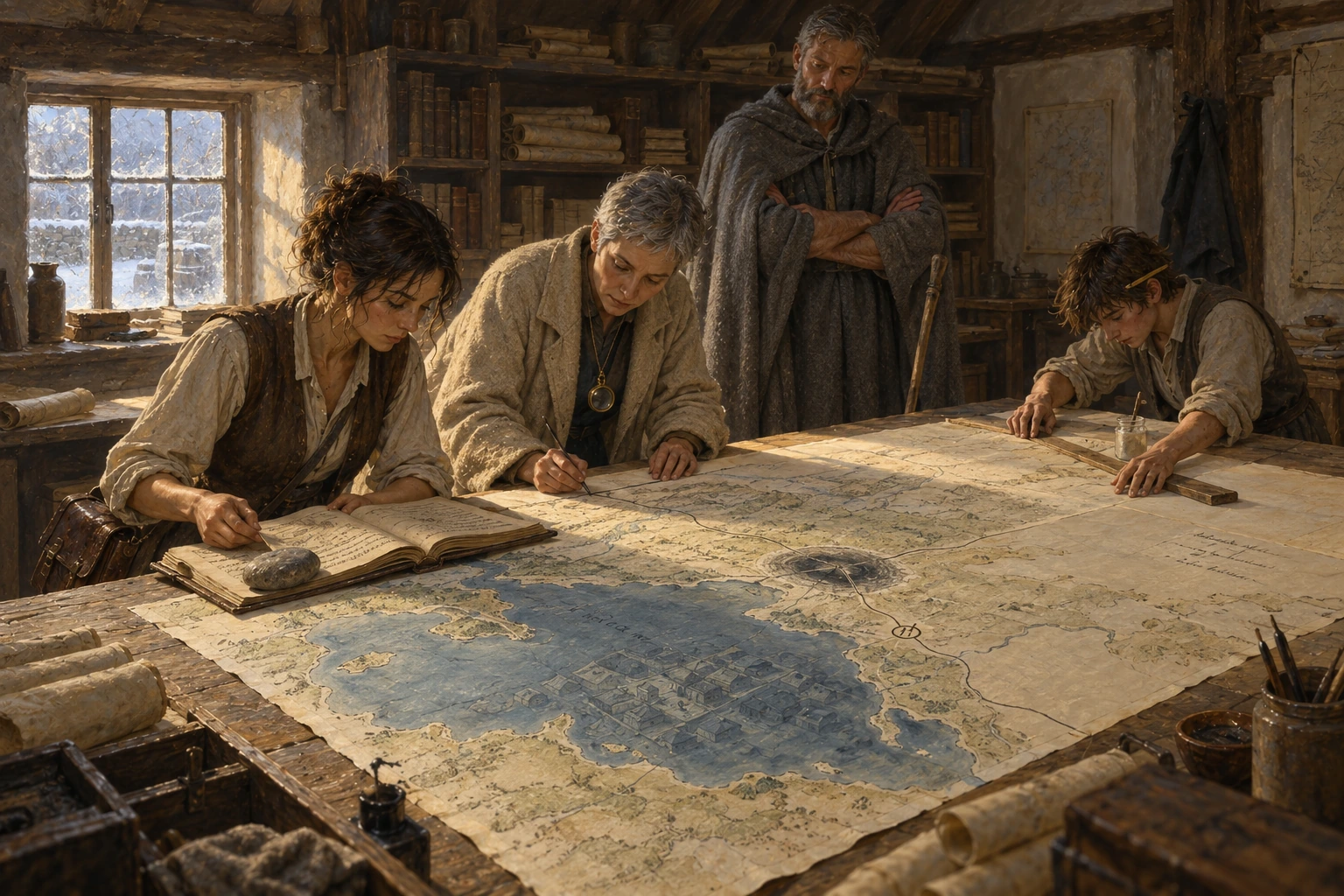
The long table that a decade of dust had claimed for itself was covered edge to edge with paper, and had been for three mornings running. Pip knelt at its far end with a jar of thin paste and a straightedge, easing the top corner of Iyene's second working sheet down against the first, checking the join by eye and then by the flat of his palm before he let the weight of a plane-iron settle onto it overnight. No single sheet the Survey carried was large enough to hold a country; Iyene's own working leaves, drawn and corrected a valley at a time across two years of walking, were what there was, and the master sheet now taking shape across the table was six of them, pasted and weighted true along their edges, squared to one another before a stroke of new ink went down anywhere.
"Two thumbs' width," Iyene said, not looking up from the sheet already dry, "and it wants to be less."
"It's less than yesterday's," Pip said, and did not look up either.
The Waybook lay open on a clean corner of the table, held down at both edges by a smooth grey stone Wren had carried up from the yard for exactly that use, and under her hands, as it had stood for a year now and no longer surprised anyone in the room to see, the ink held dark and plain in a hand three centuries dead. She read from it in a level, even voice, and Iyene turned what she read into line: a ford's true crossing, corrected two hundred yards downstream of where a lazier survey would have drawn it; a way-house Wystan had slept in and named in the margin only as the good one, ask for the loft; a stretch of road that had gone, across generations of disuse, from a king's highway to nothing at all, and back again one boot-print at a time. Nobody else in the room touched the book; the company had known for a year what its ink could and could not do, and there was no longer any wonder left in the knowing, only the work the knowing made possible. Alder stood at the table's far end with his arms folded and let the work go on around him, which he had done so many mornings running that the room no longer counted it as absence.
By the third morning the sheet carried more of the west than any single piece of paper had ever held: the fires relit or found already burning, from Woldsend's watch — the relieved one, marked now with the small ring-and-rising-stroke that meant nothing had ever been wrong with the keeper's craft, only with the world around it — down through the country nobody had thought to call sleeping until they had seen it asleep; the drowned city sitting under its own lake with its roofs still square beneath the water; Stanhope's halls, drawn from the outside only, because nobody had drawn what lay under the hill and Iyene would not guess at what she had not walked; the harbour town's sea-ledgers copied into the margin in a smaller hand than the rest, since she had run out of room and would not open a second sheet for the coast alone. Sereth and the near provinces filled the sheet's eastern shoulder, close-set and busy with names, because that was ground the company had walked twice over and knew the way a hand knows its own knuckles. Ashcroft went down at the fold's far lip, in Iyene's own careful lettering, a town that had never appeared on any map the College still owned. Roads ran between all of it in the west's own names where the west's own people had given them names, and in Iyene's plain working terms where the old ones had gone out of use entirely. The fold went down last, its deep-ground mark set square near the sheet's centre with a single road drawn straight through the worst of it, because a road was, in the end, the only way Iyene knew to say that a bad piece of ground had been crossed and lived through, and could be crossed again.
Iyene set her pen down over Wakelow's mark and studied it in silence before she spoke. "There were never nine," she said, half to herself, though everyone in the room was in fact particular enough to hear her. "There are eight, and Sereth. Wakelow's smoke was seen twice, by two people who never compared what they'd seen, because nobody living had walked the ground between them to notice it was the same hill smoking twice — once by day and badly, once longer, by night. That isn't anyone's fault. It's what a country looks like when it has to be counted by report instead of by boot." She resumed her pen. "It took walking to catch. It was always going to take walking to catch."
The room went back to its separate work, which seemed to be the response she wanted, the correction already folded into the morning's business, one fact among a dozen others going down in ink that day.
It was Bracken who brought the other reckoning into the room, standing in the doorway with a tally-stick in one hand and the look of a man who had already done the sum twice to be sure of it. "Iyene's frost-count," he said. "The one she pulled off the house's own logs. We're inside it now — four days, five if the wind holds out of the south, before the roads either side of this house shut for the winter, same as they've shut within the same handful of days every year the house's own books could account for." He looked at the sheet covering the table rather than at any person in the room. "Eleven mouths, stores struck for eleven, and two of them out on the north road for the last of it, with days, not weeks, left to get back inside the count before it closes on them."
The room took it for what it was, a quartermaster's arithmetic and nothing beyond, though outside the window the morning's frost had not yet given up its hold on the north-facing stone, and would not, this late in the year, before noon.
It was Luel who saw the travellers first, from the yard, where she had gone for no reason anyone had thought to ask her to give. She came back through the near gateway's gap at her own pace and said, to the room in general, "Two went north. Three are coming back." Nobody at Wintergarth had ever quite got around to asking Luel how she knew a given thing, and she went to stand by the wall where she generally stood. By the time Wren and Bracken reached the gap themselves and stood looking down the frost-hard road, the three figures were close enough to be told apart: a woman's stride, a man's slower one, and a third walking a half-pace behind both with nothing on his back but a satchel and no mule anywhere in sight to explain the lack. Bracken went still in the particular way of a man counting rather than looking. "That's not stores," he said. "That's a person." Wren said the name before she had decided to say it, because a name once read from a paper rarely leaves the mind that read it whole.
"Marle."
Behind them, most of the household had drifted to the gate without quite meaning to, drawn by nothing more than the ordinary pull of a threshold when something is about to arrive at it, and stood there now in a loose half-ring, breath showing, waiting on three figures still some way off down the frost-white road.
He stopped short of the gateway itself, which Wren would come to think of as characteristic of him: not shy, exactly, but careful about where he stood before he was asked to stand there. His coat was travel-stained in a way that said walking rather than riding, and his beast, wherever it had wintered, was plainly not here; he carried everything he had on his own back, and stood under it as a man stands who has carried it a long way and expects to carry it further yet. He held his papers already loose in one hand, offered before anyone had asked to see them, the way he offered them at every door the company had ever met him at. "Assessor Marle," he said, to Alder, who happened to be nearest. "I'd ask leave to winter, if the house can bear one more."
"Why," Iyene said, from behind Wren's shoulder, and the word came out flat rather than cold, a question and not yet an accusation.
He answered her in the sentences he would give and no more. "My own circular, from the summer. 'No route, holding, or site west of the province gate carries my endorsement until it has been walked and found masterless in fact, and not in form. Any tally rendered ahead of that finding is rendered without me.' I sent my riders east before the season turned, and went west myself to do the walking my own words required. The roads shut behind me before I had finished it." He did not offer it as an apology, and did not appear to expect it received as one.
Dorrit did not wait for the rest of it. She was back through the kitchen door with a bowl of broth and a heel of bread inside a quarter hour of his first word at the gate, set down on the nearest table edge without ceremony and without being asked, because a man was standing in hard frost with nothing on his back but a satchel, and that was, in Dorrit's house as in the one she had grown up in, simply what a person did.
Iyene, who had watched the bread go down before the terms had, said what she had come to the gate meaning to say. "I want it in writing, before you sleep under this roof, that you assess nothing of Wintergarth and enter nothing of it in your own ledger while you're here." She did not raise her voice. "I don't doubt your word so much as your habit. Your trade has emptied towns that never met you personally, and I'll not have it walk in behind you now because we fed you first."
"You already have," Osric said, from the gate behind them, and the room turned to him instead. "Fed him first, I mean. Jessa Linden gave the Reader's own leave to a man from the Relic Court's own bench, and she doesn't do that for strangers. She'd read his summer circular before she ever laid eyes on the man himself, and judged him by it." He said it as a fact, not as a defence of anyone, and let it sit where it landed.
Iyene looked at Dorrit rather than at Marle. "You fed him before I'd said a word."
"He was standing in the cold," Dorrit said. "I'd have fed him whoever he was."
"That isn't the point I'm making."
"It's the only one I've got."
Alder, who had not moved from beside the gate through the whole of it, said only, "There's frost enough for one afternoon's arguing," which settled nothing and was not meant to. Bracken, on his way past with Sim's heaviest pack over one shoulder, said his own piece just once and let it go: "Twelve mouths now, and stores struck for eleven, and the twelfth arrived carrying nothing." He offered it not as a complaint but as a quartermaster states a number, and went on across the yard with the pack, and the household went back to its work with the matter of Marle's ledger exactly as unresolved as it had been before anyone raised it.
By the time the light began to go, Marle had settled into the gallery's spare chamber — no larger and no better kept than any other on the row — and spent most of the afternoon exactly where Bracken's count seemed to prefer him: out from underfoot, mending a strap on his own pack with a borrowed awl, offering help with anything asked of him and nothing that wasn't.
That evening the whole household sat down twelve to a table built long before for a good deal more than twelve, with the last of Dorrit's onions gone into a pot alongside Ashcroft's own salt fish, and two candles doing the work three had done a week before, since the household had learned by now to husband its wax the way it husbanded everything else with the roads about to shut. The season's news came out the way such things came out at Wintergarth now: over food, without ceremony, at the same pitch as a question about the salt.
"Word from Sereth," Thomasin said, "by way of the Hazels, and old already — it left near the equinox and has been the length of the country getting here." She said it as she might have reported the weather, because to her it more or less was the weather. "The autumn mail never came down the Gray Stair this year. And the border watch's rider was looked for before the pass shut, and didn't come. Sereth's had nothing out of the east since midsummer."
"And nothing out of Aldwick to Millgate either, going the other way," Sim added, "though that's a smaller road, and quieter most years regardless."
Osric reached for the bread. "Early snow on the Stair, most like. Or a rider who thought better of a bad crossing and turned back to wait out the weather. It happens most years, to somebody." Bracken made a sound of agreement around a mouthful and did not look up, and the table took the answer, because it was, on the evidence any of them actually had, the plainest and most reasonable thing anyone could think to believe. Luel sat at the table's far end with both hands around a bowl she was not eating from.
Iyene set down her spoon. "I have two," she said, and stopped there, and reached for the bread instead. Some who had known her only since the fold could not have said why a woman who counted for a living would trouble to stop before the number that mattered; the rest had heard her finish that sentence before, more than once, and passed the bread along.
Bracken asked one question, of Sim, in a voice pitched for ordinary table talk and nothing under it. "Was it the pass, d'you know, or the rider?"
"Nobody at Ashcroft could say," Sim said. "Word only carries what the last mouth to speak it knew, and that mouth didn't know either."
Bracken nodded, as though the answer had told him something after all, and went back to his bowl. He did not say the name the question had actually been about.
Later, when the table had mostly emptied, Thomasin leaned toward Wren and said, low, meant for no one else: "Jessa has your letter safe. Says she'll answer it when there's an answer worth the sending, and not before." Wren thanked her under the noise of the plates being stacked, and no letter changed hands, because none had.
The last line went onto the sheet two mornings later, in the gap left where the drawn roads ran out east of the Province Gate — Iyene's own hand would go no further than that, by a rule Wren had heard her state once, plainly, months before: she had never in her working life drawn a line taken only on someone's telling, and she was not going to begin with a country's edge. Into that blank quarter, and nowhere else on the whole sheet, she set down four lines in a hand smaller and sparer than the rest:
No mail down the Gray Stair this autumn. The watch's rider not come. Reported at Sereth, and at Aldwick nothing to pass on. Relayed twice removed. Not walked, not confirmed.
She dated it, blotted it, and laid the pen across the inkwell's mouth rather than in it, which Wren had come to understand was as close as Iyene Sath ever came to putting a tool away for the day.
"That's the whole of it, then," Iyene said, looking at the sheet rather than at anyone in the map-room. "Everything we've walked, on one piece of paper, for the first time in three hundred years." She washed her pen in the little dish kept for it and wiped the nib dry, and did not make a speech of it, though the room had gone quiet enough that she could have. "The College has kept a shelf built for exactly this since before any of us were born," she said instead. "I'd like it to reach that shelf inside my own lifetime, is all." She rolled the sheet loosely, to let the last of the paste set flat, and left it lying across the table rather than carrying it anywhere. Three mornings' work had come to an end without warning, and the quiet that followed it said so on its own.
Pip held the last inch of the join flat under his palm until the paste had fully set, and only then let go.
Alder had come to stand at the table's edge sometime during the last hour, though he had come without anyone hearing him do it, and he stood there now with his arms loosely crossed, looking down at the sheet the way a man looks at ground he has walked before and never seen laid flat in front of him; and after a while he took his stick up from where it leaned by the door and went out to see about the frost on the well-rope, and that was the whole of his part in it.
That night, in the gallery chamber she had held since the company's first week, Wren took out the day-book and wrote longer than she had in some time, because a great deal of the last ten days had wanted setting down and had kept getting interrupted by more of itself arriving before she'd finished with what came before.
The clerk's room is the map-room now, and nobody announced it; it simply happened. We finished the sheet today — the first whole map of everything any of us has walked, eight keepings and Sereth and a fold with a road drawn straight through the worst of it, Wystan's own road-work standing under my hands the whole time beside a Cartographer-Royal's, which is not a thing I expected to write in one sentence and mean both halves of. Iyene found an old count wrong by one hill today and put it right without making anyone else wrong for having missed it, which struck me as harder than the finding itself, and she did neither one for credit.
The roads either side of the house close within days now, not weeks. Marle walked in off the north road today, alone, on foot, having done to himself exactly what his own writing said an honest assessor ought to do. Iyene wants it in writing that he touches nothing of ours while he's here, which is only sense, and Dorrit fed him before anyone had decided anything, which is only Dorrit, and I don't think either of them is wrong, and I don't think it's mended, and I am not going to pretend in this book that it is.
And Sereth has had no mail down the Stair this autumn, and the watch's rider they were looking for never came, and everyone at the table called it weather, which it very likely is. We have drawn everything we walked, and the sheet runs out at exactly the place our walking did, and Iyene will not put a line east of that on anybody's telling — which is honest of her, and means the only mark anywhere on the whole eastern quarter of the page is a note about a letter that never came.
Bracken started on the north gate-leaves this same morning, the ones that have lain flat against the wall since we came. He hasn't said why, and I haven't asked him, and I am putting it down here only because it happened on the same day as the rest of this, and not because I have any sentence that explains it.
I am tired, and glad of the map, and one degree colder tonight than I can properly account for.
Bracken never said why he had started on the gates, and Dorrit asked him once, straight out, on the second morning, while he stood looking up at the near gateway's hinge-jambs with a level in one hand and a stub of chalk between his teeth. "Wind's been coming down the through-road wrong all week," he said, which was not an answer to the question she had actually asked, and he did not look round while he said it. Dorrit, who knew a closed door in a man's voice when she heard one even with the actual door lying flat against the wall in front of her, let it stand, and picked up the far end of the timber he was measuring.
The leaves themselves — two long tables of oak, off their pins and leaned against the inner wall since before the company had ever walked in — had first to be rolled clear on a bed of round timber Sim cut fresh from the yard's dead elm, and only then levered upright, inch by careful inch, with rope run through the old tether-rings and Suet leaning into the pull at Bracken's word, patient as a mule leans into anything it has decided is worth doing. The pintles, when Sim scraped generations of grit out of the lower jamb, proved sound, and the timber itself rang solid rather than hollow when Thomasin rapped a knuckle along its length, gauging it the same close-eyed way she gauged any wall before she trusted her own weight to it; she sized up the whole hanging, top to bottom, jamb and pintle and the long grain of the oak between them, and pronounced it fit to trust before Bracken had finished asking her opinion of it. One hinge-strap had sprung enough to want re-clinching, and Bracken did it cold, with hammer and punch against the anvil-block left standing in the old smithy bay — ironwork anyone could trust, he said once and left at that, that wanted no forge and no fuss either. His forearm, still short of its full strength from the fight in the undercroft, kept him off the heaviest lifting, and he worked around it, with one dry remark to Sim about being outpulled by a man half his age and no second one after it.
Wren, watching from the loft over the goods-bays on the second afternoon, worked out for herself that Bracken had begun the work the very morning the news came down from Sereth, and went back down the loft ladder with it, and set it in the day-book that night unjoined, beside the fact it sat next to.
By the third evening the light was already going grey-gold and short across the yard, the way it did now well before supper, and the leaves hung true on their own pins for the first time in three hundred years. Sim swung the near gate's near leaf through its whole arc to test the new hinge-strap's clinch, out and back, and Bracken watched the arc and not the man, which was as near as he ever came to calling a piece of work good. It held, and swung back, and closed across the north end of the through-road with an ordinary, solid sound, iron finding iron in the dark of the jamb. For the first time since the house was built, both its gates could be shut at once.