The Closing
Wren said the ninth name before she let herself think about the tenth, and then she said the tenth.
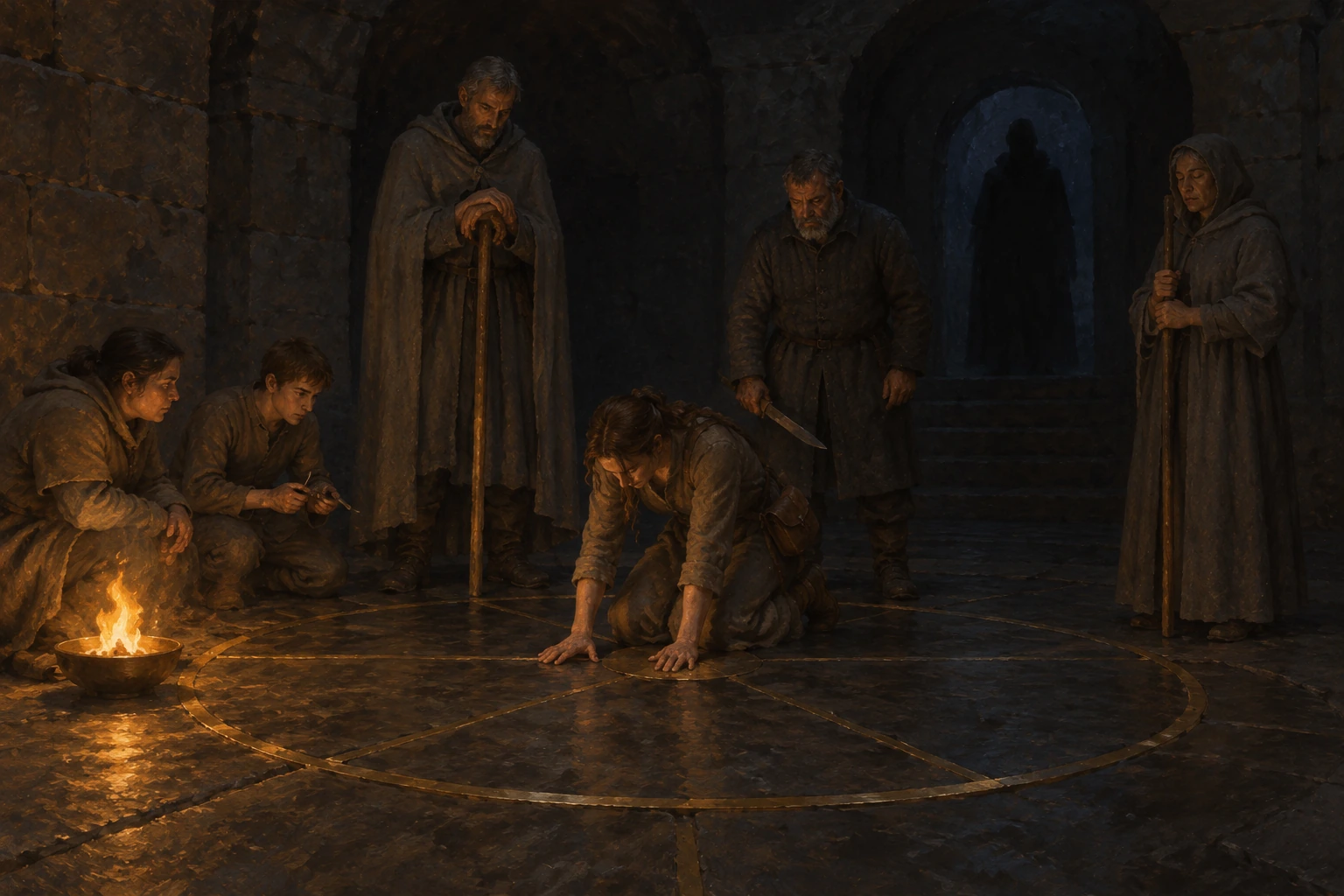
They came out of her in Wystan's own order, mother tongue and market tongue both, in the sequence she had carried them since Wintergarth and Thistleton and the sleeping streets of this city itself. Three years of the dead stood at her shoulder now like a second company no living person had ever thought to count. They had come down into the chamber a little after first light, through a door that had held all night against everything that wanted through it and then gave to Dorrit's hand like any door in any house. The round chamber under the Hall held eight lines of brass set into its floor, radiating out from a center worn smooth by feet three centuries gone. Four of those eight lines ended in marks a keeper's hand could still read: a rutted double stroke for road, a small ring with one rising stroke for fire — the same shape her grandmother had once taught her meant a beacon-hill, and she had not expected to find it waiting for her under a foreign city's floor — a plain unbroken circle for name, and at the head of the circle, alone, set apart from the other three, the shape Alder had tried twice on an empty evening five nights before and had not been able to sound either time. The Waybook lay open on the stone at Wren's left knee, at the back vellum's third leaf, where the order was written in the hand of a man who had gone down these same stairs to do this same work and had not come back up them. It had been read into her four evenings running, until she could say the whole of it with her eyes shut, and it lay open anyway, because a book carried eleven generations does not get closed on the night it was finally carried for.
Alder stood at the chamber's western arc with his ash stick planted and both hands wrapped around its head. He was not leaning on it. He was holding the room's own geometry with a dam's steady pressure rather than a wall's sudden one, a distinction Wren had learned watching him work through the whole long night above and one that mattered more than it sounded like it should. Bracken stood a half-pace behind her right shoulder, blade out and its point resting against the floor, close enough that she could hear him breathing. She had stopped, an hour or more back, letting herself notice that she could. Dorrit knelt near the fire-mark with what remained of her chest open between her knees, watching Pip's hands rather than the brass diagram, because Pip's hands were the part of this working that could still go wrong in a way a staff and a jar of salve might reach in time to matter. Luel stood apart from all of them, at the mark for road, eyes shut, her voice a single sustained low note that had not broken in the better part of an hour and would need, before the night was through, not to.
"This floor was cut before the second wall stood," Luel said once, early, to no question anyone had asked her. She did not say how she knew. None of them asked her to.
Wren had believed, walking down into this room with the others that morning, that she understood roughly the size of what waited for her here. She had spent three years learning to hold other people's names without the craft reaching sideways for more than she meant to spend. She had learned it well enough by Kelder that Alder no longer stood close enough to catch her when a working ended. She was wrong about the size of this one within the first quarter hour. By the second hour she had stopped being surprised at being wrong, because there was no room left in her for surprise once the names stopped waiting politely for their turn. They simply arrived, one on the heels of the last, faster than she could have chosen to let them come even if choosing had still been a thing available to her.
There was more going through her, in that chamber, than the shape she had spent three years learning could hold. It came on like water over a riverbank that had never had to hold anything back before — cold around the ankles before the mind had finished admitting what was happening. She went on working anyway. A river with nowhere left to go at all was worse than one running over its banks, and that had never been the safer choice, in the whole history of anything.
None of what was holding the room together belonged to any one of them alone anymore, and by the second hour there was no longer any honest way to separate it out into six people doing six different jobs: Alder's arms and the line they anchored, Dorrit's eyes on Pip's hands and her hand on his shoulder when they failed her, Bracken's breathing at her back and the half-pace he would not give up, Luel's note running under everything else like a keel under a hull that no one standing on deck ever has cause to look at, Pip's small fire that was, in some way none of them could have explained to a stranger, the same fire burning a hundred miles east on a hill called the eastern basket, and Wren's own voice carrying all four of those things at once through a body that had never been asked to carry more than one. Above them, on a road she had never walked and could not have named if pressed, Iyene was doing the same work in a different shape — not a name spoken into a floor but a mile kept clear, a rider sent before the one ahead of him had even arrived, a hundred ordinary decisions made fast enough and well enough that the beacon line still had feet under it at the one hour it most needed feet under it — and none of that was visible from where Wren knelt, and all of it was, in the only way that mattered that morning, still part of the same working.
She had known, coming down, that this would cost her something. She had not known, until the first hour was half gone, that the cost would not stay inside her own skin — it never had, not fully, not since she had learned what she carried could spill — but it had never before had this many open doors around her to spill through, five people standing near enough to catch what came off her, each of them there because they had chosen, on purpose, to be standing exactly that close.
She could feel the dead tonight in a way she did not usually let herself — not as a list, which was how she generally kept them, orderly and filed and almost bearable, but as a crowd, close enough now to feel the particular shape of an old cooper's shoulders, a shepherd's cracked hands, a woman who had died in her own doorway with a basket of washing still under one arm, a whole company of people she had never met living and would go on carrying for the rest of whatever life was left to her, heavier with every year — the slow gathering weight of a coat that has rained on and never quite dried out between one storm and the next.
The fire at the fourth wall of the chamber, banked low in a shallow brass bowl someone three centuries dead had set into the floor for exactly this purpose, was no larger than a cupped double handful. It wanted feeding the way any fire wants feeding — small dry wood laid on at the right moment, not a moment before and not a moment after. This was the whole of Pip's work in that room, and no explanation had ever needed saying twice. He had been feeding fires since before his hand had started shaking, and a fire did not care whether the hand that fed it was steady, only whether the wood arrived. Alder had told him once, on the long climb up from Kelder, that a fire-keeper's entire trade was knowing which of the two things in front of him was his to mind and which belonged to somebody else. Pip watched the flame's color and not the diagram. This was a kindness and not a small task handed to a boy because there was nothing better for him to do that night — the same trust, in miniature, that had put Alder's stick between an entire city and everything trying to come through it, and Dorrit's staff between the wounded and everything trying to reach them before she could, and Bracken's body between Wren and whatever might yet come through that doorway before the night was through: six different people holding six different pieces of one enormous thing, none of them able to see the whole of it from where they stood, all of them trusting that somebody else in the room could.
He was three names into the second hour, laying a fresh sliver along the bowl's near lip, when he reached for the smell of his own mother's hearth-smoke — an ordinary thing, called up for no reason at all, the kind of memory a person reaches for a hundred times a day without ever once noticing the reaching — and found, instead of the smell, only the bare fact that a smell had been meant to be there. He sat down hard on the cold brass, both hands flat on his knees, and said nothing, because there was nothing yet worth saying that would not have sounded like fear before he had any way of knowing whether it deserved to be. Dorrit's hand found his shoulder without her eyes ever leaving the fire-bowl. Four names later, or five, the smell came back to him whole and unannounced — birch and green pine together, so entirely his own and so ordinary that he very nearly laughed at how frightened he had let himself get over losing it. He got up. He fed the fire. He did not mention any of it again that morning, and there was too much else happening for anyone to think to ask.
The runner came down the chamber stair at a dead sprint and stopped himself hard against the doorframe rather than take the last three steps at speed — a Sereth boy Wren had seen once before, holding two skittish horses in an avenue that felt, from inside this room, as though it belonged to some other year entirely, and he held a scrap of paper folded twice and did not wait to be asked before he put it into Alder's hand, because Alder was standing nearest the door, and because a boy who had crossed a burning city twice in one night had stopped caring which of seven people received a message so long as one of them did.
Alder read it once to himself and then aloud, in Iyene's own hand and her own economy, because nothing in that room needed him to soften what she had chosen, herself, to leave hard. "Eastern basket held. Coals twice. Flame back up both times. Two men down getting it there, neither past saving." He folded the paper back along its own crease and set it inside his coat rather than letting it drop, unhurried, the plain motion of someone who expected to be asked about it later.
Bracken shifted his weight without moving his feet and said, low, not meant to carry, to Dorrit rather than to the room, "Rooke had a man under him at the ford crossing — quiet fellow, good with a picket line, went by—" and stopped there, the name simply not arriving in the space he had left open for it. His jaw worked once around nothing at all. Dorrit did not look up from the fire-bowl. Wren, three names deep into a woman she had never met and would never have occasion to meet, heard the gap in his sentence and did not turn her head to look at him, because turning her head would have cost her the woman's own name, and she had already spent more of that hour on things outside the rite than she meant to. A few breaths later Bracken finished the sentence as though he had never broken it off at all. "—Pentle's boy. Skell." Bracken went straight on to the next thing he had meant to say, as though it had cost him nothing at all.
Dorrit, reaching into her satchel a while after that for the last of the yellow-root, though there was no wounded person yet in front of her to give it to, found herself reaching for the word that named what her own hand held and coming up with nothing at all. She had known this plant by sight and smell and the particular bald patch on the hillside above Fallowmere where it grew thickest since she was four years old. Every piece of it was still there except the word itself, gone from around it as cleanly as a label lifted from a jar, the jar itself exactly as full as it had been the day before. She said nothing. She set the leaf back in its place by feel rather than by name and went on watching the fire-bowl. If anyone else in that chamber noticed, they gave no sign of it, because there was nothing yet to be done about it, and everyone in that room had already learned that particular lesson, on some other night, about some other small and terrible thing.
By the third hour the road-mark had gone warm under Luel's bare feet without her moving a single step toward it. Alder said, once, flatly, not raising his voice, "Back — all of you, and give her room to fall if she has to." That was the whole of his instruction and the whole of what any of them needed to hear. A man who had held a line the width of a city square through an entire night did not waste words on people who already knew how to listen to him. Bracken stepped a further half-pace off and did not sheath his blade. Dorrit stayed exactly where she was, because Dorrit's whole use in that room, just then, was staying close enough to catch whatever fell.
Wren had one name left that was not, strictly, a name at all — a sound out of the forty her grandmother's mother had given her grandmother, meaningless syllables handed down mother to child the way any old tune is handed down, most of them worn smooth of whatever they had once named by three centuries of mouths that no longer knew what they were saying. This was not one of the worn ones. She had found it three nights before in a locked chest's ledger, in ink four shades paler than the words around it, and she had known it the instant her eye crossed it, sure of it before she could have said why. Alder's own mouth had reached for its shape twice and failed both times. Luel's eyes had come up across the chamber and stayed on her, waiting, and said nothing at all about what she already knew was coming. Wren said it now, once, plainly, in the same voice she used for everything else the craft asked of her — not loud, not slowed for effect, not dressed up as anything larger than exactly what it was.
"Vosk."
The brass under the fourth mark went the color of old frost for the length of one held breath. Then it simply stopped being remarkable. A struck bell stops ringing like that too, sometimes — not because the sound has died on its own, but because a flat hand has come down against it from outside. Something in the whole weight of the room shifted a half-inch to one side, as though a great deal of country had leaned, briefly, its entire weight onto a single point, and the point had held. Her knees did not buckle. Something in her chest did, quietly — a knot slipping half a turn under a load, and holding anyway. She stayed upright on the strength of very little beyond having already decided, some while back, that she was going to.
The Sereth boy came a second time within the hour, slower this time, one hand pressed flat over a fresh graze at his ribs that had not been there the first time. He did not wait for anyone to ask before he said the whole of it himself, because Iyene had told him once that a message a man was too tired to deliver properly was still a message, and he had taken her at her word. "The basket's down again. It's not coming back up." He said the rest of it looking at the floor rather than at any of them. "Garrow went up after it. He hadn't come back down before I left. There's fighting on the stair below the basket now. There wasn't, the first time."
Silence answered him. Alder's jaw set once, hard, and did not move again after that. Bracken's hand closed around the hilt of his sword and did nothing further with it. Wren, with a woman's name half out of her own mouth and a country's worth of fire riding on whether that eastern basket found its flame again before this chamber finished the work it had already half spent itself on, felt the two clocks she had been running against each other since Kelder — the dead who would not stop mounting, and the little that was left in her to spend on stopping them — arrive, finally and fully, in the same room together, for the first time in the whole long night. There was nothing left to do about either of them except keep working, and let the arriving be someone else's to carry, for now, above her.
The boy did not leave at once. He stood in the doorway a moment longer, chest heaving, looking at the four marks and the small fire and the woman on her knees at the center of it all with an expression Wren had no time to read and did not try to, and then he turned and went back up the stair at a run, because there was a second basket somewhere behind him that wanted watching too, and there was nothing anyone down here could do about that except finish what they had already started.
It came up the chamber's own stair without hurrying, because hurry was a thing it had spent, along with almost everything else, well over two hundred years before. It stopped in the doorway the way a man stops at a lintel built for someone smaller than himself, testing the frame with a shoulder that no longer entirely remembered where its own edges ended. It had the shape of one person, more or less. It did not have the shape of only one. Layered, uneven, built up over a very long time out of whatever it happened to be carrying when it passed a particular corner of the dark — that was as close as Wren's own eye could come to describing it, and she gave up trying after the first look, because there was nowhere in her that a shape like that one properly fit. Its hand, lifted to the doorframe to steady itself against something none of the rest of them could see, was scarred crosswise in a pattern her own eye recognized before her mind had caught up with why: the particular ridged callus a chain leaves on a man who has paid it out link by link, all day, every day, for years, across ground too wide for any ten lifetimes to finish measuring properly. Underneath the scarring, and older than it, she could just make out the ghost of something else entirely — a ring worn thin on what had once been a third finger, a boot's stitching cut in a pattern no living cobbler this side of the mountains had used in longer than anyone could say — evidence, if she had needed any, that the hand reaching now for the doorframe had done a hundred other kinds of work in a hundred other lives folded into this one, long before chainman had ever become the word that mattered most about it.
It spoke first in no single voice Wren could place at all — low and manifold, the sound of a great many people agreeing quietly on the same handful of words at once. Then, without any warning of the change, it spoke in one voice alone. Young. Amarin-accented. Entirely familiar to the one person in that chamber who had helped bury its owner ten days before, at a river crossing two hundred miles from where they now stood.
"Aunt." Sael's voice, exact down to the inflection, half a tease and half a genuine claim, said the way she had always said it to the one woman in the company old enough to answer to it. Luel's sustained note broke clean in half.
It did not last a full breath. Luel's voice came back up under itself almost at once, rougher than it had been a moment before. But the gap was enough. The road-mark's warmth guttered under her bare feet, and Alder's arms went rigid at the elbow, holding the room's whole shape together against whatever had very nearly come loose from it.
Then, in a second voice — older, western in its vowels, a voice Pip had never heard living and knew anyway, certain of it in the same instant his free hand found the flint at his belt without his meaning it to — it said, almost gently, "Boy. You kept my fire going all this way. Bring it here to me now."
Pip's hand, laying a fresh sliver along the fire-bowl's lip, stopped moving entirely. Not slowly. All at once — a rope reaching the sudden end of its own length. The sliver of wood began to slide from between his fingers toward the floor and the small flame waiting beneath it. Bracken's hand closed over Pip's from behind before the wood had fallen the width of a hand, and pushed it, and Pip's fingers, and the kindling all together, down into the bowl where they belonged. Bracken said nothing at all while he did it. He did not let go of Pip's wrist again for the rest of that hour.
It did not come any further into the room. It did not need to. It watched all of them from the doorway with an attention that had nothing hurried in it and nothing merciful in it either, and it spoke again in its own manifold voice, low, almost companionable — the voice of a thing that had been alone in the dark long enough to have genuinely forgotten there was any other way to be. "Three hundred years," it said, "and not one of you ever thought simply to come down here and ask me my name."
It went unanswered.
It turned, then, the whole slow weight of its attention swinging off the room at large to settle on Wren alone, until the four marks and the small fire and the five living people arranged around her seemed to interest it no more than furniture would have. "You," it said, in its own voice again, low and many-throated at once, "are the only door in this whole city that has not shut itself against me tonight. I have gone and counted every other one." It did not move off the threshold to test the claim. It did not need to. Being looked at that way — considered, weighed, wanted, already decided upon, the settled attention of a buyer who has stopped bothering to haggle over the price — was cold in a manner the chamber's own deep chill had not managed to be in three hours of trying, and only now, with its whole attention finally turned on her, could she feel how long that cold had already been sitting on her skin, mistaken until this moment for nothing worse than the ordinary chill of working underground.
Wren did not put down the working she was carrying to answer it. She could not have, by then, without losing a great deal more than that chamber could afford to spend a second time in one night. The rite ran on under her hands regardless, indifferent as rivers are to whoever happens to be standing on the bridge-stones above them, and she went on feeding it, steadily, while she turned, at last, to look directly at the thing standing in the doorway.
Bracken moved without being asked to. He came up on her left side, one step nearer than he had stood all night, close enough now that his shoulder would have brushed hers if either of them had turned an inch. He did not say why. He did not look at her while he did it. He simply stood there, between her and the doorway by half a body's width, in exactly the place a man stands when he has already decided, and does not need telling twice, what he is for. The half-pace of distance he had kept between them since the sleeping streets, unexplained to anyone including himself, closed itself in that one motion the same way it had opened: silently, without a single word spent on it by anybody in the room, least of all him.
She had one name left that was not owed to anyone who had died within the last three years, and she had carried it since a locked-off morning in a hall two hundred and eleven names deep — one blank line among two hundred and ten filled ones — and she had known, without being able to say how she knew it, exactly which door in that building the name had always been meant to open.
"Gilbert Rudge," she said. Not loud. Not slow, either, though she gave it more care than she had given anything else all night. It was the gentlest voice she owned — the one she had been taught first, long before she had ever been taught the other one, the one her own mother had never had the chance to use on anything but a stranger in a cold room. "Chainman. Third gallery, second rank, on Wystan's own roll."
Nothing in the doorway moved for the length of three full heartbeats.
Then its hand — the scarred one, still raised against the frame — turned over, slowly, palm up: the turn of a hand remembering, after a very long while of not knowing, exactly what it was built to hold. Its head came down after the hand did, to look at that open palm as though a chain still lay coiled across it, waiting to be paid out one more length before dark fell somewhere it could still remember owning a name for. Whatever else it had been wearing for three centuries went still around that one small gesture and did not move again. It did not fall the way the ones out on the road had fallen, bone and dust arriving together in half a breath. It simply stopped, the way a man stops mid-stride the moment he finally hears his own name called across a crowded market after a whole long morning of believing not one person there had ever known him. It stood a moment longer in the doorway with the look of someone who had, at last, remembered exactly where he had left something important. Then the whole shape of it came apart, without violence, into the ordinary business of dust settling toward a floor.
No one in the chamber said a single word about the name. There was nothing left to say about it that had not already been said, plainly and completely, by the act of carrying it this far.
The cost of doing both at once arrived before Wren had finished lowering her own arm. It went through her like weather through a house with every window standing open, and it went out of her sideways, the way it always did when there was more of it than the shape she had been taught could hold. It found the nearest open door in that chamber, which that hour, by no choice of anyone's, was Luel.
Luel's hand rose for the next line the way it had risen for ten thousand lines across three centuries, and found nothing where the line should have been. No gap she could measure — only the flat place a shelf keeps where a jar once stood, no ring of dust left to prove it. She did not stop singing. Nobody in that room, herself included, would ever know what had been in it. Her hand came back down empty, and she went on.
No one comforted her. She asked for nothing. The rite was still running, and there was no room in that chamber, that hour, for anything except going on with it.
The last thing Wren owed the room was not a name at all but the whole accumulated weight of every one she had already given it, folding back down into the mark for name the way tension leaves a muscle that had forgotten it was ever going to be allowed to unclench. She felt it go out of her not as one motion but as a country's worth of small ones arriving together — road, and fire, and name, and the one word she had just given back to a dead chainman — closing under her own two feet into a boundary she could not see and did not need to. She could feel precisely where its edge now stood, running outward from that small stone room in every direction at once, further than she had ever held anything before in her life, and further than she would ever need to hold anything again.
Somewhere above them, through two floors of stone and the length of a whole night's fighting, a sound that had been going on so long none of them had noticed it as a sound anymore simply stopped. Not silence arriving from nowhere. Noise leaving — the particular difference a person only ever notices in the half-second after a mill-wheel finally stops turning on its own axle. Bracken's head came up first. Then Dorrit's. On the stair above them, feet that had been running came to a ragged, disbelieving halt, and somebody up there — Ashcroft or Stanhope, indistinguishable in the dark — said a single wondering word twice in a row before anyone thought to answer him. A different voice, closer, called down through the chamber's own doorway that the fighting in the square had simply and entirely stopped, all of it, all down every street at once, like a whole row of candles going out under one breath, and did not wait to find out whether that was a thing to be grateful for or a thing to be afraid of before it went pounding back up the stair to see with its own eyes.
That was the whole of it that Wren let herself take in. She had been told, long before any of this began, that the far edge of a boundary this size was not hers to watch, and for once in three years of wanting badly to see the shape of everything she carried, she found she believed it without needing to be told a second time. Whatever the ward's furthest reach was doing that hour, in roads she had never walked, to people she would never meet, was theirs to feel arrive and not hers to picture. She let it stay exactly that far away from her. She did not reach for it. She did not ask Alder, or Luel, or anyone else standing in that chamber, what it might have looked like from any distance greater than the one she already stood inside.
Dorrit's hand found the satchel at her hip without her quite meaning it to, and something eased across her whole face that Wren had seen there only twice before in three years of watching it. She said a single word under her breath to the leaf itself rather than to anyone listening. Whatever the word had been, Wren was too far gone by then, in the last long ebb of the working, to catch it clearly — only the relief in the saying of it, plain and entire, and worth more, just then, than anything either of them could have put into a full sentence about it.
Her knees went then, all at once, the strength simply no longer there to be asked for twice. Dorrit was already moving before Wren had finished going down, catching her under both arms with the flat unglamorous competence of a woman who had caught heavier things than this off worse ground more times than either of them could have counted, and lowering her the rest of the way to the brass rather than letting the floor do it for her. "I have her," Dorrit said, and that was the whole of it, and it was enough.
Alder's stick came down out of its long hold at last, the line it had been anchoring for the better part of four hours no longer needing anything further from him. For the first time since the square outside had gone quiet, his hand, wrapped around the ash shaft, shook once, hard, before he steadied it flat against his own hip and said nothing about it to anyone in the room. It was the only sign the whole night gave that any of it had cost him something too.
Six of the seven who had sworn a charter three years before were still on their feet that night, more or less, and the seventh was the one being lifted, which was its own arithmetic nobody there had the strength left to do out loud. Dorrit's knuckles had stopped bleeding sometime in the last hour without anyone noticing when. Pip's hand, when he reached down to touch Wren's hair back from her face before anyone had told him to, shook exactly as it had shaken every day since the afternoon this same chamber had first taken hold of him — no worse, and, though none of them could have proven it that particular morning, very faintly, for the first time in ten days, no better either, which was its own small mercy standing in for a larger one none of them were owed yet.
Bracken sheathed his blade for the first time since the doorway had gone still and knelt without being told to, working one arm in under Wren's knees and the other behind her shoulders before Dorrit had finished saying his name. He lifted her as a man lifts a weight he had already decided, a long time ago on a fogbound moor a long stretch of road behind them now, that he would carry regardless of what it cost him. He did not say her name. He did not say anything at all. He simply stood, with her settled against him, and turned toward the stair. Dorrit fell in on one side of him with her ruined knuckles and her empty chest. Pip came in on the other, small hands hovering near enough to help without knowing where help was wanted. Luel came last, quiet now in a way her voice had not once been in three centuries. Alder held the door for all of them and did not go through it first.
The Hall around them was different from the Hall they had climbed down into that morning, though nothing in it had physically moved — the standing desks, the rolled charts, the wall of shelved ink-pots, every one of them exactly where three centuries had left them — different only in the particular quality of a silence that had, for one whole night, meant something other than absence, and now, with the ward closed and the last of the fighting gone quiet in the square outside, meant nothing at all again, which none of them had breath left, just then, to call a mercy, though it plainly was one.
They carried her up out of the round chamber and through the Hall's own long silence, past the roll of two hundred and eleven names with one line no longer blank, and out through the door that had stood shut on the steps at dawn and now stood open onto a morning none of them had quite believed, an hour before, that they would live to see arrive twice in one turning of the sun. She was thinner already than she had been going down into that room, or seemed it, and slower, and when her eyes came open for a moment at the threshold she said nothing at all. She only looked up at the faces bent over her — four close, and one behind them holding the door — and let her eyes close again, because there was nothing left in her that needed saying, and everything that mattered in that hour was already being done by the hands carrying her out into the light.