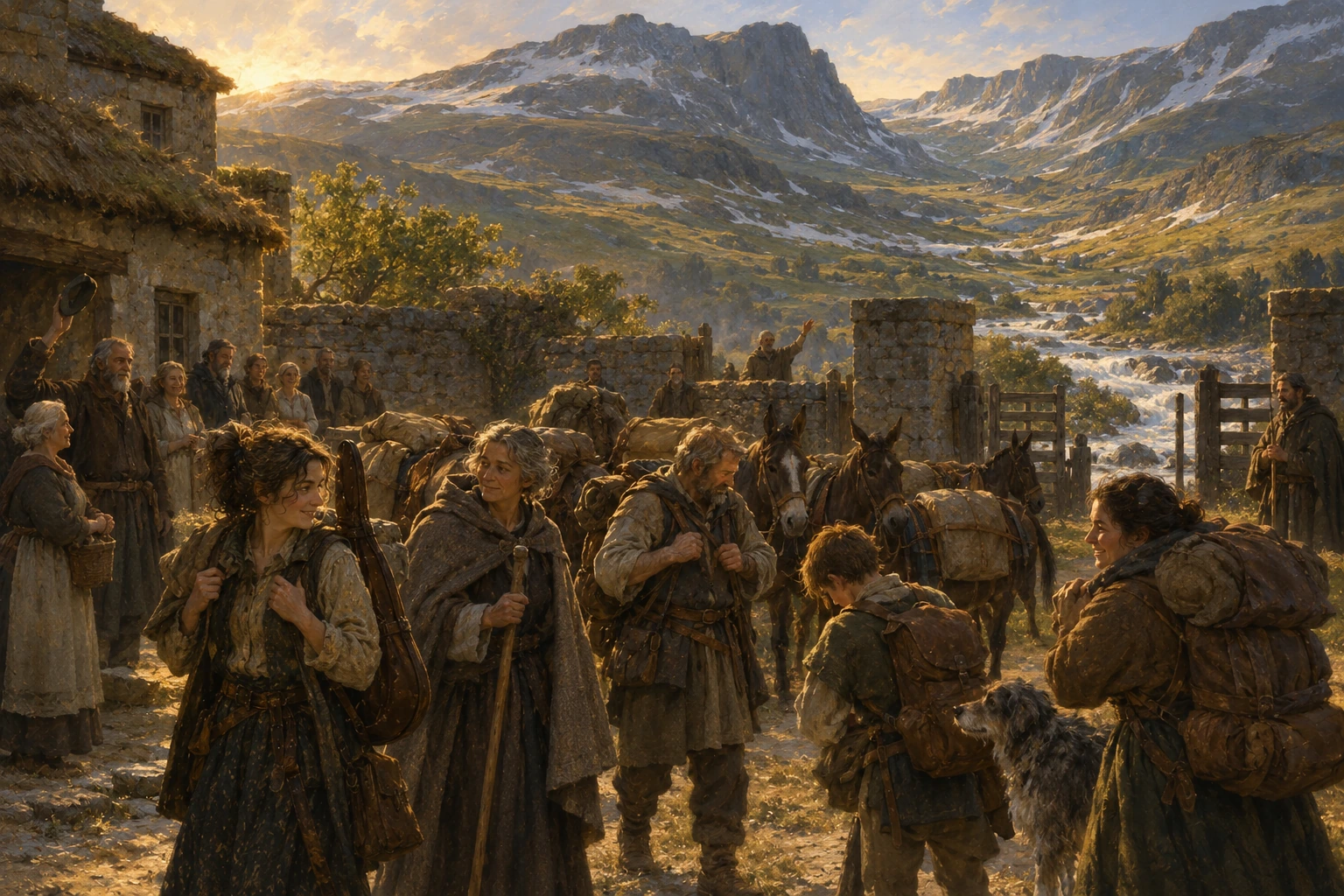
The Thaw
The thaw came to the Watch on the Stones as it comes to any high country that has earned its winter honestly: not all at once, and not without argument, but by inches surrendered and regathered and surrendered again, until a morning arrived when the surrendering simply outpaced the regathering, and everyone in the long house knew it without needing to be told.
It began, as near as anyone could agree on a beginning, with the eaves — dripping by noon, freezing hard again by dusk, a held breath let out and drawn back in, over and over, testing whether it was safe yet to let go entirely. "Dripping season," Orran called it. "Believe it in a month. Not before."
But the bare ground, when it came, came fairly. First on the south slopes below the Stones, in patches no bigger than a table; then wider, and higher, week on week, the snow-line climbing the eastern shoulder like something being erased a stroke at a time. The flocks grew restless before the shepherds admitted the grass was ready for them, and in the coomb-country south of the pass road the streams found their voice again — a walk that had asked a traveler to keep moving and say little became, once more, a walk through a country full of small, cheerful, running noise.
The road down-country reopened not with a proclamation but with a rider — a lean, weathered courier named Fossick, half-frozen and delighted with himself for having gambled the early thaw and won. He confirmed, between spoonfuls of Enna's barley soup, what the eaves had already half promised: the pass to the Steading Lamp was soft going but passable, and the King's Road West was waking up behind it, market by market.
The watch had its own spring labors to see to: the wood-ricks opened and worked down from the top, harness oiled and re-checked, the beacon-lamps trimmed and refilled against the lighter evenings ahead. Tolly and Dill were sent to whitewash the mule-yard fence, and got rather more of it on themselves than on the fence. And away east, the Hob's ruined shoulder shed its snow along with everything else, unvisited since the first storm, and the basket sat seated true in its cradle exactly where it had sat all winter, wet now with meltwater rather than sealed under snow, entirely, unremarkably at home.
The first mail came up with the first proper thaw riders, a fortnight into the dripping and the bare patches and the climbing snow-line, and it came, as it had gone, in Willem's saddlebag. Willem had ridden down to meet the earliest traffic on the reopened low road with the particular satisfaction of a man reclaiming his own proper work after a winter spent mending harness and losing, by his own cheerful account, every single arm-wrestle Enna offered him. He came into the hearth-hall stamping mud rather than snow off his boots for the first time in months, and handed Wren a flat oilcloth packet with her own name on it in a hand she would have known blind, by touch alone, anywhere in the world.
She did not open it at once. She carried it to the map-room, where the light was steadier and the company thinner, and sat with it a moment unopened on her knee, as she had once sat with a first letter by a different fire, and then broke the seal.
Wren —
The bees are up. I will tell you plainly that I do not propose to tell you how many, because you know as well as I do that a number in a letter is a number a person starts counting on, and counting on a number that has to survive a whole summer's weather is asking for grief that hasn't happened yet. They are up, and flying well on the first warm days, and came through the winter sound, which is the only arithmetic that has ever mattered and the only one I intend to give you.
The valley is much as it always is in a thaw, which is to say noisy about very little. The bridge took some damage off the ice this year — nothing the Hollin boys and a fortnight's work won't mend — and Widow Callow has already decided, before the water's even properly down, that the flood will have ruined her plums, which I expect it hasn't, any more than the wind ever did.
I saw the name in your letter a good many times before I let myself believe it, and then I sat a while with the fire, which I don't generally allow myself in the middle of an afternoon. Wystan's hand I have known my whole life, off the flyleaf of the book, and I am glad — more glad than I quite have words for, and you know I do not say that lightly — to learn it kept such respectable company on its travels as an inn's own book of ordinary names. It is a comfort to an old woman to think of him signing his name somewhere warm, among people glad to have him, rather than only walking, always walking, which is how I have privately pictured him all my life without ever quite admitting it.
So the fifth mark had a meaning after all. I find I am not surprised, only late. The not-knowing was never a heavy thing to carry, Wren — I want you to understand that clearly, and not go feeling sorry on my behalf for a burden I never felt as one — but I am glad to set it down, and gladder still of who it was carried it to me. Tell your friend of the road that nine keepers' worth of honest ignorance sends its regards, and its thanks, and would very much like to shake a hand it does not need a name to shake.
The book is where it should be. So am I. Write again when there is something worth the paper — you will know, and I expect, this year, you will know rather sooner than I'd like.
— G.T.
Dorrit — the goat has taken up with the Millson goat, and between the two of them they have opened the Hollin gate, the Callow gate, and — I am reliably told — a conversation with the miller's wife that neither goat nor miller's wife has yet recovered from. I no longer blame the goat. I have begun, against my own better judgment, to admire her. — G.T.
Wren read it through once for the news in it, and once — slower, tracing certain letters with her eye that her finger would once have traced — for the hand it was written in, exactly as the letter itself had once been read to her, months and a whole valley away. She found, as she had half hoped and half feared she would, that both readings left her glad in a way that sat comfortably beside the missing, rather than crowding it out. She read Dorrit the last paragraph aloud in the map-room's thin spring light, and Dorrit laughed until she had to sit down on the nearest bench, and then went quiet and pleased in a way that suited her better than the laughing had. Wren folded the letter along its own creases and set it in the satchel's outer pocket, beside the first, the two of them lying close together now, two seasons' worth of the same good news, never crowding what the book itself carried in its separate, older keeping.
Harrol sent her spring scouts out a full ten days ahead of the watch's own custom that year — "because a year that thaws early is a year that wants looking at early." They came back down four days later with mud to their knees and a report given flat and clear: the Gray Stair open farther than any of them had ever seen it, snow gone from ledges the watch's grandparents had called, by long habit, never-bare, green creeping up the lower steps to a height that made even Orran fall briefly quiet.
It was Iyene who gave the report its proper weight, checking it against three generations of the watch's own bound ledgers: in eighty years of logged spring scoutings, this early opening at this elevation had no precedent whatever. Harrol noted, once, and let drop as soon as it was said, that the log carried no new sighting of any kind this season, and that the two lights logged the autumn before remained exactly what they had always been — logged, unresolved, undisturbed. Iyene wrote the two of them into her own book beneath the scouts' figures and left them there. The road was waking, the Stair stood open wider and earlier than anyone alive had walked it, and a company that had spent a whole winter provisioning, mending, and waiting had, at long last, somewhere real to walk it to.
The assessors came up the newly open road eight days later, on a bright, hard-blue afternoon with the last of the yard's mud only half dried, and they came, as Harrol observed afterward with the particular dryness she reserved for facts she found irritating but could not fault, entirely within the law.
There were three of them and a string of four pack-mules travelling light — no digger-train yet, no equipment beyond what three riders and four mules could carry between them. The leader made no secret, over the first cup of tea Harrol's watch-law obliged her to offer any lawful traveler, that a heavier outfit would follow "once the going eased properly, and there was less risk of losing good tools to a late slide." The leader gave his name at once, offered his charter before anyone had thought to ask for it, and turned out to be, in the flesh, exactly the sort of man Wren had somehow not expected: not oily, not sly, not a single thing about him that a person could have pointed to and called wrong to look at. Assessor Marle was of middle years, sandy and going gray at the temples, dressed for the road rather than for effect, with the particular practiced competence of a man who had done this exact work a great many times and expected to go on doing it a great many more. He carried, tucked with evident care into an oilskin folder, a document sealed at Merrow naming himself and his party "salvage assessors" under the standing purchase of one Quill, Factor, of that city — a name that meant, to everyone at the table but Marle himself, considerably more than the ordinary clerk's hand it was written in.
Harrol read the charter through twice, said nothing about it either time, and then did the one thing the law both required and permitted her. She gave Marle and his clerk — a quiet, ink-stained young man named Mercer who spoke perhaps a dozen words the whole visit and wrote down a great many more — exactly the hospitality the border charter obliged the watch to give any lawful traveler on that road, and not the smallest scone beyond it. A bed in the guest end of the long house. A place at the ordinary table, not the good one. Water and fodder for the mules, charged, with scrupulous fairness, at the same rate she'd have charged anyone. "You are lawfully here," she told him, over that first cup of tea, in a voice that managed to be entirely courteous and entirely without warmth in the same four words, "and I have no lawful means of making you less so. I hope you will find the watch a civil place to wait in."
"I have generally found it so," Marle said, with what seemed to be genuine and unoffended good humor, "though I don't recall ever being told it quite so directly before. I'll take it as a compliment to your honesty and not trouble you for a warmer one."
The table scene, when it came that evening, came at Harrol's own table with both charters laid out side by side under the lamp — the Survey's own, sworn before King Osmund the autumn before, and Marle's, sealed at Merrow not two months past. It was Iyene who read the second one through with the same exact, unforgiving attention she gave any document that crossed her hands, her finger moving down the clauses like a coastline whose soundings she did not yet trust.
The language, when she read it aloud, carried a familiar coldness — goods recovered west of the watch, unqualified by hill, household, or history, in precisely the same key as a manifest she had once read at a different fire and never forgotten. She said so, once, flatly, without heat: "This is the same blindness I copied into my own pocket-book last autumn, Assessor, only grown a charter and a seal since. It still doesn't ask where a thing came from. Only that it came."
"It doesn't," Marle agreed, without apparent discomfort, "and I've never pretended otherwise, to you or to myself. I'm not a historian, Cartographer-Royal, whatever your charter calls you, and I've never claimed to be one. I'm a man who goes and finds what would otherwise be lost to rot and rockfall, and brings it somewhere it can be looked at, bought, kept, and used. I've seen a carved door — good work, old work, the kind your own eye would have grieved over — burned for camp-wood by border diggers with no buyer for it and a cold night ahead of them. Nobody's provenance saved that door. My trade is the only reason some of what's up there still exists at all, in any form, anywhere. I'd ask you to weigh that fairly against whatever you've come to think of me before the tea's gone cold."
She watched Alder — who could have answered it, who had answered its cousin once before at a different fire with an image of magpies and neighbors that still lived, whole and unimproved, in her day-book — decline to reach for it. The argument was not his to close a second time.
It was Pip, in the end, who spoke, and spoke directly, in the voice he used now for things he had thought through rather than merely felt.
"There's a basket on a hill two days east of here," he said, "that came off this same road, off a manifest with the same blank line where a hillside's name should have been. We know exactly where it came from, because the watch remembered what the paper wouldn't say. We carried it back — the wrong way, by your reckoning, two days the wrong way, for no coin at all — and set it in its own stone cradle, and it's sat there all winter being exactly what it always was before anyone dug it up." He looked at Marle as one craftsman looks at another whose work he recognized without sharing it. "A thing sold survives as a thing, Assessor. A thing returned survives as what it was. I don't think either of us is wrong about the value in it. I think we're only counting different things as valuable."
Marle was quiet a moment, turning his cup slowly — a trick of Alder's own, borrowed without either of them knowing it — and then inclined his head — not in defeat, Wren thought, but in the particular measured respect one tradesman gives another whose invoice he will never be able to write. "I've heard the basket's story," he said. "Word of it reached even Merrow, before winter shut the road — good iron, two days' extra carrying, for a hillside that couldn't pay for it and wouldn't have missed it, by any reckoning I know how to keep. I'll own I found it puzzling when I heard it, and I own it more charming than puzzling, hearing it told properly at last. I can't put a figure to what you've just said, Master Sandover, and I won't pretend I can bill anyone for it. But I don't think you're wrong, either. I think we're simply in different trades, and I'd rather be civil about it than pretend otherwise." He raised his cup a half inch, the smallest possible gesture of a toast, and drank.
The two charters lay side by side under the lamp a while longer, read by everyone present, their difference plain to all of them, and then Harrol gathered them both up with the unceremonious efficiency of a woman closing a ledger for the night, and the talk turned to smaller things.
The company took its own counsel at its own fire that night, in the map-room rather than the hearth-hall, the door pulled to against a cold that had, everyone privately agreed, very little bite left in it.
The facts, once laid out, argued for themselves and needed no dressing up. The assessors were waiting on their digger-train and on easier weather besides, and a digger-train, Bracken observed, with the flat certainty of a man who had spent a winter thinking about exactly this kind of arithmetic, was a slow, heavy, cautious thing that would not so much as attempt the Stair's lower steps until the melt was a good deal further along than it presently stood. The Survey traveled light, four mules and seven souls against Marle's three riders and an outfit still to arrive. It had every last scrap of the watch's practical friendship behind it — Bracken's tack mended to the last buckle, Orran's own hard-won knowledge of the road's first hard miles, the scouts' own fresh route notes handed over, Harrol observed dryly, "because nothing in my charter obliges me to be generous with a rival outfit, and a great deal in it obliges me to be generous with my own." And it had, besides all of that, a charter written for precisely this crossing, sworn before a king who had said that the keeping itself was the honor.
"We go first," Alder said, into the quiet that followed, in the voice Wren had come to think of as his closing voice, the one he used for matters already decided in every particular but the saying of them aloud. "First through the passes when the Stair allows it, which by every account we've heard today is sooner than any of us dared plan for back in autumn. And we go clean." He let the word sit a moment before he went on. "Clean meaning we take nothing that isn't freely given or truly lost with no one left to grieve it. We record everything, honestly. Iyene's trade requires it; Marle's does not. And what can be returned, we return. We carried an iron basket two days out of our way for no better reason than that it belonged somewhere and we happened to be walking past the somewhere it belonged. The freight west of here has waited three hundred years, near enough. It can wait the few days it takes us to pack properly. I see no reason at all to ask it to wait for anyone else."
It was Dorrit, breaking the small comfortable silence that followed, who supplied the evening's one piece of levity, nodding toward the door beyond which Marle's party had, an hour before, settled for the night in the guest end of the long house. "He asked Luel this afternoon," she said, "whether she'd consider guiding his outfit as far as the Stair mouth, once his train comes up — took her for a local woman who knew the country, which I suppose, strictly speaking, she is, and rather more thoroughly than he can imagine."
"And what did she say?" Wren asked, already half smiling.
"That she was presently engaged," Dorrit said, "and wished him a safe crossing when his own hour came." She shrugged, entirely pleased with herself. "Which is true in every particular, and told him nothing whatever he didn't already believe. I don't think I've ever heard anyone lie so thoroughly by saying nothing but the truth."
Luel, in her corner of the map-room, said nothing at all to this, only inclined her head a fraction, the ghost of something amused settling over her still face and staying there a good while after the talk had moved on.
The cold came down the newly opened road two nights later, a little before midnight.
Wren was awake at the start of it and did not know she was. She had gone to the map-room window out of the old habit of looking east before sleeping, and she stood there some while before she saw that the watch's lamps were wrong. They burned along the wall in their proper order, as they had burned every night since autumn. But the easternmost had gone small — not out, only small, its flame drawn in on itself the way a hand closes.
Then it went out. Then the next one did.
She had known the phrase her whole life. At the Bridge Inn it had meant nothing worse than a fire wanting a log and a household too comfortable to fetch one. She had never watched a line of lights do it in order.
"Going Meddan-wise," she said, aloud, to an empty room, and went to find Alder.
He was in the passage already, coat on and stick in his hand, and he did not ask her what she had seen.
"How many?"
"Three, when I left the window."
"Then it is moving, and it is moving up the road we spent the whole winter waiting to have opened." He was walking before he finished the sentence. "Wake Bracken. Wake Harrol first."
The watch came awake the way a border watch does, fast and without noise. Harrol had every child in the place counted and indoors inside four minutes, Tolly and Dill among them, complaining bitterly and going anyway. The doors were barred. The shutters came down. The hearth-hall fire was built high enough to light the whole long room, and every one of those things was ordinary, and every one of them was the wrong sort of preparation. Wren watched Harrol understand as much within the quarter hour.
The trouble was not cold. The hall had cold, and had had it since November, and knew what to do about it. The trouble arrived in the talk.
Enna, filling a lamp at the long table, asked Dorrit to pass her the — and stopped, and stood holding the empty place where an ordinary word had been. She laughed at it once, the way a person laughs at a stumble on a flat floor. Then she looked down at the lamp in her own hands as though no longer entirely sure of that either.
"It's the coomb," Pip said. His voice was steady and his face was not. "It's the coomb and it's come indoors."
"It is the same weather," Alder said. He had the east shutter cracked two fingers' width and his eye at the gap. "The coomb is a hollow that sits still and lets it pool. This is the same thing walking. The road opens both ways, and I do not believe a single one of us said the second half of that out loud all winter, because we were all so glad about the first."
Marle came down from the guest end fully dressed, Mercer a step behind him with a lamp. He looked at the barred door, and at Harrol's face, and at the grey-headed loremaster standing at the window in a coat he had never taken off all evening.
"I'd take an explanation," Marle said, "if one's going."
"You'll get a short one." Alder turned from the shutter. "There is a cold coming up this road that thins people out. Not kills. Thins. It takes the small furniture first — a word, a name, the reason you stood up — and it goes on taking until whoever it is taking from stops minding. One of mine sat down in the middle of it last autumn and very nearly did not get up again, and he was two dozen paces from six people who loved him."
"And you know this how?"
"Because I was one of the six." Alder set the iron ferrule of his stick against the boards. "Mistress Harrol. I can draw a line around this house."
Harrol did not blink. "A line."
"A boundary. It is the only craft I have ever had. Inside it a place goes on being itself and knowing its own name. Outside it, it does not." He said it as flatly as a man reading a bill of lading. "I want three things and I want them quickly. Every lamp in this watch that will carry oil six hours. Every soul inside these walls given to me by name, once, and given correctly. And your leave, because I'll not draw a line round a woman's house without her say-so."
"And it will hold?"
"I don't know."
The whole hall heard him say it. He did not soften it, and he did not look away from her.
"I have drawn four in my life," Alder said. "Three held. The fourth held long enough for the people inside it to walk out the far side, and I have never settled with myself whether to count that as a fourth or as a lesson. I am telling you now so that nobody in this room decides, at two in the morning, that they were promised something."
Harrol looked at him for perhaps three seconds.
"Enna," she said. "The beacon-lamps. All nine. Trimmed and filled a fortnight since, and I have never in my life been so glad of a chore done early."
He walked the line himself and would not have it walked for him.
It went out from the long house's east gable, along the inside face of the wall, round the well, across the near quarter of the yard, and back to the gable's far side. He scored it the whole way with the ferrule of his stick — a shallow bright scratch through frozen mud, no deeper than a boy would leave dragging a branch, and no more impressive to look at than that. At each turn he set one of Harrol's beacon-lamps and lit it with his own flint. At each lamp he stopped and said a name.
He named the house. He named the hearth-hall and the guest end and the map-room and the well and the barred door. Then he began on the people, and he said every one of them, and he said them right. Harrol of the Watch on the Stones. Enna. Orran. Willem. Tolly. Dill. Forty-odd names in a voice that never rose above the pitch of ordinary conversation. He named the Survey, seven and four. And then, with no pause at all and nobody having asked him to, he named Assessor Marle of Merrow, and Mercer his clerk, and Tarn Hollis who kept his mules.
Marle's face did something Wren could not read.
"You've put my people in it," he said.
"You are inside these walls. The line does not take opinions. It takes what is in it when it closes." Alder moved on to the next lamp.
What it did not take in, it left out. It left out the smithy. It left out the wood-ricks along the south wall, and the whitewashed fence, and the far three-quarters of the mule-yard.
Bracken had the string moving before Alder had finished saying so, and Marle sent Tarn out with him without being asked twice. He worked the pickets one-handed in the dark, giving Tarn the knots that wanted two hands and taking for himself the ones that did not. Seven mules came in over the scored line and stood crowded and disgusted in the near yard. The eighth was Marle's own grey, who had got her lead round a post at the far rail and would not be argued with. Tarn went back for her.
The line closed at the east gable at eight minutes past one.
The test came a little before two, and it did not announce itself.
The lamps leaned. That was all — nine flames leaning east together, though the yard's air had not moved at all and Wren's own breath stood straight up in front of her face. Inside the hall the talk began to thin. Somebody at the long table asked twice for the same cup. Iyene, who had been reading aloud out of her own pocket-book on purpose, lost the middle of a sentence and sat looking at the page with an expression Wren had never seen her wear.
"It's inside," Dorrit said.
"It leaks. A line is a line and not a wall." Alder was in the doorway, and he was breathing hard already, and the night had barely started. "It slows what wants across. It does not lock a door. Wren — keep the roll."
She did not need telling what he meant. She went down the hearth-hall from one end to the other saying every name in it aloud and in order, people and mules together, the way Dorrit had made them all do it laughing at a fire on the far side of the coomb. Harrol of the Watch on the Stones. Enna. Orran. Willem. She said Tolly and Dill twice apiece because they were the youngest. Under the whole of it, low and wordless and no louder than the fire, Luel's thread ran on, and the names came easier wherever it was nearest.
The east lamps began to go at half past two. Alder relit the first and it took. He relit it again twenty minutes later and it took worse. The third time, he came back from it slower than he had gone out.
"I need four people on that line," he said, "and I have got two hands."
"Orran," said Harrol. "Willem."
They went, and it was not enough, and every person in that doorway could see it was not enough. Alder looked at Marle and did not ask him anything.
Marle looked out at the yard for a space Wren counted at four full seconds, and the whole doorway watched him do it.
"Mercer," he said.
Mercer set his lamp down on the table, and put his coat on, and went out into the dark to hold a line he did not believe in for a man he had first laid eyes on three days earlier.
It was Bracken who counted, because Bracken always counted. He came in at a quarter to three with ice in his beard and gave it in the flat, unwelcome voice he kept for bad counts, twice over, once for the number and once for what it meant.
"Seven mules in, one out. Every soul in this hall counted twice, and every soul on the line counted twice after that. Tarn Hollis isn't in either tally."
Marle went for the door and Bracken put his good arm across it.
"How long?" Alder said.
"Twenty minutes. Might be thirty."
Alder set his stick against the wall, which Wren had never seen him do before going anywhere, and unbuttoned his coat and handed it to Dorrit. He stood a moment in the doorway looking out at nine lamps and a scratch in the mud.
"If I'm not back before the east lamp goes," he said, "the line still has to close. It closes without me. Does everyone in this room understand what I have just said?"
He went out over his own line, and it let him, and Wren watched the lamplight take him and then not have him.
She had watched him do a great many things in a year of road, and every one of them had worked. Standing in that doorway with her hands full of other people's names, she had come to think of that as a property of the man rather than a run of good fortune, and it was not a comfortable hour to have the thought arrive in. She kept the roll going. She reached Tarn Hollis, and said it, and went round again.
The east lamp went out at eleven minutes past three, by Iyene's own watch, which she was holding open in her hand for exactly that purpose.
"Line's open," Bracken said.
Wren heard Alder before she saw anything of him — not close, and not loud, a voice worn down to about the size of a voice at a sickbed, coming out of the dark somewhere off the north-east corner.
"The lamp. Somebody get to the lamp."
"It's four paces outside the turn," Orran called back.
"Then it is four paces." A pause; he was walking, and it was costing him. "Whoever goes says the name of the house, and then his own name, and then he says hold. He says it as though he had every right to. That is the whole of it. There is nothing else in it at all."
Mercer was already moving.
He was not a big man and he was not a fit one, and he went out past the north turn with a lamp swinging in one hand and Marle shouting something behind him that nobody could repeat. He got to the dark lamp. He knelt. He was a long time at the flint, longer than any of them wanted him to be, and the light when it finally came was small and yellow and entirely ordinary.
They heard him say it. He had a clerk's voice, thin and unused to carrying. He gave the name of the house, and then his own — Mercer Hallow, which not one soul in that yard had known until that moment — and then he said hold, once, and did not sound as though he had any right to it whatsoever.
It held anyway.
Alder came in over the line at twenty past three with Tarn Hollis walking beside him, on his own two feet, his hand in Alder's the way Pip had walked out of the coomb between Bracken and Dorrit. He did not know his own name. He answered to nothing at all until well after dawn and then answered to everything at once, and cried about it a while behind the wood-ricks where he believed nobody could see him; and Orran, who could see him perfectly well, went and split kindling at the far end of the rick for an hour and said nothing.
Somebody put a cup into Alder's hands a little after half past three, and for about a minute the hearth-hall was a room full of people who had got away with something. Enna laughed at nothing at all. Willem came in off the line for the warmth and reported the yard dull, which was the best word anybody had heard all night.
Then Dill was standing in the doorway of the sleeping end, barefoot, with the door open behind him on a dark Wren had not once looked into.
"Tolly won't put his boots on," he said.
It was such a small thing to say that half the room did not hear it. Pip was through the doorway before the other half had finished turning round.
The sleeping end lay at the cold end of the long house, past the passage, behind a door Harrol had ordered shut at midnight and that had stayed shut. Nine of the watch's children were asleep in there, two beds pushed together and a bolster down the middle. Tolly was not one of the children and had been furious since midnight about being put in with them to mind them, and he was sitting up on the edge of the near bed with a boot in either hand.
He had got that far. He had swung his legs down and reached for his boots the way he had every morning of his life in that house. Somewhere between the reaching and the pulling on he had stopped, and had gone on sitting in the dark holding them out in front of him.
Harrol had counted them in at midnight, and Bracken had counted the hall twice at a quarter to three, and between those two counts there was a door. The roll had gone up and down the hearth-hall all night and had never gone through it.
Pip said his name. He said it the way a person says a name at a door, and then louder. Then he knelt in front of him and took the boots out of his hands and said it a third time with his face a foot away.
Tolly looked at him. That was the part Wren could never afterward make sit properly on a page — he looked, and he was in there looking, and what looked back had already been going a good while.
She got down beside Pip and said the things that belonged to him. His name. His gran. The whitewash on the fence and the whitewash on his sleeve. The flue at the far end of the hearth-hall that Pip had spent a whole winter teaching him to read, and the fact that he was the only one at that watch who could read it now.
She was still saying it when Pip started the counting-rhyme.
He got the first line out flat and wrong, having learned it over a winter from the boy in front of him rather than in a childhood, and then the second, and then the third. At the fourth Tolly said the word.
He said it clearly. It was the only thing he said.
Luel was in the doorway. Wren, turning, saw her face for perhaps a second before it folded itself away.
Alder came as far as the foot of the bed and stopped there. He had a whisper left and he tried to use it. Wren heard him get out two words, and the second one was Pip's name, and after that he had nothing at all. He stood holding the bedpost and did not try again.
Harrol came in last and did not go near the bed.
"Enna. Get them up. All of them, into the hall, into the light, and the lamps stay lit till it's day." She said it over the heads of the two people kneeling on her floor. The children went out past her in their nightclothes inside a minute, and she counted them going, and got the count right.
Then she stood at the end of the bed a while with her hands at her sides.
"Master Alder."
"Mistress."
"Will he get up?"
Wren did not understand the question. Pip, on the floor, did not either. Bracken went entirely still in the doorway, and that was how the rest of them came to know it was a real one.
"I don't know," Alder said.
Everyone in that room heard him say it, as the whole hall had heard him say it three hours before. He did not soften it the second time either.
Harrol nodded once, as though she had been handed a figure she could work with.
"Orran," she said. "Get the forge lit."
The cold leaned on the line until something after four, and then went on up the road the way weather goes on. It did not break. Nothing broke it. It found nine lamps and a scratch in frozen mud and a house that went on knowing its own name, and it passed by, the way fog passes a lit window, having wanted nothing from any of them in the first place.
Morning found the yard exactly as it had been the evening before, minus a good deal of lamp-oil and a scored line already softening in the wet, and there was no mark on anything in that yard anywhere — and that, standing in the trampled mud with the sun coming up on a perfectly ordinary morning, and the forge door propped open at the far end of it, was going to be the hardest part of the whole night to set down at all.
The forge door stayed propped that day and the next, with the fire kept up and a lamp burning at the head of the trestle, and two of Harrol's own sitting inside it in turn. She had given them their orders out of anyone's hearing and she gave no account of them to the Survey, or to Marle, or to her own hall. Iyene, who asked everybody everything, did not ask.
Alder could not speak above a whisper for the whole of that day and most of the next. He would not sit by the fire and would not be fussed over, and answered every enquiry after his health with the same three words in the same ruined voice until people gave up asking. But he said one thing at the breakfast table loud enough for the room, and made Iyene enter it in the Survey's working record before he would touch his bread.
"I cannot draw another before midsummer." The voice was a wreck and he used it anyway. "Not a small one. Not a poor one. Nothing at all. Somebody will ask me for a line between now and then, and they will ask me in a bad hour, and I would rather every one of you had the answer today, at a table, with breakfast in front of you."
Iyene wrote it down. Nobody said anything comforting about it, which was the courtesy he had actually asked for.
Marle came to find them before the table had cleared. He had shaved, and his charter was under his arm, and he did not sit down.
"Master Alderin," he said.
It was the first time he had used the name, or the order it came out of. For two days he had said Master Alder, in the level, friendly, faintly amused way a man of business says anybody's name.
"Assessor."
"Nineteen years I've been at this trade." Marle turned his hat once in his hands and then made himself stop. "I've been up more old roads than your Cartographer-Royal has surveyed, and I have never yet seen a thing I couldn't have explained to a magistrate before noon. Last night I watched a man walk out over a scratch in the mud to fetch my muleteer, and I'd have bet my whole purchase against his coming back. I'd like to ask you what that was."
"You would," Alder agreed, in his ruin of a voice, and did not answer him.
Marle took it better than Wren would have.
"Then I'll say my other thing straight out, since you've been straight with me." He looked round the table at all of them, and there was nothing unfriendly in it, which was somehow worse. "My train comes up in three weeks. Forty mule-loads, tools, and eleven men who have worked worse ground than that stair for less money. I mean to be over the top of it before midsummer. That isn't a threat and I'd be sorry to have it taken as one. It's arithmetic, and every one of you would reach it yourselves inside the hour, so you may as well have it from me."
"We'll be gone by then," Bracken said.
"You will," Marle agreed. "Three weeks is a good start on any man. It isn't a wall." He put his hat on. "A safe crossing to all of you. I said that before and I still mean it. I'll be along behind."
Mercer said goodbye to nobody, being Mercer. But he came past the map-room door on his way out with his ledger under his arm, and stopped, and looked at Alder for a moment with an expression that had nothing of a clerk in it at all; and then went red to the ears and went on down the passage without a word, having said, Wren thought, a good deal more than his employer had managed in two days of talking.
The last full day before the Survey's own departure ran the settled, familiar course of a house that has done this kind of leaving before: not in haste, but in the ceremony of things done properly because they had been done properly a hundred times already and would want doing properly a hundred times more.
Bracken worked the loading with a winter's rest behind him and a right arm that had got back perhaps two-thirds of what it once did, and both facts showed. Pip and one of Harrol's people did the lifting, every time, to his word and his hand-signal and his eye. He touched nothing above his own shoulder all morning. Every pannier was weighed and balanced against its opposite before it went up, the ugliest stretch of the coming road — the Stair's own broken lower steps, by every account they'd heard — planned for from the very first strap rather than discovered partway up it. The fiddle, wrapped against damp, went up on Gable's steady back exactly where it had always ridden, in the place Bracken had long ago decided suited a mule too dignified to be troubled by anything so trivial as music. Dorrit's chest of cuttings and pressed leaves and her small stitched herbal, fat now with a whole winter's careful additions, went onto Suet, lashed and rebalanced with the same careful hand the beacon-basket had once earned riding the same stretch of the same mule's back. And the satchel — Wren's satchel, with the Waybook in its own old compartment and two letters lying together now in the outer pocket — went nowhere near a pannier at all. It stayed exactly where it had ridden every mile of the road so far, worn across her own shoulder, never packed away, because some freight, as Bracken had said more than once without ever quite explaining why he thought it worth saying, traveled better carried than stowed.
The watch's own send-off, Harrol had decided without argument, would be held for the morning — a proper leaving, in daylight, with the whole watch turned out to see them off, rather than any thin evening farewell already half forgotten by breakfast. Tonight was for smaller things: a last quiet supper at the long table, Enna outdoing herself one final time before the company took to its own trail rations. Willem promised, with real feeling, to carry any further letters north the moment the road allowed it. Dill came to the table late and gave Pip a whitewash-spattered carving of a mule that bore, on close examination, an unmistakable resemblance to Gable asleep, and said that it had been the two of them doing it, and went away again before anybody could answer him. The last watch of the night found Wren at the map-room window a while, looking east toward a hill she could not see and did not need to, and then, before she slept, at her day-book, open on her knee by the last of a small steady lamp.
She wrote of Granna's letter, answered now and kept, riding home in the satchel's outer pocket beside its own elder sister. She wrote of the Stair, open farther than any living memory the watch could produce, the record and the scouts' own boots agreeing on a thing neither could quite account for and neither troubled to dress up as more than it was. She wrote of the assessors, lawful and civil and entirely wrong, in the same unhaunted register Iyene had taught her, months back, to use for anything that wanted recording clearly rather than feared: lawful, and wrong, and three weeks behind us — which is the entire advantage we have, and a good deal less of one than I would like.
She wrote of the other night too, and found it took her three attempts and came out shorter each time. Tolly of the Watch on the Stones died in the sleeping end between three and four in the morning, inside the line, with nine lamps burning. That is what I know. It is all I am going to put down, because there is nothing else in it that would be for the record.
Nine lamps and a scratch in the mud, and a man who told a room full of strangers that he did not know whether it would hold before he drew a single yard of it. I have been on the road with him since the bee-yard gate and I had never heard him say that about anything. I have decided that I am glad to have heard it, and that being glad of it took me until this evening to arrive at. Assessor Marle's clerk went out past the north turn at three in the morning to light a lamp he did not believe in, and it held, and I do not think that man will ever be able to write a plain manifest again without wondering what is on the other side of the line he is writing it inside. Master Alder cannot draw another before midsummer. He made Iyene write that down, which is not the act of a man being modest about his powers. It is the act of a man handing his company a fact they are going to need.
And then, because some things asked for no more decoration than the truth already carried in them, she set down last of all the old charge, exactly as it had first come to her, nine keepers and a whole valley of quiet keeping behind every word of it:
Keep it against the thaw; and when the road opens, the book goes home.
She read the line back once, by the lamp's small steady light, and found she had nothing whatever to add to it that would not have been decoration for its own sake. Beneath it, in her own plain hand and steady, she wrote the one line that was hers to add and had, in the truest sense, been hers to write since the very first snow had fallen on a stair three hundred years shut:
The road is opening.
She capped the ink, and found Alder in the map-room doorway, which she had not heard him come to.
"You should be in bed," she said.
"So should you." He came in and stood a moment at the window, looking east at nothing, which was what there was to look at. He had been doing that for three days now, since the lamps, and she had watched him do it, because he had not been offering.
"Master Alder — the lamps. Could you do that again? If it came to it."
"No."
"Not before midsummer."
"Not before midsummer," he said, "and not for want of trying, which is a thing I would rather you understood than merely believed." He turned from the window, and in the low lamplight he looked exactly his age, which he did not often trouble to. "You are going to have a great deal of me between here and the sea. You are going to have almost none of that. Load accordingly."
Then he wished her good night, mildly, in his ordinary voice, and went to his bed; and Wren sat on a while at the map-room window with the lamp burning down, looking east toward a hill she could not see. A company with one fewer answer in it than it had carried a week ago, walking west, into country where the answers were going to be wanted.