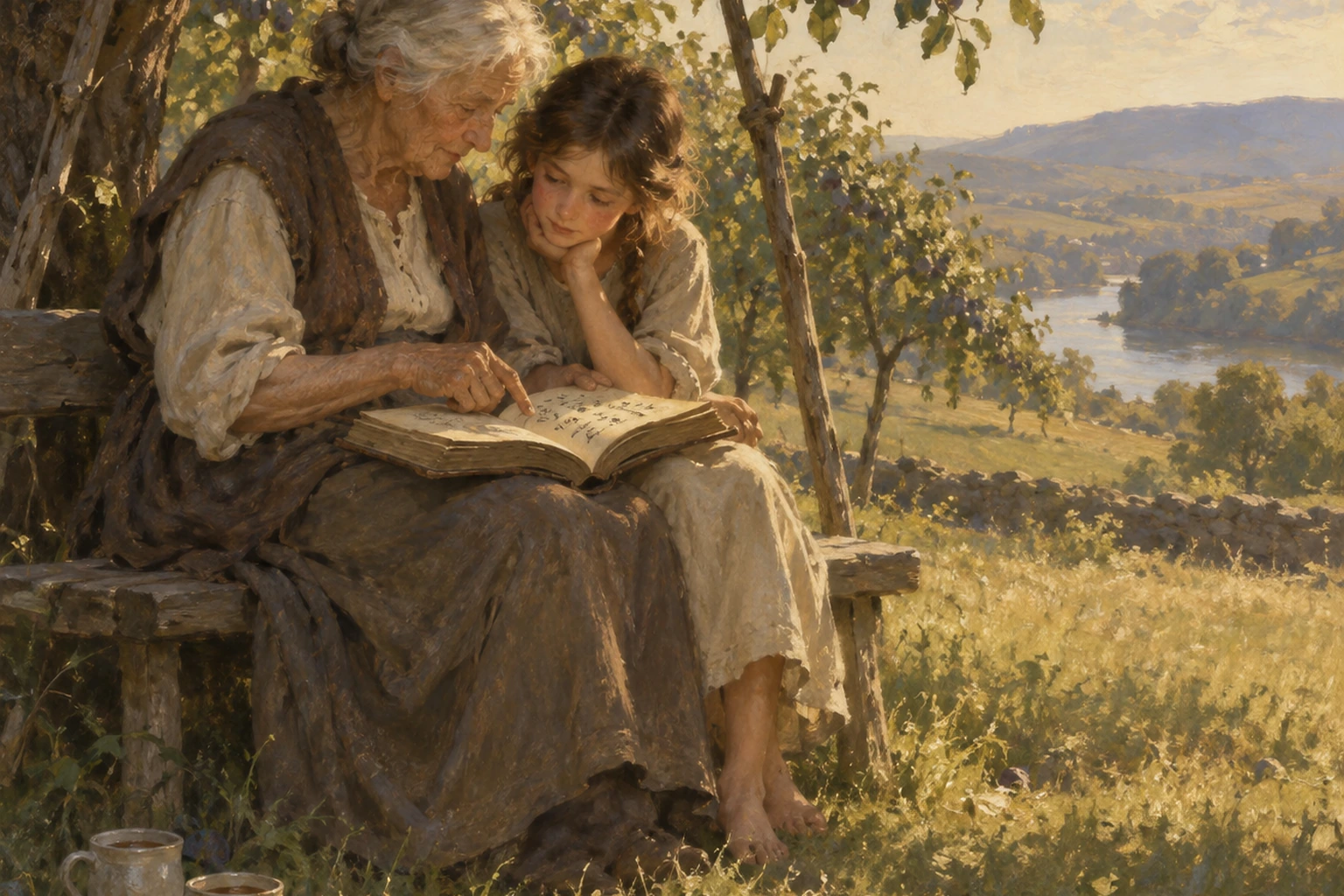
Words in the Orchard
The plums came ready four days after Master Alder had made his call at Fallowmere, which was how the valley had taken to dating things that week. Nobody in Dall had yet been told what the call had been about, and this had not stopped a single soul from having views on it at length.
By the second morning Hobb's boy had carried the news of the Fallowmere business to every doorstep between the mill and the sheep-pastures, and the valley, finding the news rather thin as it stood, had thickened it. In one telling Wren was to go down to the capital and be made a lady. In another, Master Alder had come to buy Fallowmere outright, hives and orchard and all, and old Mother Pell had already decided where she'd plant her cabbages once the family was gone. Ket Sallow's contribution traced the whole business, by a chain of reasoning nobody but Ket could have forged, back to the two-headed lamb of the flood year.
"And a fourth," said Dorrit, setting the pail down on the step with the satisfaction of a woman keeping the best for last, "which I had from Naith Ambry himself, standing at the forge with his arms folded like a man about to pass sentence, which is that the grey fellow is a tax man in disguise, sent to count our bees and report us to somebody in a city, and that Granna has cannily agreed to no such thing, and that is why nobody will say a plain word about it."
"And what does Naith think we ought to do," Wren said, "about the tax man."
"Naith thinks," said Dorrit, "that we ought to be very careful, and also that he was wrong about the last three strangers through this valley, one of whom he now calls son-in-law at every family supper, and he allowed as much himself, which from Naith was as close to an apology as the man had ever come. Ket has advice too, of course. Ket always has advice. He advises we say nothing, on the grounds that saying nothing is what he does about his own hives and look how well that answers." She picked the pail back up. "I told him we intended to say nothing regardless, and he seemed disappointed there was no argument in it."
Wren laughed, because it was funny, and because the truth had escaped the valley completely. The family had found — without ever discussing it as a policy — that the kindest thing to do with all these wrong stories was to let them run.
The orchard, that morning, smelled of ripe fruit and cut grass and, underneath both, the particular dust that rises off sun-warmed bark. It was in every practical sense an ordinary harvest day — which was exactly why Granna Tansy had chosen it.
The plum trees at Fallowmere stood in three ragged rows beyond the garden wall, and bore according to no calendar but their own: the two Early Reds by the gate always first, heavy already and dropping windfalls the wasps had claimed before breakfast. The tall damsons along the north wall came last of all, and stubborn about it. Wren went among the Early Reds first with the long-handled basket over her shoulder, setting a prop wherever a bough hung low enough to want it.
A ripe plum, taken properly, came off the spur with hardly a tug — a small give, more felt than heard — and any that resisted was left another day. Wren worked steadily down the row, feeling for that give before her eyes had properly found the fruit — a trick her father had taught her years ago, feeling for a full comb before she ever looked at it. Every so often a wasp rose up affronted from a windfall and made its slow circuit before subsiding. A wasp in a plum orchard in late summer was not an event. It was weather.
Granna Tansy sat on the bench at the orchard's edge, with a cloth spread over her knees and the sorting-baskets ranged before her — the good fruit into one, the split and windfall into another for the still-room. It was the work her hip allowed her now, since the winter she was widowed had left her unable to trust a ladder. And she did it better than anyone standing: a roll between finger and thumb, a glance, a decision — and the fruit went to its basket before Wren could have named the flaw that sent it there.
"You've an eye for the split ones I never had," Wren said, setting the basket down to be sorted.
"I've had sixty years longer than you to develop it," said her grandmother, without looking up. "Come and sit, when that row's off. There's a thing wants doing today, and it wants doing sitting down."
It was mid-morning, the sun well up and the first cool edge gone off it, when Dorrit came out from the house carrying, of all things, a folded cloth. Wren recognized it before she had properly seen what was in it — there was only one thing in that house that was ever wrapped so, and it did not come out of doors.
"Your grandmother's orders," Dorrit said, setting it on the bench beside Granna Tansy with the care of a woman handling something she has been told, rather than shown, is precious. Then, having discharged her errand, she went off down the row with the basket to see to the Early Reds herself — there was a decency in Dorrit that knew when a thing was not meant for an audience, whatever her curiosity might have preferred.
Wren looked at the bundle, and then at her grandmother, and felt something shift very slightly under her ribs, the way a hive shifts when the queen's hum changes note — nothing you could point to, and yet unmistakable once felt. In all her twenty-three years the Waybook had lived on its shelf between the clock and the unsmoked pipe, and had come down from that shelf, so far as she knew, only to the kitchen table, at night, with the door shut. It had never once, in her lifetime, come out of doors.
"It'll want no dew on it and no fruit-juice either," her grandmother said, unwrapping the cloth with the same sureness she brought to a jar of honey, "so mind your hands are dry, and set it here on my knee where the light's good and the wasps are minded elsewhere." She said it exactly as she might have said mind the smoke's not too hot. And Wren, sitting down on the bench beside her, saw the deliberateness in it: her grandmother had brought the book out into the ordinary sunlight and the ordinary business of a plum harvest on purpose, so that what was about to be given might be given as simply as everything else that morning, rather than dressed up in a solemnity neither of them wanted.
"I had this from my mother on a bench very like this one," said Granna Tansy, "though it was gooseberries that year, and I have never since been able to eat a gooseberry without thinking of it, which is a poor sort of legacy to leave a person, so I've chosen plums for you, and you're welcome to whatever they leave you with." She opened the brass clasp, which gave under her thumb with the small green sigh it always gave, and turned back the front board. There, inside it, in a hand less careful than the fine grey roadwork that filled the rest of the book, was a single line, and she laid one finger beside it without touching the ink.
I have set down what I could. Someone will want it.
Wren read it twice, and said nothing, because there did not seem to be anything to add to it. Her grandmother let the words sit there in the sun a moment before she turned the board back down and went on.
"The letters first," she said, "since they're least use to you and I'd rather have them out of the way early. My mother gave me forty of them, near enough, and I have kept every one, though I could not tell you now what more than a handful mean, since nobody living can. Your mother had a good half of them off me, in this orchard, and did not come to the rest. They are the old tongue, Wren — Wystan's own tongue, or near it — and they are given whole, sound and shape together, the way a tune is given, not the way a lesson is given. You will not understand them. You will only be able to say them, if ever you need to say them, and say them right." She spoke, then, four or five short sounds, low and strange in her mouth, worn smooth at the edges by generations of the same repeating. And Wren said them back, once, twice, until her tongue found the shape of them without her mind's help, sure of it before she had properly thought about it.
Did not come to the rest. A whole woman folded into half a sentence, out in the sun among the wasps and the sorted fruit.
Wren had asked about the rest of her three times in her life, and the last of them had been here, when she was eleven. She asked plainly, because at eleven she still believed plainness had been the trouble: would Granna tell her about the night her mother died. She got what she had got at six and at nine, in the same words and the same order, until a child could say it along with her. It was a hard winter, and it took what it took, and there's no more of it to tell than that.
It was not the answer that stopped her. It was her grandmother's hands. They had been sorting fruit; they stopped, and stayed stopped, and did not seem to know what else to do, and the old woman sat with a plum lying in her open palm and looked at the north wall a long while. Wren had said, "Never mind, Granna. I'll fetch the ladder," and gone and fetched it, and set it against the damsons a fortnight before they wanted picking. What she settled that morning, eleven years old with the ladder on her shoulder and the wet coming through her boots, was not that she had stopped wanting to know. It was that the wanting was hers to carry, and cheaper by a long way than the asking.
"And among them," Granna Tansy went on, "is one you already know, since you heard me say it back to Master Alder at my own table without a moment's pause, and wondered, I don't doubt, how an old woman came by a stranger's name so pat. Aildren. It's no more than his own name, said in the old shape of it, the way it was given down to me, sound for sound, same as the rest, and no more mysterious than that, whatever it looked like at the time." She said it plainly, almost with a touch of dry apology, as though confessing to a much smaller trick than the one Wren had privately built it into over three days of wondering. And Wren felt the little knot of that small mystery come loose and settle, painlessly, into place — one of the tidier surprises of the morning, and not the last.
"Now the marks," said Granna Tansy, and turned the pages until she found a stretch of road, fine grey lines wandering between two shaded hills, with small figures set along the margin in that spikier hand that was Wystan's own. "There are a great many marks in this book and most of them I could not swear to, but there are four that every keeper has been given straight, because the roads themselves may fail before these do, and a keeper who forgets them is no keeper at all." She touched them one by one, and Wren bent close to look, the ink dark and fine under the sun. "A stroke crossed, so — that is a well, and water where the ground gives none of its own accord. A shape like a comb, teeth and all — that is a way-house, a roof to sleep under, though whether any such roof still stands after all these years I could not tell you, only that Wystan meant it kindly when he drew it. A ring, small, with one stroke rising from it like a stem — that is a beacon-hill, a height a man might be seen from, or might see from, which comes to the same thing in the end. And a doubled line, close together, crossing the road square — that is a bridge, and worth knowing, since a river that cannot be crossed is a longer argument than any of the others."
A wasp, drunk on the windfall basket, chose that moment to blunder straight across the open page, and Granna Tansy's hand came down flat and quick beside it — not on it, never on the book itself, but close enough that the wasp took the hint and reeled off toward the Early Reds instead. She did not so much as look up from the page to do it. "Mind that basket's kept covered, Dorrit, or we'll be picking wasps as well as fruit," she called down the row, in exactly the voice she used for grading honey, and Dorrit, without breaking stride, called back that she'd covered it twice already and the wasps were simply better readers than Dorrit had given them credit for. Granna Tansy did not smile, quite, but something in the set of her mouth eased, and she bent back to the page as though the interruption had cost her nothing at all — though Wren, watching closely, saw that she kept one hand resting near the corner of the book for a good while after, in a way she had not troubled to before.
She let Wren say each one back — well, way-house, beacon, bridge — just as she had made her say the old words, until they sat as easily in the mind as the four quarters of the wind. Then she touched a fifth mark, further down the margin, smaller and finer than the rest, shaped something like a single curved wing.
"And this one I cannot give you the meaning of, because it was never given to me. My mother had it from hers the same as I have it from mine — passed on faithfully, and faithfully not understood, generation on generation, the way you might keep a key to a door nobody living has seen. I pass it to you exactly as it was passed to me, unexplained, because that is the honest thing to do with it, and because a keeper's whole office, when you come down to it, is passing on faithfully what you cannot always account for." She said this without any particular weight in her voice, as if remarking that a jar of honey had crystallized oddly and nobody quite knew why. And Wren, hearing it said so lightly, found she could hold the small ungiven mystery just as lightly in return — a thing kept rather than a thing that troubled.
"The figures next, since they're the plainest thing in the book and the most misread." Granna Tansy pointed to a string of small numbers set along a stretch of road near the western hills. "Every keeper before you has looked at these and thought, miles, because that is what a number beside a road generally means, and every keeper has been wrong, and has had to be told so, and I am telling you now so you needn't waste the years I wasted thinking it. Wystan walked his roads. He did not measure them with a chain, or if he did the chain is long lost with everything else he might have carried, and so what he set down was days — a day's walking, sound going, and no more than that. A number that looks short may be a hard day's climbing, and a number that looks long may be an easy day's road with the wind behind you. Read them as days, and you will read the book the way it was written."
Wren nodded slowly, feeling the shape of the whole thing settle, mark by mark, into the part of her mind that already held the working knowledge of two long rows of hives and the temper of every one of them — filed the same patient way, ready to hand when wanted.
"And now the margins," said her grandmother, and here, for the first time that morning, something in her voice slowed, not with reluctance exactly, but with the particular carefulness of a woman about to hand over a thing honestly, faults and all. "Most of what Wystan set down beside his roads is road-work, plain and useful — a ford that runs deep after rain, a spring that's gone bad, an inn-name, a warning about footing on a scree. Read those and trust them; he was a careful man and did not write down what he had not walked himself." She turned the pages on, past where the fine grey lines of the roads at last gave out into blank vellum — unmarked and pale, and yet not entirely empty, because there, in that same spiky hand, ran lines of writing with no road beside them at all to explain what they were doing there. "But these — where the roads stop and the page goes bare — these are another matter entirely, and I will tell you plainly, the way my mother told me, and her mother told her: I do not know what they are. They are not road-work. They are something Wystan set down for himself, or for whoever came after him, past where his own walking ended, and nine keepers before me have carried that not-knowing forward, honestly, without pretending to more than we have. I give it to you the same way. You'll form your own notion of it in time, I don't doubt, same as I have mine, and I'll not spoil it by telling you what mine is, since it's worth no more than a guess and I'd rather you came to your own." She was quiet a moment, her hand flat on the open page. "One thing more, and it is a fact and not a guess: the writing sits past where his walking ended. Whatever he put there, he put it there for further along than any keeper has ever been. Mind you're not in a hurry to be the first."
She closed the book, then, not with any ceremony, but as evenly as she closed a ledger after the day's figures were entered. She set her hand flat on the cover, and said, in the same voice she might have used to tell Wren the honey was ready for jarring: "Keep it against the thaw; and when the road opens, the book goes home."
It was the first time in all Wren's life she had heard those words spoken anywhere but at the kitchen table, at night, in the particular hush the house kept for them. Hearing them out here in the ordinary forenoon sun — with a wasp working over the windfall basket three feet away, and Dorrit's voice carrying faintly from the far row asking after a missing prop — she found that said in sunlight, over sorted plums, they weighed exactly the same.
"Mind the clasp doesn't sit in the damp," her grandmother added, in the very next breath, wrapping the book back into its cloth with unsentimental hands, "it's the hinge will go green first and the leather after, and you'll be a long way from a tin of dressing when it happens, so see you carry a scrap of oiled cloth of your own, and don't wait to be asked for it." And that was the whole of the ceremony, charge and instruction in the same breath, and no pause between them for either of them to feel the size of the thing that had just passed.
They had not been sitting five minutes more, the book wrapped and set safely back on the bench between them, when Dorrit came down the row with her basket on her hip and a look of a woman who has been turning something over and has finally settled it to her own satisfaction. Anyone who knew Dorrit recognized that look — it generally preceded her saying something nobody else had worked up the nerve to say first.
"I've been thinking," she announced, to the row of Early Reds in general and to nobody in particular, in the same flat tone she might have used to announce rain coming up from the west, "that I'll come along."
Wren looked up. "Along where."
"Along on the road, obviously, don't be slow, it doesn't suit you." Dorrit set the basket down and began sorting windfalls into it with the same quick competence she brought to everything, not looking at either of them. That was, Wren had learned over twenty-three years, exactly how Dorrit behaved when a thing mattered to her more than she cared to show. "Somebody from home has to see that you eat something besides whatever the College puts in front of you, and I've known you since you were small enough to fall in the water trough, and you have never in your life remembered to eat when there was work in front of you, and two years is a long while to go hungry out of forgetfulness. That's one reason. Here's another: the garden will keep. It has kept through worse than my absence — it kept the whole spring I had the fever, and came up finer for the rest, which I choose not to take personally. And here's the last of it, which is the one that matters to anyone but us: I've spoken to Master Alder already, at the inn, day before yesterday, and asked him straight out whether a charter bound for two years over strange country might want a hand who knows what grows and what doesn't, and what a body can eat off a hillside and what'll put them on their back for a week, and he allowed as it generally did want such a hand, and looked, I thought, rather relieved to have the asking done for him. I can name every herb in this valley and most of what grows past it, and what it's good for, and what it's good for nothing at all, which is knowledge worth having on a road as much as in a garden, whatever anybody thought when I first took it up."
She said all this to the plums, mostly, and finished it by dropping the last windfall into the basket with a small decisive thud, as though closing an account. Only then did she look up — first at Wren, then, briefly, at Granna Tansy — with an expression that dared either of them to make more of it than she had.
Wren found she had been holding something in her chest for three days without naming it, and felt it loosen all at once — the unspoken fear of going alone. What came up in its place was a relief so complete she did not trust herself to say anything clever about it, and so said only, "Good," which was the truest word she had, and which Dorrit accepted with a short nod, as though it were exactly the answer she had expected.
Granna Tansy said, into the small silence that followed, in the dry tone she kept for matters she had already decided were entirely sensible and saw no reason to praise further, "That's one less thing to worry over, and I'll say only that it's about time somebody made you a sensible woman's problem instead of mine," which from Granna Tansy was as near a blessing as either of them was likely to get.
There remained the matter of the bees, and it came up sideways, over the last of the sorting, when Ket Sallow put his head over the garden wall and offered, loudly, to take the Fallowmere hives in hand himself while the family were away. It was an offer received with exactly the careful warmth the valley reserved for kindnesses that could not possibly be accepted.
"That's good of you, Ket," said Granna Tansy, in a voice that closed the subject as gently as a lid settles on a jar, "but I find I'm not going anywhere at all, and a woman ought to keep her own bees while she's able, whatever else changes round her." She could not climb an orchard tree, had not been able to for some years, and had never let that stop her sorting a plum or grading a jar. The hives wanted steady hands and a calm way of going far more than they wanted a strong back, and a strong back could be borrowed from the Hollin boys when lifting was wanted. Wren, hearing it settled so, felt something pass between herself and her grandmother: that she was leaving her grandmother the bees just as her grandmother was sending her out with the book, each keeping the half of the inheritance that suited her hands.
They walked the bee-yard together that evening, before the light went, while Dorrit carried the last baskets in and the wasps settled for the night into whatever quiet corners wasps keep. Wren went down the row hive by hive, and gave her grandmother each one by its character, as though introducing old friends at a gate: the third from the end, which had a temper on it since spring and wanted smoke enough and no hurrying; the fifth, which swarmed early most years and should be watched from the first warm week. And the seventh, quiet and steady and slow to trouble, was the one her father had started with a swarm he'd walked two miles to collect, the year before she was born. Granna Tansy, hearing that last, was quiet a moment, and said only, "I know that one," and moved on to the next.
Supper was late that night, and full of plums. The fiddle-case sat by the door with a note pinned to it in Wren's own hand, a reminder that the strap wanted replacing before it wanted trusting on a long road. Beside it stood her good boots, cleaned and set out for the cobbler's. And on the table, growing by the hour, lay one corner of paper in Dorrit's decisive hand — a list that had begun short and was, by supper, threatening to run onto a second sheet. Most of it was given over to things that weighed almost nothing at all and mattered a great deal: a paper of seeds no charter would think to carry, a second knife for want of the first, a smaller comb than the honey-comb, for hair.
The evening came down cool over the river, the first real cool of the year, and the orchard, beyond the dark garden wall, stood full of propped boughs standing empty-handed now among the picked fruit, patient as they always were once their work for the year was done. By the time the plates were cleared, Granna Tansy had settled into her chair by the hearth and had nodded off before the clock had properly finished its next hour, her hands still folded in her lap in the shape of work. Wren sat a while longer at the table with Dorrit's growing list between them, adding a line here and there in her own hand.