Foothold
The clean ground held through breakfast and a little beyond it, and then, by slow degrees, the road began to climb again.
"Foothill country," Bracken said. "You'll feel it in your calves before you feel it anywhere else."
It was Dorrit who saw the hill first — rounder and more deliberate than the ground around it, its crown showing, even at this remove, the faint irregular grey of stone that was not simply outcrop.
Bracken narrowed his eyes at it. "Orran's ground. Has to be. He said a day or two east of the watch, a rounded shoulder standing apart, and there it stands." He looked round at Alder. "Told you he'd know it by the shape and not the name."
Nobody needed telling twice what hill this was: it had ridden with them, wrapped and lashed and patient on Suet's back, and every one of them but Luel had learned its shape secondhand, in iron, long before any of them saw it standing in stone and turf ahead of the road. Suet herself put her ears forward and quickened her pace by a fraction.
They came up under the hill's lower shoulder by midday, and it was in the early afternoon that the old road, narrowed now to little more than a foot-track, brought them among the fallen stones.
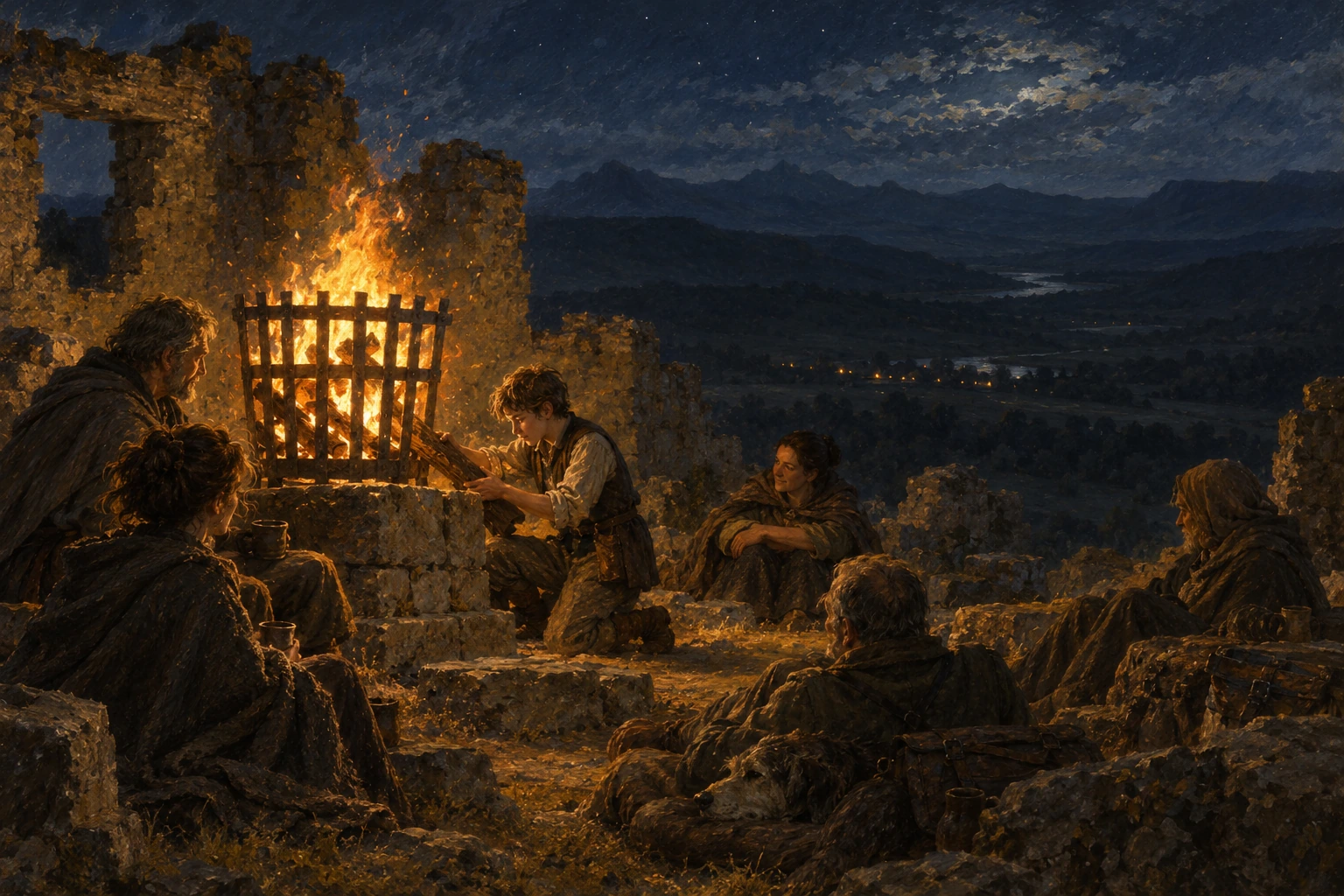
The ruin was smaller than Wren had expected, and better than she had expected too: a ring of walls, hip-high at their tallest reach, marked out what had clearly once been a small square house, its drystone courses still holding true. "Faced away from the weather," Bracken said, crouching at the doorway. "A keeper's house, not a shepherd's shelter — built to be lived in, not just slept in."
Dorrit found a herb garden gone wild at the wall's edge, and knelt over it with a small delighted sound. "Thyme," she said. "Common garden thyme, gone wild and half-strangled and still holding on, long after the last hand that pinched a sprig for the pot." Alder crouched by it, and put one finger against a sprig, and left it growing.
Beyond the garden stood the thing they had all been walking toward since morning: a squared stone base, waist-high, its four corners socketed with worn hollows where four iron legs had once stood seated. The cradle — empty, weathered, unmistakably sound. Iyene paced it with her working sheet already out. "A beacon-stand, sound," she said. "That's a very different line to write than the one I expected to be writing when we set out this morning."
A little way beyond the ruin lay the diggers' scars — three shallow trenches, already softening under new grass. Bracken looked at them a moment, jaw set. "Two summers, maybe three. Grass agrees with Orran."
Pip drew the ruin from the wall's warm south side for the better part of an hour, his pencil steadier than it had been two days before, at Iyene's plain leave: "This is a homecoming, not a grief. Draw it as one."
It was Luel who climbed alone to the hill's true crown, and stood there against the sky before the rest followed her up. "The watch call it the Hob," she said, without turning. "A hearth-shelf. They no longer remember why. Anvellon, in the old tongue — the Hearth of the East. It stood at the end of the eastern tending, where Meddan's own households kept the chain alight, hill answering hill, before the cold came up and put it out. Your borderlands kept the feeling of the name without ever being told the meaning of it." She was quiet a moment. "That is the kind most truths get kept by, in my experience."
They brought the basket up from Suet's back in the last hour before the sun began its true westering; Alder and Pip carried it between them, at Bracken's direction and in his exact words, because Bracken's right arm had not carried anything since the Long Shelf and everyone present knew better than to offer him a share of the iron. He went ahead of them instead and knelt at the cradle and cleared the four sockets out with his good hand, and then guided the basket down into them by feel — and it went into its worn stone hollows clean and true on the first setting, the four squat legs finding their places as though the years between the hand that lifted it out and the one that set it back had simply folded shut.
"There," Bracken said, and looked at it a moment with real satisfaction. "Fits like a key cut for the lock. Somebody's grandfather's grandfather knew his trade." He set one broad hand flat on the iron rim, once, gave it the same brief firm pat he gave a mule that had finished a long hard pull; and that was the whole of the ceremony anyone was going to make of the moment, and it was exactly enough. Pip had gone very still at the wall, watching; Dorrit's hand had found Wren's own without either of them deciding it.
Iyene wrote a plain professional line — beacon-stand, sound, restored to service — and, more slowly, a second line in the small book kept for memory alone. "Most things worth recording want telling twice," she said, "in two different keys."
Before the light began to lean toward evening, Alder called the company briefly together at the ruin's low wall.
"Before we left the watch, I left word with Harrol," he said, "that we might light this hill for one night, and that anyone below who saw it should know it for exactly what it is — a homecoming, not a warning. She took it down in her own hand, into the watch log. She said she'd sooner write one true line about an expected fire than field a dozen anxious ones about an unexpected one."
"So they'll know, down at the watch," Pip said, half a question.
"They'll know," Alder said. "A wonder announced in advance is still a wonder. It just doesn't frighten anybody on its way to being one."
They gathered fuel through the last of the afternoon, Pip at the center of the work under Bracken's watchful eye, laying the fire with the same care he gave any fire he'd ever tended; and when it stood ready he looked to Bracken, and Bracken gave him one short nod.
It was Alder who knelt to it, when the whole hillside had gone gold and long-shadowed, and he took flint and steel from his own belt-pouch and struck a spark into the waiting tinder.
"For courtesy," he said, quietly, as the first thread of smoke rose and caught, "and practice."
"Courtesy to whom, exactly?" Dorrit asked.
"To the people who fed this basket its nights, for as long as anyone kept it lit, and never thought it a burden," he said. "To whoever first taught these hills what a lit answer means. And practice, because the Survey is likely to be lighting more than campfires before its work is finished, and a thing done once for courtesy is a good deal easier done twice, when the need for it is less courteous than this."
He said no more than that. The kindling caught properly, and Pip fed it on, and the basket began, by slow degrees, to do the one thing it had been forged entirely to do.
It burned true — high, and steady, and clean, the flame standing almost straight in the still air, throwing a light that reached the fallen walls and picked out every stone in gold.
Far below, small and steady in the deepening blue, the watch's own lamps burned on exactly as they always did, and knowing that Harrol's own hand had logged this fire before it was ever lit, Wren could look at that distant string of lamps without any unease at all.
"Up and down the whole eastern country tonight," Iyene said at last, quietly, "for the first time in three hundred years, this hill is burning again."
Pip took the first watch, feeding the beacon exactly as he had fed every fire since that first fumbling evening on the road out of Merrow. Luel sat with each watch in turn, saying little.
It was on Wren's own watch, deep in the night, with the beacon burned down to its long steady coals and the company sleeping sound around her, that she saw it.
Far off — west, and high, well above where any lamp of any watch or farm had business being — a light. Faint. Low. Steady rather than flickering, holding for the space of perhaps three or four slow breaths before it was simply, without any drama in the going, no longer there.
She did not cry out. She sat very still instead, watching the place where it had been, in case it should come again, and it did not; and then she found a star to fix the spot by, and noted it, in her mind first and then, when she judged the moment settled, in her day-book by the coals' faint red light: bearing, duration, nothing more.
She did not wake anyone. There was nothing about the light that had asked for alarm, and morning would know everything the dark knew now, and would know it better rested. Across the fire, Luel sat as she always sat, upright in the last of the beacon's glow, and Wren did not look at her.
It was perhaps an hour later that the mules went bad.
Not one of them, and not by degrees. All four at once, heads up and round, every ear locked on the same quarter of the dark — the north-east shoulder, where the old road came up out of the low ground and the turf ran into the fallen stones. Suet, who had never in Wren's knowledge objected to anything in her life, backed against her picket line until it sang.
Wren stood up. She had the sense, very strongly and with nothing whatever to hang it on, of something coming up a slope at walking pace.
Across the fire Luel was already on her feet. She had not been asked to be, she made no sound at all, and she was looking exactly where the mules were looking.
Then the beacon leaned.
The air had not moved all evening; the flame had stood almost straight since Alder lit it. Wren watched it lie over — out toward the north-east shoulder and no other way, drawn long and thin, as though something at the far end of it were pulling — and hold there, in air that was still moving nowhere at all.
Bracken came out of his blankets without being called and put himself between the mules and the wall. Alder was already at the gap.
The ruin's wall stood hip-high the whole way round except at the doorway, where long weather had taken the courses down to their footing, and that gap was eight feet across and the only way into the ring that did not ask a person to climb.
Alder went down on one knee in it. He set the iron ferrule of his stick to the ground and drew it across, from the standing stone on one side to the standing stone on the other — a shallow bright scratch through turf and soil, no deeper than a boy would leave dragging a branch, and no more impressive to look at than that. Then he went back along it a second time, slower. Then he stayed down on the one knee, with his hand flat on the ground at the middle of it, and said their names.
He said them aloud and in order and he did not hurry over any of them, and he got every one right: six people and four mules, and Luel, whom he named last and by a name Wren had never heard.
Then nothing came.
That was the whole of it. Nothing came over the wall, nothing was seen, and no sound arrived that any of them could put on a sheet of paper; there was a stretch of time Wren could not measure, in which the flame stood pulled out toward the shoulder and Alder knelt in the gap with his head down and his hand on the ground; and then the flame came up straight, and settled, and stood as it had stood all evening. Nettle stamped once. Gable dropped his head and began, quite calmly, to eat.
Alder stayed where he was a good while after that, and when he got up he did it in two goes, and Bracken had a hand under his elbow for the second one, and neither of them remarked on it.
"What was it," Wren said.
"I don't know." He said it flat, with no softening on it at all. "I want to be exact with you, because I would rather you were frightened of the right thing. I do not know what came up that hill. I did not see it. And I will not put a name on it tonight to make either of us feel better about the morning."
He was grey for two days after — not tired, grey, in the face and about the mouth, and short with people in a way none of them had ever had from him. On the second afternoon he gave Pip a flat later that stopped the boy where he stood; and he apologized for it that same evening, at once, and looked worse for having had to.
And Bracken stopped camping on open crowns. He announced no rule and gave no reason for it, but for eight days after that he chose ground with something at its back, and put the fire where the hill above could not look down into it, and when the only good water on a day's march lay on a bare shoulder he walked them an extra hour to a worse well in a fold, and took the grumbling without answering any of it.
The debate at breakfast settled nothing at all. Wren gave her report at once — bearing, duration, the star she'd fixed it by — and Iyene entered it beside the watch's own two logged sightings.
"A third, then," she said, "or a settling star doing something a settling star does once in a long while and generally goes unwatched doing, or high weather playing a trick on tired eyes at the end of a night's watch. I don't know which, and I'd rather tell you that than guess prettier and be wrong."
"Stars do strange things on a frost night," Bracken said, around a mouthful of bread. "Means a man's tired and the sky's very big."
"I'd rather believe it and be wrong," Dorrit said, "than not believe it and be right and never know I'd missed something worth believing."
"It is logged as unconfirmed," Iyene said. "That's precisely what it is, and precisely what it will stay, until it either happens again under better watching or never happens again at all."
Luel offered only the one thing. "The west has always been better at watching than at being watched," she said, and left it there.
"And the other business," Bracken said. "The wall."
"Goes in the same book," said Iyene, "in the same hand, with the same word on it. Unconfirmed."
"It was confirmed by four mules," Dorrit said.
"Then I shall write that down as well," said Iyene, and did.
It was Alder, in the end, who closed it without resolving it at all. "Whether or not anything out there saw this hill and answered it, the courtesy was paid all the same. We lit it because it was owed, not because we expected an answer." He drank the last of his tea. "That seems to me answer enough for one morning."
Pip raked the cold ash clean himself, unasked. "You needn't do that," Dorrit told him. "It's not coming with us."
"I know," Pip said, not looking up. "But it's staying, isn't it. You leave a hearth tidy if you mean to come back to it, whether it's you coming back or somebody else entirely."
The basket stood in its cradle, seated and settled and entirely at home, when the company shouldered their packs for the day's walking.
Iyene logged the light in the west before they went: bearing, duration, nothing claimed beyond what had actually been seen, entered as a maybe beside two other maybes that had waited a long while already for good company; and beneath it went the night's second entry, four lines long, with a flame in it that had leaned the wrong way in still air. She read them all back once, and looked at the column standing in her own hand, and said, to nobody in particular, "I dislike a column of three."
"Why three?" said Pip.
"Because one is a mistake," said Iyene, "and two is a coincidence." She set her thumb on the last line and left it there a moment. "And that is four." She shut the book, and shouldered her pack, and the company turned back to the road, which climbed on ahead of them into country none of them had walked before.