The Long Keeping
Wren woke to the small sounds of a house that had never learned to be quiet about its own working, and lay a moment sorting them out as she might have sorted birdsong: a cow shifting in the byre below; a bucket set down, not dropped; a hearth being cleared of yesterday's ash; two low voices near the door trading the morning's first plain sentences, neither of them raised, neither of them in any doubt of an answer. It was very like waking at Fallowmere on a morning when the whole valley had somewhere to be.
She dressed and came down to find the kitchen already deep in its own weather. Liss had the fire built up and a pot swung over it, and Dorrit — up before Wren, which was nearly a miracle in itself — stood at the long table with her sleeves rolled, working through a basket of somebody else's beans.
"There you are," Dorrit said, not looking up. "Liss keeps a bean bed the length of the byre wall and swears half of it wants thinning before frost sets, and I've told her I consider this the finest news I've had since the Steading Lamp, so you may as well know I'll be no use to the Survey today. I've been reassigned."
"By whom," Wren said.
"By necessity," said Liss, from the hearth, already counting the beans she'd gained rather than the help she'd lost.
Out in the yard the two households were folding into each other's work, easy as water finding the low ground. Bracken had gone to the byre before full light, trading half-sentences with Garron over a lame ewe's foot; Pip turned up eventually in the garden dirt, being taught by the girl and the small boy which dog answered to which name, a matter the dogs themselves seemed to dispute.
Alder and Edda kept to no work at all, which was its own labor: the paddock rail, the well where Edda drew water she did not need and Alder carried for her, the bench by the door where neither said anything. Two keepers, each recognizing in the other an old patience that has learned a wrong moment can ruin a true thing as surely as a lie can.
By noon the morning had stopped looking like filling time and started looking like earning.
It was Garron, coming in from the byre with his hands still smelling of goat, who broke the morning's easy shape.
"If the Cartographer-Royal wants the shoulder before the light goes flat," he said, to the table generally but with his eyes resting, courteously, on Iyene, "now's a fair hour for it. Clear enough to see Ness Fell's own shoulder from ours, which doesn't happen every week this time of year."
Iyene was on her feet before he'd finished the sentence, and Garron would take her, and Wren, and Bracken; Alder stayed below with Edda, and Dorrit would not be moved from her beans for a mountain view she declared she could get well enough from the paddock rail, thank you.
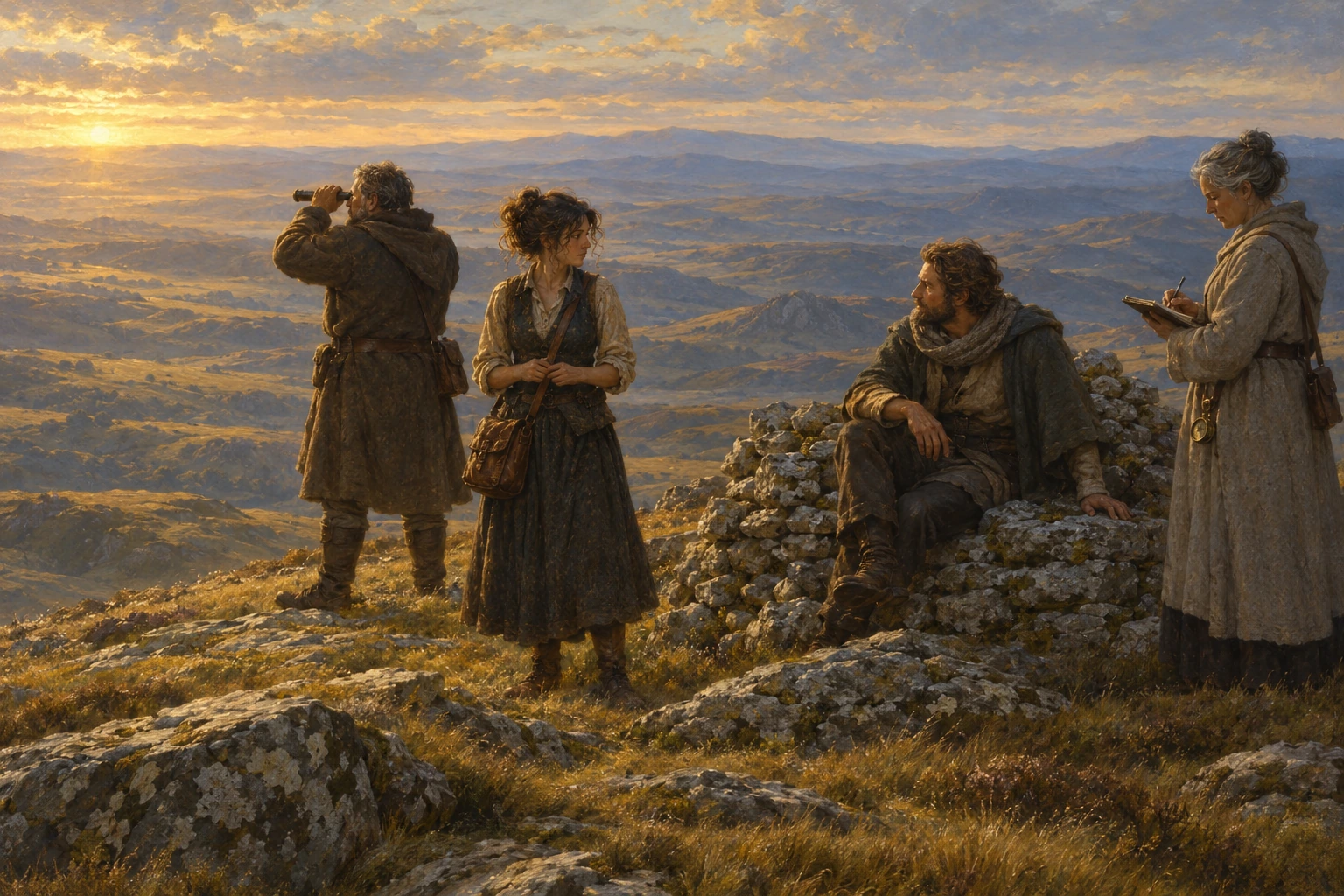
The climb was short and honest: an hour's steady walk up a shoulder of open hill behind the steading, sheep-cropped turf giving way near the top to bare rock and a wind with an edge new to the day, Garron setting a pace that never slowed, the walk of a man who had made this exact climb some few thousand evenings of his life, until near the top, tucked into a fold of rock out of the wind, stood a low cairn of loose stone, no higher than a man's waist, weathered pale, plainly very old.
"Watching-cairn," Garron said, laying a hand on it as Bracken might lay a hand on a mule's shoulder — in passing, out of habit. "Not ours only. Every keeping near enough to another builds one, somewhere with a sightline. We've kept the goats up here my whole life and my father's before that, because a goat wants watching regardless, and a man might as well watch something worth it."
From the cairn the ground fell away west and north in long folds of hill, pale gold going to blue-grey at the furthest edge of sight, and Garron pointed out its shape the way Alder pointed out a road's grammar: that ridge ran toward Ness Fell, whose shoulder showed a thread of smoke on the clearest days; that saddle hid a valley where a keeping called Wakelow had held on, by all report, longer than most; that low blue smear, which Iyene at first took for cloud, was the beginning of the deep hill-country, days distant by roads the Survey had not yet found.
"We watched your fire eleven evenings from just here," Garron said, matter-of-fact, nodding at the flattened turf where three centuries of Hazel feet had stood on almost exactly this errand. "My mother told you the seventh evening was when she stopped arguing herself out of it. I'll tell you the truth of my own count: I stopped arguing myself out of it the fourth."
Bracken, glass to his eye, swept the pale country below with the patience of a man reading ground for danger and finding only distance. "You've watched a long time for one fire," he said.
"We've watched a long time for any fire," Garron said. "There's a difference, and my mother's the one taught it me, so I'll tell it as she told me." He settled onto the cairn's flat lee side, at ease. This — not the supper table, not the hearth after dark, but here, on bare wind-scoured rock — was where the day's first real telling had waited, and everybody there could feel it start.
"There's an old custom," Garron said, "older than the closing, by what my grandmother had it from hers — a keeping shows a fire on its high ground, one night at midwinter, to say the one thing a fire can say and no more: this hearth is kept. We are still here. Nothing asked back. My people call it the showing-fire, and every keeping worth the name kept it before the Frost ever came, so that whoever else held a hearth within sight of yours would know they weren't alone in the dark."
"It near enough died in the long winter," he said. "Fuel got dear. Fear got dearer. My grandmother's grandmother let it go three winters running, by her own account, and called it sense, not failing, and I'll not argue her wrong for it. It was my mother's own father brought it back, two generations gone now, when the winters had started gentling enough that a man might risk the climb and the fuel both. He reasoned it plain: if the winters are easing for us, they're easing for whoever else is left, and somebody ought to be first to say so from a hilltop. So he climbed up here one midwinter night with more hope than sense, and lit a fire, and expected nothing." Garron looked out over the pale hills. "Three winters after that, Ness Fell answered. My mother was a girl. She says it's the only time in her life she's seen her own father cry, and the only time she's ever needed to ask him why."
The wind moved over the cairn with a small dry sound, and far off a bird Wren didn't know called once and was answered by nothing.
"The Watch on the Stones logged two lights, one winter," Iyene said at last, carefully, as she'd set a bearing she wasn't yet ready to trust. "Deep in the west. Unexplained."
"That'd be showing-fires," Garron said, without surprise. "Ours among them, like as not, some year or another — we've never thought to ask whether we might be seen as far as that." He looked at Wren then, a level, steady look. "And I'd wager there's a light your own people logged at some old beacon-ruin further east than any of this — a maybe-light, one night only, nothing to swear an oath on." It was not quite a question.
Wren felt the ground shift a little under a thing she had carried unresolved since a cold night on a foothill ruin a year gone. "There was," she said. "One night. We never knew what answered, or whether anything did."
"Then something did," Garron said, simply, "and it was a keeping a long way off, showing you the one thing it had to show, with no more notion of who might be watching than my grandfather's father had of Ness Fell. It isn't a message. It's an asking after, without the asking, because asking after outright was more than anybody's nerve could carry. A fire's smaller than a question. Easier to send. Easier to bear, if it goes unanswered."
Bracken was looking now at some private middle distance of his own, the glass loose in his hand. "There's a light that's more than a showing-fire," he said, low. "Isn't there."
Garron's face did not change, quite. Something in it went carefully, deliberately still.
"There's a fire in the far hill-country," he said, "that shows longer and oftener than the custom asks of anybody — most winters, several nights running, sometimes near the whole dark of it. We know of it the way you'd know a neighbor's chimney-smoke you've never walked far enough to knock at — by report, never confirmed by anyone living. We don't know whose it is, or why it burns past what a showing-fire owes. My mother's the one to ask for more; she'll tell you word for word what I've told you."
He stood, brushing the cold off his hands. He closed the matter precisely at the edge of what he knew.
"That's the whole of it from up here. Come on down before the light goes. There's goats to see to, and my mother'll have the kettle on."
They came down off the shoulder into an afternoon gone soft and gold, Garron setting an easier pace now the telling was done, and it was on that walk down that he gave Wren the count she would carry into her day-book.
"Nine," he said, when she asked him plainly how many keepings he could put a name to besides his own. "Nine that I know of, or my mother does. Not all known the same way. Ness Fell we've seen with our own eyes, a showing-fire every midwinter without fail. Wakelow the same, though further, and rarer — once a season, if the air sits right. Aldern you've walked through yourselves; I've made the round to it twice a year, and we count it near enough kin." He counted the rest off on his fingers, steady. "Ashcroft traded with an uncle of mine's uncle inside living memory, though nobody now living has walked there — an old visit's account, and a fire that still shows; Barrowdale, the same again, one generation further back; and three more past that, names and little else: Coldmere, Farholt, and one we've only ever called the Height, because nobody remembers what its own people called it, only that a fire shows there at midwinter on a hill no one living has walked to."
"That's eight," Wren said.
"Eight I can name plain," Garron agreed. "The ninth's the one I told you of on the shoulder. Nine fires, near as we can reckon it, and our own besides, and the dark between every one of them wider than any of them would like. A fire you can't see isn't a fire gone out. It's only a fire you haven't walked far enough to find yet."
Supper that evening carried, for the first time since the Survey's arrival, the weight of a table two households meant to fill properly rather than merely share, and Liss had put a goose on, declaring the occasion equal to it whether anyone agreed or not, and the kitchen ran warm and close and busy, Dorrit's beans finding their way to the table alongside hedge honey and a dark bread Liss baked, she said, only when there was somebody worth the baking for.
Partway through the second course, Edda turned the evening's asking around.
"We've had the better part of a day to ask after your fire," she said, "and precious little of it spent asking after yours in return. I'd hear it, if you're willing. What did you keep, over there, that a book should be worth carrying so long for?"
So the company gave it — not all at once, but in the compressed, overlapping way a family gives an account of itself at a crowded table: Wren the valley of Dall and the bees; Alder the College's long patient work; Bracken the border watch; Iyene the charter, the King, the long south road out of Merrow. Liss stopped stone-still, a bowl forgotten in both hands, at the mention of a pass called the Gray Stair and a storm that had pinned seven people and four mules on open stone; Garron made Bracken say the part about the pass again, slower, plainly disbelieving anyone had walked it in that season, until Bracken sat back shaking his head, wordless at news too large for anything smaller than silence.
Wren, listening to her own family's history pass round a stranger's table in borrowed pieces, felt the satchel's weight at her hip and thought of setting the Waybook plainly on the table — she did not, only the plain sense that the day already carried as much as it could hold, and some things wanted their own evening — and reached instead for the bread.
The children were allowed to stay past their proper hour, on the grounds — Liss said it plainly, over Edda's mild eye-roll — that an evening like this one was not coming twice, and it was the girl, at her grandmother's knee before the banked fire, who asked for the rhyme.
"Say the fires, Gran."
"You say the fires," Edda said. "You know them near as well as I do."
The girl did, mostly, with Liss prompting once at a stumble, and the boy joining the last line a half-beat behind, proud of himself regardless. It was short and plain, worn smooth as the best-loved things wear smooth — Wren thought of the Bee-Wife's Round the moment she heard its shape.
Ours is kept, and so is one over the shoulder, toward the sun — Ness Fell answers, Wakelow waits, Aldern minds its mended gates. Ashcroft, Barrowdale, and more, lights on hills we've no map for. Nine, and ours the tenth to hold — count them warm, and count them told.
"Say it again," said Dorrit, delighted, and the girl said it again, flattered past any pretense of reluctance, while Wren took her day-book from the satchel and copied it down by the fire's own light: her own family's map and a child's counting-rhyme, agreeing tonight on the same nine names.
The children went up not long after, Liss carrying the boy half asleep against her shoulder, the girl protesting on principle and yielding within three steps of the stair, and the room settled into the deeper quiet of adults left alone with a fire and a great deal still worth saying.
Edda did not begin at once. She sat with her hands folded, in the stillness Wren had learned meant somebody gathering a true thing rather than searching for one.
"You'll want it in order," she said, "and I can't give you that, because we don't keep it in order. We keep it in shape, and you'll forgive me if it runs backward and forward both — that's how a family holds onto this much time. Not laid out like your Cartographer-Royal's fine sheets. Folded, the way a good blanket folds, worn softest where it's been handled most."
She told them of the first keeper — not by name, for none had come down to her, only as the one who wrote steadier than the rest, the hand beneath the hurried names in the guest-book's last filled page. "She didn't know the last time was the last time," Edda said. "I don't believe any of them ever quite let themselves know it, and that not-knowing is the kindest thing I can tell you about any of them."
She told of the charge cut into the beam above the hearth, and how each generation had read it a little differently, though the words never changed. "My great-grandmother took believe the road to mean believe it would open. My grandmother took it to mean believe in the road itself, whether or not it ever opened in her own lifetime. I've come round to her reading, myself." She looked, briefly, at Wren. "You'll have your own reading of your own charge, I don't doubt."
Then, without raising her voice, she told the two hard passages plainly, pride and grief so mixed that no listener could have said where one ended and the other began.
"There was a winter," Edda said, "four generations back, when the fire came down to embers and the whole house down with a fever at once — mother, father, and the old grandmother besides, none fit to rise, and the only one standing was a girl of nine, who is the reason any of us are sitting here at all, who carried coals from the last live ember, wrapped in wet cloth against her own hands, from the hearth to the byre and back all one long night, because the beasts wanted warmth as much as the house did, and kept it alive till the fever broke. When they asked her afterward how she'd known to do it, she said she hadn't known anything. She'd only done what the charge said, because it was the only thing in the house that hadn't taken sick." Edda's eyes were steady on the fire. "She's my own grandmother's grandmother. We don't have her name written anywhere that I know of. We have that."
Nobody spoke. Alder had gone very still, across the hearth. It was not the listening-stillness he wore for lore freely offered, but something nearer to reverence, held so quietly that only someone who had walked beside him a year would have known to look for it at all.
"And there's the year," Edda said, after a silence she let run its own length, "that the keeping was one person only. The narrowest the line's ever run. A woman — my own line again, three generations back — alone the whole winter through, everyone else gone or lost the year before, no way up or down to anybody till the thaw. She kept the door open the whole of it. Not because anyone was coming." A beat. "The charge doesn't say keep the door when it's easy. It says keep the door." She let that sit. "She kept it, alone, the whole winter, and came out the other side of it, and called it no hardship worth complaining of."
She looked round the fire at all of them, then — at Wren longest, though not pointedly.
"That's the spine of it, if you want the shape rather than the years," Edda said. "Every one of us chose it, and nobody in this family was ever born into the keeping the way you're born into a name you didn't ask for, and every one of them could have walked east while the going was still open — some keepings did, and no shame in it — but ours chose to stay, generation on generation, right down to Garron and Liss choosing it again not twenty years back, and it was kept because somebody, every single time, chose not to."
It was later, the fire settled to its deep red hour and the cider gone round twice, that the talk turned toward the country itself, and what the west had learned, hard-won over generations, to call the thing that had closed it.
"You'll have your own name for it," Edda said. "We've our own, and it isn't a name for a creature, whatever the old stories from further east might make of it; we speak of it the way you'd speak of snow, or standing water — a thing that lies, not a thing that hunts — in the near country, mind. That ground is under the quiet, we'll say, of a valley gone bad, and it lies deep in the low country, and a person minds it as a person minds a flooded ford — not with dread, only with sense. What's further under than that, I've no word for at all."
Something in Alder had gone quiet and fixed. It was the look Wren had learned meant he was hearing a thing land where he had long suspected it must.
"And if a person must cross such ground?"
"Then you go carrying your names," Edda said, as plainly as she might have given directions to a well. "That's the whole of the craft, and it's not mine alone — every tending family teaches it to every child born to it, same as they're taught to swim or to mind a fire, your own name first, then your people's — mother's, father's, whoever raised you — and your office, said over to yourself, plain, the way you'd count your own fingers to be sure of them, and it's taught as survival, not as comfort. A child who can't say who she is and whose she is, out loud, without stumbling, isn't reckoned fit to walk deep ground alone."
Alder was quiet a moment, and when he spoke it was in the voice Wren had heard him use only a handful of times all year — not teaching, only setting a true thing down where everyone could see it.
"Three hundred years apart," he said, "and both sides of the mountains learned the same word for warm."
Edda looked at him, and something in her face agreed with him entirely.
"When the passes closed," Edda went on, "most who could went east while the going was still open. Others gathered inward, to hearths that could hold — Sereth's one, and the rest you've heard named tonight. Some wouldn't leave at all, and wouldn't gather in either — stayed exactly where they'd always stood, on ground the rest of us came, in time, to leave well alone. We call them, simply, the Stayed. It's what they did, so it's what we call them."
"And of the Stayed?" It was Iyene who asked it, gently, her pen for once entirely still in her hand.
"Little enough, and all of it told, not seen," Edda said. "Nobody living has laid eyes on one, and I'd not trust the word of anyone who claimed otherwise; what the lore says, and only this, is that some of them, in the deep ground, are held still to have kept their watches — whatever post they stood at when the closing came, they're said to be standing at it yet, and I grade it as I'd grade any old tale handed down by somebody who had it from somebody else: told, not seen, and worth exactly that much trust."
"There's a town," Garron said, from where he sat by the door. "Some days on from here, on the road you'll likely take yourselves before winter's done. We don't walk through it. None of the tending families do, and haven't in longer than anyone can say why." He said the rest of it plainly, the way a man reports a washed-out bridge rather than a warning. "There's a watch in it nobody's ever relieved."
The room let it stand, and asked nothing further — the same courtesy the whole company had learned a year gone at a different fire.
Iyene had been drawing through most of the evening's second half, and it was Edda, glancing over at last, who broke the working silence.
"That's a deal more than a map of roads you're drawing," she said.
"It is tonight," Iyene said, not looking up. "A kept fire, here." She touched the point lightly. "A sleeping town, there, with its own mark now. And this—" She drew a third mark over the low country Garron had named. "Deep ground. Not measured. Only known, and marked as known."
Garron leaned over her shoulder without asking leave, and named, plainly, which roads served a tending family's day's-walk and which a family went round rather than through, before he sat back satisfied.
"Paper remembers better than grandmothers," Edda said, watching the marks settle dry and plain onto the page, "though I'll not tell my own grandmother's ghost I said so." It drew the evening's one real laugh, small and warm.
Iyene sat back and looked at the finished sheet a long moment — three new kinds of mark on ground no map had carried before tonight — with an expression Wren had learned to recognize as Iyene's whole heart: not triumph, only the quiet, entire satisfaction of a woman watching a true thing take a shape that would outlast her.
It was well past the hour the children had been sent up, the fire burned down to its last patient red, when Wren took out her day-book and wrote by its light, the satchel, for once, set down close beside her rather than worn.
The winter lights are showing-fires, older than the closing — one night at midwinter, to say the one thing a fire can say and no more: this hearth is kept, we are still here — and it died down through the worst of the long dark and was lit again, hill by hill, two generations gone, our own maybe-light at the Hob, that cold night on watch a year ago, one more showing-fire among them, sent the same way Garron's grandfather sent his: outward, into a dark he had no proof anyone was left to see across.
Nine keepings besides Sereth. The names are already down twice on this page, in Garron's telling and the children's rhyme, and the two agree to the last one, which is its own kind of proof. One fire past all of them burns longer and oftener than any custom asks, and even Sereth cannot account for it.
Deep ground is what they call the Quiet here — not a creature, a condition, as you'd speak of low water or standing frost. And the craft for crossing it is the same craft Alder has taught me the whole length of this road: if you must cross deep ground, you go carrying your names. Your own first, then your people's, then your office, said over plain. Alder found, in one line, the truest thing said all evening: both sides of the mountains had kept, without ever meeting, the same word for warm.
Edda told the family's two hardest winters plainly, in one breath, pride and grief too mixed to tell apart: a child of nine carrying coals the length of a fever-house one long night, four generations back; a woman alone a whole winter, three generations back, keeping the door open through all of it, because the charge doesn't say keep it when it's easy, and neither of them, when it counted, needed telling that twice.
And there are those who Stayed — the ones who would not leave and would not gather in either, told of only, never seen. Some of them, the lore says, in the deep ground, kept their watches, and are held, still, to be standing them. There is a town some days on from here that the tending families go round rather than through, and all that is given of it is one line, which I set down exactly as Garron gave it and will not soften.
Iyene's sheet carries three new marks tonight that no map of this country has ever carried: a kept fire, a sleeping town, deep ground known and marked as known.
The far beacon's story stays for another morning; there is no answer for it yet, and some things want their own evening, as today wanted this one — and we came over the mountains thinking we carried the only lamp, only to find we were walking into a room where the candles had been lit for three hundred years, spaced wide across a whole dark country, waiting for somebody, someday, to walk between them and see how many were still burning.
Overhead Liss's step crossed the boards, and the byre sent its low patient breathing up through the floor, and somewhere in the dark below Edda's voice said a last quiet word to Alder before her own door closed for the night; and Wren thought, before sleep took her, that she had never in her whole life heard so much history laid so gently down, or heard so much of it ask for so little in return but the plain courtesy of being believed.